
In this article
To the uninitiated, the number is a simple abstraction on a screen. To the seasoned river runner, however, the figure—1,000 CFS, 10,000 CFS, 50,000 CFS—is the day’s vital sign, a quantitative measure of the river’s mood, power, and personality. This article decodes that number, answering “what does CFS mean for rivers” and transforming abstract data into wilderness instinct. We will unravel the science behind Cubic Feet per Second (CFS), translate it into the practical reality of whitewater, and reveal how understanding this single metric is the first step toward true river literacy.
This journey will empower you to see the river not just as a course to be run, but as a living system to be understood. We will decode the science behind the number, learning the rigorous USGS process that converts water height into a reliable flow rate. We’ll then translate that science into the rafter’s world, seeing how CFS directly impacts the International Scale of River Difficulty and creates vastly different conditions on different rivers. This leads to a data-driven safety mindset, where we’ll apply CFS knowledge to practical scenarios, from assessing wading safety with the “Rule of Ten” to understanding the unique risks of high water levels and low flow/cfs. Finally, we’ll discover the river’s pulse—the ecological significance of water flow and how natural CFS patterns are the lifeblood of the entire river’s drainage basin. You’ll begin seeing CFS as just a number and finish empowered to interpret it as a vital language, informing every decision you make on the water.
Decoding the Flow: The Science Behind the Number
Before we can translate the language of the river, we must first understand its alphabet. This section establishes the fundamental scientific principles of hydrology and water measurement, explaining exactly what this volume measurement represents and the rigorous, multi-step process hydrologists use to give us the up-to-date water flows we rely on for every trip.
What Exactly is Cubic Feet per Second (CFS)?
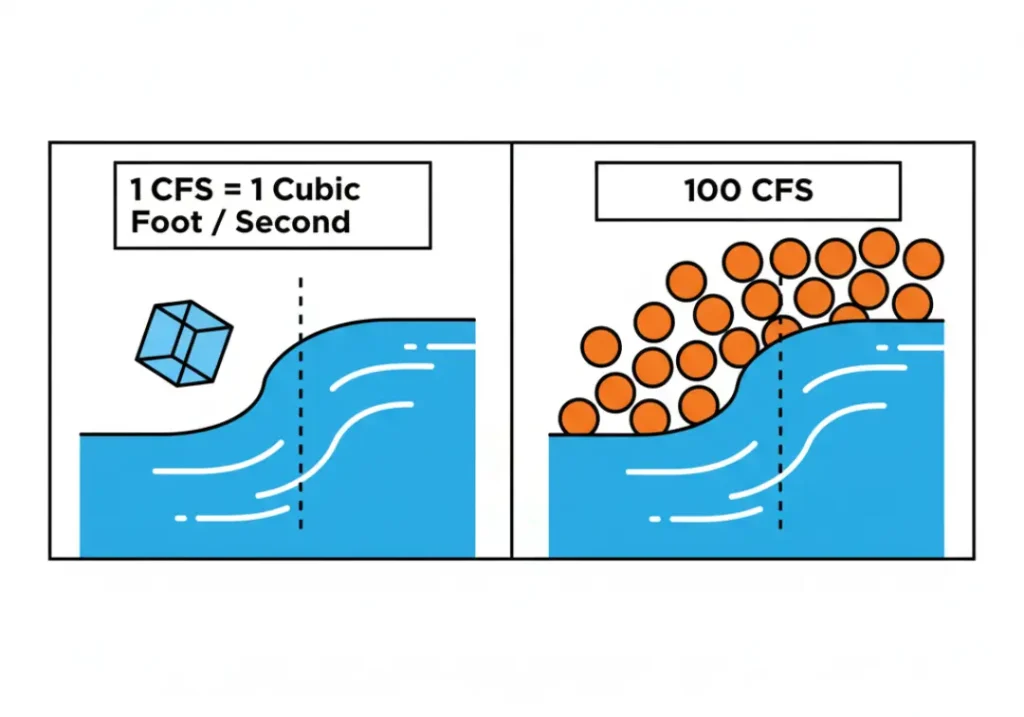
At its core, CFS stands for Cubic Feet per Second, the standard unit for measuring river discharge—a key indicator of a waterway’s power. It’s a volumetric flow rate: the volume of water, in cubic feet, passing a fixed point in one second. To make that tangible, use the standard basketball analogy: one cubic foot is roughly the size of a basketball. A small creek flowing at 100 CFS is like watching 100 basketballs rolling down a riverbed past you every single second. To be more precise, one cubic foot per second is equivalent to 7.48 gallons of water moving past a point every second. It’s a powerful visualization of water volume in motion.
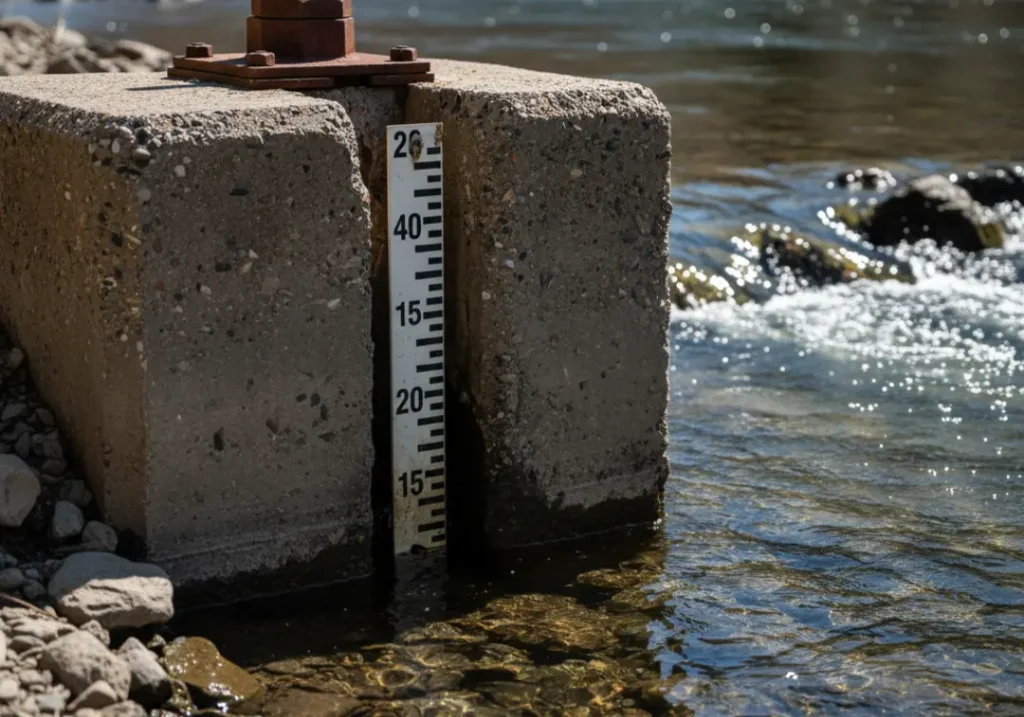
The responsibility for this critical flow monitoring falls primarily to government agencies, chiefly the U.S. Geological Survey (USGS). However, other entities like the Bureau of Reclamation, Fish and Game, and state-level bodies such as the Colorado Division of Water Resources also contribute vital water volume data. The process of generating the CFS reading you see online begins not with measuring the current flow, but with measuring its height. The first step is the continuous, automated measurement of stream stage—what boaters often call “gauge feet.” This is the water’s surface level relative to a fixed reference point. It’s crucial to understand that this is not the river’s water depth; it’s a consistent measurement of its elevation at that specific location. But stage height alone doesn’t tell us the whole story. For that, hydrologists have to get their feet wet.
The second step involves periodic, manual discharge measurements conducted by hydrologists every 6-8 weeks to ensure accuracy. These men and women perform a meticulous survey using the fundamental mathematical formula: Discharge = Area × Velocity. To perform this volume calculation, they employ the “Midsection Method,” dividing a river’s cross-sectional area into 25-30 vertical segments. In each narrow segment, they measure the depth and the average water velocity to calculate a partial discharge (q). They then sum the discharges from all segments to get the total discharge (Q) for the entire river. This hands-on, physically demanding work is the foundation of reliable data, corroborating everything the automated sensors tell us. For a deeper dive into the specifics, you can review The USGS streamflow measurement process. This link from science to sport is critical; understanding CFS is one of the fundamental principles of whitewater rafting. With a clear understanding of how hydrologists physically measure the river, the next step is to see how they turn this periodic, hands-on work into the continuous, real-time data we see online.
How Do Hydrologists Translate Water Height into Flow Rate?
The magic happens in Step 3 of the USGS process: defining the Stage-Discharge Relation, more commonly known as the “rating curve.” This curve is a unique graph, a fingerprint developed for each specific streamgage location. It’s built by plotting dozens of the manual discharge measurements from Step 2 against their corresponding stage height measurements (in gauge feet) from Step 1. Hydrologists take these measurements across a wide array of water levels—from extreme low water during a drought to flows where a river is out of its banks—to create a comprehensive and reliable relationship.
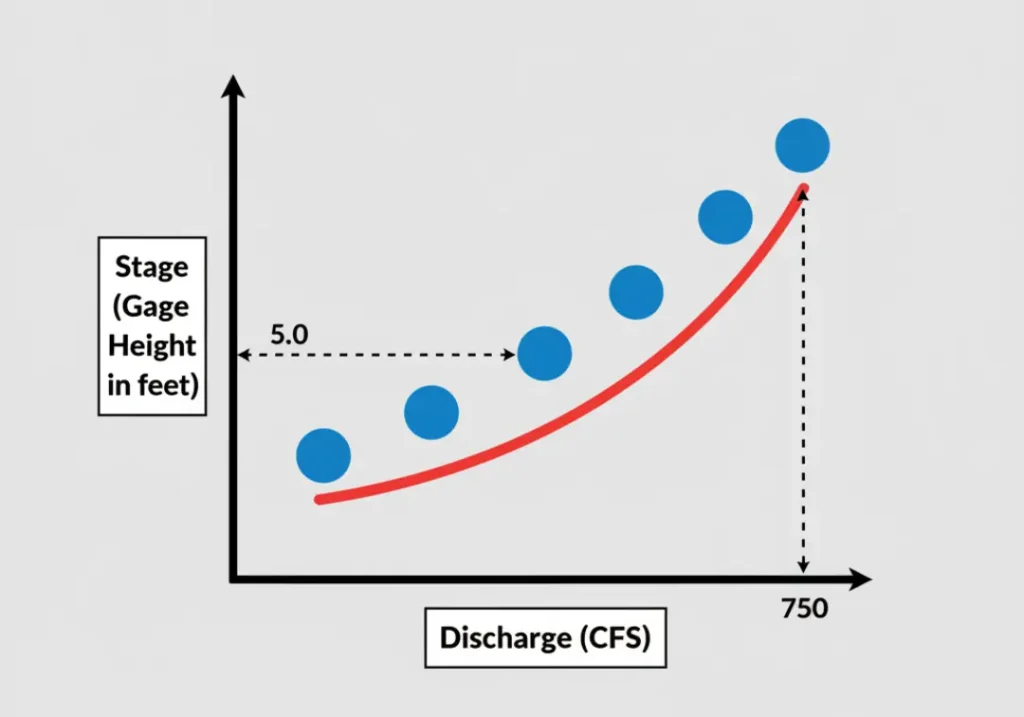
The critical function of the rating curve is that once it is established, it allows the continuous, automated stage data from the streamgage to be converted directly into a continuous record of discharge in CFS. This is how a simple height measurement becomes the flow data you check on your phone. However, this relationship is not static. A river is a living, changing entity. Major events like floods can scour the channel, move massive boulders, or deposit new gravel bars, completely altering the river’s cross-section and making the old rating curve obsolete. This is why those periodic measurement methods are so vital. They serve to verify and, when necessary, recalibrate the curve, ensuring the data remains accurate. It also explains why real-time data is often classified as “provisional” until it has been reviewed by hydrologists, a constant reminder of the dynamic nature of the river system itself. The USGS provides a helpful page for those wanting to dive deeper into Interpreting gage height and streamflow values. This technical concept of a rating curve is the foundational tool that allows us to learn to read a river and make informed decisions on the water.
The Rafter’s Perspective: How Does CFS Translate to the River Experience?

With the science established, it’s time to put on our PFDs and get on the water. This section translates the abstract data of CFS into the tangible, practical experience of a whitewater rafter. It’s where the number on the screen becomes the wave in front of your boat, explaining how a specific CFS level affects river difficulty and directly shapes a river’s character, rapid classes, and risks for boating.
How Does the International Scale of River Difficulty Classify Rapids?
To talk about a river’s challenge, we need a common language. That language is the International Scale of River Difficulty. It’s the framework we use to classify rapids and discuss risk, with Class I-VI rapids defining the spectrum. The scale runs from Class I (Easy), which is fast-moving water with small waves and minimal obstructions, up to Class VI (Extreme and Unrunnable), which is considered unnavigable with a high likelihood of a fatal outcome. In between, you have the heart of whitewater. Class II (Novice) features straightforward rapids with waves up to three feet in wide channels. Class III (Intermediate) is the entry to true whitewater, with moderate, irregular waves in classic “Class III rapids” that demand complex maneuvers.
Pushing further, Class IV (Advanced) presents intense, powerful rapids that require precise boat handling under constant pressure. Class V (Expert) is the apex of commercially navigable whitewater, defined by violent rapids, large drops, and unavoidable hazards where a mistake has serious consequences. To add more precision, boaters often use a “+” or “-” to refine a rating (e.g., Class III+), but it’s important to remember the scale is a guideline, not an exact science. But a rapid’s classification is not a permanent label; it’s a dynamic state dictated almost entirely by the volume of water flowing through it. Understanding how risk exponentially increases with each class is the first step in respecting the river’s power.
How Does CFS Dynamically Change a Rapid’s Character?
Every rapid is defined by the interaction between moving water and three static features of the riverbed: its Gradient (steepness), Constriction (width), and Obstructions (rocks and ledges). Change the volume of water flowing over these features, and you change the rapid entirely. High-flow effects are generally what people imagine when they think of “high water levels” during the high water season: high CFS creates larger waves, more powerful hydraulics (holes), and faster currents. A familiar Class III rapid can easily become a raging Class IV at peak flows. However, at very high flows, an interesting “wash-out” effect can occur. Features can become completely submerged, smoothing out a once-technical rapid and making it less complex, though much, much faster. At these levels, eddies—the safe zones of calm water we use to stop, scout, and set safety—often shrink or disappear entirely, removing your “get out of jail free” cards.
Pro-Tip: Don’t confuse “washed-out” with “easy.” A washed-out rapid may have fewer technical moves, but the water is moving incredibly fast, and the consequences of a swim are magnified. There are fewer eddies to catch a swimmer, and the sheer power of the current can be overwhelming. Always scout, even if you think a rapid will be simpler at high water.
Conversely, low water levels present a different set of challenges. As the CFS drops, the river’s raw power diminishes, but it can become far more technical. The riverbed becomes “bony,” transforming into a rock garden where newly exposed obstacles require constant, precise maneuvering to avoid getting stuck. The primary risk at low water shifts from the sheer power of the current to the technical entrapment of getting a raft “wrapped” on a rock—a dangerous and surprisingly common situation. This leads to the great paradox of river flow: more water is not always harder, and less is not always easier. The “sweet spot” or optimal flow range is often a medium flow where there’s enough water to pad the rocks but not so much that the features become dangerously powerful. To truly grasp this paradox, we must see how these principles to decode river dynamics play out on iconic American rivers, where 2,000 CFS can mean flood stage on one and a mere trickle on another.
Why Is a CFS Value Relative to the Specific River?
Here is the single most important lesson a new river runner can learn: a CFS value is meaningless in isolation. The same CFS measurement means drastically different things on different rivers. It is entirely relative to the specific river’s size, gradient, and morphology. 2,000 CFS on one river can be a life-threatening flood, while on another, it’s too low to float a boat. Let’s look at a river comparison. The Upper Animas River in Colorado is a steep, narrow, and constricted canyon. A flow of just 2,000 CFS is considered high, challenging, expert-only water, with its typical CFS range being 800-3,000 CFS. Contrast that with the free-flowing Yampa River, whose high water levels can exceed 14,000 CFS, or the desert Salt River in Arizona, with an optimal range of 500-3,000 CFS. Now, compare that to the Green River through Desolation Canyon in Utah, a large and wide desert river. Its normal range is 1,500-5,000 CFS, and “high water” isn’t even reached until the flow surpasses 10,000 CFS. On a truly massive system like the Middle Fork of the Salmon River in Idaho, peak runoff can reach astonishing levels, creating waves that tower over 25 feet high.

Even on the same river, flow dictates navigation. Consider the massive and regulated Colorado River in the Grand Canyon, where flows are typically held between 8,000 and 20,000 CFS, though its banks can handle up to 45,000 CFS. In the infamous Lava Falls, the primary line for rafts shifts from river right to river left as flows rise above 15,000 CFS to avoid the massive, boat-flipping “Ledge Hole.” A few miles upstream in Crystal Rapid, the safe channel on river left completely disappears at higher flows, forcing boats toward the powerful “Crystal Hole” on the right. This is what “reading the river” truly means. It’s understanding not just the number, but what that number means for that specific river at that specific time. This ability to translate real-time data for the Nation into on-the-ground reality is the absolute cornerstone of river safety. These case studies of iconic American rivers can be a great starting point for planning your next adventure, which our guide to the best USA rafting trips can help you explore.
Pro-Tip: Before you launch on an unfamiliar river, never trust the number alone. Talk to local boaters, outfitters, or rangers. Ask them, “What does 5,000 CFS feel like on this section?” Their on-the-ground knowledge is worth more than any single data point. They can tell you about new hazards, ideal levels, and what to expect at the current flow.
Beyond the Raft: How CFS Impacts River Safety and Ecology

A deep understanding of CFS broadens our perspective beyond just whitewater navigation. It’s a critical tool for personal safety in all river activities—from improving river access to fishing—and provides profound insight into the health of the river’s ecosystem. This knowledge transforms us from simple users into informed stewards.
What is a Data-Driven Approach to Wading Safety?
Wading is one of our most intimate but underestimated interactions with a river’s force. A current that seems manageable can easily sweep an adult off their feet. To combat this, safety-conscious anglers and river-goers use a widely accepted heuristic for safe wading: the “Rule of Ten.” The rule states that if the water’s depth (in feet) multiplied by its velocity (in feet per second) exceeds 10, the force is likely too powerful for an adult to stand or wade safely. A clear example illustrates its power: water that is only 2 feet deep but moving at 5 feet per second (a brisk walk) has a value of 10 (2 x 5 = 10) and is at the absolute limit of wadability. Any deeper water or faster current, and it becomes a dangerous trap.

This rule quantifies the often-misunderstood danger of shallow, fast water. You can get a rough estimate of velocity by tossing a stick in the current and timing its travel over a known distance. Among the most crucial safe wading tips are to always use a wading staff for a third point of contact and to wear a snug wading belt to prevent waders from filling with water. Proper crossing techniques, like facing upstream and shuffling your feet, are essential. Also, be mindful of the stream bank itself; high flows can cause unseen stream bank erosion, creating unstable and dangerous entry points. For smaller streams where good wade fishing levels are critical, a tiered risk matrix can be helpful. Flows under 100 CFS are often slow and suitable for novices. The 200-300 CFS range is typically swift and requires experience. Anything over 550 CFS on a small-to-mid-sized stream should be considered dangerous for wading. It is critical to emphasize that these are general guidelines. They must be adapted for the specific river and your individual ability. While not mentioning the Rule of Ten directly, these NOAA’s river safety guidelines provide authoritative, government-backed information on the dangers of river currents. This specific topic of wading safety is just one component of the broader principles covered in our comprehensive rafting safety guide.
What Is the Ecological Significance of a River’s Flow?
Just as flow dictates safety for humans, it is the defining force for every living organism within it. The characteristic pattern of high and low flows over seasons and years is known as the “natural flow regime,” and it is the master variable shaping a river’s ecosystem. This regime is built on four critical ecological pillars directly controlled by streamflow. Pillar 1 is Physical Habitat; the volume of flow determines the amount of wetted, usable space for aquatic life. Pillar 2 is Water Quality; flow impacts temperature (low flow is warmer) and dissolved oxygen (high, turbulent flow means more oxygen). This also has direct fishing implications, as CFS impacts fish behavior. During low, warm flows, flow fish like trout will be lethargic and seek deep, cool holes. At high flows, they often move out of the heavy main current and use stream bank structure for shelter, positioning themselves to feed on terrestrial insects washed into the river.
The final two pillars drive the river’s entire food web. Pillar 3 is Energy and Material Exchange; the current transports nutrients and sediments downstream, forming the base of the food web. Pillar 4 is Connectivity; flow creates pathways for organisms to move between habitats for feeding and spawning, especially at a confluence where joining waterways create rich zones. Low flows can fragment these habitats and isolate populations. Unfortunately, human impact—through a dam, diversions, and urbanization—creates altered and “flashy” flow regimes that degrade these ecosystems. Understanding this transforms a rafter from a recreational user into an informed steward capable of recognizing the river’s health. Reading the river’s health is just as important as reading its rapids, completing the journey from user to advocate. For those interested in the broader impacts, this governmental report on how changing water flows affect freshwater provides a comprehensive overview.
Conclusion
A river’s CFS is far more than a number; it is a scientifically derived measurement of its discharge, determined through a rigorous, multi-step process by the USGS. We’ve learned that the meaning of that number is entirely relative; a flow that is a dangerous flood on a small, steep creek is an unrunnable trickle on a massive, wide river. Understanding the dynamic relationship between flow and a river’s static features—gradient, constriction, obstructions—is the key to anticipating how rapids will change and making safe decisions on the water. Finally, we saw that river flow is the ‘pulse’ of the ecosystem. Knowledge of its patterns transforms a recreational user into an informed steward who can read the river’s health as skillfully as they read its rapids.
Continue your journey toward river mastery by exploring our complete library of river skills and safety guides.
Frequently Asked Questions about River CFS
What is a good CFS for rafting?
There is no single “good” CFS, as the ideal flow is entirely dependent on the specific river’s size, gradient, and the desired experience. For example, 2,000 CFS is a high, expert-level flow on the steep Upper Animas, while it’s a very low flow on the massive Colorado River in the Grand Canyon.
How many gallons is 1 CFS?
One Cubic Foot per Second (CFS) is equivalent to approximately 7.48 gallons of water passing a point every second. This also equates to 448.8 gallons per minute.
What is a rating curve in hydrology?
A rating curve is a graph that shows the unique, empirical relationship between a river’s stage (water height) and its discharge (CFS) at a specific monitoring location. The USGS develops these curves to convert continuous, automated water height measurements into the real-time CFS data available online.
Does higher CFS always mean a river is more difficult?
Not always; while higher CFS generally increases a river’s power, it can sometimes make a technical rapid easier through a phenomenon called the “wash-out” effect. Conversely, low CFS can make a river more difficult by exposing numerous rocks and creating a technical “bony” channel that requires precise maneuvering.
Risk Disclaimer: Whitewater rafting, kayaking, and all related river sports are inherently dangerous activities that can result in serious injury, drowning, or death. The information provided on Rafting Escapes is for educational and informational purposes only. While we strive for accuracy, the information, techniques, and safety advice presented on this website are not a substitute for professional guide services, hands-on swiftwater rescue training, or your own critical judgment. River conditions, including water levels, currents, and hazards like strainers or undercut rocks, change constantly and can differ dramatically from what is described on this site. Never attempt to navigate a river beyond your certified skill level and always wear appropriate safety gear, including a personal flotation device (PFD) and helmet. We strongly advise rafting with a licensed professional guide. By using this website, you agree that you are solely responsible for your own safety. Any reliance you place on our content is strictly at your own risk, and you assume all liability for your actions and decisions on the water. Rafting Escapes and its authors will not be held liable for any injury, damage, or loss sustained in connection with the use of the information herein.
Affiliate Disclosure: We are a participant in the Amazon Services LLC Associates Program, an affiliate advertising program designed to provide a means for us to earn advertising fees by advertising and linking to Amazon.com. As an Amazon Associate, we earn from qualifying purchases. We also participate in other affiliate programs and may receive a commission on products purchased through our links, at no extra cost to you. Additional terms are found in the terms of service.