

In this article
The roar of a rapid ahead—a chaotic mix of crashing waves and churning water. For the uninitiated, it’s a wall of noise and fear. For the prepared rafter, it’s a readable map of currents, obstacles, and safe passages. This beginner’s guide is your key to translating that chaos into confidence, providing a complete blueprint for understanding whitewater rafting, from the science of the river to the life-saving skills you need on the water.
True outdoor competence isn’t about knowing things; it’s about turning theoretical knowledge into practical, confident action. This guide will start your journey as a consumer of information about a thrilling but intimidating adventure sport. We’ll finish with you feeling empowered, holding a clear, progressive roadmap to becoming a skilled, safe, and responsible river runner. Together, we will learn the river’s language, understand the essential rafter’s toolkit, and walk a clear skill progression path from passenger to proficient paddler. We will also confront the realities of risk management and embrace the conservation ethics we all share to protect the pristine river ecosystems we are privileged to explore.
The Essence of Whitewater: What Defines the Sport?
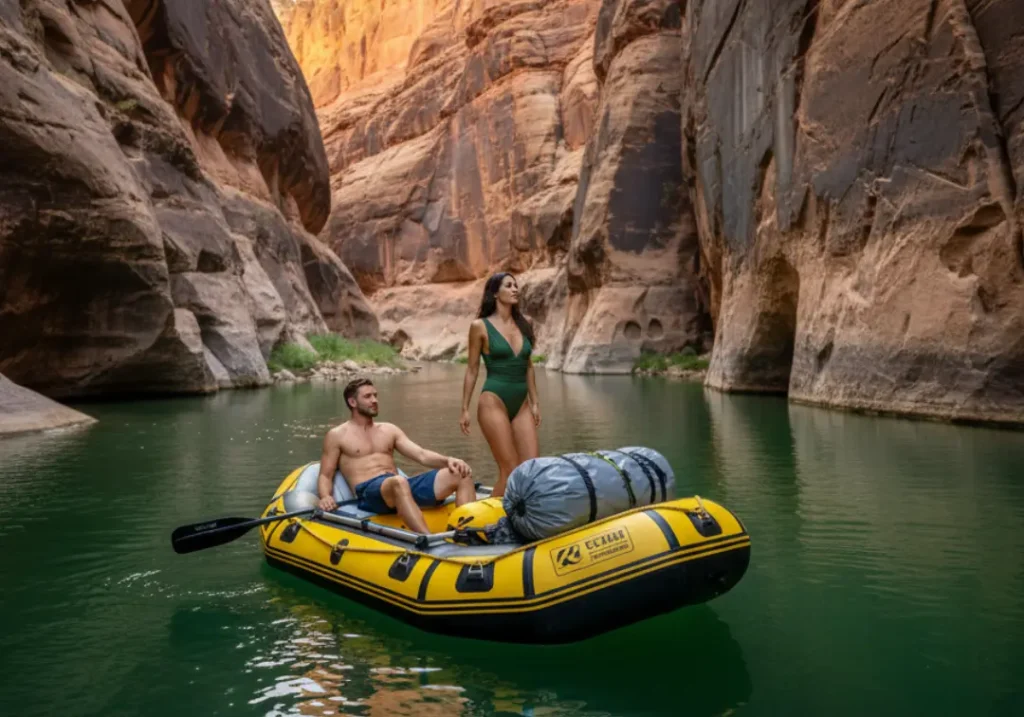
Before we can begin navigating whitewater rapids, we must first understand the heart of this recreational activity. This is where we establish the foundational context of whitewater rafting—a popular watersport that answers what it is, where it came from, and the fundamental science that makes the entire adventure possible.
What is the core definition of whitewater rafting?
At its most fundamental, whitewater rafting is a multifaceted discipline, a potent blend of adventure sport, wilderness travel, and technical skill. The name itself comes from a simple, powerful visual: as water tumbles over and around obstacles in a riverbed, it becomes aerated, turning the surface a frothy, brilliant white. Our primary vessel for navigating these turbulent sections, called river rapids, is a specialized, highly resilient inflatable raft designed to withstand immense forces while remaining maneuverable. This focus on the recreational navigation of challenging, dynamic hydrological environments is what separates rafting from calmer forms of river travel.
But to leave the definition there would be to miss its soul. A rafting trip is also a profound social and psychological experience. The teamwork requirements needed for a group of people to paddle in coordination through a wave fosters a powerful and immediate bond. It’s a shared accomplishment against a force of nature. This makes it a unique vehicle for accessing remote landscapes, whether on short day trips or immersive multi-day trips. The journey becomes a series of punctuation marks, where moments of intense focus in the rapids accent an immersive, peaceful journey through nature. This unique combination has also made the sport economically significant in many regions, driving eco-tourism and promoting a culture of active environmental impact awareness.
With a clear understanding of what the sport is, let’s look back at how this modern adventure evolved from a perilous mode of exploration.
How did modern rafting evolve from exploration to recreation?
The historical context of modern rafting was forged in the great exploratory whitewater expeditions of the American West. Its historical significance can be traced to harrowing journeys like John Wesley Powell’s 1869 descent of the Colorado River through the Grand Canyon in heavy, unforgiving wooden dories. But the pivotal technological shift came in the 1840s when U.S. Army Lieutenant John Fremont commissioned the first rubber raft for surveying. This innovation planted a seed that would fully blossom a century later. The true catalyst for recreational rafting was the end of World War II, which left a surplus of large, durable military surplus rafts. Suddenly, this form of outdoor recreation was democratized, no longer the exclusive domain of hardened non-experts.
This newfound accessibility sparked an industry. By the 1950s, the first commercial whitewater rafting trips were born, with entrepreneurs offering float trips on rivers like the Snake River and the Green River. The 60s and 70s saw a surge in innovation, with dedicated outfitting companies like OARS and Grand Canyon Dories developing specialized equipment like the revolutionary self-bailing floors. The sport’s legitimacy was cemented when whitewater slalom was included in the 1972 Munich Olympics. This evolution transformed river running from a high-risk endeavor into an accessible activity for the general public, connecting us to the enduring spirit of exploration that still defines the sport today. This link connects the historical evolution of rafting to modern-day expeditions on America’s most iconic rivers.
The technology made rafting possible, but the river itself creates the challenge. Understanding the physics of a rapid is the first step to navigating it.
What scientific principles create a river rapid?
A river rapid isn’t random chaos; it’s a predictable feature of applied physics. On a calm stretch of river, water flows in smooth sheets—a state known as laminar flow. A rapid is formed when this smooth flow is disrupted into turbulent, chaotic flow. This transformation is caused by a combination of three primary factors. The first is Gradient, the steepness of the riverbed. A steeper gradient means gravity pulls the water downhill faster, increasing its velocity. The second is Constriction, which occurs when the river channel narrows. Just like putting your thumb over the end of a garden hose, this forces the same amount of water through a smaller space, causing it to accelerate dramatically. The third factor is Obstruction, where boulders, ledges, and other features in the riverbed force the water to flow over, around, and between them, creating the complex waves, holes, and currents that define a rapid.
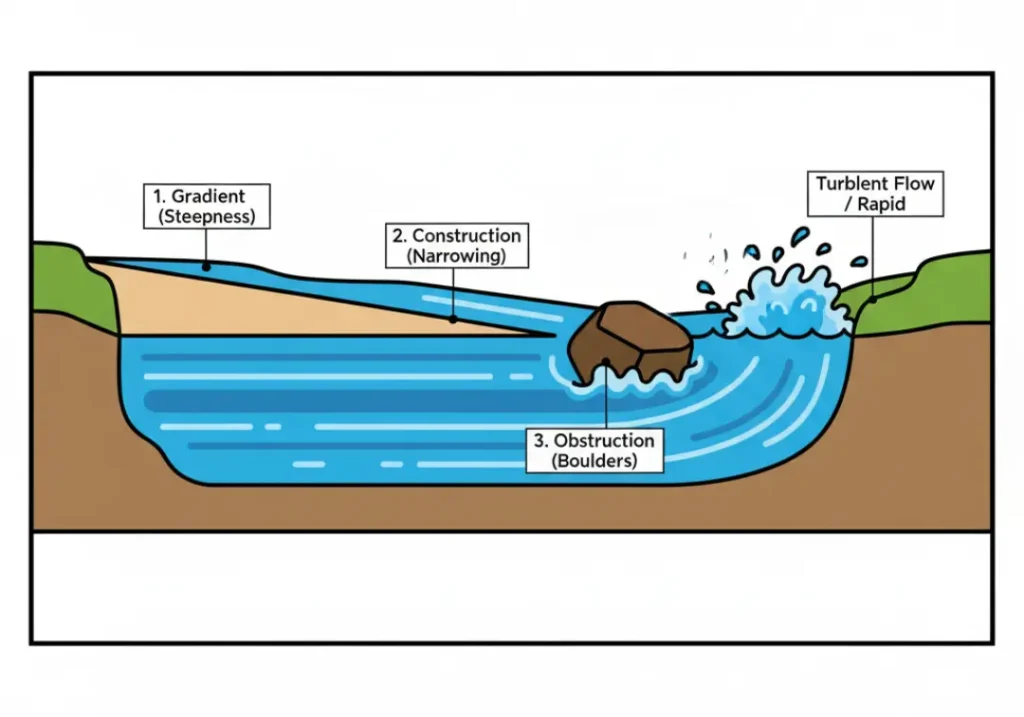
These three elements are influenced by a critical fourth variable: the river’s flow rate, or volume, measured in cubic feet per second (CFS). The relationship between CFS and a rapid is dynamic. A higher river flow rate can dramatically intensify a rapid by increasing the water’s speed and power, turning manageable waves into giants. Conversely, a very high flow can sometimes “wash out” a rapid, submerging the obstacles entirely and making the river smoother and faster, but with fewer distinct features. This ever-changing nature, along with weather conditions and water temperature, means the same rapid can present a vastly different challenge from one day to the next.
These forces create the challenge; now, we need a language to describe and classify it. You can get a head start by decoding the river’s dynamic forces.
The Language of the River: How Are Rapids Classified and Navigated?
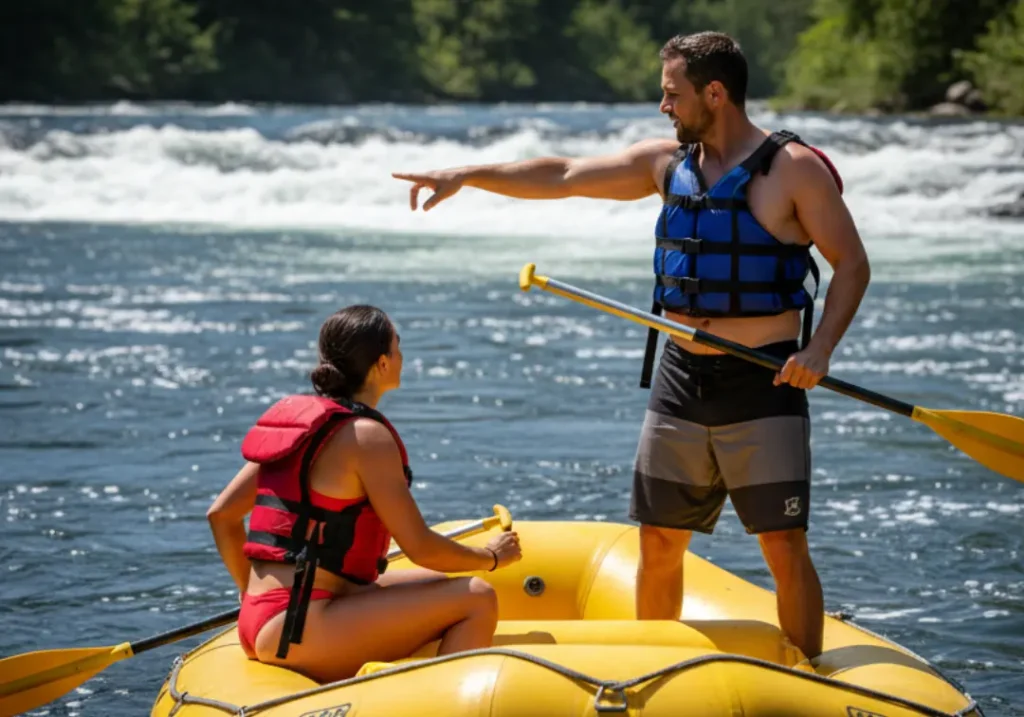
To run rivers safely, we need a universal language. This river classification system provides the terminology to assess risk, understand river features, and communicate effectively. This is the language of the river, centered on the official difficulty level classification.
What is the International Scale of River Difficulty (ISRD)?
The International Scale of River Difficulty (ISRD) is the globally recognized river grading system for rating the risk and difficulty of a rapid or an entire stretch of river. Maintained by the American Whitewater Association, this six-class system provides the foundational language for every rafter.
- Class I Rapids (Easy): This is fast-moving water with small riffles. The risk is slight, and if you fall out, self-rescue is simple. It’s a relaxing float.
- Class II Rapids (Novice): Here you’ll find straightforward rapids with wide, clear channels and medium-sized waves. Basic maneuvering is required, making it a great introduction for a first rafting trip.
- Class III Rapids (Intermediate): This is where most people’s idea of “whitewater rafting” begins. Class III features moderate, irregular waves that can easily swamp an open boat. It requires good boat control and complex maneuvers.
- Class IV Rapids (Advanced): Rapids become more intense and powerful, though still largely predictable for an experienced crew. The water is turbulent, and precise boat handling is a must. The risk of a swim increases, and self-rescue can be challenging.
- Class V Rapids (Expert): This represents the upper limit of navigation for even expert rafters. Rapids on rivers like Cherry Creek or the Zambezi River are extremely long, obstructed, or violent, with features that pose a significant risk.
- Class VI Rapids (Extreme/Exploratory): These rapids are considered effectively unnavigable on a reliably safe basis. The consequences of any error are severe, often involving a high risk of fatality.
It’s crucial to remember that this scale is subjective. The difficulty level of a rapid can be significantly influenced by the water level, weather conditions, seasonal availability, and the remoteness of the location. It serves as a critical guideline for risk assessment, not an absolute rule. You can find the primary source document from the governing body that created and maintains the ISRD in American Whitewater’s official classification system.
ISRD Rafting Classifications
An interactive guide to the International Scale of River Difficulty (ISRD), from easy to extreme.
Description
Swift current with small riffles and waves; few, obvious obstructions.
Experience & Features
- Grand Canyon Scale: 1-2
- Required Experience: None required; suitable for all ages.
Description
Straightforward rapids with medium-sized waves and wide, clear channels.
Experience & Features
- Grand Canyon Scale: 3-4
- Required Experience: None required; adventurous first-timers.
Description
Moderate, irregular waves; strong eddies; requires complex maneuvering.
Experience & Features
- Grand Canyon Scale: 5-6
- Required Experience: Previous experience recommended or strong physical fitness.
Description
Intense, powerful rapids with large, unavoidable waves, holes, and constricted passages.
Experience & Features
- Grand Canyon Scale: 7-8
- Required Experience: Advanced skills and previous Class III+ experience essential.
Description
Extremely long, violent, and obstructed rapids with steep drops and severe hazards.
Experience & Features
- Grand Canyon Scale: 9-10
- Required Experience: Expert-level skills, extensive experience, and practiced rescue abilities.
Description
Considered unnavigable on a reliably safe basis; severe consequences.
Experience & Features
- Grand Canyon Scale: N/A
- Required Experience: For teams of world-class experts only, after inspection and at favorable flows.
Knowing a rapid’s classification is the first step. The next is to read the specific features within it to find your path, which is key to understanding the risks of each river class.
How do you “read water” to find a safe path?
“Reading water” is the essential skill of interpreting the river’s surface to understand the underlying currents and choose the safest, most efficient path from the put-in point to the take-out point—often called “the line.” An experienced rafting guide excels at these rafting techniques. The river gives you a constant stream of information, if you know what to look for. The most welcome sign is the Downstream V, or Tongue. This is a smooth, V-shaped chute of water with the point of the V aimed downstream, indicating the deepest and fastest channel. Its opposite is the Upstream V, where the V points upstream. This indicates water flowing around a submerged obstacle, like a boulder, and is a clear signal of a hazard to avoid.
You’ll also encounter Standing Waves, or Haystacks, which are stationary waves formed by water flowing over an obstacle. A series of these is called a “wave train.” However, some features must be treated with extreme caution. Holes, or Hydraulics, are dangerous recirculating features where water pours over an object and flows back on itself. These can trap swimmers or even boats. Your safe zones are Eddies, areas of calmer, often upstream-flowing water found downstream of an obstruction. River guides use eddies constantly to stop, scout, or rest. The turbulent shear zone between the main current and the eddy is called the Eddy Line, and crossing it requires deliberate technique. Finally, always be vigilant for a Horizon Line—a distinct, flat line across the entire river. This signals an abrupt drop, like a waterfall or a very steep rapid, and demands immediate caution.
Pro-Tip: A common mistake for beginners is to stare at the obstacle they want to avoid. Instead, focus on your target—the safe water, the tongue, the calm spot at the bottom. Look where you want to go, and your paddle strokes will follow. Your brain and body will naturally guide the craft toward your focal point.
With the ability to speak the river’s language, you now need the right tools to engage with it. For a deeper look, check out this guide to a rafter’s hazard identification system.
The Rafter’s Toolkit: What Gear is Essential for a Rafting Trip?
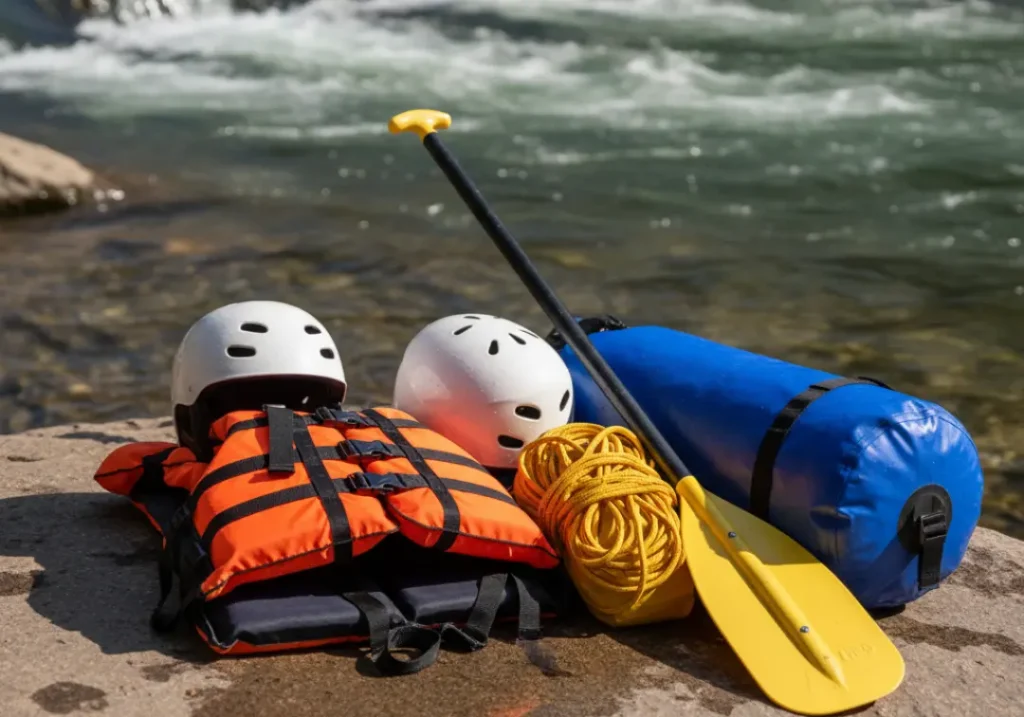
Having the right equipment isn’t just about comfort; these gear requirements are the foundation of safety and success on the river. This section provides an overview of the critical equipment needed for whitewater rafting, from the watercraft itself to the non-negotiable safety equipment every single person must wear.
What are the different types of whitewater craft?
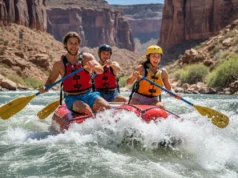
While the image of a big inflatable raft full of paddlers is classic, modern whitewater rafts come in many forms, and your choice significantly impacts the whitewater rafting experience. The most common are Paddle rafts, the quintessential team experience where a crew of 4-8 participants propels the raft with single-bladed paddles. In contrast, Oar rafts (or Gear Boats) are controlled by a guide who rows from a central frame using two long oars, allowing passengers to enjoy the scenic value. A popular hybrid is the Oar/Paddle Combination Raft, where a guide rows but passengers can also paddle.
For those seeking more independence, there are smaller options. Inflatable Kayaks, affectionately known as “Duckies,” are one- or two-person crafts where participants have full control using a double-bladed paddle. For peak performance, many guides prefer Catarafts. These consist of two large inflatable tubes connected by a rigid frame, giving them incredible maneuverability. The choice of craft ultimately dictates passenger participation, group size, and its suitability for different river types. To dive deeper, here’s a guide on how to choose the best whitewater raft.
Once your craft is chosen, equipping every person with the proper protective gear is the next critical step.
What Personal Protective Equipment (PPE) is non-negotiable?
On a river, there is no room for compromise on safety gear. The following pieces of Personal Protective Equipment (PPE) are absolutely mandatory. First and foremost is the Personal Flotation Device (PFD), or life jacket. This is the single most critical piece of safety gear. For whitewater, it must be a U.S. Coast Guard-approved Type III or V model that fits snugly. Next is a Helmet, providing essential protection against impacts.
Pro-Tip: To ensure your PFD fits correctly, perform a “lift test.” After buckling and tightening all the straps, have someone grab the shoulder straps and pull up sharply. The jacket should stay put, not ride up past your chin or ears. If it does, it’s too loose and won’t properly keep your head above water.
Your clothing requirements form your Thermal Protection. The cardinal rule is to avoid cotton. Cotton loses all insulating properties when wet and can accelerate hypothermia. Stick to quick-drying synthetics. Proper Footwear is also required—secure, closed-toe shoes are mandatory. For colder conditions, a Wetsuit, made of neoprene, provides insulation. In the coldest environments, a Drysuit with a Dry Top keeps you completely dry. A Splash Jacket protects against wind and spray. Finally, every rafter’s PFD should have a pea-less plastic Whistle attached for attracting attention in an emergency. This link can help you learn how to select the right rafting PFD.
Personal gear protects the individual, but group safety gear is what enables effective team rescue.
The Skill Progression Arc: What Are the Core Skills for a Rafter?
Whitewater rafting is a journey of skill, not just a ride. This section demystifies the on-water experience, outlining a clear learning pathway that takes you from a beginner participant to an aware self-rescuer.
What are the fundamental skills for a paddle raft participant?
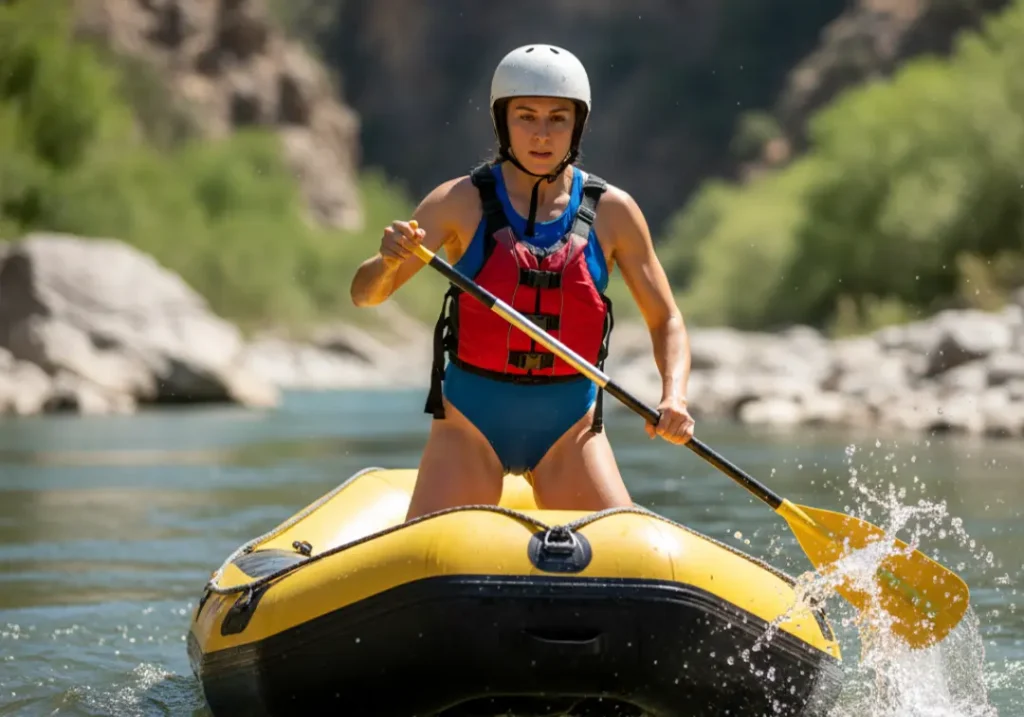
The foundation of rafting is learning to function as a part of a coordinated paddle crew, responding instantly to your whitewater rafting guide’s commands. The engine of the raft is the Forward Stroke. This is a powerful stroke using your core to pull the blade through the water, synchronized with the paddlers in front of you. Its counterpart is the Back Stroke (Back Paddle), used to slow, stop, or help turn the raft by pushing water forward.
These two strokes are combined for turning. A command of “Left Turn” means the paddlers on the left side will back paddle while those on the right paddle forward. A “Right Turn” is the opposite. Even more critical are the stability commands. When a guide yells “High Side!” or “Over Left/Right!” it’s an urgent command to stay in the raft and prevent a flip. The entire crew must immediately move their weight to the designated downstream tube. In large waves, a guide might call “Get Down” or “Lean In,” where paddlers move to the floor to lower the raft’s center of gravity. These key terms form a universal language of trust and response that allows a team to function as a single unit. For more detail, check out this essential field guide to rafting commands.
Paddling as a team is the first level. The next level of skill is knowing how to take care of yourself if you fall out of the raft.
What is the correct procedure for self-rescue after falling in?
Falling out of the raft can be startling, but there are clear rescue procedures to follow. The moment you hit moving water, your primary action is to assume the Defensive Swimmer’s Position. This means you lie on your back with your feet raised and pointed downstream, head above water. The critical goals are twofold: it lets you see where you are going, and it allows you to use your feet to fend off rocks. While in this position, remember the single most important safety rule: Never attempt to stand up in moving water deeper than your knees. This is to avoid foot entrapment.
A basic swimming ability is crucial. The defensive position is for riding out a rapid, but you’ll need to get to safety. This requires switching to Aggressive Swimming (Offensive Swimming). You roll onto your stomach and use a strong front crawl stroke to swim toward a clear path—be it the shore, an eddy, or the raft. You must swim aggressively away from deadly in-water hazards like Strainers (e.g., fallen trees). If you are swept into a Hole/Hydraulic, the escape technique is often to tuck into a ball, dive deep, and let the downstream current beneath the surface flush you out. Once you reach the raft, the technique for Re-entering is to grab the perimeter line while your teammates pull you in by your PFD shoulder straps. You can explore a breakdown of defensive vs. aggressive swim positions here.
Individual safety is paramount, but true mastery involves understanding the systems that keep everyone safe and the ethics that protect the river itself.
The Safety Imperative: How is Risk Managed in Whitewater Rafting?
Any adventure worth having involves some element of risk. The key is not to ignore it, but to understand and manage it through proper safety considerations. This section addresses the inherent risks with a clear-eyed assessment of safety information, advanced rescue systems, and the crucial role of our environmental ethics.
How safe is commercially guided whitewater rafting?
So, how dangerous is whitewater rafting? Contrary to its high-adrenaline public perception, the safety record for commercial whitewater rafting is remarkably strong. The accepted industry average fatality rate is approximately one death per 250,000 to 400,000 participant days. To put that risk level in perspective, you are statistically safer on a guided raft trip than you are driving your car. It’s also critical to highlight a key detail: about 30% of these fatalities are attributed to pre-existing medical conditions, not to traumatic river injuries. When compared to general water-based recreation, the safety of a guided trip is clear.
The reason for this excellent record is the primary safety protocol: the trained, experienced guide. A guide’s expertise, often backed by guide certification, is what transforms a high-consequence environment into a managed experience. The company reputation of a commercial rafting operator is built on these safety standards, including pre-trip safety meetings and sometimes having a safety kayaker accompany trips on more difficult water. A managed, professional excursion has a fundamentally different and far lower risk profile than a private, unguided trip. This National Park Service mortality data provides an unimpeachable factual basis for comparing these risks.
While guides manage most risks, complex situations can arise where the whole team must assist in a technical rescue. To learn more, check out this comprehensive Class I-V river safety guide.
What is the ‘Rafter’s Code of Ethics’ for river conservation?
Our responsibility as part of a responsible rafting community extends beyond our own safety to the health of the river itself. The guiding code of conduct for river stewardship and environmental conservation is the Leave No Trace (LNT) framework. The cornerstone of the river ethic is simple: Pack it in, pack it out. All trash must be carried out of the canyon. We adhere to the principle of Travel and Camp on Durable Surfaces, using established campsites on sand or gravel to avoid damaging fragile vegetation. This also extends to proper disposal of liquid waste (“gray water”) and human waste, which on multi-day expeditions often requires the use of specialized, portable toilet systems.
Further principles guide our behavior. We practice Minimizing Campfire Impacts by using a fire pan and packing out all the ashes. We show respect for the river’s other inhabitants by Respecting Wildlife, which means observing from a distance and storing food securely. We also embrace Leaving What You Find, allowing others the same sense of discovery. Following this code concludes that rafting is more than a sport; it is an act of engagement with the natural world that carries an inherent responsibility to protect it for future generations. For the source material, see The 7 Principles of Leave No Trace.
This code of conduct transforms a rafter from a tourist into a steward, a role that completes the journey from novice to expert. For more on the social contract of the river, read about a code for the whitewater community.
Conclusion
The journey of a rafter is a powerful one. We’ve seen that whitewater rafting is a holistic discipline defined by its environment, specialized equipment, essential team collaboration, and a clear, progressive skill pathway. The International Scale of River Difficulty provides the universal language for assessing risk. At its core, safety on the river is a system built on proper PPE, proven self-rescue techniques, and the invaluable expertise of trained guides, which together have forged a strong safety record for commercial trips.
Ultimately, true mastery of the sport integrates this technical skill with a deep and unwavering commitment to stewardship, guided by the principles of Leave No Trace that compel us to protect our wild rivers.
Now that you have the roadmap, explore our full library of skill-building guides and river destinations to plan your next confident step into the world of whitewater.
Frequently Asked Questions about Whitewater Rafting
What are the different classes of rapids?
Rapids are classified on the International Scale of River Difficulty (ISRD) from Class I (easy) to Class VI (extreme and exploratory). This system helps rafters understand the technical difficulty and potential risks of a river, with most commercial trips running on Class II, III, and IV rapids.
What to wear for whitewater rafting?
You should wear quick-drying, non-cotton clothing, secure closed-toe footwear, and the provided PFD and helmet at all times. In colder conditions, a wetsuit or splash jacket is necessary for thermal protection against cold water.
Do I need any experience to go whitewater rafting?
No prior experience is required for most commercially guided trips on Class I-III rivers. Physical fitness requirements are generally moderate for these trips. Guides provide a thorough safety briefing and all necessary paddling instruction before you get on the water.
Are there age restrictions for whitewater rafting?
Yes, age restrictions vary by outfitter and river difficulty. Milder floats may be suitable for children as young as 5, while more intense Class IV or V trips often have a minimum age of 16 or 18. Always check with the specific commercial rafting company.
How dangerous is whitewater rafting?
While there are inherent risks, commercially guided whitewater rafting has a very strong safety record, with a fatality rate of approximately one per 250,000 to 400,000 participant days. Following guide instructions and wearing all safety equipment are the most critical factors in mitigating risk.
Risk Disclaimer: Whitewater rafting, kayaking, and all related river sports are inherently dangerous activities that can result in serious injury, drowning, or death. The information provided on Rafting Escapes is for educational and informational purposes only. While we strive for accuracy, the information, techniques, and safety advice presented on this website are not a substitute for professional guide services, hands-on swiftwater rescue training, or your own critical judgment. River conditions, including water levels, currents, and hazards like strainers or undercut rocks, change constantly and can differ dramatically from what is described on this site. Never attempt to navigate a river beyond your certified skill level and always wear appropriate safety gear, including a personal flotation device (PFD) and helmet. We strongly advise rafting with a licensed professional guide. By using this website, you agree that you are solely responsible for your own safety. Any reliance you place on our content is strictly at your own risk, and you assume all liability for your actions and decisions on the water. Rafting Escapes and its authors will not be held liable for any injury, damage, or loss sustained in connection with the use of the information herein.
Affiliate Disclosure: We are a participant in the Amazon Services LLC Associates Program, an affiliate advertising program designed to provide a means for us to earn advertising fees by advertising and linking to Amazon.com. As an Amazon Associate, we earn from qualifying purchases. We also participate in other affiliate programs and may receive a commission on products purchased through our links, at no extra cost to you. Additional terms are found in the terms of service.