
In this article
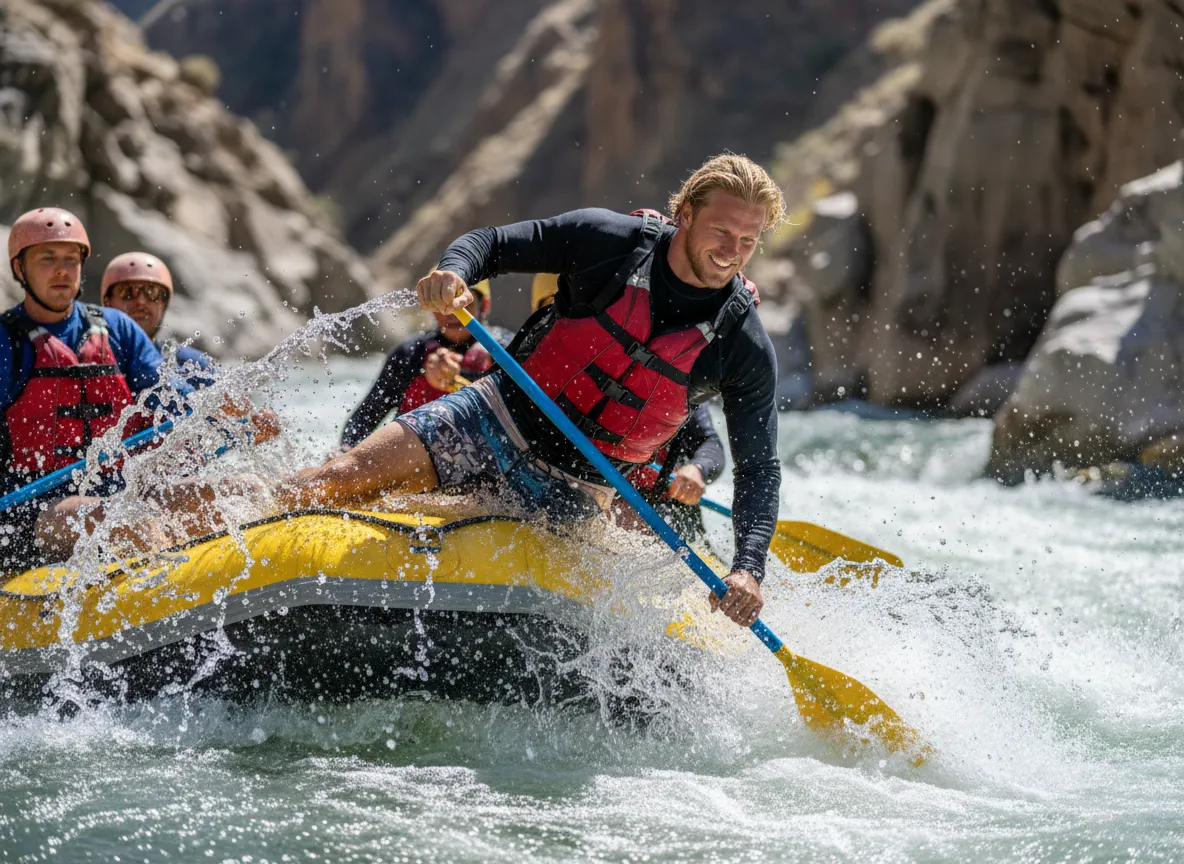
The raft lurches violently, the downstream tube climbing a churning wave as your world tilts. In that split second, panic and instinct collide. This guide is your training manual for that moment, transforming the reflexive flail that leads to a swim into a practiced, powerful rafting paddle brace that keeps you in the boat. We will move beyond the common kayak-centric advice to give you the raft-specific, safety-focused framework to turn bracing from a last-ditch effort into a core wilderness instinct for any serious paddler.
This isn’t just about theory. It’s about turning knowledge into muscle memory, so when the river tests you, you have the answer. We’ll discover why a raft demands an “Anchor” paradigm, not the “Lever” of a kayak. We’ll learn the single most important safety concept—the “Paddler’s Box”—to protect you from the number one whitewater rafting injury: shoulder dislocation. You’ll master a toolkit of brace strokes, from the foundational Low Brace to the advanced bracing technique of the Sculling Brace, and finally, go beyond individual survival to learn the proactive “Over” command for coordinated team stability.
You’re starting as a student of this guide. You’ll finish as a confident practitioner, ready to act when it matters most.
Why is Bracing in a Raft Fundamentally Different?
The most dangerous advice is often the advice that’s only half-right. Many paddlers learn to brace in a kayak or canoe and assume the skill is universal. This misconception isn’t just ineffective in a raft; it’s a direct path to injury. To understand why, we have to grasp the fundamental physics separating these crafts, from recreational kayaks to large rafts.
What is the “Anchor vs. Lever” Paradigm?
A paddle brace, in any craft, is a reactive or proactive brace stroke that uses the flat face of the paddle blade against the water for a moment of support. But how you use that support is entirely different.
A kayaker in their boat becomes a single unit. When a kayak tips, the paddler can use the paddle as a pivot and act as a lever. A powerful “hip snap” that uses wrist rotation and is controlled by the lower body can lever off the hull to get the kayak upright. This same principle applies to open canoe bracing, though the high gunwale changes the technique. This ability to edge the boat is a prerequisite for effective kayaking braces.
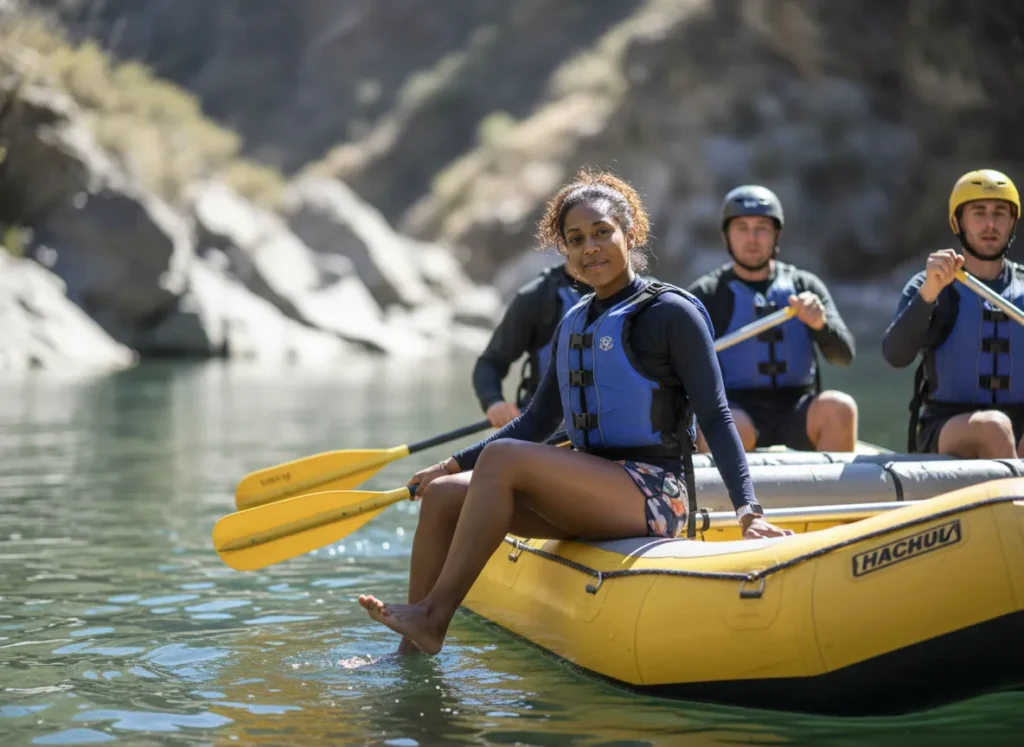
A raft is a vessel of shared experience. It’s a massive, stable platform. You sit on the raft, not in it. Your role shifts entirely: you are an anchor. Your job is to anchor yourself to the boat to avoid being ejected. This anchoring requires proper footwork—like using cross bracing to wedge your heel into the joint between the floor and an air tube—and a core engaged posture. A proper high brace technique in rafting is fundamentally different from a draw stroke; its primary purpose is to stabilize the body, not move the boat.
This distinction is the root of why common bracing advice is so often flawed for rafters. Understanding this paradigm shift is the first step. Now, let’s build the safety framework that protects your body, which is echoed in U.S. government river safety principles. This core difference is just one of the many fundamental differences between rafting and kayaking.
What is the Most Critical Safety Protocol for Bracing?
In the heat of the moment, your body will do what it’s been trained to do. If you haven’t trained it for safety, it will default to a position of weakness. For bracing, this can lead to a potential shoulder injury. Understanding the “why” behind safe form is the non-negotiable rule for injury prevention and building an expert’s deep-seated instinct for shoulder safety.
How Does the “Paddler’s Box” Prevent Shoulder Dislocation?
The injury almost always happens during a high brace. A paddler reaches too high or too far back. With the elbow raised above shoulder height and the arm not kept close to the body, the shoulder joint is in its most biomechanically weak position. We call this the “tenuous shoulder position.” It creates a long, weak lever where the river’s force can easily dislocate the shoulder.
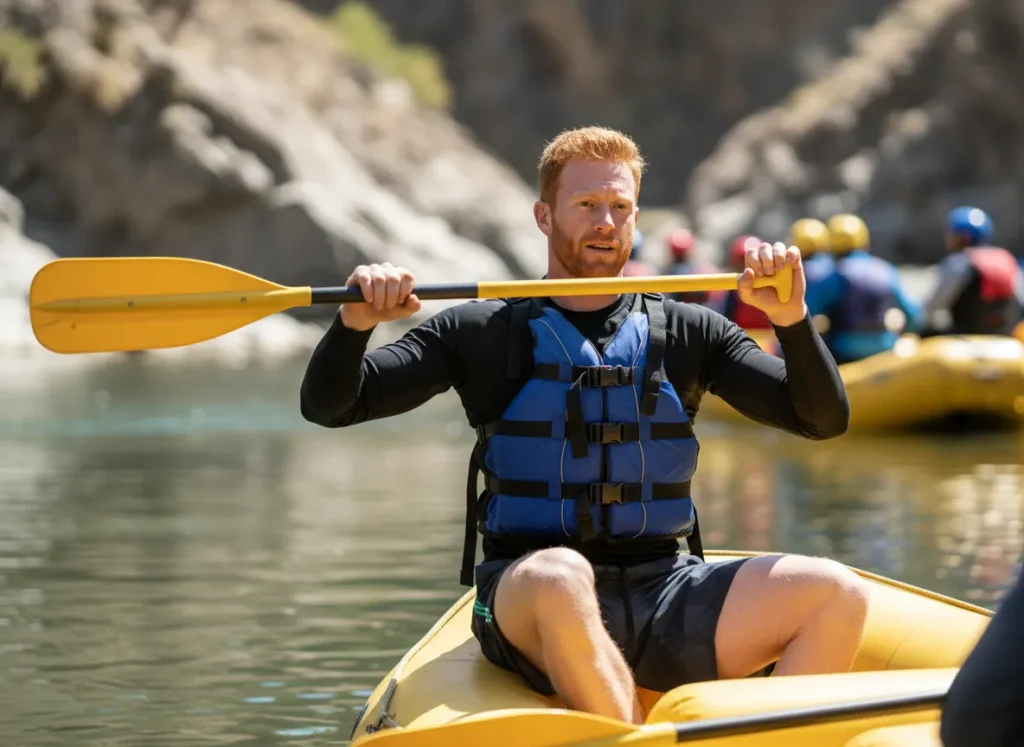
The solution is the “Paddler’s Box.” Picture an imaginary rectangle in front of your torso. Its sides are your arms, and the top and bottom are your chest and your paddle shaft. The Golden Rule of Bracing is simple: All bracing actions must occur within this box.
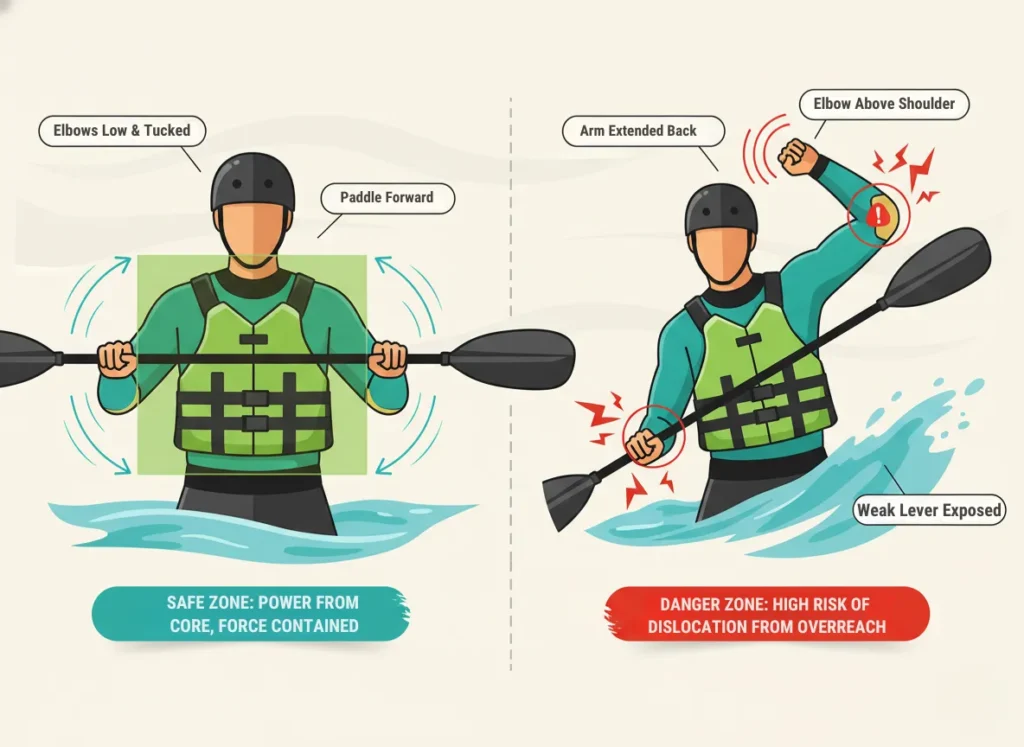
In practice, this means your paddle is always maintained in front of your body. Most importantly, you must keep your elbow low. This proper body positioning ensures the brace is powered by your core and back muscles. The force is distributed safely, which prevents injury. As emphasized by experts like Wayne Horodowich of the University of Sea Kayaking, proper blade mechanics and hand position are central to safety. This proactive knowledge is your best defense, but should an injury occur, knowing the basics of first aid for a dislocated shoulder is a critical field skill.
With this safety framework hard-wired, you’re ready to learn the specific techniques.
How Do You Perform the 3 Individual Raft Braces?
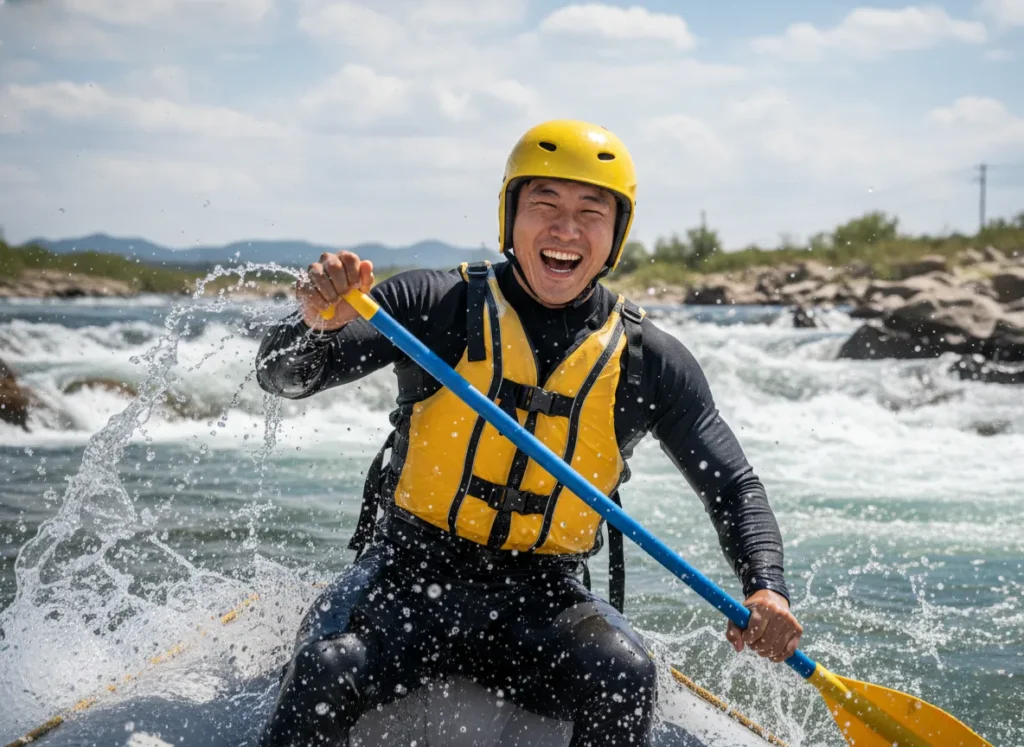
These three techniques—Low, High, and Sculling—form the core of your individual recovery skills. Each is a tool for a different situation, but all are governed by the principles we’ve just established. We’ll break them down step-by-step.
| The Paddler’s Box: Safe vs. Unsafe Biomechanics | ||
|---|---|---|
| Biomechanical Position | Safe Zone (Inside the “Paddler’s Box”) | Danger Zone (“Tenuous Shoulder Position”) |
| Elbow Position | Elbows are kept low, at or below shoulder level. | Elbows are raised above the shoulder. |
| Arm Position | Arms and paddle are kept in front of the torso. | Arms reach “far out behind” the body. |
| Associated Brace | Low Brace 3 or a correctly performed High Brace. | The “Dislocation Brace,” an incorrect High Brace. |
| Kinesiology | Force is distributed to the core, back, and torso. | Force is isolated on the vulnerable shoulder joint capsule. |
Technique 1: The Low Brace (The Safest Default)
The low brace is your workhorse. It’s the safest, most reliable recovery stroke and one of the most essential kayak techniques adapted for rafts. Its core biomechanic is a “push-up” position. For this brace, you will use the back face of the blade.
The motion for this emergency maneuver to reverse rolling is a simple sequence:
- Anchor: Lock your feet securely under a thwart. Your connection to the boat is paramount.
- Setup: As you feel the raft tilt, rotate your wrists forward. This naturally lifts your elbows into the stable push-up position.
- Brace: Firmly slap the water with the blade. Each brace produces a paddle slap on the water, creating momentary support.
- Recover: This is the most crucial part. Immediately lean your head onto the bracing-side shoulder. This action keeps your center of gravity low and uses the support to pull your body back into the boat, keeping the boat flat. Your head must be the last thing to come back up.
Pro-Tip: Practice the low brace recovery on dry land. Sit on the floor and mimic the motion of falling to one side, catching yourself with your hand, and consciously dropping your head toward your support arm before pushing yourself back up. This builds the counter-intuitive muscle memory of leading with your head down, not up.
Technique 2: The High Brace (Power and Risk)
You’ve mastered the safest recovery. Now let’s examine the most powerful one, understanding that a high brace provides maximum power but comes with greater risk. The high brace in rafting can stop a violent lurch, but carries the highest risk of shoulder injury if done incorrectly. Its biomechanic is a “pull-up” motion. Here, you use the power face of the blade, with the power face down towards the water.
The unmissable safety imperative for a safe high brace technique: The elbows must be kept below shoulder level, staying inside the Paddler’s Box.
Here is the sequence:
- Anchor: Feet locked in. Core engaged.
- Setup: As the boat tips, rotate your wrists backward, bringing your hands to about shoulder height but keeping your elbows low and tight to your body, setting your high-brace position.
- Brace: Slap the power face of the blade flat onto the water’s surface for support.
- Recover: Just like the low brace, immediately drop your head towards the bracing side. Pull the paddle shaft inward toward your chest, using that leverage to keep yourself anchored. Again, your head comes up last. This universal principle of brace recovery is non-negotiable, a topic well-covered by sources like Rafting Magazine.
This high-risk, high-reward technique is detailed in many a technical rafting course manual, but its danger cannot be overstated. An improper high brace is one of the most critical rafting paddling mistakes a person can make.
Technique 3: The Sculling Brace (Advanced Active Stability)
Static braces offer a moment of stability. But what if you need continuous bracing support? The sculling brace bridges that gap. This advanced technique, similar to the kayak sculling brace highlighted in NRS‘s Kayaking Fundamentals series with expert kayaker Ken Whiting, provides a steady support platform while you regain balance. It relies on smooth torso rotation while you keep the paddle as horizontal as possible.
The key concept here is the “climbing angle.” The climbing angle on the blade is what creates lift and pressure.
- Anchor & Setup: Lock your feet and engage your core. Start from a brace position and extend the paddle out horizontally.
- Brace & Control: Begin to sweep the paddle forward and backward in a one-to-two-foot arc, essentially making the sculling blade back and forth motion. As you sweep forward, lift the forward edge slightly. As you sweep backward, lift the backward edge. This continuous motion maintains steady downward pressure and lift, allowing for quick transitions and ongoing support. Differentiate this sculling brace from a sculling draw.
How Do You Brace as a Coordinated Team?
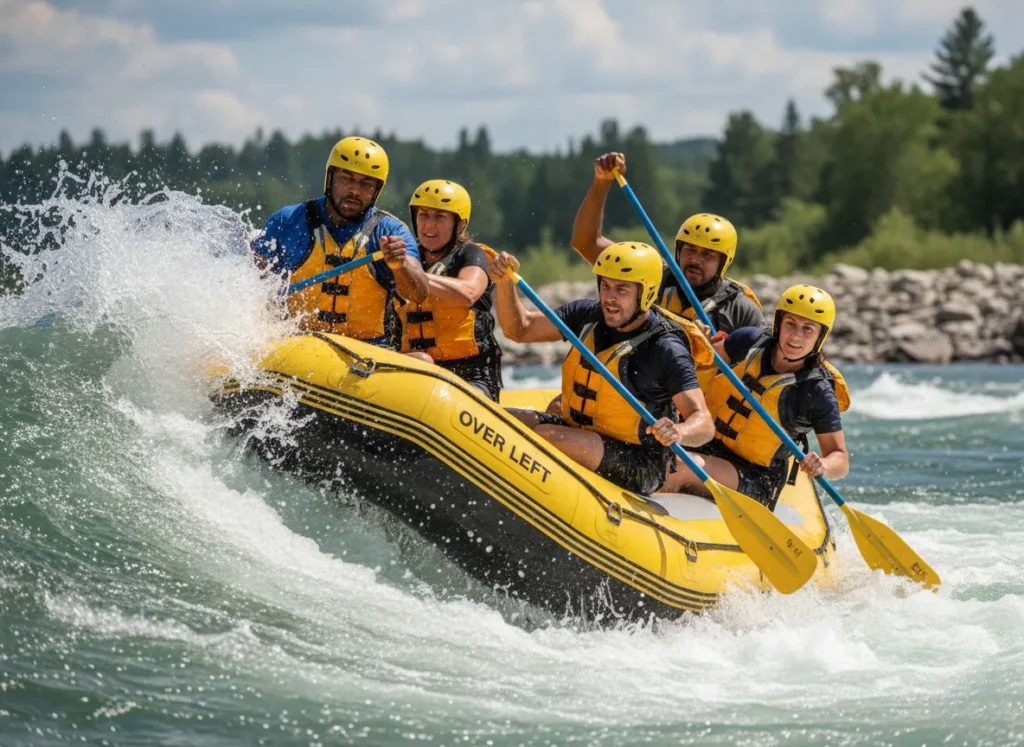
Mastering individual recovery is vital, but whitewater kayaking and rafting are team sports. The ultimate expression of bracing is not an individual save, but a coordinated team maneuver that prevents a raft flip from ever happening. This means shifting from individual survival to proactive team coordination.
Why is the “Over” Command Superior to “High Side”?
In whitewater, you live and die by your guide’s commands. The most common command is “High Side!” This is a reactive command, called when a tube is already lifting and the raft is nearly vertical. The crew must scramble frantically. Most experienced guides are not a fan of this command, because it’s often too late to keep the boat upright.
The expert command is “Over Right!” or “Over Left!” This is a proactive command, called before the raft hits a major feature. The goal is to intentionally and aggressively plant in the downstream current by weighting the downstream tube. This action lifts the upstream tube, preventing a “tube wrap”—the most common cause of a flip in rapids.
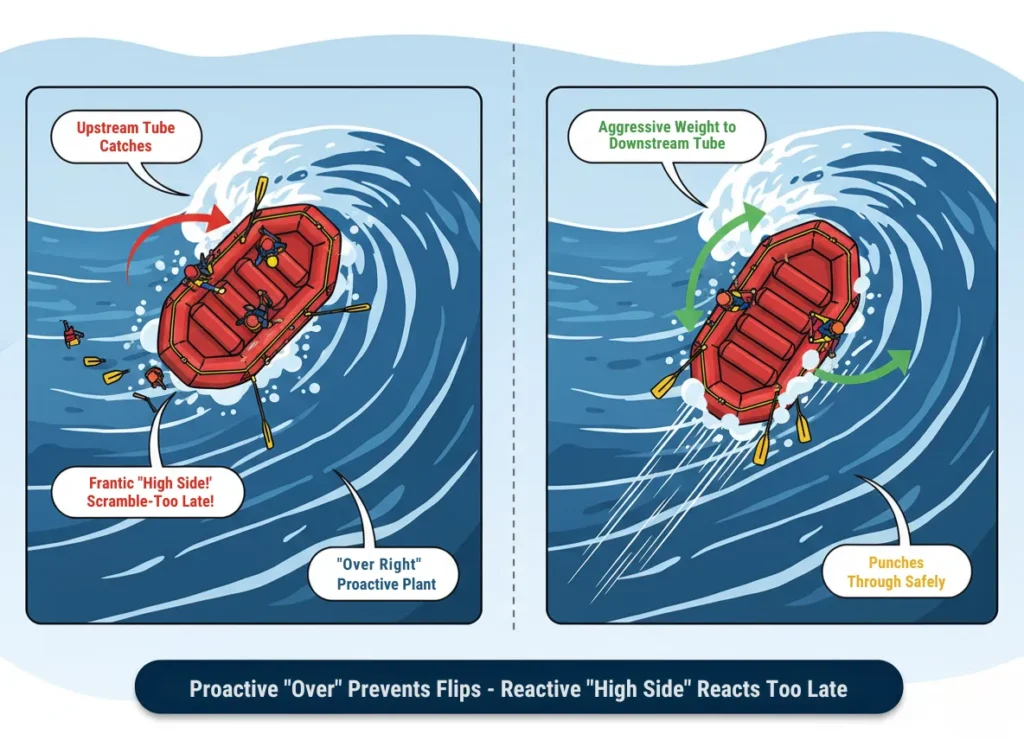
In short: “High Side” reacts to a problem. “Over” prevents the problem from ever happening.
Understanding the theory is one thing; executing it in chaos is another. To truly understand its power, it’s worth exploring a deep dive into The high-side command and why its proactive cousin is the mark of a well-coordinated team.
How Can You Build Bracing into a Wilderness Instinct?
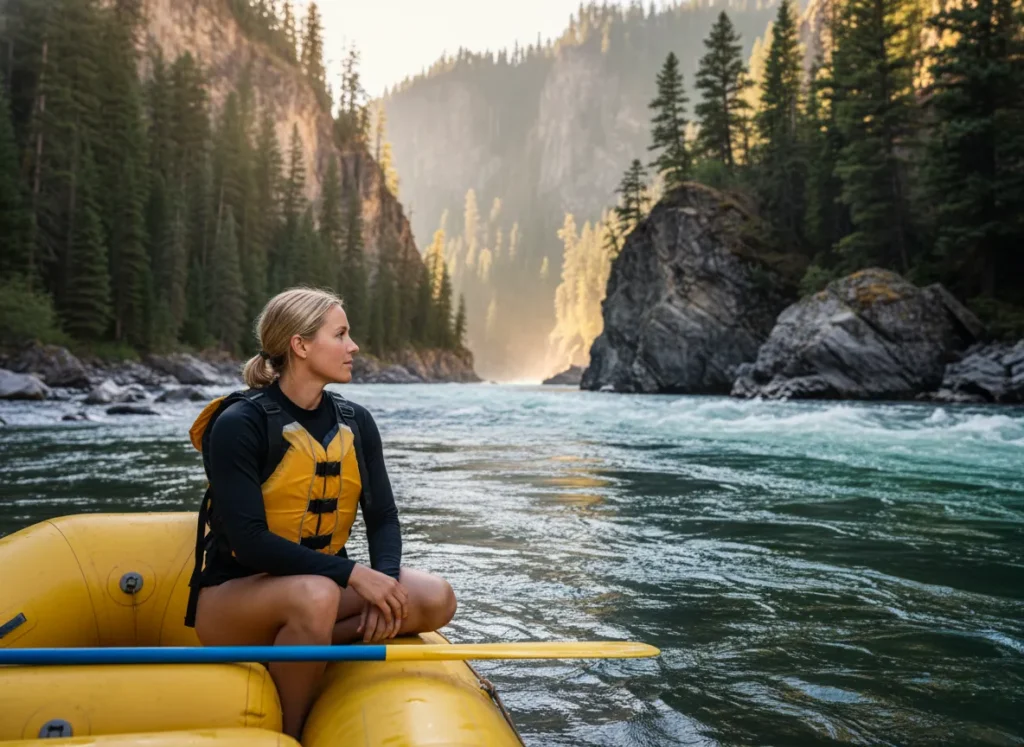
The final step is to take these physical skills and connect them to a deeper purpose. True mastery isn’t just about protecting yourself; it’s about protecting the places we love. To practice bracing in whitewater is an act of conservation.
What is the Connection Between a Successful Brace and River Conservation?
The direct consequence of a failed brace is a swim, a capsize, or a wrapped raft. The recovery that follows, while necessary, almost always has an environmental impact.
Think about two major problems. First, Bank Erosion: Swimmers scrambling for shore damage fragile riverbanks, which are not “durable surfaces” as defined by Leave No Trace principles. Second, Riverbed Disturbance: During a recovery, people walking in the shallows disturb sensitive aquatic habitats.
Pro-Tip: Build instinct through visualization. Before a big rapid, close your eyes for a moment and mentally rehearse your response. Feel the raft tilt right. See yourself anchoring your feet, setting up a low brace, and dropping your head to recover. By pre-programming the correct response, you shorten your reaction time and make the safe choice the automatic choice.
Mastering the paddle brace is not just a personal safety skill; it is an environmental preservation tool. When you execute a brace, you stay in the boat. When your team executes a flawless “Over” command, you prevent a wrap. These successful actions eliminate the need for a high-impact recovery. You minimize environmental damage simply by being a skilled paddler. This frames skill mastery as the highest form of respect for the river, aligning perfectly with the ethos of active river conservation.
This connection between personal skill and environmental respect is the heart of responsible river running.
Conclusion
True competence is born when knowledge becomes instinct. In the dynamic world of whitewater, your ability to react correctly is everything. Let’s boil it down to the core truths:
- Raft bracing is an “anchor” skill focused on securing yourself with proper footwork and core strength, not a “lever” skill like in kayaks.
- The “Paddler’s Box” is the non-negotiable safety framework; keeping elbows low and your shoulder low is the key to preventing dislocation.
- The proactive, team-based “Over” command is the definitive raft brace, preventing flips by intentionally weighting the downstream tube before impact.
- Mastering the brace is an act of conservation, as a successful execution prevents the environmental damage caused by out-of-boat recovery efforts.
Explore our complete library of Rafting Skills guides to continue transforming your knowledge into wilderness instinct.
Frequently Asked Questions about Paddle Bracing in a Raft
What is the difference between a high brace and a low brace?
The primary difference in the high vs low brace debate is biomechanics and which face of the paddle blade is used: a low brace uses the back face of the blade in a push-up motion, while a high brace uses the power face in a pull-up motion. The low brace is universally safer for the shoulder joint, while the high brace is more powerful but carries significant injury risk if performed incorrectly.
How do you practice bracing in whitewater safely?
Start in a controlled environment like flatwater to find the raft’s balance point and drill static brace strokes. On an easy stretch of river, intentionally enter small waves at an angle to force a bracing reaction. This builds reflexive competence in a low-risk setting before you attempt it in challenging rapids.
What commands does a raft guide use for bracing?
Guides use reactive commands like High Side when the raft is already tipping, and proactive commands like Over Left or Over Right before hitting a feature to prevent a tip. Basic commands like Get Down and an aggressive forward stroke, which acts as a stabilizing brace, also function as team braces.
How do you prevent shoulder injury while bracing?
Always keep your elbows at or below shoulder level and in front of your body, a concept known as the Paddler’s Box. This ensures the brace is powered by your strong core and back muscles, not the vulnerable shoulder joint, and is why the low brace is recommended as the default.
Risk Disclaimer: Whitewater rafting, kayaking, and all related river sports are inherently dangerous activities that can result in serious injury, drowning, or death. The information provided on Rafting Escapes is for educational and informational purposes only. While we strive for accuracy, the information, techniques, and safety advice presented on this website are not a substitute for professional guide services, hands-on swiftwater rescue training, or your own critical judgment. River conditions, including water levels, currents, and hazards like strainers or undercut rocks, change constantly and can differ dramatically from what is described on this site. Never attempt to navigate a river beyond your certified skill level and always wear appropriate safety gear, including a personal flotation device (PFD) and helmet. We strongly advise rafting with a licensed professional guide. By using this website, you agree that you are solely responsible for your own safety. Any reliance you place on our content is strictly at your own risk, and you assume all liability for your actions and decisions on the water. Rafting Escapes and its authors will not be held liable for any injury, damage, or loss sustained in connection with the use of the information herein.
Affiliate Disclosure: We are a participant in the Amazon Services LLC Associates Program, an affiliate advertising program designed to provide a means for us to earn advertising fees by advertising and linking to Amazon.com. As an Amazon Associate, we earn from qualifying purchases. We also participate in other affiliate programs and may receive a commission on products purchased through our links, at no extra cost to you. Additional terms are found in the terms of service.