

In this article
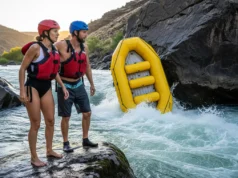
The roar of the river is deafening. It’s a physical force, a constant pressure on your ears and chest as thousands of pounds of hydrodynamic force hold your fully-loaded raft pinned against a mid-stream boulder. It refuses to budge. Your team is straining on the haul line of a standard 3:1 Z-drag, the rope is bar-taut, but the boat remains locked in the river’s grip. This is the moment where basic knowledge fails. It’s where instinct, honed by expert skill, becomes the only path to recovery.
This guide provides that skill. It is the definitive method for rigging a 5:1 mechanical advantage system specifically hardened for the unique and brutal challenges of whitewater. We’re not just talking about hauling something heavy; we’re providing river-specific adaptations, accounting for the catastrophic friction impact of wet rope, the unique anchoring requirements, and the sheer, immense forces that make standard rescue techniques dangerously insufficient.
This is your blueprint to transform from a passenger into a self-reliant problem-solver. You will learn the non-negotiable principles of force multiplication and why a five-to-one mechanical advantage ratio is the gold standard for heavy-duty raft rescue scenarios. You’ll understand why your choice of rope, pulleys, and especially your progress capture device (PCD) is critically different in a wet, gritty environment. You will master the most practical conversion techniques for upgrading a failed 3:1 Z Rig into a powerful 5:1 system, in place and already under tension. And most importantly, you will learn the unbreakable safety protocols needed to mitigate the single most dangerous hazard in any haul system—the “Impact Zone”—to ensure your rescue doesn’t create a second emergency.
Why is Mechanical Advantage a Rafter’s Ultimate Insurance Policy?

This isn’t just about ropes and pulleys; it’s about understanding the fundamental laws of the universe and making them work for you when everything else has gone wrong. Knowing these principles is a non-negotiable part of your safety toolkit, the ultimate insurance policy that you rig yourself.
What is the Core Trade-Off in Any Pulley System?
There’s a core principle in physics that every guide knows in their bones: there’s no such thing as a free lunch. You cannot create energy from nothing; you can only trade one form of it for another. In the world of mechanical advantage systems, the trade is simple and absolute: you trade rope pull distance for force multiplied. For a 5:1 system, this relationship is crystal clear: to move the load a distance of one foot, your haul team must pull five feet of rope through the system. This trade-off is precisely what allows a small, tired team to generate the immense force required to overcome the crushing pressure pinning a multi-ton raft. Think of it like the transmission in a truck. It’s a simple machine that provides a massive advantage in torque.
The practical implication of this trade-off is the need for a lot of rope and a well-managed haul area. A 3:1 system, by comparison, requires less rope pull—only three feet for every one foot of movement—but it also provides significantly less force. When you’re dealing with the massive, unyielding static load of a wrapped raft, the raw force multiplication of the 5:1 is always prioritized. This directly impacts the system’s “throw”—the amount you can haul before the pulleys touch and the system requires a reset. The increased rope pull distance means a 5:1 system has a shorter throw than a 3:1, leading to a higher reset frequency, but it’s a necessary price to pay for the power you gain.
For authoritative definitions of mechanical advantage systems, fire academies provide excellent, NFPA-aligned resources that corroborate this core physics. Now that we understand the fundamental exchange, let’s look at the simple machines that make it possible.
How Do Pulleys Actually Create Force?
In any rescue system, there are only two types of pulleys that matter: Fixed and Movable. A Fixed Pulley is attached to a stationary anchor, like a solid tree on the riverbank. Its only job is to change the direction of pull. Like the pulley at the top of a flagpole, it provides zero mechanical advantage (a 1:1 MA). While it doesn’t add power, it’s a critical safety component, allowing the haul team to pull in a safe and convenient direction—for example, downstream and away from the river’s edge. A Movable Pulley, on the other hand, is attached to the load (the raft) and moves with it. This is the component that actually multiplies force.
The physics are beautifully simple. A movable pulley, with its rope running over the sheave and rotating on its axle, acts as what physicists call a second-class lever. This lever arm distributes the load’s weight across two strands of rope, effectively halving the effort required to move the load and giving you a 2:1 mechanical advantage right off the bat. A functional system is created by combining these two types: the moving pulleys create the advantage, while the fixed pulley directs the force into a safe pulling zone. With every moving pulley added to a simple system, the theoretical mechanical advantage increases. However, it’s crucial to remember that replacing any of this hardware with a simple carabiner introduces massive friction and grinding, robbing the system of its power.
Pro-Tip: In a pinch, any carabiner is better than no change of direction, but never mistake it for a pulley. The friction of rope running over a non-rotating carabiner surface, especially when wet and gritty, can reduce your system’s efficiency by 50% or more at that single point. Always pack real pulleys.
This principle of force multiplication is what allows you to overcome the immense forces behind a river pinning, a hazard these systems are specifically designed to defeat. For more in-depth diagrams and explanations, many universities offer excellent technical rescue course materials on pulley systems, often drawing examples from mountaineering crevasse rescue as well as swiftwater applications.
How Are 5:1 Systems Classified for Rescue Rigging?
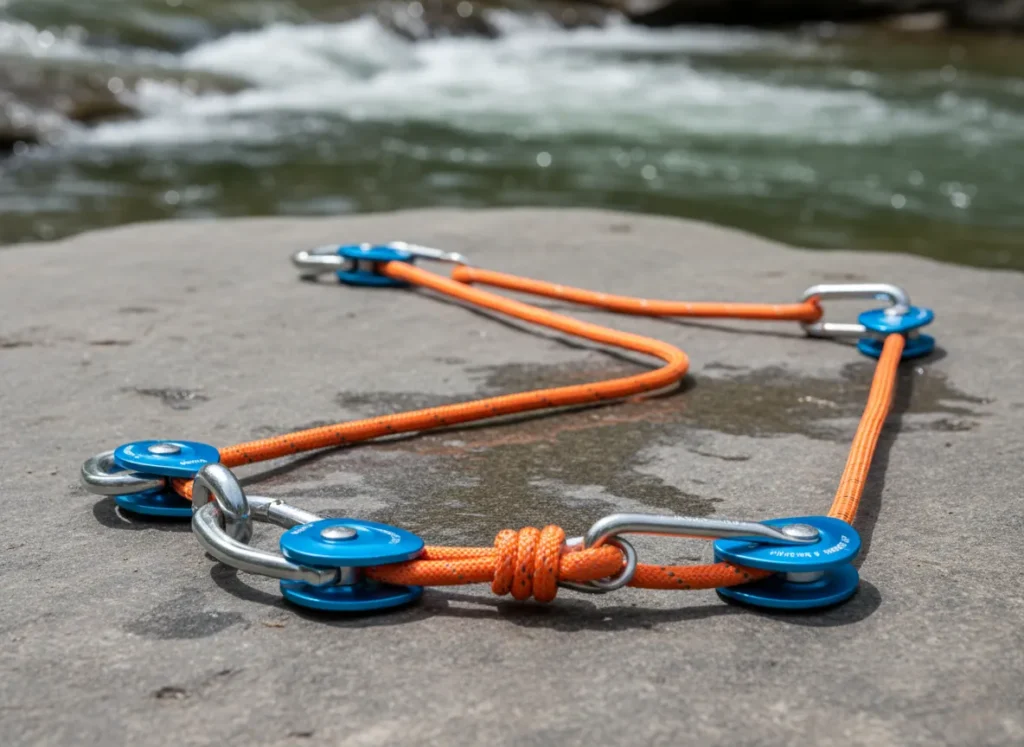
To truly master rigging, you need to speak the language. The terms Simple, Compound, and Complex aren’t just jargon; they describe critically different systems with unique behaviors, advantages, and disadvantages. Understanding how a 5:1 system is rigged as a simple, compound, or complex system is what separates a novice from an expert.
What Defines Simple, Compound, and Complex Systems?
In a Simple System, a single rope is woven or “reeved” between the anchor and the load, and all movable pulleys travel at the same speed and in the same direction. The classic 3:1 Z-Rig is a perfect example of this reeving method. In a Compound System, one simple pulley system pulls on the haul line of another simple pulley system. The key difference here is mathematical: the individual mechanical advantages are multiplied. For instance, if you rig a 2:1 system to pull on the haul line of a 3:1 system, you create a powerful 6:1 MA (2 x 3 = 6). A Complex System is any system that doesn’t meet the definition of simple or compound. In these complex pulley system setups, moving pulleys can travel at different speeds or even in opposite directions.
Here’s the crucial distinction that many beginners miss: the most common and practical 5:1 build used in swiftwater rescue is a complex system, not simple or compound. This is vital to know because many complex systems have a primary disadvantage known as “system collapse,” or collapsing behavior, where sets of moving pulleys travel toward each other. This severely limits the “throw,” requiring you to reset the system more often. Recognizing these classifications is key to diagnosing efficiency problems and rigging the right system for the job, especially when you consider how environmental factors dramatically affect The U.S. Marine Corps’ explanation of rope properties in wet conditions. This distinction becomes critically important when we examine the most common way rafters create a 5:1, which starts with the standard 3:1 Z-Drag rescue system and often leads to a mathematical paradox.
What is the “5:1 Paradox” and Why Does It Matter?
Here’s the point of confusion that trips up almost everyone: you’ll hear that a 5:1 is made by combining a 3:1 system and a 2:1 system. But basic math tells you that 3 x 2 = 6. So where did the 6:1 go? This is the paradox, and its solution lies in the distinction we just covered. When one system pulls on another in series (a compound system), the forces multiply, giving you that 6:1. But that’s not how the common rescue 5:1 is built.
The solution to the paradox is that the rescue 5:1 is a complex system where a 2:1 and a 3:1 are rigged in parallel to the load. In this specific parallel configuration, the mechanical advantages are added, not multiplied. Thus, 2:1 + 3:1 = 5:1. Understanding this distinction between series and parallel rigging is a cornerstone of expert instruction. The practical outcome is that this complex pulley system build is often more efficient in the real world than a simple 5:1 because it can be constructed with fewer pulleys, which means fewer points of friction to rob your power. However, you must remember the disadvantage: this build suffers from “collapsing pulleys,” which significantly shortens the hauling distance (“throw”) before you need to reset. Understanding this paradox allows you to intentionally build this system, fully aware of its strengths (efficiency) and weaknesses (short throw) before you even start pulling the rope. The reason such power is needed is confirmed by the National Park Service warnings about boat salvage forces, which notes that forces in boat recovery are ‘drastically higher’ than life-safety loads.
With the theory firmly in place, it’s time to get our hands dirty. This starts with assembling the right tools for the job, which you can find in our guide to a complete raft pin kit.
How Do You Build a 5:1 System on the Riverbank?
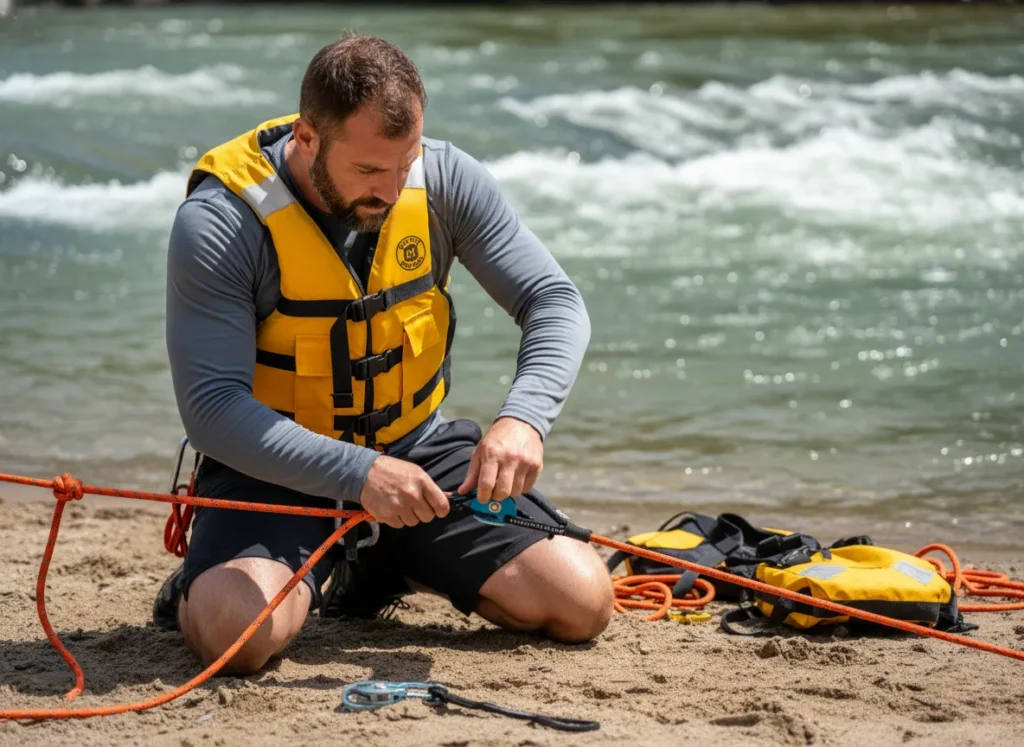
This is the core of your new skill set. Building a system under pressure requires knowing your gear inside and out and having a simple, repeatable process. This isn’t about complex, theoretical rigs; it’s about the most practical, field-relevant techniques that work when you’re cold, wet, and tired.
What Gear Belongs in a Whitewater-Specific Pin Kit?
The gear you carry must be deliberately chosen for the harsh reality of a river rescue. There is no room for compromise.
Your rope must be a low-stretch, or “static,” rescue rope. Your pulleys must be high-efficiency models with bearings. The heart of the system is the progress capture device (PCD), essentially a mechanical rope grab that acts as a ratchet, automatically grabbing the rope to hold the progress you make between pulls.
This brings us to the central gear debate for any whitewater system: traditional friction hitches like the Prusik versus mechanical ascenders with toothed cams, like the popular Petzl Micro-Traxion or a Petzl Tibloc. While excellent climbing gear, a toothed cam device is a significant liability on wet, gritty river ropes. Under the sudden shock load of a shifting raft, those teeth can bite too aggressively, shredding the rope’s protective sheath and potentially leading to catastrophic failure.
The expert’s choice for whitewater is the VT Prusik, an advanced type of friction knot. While classic mountaineering texts like Freedom of the Hills have long established the standard Prusik hitch, modern river-specific adaptations favor the VT Prusik. Its most critical feature is that it is releasable under load. While some professional rescue kits utilize advanced equipment like the ISC R-ALF Pulley with its integrated overspeed brake, high load rating, and specified service intervals, the field-expedient VT Prusik is an essential skill. This conscious choice of material type and design prioritizes rope integrity and operational safety.
How Do You Convert a Failing 3:1 Z-Rig into a 5:1?
Once you’ve assembled the correct, river-hardened gear, the most valuable skill is not building a system from scratch, but upgrading one that’s already in place and failing. Imagine the scene: your standard 3:1 Z-Rig is deployed and under full tension, held by its PCD, but it isn’t powerful enough to move the pinned raft. This is how you convert 3:1 systems without losing ground.
Your base 3:1 Z-Rig consists of your anchor, a PCD, a traveling pulley attached to the load with a Prusik, and your haul line. The first action is simple:
Step 1: Unclip the haul line from the carabiner on the traveling Prusik (the one attached to the load).
Step 2: Clip a new sling or cordelette directly to that same traveling Prusik, which now acts as a master point for the added advantage, followed by a new pulley at the end of that new sling.
Step 3: Take your haul line and run it through this new pulley, directing it back toward the anchor.
This is one of the most effective conversion techniques for increasing power without a full reset. This specific technique is the most practical, time-sensitive skill a rafter can learn for moving the load. Practice this conversion in a controlled environment until it becomes pure muscle memory. Rigorous information on these systems can be found in resources like the University of Montana’s Technical Rescue Handbook.
How Does the River Environment Sabotage Your System’s Power?
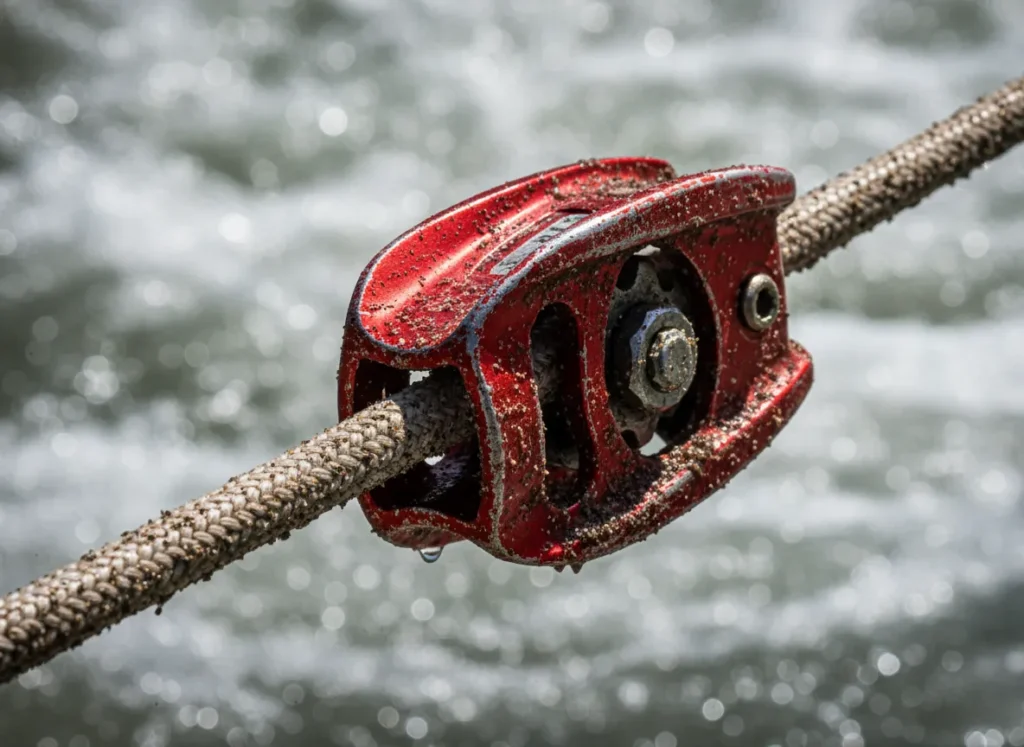
You’ve built a powerful system on paper. But in the real world, the river has a vote, and it always votes for more friction. This is where we confront the gap between how a system should work and how it actually performs in the grit, water, and chaos of a real rescue.
What is the Critical Difference Between Theoretical and Actual Mechanical Advantage (AMA)?
Theoretical Mechanical Advantage (TMA) is the perfect-world mechanical advantage ratio you calculate. For a 5:1 system, the TMA is 5:1. Actual Mechanical Advantage (AMA) is the real-world force output your system delivers after the friction inherent in the hardware has robbed it of its power. As a common field estimate, rescuers often use the “50% Rule,” assuming you will lose roughly half of your theoretical advantage.
This brings us to the core justification for building a 5:1 in the first place. Due to this dramatic loss in efficiency, a 3:1 Z-rig in practice “is closer to delivering a 2:1 mechanical advantage.” Read that again. Your 3:1 is really a 2:1. That single fact is the entire reason a 5:1 is necessary for the heavy loads in rescue.
The hard numbers prove the point. A high-quality rescue pulley is, at best, 85-95% efficient. A carabiner is catastrophically worse. When calculated with professional methods, a theoretical 3:1 system has an actual mechanical advantage of only 2.57:1. And remember, that optimistic 2.57:1 baseline is calculated for a clean, dry-land rescue. That figure assumes a clean, dry rope. Now, let’s dunk it in the river. The river environment introduces multipliers that degrade performance even further, making that 2.57:1 a best-case scenario before even considering the added effects of swift water friction and gritty wet ropes.
How Do You Apply the 5:1 System Safely to Unpin a Raft?

We’ve covered the physics, the gear, and the rigging. This final section synthesizes all that knowledge into an actionable, safety-focused protocol for the target scenario: using your 5:1 to unpin a raft in whitewater. Get this wrong, and you risk equipment damage or serious injury.
What are the “Bombproof” Anchoring Rules for a Wrapped Raft?
Your rescue system is only as strong as its anchors, the critical termination points at each end. The Boat Anchor is an even more critical termination point. The cardinal rule is this: Never attach the entire system’s force to a single D-ring on the raft. The forces involved can easily rip a single D-ring clean off the boat.
The professional method is to build a 3-point self-equalizing anchor. This is constructed by running a long sling or webbing to three separate, strong attachment points on the raft (e.g., two D-rings and a solid part of the frame). This technique distributes the massive load across all three points, significantly reducing the strain on any single one. It is absolutely non-negotiable for safety and for preventing catastrophic damage to the raft. This philosophy of secure and balanced rigging is a cornerstone of overall raft safety, from setting up an overnight gear boat to learning how to rig a raft to flip.
Pro-Tip: Make inspecting your raft’s D-rings and frame welds part of your pre-trip checklist. Look for signs of UV degradation on the D-ring material, worn stitching, or cracks in the welds. The time to find a weakness is on the shore, not when it’s holding back a river.
What is the “Impact Zone” and How Do You Rig to Avoid It?
With both ends of your system securely anchored, you must now address the single greatest threat to your haul team. This is the “Impact Zone,” also called the “Line of Fire.” It is the high-danger area in a direct line running between your anchor and your load. The hazard is brutally simple: if any piece of hardware in the system—a pulley’s axle, a carabiner, a D-ring—fails under load, it will be launched along this path at extremely high velocity. As the NPS rescue manual grimly states, “Anticipate that rigging could suddenly fail without warning.” This is not a theoretical risk; it’s a reality that professional NFPA standards are designed to mitigate.
The non-negotiable solution is to always rig a final Change of Direction (COD) Pulley at your shore anchor. While any pulley provides friction reduction, the sole function of this COD pulley is safety. Its job is to redirect the haul line 90 degrees away from the main system axis. This simple addition allows your haul team to stand and pull perpendicular to the Line of Fire, completely outside of the Impact Zone. That one, simple, extra piece of gear is the difference between a safe rescue and a potentially fatal accident. Mastering the technical rigging of a 5:1 is utterly useless without mastering this fundamental safety protocol. These principles of risk management are universal in paddlesports, reinforced by sources like the kayaking safety guidelines from the National Park Service.
By understanding the physics, choosing the right river-hardened gear, and prioritizing this unbreakable safety protocol, you’ve turned a potential catastrophe into a controlled, successful recovery. This application of mechanical principles, as detailed in many academic resources on pulley system physics, becomes a life-saving skill. It also fits into a larger strategic approach to any incident, as outlined in the hierarchy of river rescue.
Conclusion
The lessons of the river are often written in the language of force. A 3:1 system, with its actual power degraded by friction to closer to a 2:1, is often not enough to answer the immense forces of a pinned raft. A 5:1 is the necessary starting point. In the wet, gritty whitewater environment, a heat-resistant, load-releasable VT Prusik is the superior and safer choice over toothed mechanical ascenders that risk shredding your rope’s sheath. The most practical field skill isn’t building these systems from scratch, but knowing how to quickly and seamlessly convert a failed 3:1 Z-Rig in place and under tension. But above all, the most critical safety protocol is to always rig a final Change of Direction (COD) pulley, moving your team out of the direct “Impact Zone” and protecting them from catastrophic hardware failure.
The river demands respect and preparation. Use this guide as your blueprint. Practice these skills in a safe, controlled environment until they are second nature. Explore our full library of river rescue guides, and continue to build that quiet confidence that transforms theoretical knowledge into life-saving wilderness instinct. Mastering these rescue techniques for efficient hauling is not just about safe boating; it’s also a key part of our river conservation tie-in, as clean, successful rescues minimize environmental impact during a crisis.
Frequently Asked Questions about 5:1 Rigging for Raft Rescue
Can you convert a 3:1 system to a 5:1?
Yes, you can quickly convert a 3:1 Z-Rig into a 5:1 system even while it’s under tension. This is the most common and practical scenario in a real river rescue, where the 3:1 has already been deployed and proven insufficient.
Why is a 5:1 system better than a 3:1 for unpinning rafts?
A 5:1 is necessary because friction from pulleys and wet rope can reduce a 3:1 system’s actual power to closer to a 2:1. The immense, static force of water pinning a raft requires the significantly higher force multiplication provided by the 5:1 system to overcome it.
What’s the most dangerous mistake when rigging a haul system on a river?
The most dangerous mistake is allowing the haul team to pull from within the Impact Zone—the direct line between the anchor and the load. A catastrophic failure of any hardware component will turn it into a high-velocity projectile along this line, so a Change of Direction (COD) pulley must always be used for safety.
How much rope do you need for a 5:1 system?
In a simple 5:1 system, you will need to pull five feet of rope for every one foot you move the load. Therefore, you need a significantly long rope (e.g., over 100 feet to move a raft 20 feet) and a large, clear area to manage the rope during the haul, which is one of the practical setup limits of any high-ratio system.
Risk Disclaimer: Whitewater rafting, kayaking, and all related river sports are inherently dangerous activities that can result in serious injury, drowning, or death. The information provided on Rafting Escapes is for educational and informational purposes only. While we strive for accuracy, the information, techniques, and safety advice presented on this website are not a substitute for professional guide services, hands-on swiftwater rescue training, or your own critical judgment. River conditions, including water levels, currents, and hazards like strainers or undercut rocks, change constantly and can differ dramatically from what is described on this site. Never attempt to navigate a river beyond your certified skill level and always wear appropriate safety gear, including a personal flotation device (PFD) and helmet. We strongly advise rafting with a licensed professional guide. By using this website, you agree that you are solely responsible for your own safety. Any reliance you place on our content is strictly at your own risk, and you assume all liability for your actions and decisions on the water. Rafting Escapes and its authors will not be held liable for any injury, damage, or loss sustained in connection with the use of the information herein.
Affiliate Disclosure: We are a participant in the Amazon Services LLC Associates Program, an affiliate advertising program designed to provide a means for us to earn advertising fees by advertising and linking to Amazon.com. As an Amazon Associate, we earn from qualifying purchases. We also participate in other affiliate programs and may receive a commission on products purchased through our links, at no extra cost to you. Additional terms are found in the terms of service.