

In this article
The sound—a deep, constant roar that vibrates through the soles of your shoes before you even see the water. Then, a glimpse of emerald green or glacial blue, churning into brilliant white as it collides with ancient rock. This is the call of Europe’s wild rivers, a continent offering some of the best whitewater rafting in the world. As a premier destination for adventure travel and outdoor recreation, its waterways provide a unique challenge. This guide is your passport to answering that call, transforming you from a passenger into a participant by equipping you with the essential knowledge to navigate the continent’s most iconic whitewater, from the first paddle stroke to the final, triumphant surge.
To paddle these currents is to learn a new language, one spoken in waves and eddies. It’s about turning knowledge into instinct. It’s about understanding the raw power of the river and working with your team to find a path through the chaos. Before we push off from the bank, let’s preview the key waypoints on our journey:
- Decoding the River: We’ll learn the International Scale of River Difficulty (ISRD) to match your skill level with the perfect waterway.
- Gearing for Success: We’ll cover the non-negotiable safety equipment and personal gear that form an integrated system against cold and impact.
- The Paddler’s Code: You’ll master the fundamental commands, paddle strokes, and safety procedures that ensure teamwork and survival on the water.
- A Continental Guide: We’ll explore a curated list of Europe’s premier rafting destinations, from the alpine gems of Slovenia to the high-volume powerhouses of Austria.
The reader who begins this journey curious about Europe’s top rafting spots will finish with a foundational understanding of the sport itself—empowered not just to choose a destination, but to arrive as a prepared, competent, and safety-conscious crew member ready to engage with the river.
The Call of the Current: An Introduction to European Whitewater Rafting
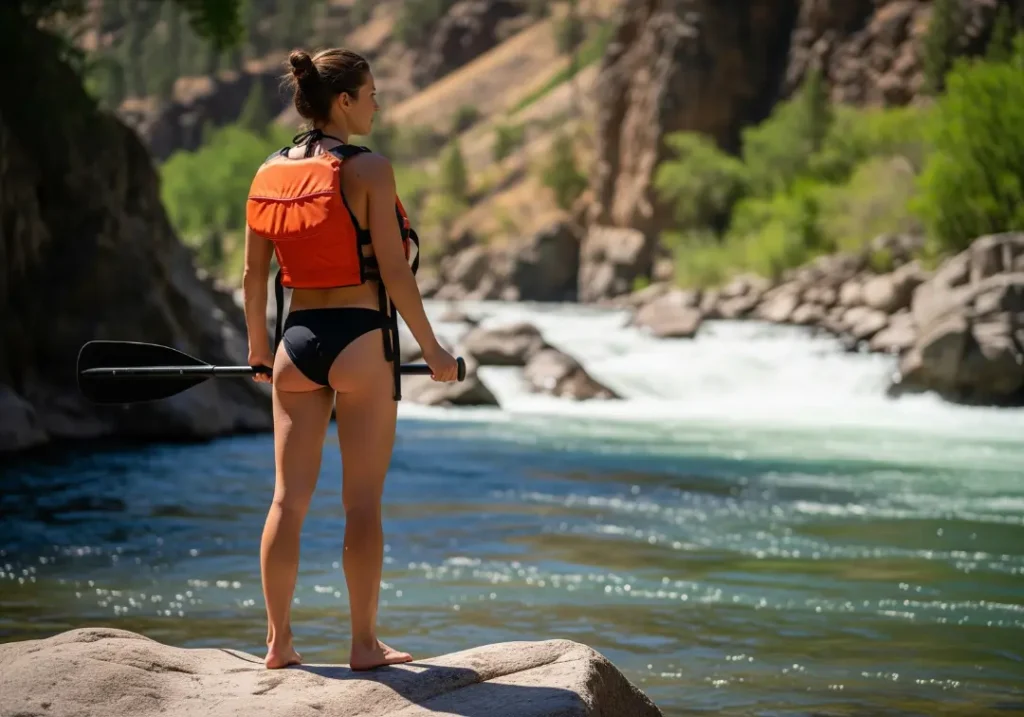
At its heart, whitewater rafting is a practice of focused intention. It’s the act of navigating a river’s rapids in an inflatable raft, but that definition barely scratches the surface. The term “whitewater” itself describes water so aerated by turbulence that it turns opaque and white—a visual sign of the river’s energy. To move through this environment requires more than just paddling; it demands teamwork. A group of individuals must learn to paddle in perfect unison, transforming their separate efforts into a single, collective force that can power through waves and maneuver around obstacles. This shared effort forges a direct and profound connection with the raw power of nature, a dialogue between the crew and the current.
The enduring allure of the sport lies in its fundamental duality. One moment, your heart is pounding as you dig your paddle into a surging wave, your crew yelling with a mix of focus and exhilaration. The next, you’re floating through a silent, deep canyon, the raft drifting gently as you gaze up at waterfalls cascading down thousand-foot cliffs. These calm sections are not just rest periods; they are opportunities to access remote, otherwise inaccessible landscapes and appreciate a profound wilderness. This unique blend of intensity and tranquility is what makes the sport remarkably accessible to everyone from families looking for a splashy adventure to seasoned experts seeking the ultimate challenge. The capacity to be both a thrilling adventure and a serene communion with nature is the key to its magic. This modern blend of thrill and accessibility evolved from much humbler, and often more perilous, beginnings, made possible by today’s highly engineered whitewater rafts.
What is the Essence of the Sport, Beyond Adrenaline?
River rafting is not simply about chasing an adrenaline rush. It is a practice of turning knowledge into instinct. It’s about reading the river’s language, trusting your gear, and working as a team to transform a chaotic force of nature into a path of exhilarating adventure.
The sport’s core is a fascinating duality: the heart-pounding thrill of conquering exhilarating white water rapids versus the profound serenity of the calm stretches that connect them. These moments of peace are just as vital as the moments of intensity. They are your ticket to remote canyons, hidden waterfalls, and untouched wilderness that are inaccessible by any other means. This blend of high-stakes action and peaceful immersion is what makes rafting a lifelong pursuit for so many, offering a different experience every time the paddle dips into the water.
What Are the Origins of Modern Rafting?
For millennia, navigating rough rivers, whether by canoeing or primitive raft, was a matter of necessity—for exploration, for transport, a challenge to be overcome. The idea of doing it for fun is a surprisingly modern one. The seeds of modern recreational rafting were planted post-WWII, when military surplus rubber rafts became available to adventurous pioneers. They saw these rugged crafts not as tools of war, but as keys to unlocking the wild arteries of the continent.
The evolution was swift. The small, individual rafts of the 1950s soon grew into the larger, multi-person crafts that define commercial rafting today. Contrast this with an early, ill-equipped attempt on Wyoming’s Snake River in 1811, which was so harrowing it earned the river the name “Mad River.” For those early explorers, the river was a terrifying obstacle; for us, it is a source of joy.
This transformation was driven by a crucial technological leap. Early trips in rudimentary rubber boats were a constant battle against swamping. The single most important innovation was the self-bailing floor. This ingenious design features a separate, inflated floor suspended above the boat’s true bottom. Holes around the inside perimeter allow water that crashes into the raft to drain out almost instantly. This invention revolutionized the sport. It eliminated the need to constantly stop and manually bail water, allowing for safer, more continuous descents through more challenging rapids. This technological evolution, from high-risk exploration to a structured and accessible form of recreation, is a perfect mirror of the sport’s own journey. And with this new technology came new materials and a choice for every rafter when it comes to choosing between PVC and Hypalon rafts.
Navigating the Flow: The International Scale of River Difficulty (ISRD)
With the right equipment established, the next critical piece of knowledge is understanding the language used to describe the rivers themselves. To ensure that a family on their first rafting trip doesn’t accidentally find themselves on a section meant for experts, the global rafting community uses a universal system for classifying river rapids. This system, with its clear grades of difficulty, empowers rafters to make informed and safe decisions about where to paddle.
How Are Rivers Graded for Rafting?
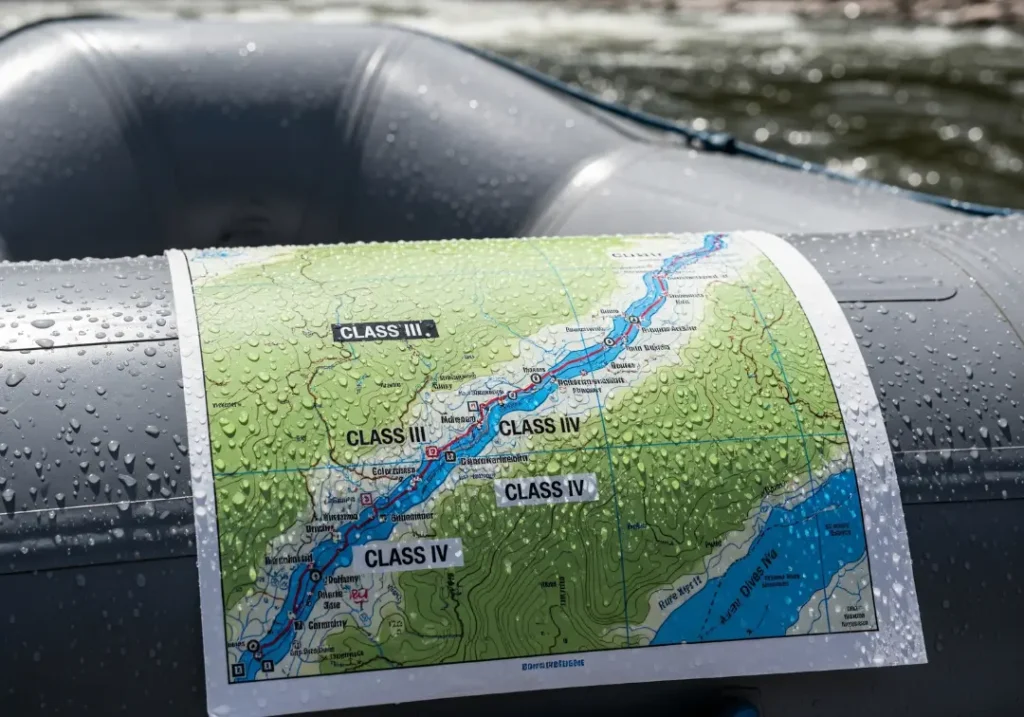
The universal language for assessing a river’s challenges is the International Scale of River Difficulty (ISRD). Developed and maintained by the American Whitewater Association (AWA), it has become the de facto global standard for recreational rafting, creating a shared vocabulary for guides and participants from the Alps to the Andes. The scale runs from Class I (easy, moving water with small waves) to Class VI (extreme and unrunnable). This guide, and the heart of recreational rafting, focuses on the dynamic and thrilling range of Class II, Class III, Class IV, and Class V.
It is crucial to understand that the scale is a subjective guideline, not an exact science. A Class IV rating in the Alps might feel different from one in the Rockies, and its application can vary by region. The single most significant variable that can change a rapid’s classification or difficulty grade is the water level, or flow. High water, often from snow-melt season or heavy rain, generally increases difficulty by creating a faster current and bigger, more powerful waves. Conversely, low water can expose more rock hazards, making a run more technical and challenging in a different way. A static rapid rating in a guidebook is only a starting point; risk must always be assessed based on current conditions. To truly understand this system, there’s no better resource than the American Whitewater’s official classification system, the primary source document from the governing body that created it. Understanding the classes is the first step to navigating the full spectrum of river hazards.
| The International Scale of River Difficulty (ISRD) | |||
|---|---|---|---|
| Class | River Environment | Required Skill Level | Typical Rafter Profile |
| II – Novice | Easy rapids and waves requiring some maneuvering. Wide, clear channels. | Basic paddling skill. | First-timers and families seeking a splashy introduction to whitewater. |
| III – Intermediate | Moderate difficulty with large, irregular waves and features requiring skilled maneuvering. | Some experience in rafting; good boat control needed in tight passages. | Adventurous beginners and repeat rafters looking for an exciting and fun challenge. |
| IV – Advanced | Difficult with powerful rapids and hazardous features requiring precise maneuvering. | Exceptional rafting experience; fast, reliable eddy turns and practiced rescue skills required. | Experienced rafters with strong fitness and a desire for high-adrenaline, technical runs. |
| V – Expert | Very difficult with long rapids, strong turbulence, and frequent obstacles. Near the limits of navigation. | Full mastery of rafting; extensive experience and practiced rescue skills are essential. | Highly skilled teams of experts seeking extreme challenges with significant risk. |
Gearing Up for Adventure: Essential Equipment and Preparation
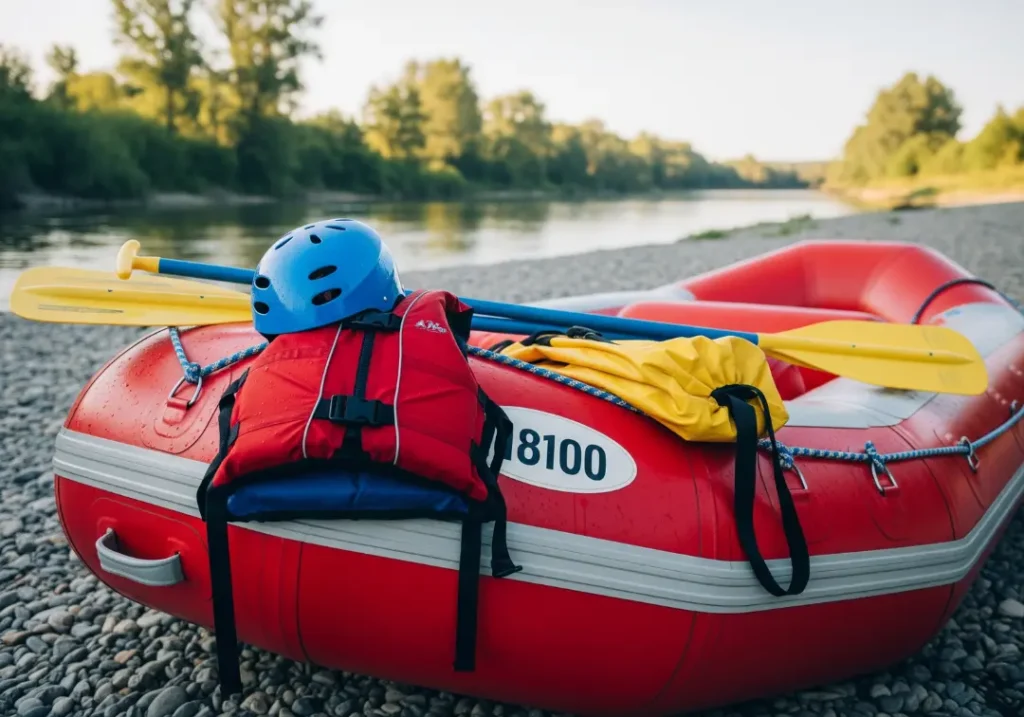
On a river, your gear is more than just equipment; it’s a system for managing risk. While your guide and outfitter are responsible for the raft and group safety kit—and ensuring their own guide qualifications are up to date—your personal gear is what keeps you safe, warm, and comfortable. Understanding the required equipment is a critical part of being a prepared crew member.
What is the Essential Safety Gear for a Rafting Trip?
On any commercial trip, your outfitter will provide the non-negotiable, life-saving gear, which we call the “Outfitter’s Kit.” This is your primary defense against the river’s power. The most important piece is your Personal Flotation Device (PFD). This is not your average lake-day life jacket; it’s a specific type designed for whitewater, with more buoyancy and a snug fit to ensure it stays on you in turbulent water. Next is the Helmet, which is mandatory for its obvious role in protecting you against impact with rocks, paddles, or the boat itself. Finally, you’ll be given a Paddle, the “engine” of the raft. Your paddle is your connection to the water and your primary tool for contributing to the team. Outfitters will also enforce any age/weight limits for the trip.
Beyond the hard gear, we must manage the risk of cold-water immersion and hypothermia. This is the role of Thermal Protection. The foundation of this system is the Wetsuit, typically made of neoprene. It works by trapping a thin layer of water against your skin, which your body then warms up, creating an insulating barrier. Over this, you’ll often wear a Splash Jacket, a waterproof and windproof outer layer that blocks wind and spray, working with the wetsuit for added protection. On your feet, Neoprene Booties provide warmth, grip on slippery rocks, and protection. While the outfitter provides the lifeline, what you wear underneath is your personal contribution to the thermal management system. For more information on PFDs, the U.S. Coast Guard’s guidance on PFDs is the authoritative source, and for those wanting to dive deeper into thermal protection, understanding the difference is key when deciding between a wetsuit and a drysuit.
Pro-Tip: Before you get on the water, do a final gear check. Cinch your PFD until it’s snug—you shouldn’t be able to lift it more than an inch off your shoulders. Your helmet strap should be tight enough that only two fingers can fit between it and your chin. A properly fitted PFD and helmet are your most important lines of defense.
The Paddler’s Code: Safety, Technique, and Teamwork
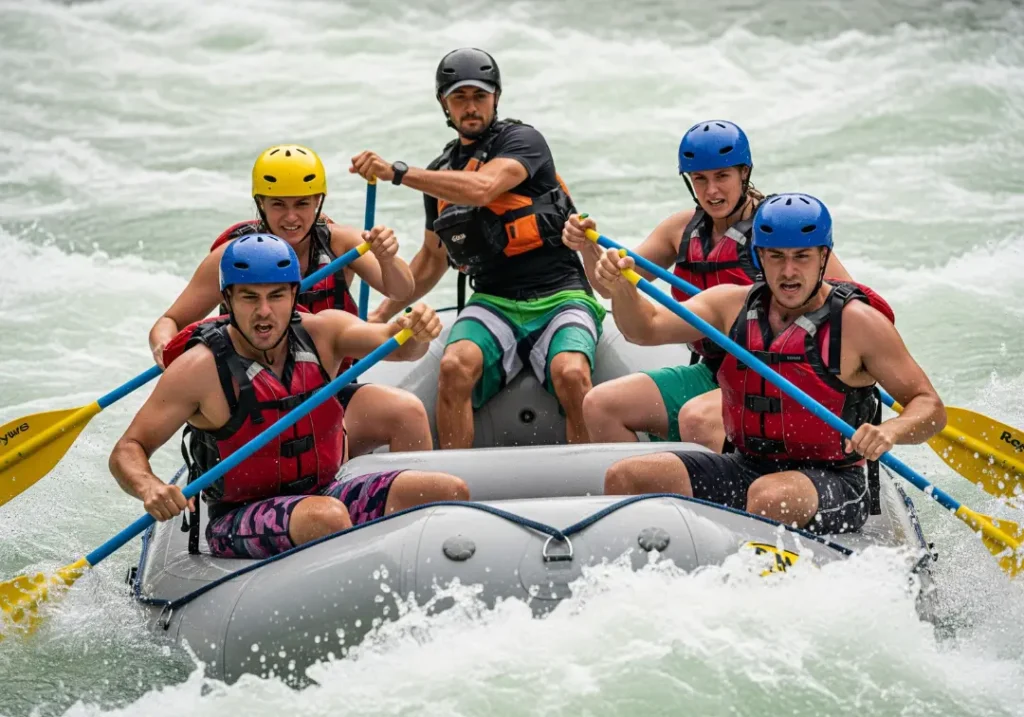
With the right gear, you’re protected. Now, it’s time to learn how to be an active, effective, and safe member of the paddle crew. The knowledge you gain in the next few minutes on the riverbank, from paddling techniques to safety protocols, is as important as anything you’ll do on the water. This is where your skill development begins.
What are the Most Critical Rafting Commands and Paddle Strokes?
The single most important lesson of any raft trip happens before you even touch the water: the guide’s pre-launch safety briefing. Pay close attention. Here you’ll learn the core propulsion commands: “All Forward” and “All Back,” which are the gas and the brakes for the raft. More critically, you’ll learn the primary safety command: “High-Side!” This is a command to shift your weight to the side of the raft that is being pushed up by an obstacle (like a rock or powerful hydraulic features). By moving your weight to the “high side,” you use your body to counterbalance the force of the water and prevent the raft from flipping. You’ll also learn the correct way to hold your paddle—one hand on the T-grip at the top, the other on the shaft—to prevent injuring yourself or your teammates in turbulent water.
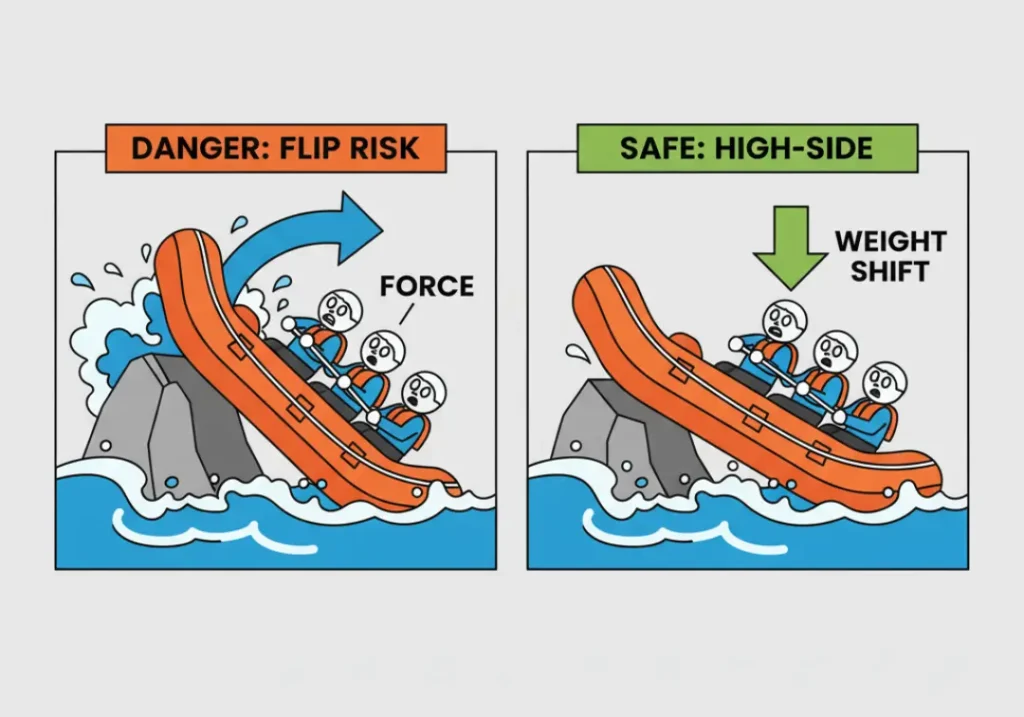
Your guide will also introduce basic terminology like “River Left” and “River Right” (always determined by looking in the direction of travel) for situational awareness, and define an “Eddy”—a calm area of water downstream of an obstacle that is used for stopping or regrouping. You’ll practice the two primary crew paddle strokes: the Forward Stroke (reach, plant the blade, pull to your hip) and the Back Stroke (plant the blade behind you, push). Proper technique and synchronized paddling with quick paddle strokes are absolutely essential for giving the raft the power and maneuverability it needs to navigate the rapids successfully. For a complete breakdown of the commands you’ll hear on the river, you can review this comprehensive guide to rafting commands. Responding to these commands keeps you in the boat, but knowing how to react if you fall out is the ultimate safety skill.
What is the Proper Way to Handle a Swim in Whitewater?
Falling out of the raft can be disorienting, but it is a manageable situation if you follow a few critical rules. The first and most important rule is: Don’t Panic. Your PFD is designed to keep your head above water, so trust it to do its job.
Your immediate action should be to get into the “Down River Swimmer’s Position,” also known as the “Defensive Swim Position.” This means you are lying on your back with your feet pointing downstream. Your knees should be slightly bent, and your head should be up so you can see where you are going. The purpose of this position is to use your feet and legs as shock absorbers to fend off any rocks you might encounter.
There is one cardinal sin of whitewater swimming: Never Stand Up in moving current. This is the most common cause of serious river injuries. If you try to stand up in water that is deeper than your knees, your foot can become wedged between rocks—a situation called foot entrapment. The immense force of the water can then push your body over, holding you underwater. The danger is extreme and very real. Your rescue priorities are simple: first, try to swim back to the raft and grab the perimeter line. If you can’t, look for your guide to throw you a “throw bag,” a rope used to pull swimmers to safety. Following these rules is critical for your safety, and you can get a deeper understanding by reviewing the techniques for mastering both defensive and aggressive swim positions.
Pro-Tip: When swimming through a wave, actively exhale as the water washes over your face. This simple trick prevents you from reflexively inhaling water and keeps you calmer and more in control during an unexpected swim.
Europe’s Premier Rapids: A Continental Guide
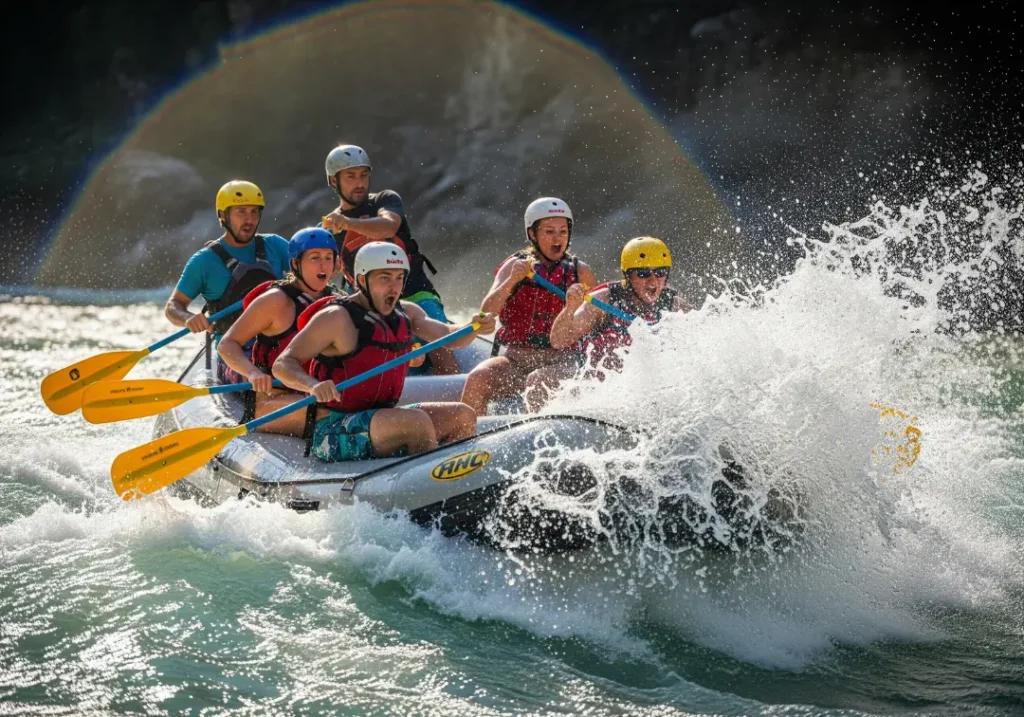
Armed with the fundamental knowledge of safety and technique, you are now ready to explore the stunning arenas where these skills are put to the test. Europe offers a world-class theater of rivers, each with a distinct character—from the high-volume power of the Alps to the monumental canyons of the Balkans. These are some of the most beautiful rafting destinations on the planet.
The Alpine Heart: Austria, Switzerland, Slovenia & Italy
- Soča River (Slovenia): The Emerald Beauty
- Location & Scenery: Flowing through Triglav National Park with the adventure hub of Bovec as its base camp, the Soča is world-renowned for its supernatural, vibrant emerald green colour and dramatic limestone gorges set against the snowcapped Julian Alps.
- Classification & Sections: Dynamic Class II-IV. The popular 10km commercial run from one of several starting points combines playful waves with challenging rapids, while gentler Class II-III sections offer a family-friendly rafting experience.
- Best Time to Visit/Season: April-October. Spring (April-May) is the high-water season for thrill-seekers. Summer (June-August) has warmer water and is ideal for beginners and families.
- Technical Mastery & Skill Focus: The water source is consistently cold (snow-melt dependent), making wetsuits essential. The river’s “pool-drop” character requires paddlers to switch frequently between relaxed floating and intense, coordinated paddling to navigate narrow passages, honing your team’s timing and power application. It’s a great place for intermediate rafters.
- Inn River (Austria): High-Volume Powerhouse
- Location & Scenery: Carving through steep, evergreen-clad gorges in the Tyrol region and the Oetztal Valley of western Austria, with trips often starting from Landeck or Imst.
- Classification & Sections: The Imst Gorge is a famous Class III+ run with large, bouncy waves. For experts, the Landeck Gorge offers a more intense Class IV-V section.
- Best Time to Visit/Season: May-September, with peak conditions from its snow-melt water source in June-August.
- Technical Mastery & Skill Focus: The Inn is defined by its high volume, not tight technicality. The primary challenge is navigating powerful currents and immense “wave trains.” Crews must focus on maintaining momentum and holding a straight line through the largest waves to avoid being turned sideways—a true test of crew synchronization.
- Lütschine River (Switzerland): Glacial Rush from the Eiger
- Location & Scenery: Beginning from the glacier below the Eiger’s North Face, this glacier-fed river flows through the stunning valley near the base town of Interlaken.
- Classification & Sections: A continuous and demanding stretch of Class III-IV whitewater. The rapids are relentless from start to finish.
- Best Time to Visit/Season: Summer-only, as its flow is tied directly to glacial melt, creating tumultuous icy waters.
- Technical Mastery & Skill Focus: This is a significant step up from a typical Class III run. It requires strong, confident swimmers and an athletic crew. The continuous nature means there are few calm pools for recovery, demanding sustained focus and powerful, synchronized paddling to punch through features. A safety kayaker often accompanies these trips.
- Noce River (Italy): National Geographic’s Alpine Gem
- Location & Scenery: Found in Val di Sole in the Trentino region of the Italian Alps, featuring picturesque canyons and lush green valleys. The main base camps are Commezzadura and Mezzana.
- Classification & Sections: Highly versatile, with 28 km of navigable route from Class II to Class IV+. This allows outfitters to tailor trips for all skill levels.
- Best Time to Visit/Season: April-September.
- Technical Mastery & Skill Focus: The Noce offers a perfectly balanced experience, interspersing technical rapids with calmer stretches. This makes it an ideal training ground for practicing skills like eddy turns and ferrying in a progressive environment, allowing crews to build confidence section by section. It is a fantastic rafting river.
While these rivers represent the pinnacle of European rafting trips, the Alps are dense with other world-class whitewater. In Switzerland, the Rhine Gorge on the Vorderrhein offers stunning canyon scenery with its own unique character, while in France, the Verdon Gorge, though more famous for river kayaking, provides breathtaking views and seasonal rafting opportunities.
Balkan Depths: Montenegro & Bosnia and Herzegovina
- Tara River (Montenegro/BiH): Europe’s Deepest Canyon
- Location & Scenery: Forming the border of Montenegro and BiH within Durmitor National Park, the Tara has carved the deepest canyon in Europe (1,300m), making it the continent’s longest canyon. A UNESCO World Heritage Site, the scenery is monumental, wild, and rugged.
- Classification & Sections: A long journey with rapids from Class II to powerful Class IV (and V at peak flow).
- Best Time to Visit/Season: Late spring (April-June) for high-water adrenaline. Summer (July-September) for calmer, scenic family trips.
- Technical Mastery & Skill Focus: The defining characteristic is the sheer scale and length. Multi-day expeditions are the best way to experience it. While the rapids are excellent, the challenge is also one of endurance and remote wilderness travel, requiring well-prepared gear and a self-sufficient mindset. This river hones expeditionary skills beyond just paddling.
British Classics: Wales & Scotland
- Tryweryn River (Wales): Dam-Released and Reliable
- Location & Scenery: Situated in Snowdonia National Park near the town of Bala, the river runs alongside the National White Water Centre.
- Classification & Sections: The Upper section is a 2 km stretch of continuous Class III-IV. The Lower is a longer Class II-III journey culminating in a Class IV finale.
- Best Time to Visit/Season: All-year-round rafting is possible due to its reliable dam-released water source and scheduled water release, a unique feature in the UK.
- Technical Mastery & Skill Focus: The Tryweryn is famous for being technical and “pushy” with many rapids per mile. Rapids like the “Cheese Grater rapid” require precise maneuvering and fast eddy turns to set up for subsequent moves. It is a premier destination for technical rafting and training, ideal for developing the skills of reading water and making quick, decisive paddle strokes.
Beyond the Rapids: The Culture and Conservation of River Running
To be a rafter is to be more than just a sports enthusiast; it’s to be a steward. Our sport connects us intimately to the health of these wild waterways, placing us in a unique position to advocate for their protection. We see firsthand the threats they face and understand the delicate hydrology of these systems.
Why is River Conservation Crucial for the Future of the Sport?
The rafting community—both guides and participants—are uniquely situated to advocate for river health because we witness the threats firsthand. European rivers face significant challenges, including habitat fragmentation from hydropower dams, water pollution, and the impacts of climate change on water levels. The primary legislative tool guiding river conservation in the EU is the Water Framework Directive (WFD), which aims to restore rivers to “good ecological health” through integrated management plans. This framework is a cornerstone of Europe’s sustainable water management policies.
A central focus of modern restoration is restoring “river continuity.” This concept involves the strategic removal of obsolete dams and barriers that block the natural flow of water, sediment, and migratory species like fish. By creating free-flowing rivers, conservationists aim to rejuvenate entire ecosystems. As rafters, when we choose to participate responsibly by supporting conservation-minded operators and practicing proper river etiquette, we contribute positively to protecting the very environments we come to enjoy. This powerful connection between adventure and advocacy brings our journey full circle, reminding us that every paddle stroke is a vote for the future of our planet’s wild waterways.
Conclusion
Whitewater rafting is a multifaceted sport that combines teamwork, adrenaline, and a unique connection to nature, made accessible by modern equipment technology. The International Scale of River Difficulty is the essential framework for rafters to safely match their skills to a river’s challenges, with Classes II-V forming the core of recreational rafting. Your preparation is a system, involving essential safety gear like a PFD and helmet, and a mastery of core skills like paddle commands and self-rescue techniques. From the high-volume power of the Alps to the monumental canyons of the Balkans, Europe offers a world-class theater of rivers, each with its own distinct character for your next rafting adventure.
The river is a teacher, and the lessons are endless. Continue to build your knowledge and skills by exploring our complete library of river running guides, and share your own European rafting experiences in the comments below.
Frequently Asked Questions about Whitewater Rafting in Europe
What is the best country for white water rafting in Europe?
There is no single “best” country, as the ideal choice depends on the rafter’s skill level and desired experience. However, countries like Austria and Switzerland are famous for high-volume alpine rivers, Slovenia’s Soca River is renowned for its beauty, and Montenegro’s Tara River offers an epic canyon expedition.
Can beginners go whitewater rafting in Europe?
Yes, Europe has countless opportunities for beginners. Look for commercial trips on Class II and Class III rivers, which offer a fun, splashy, and safe introduction to the sport under the guidance of professional outfitters. Many outfitters have strict age limits for family suitability.
What is the most difficult river to raft in Europe?
Many rivers have extreme Class V sections that are reserved for expert, non-commercial kayakers, but among commercially rafted rivers, runs like the Landeck Gorge on the Inn River (Austria) or certain high-water sections of the Sjoa River (Norway) are considered some of the most challenging. Difficulty is highly dependent on water levels at any given time.
What is the best time to visit for rafting in Europe?
The main rafting season generally runs from April to October. Spring (April-June) typically offers higher, more powerful water from snowmelt, which is ideal for thrill-seekers. Summer (July-August) provides warmer weather, more stable water levels, and is perfect for families and beginners. Some rivers, like the Tryweryn in the UK, have dam-release schedules allowing for all-year-round rafting.
Risk Disclaimer: Whitewater rafting, kayaking, and all related river sports are inherently dangerous activities that can result in serious injury, drowning, or death. The information provided on Rafting Escapes is for educational and informational purposes only. While we strive for accuracy, the information, techniques, and safety advice presented on this website are not a substitute for professional guide services, hands-on swiftwater rescue training, or your own critical judgment. River conditions, including water levels, currents, and hazards like strainers or undercut rocks, change constantly and can differ dramatically from what is described on this site. Never attempt to navigate a river beyond your certified skill level and always wear appropriate safety gear, including a personal flotation device (PFD) and helmet. We strongly advise rafting with a licensed professional guide. By using this website, you agree that you are solely responsible for your own safety. Any reliance you place on our content is strictly at your own risk, and you assume all liability for your actions and decisions on the water. Rafting Escapes and its authors will not be held liable for any injury, damage, or loss sustained in connection with the use of the information herein.
Affiliate Disclosure: We are a participant in the Amazon Services LLC Associates Program, an affiliate advertising program designed to provide a means for us to earn advertising fees by advertising and linking to Amazon.com. As an Amazon Associate, we earn from qualifying purchases. We also participate in other affiliate programs and may receive a commission on products purchased through our links, at no extra cost to you. Additional terms are found in the terms of service.