The roar is deafening as your raft surfs helplessly in place, trapped in what feels like a top-loading washing machine set to a permanent spin cycle. This is the grip of a keeper hole hydraulic, one of the most powerful and misunderstood whitewater river features. But it’s not a monster; it’s a puzzle of physics and hydrology. True river competence comes from transforming theoretical knowledge into the practical, confident instinct needed to navigate whitewater’s most powerful features safely. This guide is your key to solving that puzzle, an essential read for anyone involved in recreational paddling.
For the student learning the “textbook” definitions of dangerous river hydraulics, this is your educational guide. For the experienced boater, this is the mental blueprint to turn chaos into controlled, life-saving action. This is your comprehensive plan for identifying, avoiding, and—if necessary—surviving and escaping keeper holes by mastering the raft-specific team maneuvers that turn victims into victors.
First, we’ll dissect the trap to understand the formation of holes, examining the core components. Then, we’ll learn the critical visual cues, from “smiling” vs. “frowning” holes to deadly low-head dams, that allow for split-second safety decisions from upstream. From there, we’ll master the coordinated, in-boat rafting response drills for both punching through a hole and executing a high-side to prevent a flip. Finally, we’ll cover the crucial escape strategies for swimmers and the expert-level protocols for recovering people and equipment.
What is the Anatomy of a Keeper Hole Hydraulic?
To defeat an opponent, you must first understand them. A hydraulic isn’t a single, malevolent force; it’s a system of competing currents created by a simple law of physics. This section deconstructs that system into its core components, giving you the foundational knowledge to see not just a churning mass of water, but a predictable, navigable machine. Understanding holes is the first step toward safe whitewater boating.
How Does a Hydraulic Form and Function?
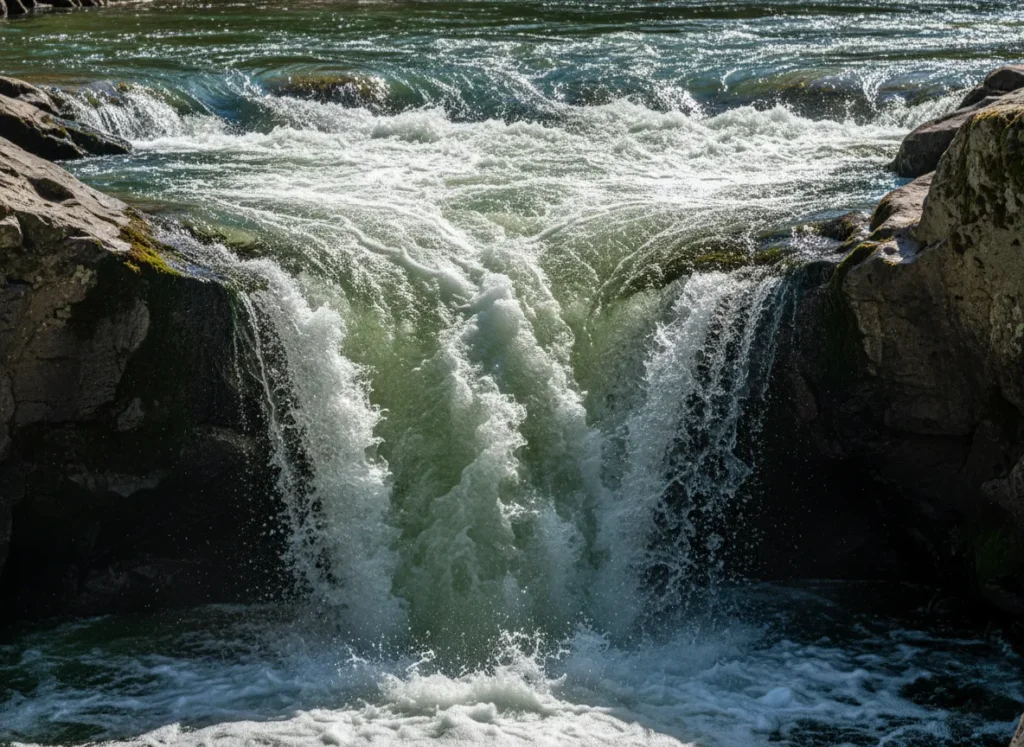
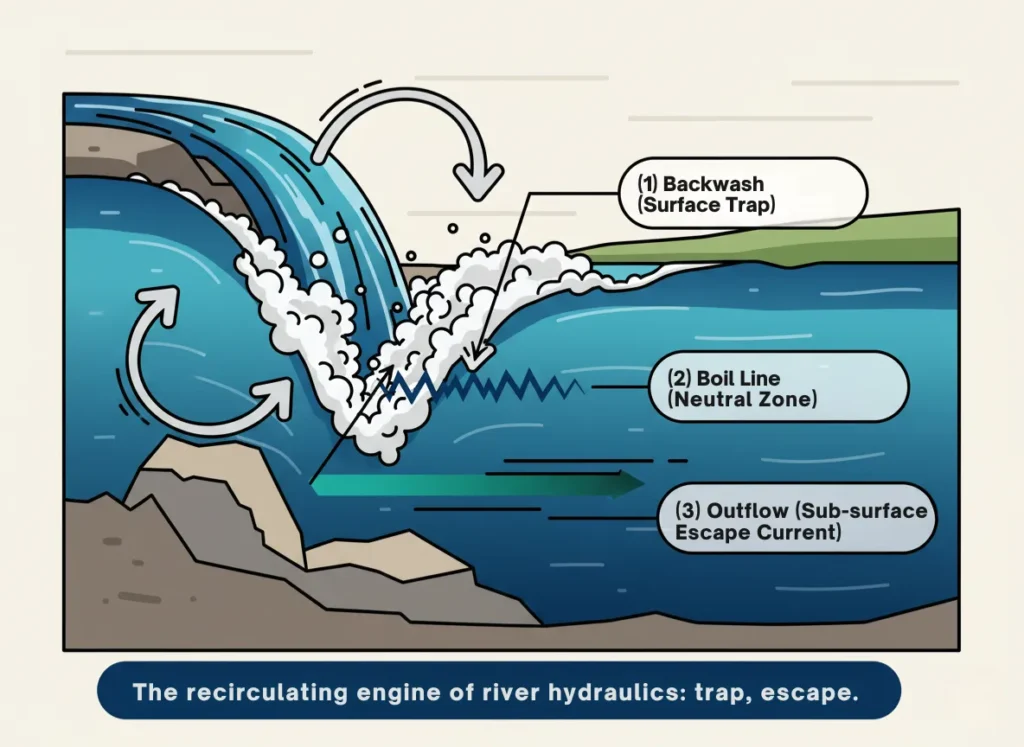
Every hydraulic, sometimes called a pourover hole, begins with a simple action: the downstream current diving over a submerged or partially submerged obstacle, be it a ledge, a boulder, or a man-made dam. As the main volume of water flows over the top, it creates a low-pressure void, or a deep depression, directly behind the obstacle. The river, always seeking equilibrium, needs to fill this void. To do so, it pulls surface water from downstream and sends it tumbling upstream to fill the gap. This recirculating water is the engine of the hydraulic. This process creates three distinct anatomical zones you must know: the Backwash, the Boil Line, and the Outflow.
The Backwash, often called a backroller, is the visible, aerated, foamy water on the surface flowing upstream back towards the obstacle. Think of it as the hydraulic’s tractor beam; this is the current that traps boats and swimmers. The Boil Line is the turbulent, often chaotic-looking zone where the upstream current collides with the downstream-flowing river current. This is the true boundary of the hydraulic’s power; a raft isn’t free until it has completely crossed this line. Beneath it all is the Outflow—the powerful, deep “green water” current flowing downstream. This is the only way out for a swimmer, the subsurface escape route. The American Whitewater Safety Code perfectly summarizes this dynamic, defining a hydraulic as water that “curls back on itself, forming a strong upstream current.” Understanding these three zones is like learning the parts of an engine. To truly grasp the fundamental principles of river hydraulics and the academic models of river dynamics, you have to see them not as separate parts, but as a functioning system.
What Factors Determine if a Hole Becomes a “Keeper”?
Not all hydraulics are created equal. Some are playful surf spots; others are terminal traps with a long and dangerous recirculation time. A hole’s power, or hydraulic strength, is not random, but a predictable equation of variables. The first and most important factor is Flow (CFS) / Volume. As the volume of water in a river increases, the power of its features increases exponentially. A benign ledge on a whitewater stream like the Buffalo River at 300 CFS (a typical reading on the Boxley gage) can transform into a lethal, inescapable keeper hydraulic after a heavy rain brings the flow levels up to 1000 CFS. The second key variable is Drop Shape. A uniform, river wide ledge, like a man-made low-head dam, creates a “perfect” hydraulic with no weak points. An irregular, natural boulder creates an “imperfect” hydraulic with weaker spots and potential exits. It is this combination of power and uniformity that creates “extreme retentiveness”—the key attribute that elevates a simple “hole” to a dangerous “keeper.”
These variables are compounded by others. The Backwash Distance—the distance from the obstacle to the boil line—is a critical visual cue. A two-foot backwash might feel “sticky,” but a four-foot backwash indicates a powerful recirculation that can be a terminal trap. The Pool Depth downstream also plays a role; a deeper pool can support a more powerful and stable recirculating current. When you combine these factors—high volume, a uniform shape, and significant backwash distance—you get the “Keeper Equation.” This is the formula for a powerful hole that will not easily release objects. Understanding how flow alteration impacts river features is not just academic; knowing how river flows measured in CFS directly correlates to a hydraulic’s intensity is a critical predictive skill.
How Can Rafters Identify and Triage Hydraulic Threats?
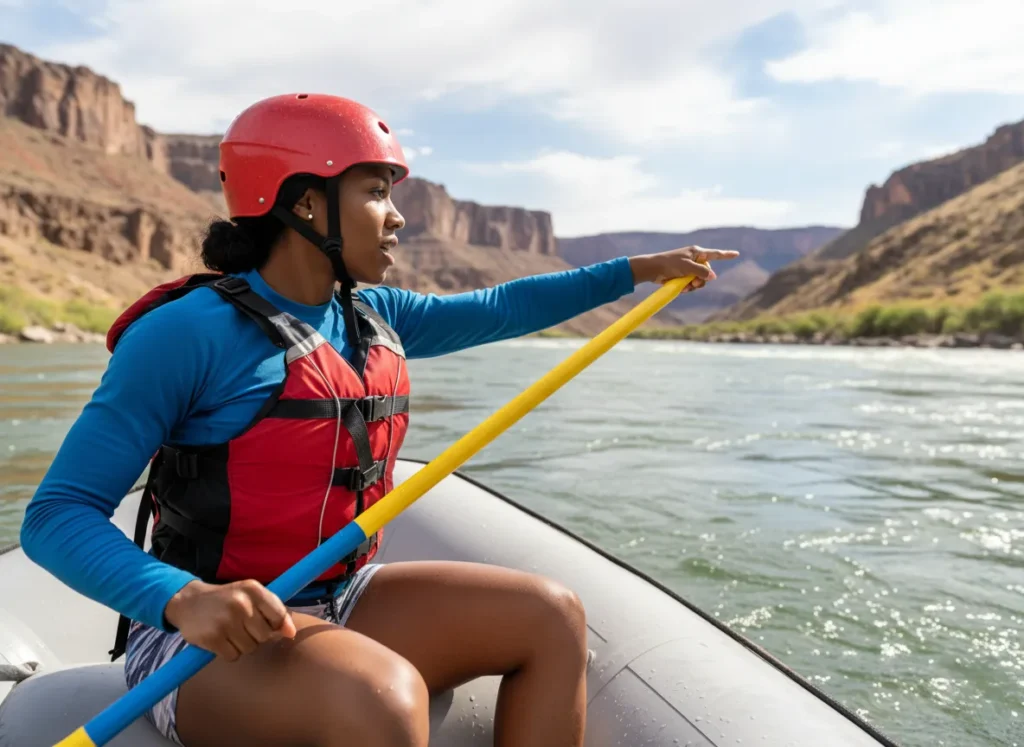
With the physics understood, the next step is to translate that knowledge into a visual language you can read from your raft, often in a split second. This is the art of reading water—a field guide for visually identifying dangerous hydraulics from upstream, enabling you to make crucial go/no-go decisions long before you’re in the grip of the current. This skill is paramount for all whitewater paddlers, whether in a raft, whitewater canoe, or ww kayak.
What Upstream Signs Warn of a Major Drop or Hazard?
The most important rule in whitewater boating is simple: “Don’t run what you can’t see.” The river provides one universal, non-negotiable sign that you are approaching a major drop or hazard for which you cannot see the outcome. It’s called a Horizon Line. This occurs when the riverbed drops away so steeply—over a dam, a waterfall, or a large ledge—that the river’s surface seems to disappear ahead of you, blending with the horizon. A horizon line is a mandatory trigger for action. It means you pull over immediately to scout the rapid on foot or prepare to portage (a practice often needed at portage dams). This visual cue is the river’s most unambiguous warning signal and must be respected without question.
Once you have a clear view downstream, the river offers a simpler navigation system in the form of “V’s” leading into a wave train. A Downstream “V” is a V-shape in the current pointing downstream. This is your “green light.” It marks the main channel and indicates the deepest, safest path through a whitewater rapid. Conversely, an Upstream “V” is a V-shape pointing upstream. This is your “yellow light.” It signals an underwater rock or log that water is flowing around. Mastering the difference between these two V’s is one of the most fundamental skills to read river hydraulics for beginners. The official water safety guidelines from the National Park Service reinforce the importance of these visual cues, and understanding them is the foundation of the entire hazard identification system for rafters.
Pro-Tip: When scouting from the bank, practice a “Leave No Trace in Hydraulics” approach. Scout from durable surfaces like rock or sand to avoid disturbing fragile riverbanks. Your goal is to gather information, not to alter the environment for those who come after you.
How Do You Differentiate a “Smiling” from a “Frowning” Hole?
Once you’ve identified a hydraulic, the V’s and horizon lines have done their job. The next critical skill is to triage the specific type of threat you’re facing. This is a split-second assessment.
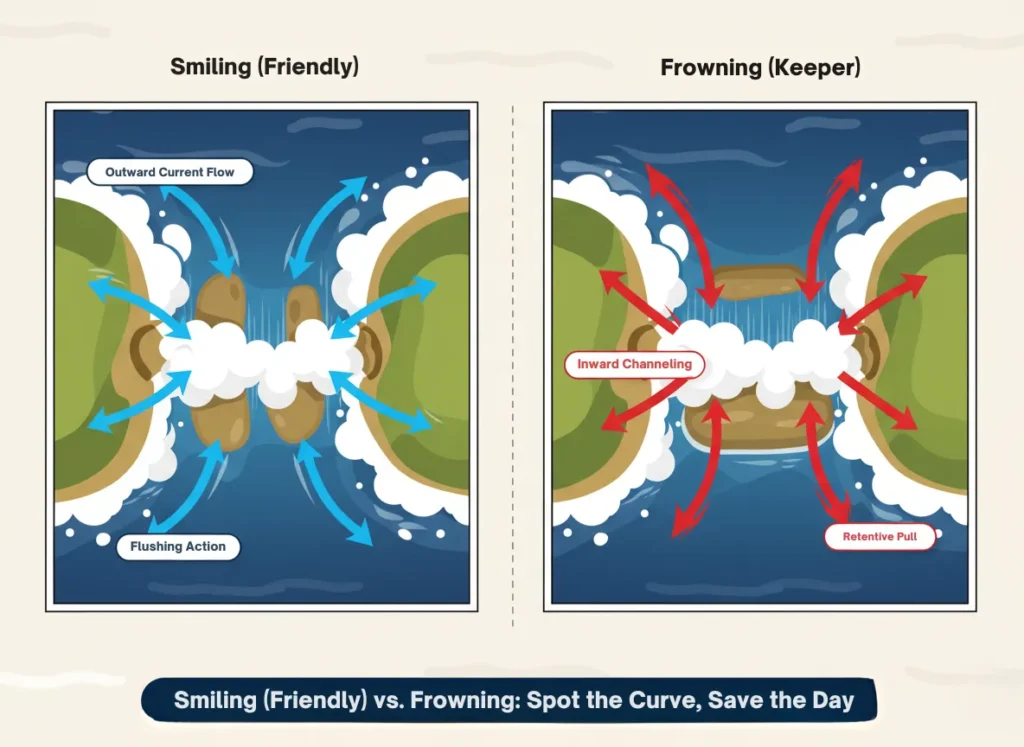
The Smiling Hole (Friendly) is a hydraulic where the outer edges of the foam pile curve downstream, resembling a smile when viewed from upstream. Its hydrology reflects its shape: the currents “feed OUT” toward the sides. This current flushing action actively pushes a boat or swimmer out of the hole. These are often formed by single, rounded boulders and can be considered “playable” features or pleasure holes for surfing, with appropriate caution.
The Frowning Hole (Keeper) is the opposite. It’s a retentive hole where the outer edges curve upstream, resembling a frown. Its dangerous hydrology pushes everything back into the center of the hydraulic, making escape extremely difficult. A horseshoe shape is an especially aggressive variation. The infamous “Evil Nasty Hole” (also called Unemployment Hole) on the Dead River in The Forks, Maine, is a classic frowning keeper that transforms into a nasty keeper hydraulic at Class IV-V flows above 5500 cfs. This differentiation is not academic; it is a crucial survival skill for quickly assessing the immediate threat level of a hydraulic. For a deeper guide to decoding river features, and an introduction to swiftwater rescue concepts, recognizing these shapes is step one.
Why are Low-Head Dams Considered the Most Dangerous Hydraulics?
While nature creates dangerous frowning holes, the most perfectly inescapable hydraulics are tragically man-made. A Low-Head Dam is often called a “drowning machine” for good reason. It is a man-made, “perfect” hydraulic, where the danger comes from its perfectly uniform shape, extending from one river bank to the other. Natural ledge holes, like the notorious bad holes at Woodall Shoals on the Chattooga River, are often “imperfect,” with weaker spots. Because of a low-head dam’s uniformity, there is no escape to the side. The backwash is consistent and inescapable along its entire length, often collecting dangerous debris presence and flanked by powerful feeder eddies.
The statistics are grim. According to one study, there were 149 reported deaths at low-head dams in the US between 2018-2021. A Brigham Young University-led inventory has identified over 13,000 of these structures across the country. The only exit for a swimmer trapped in one is the terrifying and counter-intuitive “swim down” maneuver to find the outflow current. The ultimate skill for this hazard, therefore, is avoidance. Pre-trip planning, checking maps, and consulting resources like the US Army Corps of Engineers (USACE) for known dam locations are paramount. USACE provides definitive information on man-made river structures and their associated dangers, including federal requirements for recreational boats in their vicinity. You now have the knowledge to see and classify the threat. The next step is to build the muscle memory for how your team must react, both offensively and defensively.
Hydraulic Threat Identification Matrix
Visual Shape (From Upstream)
Edges curve downstream
Hydrology (Exit Path)
Feeds to the sides (Flushing)
Rafter’s Action
Playable (with caution)
Visual Shape (From Upstream)
Edges curve upstream
Hydrology (Exit Path)
Feeds to the center (Retentive)
Rafter’s Action
Punch or Avoid
Visual Shape (From Upstream)
Uniform, flat horizon line
Hydrology (Exit Path)
No side exit (Terminal)
Rafter’s Action
Portage – Do Not Run
What are the Coordinated Raft Protocols for Engaging Hydraulics?
Knowing what a hydraulic is and how to spot it is the first half of the battle. The second half is execution. This section delivers the specific, coordinated, in-boat team maneuvers required to mitigate hydraulic encounters. These raft-specific drills are not suggestions; they are protocols drilled into every professional guide until they become pure instinct.
What is the Offensive Protocol for “Punching” a Hole?
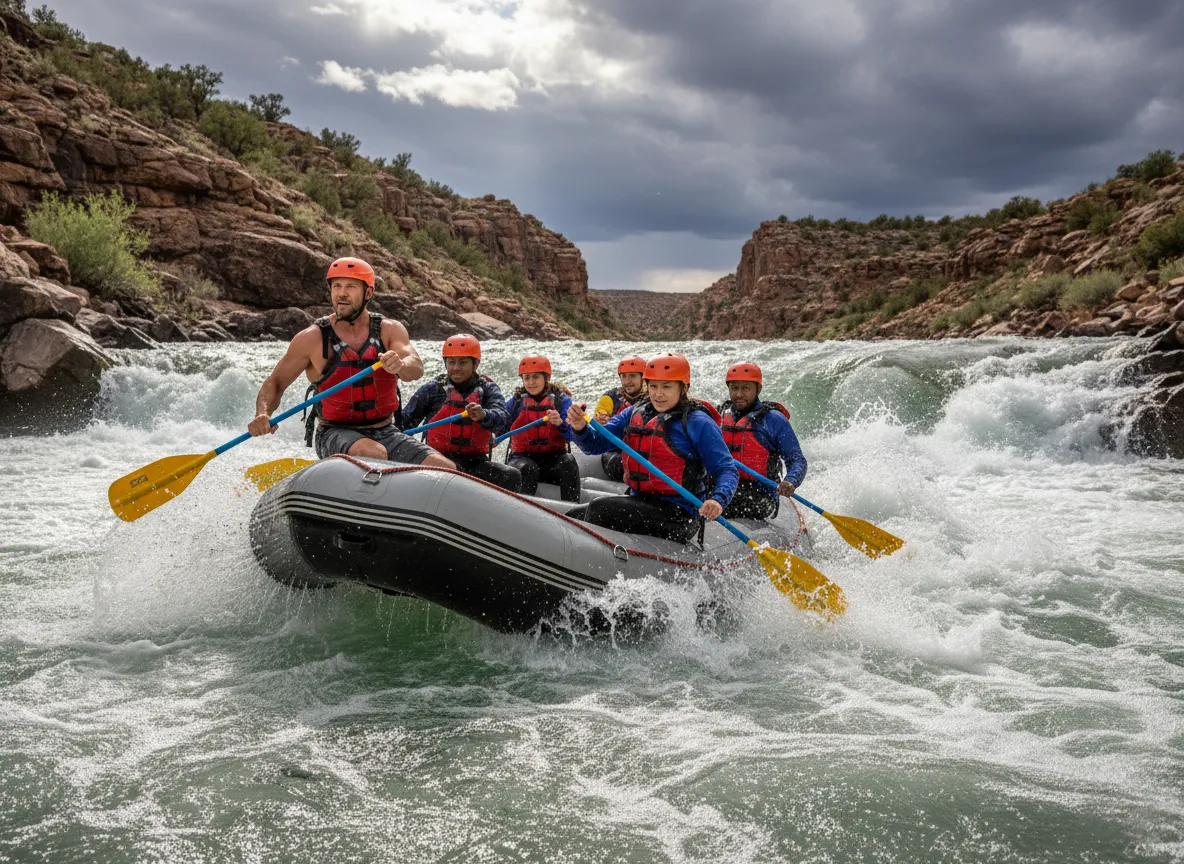
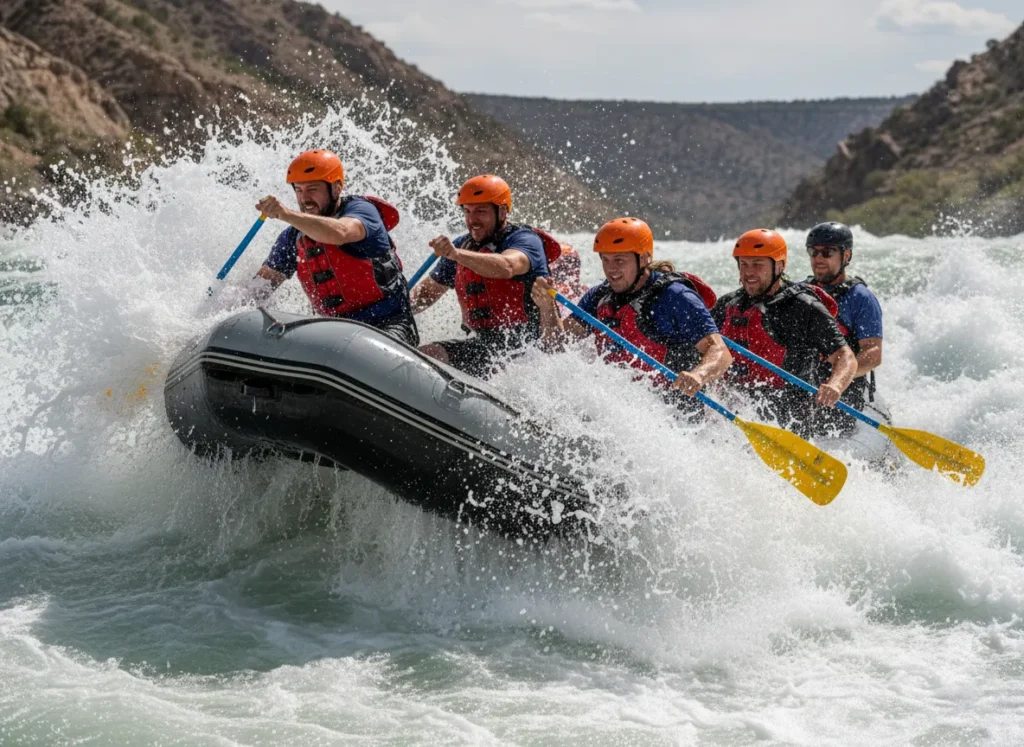
This is an offensive action for unavoidable but not terminal keepers, often called “stoppers” or wave holes. The goal is simple: use overwhelming, perpendicular momentum to pierce the backwash and “punch” a hole, crossing the boil line. The drill has four critical steps. First is Alignment: the guide must square the raft up perfectly perpendicular to the foam pile. A glancing or angled approach will fail, causing the raft to be turned sideways and trapped. Second is Momentum: the crew paddles hard and in unison to build maximum speed approaching the hole.
The final two steps happen in a flash. Third is the Command. Just before impact, the guide calls a clear, powerful “All Forward!” This signals a final, coordinated, explosive burst of power from the entire team. Fourth is the Technique. On that command, the crew executes an “Aggressive Forward Lean” to put weight on the bow and keep it from rising up. They dig their paddle blades deep to find the solid “green water” beneath the aerated foam on the surface. Punching a hole is a coordinated, full-team effort that requires absolute timing and commitment to succeed. While The NPS Swiftwater Rescue Manual provides the broad safety context for hazard response, you must Master Speed, Angle & Power to Punch Through as a specific, drilled maneuver.
What is the Defensive “High-Side” Command and How Does it Prevent a Flip?
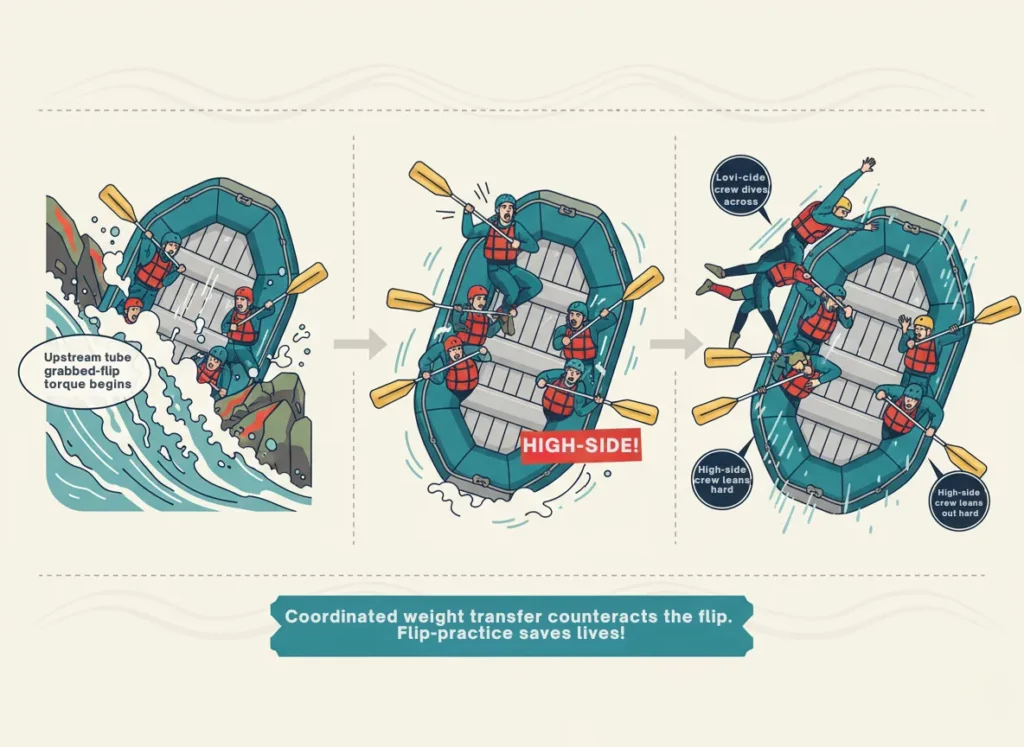
Punching is the plan when you see it coming. But sometimes the river surprises you, demanding a last-second defensive reaction to prevent a disaster. This is the high-side. The situation is always the same: the raft is caught sideways in a hydraulic or pinned against an undercut rock. The Threat is the upstream tube being grabbed by the current, which starts to pull it under, tilting the boat. The physics require an immediate, aggressive shift of the crew’s body weight to counteract this flipping “torque.” The guide’s Command must be an instantaneous, loud “High-Side!”
The Action is a coordinated ballet of survival. Paddlers on the low (upstream) side—the side being pulled down—must immediately leave their seats and dive across the raft toward the high side. Paddlers already on the high (downstream) side must throw their body weight hard onto that tube, leaning out aggressively. The Result of this combined weight transfer is that it counteracts the flip. Often, this results in a “tube stand” where the raft rears up vertically but then settles back down, saving the crew from a swim. The high-side is perhaps the single most important coordinated safety drill in rafting. It requires an immediate, instinctual response from the entire crew. It is a core tenet of preventing capsizes, as outlined in The American Whitewater Safety Code, and deserves dedicated practice. You can find A Tactical Guide to the High-Side Command for an in-depth breakdown of its physics and execution.
Pro-Tip: Don’t wait for a real emergency to practice a high-side. In a calm pool, have your crew practice the command. Have two people lean on one tube to simulate the “threat” and have the rest of the crew react. Building this muscle memory in a controlled environment is what makes it instinctual in chaos.
What is the Protocol for Emergency Rescue and Recovery?
These in-boat drills are your primary lines of defense. But if they fail, the situation shifts from mitigation to pure rescue. This final section covers the essential out-of-boat group rescue protocols for self-rescue and team-based recovery of swimmers and equipment.
What is the Counter-Intuitive Self-Rescue Technique for a Swimmer?
The trap for a swimmer is the same as for a boat: the surface-level backwash will hold you indefinitely if you try to fight it and stay on the surface. Fighting wastes precious energy and oxygen, and a long recirculation time can be fatal. As cited by the American Whitewater Safety Code, there is only one way to escape a hydraulic: the counter-intuitive move to “actively swim DOWN toward the river bottom.” This feels wrong, but it is the only way to escape the surface trap. A swimmer must take a deep breath, curl into a ball to become less buoyant, and actively pull themselves downward.
The physics behind this move are your lifeline. This action allows the swimmer to escape the surface-level recirculation and “catch” the deeper, flushing Outflow current. This powerful, laminar current will then carry them under the backwash and past the boil line. Once past that line, they can relax and allow their PFD’s buoyancy to bring them to the surface in safer, downstream-flowing water. The principle of trained, non-intuitive responses is a core component of water survival, echoed in resources like Air Force water survival training. Before attempting such a maneuver, a swimmer must first master the difference between defensive vs. aggressive swim positions in standard whitewater.
How Should a Team Rescue a Swimmer or Pinned Raft?
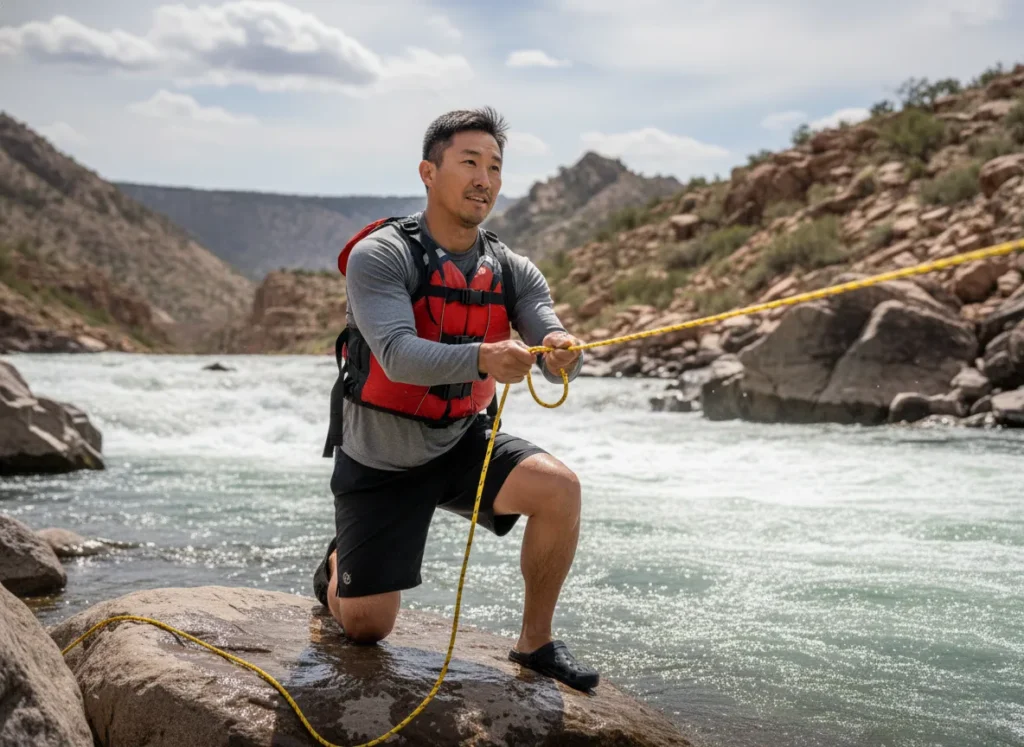
A swimmer’s ability to self-rescue is paramount, but a prepared team should always be ready to provide assistance. For a swimmer recirculating in a hole, a standard throw bag rescue is extremely dangerous. The excess rope will be sucked into the recirculation and can entangle the victim. The correct and safer rescue rope use is the expert technique known as the “Handful Method.” The rescuer holds onto the bag and throws just a “handful” of loose rope toward the swimmer. This minimizes rope in the water, reducing entanglement risk, and is effective because the swimmer is a predictable, stationary target.
The problem of a pinned or wrapped raft, especially against an undercut rock or bedrock wall, is one of brute force. The immense power of the water makes a simple pull impossible. The solution is a 3:1 “Z-Drag” Mechanical Advantage (MA) system, which triples the pulling force. This is a technical rescue requiring a dedicated kit of static rope, pulleys, prusiks, carabiners, and webbing. The primary rule of all rescue is: “Don’t become a second victim.” These are advanced techniques that require training, and their principles are corroborated by official guides like Pennsylvania’s Water Rescue and Emergency Response manual. Mastering these rescue skills represents the peak of a rafter’s responsibility, but they are skills you hope to never use. The Z-Drag rescue system is an expert-level solution, and the true goal is to build a foundation of knowledge that makes it unnecessary.
Conclusion
A keeper hydraulic is a predictable feature of fluid dynamics, defined by its powerful upstream-flowing Backwash, turbulent Boil Line, and subsurface Outflow current. Rafters can triage threats by reading visual cues like “frowning” shapes (retentive) versus “smiling” shapes (flushing) and giving special deference to man-made low-head dams, the most dangerous hydraulic type. The primary defense for a raft crew is mastering coordinated, in-boat drills like the offensive “Punch” and the defensive “High-Side” to prevent entrapment or capsizing.
True safety is built on a “Pyramid of Safety”: Knowledge is the base, followed by Avoidance, In-Boat Mitigation, Self-Rescue, and finally, Team Rescue at the peak. The goal is to master the lower layers so the higher-risk layers are never needed. The river speaks a language of physics and flow. Continue learning to read it by exploring our full library of river safety and navigation guides.
Frequently Asked Questions about Keeper Hole Hydraulics
What is a keeper hole in whitewater?
A keeper hole is a very powerful and retentive river hydraulic, sometimes called a backroller or stopper. Its recirculating current is so strong, and its recirculation time so long, that it doesn’t easily release boats, swimmers, or debris. It is defined by its extreme retentiveness and is considered one of the most significant hazards in whitewater.
How do you escape a hydraulic if you are swimming?
The primary escape technique is to not fight the surface current, but to take a breath and actively swim down towards the river bottom. This allows you to escape the surface recirculation and catch the powerful, downstream-flowing outflow current that will carry you out past the boil line.
What’s the difference between a smiling and a frowning hole?
A smiling hole is less dangerous because its edges curve downstream, creating currents that flush a boat or swimmer out to the sides. A frowning hole is much more dangerous because its edges curve upstream, creating currents that push everything back into the center of the hydraulic, making it very difficult to escape.
Why are low-head dams dangerous?
Low-head dams are called drowning machines because they create a perfectly uniform, river-wide hydraulic with no weak spots or side exits. Unlike natural, irregular holes, their predictable and inescapable shape makes them the most statistically lethal type of keeper hydraulic.
Risk Disclaimer: Whitewater rafting, kayaking, and all related river sports are inherently dangerous activities that can result in serious injury, drowning, or death. The information provided on Rafting Escapes is for educational and informational purposes only. While we strive for accuracy, the information, techniques, and safety advice presented on this website are not a substitute for professional guide services, hands-on swiftwater rescue training, or your own critical judgment. River conditions, including water levels, currents, and hazards like strainers or undercut rocks, change constantly and can differ dramatically from what is described on this site. Never attempt to navigate a river beyond your certified skill level and always wear appropriate safety gear, including a personal flotation device (PFD) and helmet. We strongly advise rafting with a licensed professional guide. By using this website, you agree that you are solely responsible for your own safety. Any reliance you place on our content is strictly at your own risk, and you assume all liability for your actions and decisions on the water. Rafting Escapes and its authors will not be held liable for any injury, damage, or loss sustained in connection with the use of the information herein.
Affiliate Disclosure: We are a participant in the Amazon Services LLC Associates Program, an affiliate advertising program designed to provide a means for us to earn advertising fees by advertising and linking to Amazon.com. As an Amazon Associate, we earn from qualifying purchases. We also participate in other affiliate programs and may receive a commission on products purchased through our links, at no extra cost to you. Additional terms are found in the terms of service.