


In this article
The rhythmic splash and pull of oars can feel like a perfect dance with the river, a seamless transfer of power where your will becomes the boat’s command. But when one oar feels heavier, your turns are sluggish, and your shoulders ache after only a few miles, that dance becomes a fight. This fight isn’t about strength; it’s about physics and achieving optimal weight distribution. True competence on the water comes from turning theoretical knowledge into practical, confident action. This guide moves beyond simple adjustments and deconstructs “balance” into a unified system of three distinct pillars, transforming your oar rig from a source of frustration into a responsive, efficient, and high-performance extension of yourself.
By the end of this guide, you will understand that a balanced oar rig is an equilibrium between Boat Balance (the raft’s handling), Rig Balance (the rower’s ergonomics), and Oar Balance (the oar’s physical properties). You will learn why, for over 160 years, experts have converged on an optimal leverage ratio of approximately 28-29% inboard, and how to calculate it for your specific setup. Most importantly, you will discover how a properly tuned oar rig is your most critical piece of proactive safety equipment, a key to injury prevention that reduces fatigue and gives you the control needed to navigate challenging water. We will follow a field-tested workflow for oar rigging, ensuring each pillar is established correctly before moving to the next.
Why is a “Balanced Rig” a System, Not a Single Fix?
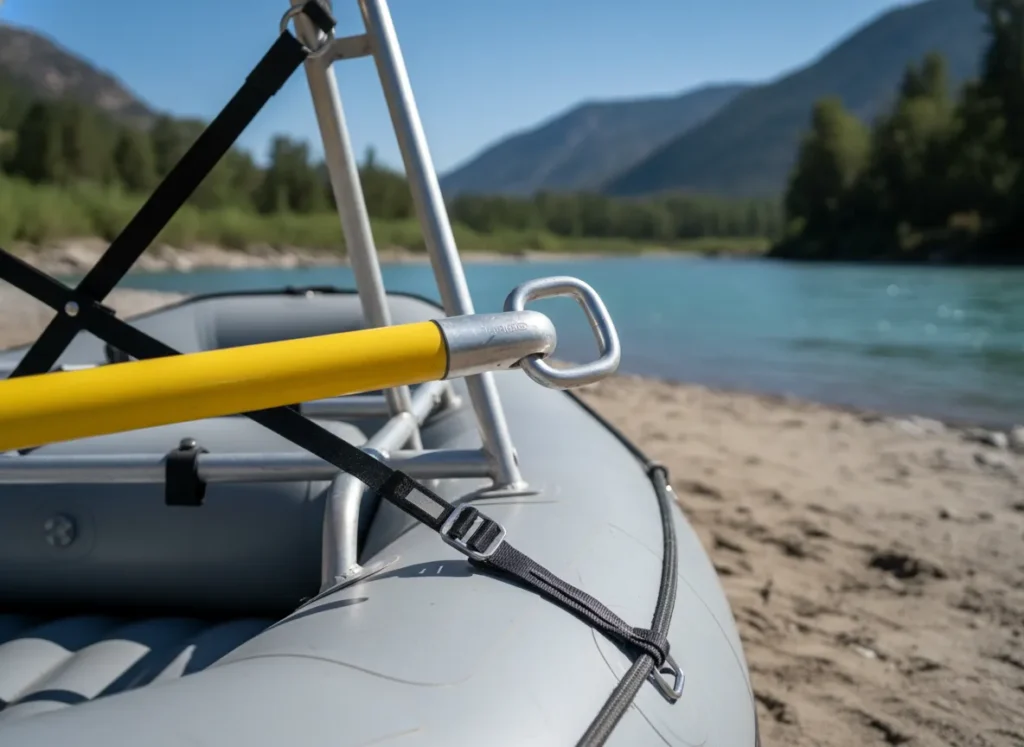
On the river, everything is connected. The way your raft pivots in an eddy, the way your back feels after a long day, the efficiency of your stroke—it all originates from a single source: the balance of your oar rig. Thinking of “balance” as a single problem is like trying to fix a car that won’t start by only checking the gas. The issue could be fuel, spark, or air. Similarly, a poorly performing rig isn’t just “unbalanced”; it has a specific issue within a larger system. “Balance” is a dynamic equilibrium achieved by mastering three interconnected pillars, not by making one isolated adjustment.
What are the Three Pillars of a Balanced Oar Rig?
These three pillars represent a logical flow of force, from the boat’s interaction with the water to your hands on the oar grips. They are not a checklist but a kinetic chain. A failure in one pillar cascades and creates symptoms that are often misdiagnosed as problems in another. For example, poor ergonomics in Pillar 2 can create a sensation of the oars being excessively blade heavy, a problem you might mistakenly try to fix with counterweights in Pillar 3.
A professional rafter tunes the system in a specific sequence. Boat Balance must be established first, followed by Rig Balance. Oar Balance is the final, and often optional, fine-tuning step. This logical order of operations is the key to moving from subjective feelings like “it feels heavy” to objective diagnostics. It allows you to ask the right questions: Is the raft sluggish (Pillar 1), is my leverage poor (Pillar 2), or is the oar itself fatiguing on the recovery (Pillar 3)?
- Pillar 1: Boat Balance (The Dynamic Foundation): This is the macro-level handling of the raft itself. It’s the platform upon which everything else is built. Boat Balance is determined by frame placement over the raft’s natural pivot point and the strategic distribution of weight (gear, passengers). Get this wrong, and you’ll be fighting the boat before you even take a stroke.
- Pillar 2: Rig Balance (The Ergonomic Engine): This pillar governs the geometric relationship between you—the rower—and the rig’s components. It’s the engine that translates your body’s power into the water. This includes oar length, tower height, and seat position. A proper setup, whether with a composite oar shaft or traditional wood, utilizes long shafts for leverage and a rowing technique that incorporates torso twist, a powerful leg push from a foot bar, and full arm extension.
- Pillar 3: Oar Balance (The Physical Interface): This refers to the static oar balance of the oar itself as it rests in the oarlock. It directly addresses the inherent blade-heavy nature of standard, non-balanced oars, with the goal being to achieve neutral balance. While often considered a matter of comfort, it has significant implications for endurance and safety.
Understanding this system is more than just a setup preference; it’s a core principle of the ‘rig-to-flip’ philosophy, which connects the concept of a balanced system to the overarching safety philosophy of rigging a raft to withstand catastrophic events. With this system in mind, our first step is to establish the foundation upon which everything else is built: the balance of the boat on the water.
How Does Frame Placement Affect Boat Balance and “Swing Weight”?
Every raft or drift boat has a natural pivot point, typically its geometric center. For optimal turning efficiency and responsiveness, the oar towers of your raft rowing frame—the fulcrum of your entire rowing system—must be positioned directly over this point. Misalignment is the most common and most detrimental error in rigging. Placing the oar frame too far forward or aft of the pivot point dramatically increases the raft’s swing weight. This term doesn’t refer to the raft’s total mass but to its rotational inertia. It’s about how that mass is distributed relative to the pivot point. Think of the difference between spinning a dumbbell held close to your chest versus holding it at arm’s length. The weight is the same, but the effort required to start and stop the spin is vastly different.
A high swing weight transforms a craft’s handling from nimble to sluggish, whether you’re rowing a small Phatcat or a fully-loaded NRS Otter. It makes pivots feel unresponsive and physically demanding, forcing you to expend significantly more energy to initiate or stop a turn, or even to use one oar as a rudder effectively for fine-tuned boat control. This is not only inefficient but also dangerous in technical water where quick maneuvers are critical. A correctly centered frame minimizes swing weight, making your boat feel lighter and more responsive. This is essential for executing an efficient pivot turn. Once the frame is centered, you can use strategic weight distribution as a tool. This is where trick loading gear comes into play. For shallow rocky rivers, a centered load of heavy gear and passengers aids maneuverability. Conversely, on high volume rivers, concentrating weight heavily in the bow helps the raft maintain momentum and push for waves or hydraulics.
Pro-Tip: To find your raft’s geometric center quickly, run two cam straps diagonally from corner to corner, creating an “X” across the boat. The point where the straps cross is the center. Mark it with a grease pencil for easy reference when placing your frame.
How Do You Calculate the Optimal Oar Length and Leverage?
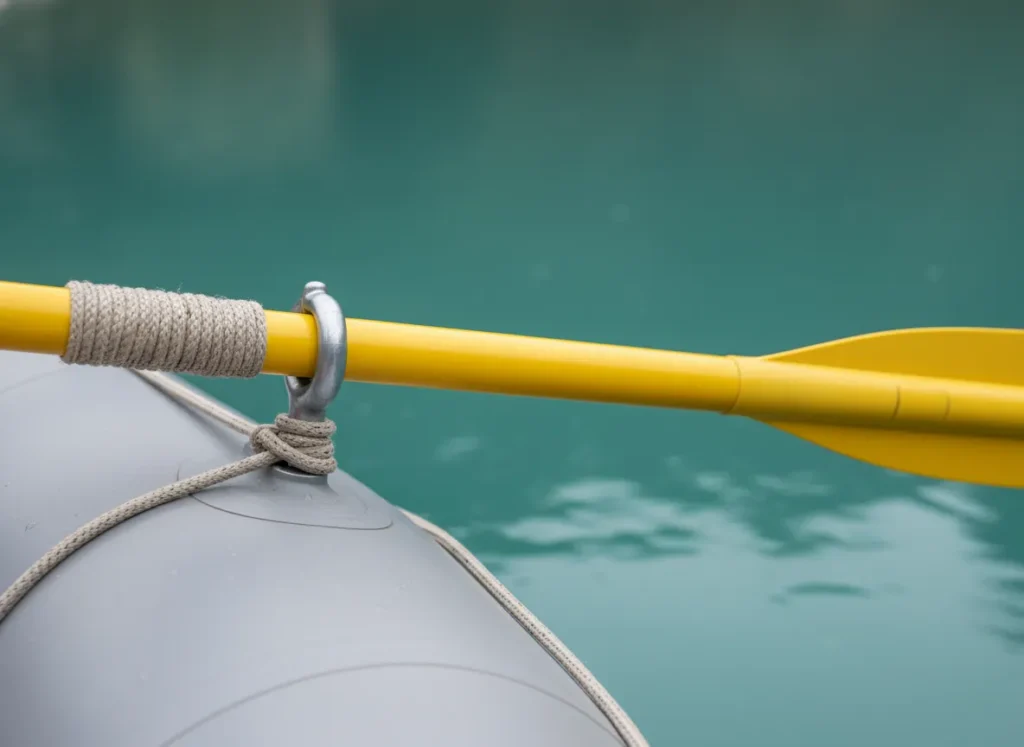
With the raft’s foundation established, we can now build the engine that powers it. This section dives deep into the physics and established formulas of Rig Balance (Pillar 2), providing a clear, evidence-based methodology for selecting the most important variable in the entire system: oar length. This single measurement dictates the geometry of your stroke, your power, comfort, and safety.
What is the Difference Between Inboard, Outboard, and Span?
Before we can use any formulas, we need to speak the language of leverage. These three terms are the foundation of oar rig geometry.
- Span (or Spread): This is the foundational measurement. It is the horizontal distance between the centers of your two oarlocks. All other calculations are derived from this.
- Inboard: This is the length of the oar from the handle to the oarlock. This segment, often a composite tube or wood with a tapered shaft for better flex, acts as your lever arm; it determines your mechanical advantage. A longer inboard gives you more leverage but requires a wider sweep of the handles.
- Outboard: This is the length of the oar from the oarlock to the tip of the blade. This segment determines the oar’s “gearing” and the arc of the stroke. A longer outboard moves more water but requires more force.
The relationship between the inboard and outboard length creates the leverage ratio. A shorter inboard relative to the outboard means higher “gearing”—you get more blade movement for less handle movement, but it requires significantly more force. Critically, the inboard length also dictates the spacing between your oar handles, which should ideally be about a fist width between handles. An incorrect setting forces you into poor biomechanics, leading to a weak, inefficient, and potentially injurious position. This is why oar length is the prime variable: it dictates this entire geometric and ergonomic system, affecting power, comfort, and control. These principles aren’t just river-guide wisdom; they are grounded in science, as documented in studies on The biomechanics of the rowing stroke from sources like the National Center for Biotechnology Information. Understanding the biomechanics of a whitewater oar stroke connects the ‘what’ (leverage terms) with the ‘how’ (body mechanics).
Which Oar Length Formula is Most Effective?
For decades, riggers have used various formulas to find the ideal oar length. While they seem different, they are all attempts to solve the same geometric puzzle: achieving the optimal leverage ratio for everything from traditional wooden oars to modern composite models like Sawyer Squaretops, Cataracts, or even Carlisle outfitter oars.
- The “Rule of Thirds” (Novice Rule): A common starting point is Total Length = (Span / 2) * 3. This produces a simple 1:2 leverage ratio, where the outboard is twice the length of the inboard. This results in an inboard length that is 33.3% of the total oar length. It’s simple, but generally considered less efficient by modern standards.
- The NRS “Modified Thirds” Formula: A smart ergonomic adjustment to the novice rule is Total Length = ((Span / 2) – 2″) * 3. That “- 2 inches” is a deliberate calculation to shorten the inboard slightly, creating a 4-inch gap between the handles for a more powerful and comfortable chest position.
- The 1.63 Multiplier (Modern Expert Oar Length Formula): The most direct and refined method is a simple mathematical shortcut: Total Oar Length = Oarlock Span (oarlock distance) * 1.63. This formula is specifically designed to achieve a precise 11:27 leverage ratio, which has become the gold standard.
To validate this modern approach, we can look back. The Shaw & Tenney 1858 formula, one of the oldest on record, produces a 7:18 leverage ratio. Let’s analyze the results: The novice rule suggests 33.3% inboard. The historical expert formula from 1858 results in 28.0% inboard. The modern expert formula results in 28.9% inboard. The takeaway is clear: for over 160 years, expert riggers have independently converged on the same optimal leverage ratio of approximately 28-29% inboard. The 1.63x Multiplier is the easiest and most reliable modern way to calculate this. Formulas provide a baseline, but the “art” of rigging lies in adjustments that fine-tune that baseline for the unique variables of the rower, the rig, and the river when you are setting up your oar frame correctly.
Oar Length Formula Showdown
Compare oar length calculations across different methods for various oarlock spans.
Rule of Thirds
33.3% Inboard60″ Span: 90″ (7.5 ft) / 30.0″ Inboard
66″ Span: 99″ (8.25 ft) / 33.0″ Inboard
72″ Span: 108″ (9.0 ft) / 36.0″ Inboard
1.63 Multiplier
28.9% Inboard60″ Span: 97.8″ (8.15 ft) / 28.3″ Inboard
66″ Span: 107.6″ (8.96 ft) / 31.1″ Inboard
72″ Span: 117.4″ (9.78 ft) / 33.9″ Inboard
Shaw & Tenney
28.0% Inboard60″ Span: 100.0″ (8.33 ft) / 28.0″ Inboard
66″ Span: 107.1″ (8.92 ft) / 30.0″ Inboard
72″ Span: 114.3″ (9.52 ft) / 32.0″ Inboard
How Do You Modify the Baseline for Rower and Raft Geometry?
The oar length formula gives you a mathematically perfect starting point, but you are not a robot and your boat is not a static object. You must fine-tune for three key variables: the rower, the raft, and the water.
The rower’s physiology and ergonomics are paramount. Taller rowers with longer arm spans may require slightly longer oars to maintain a powerful stroke arc. Conversely, shorter rowers will need a shorter setup. Rower strength is also a factor, as long oars (with more outboard) feel “heavier” to pull. Just as important is seat height. This critical, often-overlooked variable changes the entire geometry. A higher seat position—sitting on a tall cooler versus a short dry box—requires long oars. The longer oar shafts are needed to allow the blade to be fully submerged while keeping the oar handles at the correct shoulder-height position during the power stroke.
Your oar’s construction also plays a role. An oar blade made of a heavier wood or composite blade material will feel different than an ultra-light one like a Dyne Lite blade. Some designs, like a Shoal Cut blade, are intended for shallow rocky rivers and have a different profile. The oar itself, whether it has a straight composite tube or a tapered shaft, affects flex and feel. While these details are secondary to proper oar length and frame position, they contribute to the final feel of your rig.
The raft’s geometry matters, too. A raft with larger diameter tubes (e.g., 26 inches) places the entire frame higher off the water than a raft with smaller tubes (e.g., 24 inches). This increased height, similar to a taller seat, also necessitates long oars to achieve the proper blade entry angle. Finally, consider the water type and load. Long oars provide more power and are favored for big water. Shorter oars are more nimble and are often preferred for technical rivers. An overloaded gear boat sits lower in the water and may require a shorter oar than the same boat with a light gear load.
Is Counterbalancing Oars an Effective Solution or a Dangerous Crutch?
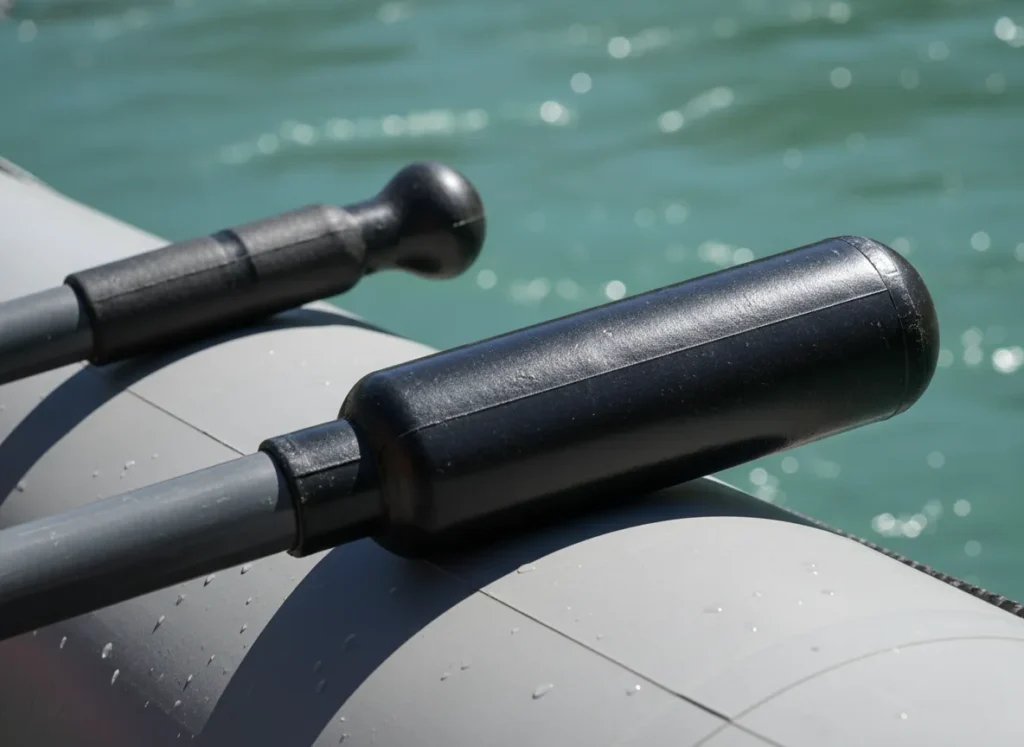
Having perfected the rig’s ergonomics, we can now address the final, and most debated, pillar: the physical balance of the oar itself. This section provides a balanced, expert-level analysis of counterbalanced oars (Pillar 3), weighing its pros against its significant efficiency and safety cons. The goal is to frame it as a situational tool for trip-specific adaptations, not a universal fix.
What is the Argument For Counterbalancing?
Standard, non-balanced oars are inherently blade-heavy. Their center of mass is located significantly outboard of the oarlock. This is a simple fact of physics. This reality forces the rower to expend muscular energy on every single recovery stroke simply to lift the oar blade out of the water. While the effort for one stroke is minuscule, over thousands of strokes on long multi-day trips with many long rowing days, this constant, subtle effort leads to significant and specific fatigue in the triceps and shoulders.
The goal of counter balanced oars is to achieve neutral balance. This is done when counterweights add weight to the handle end (e.g., 2.5 lbs of lead). A perfectly balanced oar will rest horizontally in the oarlock with no effort from the rower, feeling almost weightless in the hands during the recovery phase. This is the endurance solution, providing less arm strain for the rower. The benefit is a comfort factor that minimizes the downward force required on every stroke, resulting in less fatigue at the end of a long day, especially on flatwater stretches like the Westwater runout or during a Grand Canyon trip.
What are the Physics and Safety Arguments Against Counterbalancing?
While reducing fatigue sounds like a clear benefit, experts caution that counterbalancing often masks a deeper problem and introduces new, serious risks.
First is the “crutch” argument: an oar that feels excessively heavy is often a symptom of a Pillar 2 (Ergonomic) failure. If your oar length is wrong or your inboard setting is incorrect, the leverage will be poor, making the oar feel heavy. Using the added weight of counterweights to “fix” this is a critical error that fails to address the root cause of the inefficiency. Second is the physics argument: adding mass does not make the oar lighter; it makes it heavier. This added weight must be accelerated and decelerated during every stroke, requiring more total energy expenditure over the course of a day.
The safety arguments, however, are the most compelling. Added weight makes oars likely to sink if untethered during a flip, creating an expensive loss and a “leave no trace” violation. But the deal-breaker is the impact hazard. A loose, swinging oar is a primary weapon on a raft. A heavier, counterbalanced oar handle simply “will hit you harder,” posing a real injury risk like breaking jaw or teeth. This isn’t speculation. Multiple studies of whitewater rafting injuries have identified the face as the single most frequently injured body part, accounting for 33.3% of all injuries. The primary cause of these injuries is “collisions… being struck by… equipment.” Corroborating this with official Data on injuries in commercial whitewater rafting from sources like PubMed confirms the risk. A counterbalanced oar swinging in a chaotic rapid directly and dramatically increases the risk of the most common and serious types of rafting injuries.
Now that we’ve established the complete theoretical framework, let’s put it into practice with a step-by-step field guide.
What is the Step-by-Step Process for Rigging an Oar Frame?
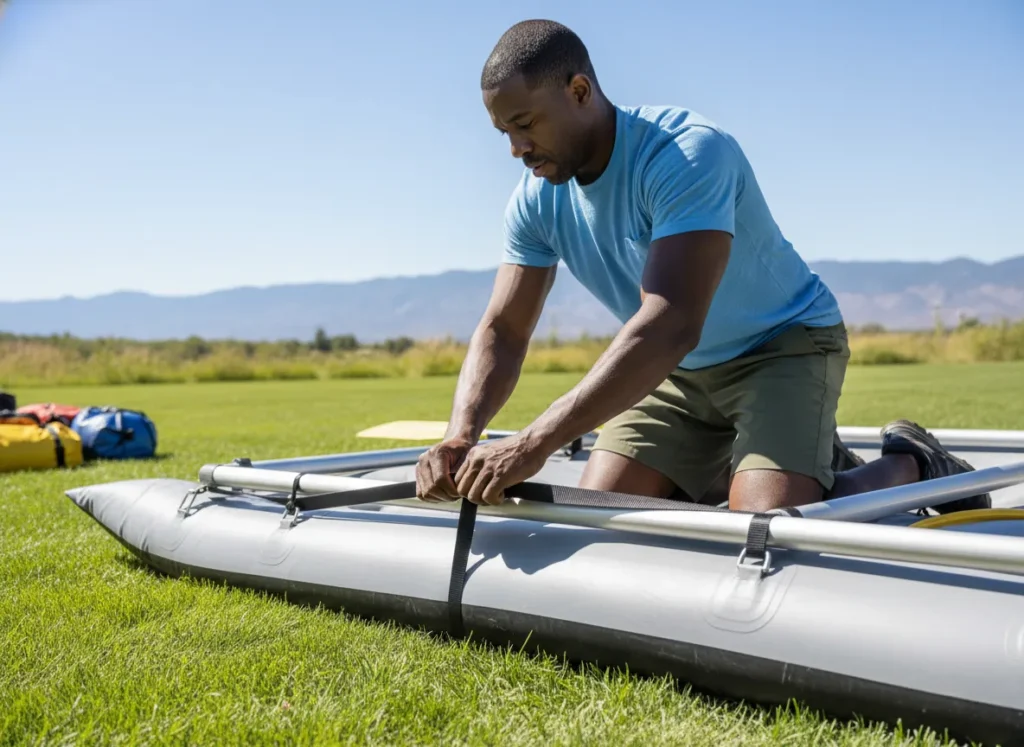
This section synthesizes all the principles we’ve discussed into a single, logical, and actionable workflow of setup steps. This is how to balance oars from the ground up, empowering you to apply your new knowledge in the field.
Step 1 & 2: How Do You Set the Frame and Oar Towers?
Step 1 Objective: Establish Boat Balance. The goal is to align the oar towers with the raft’s natural pivot point. On a fully inflated but unladen raft, find the geometric center. Position the frame so the oar towers are directly over this point. Secure the frame using at least four high-quality cam straps in an opposing, counter-tension pattern (e.g., front-left corner pulls to the back-right, front-right pulls to the back-left). This “locks” the frame in place and prevents it from shifting.
Step 2 Objective: Configure the Fulcrum’s Position. The goal is to set the vertical height and horizontal angle of the oarlocks to match the rower. For open oarlocks, ensure they are made of a malleable metal like brass, which can be slightly hammered for a secure fit around the oar sleeve. Some adjustable frames allow you to adjust oar towers to achieve a wider spread or tilt angle, which changes the pivot point for better balance. The tower height must be set relative to the seat height. The goal is a final handle position at the rower’s shoulder height during a power stroke, ensuring the oar shafts clear the knees. The tower angle is an ergonomic choice; angling the towers “in” slightly can feel more natural for some rowers, while straight up (90-degrees) provides a simple vertical pivot. Finally, perform a critical safety check: Ensure the base of the oarlock fitting is at least 1/4 inch above the raft’s tube material to prevent wear and abrasion. Depending on how different raft frame types affect this setup, the specific adjustments might vary, but the principle remains the same.
Pro-Tip: A quick field check for tower height is to sit in the rower’s seat with the oar in the oarlock. Hold the oar handle and extend it forward. At the end of your power stroke (handle near your chest), the handle should be roughly level with your shoulders. If it’s at your chin, your towers are too high; if it’s at your stomach, they’re too low.
Step 3 & 4: How Do You Dial in the Rower’s Cockpit and Inboard?
With the frame and towers locked in, the next step is to customize the rower’s cockpit for power and endurance.
Step 3 Objective: Set Rig Balance. This is about positioning the seat and foot brace to enable power generation from the legs and core. The fore-aft position of the seat is a matter of personal preference based on the rower’s reach. The foot bar, however, is a non-negotiable component that must be positioned to allow you to brace securely and push with your legs, the primary source of power in a rowing stroke.
Step 4 Objective: Set the Inboard. This final step fixes the oar’s inboard/outboard leverage ratio by correctly setting the oar stop (e.g., stopper, sleeve, or rope wrap). With the oars in the oarlocks, sit in the seat and pull the oars into the horizontal “at rest” position, with the oar blade feathered on the water’s surface and the handles pulled back towards your chest. Adjust the oar stops on the shaft. Continue adjustments until the oar handles are separated by “about four inches” or “a fist width between handles.” This “handle gap” is a critical metric. It validates that the oar length and inboard setting are correctly matched to you and your frame, allowing for a biomechanically powerful push from the chest and core. This ergonomic setup is what allows you to execute a powerful rafting forward stroke, engaging your legs and torso rather than just your arms.
Your rig is now a well-tuned hypothesis; the river will provide the final data needed to validate your setup.
Conclusion
A truly “balanced” oar rig is not a single setting but a system in equilibrium, requiring the logical tuning of Boat Balance, Rig Balance, and Oar Balance in that specific order. The most critical variable for performance and comfort is oar length, which should be based on the expert-validated leverage ratio of ~29% inboard, easily calculated with the Span * 1.63 oar length formula. Remember that counterbalancing is a situational tool for endurance on long, flatwater trips, not a fix for poor ergonomics, and it introduces significant inefficiency and safety risks—particularly the danger of facial impact, the most common injury in whitewater rafting.
Ultimately, proper oar rigging is proactive safety management. A responsive, efficient, and comfortable rig reduces fatigue, prevents injury, and gives you the power to control the craft with precision. It turns your rig from a potential hazard into a reliable partner.
Master these principles on flat water first, perhaps on a class 2 run where the stakes are low. Experiment, adjust, and feel the difference. Explore our full library of rigging and rowing guides to continue turning your knowledge into wilderness instinct.
Frequently Asked Questions about Balancing an Oar Rig
How do you balance oars on a raft?
You balance oars by tuning a three-part system:
- Boat Balance (centering the frame on the rafts pivot point),
- Rig Balance (setting the correct oar length and ergonomics for your body and boat),
- Oar Balance (optionally adding counterweights for specific situations).
What is the best oar length for a raft?
The best oar length is calculated to achieve an inboard length of approximately 28-29% of the total oar length. A reliable expert oar length formula is Total Oar Length = Oarlock Span * 1.63. This provides an excellent baseline that should then be adjusted for variables like rower height, seat height, and raft tube diameter.
Are counterbalanced oars worth it?
Counter balanced oars can be worthwhile for long, flatwater trips to reduce recovery-stroke fatigue, but they are generally not recommended for technical whitewater like class 3 and class 4 rivers. They add inefficiency to the stroke and pose a significant safety risk due to the increased mass at the handle, which can cause serious injury during a chaotic event. Always ensure your rigs ergonomics are perfect before considering counterweights.
What are oar rights and when should you use them?
Oar Rights are splined sleeves that fit over the oar shaft and sit in an open oarlock, fixing the blade angle to a fixed angle like a pins and clips system while still allowing the oar to be easily shipped (pulled in). They are critical safety tools on shallow rocky rivers, as they prevent an oar from rotation and getting wrapped on a rock, which can snap the oar or pin the raft.
Risk Disclaimer: Whitewater rafting, kayaking, and all related river sports are inherently dangerous activities that can result in serious injury, drowning, or death. The information provided on Rafting Escapes is for educational and informational purposes only. While we strive for accuracy, the information, techniques, and safety advice presented on this website are not a substitute for professional guide services, hands-on swiftwater rescue training, or your own critical judgment. River conditions, including water levels, currents, and hazards like strainers or undercut rocks, change constantly and can differ dramatically from what is described on this site. Never attempt to navigate a river beyond your certified skill level and always wear appropriate safety gear, including a personal flotation device (PFD) and helmet. We strongly advise rafting with a licensed professional guide. By using this website, you agree that you are solely responsible for your own safety. Any reliance you place on our content is strictly at your own risk, and you assume all liability for your actions and decisions on the water. Rafting Escapes and its authors will not be held liable for any injury, damage, or loss sustained in connection with the use of the information herein.
Affiliate Disclosure: We are a participant in the Amazon Services LLC Associates Program, an affiliate advertising program designed to provide a means for us to earn advertising fees by advertising and linking to Amazon.com. As an Amazon Associate, we earn from qualifying purchases. We also participate in other affiliate programs and may receive a commission on products purchased through our links, at no extra cost to you. Additional terms are found in the terms of service.