In this article
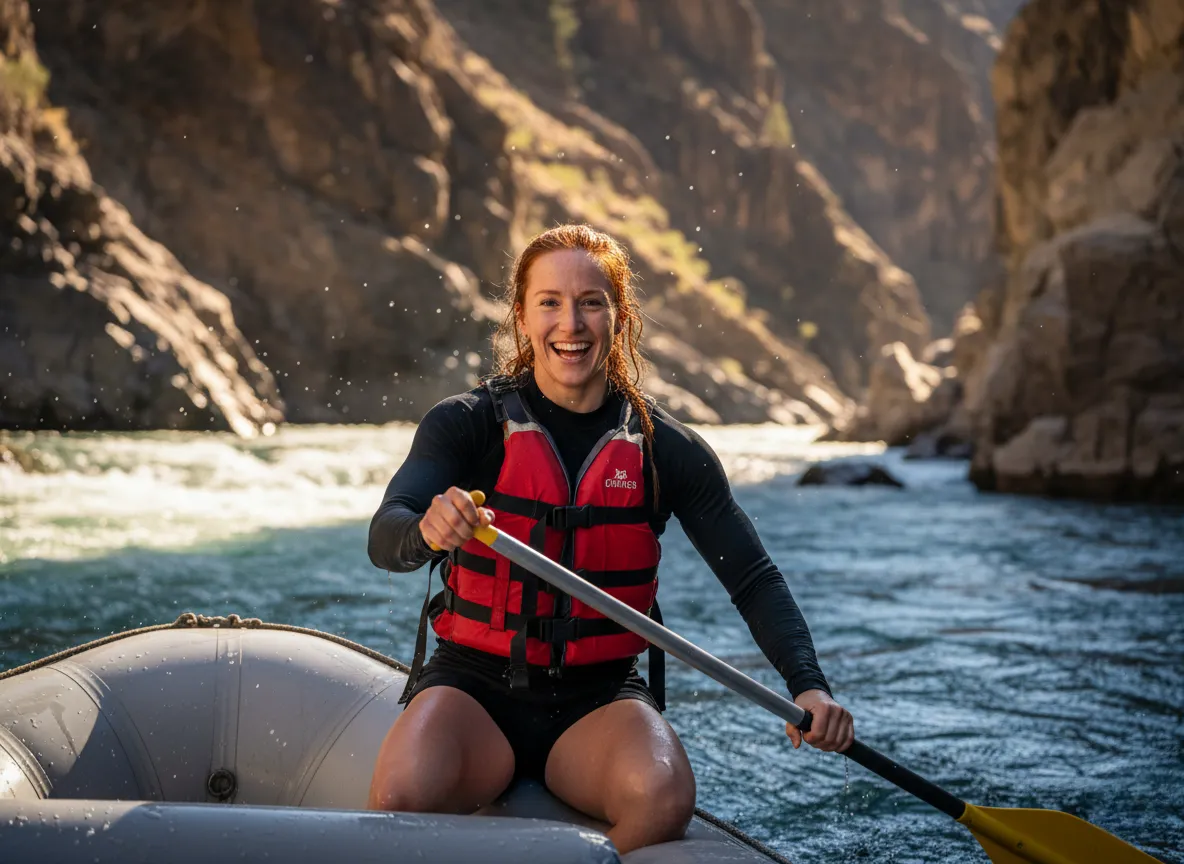
The moment the river’s roar quiets the outside world is a feeling you never forget. Ahead, the water gathers itself, a liquid muscle tensing before the explosion of a rapid. But it’s not just the thrill that calls you to this outdoor adventure on iconic whitewater rivers. It’s the quiet confidence of the women paddling beside you, a community forged in shared challenge and mutual support. This guide is built on that dual promise. It closes the gap between the hard, technical skills of whitewater rafting and the practical, women-specific logistics that are so often overlooked yet are fundamental to not just participating, but thriving on the river during multi-day trips. We will equip you with a complete path to mastery, self care, and personal growth.
This is your roadmap. You will learn to speak the river’s language, turning the chaos of a rapid into a clear, navigable path. You will master the woman’s toolkit, a system for gear, hygiene, and packing that integrates comfort and safety with a deep-seated Leave No Trace ethic. You will discover how to leverage technique over force, transforming your paddle stroke from a struggle into an efficient, powerful, and sustainable practice. And you will learn to navigate the culture of whitewater, finding empowerment by understanding our history and learning from the sport’s female pioneers.
Who Were the Female Pioneers of Whitewater?

To understand where we’re going, you need to know where we’ve been. The story of whitewater is often told through a male-dominated lens, but women in rafting have always been a central, driving force in this sport. By honoring these pioneers, we claim our rightful place in the narrative and frame this sport not as something we are breaking into, but as something we have always helped to build.
How did Georgie White change the sport of rafting?
Georgie White wasn’t just a participant; she was an inventor, an innovator whose vision shaped the very industry we know today. In 1952, she became the first woman to row the entire length of the Colorado River through the Grand Canyon, but her contribution goes far beyond that single, monumental achievement. Facing the challenge of running massive white water with the gear of the day, she innovated the “triple rig,” a revolutionary system of lashing three surplus military bridge pontoons together to create an incredibly stable, high-capacity platform.
This design, born from necessity and sheer ingenuity, fundamentally changed commercial rafting. The stability of the “G-Rig,” as it became known, made navigating the colossal rapids of the Grand Canyon significantly safer for passengers. It allowed for larger groups and more gear, making long, remote expeditions accessible to thousands of people who otherwise would never have seen the heart of those canyons. Her legacy isn’t just that of a “first”; it’s that of a foundational inventor who proved that success on the river is about grit and brilliant problem-solving, not gender. For a deeper look into her life, explore the technical legacy of Georgie White Clark.
Georgie White’s raw innovation opened the door, and in the decades that followed, women like Liz Hymans would walk through it, bringing technical precision to the most challenging rivers.
Why is Liz Hymans a significant figure in modern guiding?
If Georgie White was the sport’s foundational inventor, Liz Hymans was one of its master technicians. In the 1970s, she became one of the first women guides certified to guide the technically demanding Tuolumne River—a proving ground for the best boaters. Her career represented a critical shift from an era of brute-force innovation to one of refined skill and professionalism in guiding. Leading over 100 trips through the Grand Canyon, she established herself as an undisputed expert on one of the world’s premier whitewater destinations, operating at the highest level of the sport when a female guide was still a rarity.
Hymans’ success was a powerful demonstration that technical proficiency, precise river-reading, and calm leadership were the true measures of a guide. Her constant presence on the most challenging commercial runs helped normalize women in leadership roles, proving that a long-term, professional career was not only possible but attainable on a merit-based system. She became a role model for a new generation of female guides, and her story is a testament to the perseverance and skill required to earn respect and build a career in a field that was, at the time, overwhelmingly male. These pioneers navigated rivers using a shared, universal language of hydrology and risk. To follow in their wake, you must first learn to speak that language.
How Do You Speak the River’s Language?
Every river has a story to tell. It speaks in currents, waves, and eddies. Learning to understand this language is the first step toward competence and safety. This foundational lexicon defines what we do and provides the universal standard for classifying a river’s power, allowing us to make safe, informed decisions.
What is whitewater rafting, fundamentally?
At its core, whitewater rafting is the art of navigating a rapid with flowing water in a highly durable, inflatable vessel. We operate in dynamic, often high-consequence natural environments that are governed by the unforgiving principles of hydrology. Participation can range from being a passenger on a guided trip to being the guide responsible for every single maneuver in your own raft. It is an outdoor adventure defined by the constant need to read the water and react to river features—the waves, holes, and eddies that make up a rapid. For a deeper understanding of the core activity, see this deeper explanation of whitewater rafting.
Unlike flatwater paddling, this is fundamentally a team sport. It requires synchronized paddling and crystal-clear communication to move a heavy boat through a complex environment. Safety is paramount, built on a foundation of specialized equipment like PFDs and helmets, and a deep respect for the river’s power, as outlined in the official river and stream safety protocols. But it’s not just about adrenaline. It’s about skill acquisition, collaborative problem-solving, and forging a powerful connection with a wild, untamable place. The power of that environment is not uniform; it’s measured and classified by a global standard that every rafter must understand to make safe decisions.
How is river difficulty classified?
To travel safely, we need a universal map for risk. That map is the International Scale of River Difficulty, the non-negotiable standard created by American Whitewater to quantify a rapid’s severity. This scale uses six “Classes” (a river difficulty class from I to VI) to describe the severity of rapids. Class I is essentially flat, moving water with small waves and no real obstacles. Class II introduces “easy” rapids with clear channels, perfect for novices and often described as “splashy.”
The heart of commercial rafting lies in Class III and IV, which range from “intermediate” to “advanced” rapids requiring skilled maneuvering around powerful features on iconic whitewater rivers like the Salmon River or American River. Class V is “expert” territory—long, violent rapids with significant, unavoidable hazards that push the very limits of navigation. Class VI is considered unrunnable or extremely dangerous. This scale is the most crucial tool for your safety, allowing you to match your skill level and comfort to an appropriate trip. Understanding these river classification breakdowns translates abstract danger into a concrete set of expectations, which you can connect to understanding specific river hazards like strainers and hydraulics. You can review the definitive International Scale of River Difficulty directly from the source. With this language of classification in mind, you can begin to learn the grammar of the river itself—the visual cues that signal a safe path forward.
International Scale of River Difficulty
A guide to understanding river rapid classifications for whitewater adventures
River Environment & Features
Water moving downstream, riffles, or small waves.
Example Sensation & Experience
Calm, like a swimming hole. No training needed.
River Environment & Features
Easy rapids and waves requiring some maneuvering. Easy-to-miss obstacles.
Example Sensation & Experience
Perfect for young children and tentative adults.
River Environment & Features
Moderate difficulty with large waves and features requiring skilled maneuvering. Rocks and obstacles require moves.
Example Sensation & Experience
Fun, splashy rapids. Ability to swim recommended.
River Environment & Features
Difficult with powerful rapids and hazardous features requiring precise maneuvering.
Example Sensation & Experience
Fast, exciting, and requires an active paddle crew.
River Environment & Features
Very difficult with long rapids, strong turbulence, and frequent obstacles. Near the limits of navigation.
Example Sensation & Experience
A high-intensity experience for skilled groups only.
What Are the Core Skills for Navigating a Raft?
Knowing the language is one thing; speaking it is another. This is where we transition from theory to action. Mastering the essential skills to read the water, use your paddle effectively, and maneuver the raft as a team is how you become an active, confident participant on any trip.
How do you read the water to find the safest path?
“Reading water” is the single most important skill in rafting. It’s the practice of looking at a chaotic surface and seeing a clear path through it. The most important “safe” signal is the Downstream V, a V-shape on the water’s surface with the point aimed downstream. This indicates the deepest, clearest channel—your highway through the rapid. Conversely, an Upstream V, where the point aims upstream, indicates a submerged river obstacle like a rock that must be avoided. Dotted along the sides of the current are Eddies, pockets of calmer, often upstream-flowing water behind obstacles. These are your safe zones, crucial “rest stops” used to slow down, stop, or scout what lies ahead.
The turbulent seam between the downstream current and the upstream eddy is called an eddy line. Crossing it requires commitment and proper technique. The most dangerous features to identify are Hydraulics, or Holes. These form when water flows over a submerged object, creating a powerful, recirculating wave that can trap boats and people indefinitely. Recognizing these features allows you to create a “mental map” of the rapid before you even enter it, planning your route from one safe zone to the next. This skill is what separates a passive passenger from an active, competent paddler who contributes to the team’s safety. For a full breakdown, review a complete system for how to read a river.
Once you can see the path, you need the tools to follow it. That tool is your paddle, and using it correctly is a team sport.
What are the fundamental paddle strokes?
Effective paddling begins with a proper grip. One hand goes on the shaft, while the other covers the T-Grip at the top. This grip maximizes power and, crucially, prevents you from losing control of the paddle in turbulent water. The raft’s engine is driven by two primary crew commands: the Forward Stroke and the Back/Reverse Stroke. The Forward Stroke isn’t an arm exercise; it involves reaching forward, planting the blade fully in the water, and pulling back toward your hips by rotating your torso and using your powerful core muscles. The Back Stroke is the reverse motion, used to slow down, stop, or help turn the raft. You can focus on mastering the rafting forward stroke with our detailed guide.
Pro-Tip: Always keep the thumb of your T-grip hand pointed down, wrapping it around the grip with your fingers. This prevents the classic rookie mistake of holding it like a microphone. In a big hit, an improper grip can send the T-grip flying into your face or teeth. A secure grip is a safety essential.
While the crew provides the power, guides use more nuanced positioning strokes to steer. The Draw stroke pulls water towards the raft, moving it sideways. The Pry pushes water away from the raft, also for lateral movement. A Sweep stroke is a long, arcing motion used to turn the raft effectively. It is the perfect synchronization of these strokes as a team that allows a guide to maneuver a heavy, loaded raft through a complex rapid with precision. These individual strokes are like letters of the alphabet; learning to combine them into “words” and “sentences” is how you truly navigate.
How do you combine strokes to maneuver a raft?
Advanced boat handling isn’t about fighting the river; it’s about using your maneuvering techniques to work with the water’s features. The Ferry is a critical maneuver for moving the raft laterally across the current with minimal downstream travel. To execute it, the guide angles the raft relative to the current (typically 45 degrees), and the raft crew paddles forward just enough to hold that angle. The force of the current then pushes the boat sideways across the river. This technique is essential for reaching a specific point on the opposite shore or avoiding a hazard downstream. You can learn the fine points with these Pro techniques for raft ferrying.
The Eddy Turn is the maneuver for entering an eddy. It requires angling the raft toward the eddy line and paddling aggressively to punch through the turbulent barrier into the calm water. The Peel Out is the opposite: maneuvering to exit an eddy and re-enter the main downstream current. These two skills, often performed back-to-back, are the foundation of advanced boat control, allowing a team to stop, scout, and reposition at will. Mastering these techniques at training clinics represents the final transition from being a passenger to being a proficient, confident river guide.
Skillful maneuvering can prevent most problems, but on the river, you must always be prepared for when things go wrong.
How Do You Manage a Crisis on the River?
Confidence on the river isn’t about never being scared; it’s about knowing exactly what to do when things don’t go as planned. Building client trust in yourself and your team starts by directly addressing the “what-ifs.” Understanding common hazards, universal signals, and essential rescue protocols transforms fear into focused action.
What are the most common river hazards?
Some of the river’s most serious dangers are silent and can appear even on easy stretches of water. Strainers are obstructions like fallen trees that allow water to pass through but “strain” out larger objects like people and boats; they are extremely dangerous. Sieves are narrow channels between rocks too small for a person to pass through, creating a deadly trap. Undercut Rocks are insidious features where the current flows underneath the visible surface, creating an invisible, inescapable trap. Finally, Foot Entrapment occurs when a person tries to stand up in moving current and gets a foot wedged between rocks. The force of the water can easily hold you under. This is why the number one rule of swimming in a river is: never stand up in moving current.
These hazards are often independent of a rapid’s classification. The key to safety is identification and avoidance—your whitewater knowledge is your first and best line of defense. Unlike a hydraulic hole, which can sometimes be navigated, these are considered “terminal” hazards that must be avoided at all costs. Understanding these dangers is critical for strategic positioning for rapids and fosters a deep respect for the river. Because these hazards are often silent, a clear, non-verbal communication system is essential for safety.
What are the universal signals for river communication?
When the roar of a rapid makes shouting impossible, we rely on a set of universal signals. For Whistle Signals, one blast means “attention,” while three long blasts signify an emergency. For Hand/Paddle Signals, a paddle held horizontally means “Stop.” A paddle held vertically means “All Clear/Go.” Waving your arms or paddle signals “Help” or distress, and pointing with a single arm or paddle indicates the intended direction of travel.
This non-verbal language is crucial for communication between boats and with safety personnel on shore. The signals are designed to be simple, unambiguous, and easily visible from a distance. Every person on a trip should be familiar with these signals as part of the pre-launch safety briefing. This shared vocabulary is a foundational element of group safety and risk management. Check out this visual guide to universal river hand signals to see them in action. Knowing these signals is critical for when a crisis occurs, but the most important rescue is always the one you perform for yourself.
What should you do if you fall out of the raft?
If you find yourself in the water, your first move is automatic. Immediately get into the Defensive Swim Position, also known as the “Whitewater Swim Position.” Float on your back with your feet up and pointed downstream. It is absolutely critical to keep your toes out of the water to avoid foot entrapment. Arch your back for buoyancy and use your arms to scull and steer. This position allows you to breathe, see where you are going, and use your feet to fend off rocks.
If you need to get to shore or an eddy quickly, you must transition to the Aggressive/Offensive Swim Position. This involves flipping onto your stomach and swimming a strong front crawl, angling your body toward your target. You should only switch to aggressive swimming when the path is clear of hazards; switch back to the defensive position if you are approaching an obstacle. Knowing when to use each position is a critical self-rescue skill that transforms panic into purposeful action, as detailed in ACA’s safety and rescue handbook. You can learn more about the difference between defensive vs. aggressive swimming. Your personal rescue is the first priority, but rafting is a team sport, and you must also know how to help your crew recover from a major incident like a flip.
What Is the Essential Toolkit for a Woman Rafter?
True competence on the river means addressing every barrier to performance. For women, that includes the practical and logistical challenges that are too often dismissed as “comfort” issues. In reality, these are integral components of safety, performance, and environmental stewardship. Dialing in your packing list with eco-friendly products and quick-dry clothing is a non-negotiable step toward excellence.
What gear is essential for a woman’s safety and comfort?
The single most critical piece of gear you will ever own is your Personal Flotation Device (PFD). For women, a women’s-specific PFD is crucial, not optional. Unlike unisex models cut for a flat torso, women’s PFDs use sculpted foam and articulated panels to accommodate a bust and a typically shorter torso. This design ensures a secure, comfortable fit that won’t ride up to your chin in a swim—an ill-fitting PFD is a dangerous PFD. When it comes to clothing, the cardinal rule is “No Cotton.” Cotton absorbs water, loses all insulating value when wet, and can quickly lead to hypothermia. Stick to synthetics like a rash guard from a brand like Summersalt, or wool layers. Secure footwear like water shoes or outdoor sandals is also a must-have.
A proper layering system is key to managing your temperature. This includes a synthetic base layer (like a one-piece swimsuit or bikini), an insulating mid-layer (like a fleece), and a protective outer shell (a splash jacket). For cold water trips, a wetsuit (which traps a layer of water your body warms) or a dry suit (which keeps you completely dry) is required. Expert-cited PFDs like the Astral Layla are designed with these principles in mind, offering a secure, adaptable fit. Investing in properly fitting, gender-specific gear is a foundational step toward both safety and high performance. If you’re ready to find the right one, you can explore our guide on Which rafting PFD fits your style?.
Once your on-river apparel is sorted, the next challenge for multi-day trips is managing personal hygiene in a way that is both practical and environmentally responsible.
How do you manage hygiene and periods on a multi-day trip?
This is where personal care merges with Leave No Trace (LNT) ethics; managing your body in the backcountry is an act of stewardship. For urination, the Female Urination Device (FUD), or pee funnel, is a game-changing tool. It allows you to pee standing up discreetly, which is invaluable on a boat or on a rocky shoreline. For menstruation, the most recommended, zero-waste option is a menstrual cup or disc, which can be worn for up to 12 hours. Tampons are a secondary option, and some women opt for period panties or period swimsuits from brands like Knix, but traditional pads are not recommended as they quickly become wet and useless. All essentials should be kept in a dedicated dry bag.
Pro-Tip: Practice with your FUD at home in the shower several times before your trip. Getting the angle and seal right takes a bit of practice. Building that muscle memory at home will give you the confidence to use it quickly and cleanly when you’re on the river.
The LNT rules for hygiene are non-negotiable. For menstruation, all tampons, applicators, and biodegradable wipes must be packed out in a discrete “Flow Kit” or “Lady Packet.” As established by the LNT principles for human waste disposal, in many sensitive river corridors, the “dilution solution” is policy: urinate directly into the river’s main current to dilute it. When cleaning a menstrual cup, empty it into the camp toilet (the “groover”) and rinse it with clean drinking water and biodegradable soap—not silty river water, which can cause irritation. Framing these personal tasks within the LNT framework is a mark of an expert, respectful river runner. This same ethic applies to all human waste, and you can learn more about the systems used in our guide to Groovers & Wag-bags: How to Poop on a River Trip.
How Can Women Adapt Rafting Techniques for Peak Performance?
This is where we fill the primary content gap in whitewater instruction. Excelling in a historically male-taught sport isn’t about trying to match men’s physiology; it’s about leveraging our own. By linking female biomechanics with advanced technical skills, we reframe the conversation from “can women do it?” to “here is how women can do it smarter,” especially when facing the steep learning curve of whitewater sports.
How can you leverage female biomechanics for a more powerful paddle stroke?
The key to power on the water is to leverage technique over brute muscle. Women typically have a lower center of gravity, which is a significant advantage for balance and stability in the raft. True power in a paddle stroke should never come from the small muscles in your arms and shoulders; that is a fast path to fatigue and injury. The “High-Leverage” paddle stroke generates power from the largest muscle groups in your body: the legs, glutes, and core.
As validated by NIH research on paddling kinematics, true power comes from torso rotation and core engagement. Plant the paddle blade, and then unwind your torso to pull the raft past the paddle. Think of your arms and shoulders as a rigid, unbending frame that connects your powerful core to the paddle; they are not the primary engine. This technique is vastly more efficient and sustainable over a long day or a multi-day trip. By adapting paddle strokes to focus on biomechanics, a woman can generate equal or even greater power than a larger person using poor, arm-dominant technique. You can use The Paddling Strength Audit to build the functional strength needed to execute it. This principle of using leverage instead of strength is even more critical when facing one of the trickiest physical challenges: getting back into the raft from the water.
What are technique-based methods for re-entering and righting a raft?
Climbing back into a raft from the water can be notoriously difficult, but it relies far less on upper-body pull-up strength than on clever technique. The “Stirrup” Method involves using a loop of webbing, like a flip line or a cam strap, draped over the side of the raft as a step for your foot. This allows you to use your powerful leg muscles to boost yourself up. For the Partner-Assist “Knee-In” Method, a partner in the raft can grab your PFD shoulder straps while you get a knee onto the raft tube, then help leverage you in. These methods bypass the need for pure arm strength, making re-entry accessible to everyone.
Similarly, righting a flipped raft is a matter of physics, not force. The “Flip Line” Righting Technique is ideal for practicing flip drills. A flip line is a long piece of webbing attached to the raft. The rescuer throws the line over the overturned hull, stands on the tube, and leans back, using their body weight and leg power as a counter-lever. This technique allows a smaller person to right a heavy raft without relying on arm strength. Mastering these leverage-based rescues builds profound self-sufficiency and confidence on the water. You can learn these with our step-by-step guide to self-rescue techniques for getting back in a raft.
Developing this technical competence is the best way to navigate the cultural landscape of the rafting industry, where strength has often been unfairly prioritized over skill.
What is the Reality for Women in the Rafting Industry?
To chart our own course, we need an honest map of the terrain. The socio-cultural dynamics of the rafting world are complex. Acknowledging the documented gender-specific challenges is the first step toward navigating them, while highlighting the positive, empowering opportunities for community and career is how we move forward.
What are the cultural challenges and opportunities for women in rafting?
The whitewater industry has a documented history of a male-dominated industry and a “cowboy culture.” This has presented real challenges for women, including sexism, misogyny, and having to repeatedly “prove themselves” to male peers and guests who express doubt. Data has shown significant gender gaps in guide ratios at some companies, such as in Idaho’s community where the split has been documented at 80% male to 20% female. However, this narrative is not universal and is actively being challenged and changed from within the industry by women supporting women.
The greatest opportunity lies in the powerful, supportive camaraderie that women are building for themselves. The rise of women-only rafting trips and guide clinics creates a positive, empowering supportive space for both guests and guides to learn and build confidence. Outfitters like OARS have pioneered the all-women adventure trip, some even becoming women’s wellbeing retreats that incorporate wellness elements like yoga and mindfulness. This focus on bonding and wellness has created a powerful niche. Furthermore, some companies have actively reversed the trend, achieving guide staffs that are majority female—Arizona Raft Adventures, for example, boasts a staff that is 70% female. This proves that a male-dominated staff is a cultural choice, not an operational necessity. The industry is evolving, slowly but surely, toward greater inclusivity, thanks to the strong river community being fostered on rivers like the Arkansas River and beyond. Armed with this complete picture—from historical context and technical skills to cultural awareness—you are now ready to chart your own course.
Conclusion
Mastery in whitewater for women is achieved by seamlessly integrating technical skills with women-specific logistics and biomechanics, not by treating them as separate issues. We’ve seen that effective paddling relies on leveraging core strength and torso rotation—a technique that allows women to excel in power and endurance by focusing on finesse over brute force. We’ve established that managing backcountry hygiene is not merely a matter of comfort but a critical component of Leave No Trace stewardship, an act that demonstrates an expert-level environmental ethic. Finally, we recognize that the challenges of a historically male-dominated culture are being actively countered by the growth of supportive, women-led communities and inclusive outfitters, creating more opportunities than ever before.
Use the skills and knowledge from this guide to confidently plan your next adventure. Share your own experiences and tips for women in rafting in the comments below to help build our community.
Frequently Asked Questions about Women in Whitewater Rafting
What’s it like to take a women’s rafting trip?
Women-only rafting trips are known for creating a uniquely supportive, non-competitive, and empowering environment. Participants often highlight the strong sense of camaraderie, uninhibited fun, and encouragement to step outside their comfort zones for personal growth.
How safe are rafting trips for solo women?
Guided rafting trips are extremely safe for solo women, as you are integrated into a group with professional, certified guides responsible for all safety protocols. The group dynamics provide built-in support, and the guide expertise ensures a well-managed experience. Outfitters are experienced in welcoming solo travelers and fostering an inclusive atmosphere.
Can women become raft guides?
Yes, women absolutely can and do become successful raft guides, excelling at the highest levels of the sport. While it can be a challenging, male-dominated field, success is based on skill, training, and a strong work ethic. This guide provides career advice to help navigate your rookie season, and many companies offer training clinics to build skills.
What gear do women need for whitewater rafting?
The most essential piece of women-specific gear is a properly fitting PFD designed for a female torso. Beyond that, key gear requirements include non-cotton layers (synthetics or wool), secure footwear, and a well-planned backcountry hygiene kit for multi-day trips, as outlined in our packing lists and hygiene tips.
Risk Disclaimer: Whitewater rafting, kayaking, and all related river sports are inherently dangerous activities that can result in serious injury, drowning, or death. The information provided on Rafting Escapes is for educational and informational purposes only. While we strive for accuracy, the information, techniques, and safety advice presented on this website are not a substitute for professional guide services, hands-on swiftwater rescue training, or your own critical judgment. River conditions, including water levels, currents, and hazards like strainers or undercut rocks, change constantly and can differ dramatically from what is described on this site. Never attempt to navigate a river beyond your certified skill level and always wear appropriate safety gear, including a personal flotation device (PFD) and helmet. We strongly advise rafting with a licensed professional guide. By using this website, you agree that you are solely responsible for your own safety. Any reliance you place on our content is strictly at your own risk, and you assume all liability for your actions and decisions on the water. Rafting Escapes and its authors will not be held liable for any injury, damage, or loss sustained in connection with the use of the information herein.
Affiliate Disclosure: We are a participant in the Amazon Services LLC Associates Program, an affiliate advertising program designed to provide a means for us to earn advertising fees by advertising and linking to Amazon.com. As an Amazon Associate, we earn from qualifying purchases. We also participate in other affiliate programs and may receive a commission on products purchased through our links, at no extra cost to you. Additional terms are found in the terms of service.