
In this article
The moment comes on every river trip. The river’s calm, glassy surface begins to fracture, giving way to the tell-tale roar of a rapid ahead. For the unprepared river traveler, this sound triggers a spike of anxiety. For the prepared, it triggers a plan. True whitewater rafting safety isn’t about avoiding this moment—it’s about mastering it. This isn’t just another checklist; it’s a blueprint for shifting your mindset from that of a passive passenger to a confident, proactive participant. It’s a comprehensive safety program, a five-phase framework that turns the fear of the unknown into the confidence of a well-rehearsed plan.
This journey will teach you to adopt a proactive framework for risk management, moving beyond simply avoiding risk to actively managing the human factors that cause accidents. You will learn to see your safety plan not as a document, but as a continuous lifecycle that starts with detailed trip planning and continues long after you’ve taken out. We’ll master an on-river execution heuristic—the CLAPT acronym—a mental checklist for the heat of the moment, and discover how a modern safety plan intrinsically links personal safety with the protection of the wild places we love. By the end, you won’t just know the safety tips; you will have begun to build the instincts of experienced river runners.
Why Is a Systematic Safety Plan Non-Negotiable?
Modern outdoor safety management is built on a philosophy that moves beyond simple checklists. It requires a clinical framework for understanding how accidents truly happen, allowing us to dismantle the chain of events before it leads to disaster. This philosophy is the bedrock of every decision a competent Trip Leader or Boat Captain makes.
What is the “Dynamics of Accidents” model?
At the heart of this modern approach is a simple but powerful formula for understanding risk: Environmental Hazards × Human Factor Hazards = Accident Potential. It’s not just an equation; it’s a lens through which to view every moment on the river. Environmental Hazards are the objective hazards inherent to the activity and location. These are things like cold water and the risk of hypothermia or cold water shock, the remoteness of your location, and specific river hazards like strainers and hydraulics. You can’t eliminate them; they are part of the challenge we seek. Human Factor Hazards are the subjective hazards we bring with us: a lack of knowledge, fear, poor group communication, or inadequate skills. This is the variable you can control.
The formula’s core insight is its multiplicative effect. Hazards don’t simply add up; they compound, dramatically increasing the Accident Potential. This is the entire purpose of a safety program. While you cannot eliminate the river’s inherent dangers, you can control and systematically reduce the Human Factor variable. The goal is to shrink that human factor number as close to one as possible, so it doesn’t magnify the environmental risk. Think of it this way: two environmental hazards, like cold water and a strainer, combined with two human factor hazards, like fatigue and poor communication, don’t result in four units of risk. They result in nine or more. By preparing, training, and communicating effectively, your boating team multiplies the environmental risk by a much smaller number, effectively neutralizing the danger. With this clinical framework from Princeton University’s outdoor safety framework in mind, the first practical step is to systematically dismantle the “Human Factor” long before your boat ever touches the water.
How Do You Build the Foundation Before Launch? (Phase 1: Preparation)

The most important safety work happens on dry land. This is the critical pre-trip intelligence gathering and risk assessment phase, where you begin to methodically reduce the “Human Factor” variable by replacing unknowns with hard data, good planning, and honest conversation.
How do you perform a data-driven river assessment?
Every safe river trip begins with objective research and detailed trip planning. The first step is to match the river to your group’s lowest skill level using the International Scale of River Classification (Class I-VI). Once you’ve chosen a suitable run, you must consult resources like the U.S. Geological Survey (USGS), American Whitewater, or a Whitewater Guidebook for real-time flow rates and known hazards. Understanding the two primary metrics is non-negotiable: Streamflow (Discharge), measured in Cubic Feet per Second (CFS), and Gage Height (Stage). A CFS value is meaningless without local context; 3,000 CFS can be a suicidal flood on a narrow creek and a bony drought on a major river like the Kern River.
The only way to truly understand the data is to compare the real-time CFS to the historical median flow for that specific day, which indicates if the river is running high, low, or normal. This information, detailed in the USGS guide to interpreting flow data, is critical because water conditions dramatically change a river’s character. High water can “wash out” whitewater rapids, while low water can expose rocks and strainers. Your pre-trip mapping must identify all put-in, take-out, scout locations, and potential emergency egress points or portage locations. Finally, you must secure necessary permit requirements, often months in advance, and check the weather forecast. Once you have a clear picture of the river, you must turn that same analytical lens on the most unpredictable variable: your own group.
What does a “Human Factor Audit” involve?
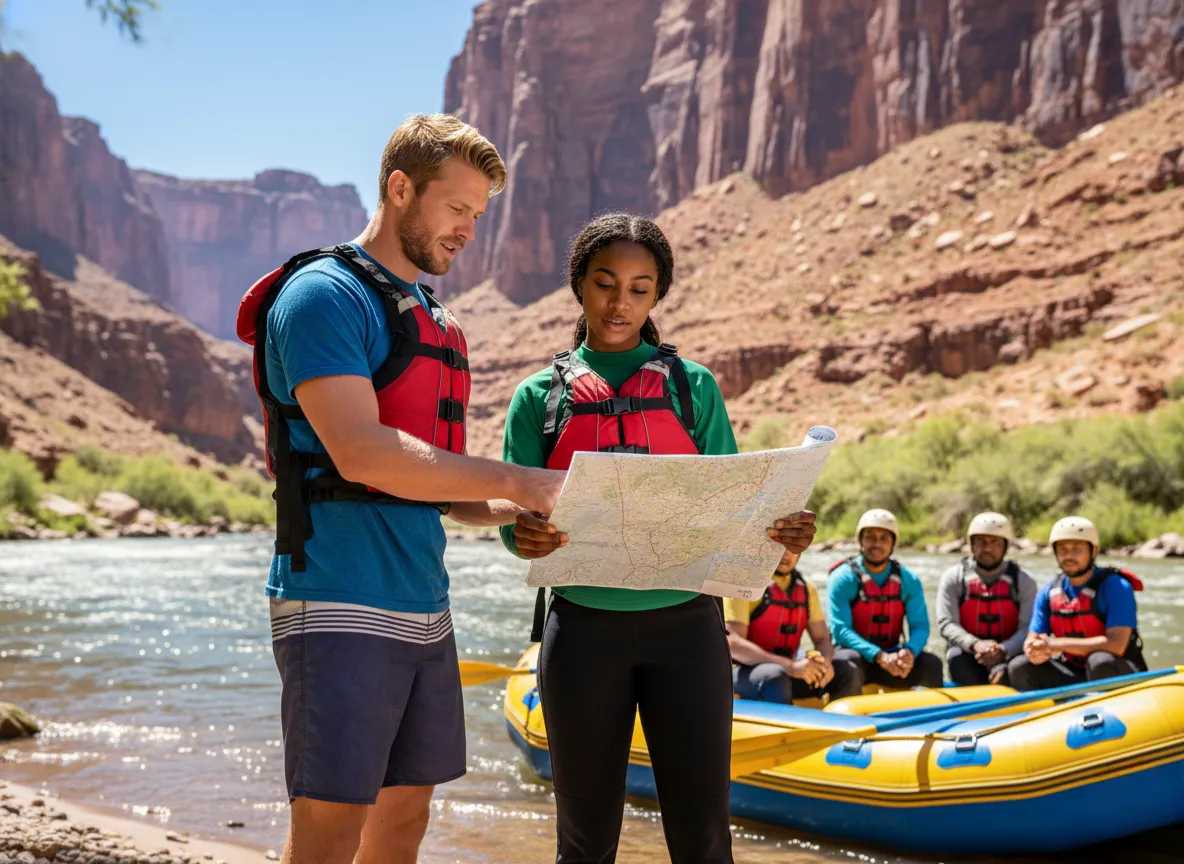
This is a formal, brutally honest assessment of your group’s subjective hazards and group dynamics. It begins with Skill Level & Experience. The entire trip—considering its duration and remoteness—must be planned for the least experienced person. Next, assess the Physical Condition of every participant. Is anyone overly fatigued, ill, or managing a medical condition? Then, evaluate the Psychological State. Is there unaddressed fear or anxiety? Finally, inventory the group’s Rescue Training, identifying who has up-to-date certifications.
This audit process often reveals the “common adventurer” fallacy, where no one is formally in charge. This frequently fails, as beginners lack the judgment to understand risks. Therefore, a formal Trip Leader must be designated. This person, often the most experienced boat captain, is responsible for facilitating this environmental briefing and making final safety decisions, a concept detailed in Princeton’s guide to safety management programs. This structure provides clear authority and accountability. Understanding the role of a competent trip leader is key to a safe group dynamic. With the river and the group assessed, the final piece of pre-launch preparation is creating a formal float plan.
Pro-Tip: The Human Factor Audit must be brutally honest. The group is only as strong as its least comfortable, least skilled member on that specific day. Ego has no place here. As trip leader, your job isn’t to push people, it’s to create a plan where everyone succeeds and feels safe.
What are the essential components of a float plan?
A float plan is a formal document you leave with a reliable, responsible person on shore. It is the official trigger for a rescue if you fail to return by a pre-determined time. This simple tool is one of the most effective safety nets available, ensuring that a response is initiated even when you cannot make an emergency call. The American Canoe Association (ACA) standardizes the core components in its float plan standard using the “4 Ws.”
- WHO: The names of all participants and their emergency contact information.
- WHERE: Details on the planned put-in, take-out, and the intended river route.
- WHEN: The estimated launch time, estimated return time, and the exact time to notify authorities if the group is overdue.
- WHAT TO DO: The direct phone numbers for appropriate local authorities (e.g., County Sheriff, National Parks Service).
Filing a float plan is a non-negotiable step that fits into the larger framework of systematic trip planning. Your pre-trip blueprint is now complete, but a plan is meaningless without the right rafting gear.
What Gear Forms Your Strategic Safety Net? (Phase 2: The Gear Audit)
Rafting gear is not just a checklist of items to buy; it’s a strategic system. A modern gear audit involves a holistic process of equipment selection, inspection, and maintenance connecting the tools that keep you alive with a conservation mindset.
How do you choose the right Personal Protective Equipment (PPE)?
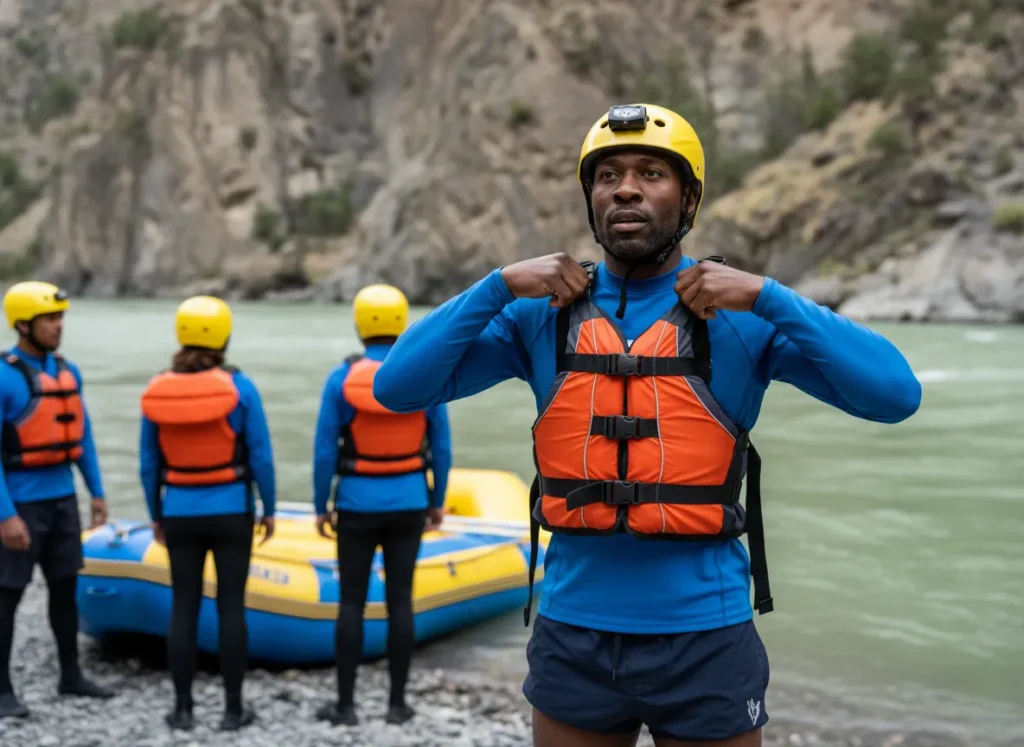
Your PFD (Personal Flotation Device) is the single most important piece of safety gear. You must wear a properly fitting, U.S. Coast Guard-approved PFD at all times on the water. As the U.S. Coast Guard boating accident statistics consistently show, over 80% of drowning victims were not wearing one. You must match the PFD type to the risk; proper flotation fit is critical. A Type III PFD is for calm water. For turbulent whitewater (Class III+), a Type V PFD is the standard. A Helmet with a snug fit is the other non-negotiable piece of PPE, along with coldwater protective clothing like a wetsuit or drysuit in appropriate water temperatures.
Many Type V vests are Rescue PFDs, featuring a built-in Quick-Release Harness. This is an advanced tool for trained rescuers. Crucial Safety Warning: For an untrained user, this harness is a severe entanglement hazard and should never be used without professional swiftwater training. Equipment inspection extends beyond purchase. You must annually inspect PFD foam and check all straps and buckles. Proper equipment maintenance for thermal wear, like rinsing drysuit gaskets, is also a critical safety task. When you’re ready to select the right vest, you can find guidance on choosing the best PFD for rafting. With your personal safety dialed in, the audit expands to the team rescue gear.
What constitutes a complete team rescue kit?
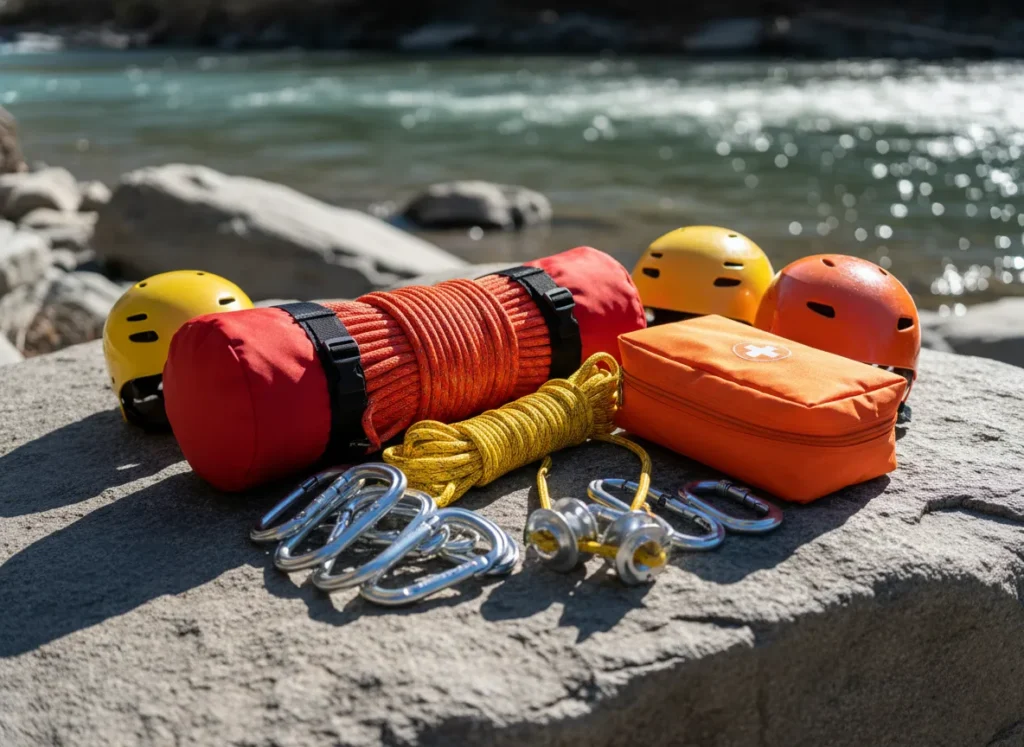
The primary rescue tool is the Throw Bag, a simple bag containing a floating rope of adequate length. Every trip must have multiple throw bags, with one immediately accessible in every boat. A comprehensive First Aid Kit is also mandatory. For a Pinned Boat, where a raft is wrapped on an obstacle, a mechanical advantage system is required, and the industry standard for this difficult rescue is the Z-Drag.
A Z-Drag is a specific arrangement using rescue pulleys and rope creating a 3:1 mechanical advantage—for every one pound of force you pull, three are exerted on the boat. A basic kit includes rescue-rated ropes, pulleys, locking carabiners, webbing, and prusik loops. This is an advanced technique, detailed in academic resources like Frostburg State University’s research on rescue systems, but having the rescue gear is meaningless without the training to deploy it. You can learn more about building a comprehensive river rescue kit to ensure your team is prepared. The final layer of a modern gear audit aligns your tools with your values.
How can your gear choices support river conservation?
A modern safety plan integrates environmental stewardship. Gear failure is not just a safety hazard; it’s a source of pollution. A “Conservation-Infused Gear Audit” means choosing durable, repairable, and sustainable gear—like quick-dry clothing and footwear with good grip—making a direct investment in our river corridors. Seek out gear made with eco-material recommendations, such as PVC-free rafts or apparel made from Yulex, a plant-based alternative to neoprene.
Properly maintaining your gear is itself an act of conservation. A well-cared-for drysuit or PFD lasts longer, reducing landfill waste and micro-trash. This mindset shifts you from consumer to steward. This philosophy aligns with foundational ethics like the National Park Service’s Leave No Trace principles and is a core component of active river conservation. With your plan built and your gear audited, it’s time to launch.
The Rafter’s Gear-Risk-Conservation Matrix
Gear recommendations by river class, maintenance, and sustainable options.
Class I-II (Recreational)
U.S. Coast Guard Type III Focus on comfort & mobility.
Class III-V (Advanced/Rescue)
U.S. Coast Guard Type V 5 High-flotation (22+ lbs). “Rescue PFD” with quick-release harness (for trained users only).
Maintenance Protocol
Inspect foam annually: Squeeze foam; replace if “lumpy or hardened”. Inspect straps/buckles: Check for UV damage, fraying, or cracks.
Eco-Conscious Alternative
Shell: Recycled PET (polyester). Foam: PVC-free (e.g., EPE or PE foam).
Class I-II (Recreational)
Wetsuit (Neoprene) For cool water or splash.
Class III-V (Advanced/Rescue)
Drysuit (Latex Gaskets) Required for cold water to prevent hypothermia.
Maintenance Protocol
Rinse latex gaskets with fresh, salt-free water after each use. Store in a cool, dark, dry place. UV/heat destroys latex. Keep solvents (sunscreen, bug spray) off gaskets.
Eco-Conscious Alternative
Wetsuit: Yulex (plant-based natural rubber) as a neoprene alternative.
Class I-II (Recreational)
(N/A)
Class III-V (Advanced/Rescue)
(N/A)
Maintenance Protocol
Check all valves and chambers for leaks. Inspect for abrasions and patch immediately.
Eco-Conscious Alternative
Raft Material: PVC-Free (Natural Rubber) or Recycled PVC construction.
Class I-II (Recreational)
Whitewater-rated helmet.
Class III-V (Advanced/Rescue)
Whitewater-rated helmet.
Maintenance Protocol
Inspect foam liner for cracks or compression after any significant impact. Check straps and buckles.
Eco-Conscious Alternative
Liner: Bio-foam (e.g., soy-based).
Class I-II (Recreational)
1 per group.
Class III-V (Advanced/Rescue)
1 per boat.
Maintenance Protocol
Inspect rope for fraying or flat spots. Practice throwing and re-stuffing.
Eco-Conscious Alternative
(N/A)
How Do You Execute the Plan on the Water? (Phase 3: The CLAPT Framework)
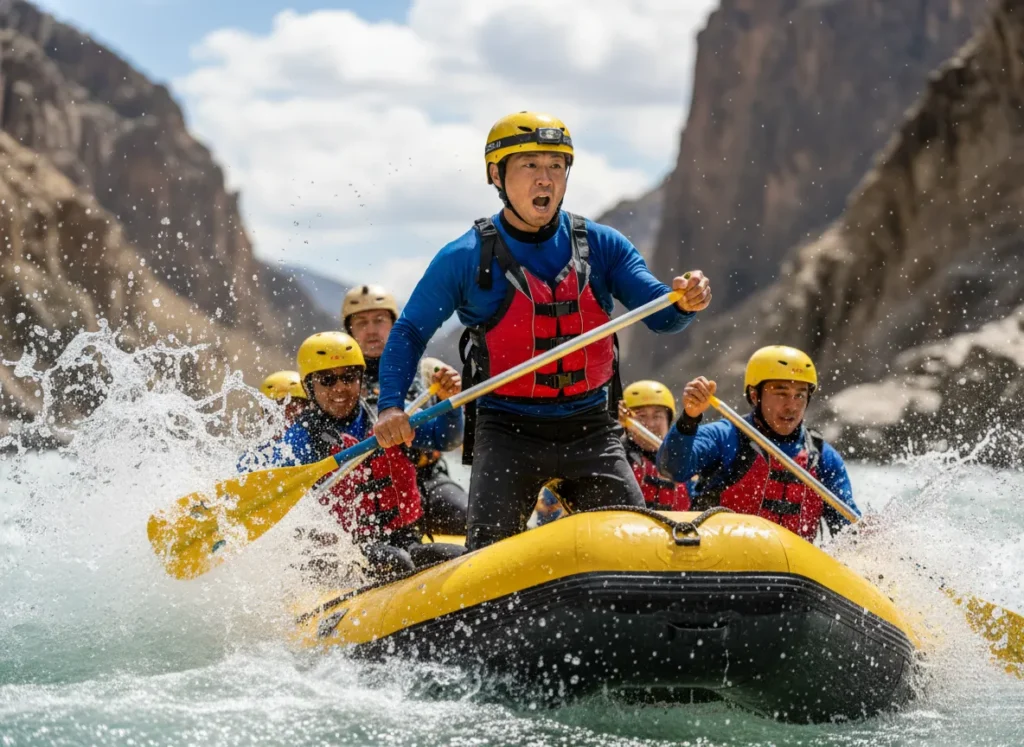
On the water, the detailed plan transforms into a memorable heuristic for continuous risk management. The CLAPT framework—Communication, Line of Sight, Avoid Hazards, Position, Technical Skills—is your active, rolling mental checklist for river navigation safety.
What are the core principles of on-water communication and positioning?
The plan is first executed through a pre-launch River Safety Talk. But on the water, where voices are lost, Universal River Signals (or AWA River Signals) become the primary language for group communication. Every team member must know these communication signals, as defined by authorities like American Whitewater. You can find a helpful visual guide to river hand signals to study. A critical emergency command every paddler must know is “High-Side!”—an instant directive to prevent a flip. Line of Sight is essential; boats must maintain visual contact and proper boat spacing. The most common application of proactive Boat Position is to set safety, where one boat runs a rapid while the next waits in an eddy below, ready to assist.
Trips are managed with designated Lead and Sweep Boats. The Lead sets the pace and chooses the route, while the Sweep is the last boat, piloted by a strong rescuer. The cardinal rule is to “Point Positive”—only point in the safe direction, never at the hazard. Listen to your guide or trip leader. The physics of the “High-Side” command is simple: by shifting the crew’s weight, you counteract the river’s rotational torque. These three elements—Communication, Line of Sight, and Position—form the strategic backbone to avoid hazards. With your team in constant communication, the focus shifts to how to read water.
How do you read the river to avoid hazards?
This skill is about hazard identification. It involves spotting “green lights” (safe paths) and “red flags” (river hazards). The primary green light is the Downstream V, indicating the deepest, safest channel. The primary red flag is the Upstream V, indicating a submerged obstacle like a rock. But some downstream obstacles are “river-killers” that require absolute avoidance, as detailed by the National Park Service guide to river safety.
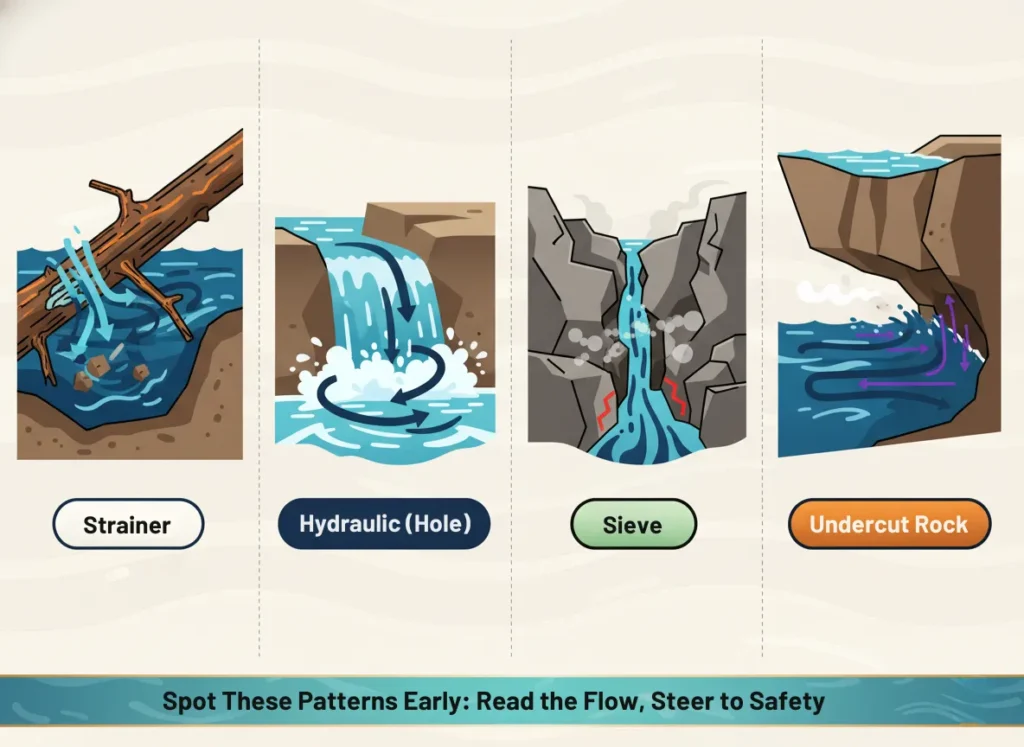
The first is a Strainer, an obstacle like a downed log or sweeper that lets water through but pins objects. A Hydraulic (or Hole) is where water pours over an obstacle and recirculates. A Sieve is a boulder-choked section where water disappears into cracks. An Undercut Rock is lethally deceptive; water flows underneath the rock, pulling swimmers into a void. Learning to recognize these patterns by studying how to read a river is the most critical proactive safety skill. Reading the river tells you where to go; technical skills get you there.
What are the fundamental technical skills for maneuvering a raft?
When simple paddling isn’t enough, it’s time for technical skills. The most fundamental maneuvering skill is Ferrying—moving the boat laterally across river currents. The standard Upstream Ferry involves angling the raft’s bow upstream and paddling with less force than the current, allowing the river to push the boat sideways. Another core skill is Catching an Eddy, using a pocket of upstream-flowing water to stop, scout, or set safety.
To catch an eddy, the raft must cross the turbulent “eddy line” with a proper combination of Angle, Position, and Speed. You must set your angle toward the eddy from an upstream position, then apply aggressive speed. Slacking on speed is the most common mistake. As explored in Princeton’s analysis of accident scenarios, these rescue skills aren’t for showing off; they are essential for precise boat handling. You can dive deeper into mastering the art of ferrying a raft to hone this critical ability. But no matter how well you plan, the river can have the final say. This is when your training for failure becomes your most important asset.
Pro-Tip: Every eddy is a training opportunity. Before you need to make a critical ferry or catch a “must-make” eddy in a challenging rapid, spend time in easier water practicing. Ferry back and forth across the current. Peel out of eddies and catch them again. Build the muscle memory when the stakes are low, and it will be there for you when they are high.
What Happens When the Plan Fails? (Phase 4: Emergency Response)
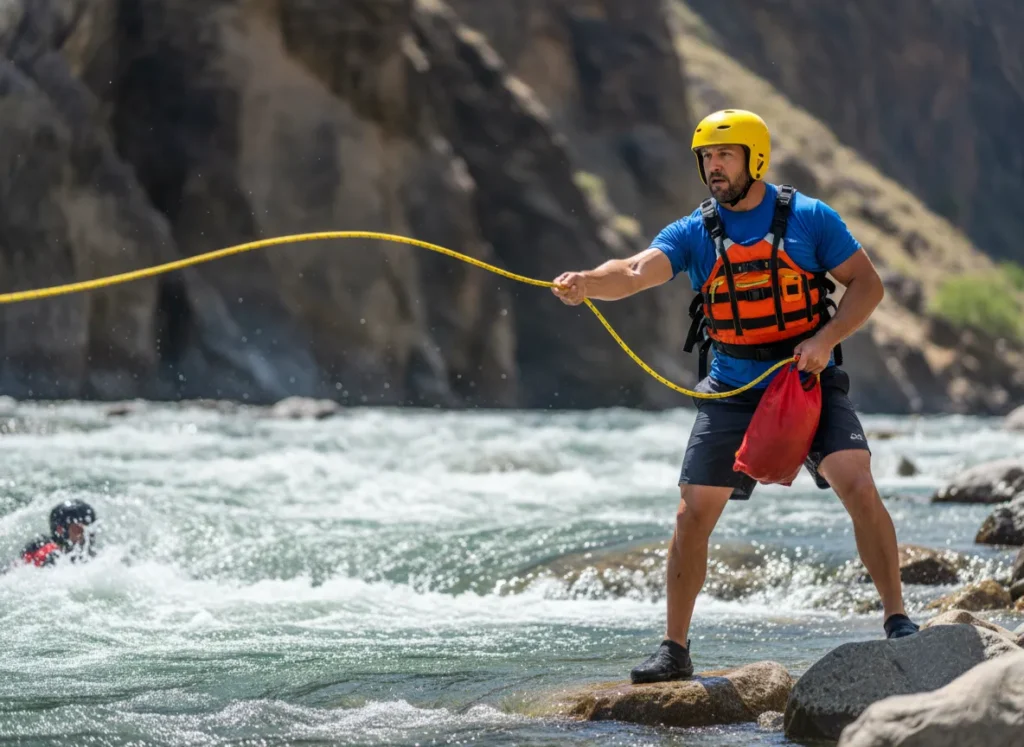
This is the “what if” moment. When you fall out of the raft or another emergency situation arises, panic is the enemy and systematic emergency response protocols are your salvation. This is where rescue training takes over.
What are the universal protocols for self-rescue?
The first priority in any swim is to remain calm and locate your exit strategy. Immediately assume the default Defensive Swimming position: on your back, feet up and pointing downstream, with your hips at the surface. This “feet-up” position allows you to see, breathe, and fend off submerged rocks. Crucially, this prevents foot entrapment, a deadly scenario where a foot gets wedged in rocks and the powerful undercurrents push the swimmer’s head underwater. Never attempt to stand up in moving currents. The medical context for these injuries, as studied by the National Institutes of Health, underscores this rule (PubMed study on whitewater injuries).
Aggressive Swimming is a proactive posture used to actively move across the current. The swimmer rolls onto their front and performs a powerful crawl stroke. There is one life-threatening exception to the “feet-up” rule: a strainer. If a strainer is unavoidable, you must flip onto your stomach, swim hard at the strainer, and lunge to climb up and over it. Floating feet-first will wash you under it. Understanding the difference between defensive and aggressive swimming is a core self-rescue technique. While a swimmer executes their plan, the rest of the team must immediately pivot to executing their rescue techniques.
How does a team execute a successful swimmer rescue?
The primary tool is the throw bag. The rescuer must first make eye contact and yell “Rope!” The bag should be thrown over and past the swimmer, so the rope lands within reach. The swimmer’s role is to grab the rope, lie on their back with it over their upstream shoulder, and let the current ferry them to safety. A backup teammate should be ready to assist.
To get a swimmer back into a raft, they first hand their paddle up. Rescuers then grab the swimmer’s PFD by the shoulder straps—the strongest point—and pull, while the swimmer kicks. This combination is the most effective way to overcome the weight of a water-logged swimmer. These step-by-step procedures are standard practice, as corroborated by resources like The Commonwealth of Pennsylvania’s water rescue workbook. You can also review the proper technique for using a throw bag to refine your skills. Rescuing a swimmer is a common scenario; rescuing a pinned, multi-ton boat is an advanced challenge.
What is the standard procedure for a pinned boat rescue?
When a boat is wrapped on an obstacle, the standard solution is the Z-Drag mechanical advantage system. This requires advanced technical skills, including knot tying (like the Figure 8, Bowline, and Water Knot) and anchor building techniques (like a Basket Hitch or Girth Hitch). The first step is to establish a “bomber” Anchor. The Load Line (main rope) is then secured to the pinned raft. A Capture Prusik friction hitch is attached to the main rope near the anchor, acting as a ratchet.
A second prusik, the Traveling Prusik, is attached to the line farther down, along with a pulley. The tail of the rope (the Haul Line) is run from the raft, through a pulley at the anchor, then through the traveling pulley, and back toward the anchor. This configuration creates a “Z” shape. Pulling on the haul line engages the pulleys and creates the 3:1 mechanical advantage needed. This complex scenario is covered in advanced outdoor leadership training (see U.S. Department of Education research on outdoor leadership), and you can study a guide on how to set up a Z-Drag rescue system to understand the mechanics. The trip is over, but the safety plan is not yet complete.
How Does the Safety Cycle Continue After the Trip? (Phase 5: Lifecycle)

The risk management loop doesn’t end at the take-out. Post-trip actions close the loop, reinforcing both safety and conservation and turning the lessons from one trip into the foundation for the next.
Why is a post-trip debrief essential for continuous improvement?
The safety plan doesn’t end when the boats are packed. The post-trip debrief is a powerful tool to reflect on what went well, what went wrong, and what was learned. It is the formal mechanism that directly reduces the “Human Factor” variable for the next trip. It creates a space for honest discussion about decisions made, challenges faced, and skills tested. This process converts “near misses” into valuable, collective experience and teamwork.
Without a debrief, crucial lessons are lost, and the same mistakes are likely to be repeated. The debrief is the final step of one safety plan and the first step of the next, creating a continuous loop of improvement. This practice, supported by research on the value of debriefing for experiential learning (like this NIH study on critical thinking and debriefing), is what elevates a group from recreational boaters to a self-aware, constantly improving expedition team. The final act of a responsible rafter is to ensure the environment is left better than they found it.
What are the non-negotiable Leave No Trace principles for river corridors?
Protecting the resource is a core part of any modern safety plan. In sensitive river corridors, three LNT principles are paramount. Principle 3: Dispose of Waste Properly. On multi-day trips, this requires packing out all solid human waste in a portable, sealable river toilet system known as a “Groover.” All urine goes directly into the river. Dish cleanup must be done using a 3- or 4-bucket system set up 200 feet from the water, often preceded by a foot rinse protocol to keep sand out. Principle 5: Minimize Campfire Impacts. Ground fires are prohibited in most corridors. A raised, metal fire pan is required to prevent sterilizing the soil, and you must pack out all ash.
After washing and hand washing, “gray water” from the buckets must be strained and broadcast broadly 200 feet from the river. Always check for seasonal fire restrictions, which often ban wood and charcoal cooking entirely. Adherence to these LNT principles, including proper recycling and being mindful of wildlife, is not just about ethics; it is often a legal requirement. Following a complete guide to Leave No Trace for river trips is essential for preserving the wild character of the rivers we love. This complete, lifecycle approach transforms a simple rafting trip into a responsible, empowering, and repeatable adventure.
Conclusion
A true river trip safety plan is not a static checklist but a dynamic, multi-phase process designed for hazard mitigation by managing the “Human Factor” in the Dynamics of Accidents formula. On the water, your on-river execution is guided by the continuous mental model of the CLAPT framework. Your rafting gear is a strategic system, meticulously maintained and chosen not just for the river’s difficulty, but with an eye toward conservation. This plan is a continuous loop, ending with a post-trip debrief and LNT practices that feed directly into the preparation for the next safe and responsible adventure.
Your journey to becoming a safer, more competent rafter starts with understanding these systems. Use this blueprint as your guide and share your own essential safety tips in the comments below.
Frequently Asked Questions about The River Trip Safety Plan
What should be included in a river safety talk?
A river safety talk must cover PFD use, what to do if you fall out of the raft (self-rescue swim positions), team rescue procedures like throw bags, and on-water commands like High-Side! It should also establish boat order, review communication signals, and briefly touch on the day’s expected hazards and the overall float plan.
How do you prepare for a safe rafting trip?
Preparation involves a thorough assessment of three key variables: the river (River Classification, flow data), the group (skill level, medical needs), and the equipment (suitability, equipment inspection). This includes securing permit requirements, studying maps, and filing a formal float plan with a contact on shore.
What are the most essential safety tips for whitewater rafting?
The most critical safety tips for whitewater rafting are: always wear your PFD at all times on the water, never attempt to stand up in moving river currents, listen to your trip leader or guide, and know the universal river signals. Additionally, always Point Positive (point to the safe route, not the hazard) and be prepared to perform a High-Side to prevent a flip.
What to do if you fall out of the raft?
If you fall out of the raft, immediately get into the defensive feet-up swimming position on your back with your feet pointing downstream to fend off rocks. Do not panic. Locate the boat or shore, listen for instructions, and be prepared to grab a rescue rope. Do not try to stand up.
Risk Disclaimer: Whitewater rafting, kayaking, and all related river sports are inherently dangerous activities that can result in serious injury, drowning, or death. The information provided on Rafting Escapes is for educational and informational purposes only. While we strive for accuracy, the information, techniques, and safety advice presented on this website are not a substitute for professional guide services, hands-on swiftwater rescue training, or your own critical judgment. River conditions, including water levels, currents, and hazards like strainers or undercut rocks, change constantly and can differ dramatically from what is described on this site. Never attempt to navigate a river beyond your certified skill level and always wear appropriate safety gear, including a personal flotation device (PFD) and helmet. We strongly advise rafting with a licensed professional guide. By using this website, you agree that you are solely responsible for your own safety. Any reliance you place on our content is strictly at your own risk, and you assume all liability for your actions and decisions on the water. Rafting Escapes and its authors will not be held liable for any injury, damage, or loss sustained in connection with the use of the information herein.
Affiliate Disclosure: We are a participant in the Amazon Services LLC Associates Program, an affiliate advertising program designed to provide a means for us to earn advertising fees by advertising and linking to Amazon.com. As an Amazon Associate, we earn from qualifying purchases. We also participate in other affiliate programs and may receive a commission on products purchased through our links, at no extra cost to you. Additional terms are found in the terms of service.