In this article
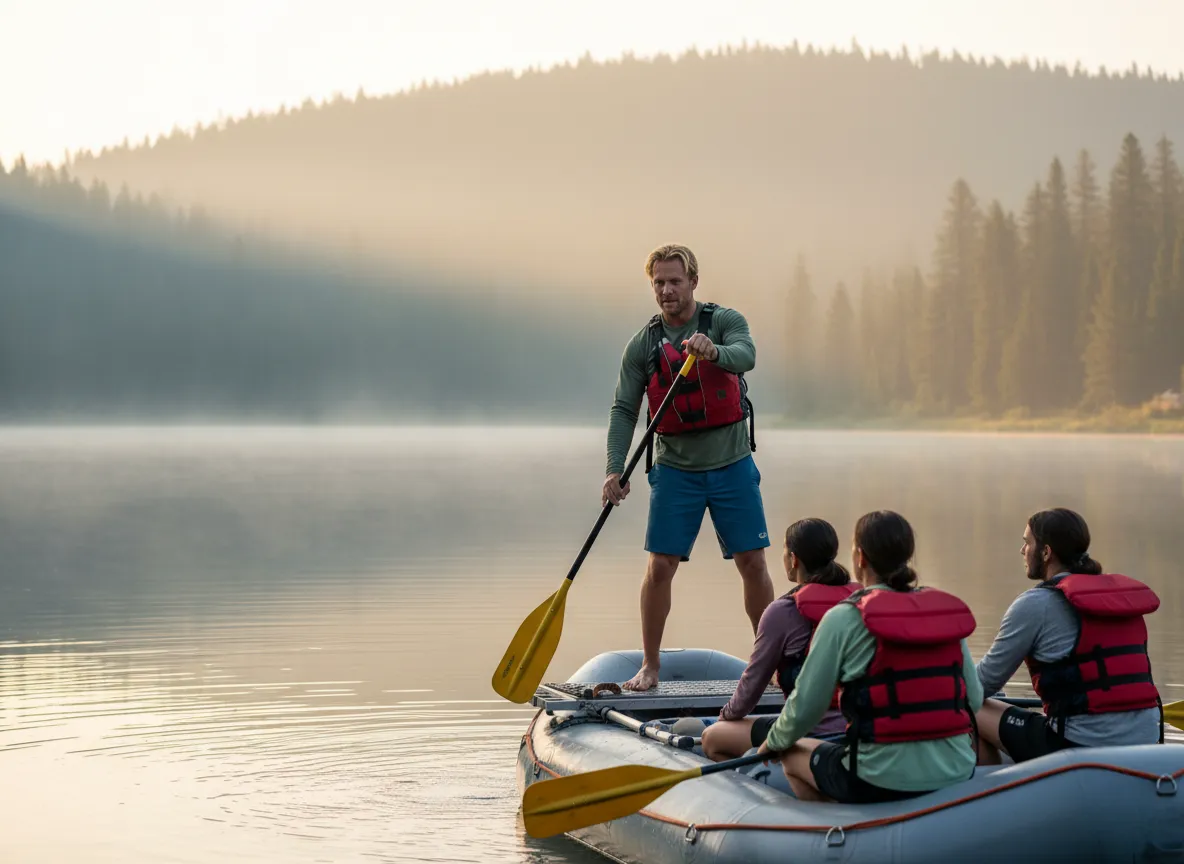
The roaring chaos of a Class III rapid is a puzzle of crashing waves and swirling currents where survival during a whitewater rafting adventure depends on muscle memory you don’t have time to think about. Now, picture a glassy lake at dawn, the water still and silent. This is the rafter’s paradox: the necessary skills needed to master the former are perfected on the latter. That calm lake is your essential “lab.” It removes the unpredictable variables of current and consequence, allowing you to isolate and master the three pillars of whitewater competence through focused flatwater drills: Individual Mechanics, Team Synchronization, and Instant Safety Responses.
This is the journey from novice to a skilled rafter, a clear roadmap for the beginner-to-intermediate progression. It begins not in the intimidating heart of the rapid, but in the quiet control of flatwater practice. Here, we will build your foundation of beginner rafting techniques, transforming theoretical knowledge into life-saving instinct. We’ll show you how to master self-rescue techniques before you need them, how to build a perfect paddle stroke, how to turn a group of individuals into a synchronized team, and finally, how to develop your river reading and apply those skills to moving water. This is your guide for the transition from flatwater to whitewater.
Why Is Safety the Non-Negotiable First Step in Rafting?

Before we ever talk about a paddle stroke, we must address the fundamental truth of river running: you are responsible for your own safety. This isn’t about fear; it’s about empowerment. A proper safety briefing is non-negotiable, and mastering basic safety is not just about having the right gear, but about building a foundational skill set that becomes as reflexive as breathing. These self-rescue techniques are the bedrock upon which all other rafting skills are built.
What Personal Safety Skills Must Be Mastered on Flatwater?
Your journey begins by getting comfortable with the water itself. Your personal safety system starts with the correct equipment. The “river uniform” consists of a properly fitted, USCG-approved Type III or V PFD (lifejacket) from a reputable manufacturer like NRS, and a whitewater-specific helmet. Just as critical is your attire. The cardinal rule is to dress for the water temperature, not the air temperature. This means a wetsuit or synthetic layers and proper river shoes—and absolutely avoiding cotton, which can rapidly lead to hypothermia.
The first and most critical drill is the Whitewater Swim. In the calm, controlled environment of a lake, get in the water wearing your full gear. The goal is to build confidence and learn to don’t panic. Feel the PFD support your buoyancy, learn how it holds you in the water, and trust your equipment. From here, you master two swimming positions for swift water. The Defensive Swim Position, or float position, is your default “safe” posture. You lie on your back with your feet up and pointed downstream, toes just breaking the surface.
The primary purpose of this position is to prevent the single most dangerous hazard on a river: Foot Entrapment. This occurs when a person tries to stand up in moving water, their foot becomes wedged between submerged rocks, and the force of the current pushes them under. The Defensive Swim ingrains the “Golden Rule” of whitewater safety: never attempt to stand up in moving water deeper than your knees. When you need to actively rescue yourself, you must swim aggressively using the Aggressive Swim Position. This bodyraft technique has you roll onto your stomach and swim with a powerful crawl stroke toward a specific target—the shore, a calm pool called an eddy, or the raft itself.
With the instinct for personal survival locked in, you’re ready to shift focus from your paddle to the tool in your hands. For more detailed definitions, see these Foundational whitewater safety guidelines from Idaho Parks and Recreation. Understanding the critical difference between defensive and aggressive swim positions will also deepen your tactical awareness.
How Do You Master Individual Paddle Mechanics in a Controlled Setting?
The flatwater “lab” offers a zero-consequence environment where you can deconstruct the physical components of boat control. This is where flatwater practice prepares for whitewater maneuvers by building efficient, powerful muscle memory that will serve you when the water gets loud and fast.
What is the Correct Technique for the Forward Stroke?
The first thing every new paddler must learn is that you don’t paddle with your arms. Your arms are just levers; the engine is your core. True effective paddling comes from torso rotation and core muscle engagement. A powerful forward stroke is a fundamental paddling technique—a fluid sequence of three phases designed to maximize power and efficiency: the Catch, the Power, and the Recovery.
For the Catch, you rotate your torso and lean forward from the hips, planting the paddle blade fully and vertically in the water as far forward as you can comfortably reach. The Power phase is the explosive unwinding of your torso. The goal here is to pull your body forward to the paddle, not to pull the paddle back with your arms. Finally, the Recovery: once your shaft hand reaches your hip, you slice the blade out of the water.
The most common mistake is “arm paddling.” This is weak, inefficient, and will exhaust your paddling muscles quickly. Proper grip is also crucial: place one hand over the T-grip to provide leverage and hold the T-grip correctly. Proper gear maintenance, like checking your paddle for cracks, is also part of good technique. This practice is invaluable because it allows you to perform hundreds of repetitions. This focus on proper form is more than just about performance; as this study on whitewater rafting injuries implicitly shows, biomechanically efficient technique is key to preventing overuse injuries. For a deeper analysis, you can learn how to get maximum power from the rafting forward stroke.
How Do You Use the Back Stroke and Brace for Control and Stability?
Now that you can propel the raft downstream, the next step is learning other maneuvers. The Back Stroke is the raft’s brake, used to slow, stop, or help turn the boat. While the forward and back strokes control momentum, the Draw Stroke and Pry Stroke are essential for moving the raft sideways and avoiding obstacles.
Pro-Tip: For maximum power in a back stroke or a pry, brace the paddle shaft against your hip. This turns your entire body into a solid lever, allowing you to use your body weight and core strength instead of just your arms.
The Brace Stroke is your emergency stability move. Dedicated brace practice is what prevents a flip in big waves. To perform a Low Brace, you must fight your instinct. As the raft tilts, lean your body toward that low side. Slap the back face of your paddle blade flat onto the water’s surface for leverage. As the blade hits, use your hips to snap the boat back upright. A High Brace is a more powerful but less stable version used by more experienced paddlers. On calm water, a partner can rock the raft, allowing you to practice the brace-and-hip-snap recovery.
Mastering these individual movements is only the first half of the equation; the true power of inflatable rafts is unlocked when these strokes are synchronized as a team. For more on these techniques, the American Canoe Association handbook offers Authoritative definitions of rafting terminology. While we focus on paddles, the principles of leverage are universal, as seen in this discussion of the anatomy of a rafting oar stroke.
How Does a Group of Paddlers Become a Cohesive Rafting Team?
River rafting is the ultimate team sport. A boat full of strong individuals paddling out of sync is chaotic and weak. But a crew that moves as one can navigate the most challenging rapids with precision control. This section is about forging that cohesion during your rafting session.
What Are the Essential Raft Commands and Why Practice Them on Flatwater?
The guide’s command system is the “language of the raft.” In the roar of a rapid, there is no time for processing; response must be reflexive muscle memory. The core commands are straightforward: “All Forward,” “All Back,” “Stop,” a “Left Turn,” a “Right Turn,” and “High Side.” Practicing in a flat water environment is non-negotiable because it builds this reflexive response and coordination before it truly matters.
Synchronization is just as important as command response. The benefit of synchronized control is immense; a raft’s engine is only powerful if all pistons fire at once. The two front paddlers are the “metronome.” Everyone else must watch the person directly in front and follow their timing. Key flatwater drills include “Setting the Pace” and the “Flatwater Pivot,” where the crew works to spin the raft 360 degrees. Drills like power circles also build endurance and team timing.
Once your team is moving as a single unit, you are ready to apply your skills to the dynamic environment of the river. This academic framework is echoed in A collegiate guide to rafting from Frostburg State University. To learn more, this guide deciphers every rafting command in detail.
How Do You Apply Flatwater Skills to the Dynamics of Moving Water?
This is the bridge from controlled practice to real-world application. It introduces the cognitive skill of reading the river—developing a deep hydraulics understanding to know what’s happening underneath—and connects that knowledge to the paddle strokes you’ve mastered.
How Do You Read the River’s “Map”?
To understand hydraulics, you must recognize patterns. The Primary Current is the main, fastest flow, typically marking the safest path. The clearest indicator is a Downstream V, a V-shape pointing downstream. An Upstream V points upstream and indicates a hazard.
The other key features are eddies and holes. Eddies are areas of calm or even upstream-flowing water downstream of an obstacle. The Eddy Line is the turbulent boundary. The most dangerous river features are Holes (Hydraulics). These form when water pouring over an object recirculates back on itself, creating a powerful upstream flow. Learning to differentiate these features is the first step in applying your paddle strokes with purpose.
Once you can read the map, you can begin to execute the advanced paddling techniques that allow you to navigate it. The core factual basis for these features is detailed in these Scientific definitions for river dynamics. This knowledge is the foundation for a field-tested Hazard Identification System.
How Do You Perform an Eddy Turn and a Peel Out?
The Eddy Turn is the fundamental maneuver for getting out of the main current. It involves three steps: Angle, Momentum, and Lean. First, Angle: approach the top of the eddy, angling the raft at approximately 45 degrees toward the bank. Second, Momentum: the crew must paddle forward hard (“All Forward”) to achieve momentum control for punching through waves and eddy lines. Do not stop paddling.
Third, and most important, is The Lean (CRITICAL). As the raft crosses the eddy line, the entire crew must lean hard into the turn (i.e., lean toward the eddy’s center). This is also called a “High Side.” The Peel Out is the maneuver for getting into the current from an eddy. You point the bow upstream at a 45-degree angle out, paddle hard, and as the current turns the raft, the crew must lean downstream. Outfitters like Outland Expeditions drill these specific techniques relentlessly to prepare crews for the challenges of rivers like the Ocoee River.
Pro-Tip: The eddy line is a zone of chaos. Hesitation is your enemy. When performing an eddy turn or a peel out, you must commit. Paddle hard all the way across the line and hit your lean aggressively. A timid attempt is more dangerous than a decisive one.
With a full grasp of technical skill and environmental awareness, the final stage of mastery integrates a sense of responsibility. The National Park Service river safety advice reinforces the practical application of these skills. With practice, you can learn to land every must-make micro-eddy with precision control.
What Does It Mean to Be a Responsible River Runner?
True skill on the river extends beyond technical maneuvers. It includes a deep respect for the environment and for fellow rafters. This ethic of conservation is an active, integrated component of skilled rafting that includes everything from seasonal health routines to low-impact camping.
How is Leave No Trace (LNT) an Active Rafting Skill?
The ethical framework of rafting is built on The seven principles of Leave No Trace. In a river corridor, these principles have stringent applications. All trash must be packed out. In many canyons, this includes solid human waste, managed with a “groover.” Fires must be in an elevated fire pan.
This is where conservation becomes an active skill. Consider “Travel and Camp on Durable Surfaces.” An unskilled team will crash their boat onto a fragile bank. Skilled rafters use the very eddy turn we practiced to land their raft flawlessly on a sandbar. In this context, expert boat control is an LNT technique. Mastering these maneuvering skills directly enables you to be a better environmental steward on all waterways.
This sense of stewardship extends beyond the environment to how we interact with each other, ensuring a safe and positive adventure. You can learn more about preserving that wild beauty on your next whitewater adventure.
Conclusion
The path to whitewater competence is clear, and it begins on the quiet water of a lake. The journey is built on a sequence of key truths:
- The safest way to learn white water rafting is through a systematic progression that begins with practicing rafting skills on flatwater.
- Mastery requires building skills sequentially: first individual safety and mechanics, then team coordination, and finally application on moving water.
- Rafting is fundamentally a team sport; synchronization and instant command response are more critical than individual strength.
- Advanced boat control is not just for performance; it is an active conservation skill that allows rafters to protect fragile river ecosystems.
Use the Flatwater-to-Rapids Readiness Checklist as your guide, practice deliberately, and explore our full library of skill-building guides to continue your journey as a safe, skilled, and responsible river runner.
Frequently Asked Questions about Progressing from Flatwater to Whitewater Rafting
What skills do you practice on flatwater for whitewater rafting?
On flatwater, you practice the three pillars of rafting: individual paddle mechanics (forward stroke, back stroke, brace strokes), team synchronization and command response, and essential safety precautions like the defensive and aggressive swim. The goal of these flatwater drills is to build muscle memory in a zero-consequence environment before facing beginner-level rapids.
How do I know when Im ready to transition to whitewater?
You are ready for the transition from flatwater to whitewater when you and your team can perform all paddle strokes with good form, respond to guide commands instantly, and have mastered self-rescue techniques. Confidence and a solid foundation in these basics are more important than rushing to the river.
What is the first thing I do if I fall out of the raft in moving water?
The very first thing you should do is get into the Defensive Swim Position: on your back, feet up and pointed downstream. This float position allows you to breathe, assess the situation, protect yourself from hazards like foot entrapment, and prepare for self-rescue.
How do I avoid getting my foot stuck in a river?
To avoid the deadly hazard of foot entrapment, you must follow the Golden Rule: NEVER attempt to stand up in moving water that is deeper than your knees. Always stay in a horizontal swimming position (Defensive or Aggressive) until you can safely move to very shallow water.
Risk Disclaimer: Whitewater rafting, kayaking, and all related river sports are inherently dangerous activities that can result in serious injury, drowning, or death. The information provided on Rafting Escapes is for educational and informational purposes only. While we strive for accuracy, the information, techniques, and safety advice presented on this website are not a substitute for professional guide services, hands-on swiftwater rescue training, or your own critical judgment. River conditions, including water levels, currents, and hazards like strainers or undercut rocks, change constantly and can differ dramatically from what is described on this site. Never attempt to navigate a river beyond your certified skill level and always wear appropriate safety gear, including a personal flotation device (PFD) and helmet. We strongly advise rafting with a licensed professional guide. By using this website, you agree that you are solely responsible for your own safety. Any reliance you place on our content is strictly at your own risk, and you assume all liability for your actions and decisions on the water. Rafting Escapes and its authors will not be held liable for any injury, damage, or loss sustained in connection with the use of the information herein.
Affiliate Disclosure: We are a participant in the Amazon Services LLC Associates Program, an affiliate advertising program designed to provide a means for us to earn advertising fees by advertising and linking to Amazon.com. As an Amazon Associate, we earn from qualifying purchases. We also participate in other affiliate programs and may receive a commission on products purchased through our links, at no extra cost to you. Additional terms are found in the terms of service.