


In this article
You can spend weeks comparing raft lengths and tube fabrics and still get blindsided by the one part nobody talks about: the floor under your feet. After a couple decades of rowing both soft, sloshy boats and rigid modern ones, I can tell you the floor decides more about your day than the brand on the side. It’s the difference between standing tall to read a rapid and stumbling around ankle-deep in cold water. There are four floor types worth knowing, and the right one depends entirely on the water you actually run. Here’s how they stack up at a glance.
| Floor Type | Self-Bailing? | Best For | Underfoot & Tracking |
|---|---|---|---|
| Bucket (Standard) | No — hand-bail | Calm water, lakes, tight budgets | Soft, low-riding, sluggish when full |
| I-Beam | Yes | Swift and technical whitewater | Tracks straight; softer, bumpier hull |
| Drop-Stitch | Yes | Fishing, photography, family, expeditions | Rigid standing deck; turns easy, tracks less |
| Slat | No | Dinghies and tenders, not rivers | Hard flat boards; no place on whitewater |
The Two Big Questions Behind Every Raft Floor

Before anyone argues I-beam versus drop-stitch, there’s an earlier fork in the road most buyers skip right over. Floor choice is really two nested questions, not one. First: do you want a self-bailing floor or a bucket floor? Only after you’ve answered that does the second question — which self-bailing build — even matter.
Self-bailing vs bucket — the real first decision
A self-bailing floor is an inflated chamber, roughly four to five inches thick, with drain holes set right where the floor meets the tubes. Water that splashes in runs across the top of that inflated floor and straight back out the holes. A bucket floor does the opposite — it’s a sealed sheet of fabric, so every drop that comes over the side stays in the boat until you scoop it out by hand.
That single design choice shapes everything downstream: weight, price, how the boat rides, and how hard you work on a wave train. Most outfitters running real whitewater have settled the question for you — they run 14-foot self-bailing rafts as standard safety kit on commercial trips.
Then: which self-bailing build
Once you’re committed to self-bailing, the floor splits into two camps: the I-beam floor and the drop-stitch floor. They drain water the same way but feel like completely different boats underfoot. One tracks like it’s on rails; the other gives you a hard, flat deck you can stand and walk on. We’ll get to both.
How a self-bailing floor actually drains
Picture an air mattress glued inside the boat with a gap around its edge. As water comes over the tube, it has nowhere to pool — it sheets off the raised floor and out the perimeter drains. Before the 1990s, rafts used a flat sealed floor that stretched and bagged under the weight of water, and paddlers would lose their footing as the boat filled. The inflated self-bailing floor quietly fixed that, and it’s why a modern boat feels so much more planted. If you want the bigger picture on matching all of this to your river, start with our guide to the right whitewater raft for your river.
Bucket (Standard) Floors
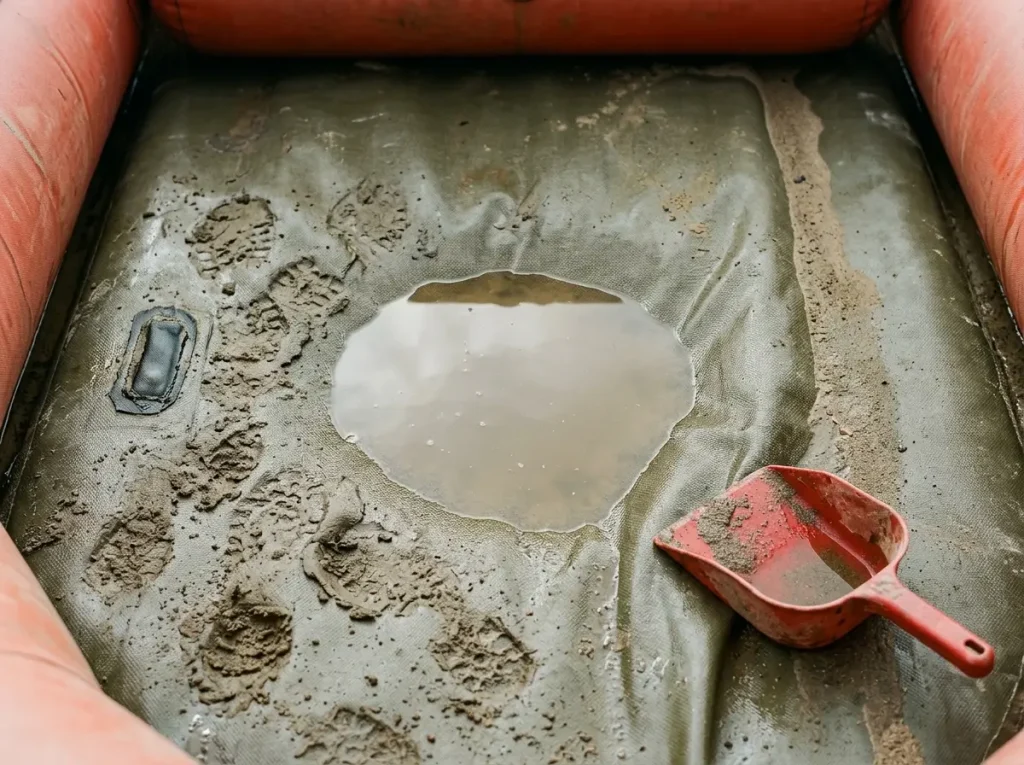
The bucket floor is the old-school standard, and it’s easy to write off as a relic. That’s a mistake. For the right water, it’s still the honest budget pick — you just have to know what you’re signing up for.
How a standard floor is built
A standard floor is a single layer of coated fabric sealed to the tubes around the whole perimeter. There’s no inflation, no drain holes — it’s basically a tough tarp stretched across the bottom of the boat. That simplicity is exactly why it’s the cheapest and lightest floor you can buy, and why bucket boats pack down small and cost a fraction of a self-bailing rig.
Where a bucket boat still makes sense
If you mostly float flatwater, mild rivers, or the local lake, a bucket floor is genuinely fine. Calm water doesn’t fill the boat, so the one weakness never shows up. For a budget paddler who wants a capable boat without the premium price, this is the value play, and there’s no shame in it.
The downside in real rapids
Run anything with back-to-back waves, though, and the bucket boat earns its reputation. Water pours in and sits there, weighing the boat down, making it sluggish and prone to hanging up on rocks. You end up bailing between every rapid with a cut-off jug — and on a long whitewater day, that gets old fast. The classic beginner mistake is buying a cheap bucket boat for a multi-rapid run and spending the trip wrestling water instead of reading the line.
I-Beam Self-Bailing Floors
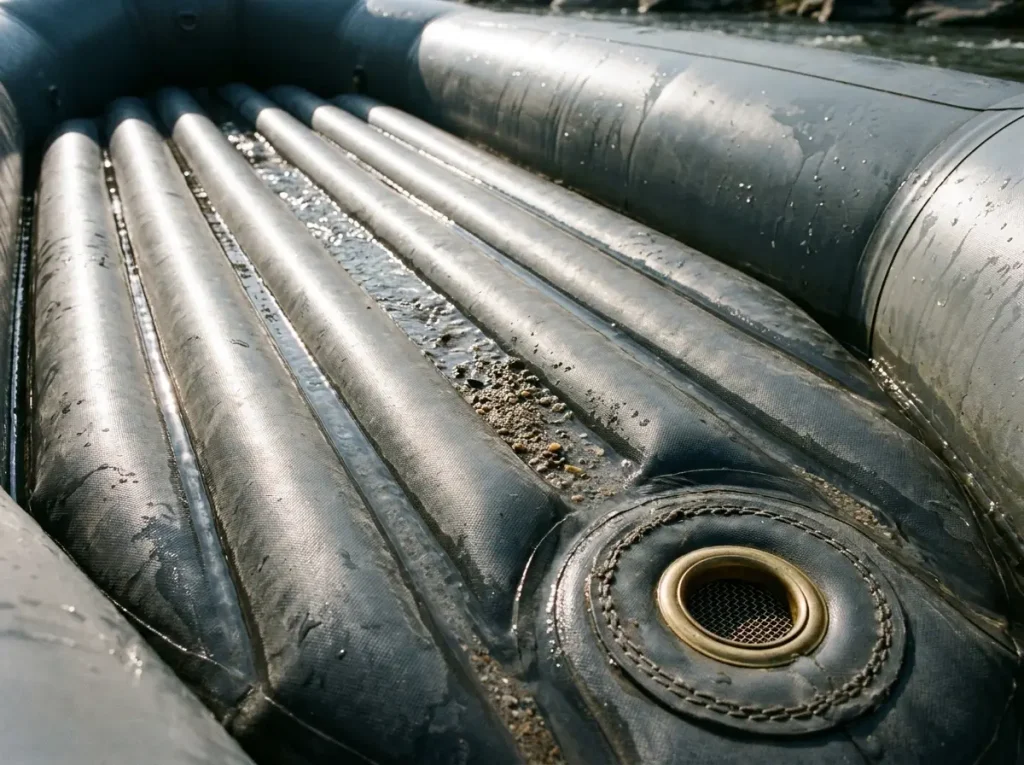
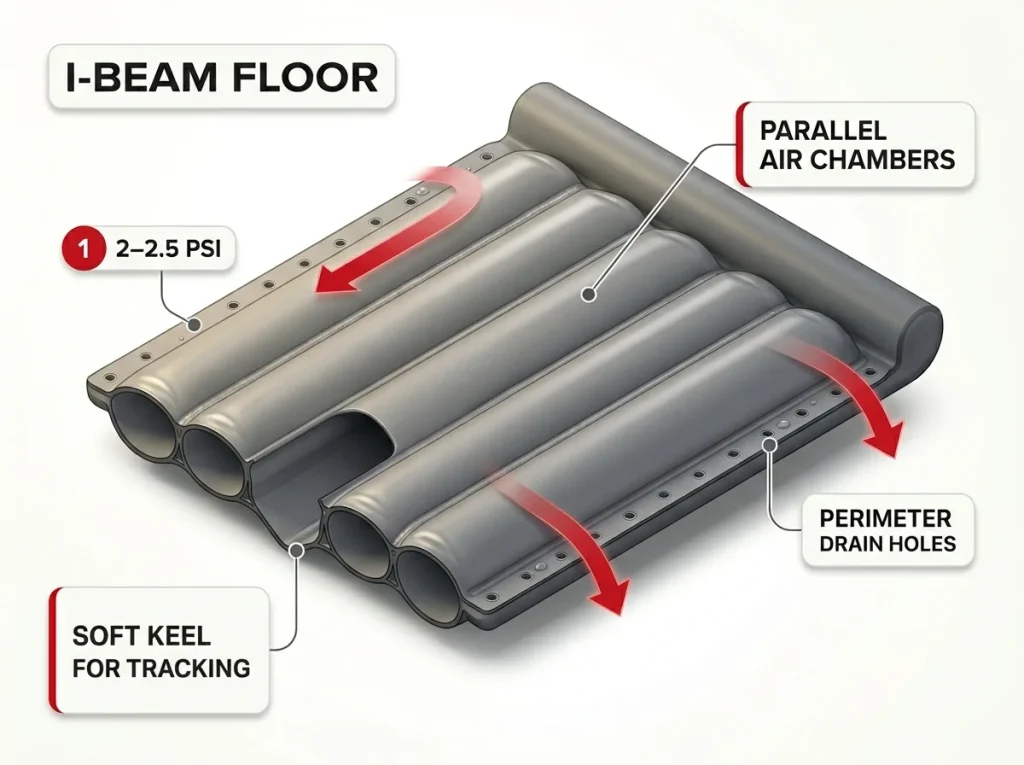
The I-beam floor is the self-bailing design that guides who run pushy, technical water still reach for. The name comes from the internal baffles: long air chambers that run bow to stern like the ribs of an I-beam, forming a subtle keel down the center of the boat.
What the I-beam design does
Those longitudinal chambers act like a soft keel. They give the hull a V-ish profile that bites the current and helps the boat hold its line instead of getting shoved sideways. On swift, continuous water that tracking is gold — the boat goes where you point it and resists the river’s attempts to spin you. It’s the reason the I-beam is the default for one-boat-does-it-all owners who want a craft that handles whitewater first. Matching that to the correct hull size matters too, which is where our raft size guide for every river and crew comes in.
Tracking and whitewater feel
Drop into a wave train in an I-beam boat and you feel connected to the river. It holds a straight line through chaos, and you adjust less at the oars. The trade-off is that the ribbed underside is a little bumpier — it grips the water rather than sliding over it, which is great for control and less great in skinny, rocky shallows.
The trade-offs (soft pressure, weight, bulk)
Here’s the part competitors gloss over: an I-beam floor runs at low pressure, usually around two to two-and-a-half psi, and owners will tell you straight that it’s always soft and always needs topping off. It’s also heavier and bulkier to pack than a drop-stitch floor of the same size. None of that is a dealbreaker — it’s just the cost of that keel-like tracking. A proven example of this build is the NRS E-142 Self-Bailing Raft (check it on Amazon), a 14-foot whitewater boat that shows what a classic inflated floor feels like under load.
Budget a pump stop with an I-beam floor. Throw the hand pump where you can reach it, and top the floor off at lunch — a soft floor drags and steers lazily, and you won’t notice how much until you firm it back up.
Drop-Stitch Self-Bailing Floors

If the I-beam is the tracker, the drop-stitch floor is the standing deck. It’s the newer self-bailing build, and for anyone who spends time on their feet in the boat — anglers, photographers, families — it has quietly become the favorite.
How drop-stitch holds high pressure
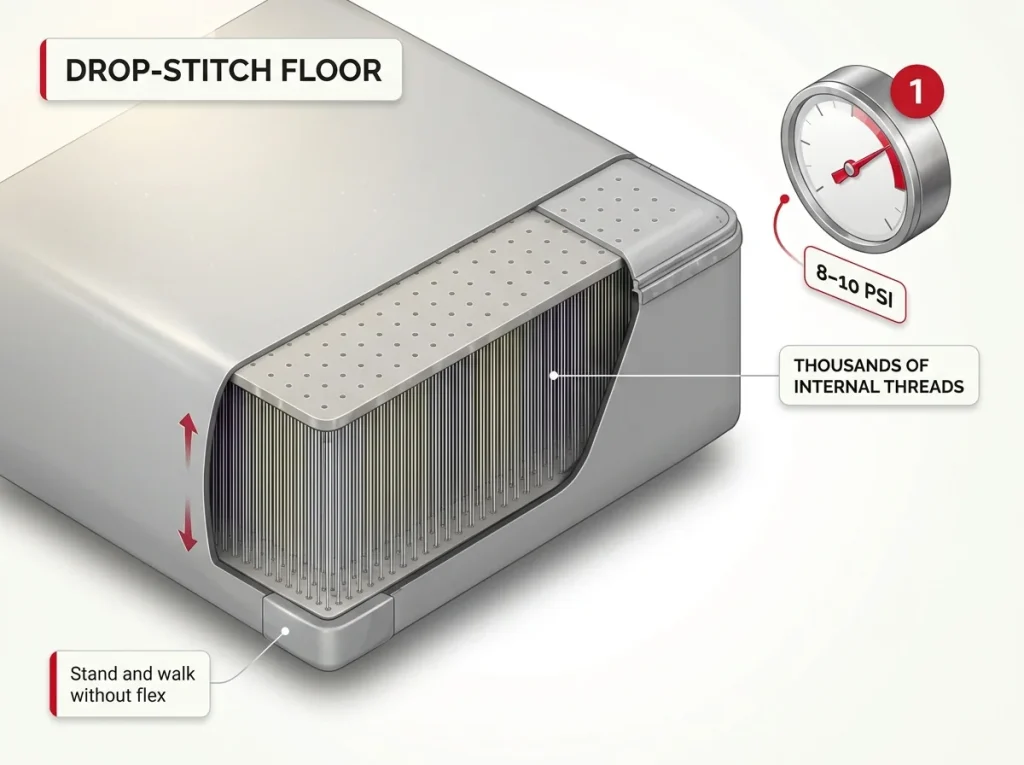
Drop-stitch construction uses thousands of tiny threads connecting the top and bottom skins of the floor. Those threads let the floor inflate hard — a four-inch drop-stitch floor runs a rigid eight to ten psi, far stiffer than any I-beam. The result is a flat panel that feels less like an air mattress and more like a hardwood deck bolted into the boat. That high pressure is the whole point: it’s what lets you stand, walk, and brace without the floor flexing under you. The same idea shows up in the smaller boats covered in our roundup of packrafts matched to your skill and trip.
The standing/fishing advantage
Spend a day fishing and the difference is night and day. On a drop-stitch floor you can stand to cast, shift your weight, and climb in and out without the wobble you get on an I-beam. It also rides higher and drafts shallower, so it slips into skinny fishing water and slides over rocks instead of grabbing them. And because the underside is smooth and flat, the boat turns and spins with almost no drag. A solid, affordable example built around exactly this floor is the Inflatable Sport Boats 12′ Drop-Stitch Self-Bailing Whitewater Raft (check it on Amazon), a river boat whose rigid air floor lets you stand and work the water.
Where it falls short (tracking, drying)
No floor is free. Because the hull is flat and slick, a drop-stitch boat doesn’t track like an I-beam — it gets surfed and pushed off wave trains and slides sideways more easily in big, pushy water. There’s also a maintenance catch: those thousands of internal threads make the floor harder to dry out if water ever works its way inside, which over years can invite rot. Keep water out of the bladder and dry it fully before long storage and you’ll sidestep the one real weakness.
If your drop-stitch floor ever feels squishy or you hear sloshing inside it, stop and dry it out before it goes into storage. Water trapped between those threads is the one thing that kills these floors early — a sunny afternoon with the valve open is cheap insurance.
Slat Floors and Why They’re the Odd One Out
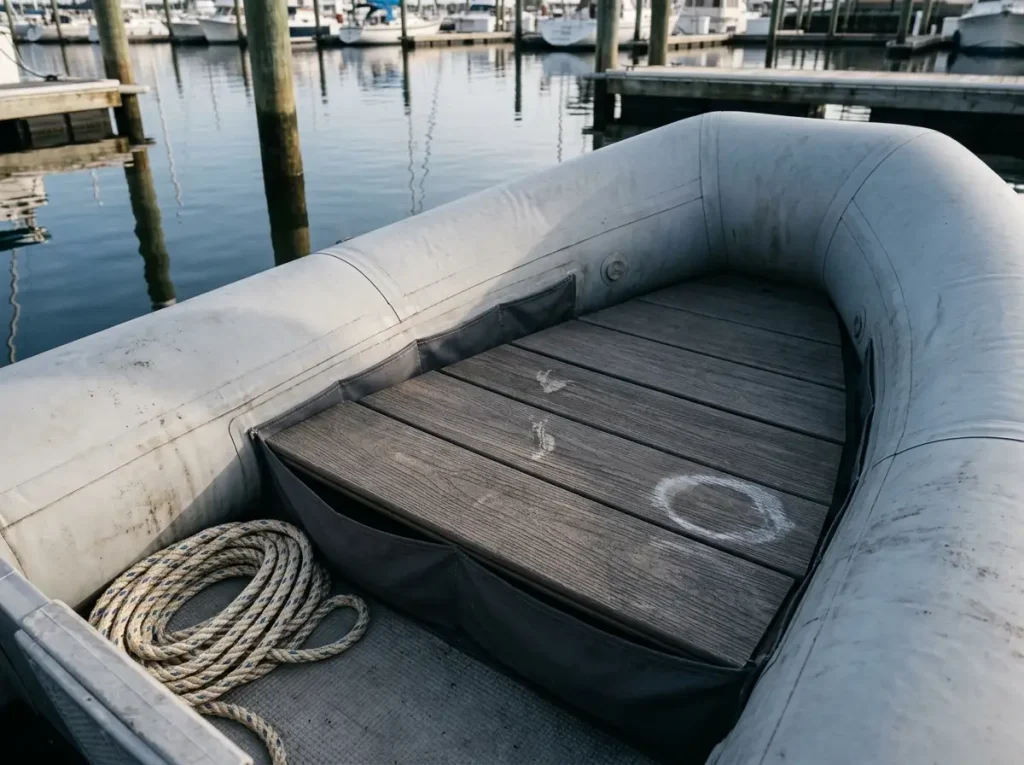
The fourth floor type confuses a lot of shoppers, so it’s worth a quick word. A slat floor isn’t really a river-raft floor at all — but you’ll meet the term browsing listings, and you don’t want to buy one by accident.
What a slat floor is
A slat floor is a set of rigid wooden or composite boards that drop into fabric pockets along the bottom of the boat. It gives you a hard, flat surface to stand on, and it’s common on small inflatable dinghies and tenders — the kind of boat you’d row out to a moored sailboat or putter around a calm marina in.
Why it’s wrong for rivers
On a river, a slat floor is the wrong tool. It has no give, no self-bailing drainage, and none of the forgiving flex that lets an inflatable absorb rocks and waves. If a listing calls something a raft but shows interlocking floorboards, that’s a calm-water boat wearing the wrong label — fine for a flat bay, out of place in a rapid.
How to Choose Your Floor by River and Use

This is where it all comes together. Forget the spec sheet for a second and answer two questions: what water do you run, and what do you do in the boat? Tell me those and I’ll tell you your floor.
Whitewater & technical water
If your main diet is swift, technical rapids, the I-beam floor is your friend. That keel-like tracking keeps you on your line when the river is trying to spin you, and the lower-riding hull bites the current for control. This is the I want one boat that charges whitewater answer.
Fishing, photography & family
If you fish, shoot photos, or haul a relaxed family crew, the drop-stitch floor wins. The rigid standing platform lets people move around without the boat feeling tippy, and the higher ride opens up shallow water. It’s the same logic that makes a tough, do-everything boat like the AIRE Tributary 14′ HD Self-Bailing Raft (check it on Amazon) such a popular expedition and fishing rig.
Calm water & budget
Mostly flatwater, mild floats, or a tight budget? Don’t let anyone talk you into a premium rig you don’t need. A bucket floor keeps the cost down and does the job where waves never fill the boat. Buying more floor than your water demands is just money left on the river bank.
Match it to your river class
The honest cut line is river difficulty. Calm Class I–II floats forgive a bucket boat; pushy Class III+ rewards a self-bailing floor, and the choice between I-beam and drop-stitch comes down to tracking versus standing comfort. If you’re unsure where your runs land, the American Whitewater International Scale of River Difficulty (Class I–V) is the standard reference, and you can round out the rest of your kit with our rafting gear checklist by river class.
If you can, stand in both floors before you buy. A five-minute test at a dealer or a friend’s boat tells you more than any spec line — the I-beam-versus-drop-stitch feeling is something your feet decide, not your wallet.
Floor Pressure, Materials, and Durability
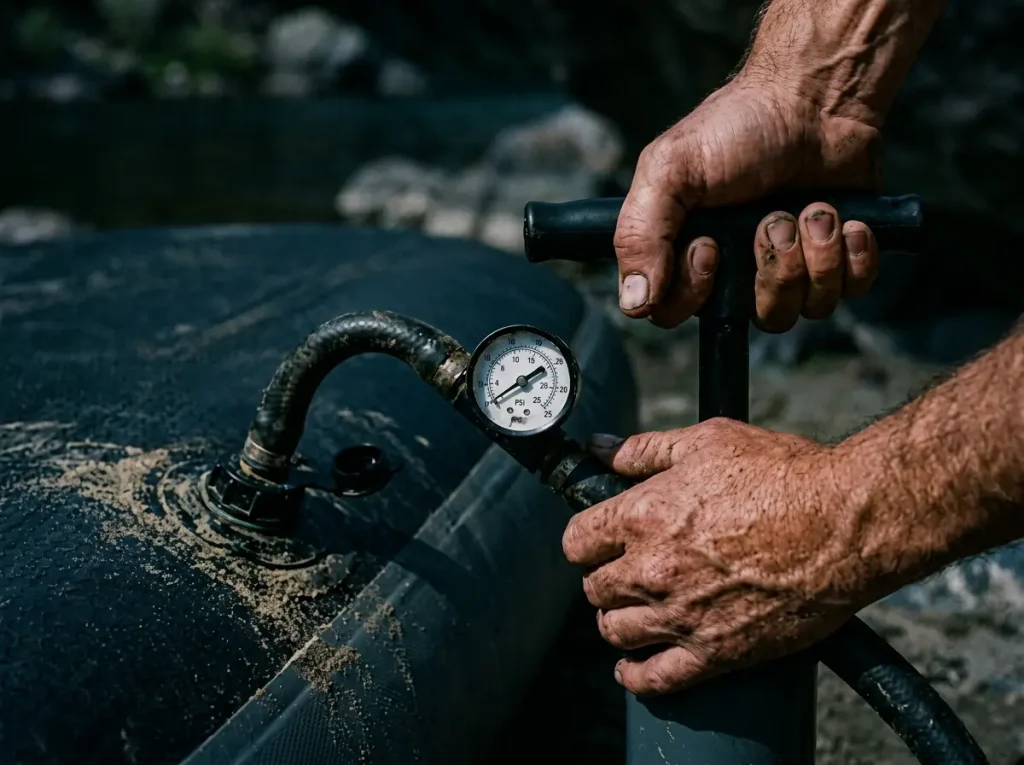
Here’s the gear talk nobody bothers to translate. The numbers on a floor — psi, denier, ounces — actually mean something on the water, so let’s turn them into plain English.
Pressure (psi) by floor type
Pressure is the cleanest way to understand how a floor feels. A drop-stitch floor runs eight to ten psi and feels hard underfoot. An I-beam floor runs low, around two to two-and-a-half psi, which is why it feels softer and needs topping off through the day. A bucket floor isn’t inflated at all — it’s just fabric. More psi means a more rigid, more stable platform, full stop.
Materials, denier & seams
Floors take the worst abuse in the boat, so material matters. A quality drop-stitch floor sits in a protective pocket of heavy PVC — often 4000-denier on the bottom and 2000-denier on top — where the denier number is basically the armor rating against rock strikes. Heavy fabric (a 42-ounce cloth is roughly 50 percent stronger than a 35-ounce one) and welded seams instead of glued ones are what separate a floor that lasts decades from one that doesn’t. If you want to go deeper on the fabric side, see how the floor stacks up against the tube material in our breakdown of PVC vs Hypalon rafts.
Weight, pack size & temperature
Weight and pack size track with the build: a drop-stitch floor is lighter and packs smaller than an I-beam of the same size, and a bucket floor is the lightest of all. The sneaky one is temperature. A high-pressure drop-stitch floor pumped firm in the cool morning will gain pressure as the sun heats it, and on a hot afternoon it can over-pressurize. Carry a gauge, check it, and burp a little air out when the day warms up — don’t just eyeball a drop-stitch floor.
Inflate a drop-stitch floor to full pressure in the shade, then re-check it after the boat has sat in the sun for an hour. Letting a touch of air out then is far better than coming back to a drum-tight floor at the takeout.
Can You Replace or Upgrade a Raft Floor?
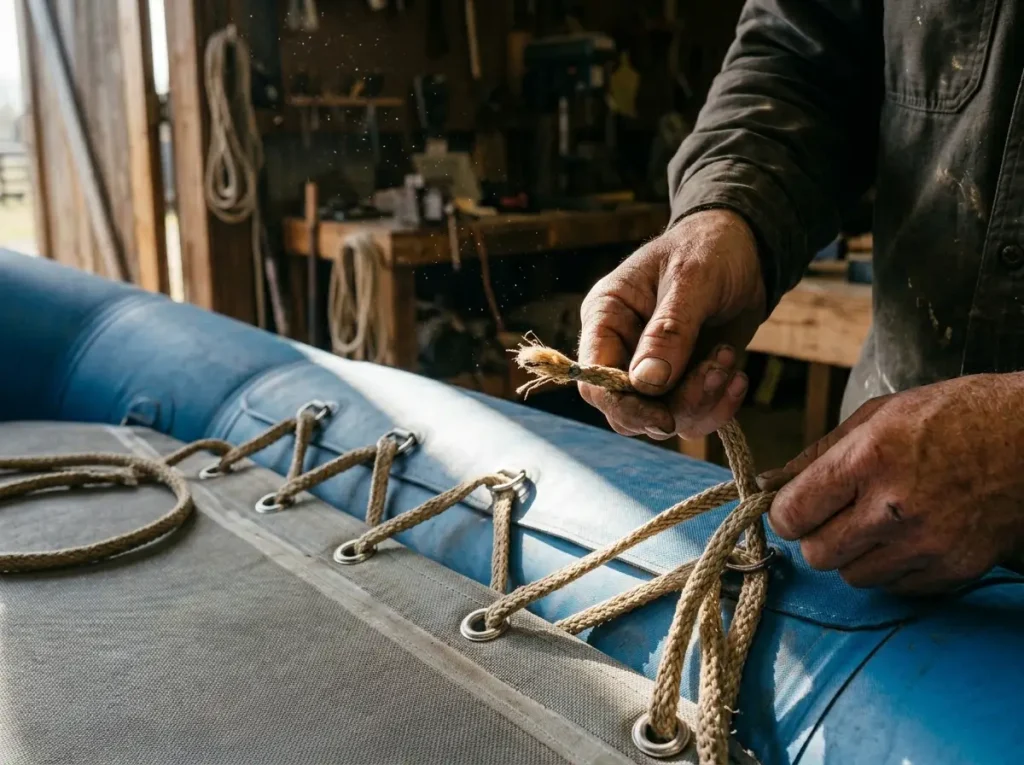
This is the question almost nobody answers, and it’s the one that saves you the most money long-term. The short version: sometimes yes, and it depends entirely on how the floor is attached.
Laced-in vs glued-in
Floors come two ways. A laced-in floor is held in with cord through loops around the perimeter, which means it’s removable — you can pull it out to clean it, dry it, repair it, or swap it. A glued-in floor is bonded to the boat permanently. Glued floors are clean and simple, but they can’t be removed, and over a couple decades the glue itself is what eventually fails, not the fabric.
Upgrading an existing boat’s floor
If your boat has a laced-in floor, you’ve got options. Plenty of owners start with one floor and later upgrade to a drop-stitch floor when they get more into fishing or standing work — the boat stays, the floor changes. It’s not a five-minute job, but it’s a real path, and it’s worth confirming a boat is laced-in before you buy if upgrading is on your mind.
Field repair & failure modes
Patching a floor is the same core skill as patching a tube, so if you can fix a leak in the field you can handle a floor. The one floor-specific failure to watch is drop-stitch delamination — the skins separating from the internal threads — which is its own animal and harder to repair than a simple puncture. For the step-by-step on doing it right, our walkthrough on field repair for whitewater safety covers the process.
Conclusion
Match the floor to your water, not to the spec sheet. If you run pushy whitewater and want a boat that holds its line, the I-beam floor earns its keep; if you fish, shoot, or haul a family and live on your feet, the drop-stitch floor is the rigid deck you’ve been missing; and if you float calm water on a budget, an honest bucket boat does the job for less.
Start with the first fork — self-bailing or bucket — then let your river class and what you do in the boat settle the rest. Get that right and the floor disappears under you, which is exactly what a good floor is supposed to do.
Frequently Asked Questions
01Is a drop-stitch floor better than an I-beam floor?
Neither is universally better. A drop-stitch floor wins for standing, fishing, and stability, while an I-beam floor tracks straighter in technical whitewater. Pick by how you use the boat.
02Are all self-bailing rafts drop-stitch?
No. Self-bailing is the category, and it includes both I-beam and drop-stitch floors. Both drain water automatically through perimeter holes — they just feel different underfoot.
03Can you stand on an I-beam raft floor?
Yes, but it feels softer and bumpier than a drop-stitch deck. Because an I-beam floor runs low pressure, it flexes more underfoot, so it’s less stable for casting or moving around.
04How much air pressure does a drop-stitch raft floor need?
A typical four-inch drop-stitch floor runs eight to ten psi for a firm, rigid platform. Use a gauge, not your thumb, and let air out as the sun heats the floor.
05Can you replace a raft floor?
It depends on how the floor is attached. A laced-in floor can be removed and replaced or upgraded, while a glued-in floor is permanent. Confirm which yours is before planning an upgrade.