
In this article
Standing at the river’s edge, you feel the current pulling at the loaded rafts. This isn’t one of the typical guided trips; every decision, from the permit in your pocket to the knots on the gear, is yours. The weight of that responsibility is matched only by the thrill of true self-sufficiency. This is the moment where competence is forged. This blueprint is your guide to shouldering that responsibility, transforming you from a passenger into the architect of an unforgettable whitewater rafting river trip.
True competence isn’t just a checklist; it’s a mindset. It’s about transforming trip planning and logistics and safety rules into a wilderness instinct for leadership, self-sufficiency, and conservation. This guide will walk you through that transformation. We’ll navigate the complex world of the permit lottery and discover viable “Plan B” beginner-friendly rivers. We will cover team assembly for a compatible crew with the right required skills and group dynamics. We’ll master the phased approach to logistics, from meals planning to executing the vehicle shuttle service. And we will embrace the code of Leave No Trace protocols, understanding why it’s not just a suggestion but a set of legally mandated regulations at the core of private boating. By the end of this journey, you won’t just have a plan; you’ll have the confidence to lead a memorable adventure.
First Principles: What Defines a Private Expedition?
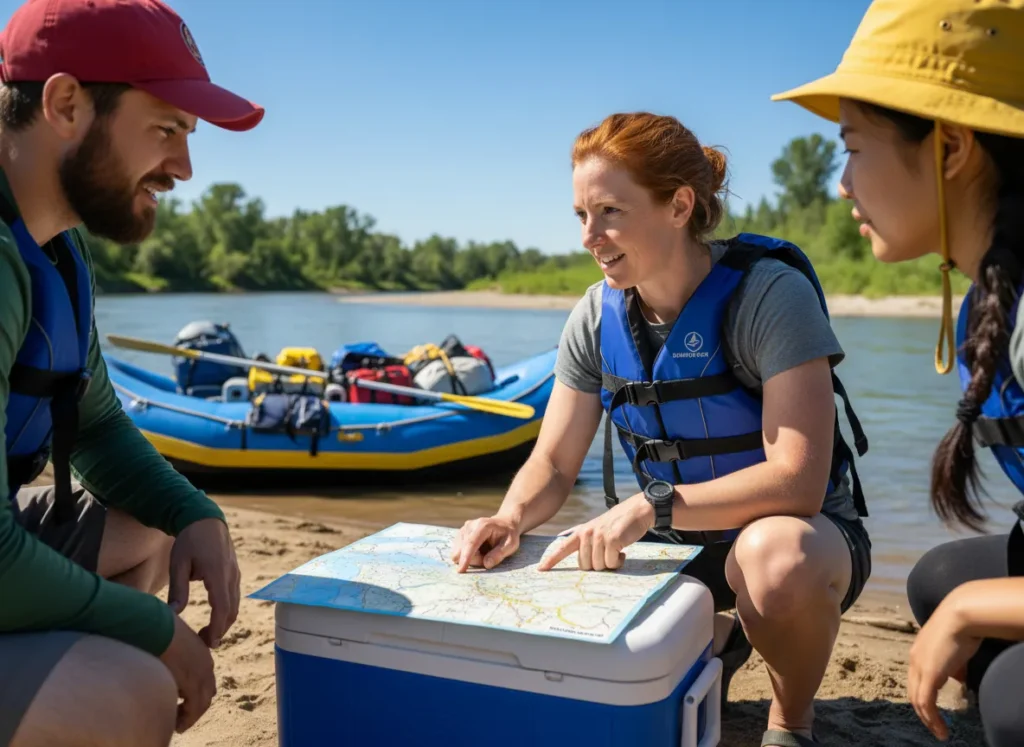
The heart of a private expedition, or private river excursions, is a fundamental shift in responsibility. This section establishes that critical transfer of duty and introduces the universal language of the river—its classifications—setting the stage for every decision you’ll make from this point forward.
What is the difference between a private and a guided trip?
A private expedition is defined by the complete transfer of responsibility from a professional outfitter to the private trip leader. Unlike a guided trip where participants are passive clients, members of a private trip are active crew, with specific crew roles responsible for chores, navigation, and self-rescue. The designated Trip Leader (TL) is the legal permittee, assuming 100% of the legal, logistical, technical, and interpersonal planning, execution, and risk for the entire group size. They hold the ultimate responsibility for the group’s safety and its compliance with all agency regulations, such as those detailed in the Noncommercial River Trip Regulations for major canyons.
This “cascade of responsibility” means the private group functions as its own outfitter, guide, and client simultaneously. Success is not just about rowing an oar boat through challenging rapids; it’s born from meticulous pre-trip planning, deliberate team coordination, and an unwavering commitment to conservation. This model demands a significant investment in skills, gear, and time, often beginning 12-18 months before the launch date. The transition from passenger to expedition leader is the core journey of a first private rafting trip, marking a shift toward self-sufficient wilderness travel.
How is river difficulty officially classified?
Before you can take on that responsibility, you must learn to speak the river’s language. The first words in that vocabulary describe its power. The International Scale of River Difficulty is the universal system for river classifications (Class I-VI), defining the rapids type you’ll encounter. Class I is fast-moving water with small riffles requiring minimal maneuvering. Class II (Novice) presents straightforward rapids with wide, clear channels that require some positioning to avoid obstacles. Class III (Intermediate) is characterized by moderate difficulty with irregular waves, strong currents, and passages that demand skilled maneuvering; this is the realistic upper limit for most beginner-led private trips, especially when water levels are high.
As the numbers climb, so does the consequence. Class IV (Advanced) involves difficult, powerful, and intense rapids demanding precise maneuvering in turbulent water. Class V (Expert) consists of long, violent, and complex rapids with significant hazards like large drops and unavoidable hydraulics, suitable for expert-only groups with experience in big whitewater. Class VI (Extreme) is considered unnavigable or is rarely attempted, representing the extreme edge of possibility with a high risk of serious injury or death. This classification system, authoritatively defined by resources like the American Whitewater Safety Code, is a critical first step in risk assessment. It directly informs your choice of river, required skill level, and necessary safety protocols, connecting directly to the fundamentals of whitewater rafting.
What is the “Beginner’s Danger Paradox”?
While the class number seems like a simple risk meter, the most lethal dangers often hide in plain sight on “easy” water. The “Beginner’s Danger Paradox” is one of the most common mistakes inexperienced rafters make: assuming that a high volume of river fatalities occurs only in expert-level rapids. The critical fact is they often happen on Class I-II water. The primary cause is not the complexity of the rapid but a failure of basic safety protocols due to complacency, especially on trips perceived as family-friendly rafting adventures. Key contributing factors include a lack of hazard recognition and, most critically, the failure to wear a Personal Flotation Device (PFD). First-time rafters may mentally prepare for obvious, fun rapids but fail to identify lethal, common underwater obstacles like strainers (fallen trees) on a calm stretch.
This paradox is consistently validated by official data, including Coast Guard recreational boating statistics, which show that not wearing a PFD is the leading contributor to paddling fatalities. It reframes safety not as a reaction to a high-class rapid, but as a constant mindset of preparation. This mindset demands always wearing your PFD, knowing how to identify hazards at any water level, and never underestimating the power of the current. The greatest danger for a first-timer is not the Class IV rapid they know to avoid, but the complacency on a Class I float that leads to a preventable accident. This is where a rafter’s field manual to river hazards becomes an essential resource.
Phase 1: How Do You Secure a Permit for Your Trip?

Understanding this paradox is your first step in building a professional mindset. The second is navigating the single biggest hurdle in private boating: securing legal access to the river. This process is defined by a critical “Timeline Dissonance,” requiring two distinct strategies for the long-range planner and the immediate-action seeker.
For Long-Range Planners: How does the permit lottery system work?
Access to most premier multi-day rafting trips in the U.S.—like the Grand Canyon on the Colorado River, Idaho’s Main Salmon River, or Oregon’s Rogue River—is managed by federal agencies through highly competitive permit lotteries, a process detailed in a strategic guide to USA river permits. These lotteries typically run on Recreation.gov and require applications to be submitted during a specific winter window, often from December 1st to January 31st, for the following summer’s best season. This system forces a potential trip leader to commit to planning 12-18 months in advance, long before they may feel ready for such an expedition. Key lottery dates, such as for the “Four Rivers” in Idaho (Main Salmon, Middle Fork Salmon, Selway, and Hells Canyon on the Snake River), are non-negotiable; being even one day late means missing the entire prime season.
Some rivers, like the Grand Canyon, use a weighted lottery system to give preference to applicants who have not held a permit recently, increasing fairness. Winning a lottery grants you the opportunity to lead a once-in-a-lifetime trip on a specific date; you must then confirm, pay, and assemble a crew that meets all agency requirements. The low odds of success mean that having a contingency plan is not just wise, but essential. This long-lead time is a primary reason why planning a first private trip must be approached like a formal project with clear deadlines and milestones.
Big 5 US Permit Lottery Guide
Essential information for applying to the major US river permit lotteries.
Managing Agency & Application
National Park Service (NPS)
Main Lottery: First 3 weeks of Feb for following year.
Permit Details
High-Use Season: All Year
River Class: Class I-V (Technical)
Managing Agency & Application
U.S. Forest Service (USFS)
Dec 1 – Jan 31
Permit Details
High-Use Season: May 28 – Sep 3
River Class: Class III-IV
Managing Agency & Application
U.S. Forest Service (USFS)
Dec 1 – Jan 31
Permit Details
High-Use Season: Jun 20 – Sep 7 (Varies)
River Class: Class III
Managing Agency & Application
Bureau of Land Management (BLM)
Dec 1 – Jan 31
Permit Details
High-Use Season: May 15 – Oct 15
River Class: Class III-IV
Managing Agency & Application
Bureau of Land Management (BLM)
Dec 1 – Jan 31
Permit Details
High-Use Season: May 1 – Sep 30
River Class: Class II-III
For Immediate-Action Seekers: How can you raft this year without a lottery win?
But what if you didn’t win, or you just decided in March that you want to go rafting this summer? Don’t despair; the system has a backdoor. The alternative to the lottery is seeking out non-lottery, “self-permit” rivers or looking for post-lottery cancellations. Many excellent rivers, like Oregon’s John Day, require a permit for record-keeping but have no quota, making them available on demand via online systems. Other rivers, like Utah’s Green River through Desolation-Gray Canyons or Gates of Lodore, release all un-awarded and canceled dates on a specific day (e.g., March 15) on a first-come, first-served basis. These self-permit rivers, like the St. Joe River or Clark Fork River, are often less difficult (Class I-III), making them perfect beginner-friendly rivers and training grounds for a first private expedition.
Classic beginner-friendly self-permit sections include the Ruby-Horsethief and Labyrinth Canyons on the Green River (Class I-II). For those seeking more challenge, Idaho’s Lower Salmon River is a Class III self-permit trip, often with forms available right at the launch site. This “Plan B” strategy is crucial for gaining experience, testing gear, and building a solid crew while waiting for a high-demand lottery win. As an example, the BLM permit system for the Rogue River is a great case study of how these systems work. By targeting these alternatives, an “Immediate-Action Seeker” can successfully plan and execute a multi-day rafting trip within a single season.
Phase 2: How Do You Assemble a Competent and Compatible Crew?
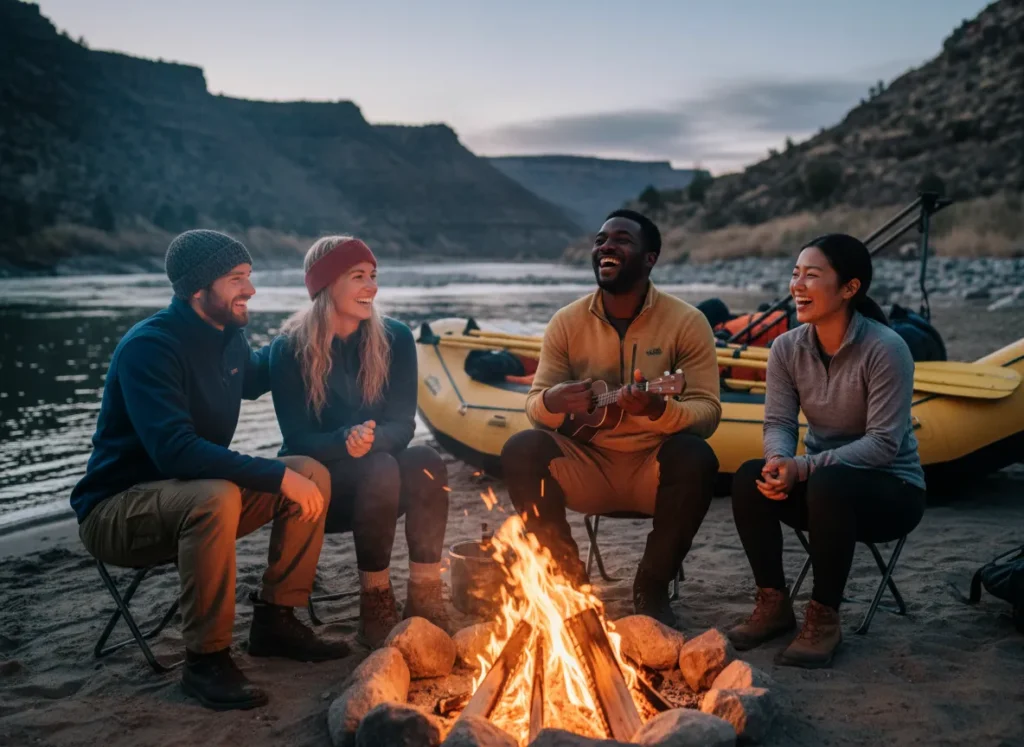
Once your name is on a permit—whether from a lottery win or a self-serve system—your next task is team assembly to build the human engine that will power the expedition. This section details the “human element,” explaining the non-negotiable crew roles, skills, and interpersonal dynamics required for a functional and safe team.
What are the three pillars of building a private rafting team?
Building a team rests on three core pillars. The first is Skillsets. The group must have a critical mass of verifiable expertise. This includes enough experienced oarspeople to navigate all rapids safely, paddlers with medical training (Wilderness First Aid or higher), and ideally, individuals with formal swiftwater river rescue training. Understanding the fundamentals of how to guide a raft is a baseline. The second pillar is Shared Interests. The team must be aligned on the purpose of the trip, from daily activities/entertainment to the overall sense of adventure. Misalignment on pace and daily goals, such as hard-charging hiking versus relaxed floating, is a primary source of conflict. The final pillar is Interpersonal Compatibility. Team members must be willing, hardworking, and able to get along in close quarters under stress. A multi-week trip is not the place for non-team-players or difficult personalities.
The Trip Leader is responsible for vetting participants against these three pillars to minimize liability and maximize the chances of a successful trip. For skillsets, having redundancy is key; for example, having more than one person with medical training or rescue skills. Setting clear expectations about the trip’s “style” before finalizing the roster prevents on-river friction. Compatibility is often the hardest to judge but is magnified under the pressures of a long expedition; the ideal crew member is low-maintenance, helpful, and resilient. A breakdown in any one of these pillars can jeopardize the entire expedition, turning a dream trip into a logistical and social nightmare.
Pro-Tip: Hold a mandatory pre-trip video call with all potential crew members. Use this meeting to transparently discuss the trip’s goals, pace, budget, and non-negotiables (like safety protocols and chore participation). This single conversation can prevent immense friction on the river.
How do you manage group dynamics and chores?
A well-assembled team is a powerful asset, but even the most skilled and compatible group can fall apart if the daily work isn’t distributed fairly. The only way to ensure fair labor distribution and avoid resentment on a long trip is with a clear, pre-assigned chore system. A “chore wheel” or similar schedule for chore duties should be created before the trip and agreed upon by all members. Divide all major camp responsibilities—like cooking dinner, washing dishes, preparing breakfast, and managing the toilet system—into teams of 2-3 people.
Rotating these duties ensures that no single person or group gets stuck with the least desirable jobs for the entire trip. This system creates predictability and efficiency, allowing your camping set up to be established and broken down smoothly. It also reinforces the “active crew” mindset, making it clear that everyone is expected to contribute to the expedition’s success. Without a formal system, the workload inevitably falls on a few highly motivated individuals, which is the fastest way to poison group morale. This internal system is a reflection of the code of whitewater river etiquette that governs the entire private boating community.
Phase 3: What Gear is Essential for a Self-Sufficient Expedition?
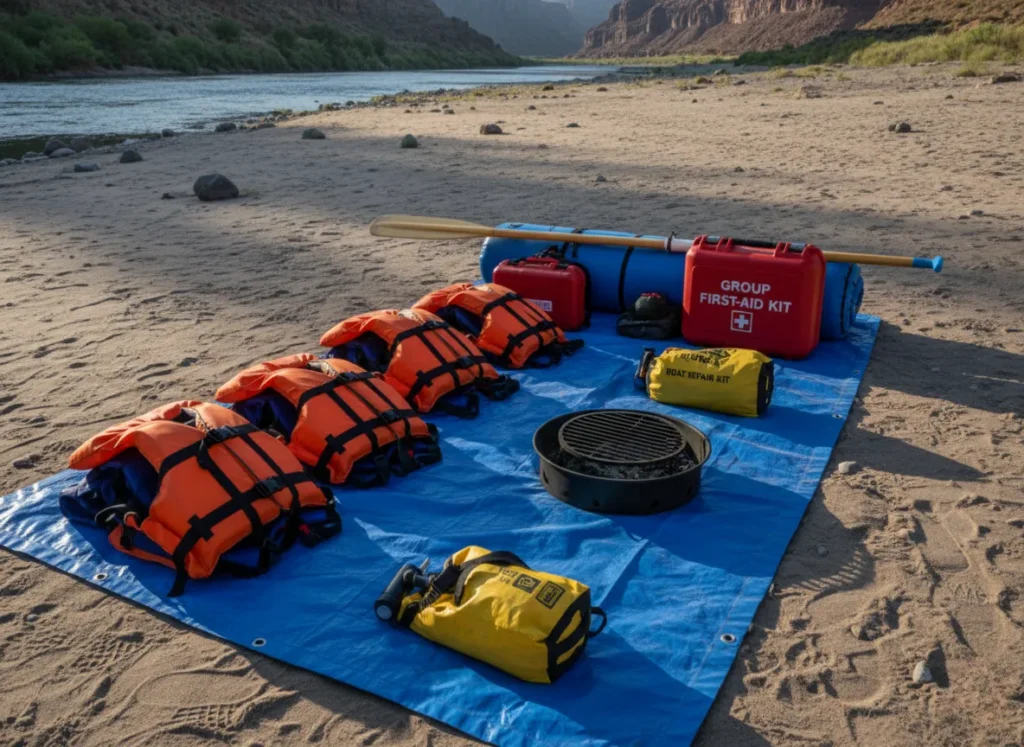
With your crew assembled and your chore wheel built, it’s time to equip them. The next phase is about acquiring the hardware for your self-sufficient floating community. This section provides a blueprint for outfitting the expedition, separating the non-negotiable, legally mandated group gear from the essential personal items.
What is the legally mandated group gear required for a permit?
Federal land management agencies (NPS, BLM, USFS) mandate a specific inventory of group safety and sanitation gear that is often checked by a ranger at the launch ramp. This gear list, as seen on official pages like the BLM required equipment for boating, is non-negotiable. Failure to have any required item can result in the revocation of your permit on the spot. Key safety items include one serviceable, USCG-approved personal flotation device (pfd) for each participant, a spare PFD, a throw bag per boat, and a comprehensive group first-aid kit. Required boat items include a spare oar per oar boat, an adequate air pump, and a boat repair kit capable of major field repairs.
Key sanitation items, rooted in Leave No Trace principles, are also legally required. These include an approved, washable, and reusable toilet system (the “groover”) to pack out all solid human waste. A rigid, durable metal fire pan is also required to contain all fire ash and debris, preventing scorch marks on beaches. Finally, a fine-mesh strainer is mandated for filtering dishwater to pack out all food scraps. These items form the backbone of your legal compliance and are essential for safety and comfort, forming just the beginning of a systematic rafting gear checklist.
| NPS/BLM Mandatory Group Gear Checklist (Sample) | ||
|---|---|---|
| Equipment Category | Required Item | Specification |
| Personal Safety | Personal Flotation Device (PFD) | One serviceable USCG-approved Type I, III, or V for each participant. Must be rated for whitewater. |
| Group Safety | Spare PFD | One spare for every 1-10 people, depending on agency rules. |
| Group Safety | Throw Bag(s) | At least one per group, often required per raft. |
| Group Safety | First-Aid Kit | One major kit for the group; smaller kits on each boat. |
| Group Safety | Signal Device | Signal mirror, panels, or sat phone (recommended). |
| Boat | Spare Oars/Paddles | One extra oar per oar boat; two extra paddles per paddle raft. |
| Boat | Air Pump | At least one per trip for inflatables. |
| Boat | Boat Repair Kit | Adequate for field repairs of fabric, valves, and frames. |
| Camp & LNT | Approved Toilet System (“Groover”) | A washable, reusable, leak-proof container OR approved bag system (e.g., Wag Bag). |
| Camp & LNT | Fire Pan | A rigid, durable metal pan large enough to contain all fire ash and debris. |
| Camp & LNT | Fine-mesh Strainer | For straining dishwater and fire ash. |
What personal gear should each crew member bring?
This mandatory gear ensures the group’s collective survival and legal compliance. Just as important is the personal gear that ensures each individual’s safety and comfort. Personal gear is divided into two categories: “On-River Gear” for daytime use and “Camp Gear” for evenings. The cardinal rule of on-river clothing recommendations is to AVOID COTTON. Cotton absorbs water, loses all insulation, and is a primary cause of hypothermia. On-river wear consists of layers and dry clothes: a synthetic base layer, a fleece or wool mid-layer for insulation, and a waterproof/windproof outer shell (splash top, wetsuit, or drysuit). Essential on-river items also include secure, closed-toe river shoes, a PFD (worn at all times on the water), a helmet (depending on the rapid class), sunscreen, water bottles, and sunglasses with retainers.
Your camping gear is packed in large, waterproof dry bags and includes personal items like a tent, sleeping pads, or hammocks, a sleeping bag, camp chair, and headlamp. Camp clothes can be cotton, providing comfort after a day on the river. The choice between a wetsuit and one of the more advanced dry suits, a critical decision explained in this data-driven guide to wetsuits vs. drysuits, depends on water temperature. The American Canoe Association’s “60-Degree Rule” states that if water is below 60°F, thermal protection is mandatory. Dressing for the water temperature, not the air temperature, is a critical safety discipline.
Phase 4: How Do You Manage Expedition Logistics Before Launch?
You have your team and your gear. Now comes the final, intense phase of off-river preparation: transforming raw ingredients and loose equipment into a well-oiled expedition machine. This section covers the critical pre-launch operations that happen in the final weeks and days, focusing on provisioning and vehicle transport.
What is the professional method for packing food and coolers for multiple weeks?
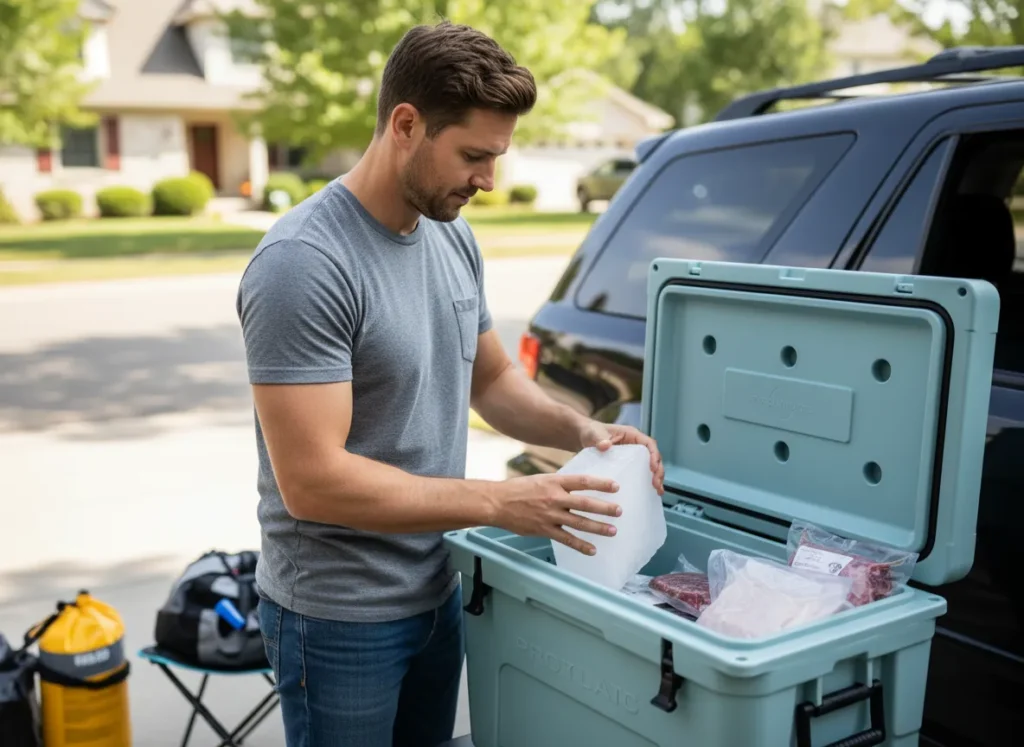
The goal is to maximize ice retention and minimize food contamination, a process that begins at home with pre-chopping vegetables, pre-cooking meals, and vacuum-sealing meats. Use a multi-cooler system: at least one for food (opened infrequently), one for drinks (opened constantly), and if you have the space, a third just for ice. Pre-chill the coolers for a day before packing and freeze all meats solid. Use a mix of ice types: a bottom layer of dry ice (handled properly), a main layer of block ice, and filler cube ice to eliminate all air gaps. Proper meals planning, potentially including a propane stove, is critical to the success and morale of any trip, regardless of its duration.
Pack in reverse order of use: last week’s frozen meats go on the bottom, with the first day’s delicate produce on top. Place a final layer of insulation, like a foam pad, on top before closing the lid. This disciplined system is how professional outfitters keep ice for 17 days or more. Organizing meals by “camp day” into separate dry boxes (“rocket boxes”) simplifies kitchen setup and prevents rummaging. This physical process is the outcome of strategic, data-driven river meal planning.
Pro-Tip: Instead of buying bags of ice that melt quickly, freeze water in 1-gallon jugs or 2-liter bottles. They act as large blocks of ice, last much longer, and provide you with cold drinking water as they thaw. This maximizes space and utility.
How does a vehicle shuttle work?
With the coolers packed like a science experiment, you now face what is often the most confusing logistical hurdle of the entire trip: the vehicle shuttle. A shuttle is the process of moving the vehicles from the put-in to the take-out location, so they are waiting at the end of the trip. The most common method is Option 1 (Professional Shuttle Service). A hired, insured company drives your vehicles for you. This must be booked in advance. Option 2 (Self-Shuttle) requires at least two vehicles; the group drives all vehicles to the take-out, leaves most, and then everyone piles into one vehicle to drive back to the put-in. This is time-consuming and must be carefully coordinated.
When using a professional service, you will need to provide them with keys, a contract, and ensure your vehicle has adequate fuel and liability insurance. In some high-security areas, a mandatory outfitter shuttle is the only option. The shuttle is one of the most complex logistical hurdles and requires significant planning to ensure a smooth transition from the road to the river. Forgetting to arrange the shuttle is a rookie mistake that can derail a trip before it even begins. You can find a complete overview in the definitive paddler’s guide to river shuttles.
Phase 5: What Are the Core Safety Protocols on the River?
The cars are shuttled, the coolers are packed, and the crew is ready. You’ve reached the launch ramp. Now, the operational phase begins, starting with a comprehensive safety briefing and the most important safety philosophy in rafting. This section covers the execution of the trip itself, detailing essential on-river systems, from rigging inflatable rafts to executing emergency action plans.
What is the “Rig to Flip” philosophy?
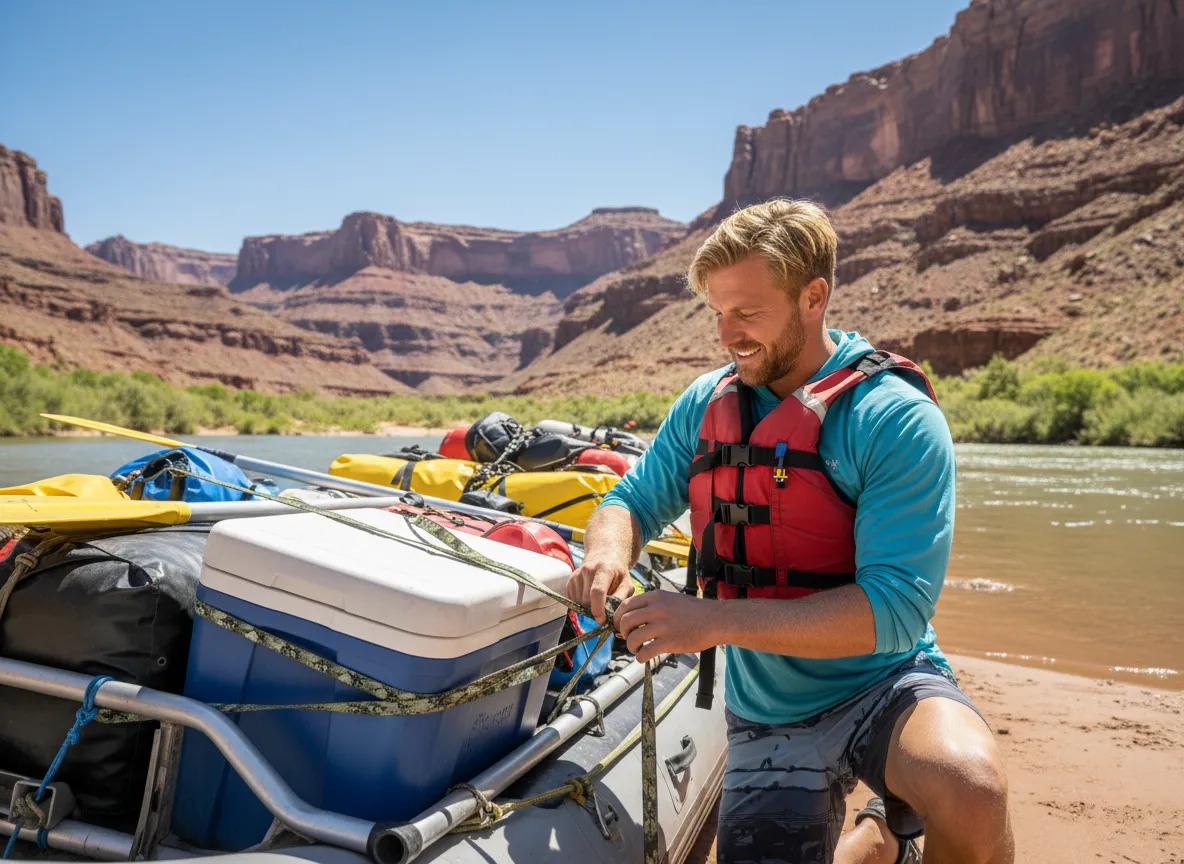
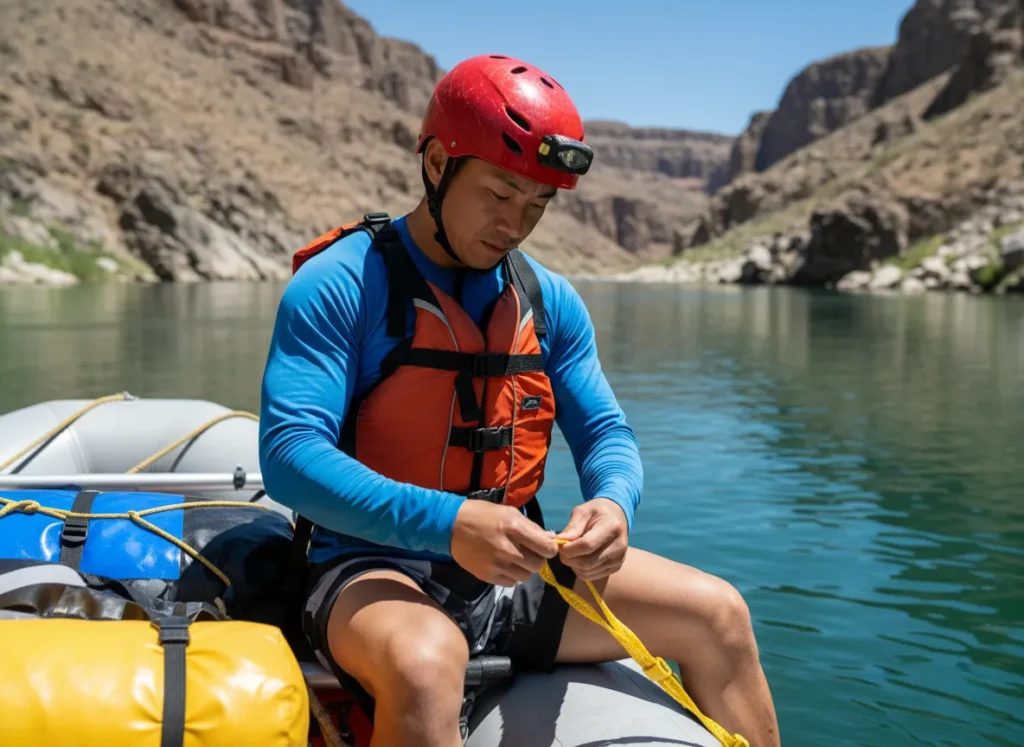
“Rig to Flip” is a core safety philosophy that assumes a raft flip is not a matter of if, but when. The goal is to rig the boat so that when a flip occurs, it is a controlled, survivable event where 100% of the gear remains secured to the raft. This is achieved by using cam straps and locking carabiners with counter-tension to securely lock the frame to the raft’s D-rings. All gear, like coolers and dry boxes, must be suspended from the frame, not resting on the inflatable floor. This is a key part of a pro guide to raft safety.
A critical part of this philosophy is creating a “clean rig” with no entanglement hazards, such as loose rope loops (“danger ropes”) or gaps between gear (“tiger traps”). All cam strap tails must be meticulously managed by daisy-chaining or rolling them tightly to prevent them from becoming snag hazards in a swim. A properly rigged boat becomes a stable recovery platform even when upside down, allowing the crew to consolidate and begin the recovery process. This disciplined mindset is a hallmark of professional-level boating and is non-negotiable for expedition safety.
What happens if you fall in the water?
With the rafts rigged for the worst-case scenario, it’s time to prepare the human crew. The most common on-river emergency is a swimmer in the water. The first and most critical self-rescue skill is assuming the Defensive Swim Position. Float on your back with your “Nose and Toes” out of the water. Keep your feet pointing downstream with your legs slightly bent to act as bumpers, allowing you to push off rocks. Use your arms out to the side for maneuvering.
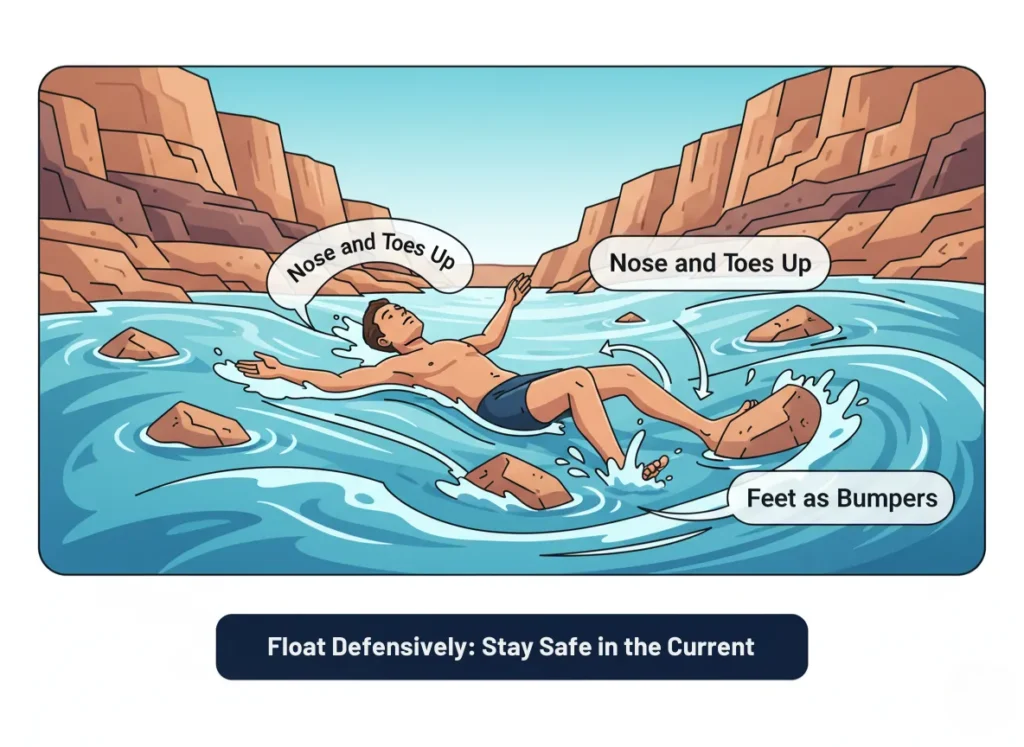
The single most important rule from all guide instructions is NEVER try to stand up in moving water. This is the primary cause of foot entrapment, a deadly hazard where a foot gets wedged in rocks and the current pushes the body under. For rescue, swim toward the nearest boat or shore. If a throw bag is tossed, grab the rope, not the bag, and roll onto your back to be pulled in. Being comfortable in moving water is a prerequisite for all participants. This is explored further in the whitewater defensive vs. aggressive swim guide.
What is the emergency action plan if the raft flips?
Knowing how to save yourself is the first step. The next is knowing how to function as a team when a more chaotic event occurs. A raft flip is more chaotic but manageable. The first priority for the trip leader is a head count. If trapped underneath the flipped raft, there will be an air pocket; do not stay there—pick a direction (toward the light) and swim out immediately. Once clear, your goal is to self-rescue and consolidate on the now-stable, upside-down raft. If you are swept away, revert to the defensive swimming position.
The final step is to re-flip the raft using established raft flip recovery techniques. The crew works together, using their body weight on one side of the boat to pull it back upright. Many crews will rig a “flip line”—a strap running over the bottom of the boat—before entering a major rapid, providing leverage to make re-flipping easier. This coordinated procedure, when practiced, turns a potentially catastrophic event into a recoverable incident.
The Conservation Code: How Do You Practice Legally Mandated LNT?
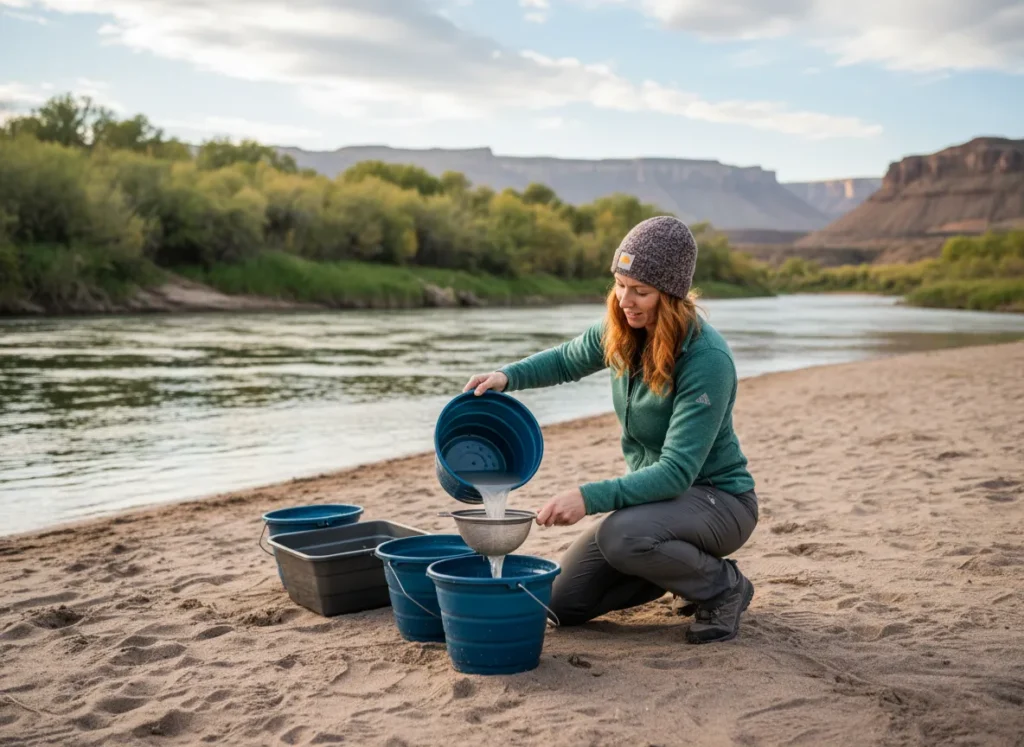
Executing on-river protocols is about ensuring survival. This final pillar of a private expedition is ensuring the survival of the river corridor itself. This section reframes conservation from an optional “green tip” to a core component of legal compliance, detailing the specific, mandated Leave No Trace protocols for waste disposal on permitted rivers.
How do you properly dispose of human waste on a river trip?
On most, if not all, permitted river canyons, burying solid human waste is prohibited by law. All solid human waste must be packed out. This requires using an “approved portable toilet system,” universally known as a “groover.” The system must be set up in a private location with a good view, accompanied by a handwash station. An “occupancy key” like a paddle is placed at the start of the path to signal when it’s in use. This entire process is covered in detail in this guide to groovers & wag-bags.
Only solid waste and toilet paper go into the groover; urine fills it up too quickly. The LNT-approved method is to urinate directly into the river, where the high volume of water provides adequate dilution. A dedicated “pee bucket” can be used in camp at night and then emptied into the river in the morning. Adherence to this system is a non-negotiable legal requirement for waste management, as documented by land managers like the BLM regarding regulations on human waste disposal, and is a sign of a responsible, well-led private expedition.
What is the LNT method for washing dishes?
Managing human waste is the most infamous LNT practice, but managing waste from the kitchen is just as critical to the river’s health and habitat protection. The expert-level, LNT-approved method for washing dishes is the “4-Bucket System,” designed to capture all food waste. Bucket 1 (Scrape & Pre-Rinse): Scrape all food particles into the trash and use cold river water for an initial rinse. Bucket 2 (Hot Wash): Use hot water with a minimal amount of biodegradable soap. Bucket 3 (Hot Rinse): Use clean hot water to rinse off all soap. Bucket 4 (Cold Bleach Sanitize): Use cold river water with a capful of bleach for a final sanitizing dip.
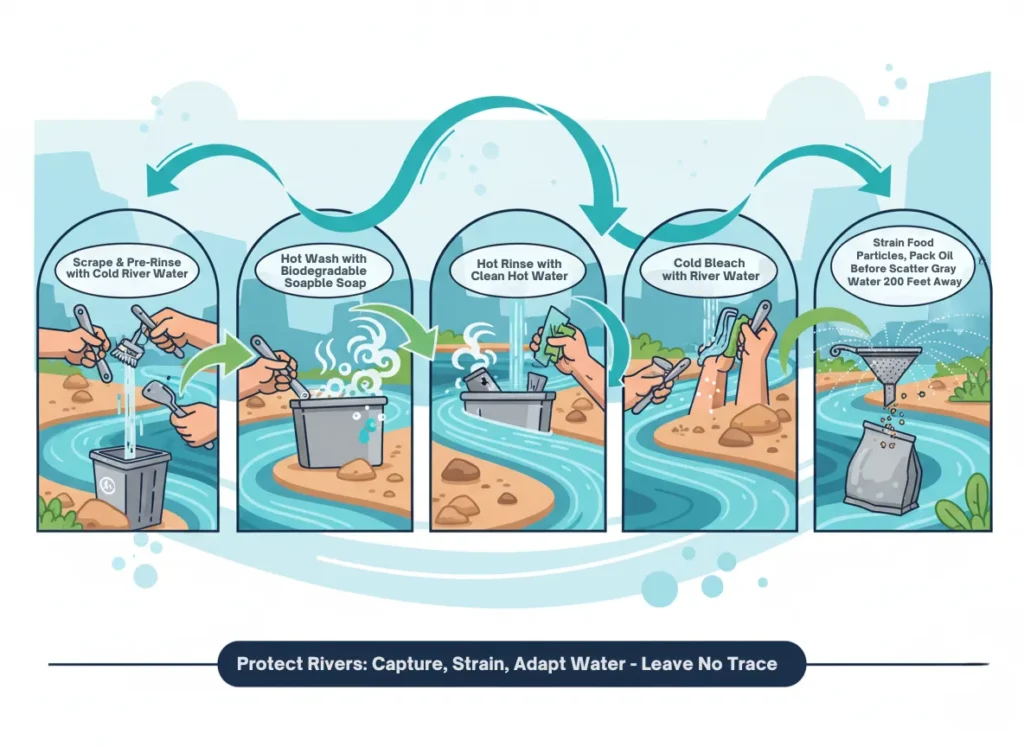
After washing is complete, all dishwater from all four buckets must be strained through a fine-mesh strainer to capture any remaining food particles. The strained food bits are packed out with the trash. The strained gray water is then carried at least 200 feet away from the river and scattered broadly. This system protects river water quality and prevents animals from becoming habituated to human food scraps, aligning with the core Leave No Trace principles for waste disposal.
Conclusion
Mastering these systems—from permits to PFDs to groovers—is the essence of the private boater’s journey. Your first private rafting trip represents a “cascade of responsibility,” requiring you to adopt the mindset, skills, and legal compliance of a professional outfitter. Remember that risk on the river is not linear; the “Beginner’s Danger Paradox” shows that complacency on easy water is often more deadly than a feared rapid. Navigating the permit system requires a bifurcated strategy, planning months in advance for lotteries while having self-permit “Plan B” options ready. Finally, conservation via Leave No Trace principles is not optional; practices like packing out human waste in a groover are legally mandated and core to responsible boating.
Your journey from passenger to expedition leader is just beginning. Use this blueprint as your framework, and share your own first-trip experiences and questions in the comments below.
Frequently Asked Questions about Your First Private Rafting Trip
Do I need to know how to swim for rafting?
While PFDs provide flotation, all participants on a private trip must be comfortable in moving water and able to assist in their own self-rescue. For Class IV and higher rapids, strong swimming ability is considered a mandatory skill.
What are the most common mistakes on a first private trip?
The most common mistakes are wearing cotton clothing (which leads to hypothermia), failing to properly plan logistics like the vehicle shuttle, and underestimating the importance of group compatibility. Another major mistake is not understanding your role as an active crew member responsible for chores and self-rescue.
How do I assemble a team for a private expedition?
Assemble your team based on three pillars: essential skillsets (boating, medical, rescue), shared interests (trip pace and goals), and interpersonal compatibility. The trip leader is responsible for vetting everyone to ensure the group is both safe and functional for the duration of the trip.
What is a groover and why is it important?
A groover is the common name for an approved portable toilet system required on most permitted rivers to pack out all solid human waste. It is a non-negotiable piece of legally mandated gear essential for complying with Leave No Trace regulations and protecting the river environment.
Risk Disclaimer: Whitewater rafting, kayaking, and all related river sports are inherently dangerous activities that can result in serious injury, drowning, or death. The information provided on Rafting Escapes is for educational and informational purposes only. While we strive for accuracy, the information, techniques, and safety advice presented on this website are not a substitute for professional guide services, hands-on swiftwater rescue training, or your own critical judgment. River conditions, including water levels, currents, and hazards like strainers or undercut rocks, change constantly and can differ dramatically from what is described on this site. Never attempt to navigate a river beyond your certified skill level and always wear appropriate safety gear, including a personal flotation device (PFD) and helmet. We strongly advise rafting with a licensed professional guide. By using this website, you agree that you are solely responsible for your own safety. Any reliance you place on our content is strictly at your own risk, and you assume all liability for your actions and decisions on the water. Rafting Escapes and its authors will not be held liable for any injury, damage, or loss sustained in connection with the use of the information herein.
Affiliate Disclosure: We are a participant in the Amazon Services LLC Associates Program, an affiliate advertising program designed to provide a means for us to earn advertising fees by advertising and linking to Amazon.com. As an Amazon Associate, we earn from qualifying purchases. We also participate in other affiliate programs and may receive a commission on products purchased through our links, at no extra cost to you. Additional terms are found in the terms of service.