

In this article
Standing on a riverbank, the roar of a rapid filling the air, you can feel the power thrumming through the soles of your boots. You’re about to build something—not with wood and nails, but with paddle strokes and precise angles. The search for how to be a good rafter often leads online to the world of carpentry, but the metaphor is surprisingly perfect. Becoming an expert on the water, like a master framer, is a journey of roof framing knowledge, progressing from simple common rafter skills to complex hip rafter maneuvers. This guide is your blueprint for a solid rafter system, showing you how to perfect your rafter layout, master your rafter tools, and progress from basic plumb cuts to the ultimate goal: not just skill, but impeccable judgment.
This journey is about understanding the foundational rules of the river, from the International Scale of River Difficulty to reading the “angles” of the water itself—this is the rafter’s ‘Building Code.’ We’ll equip you with the ‘Tools of the Trade,’ the essential personal, group, and safety gear that forms your non-negotiable toolkit. From there, you’ll master the fundamental, “straight-line” techniques of self-rescue and basic paddle strokes—your ‘Common Rafter’ Skills. Then, you’ll progress to advanced, multi-vector skills like precision eddy turns, the ‘Hip Rafter’ Maneuvers that define a confident guide. Finally, we’ll go beyond technique to cultivate the judgment, leadership, and ethical framework of The ‘Master Rafter’s’ Mindset, the sign of true mastery of the entire structure.
What is the Rafter’s ‘Building Code’ for Understanding the River?
Before you ever dip a paddle in the water, you need to understand the blueprint. Just as a framer reads architectural plans to determine the total run and span of a roof, a rafter must understand the objective classifications of risk and the basic language of hydrology. This is the foundational knowledge that informs every decision you’ll make, ensuring your rafter design complies with the river’s demands.
How is River Difficulty Officially Classified?
The universal “building code” for rafters is the International Scale of River Difficulty. It’s not a subjective feeling; it’s an objective measure of a rapid’s technical challenge, slope, and risk, providing a common language for river runners worldwide. The scale ranges from Class I (easy, moving water) to Class VI (extreme and unnavigable), with each class representing a significant leap in intensity—much like the difference in loads and complexity between framing a simple shed roof and a complex intersecting roof with dormers and gambrel features.
Class I is “very easy with small, regular waves,” the kind of water that requires no training to enjoy—analogous to a low-pitch gable roof. Class II introduces “easy rapids” with clear channels that require some basic maneuvering. This is where most people begin their journey.
AW Whitewater Class Definitions
Understanding difficulty levels, required skills, and real-world examples for river ratings.
Definition
Easy
Example
A gentle float on a lazy river.
Definition
Novice
Example
“Easy rapids,” perfect for beginners and families.
Definition
Intermediate
Example
Irregular waves, strong eddies; requires skilled maneuvering.
Definition
Advanced
Example
Powerful, long, and obstructed rapids with high consequence.
Definition
Expert
Example
Extremely long, violent rapids with severe hazards. Rescue is difficult.
Definition
Extreme
Example
Considered unnavigable. For expert teams exploring first descents only.
The jump to Class III is significant. This is “intermediate” whitewater, featuring large, irregular waves and powerful currents that demand skilled maneuvering. A trained guide or significant prior experience is highly recommended here. Class IV (“advanced”) and Class V (“expert”) are another world entirely. They involve powerful, hazardous features, major obstacles, and demand precise, high-consequence maneuvering where errors can be severe, not unlike miscalculating the cuts for hip rafters or valley rafters.
While rafting has a reputation for danger, it’s important to understand the context. The actual injury rate is very low (0.263 per 1,000 rafters) if protocols are followed. The highest risks stem from user error, with the most common and tragic being the failure to wear a Personal Flotation Device (PFD). Class VI exists to underscore the absolute limit of the sport—a rating for rapids that are considered unnavigable or have yet to be run successfully. For a complete breakdown, consult American Whitewater’s official classification system, the primary authority on the matter. This knowledge is a core part of understanding the fundamentals of whitewater rafting.
With the objective “code” understood, the next step is to learn how to read the “site plans”—the specific features of the water itself.
How Do You ‘Read the Water’ for Safe Passage?
A master carpenter has a speed square or rafter square to perfect angles and mark common rafter layouts. A master rafter has a mental speed square, a tool used to read the river’s angles and features to distinguish safe paths from hazards. This skill, “reading water,” is about interpreting the river’s surface to understand the unit rise and unit run of the riverbed underneath. It is how you lay out and cut your line through the rapid.
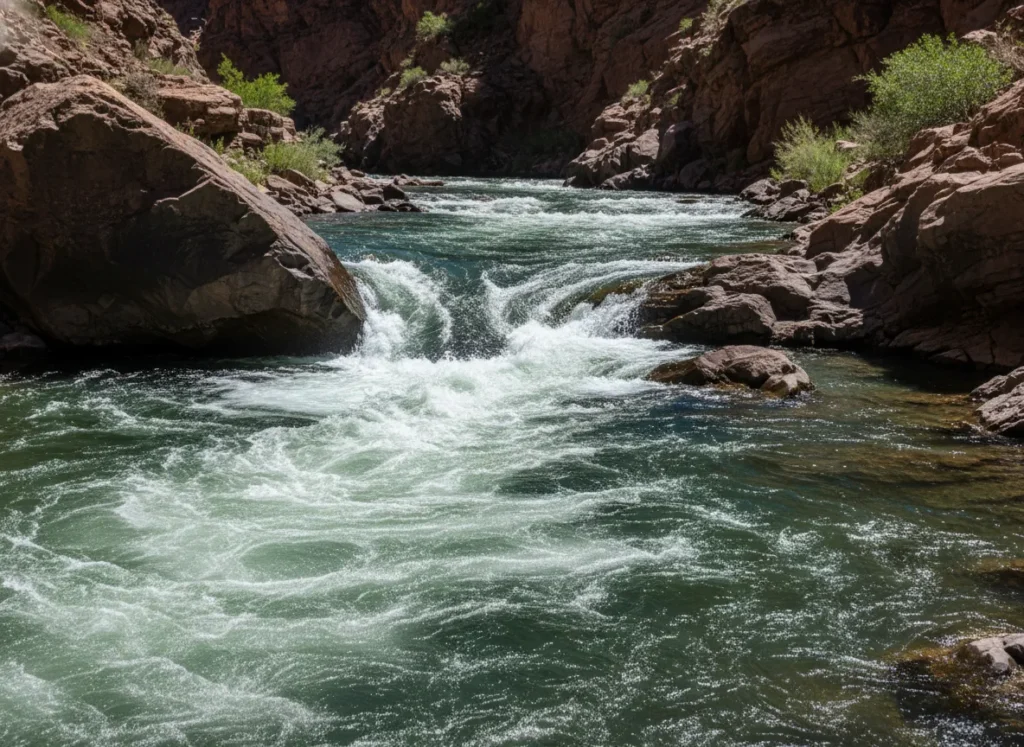
The primary “Go” signal is the Downstream V, sometimes called the “tongue.” It’s a smooth V-shape pointing downstream, formed by water accelerating as it funnels between two obstacles. This V indicates the deepest, fastest channel—think of it as the ridge board of the current where the flow is cleanest. Conversely, the Upstream V is the primary “No-Go” signal. This V points upstream, and its tip is a rock or other obstacle lying just under the surface. It’s a clear sign of a hazard to be avoided. A crucial safe zone is the Eddy, a calmer area of water behind an obstacle where the current flows upstream. Eddies are the river’s top plates, stable zones used to stop, scout, or set up for the next maneuver.
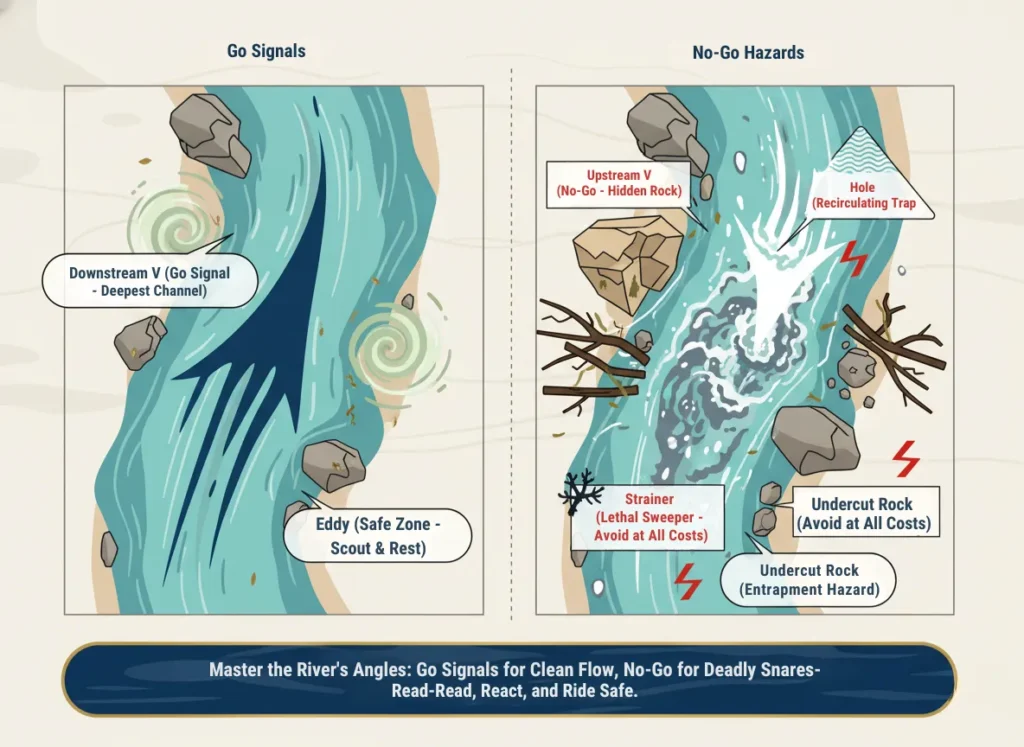
Beyond these basics are the river’s more serious hazards. A Hole (or Hydraulic) is a dangerous recirculating feature formed by water pouring over a submerged object, which can trap boats and swimmers. A Strainer or Sweeper is one of the most lethal hazards—often a fallen tree or debris resembling messy, exposed rafter tails—that allows water to pass through but strains out and traps objects and people. The rule is simple: AVOID AT ALL COSTS. Other critical hazards include Undercut Rocks, where the current flows underneath the rock creating a severe entrapment hazard, and Sieves, which are jumbles of rocks that strain the water. For those wanting a deeper dive, Frostburg State University offers detailed academic hydrology definitions that provide an excellent framework. Mastering this rafter lingo is the first step toward building a complete system for reading a river.
Reading the river is the essential mental skill; now it’s time to gather the physical tools needed to act on that knowledge.
What Are the Essential ‘Tools of the Trade’ for a Rafter?
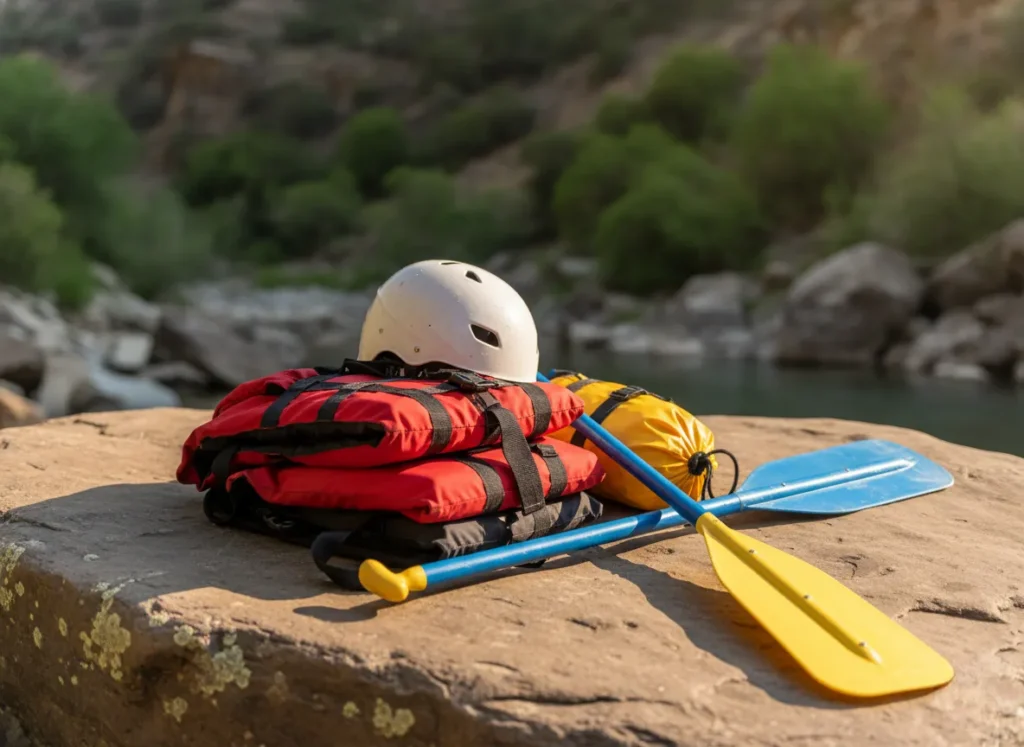
No roofer shows up to a job site without their hammer, circular saw, and framing square. For a rafter, your equipment is not just for performance; it’s your survival system. This is the non-negotiable personal and group gear required for safety on the river.
What Personal Gear is a Non-Negotiable Safety Kit?
Your personal gear is what keeps you, specifically, safe. It starts with the three most important pieces of equipment.
First and foremost is the PFD (Personal Flotation Device). This is the single most critical piece of gear you will ever wear. It must be a U.S. Coast Guard Approved model and must be worn, buckled, and cinched tight at all times on the water. A standard Type III PFD is great for most rafters, while a Type V Rescue PFD, which includes a quick-release chest harness, is a specialized tool for advanced rescue techniques.
Next is your Helmet. Whitewater-specific helmets are designed to protect your head from impacts with rocks, paddles, and other debris. It’s non-negotiable on anything above Class II.
Finally, your apparel is a critical safety system. The cardinal rule is: “Dress for the water temperature, not the air temperature.” Cold water shock and hypothermia are silent killers. Choosing the right rafter material—your layers—is crucial. This means avoiding cotton at all costs, as it acts like poor insulation when wet. Instead, choose wetsuits (neoprene) or drysuits for thermal insulation, layered over synthetic or wool base layers that retain warmth when wet. Sturdy footwear like river booties or water shoes and sun protection round out your personal kit.
Pro-Tip: Every guide’s PFD has two essential items attached: a high-decibel whistle for signaling (three blasts is the universal distress signal) and a river knife for emergency rope-cutting situations. Get a PFD with a lash tab and make this part of your standard setup.
For the definitive word on equipment, always reference the official U.S. Coast Guard PFD standards. If you’re ready to select your own, our guide on how to choose the right rafting PFD builds on these principles.
What Group Gear Completes the Safety System?
Once you are personally equipped for survival, the focus shifts to the tools that enable the group to function and respond to emergencies.
The primary team rescue tool is the Throw Bag, a high-visibility floating rope stuffed into a bag for quick deployment to a swimmer in the water. Every raft should have one, and everyone should know how to use it. The rafts themselves come in two main types: Paddle Rafts and Oar Rigs. In a paddle raft, the guide steers from the bottom with a paddle while the crew provides the “engine” power by paddling in unison. This fosters teamwork and is great for day trips. The learning curve for a participant is gentle. An oar rig, or “gear boat,” is controlled entirely by one person, the rower, using two oars mounted on a frame. This setup is the heavy-duty beam of the fleet, ideal for carrying gear on multi-day expeditions, but rowing it has a steep learning curve and is a complex solo skill.
Other critical group items include a comprehensive wilderness First Aid Kit and a Raft Repair Kit. For advanced teams, a Z-Drag system, a set of ropes and carabiners used for mechanical advantage, is a crucial tool for unpinning a stuck raft. Learning how to build a Z-Drag rescue system is an expert-level skill, a form of timber framing with ropes that demonstrates deep topical expertise.
With the full toolkit assembled, it’s time to learn the foundational carpentry—the ‘Common Rafter’ skills that form the roof system of all river running.
How Do You Master Foundational ‘Common Rafter’ Skills?
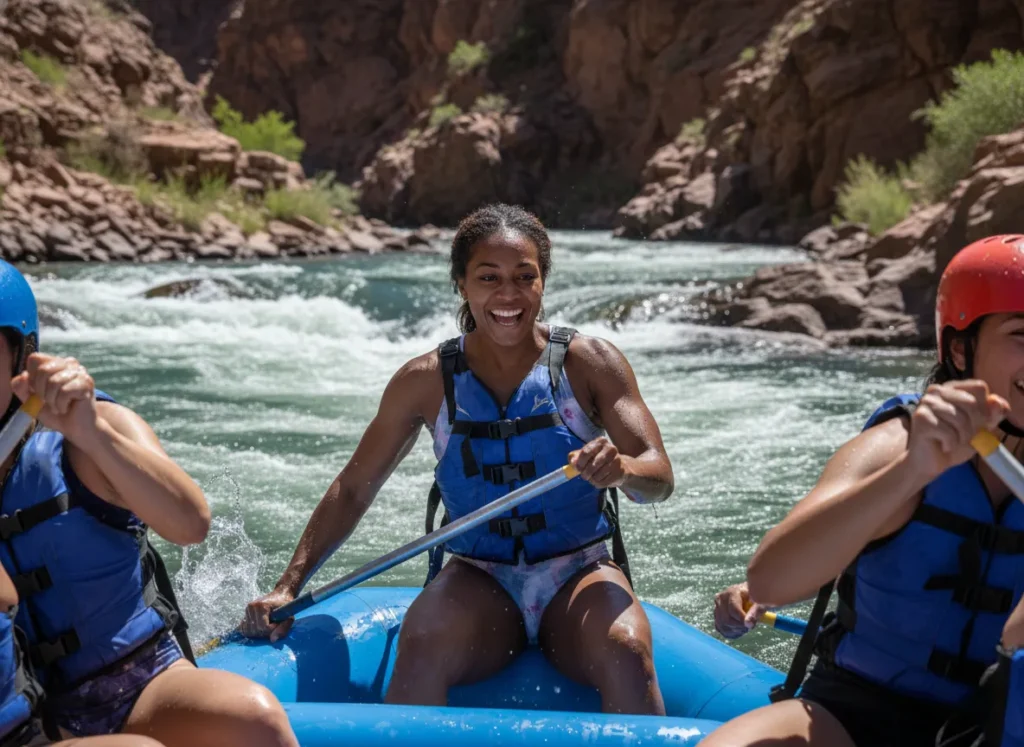
A master carpenter first learns to lay out and cut a single rafter perfectly—this is the pattern rafter for all others. In rafting, these are your ‘Common Rafter’ skills—the fundamental techniques every participant must know for basic safety and propulsion.
What is the First and Most Important Self-Rescue Skill?
Before you can help anyone else, you must be able to save yourself. The first and most crucial skill for any rafter is the “Safe Swim Position,” also known as Defensive Swimming. If you fall out of the raft, you immediately get on your back with your feet up and pointing downstream. Keep your knees slightly bent. This posture allows your legs and feet to absorb impacts from rocks and fend off obstacles, protecting your head and vital organs. It also allows you to see where you are going and, most importantly, to breathe.
The Cardinal Rule of whitewater swimming is: NEVER try to stand up in moving water, no matter how shallow it appears. The reason for this rule is the life-threatening hazard of “foot entrapment.” The current is deceptively powerful; if your foot gets wedged between rocks, the force of the water can push you over and hold you underwater. The complementary technique is Aggressive Swimming. This involves rolling onto your front and swimming with purpose (like a front crawl) toward a specific target like the shore, the raft, or a rescue rope, usually at the direction of a guide. Defensive swimming is the default, while aggressive swimming is for directed, purposeful movement to escape danger. For a deeper dive, focus on mastering the whitewater swim position.
What Are the Basic Paddle Commands for the ‘Engine Room’?
In a paddle raft, the paddlers are the “Engine Room,” providing the power that the guide directs. Just as a template rafter ensures all subsequent rafter cuts are consistent, the lead paddlers set the stroke rate, and the crew follows the instructions in unison.
The primary “go” command is “Forward Paddle.” All paddlers take a strong, synchronized forward stroke. The key here is a plumb cut: the paddle shaft must be vertical (plumb) to catch the water efficiently, driving power from the core rather than just the arms. The “Back Paddle” command is the opposite: a synchronized backward stroke used for braking, reversing, or using the step off method to set up for a maneuver. Turning commands, like “Left Turn” and “Right Turn,” work on a power differential. To turn left, the right side paddles forward while the left side back paddles, pivoting the boat.
Key safety commands include “Hold On,” where paddlers stop paddling, brace by placing their paddle’s T-grip on the floor, and grip the raft’s safety line (the “chicken line”). This ensures stability through big waves. “Get Down” is a more extreme command. Paddlers move from their seats to the floor of the raft, lowering the boat’s center of gravity to prevent flipping in very turbulent water.
| Paddle Raft Commands & Strokes | ||
|---|---|---|
| Command | Action | Purpose / “Why” |
| “Forward Paddle” | All paddlers take a strong, synchronized forward stroke. Power comes from the core, not the arms. | The primary “go” command. Propels the raft forward. |
| “Back Paddle” | All paddlers take a strong, synchronized backward stroke. | The primary “stop” or “reverse” command. Used to slow down or set up for a maneuver. |
| “Left Turn” | The left side of the boat back-paddles. The right side of the boat forward-paddles. | Creates a power differential that pivots the raft. The “right side” pushes the bow, the “left side” pulls the stern. |
| “Right Turn” | The right side of the boat back-paddles. The left side of the boat forward-paddles. | The opposite of a Left Turn. “If your side of the raft gets called, you will perform the Back Paddle”. |
| “Hold On” | Paddlers stop paddling, place their paddle T-grip on the floor, and grip the raft’s “chicken line”. | A safety command for a large wave or drop, to ensure stability and prevent falling out. |
| “Get Down” | A more extreme safety command; paddlers move from their seat to the floor of the raft. | Used in very large, turbulent rapids to lower the center of gravity and prevent a “high side” situation. |
With these basic ‘common rafter’ skills in place, the journey progresses to the complex angles and precision cuts of the ‘Hip Rafter.’ Our complete guide to all rafting commands expands on these basics.
How Do You Execute Advanced ‘Hip Rafter’ Maneuvers?
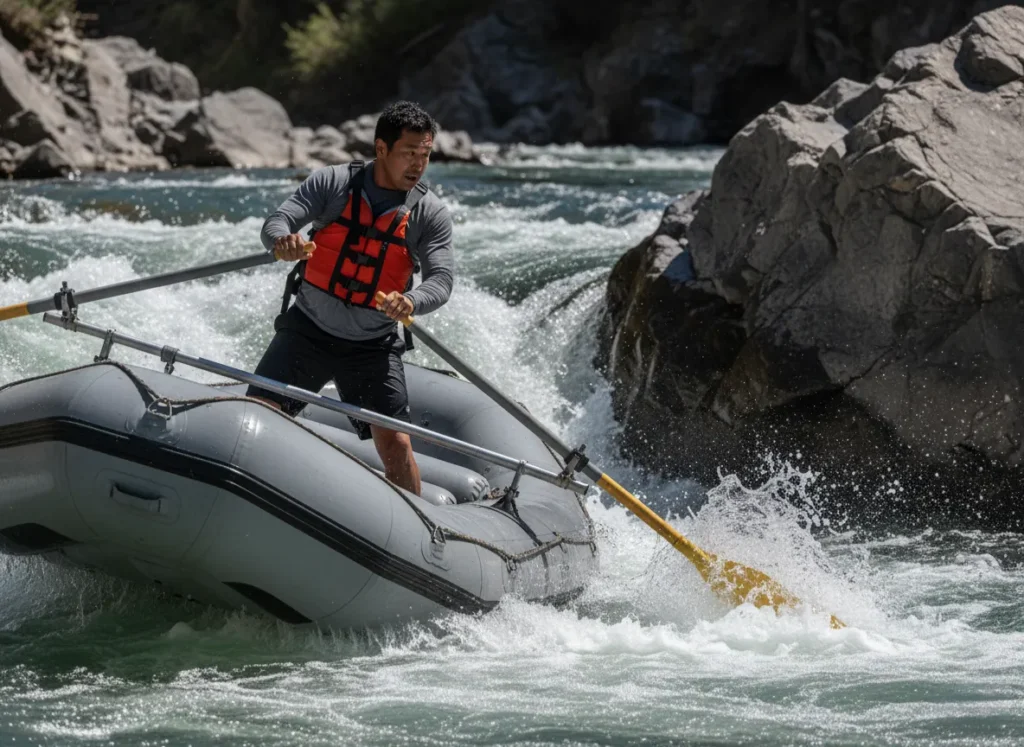
A hip rafter is a complex piece of common rafter framing, requiring compound cuts to join different roof pitches where they intersect. In rafting, these are the multi-vector, guide-level skills that require a deeper understanding of river dynamics and precise boat control. They separate passengers from true river runners.
What is the ‘Bird’s Mouth’ of Rafting?
In carpentry, a bird’s mouth cut is a notch—consisting of a seat cut and a heel cut—that allows a wood rafter to sit securely on the wall plate. In rafting, our “bird’s mouth” is the Eddy Catch—a critical precision maneuver for stopping in a rapid. The move involves “cutting” across the turbulent eddy line (the “heel cut”) to securely “seat” the raft in the calm, upstream-flowing water of the eddy (the “seat cut”). This move locks the raft to a stable top plate on the river, arresting its downstream momentum.
A successful eddy catch relies on four pillars: Angle, Position, Speed, and Lean. You must position the boat correctly and approach the eddy line with the precision of a knife line. Forget the myth of the universal “45-degree rule.” For a heavy, high-momentum raft, you often need a wider angle of approach (closer to 90 degrees) to build the lateral momentum to cross the eddy line without being swept past. This angle adjustment is your cheek cut—the slight modification needed to fit the specific geometry of the current, ensuring your cheek cut lines are perfect. As you cross, you must lean by weighting the upstream tube of the raft. This prevents the current from catching the downstream edge and flipping the boat.
Pro-Tip: Don’t try to learn the eddy catch in a big, boiling rapid. Find a Class I or II section with small, well-defined eddies. Practice entering and exiting them over and over. This builds the muscle memory for angle, speed, and lean in a low-consequence environment.
Mastering the eddy catch is the gateway skill. It’s the fundamental building block of advanced boat control. You can find a full tutorial on mastering the eddy catch here.
What Advanced Maneuver Epitomizes ‘Intelligence Over Muscle’?
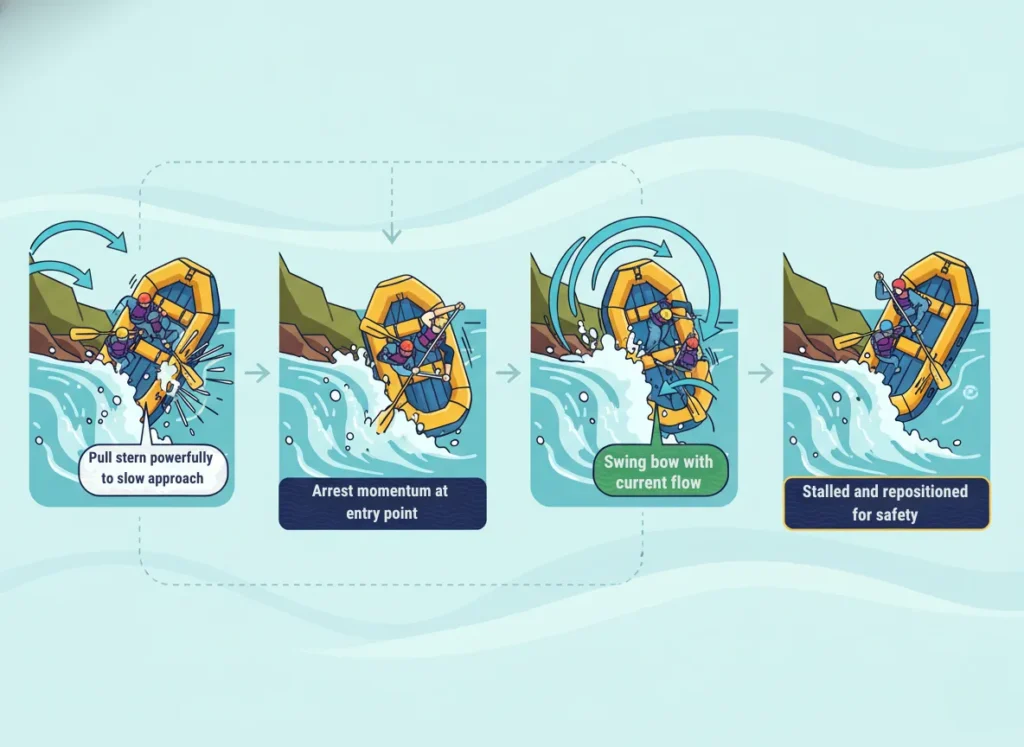
The ultimate expression of river mastery isn’t about overpowering the water; it’s about using its own energy to your advantage. The Stern Pivot, a highly advanced oar rig technique, is the epitome of this principle. It is using your head instead of your muscles, much like using a Construction Master Pro calculator and the Pythagorean theorem to calculate rafter length rather than guessing.
The setup is counter-intuitive. The guide approaches a rapid stern-first (backwards) with a slight downstream angle. The primary action is to actively pull on the oars, driving the stern of the raft into a specific river feature, like a wave or a small hole. This action uses the river feature’s power to arrest the raft’s downstream momentum, effectively stalling the stern. Because the bow is still in the faster main current while the stern is stalled, the current itself does the work, swinging the bow downstream and pivoting the entire raft around the stalled stern, a move as elegant as a perfectly executed tail cut.
The result: the raft is now stalled, perfectly positioned, and facing upstream. This allows the guide to avoid a major downstream hazard—like a dangerous feature with a steep drop or undercut—and then “back ferry” (pulling on the oars) into a precise, safe channel with complete control. This maneuver is the height of expert-level river reading, navigating the valley rafters and hip rafters of the current by using the river’s power against itself.
Having mastered the physical skills of a craftsman, the final step is to adopt the mindset and responsibilities of a master.
What Defines the ‘Master Rafter’s’ Mindset?
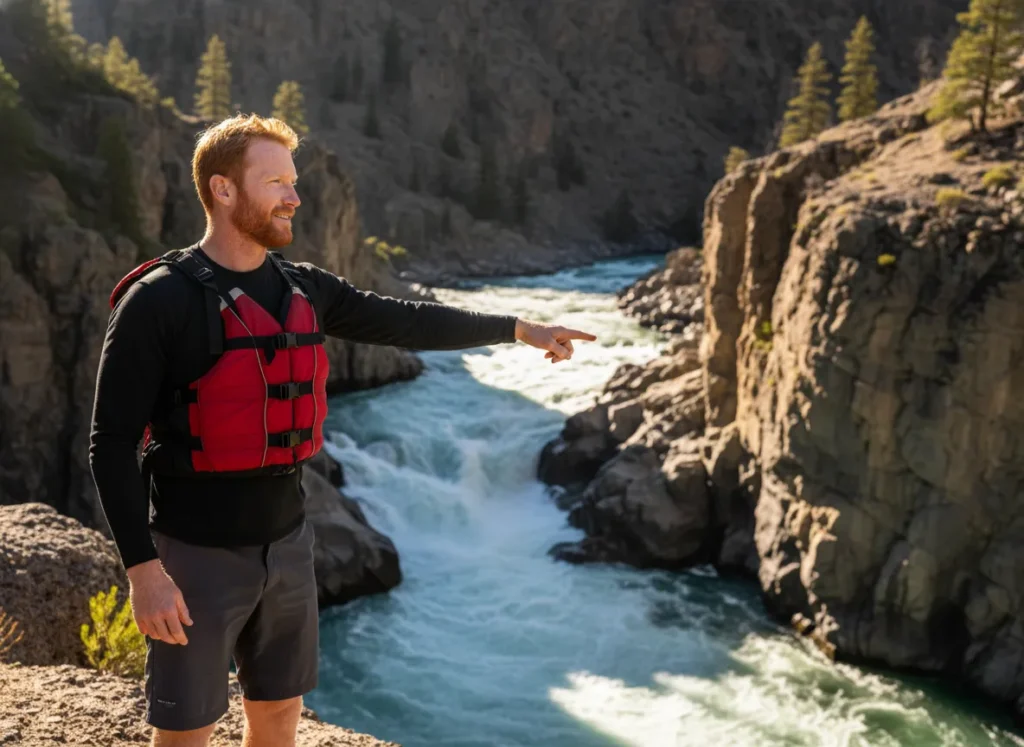
The difference between a skilled technician and a true master lies beyond the physical. It’s in the meta-skills of judgment, leadership, and ethics that transcend mere technical ability and define true expertise.
How Do Experts Manage Risk and Make Decisions Under Pressure?
The expert’s ultimate skill isn’t a paddle stroke; it’s psychological. It is the ability to remain “calm and in control” during high-stress situations. This composure is the ridge beam holding the entire structural design together.
A powerful cognitive framework for systematic risk assessment is the “CLAPT” heuristic. The acronym stands for:
- Communication
- Line of sight
- Avoid hazards
- Position
- Technical skills
The ordering of CLAPT is revolutionary for beginners because it prioritizes awareness, communication, and planning above raw technical skill. It connects directly to the psychological attributes of an expert: managing emotions, making accurate judgments of personal and team skills under pressure, and checking one’s own ego to prioritize safety. At the highest level, a good rafter moves from simply reacting to the river to predicting its behavior and actively managing group risk. This reflects the expert-level judgment-based skills of a guide.
What is the Rafter’s Unwritten Code of Ethics?
A “good rafter” is not just a skilled boater; they are a steward of the environment, strictly adhering to a code of conservation ethics. This code is founded on the 7 Leave No Trace (LNT) Principles.
On the river, this has specific, non-negotiable applications. Principle 3 (Dispose of Waste Properly) means all solid human waste must be packed out using a portable river toilet known as a “groover.” For liquid waste, the rule is “dilution is the solution to pollution”: urine should only be deposited directly into the river if the flow is high (generally >500 CFS). Principle 5 (Minimize Campfire Impacts) requires that campfires be built in a metal “fire pan” to prevent scorching the ground, and only dead and downed “driftwood” can be used for fuel. All ashes must be packed out. Principle 6 (Respect Wildlife) means observing animals from a distance (use the “thumb rule” to gauge proximity) and, crucially, never feeding wildlife.
These principles are not optional. They are a core responsibility of our community to preserve the wildness of the rivers for future generations. For a complete understanding, refer to the official 7 Leave No Trace Principles, and for more specific applications, check out our guide to Leave No Trace for whitewater trips.
This complete blueprint—from understanding the code to mastering the craft and honoring the environment—is the true path to becoming a good rafter.
Conclusion
The journey to becoming a good rafter is a structured progression. It begins with foundational knowledge and core skills—the “common rafter framing” work of understanding objective risks like River Classes, using the right tools like PFDs and helmets, and mastering self-rescue. From there, it moves to advanced maneuvers and high-level decision-making—the “hip rafter” skills that blend technique with river dynamics. But true mastery is defined by the synthesis of this technical ability with the psychological capacity for high-stakes judgment, risk management, and leadership. And woven through it all is a core tenet: being an environmental steward, strictly adhering to river-specific Leave No Trace ethics to preserve the wilderness we love.
You now have the blueprint. The next step is to apply it. Explore our complete library of river guides and skill tutorials to continue your journey from apprentice to master on the water.
Frequently Asked Questions about Becoming a Good Rafter
What truly makes someone a good rafter?
A good rafter is ultimately defined by their high-stakes judgment, not just their technical skill. It’s a synthesis of deep environmental knowledge, interpersonal leadership, and the psychological ability to remain calm and make sound decisions under pressure.
Is rafting more about strength or technique?
Technique is far more important than strength, as relying on power is often a sign of poor technique. However, given equal technique, greater strength is an advantage for more powerful strokes and in demanding rescue situations.
How do I swim safely if I fall out of the raft?
Immediately get into the Safe Swim Position: on your back with your feet up and pointing downstream. This protects your head and allows your legs to fend off rocks. Never try to stand up in moving current.
What are the most important Leave No Trace rules for a river trip?
The two most critical river-specific rules are packing out all solid human waste in a groover and building any campfires in a fire pan. These practices prevent pollution and protect the sensitive riparian environment from damage.
Risk Disclaimer: Whitewater rafting, kayaking, and all related river sports are inherently dangerous activities that can result in serious injury, drowning, or death. The information provided on Rafting Escapes is for educational and informational purposes only. While we strive for accuracy, the information, techniques, and safety advice presented on this website are not a substitute for professional guide services, hands-on swiftwater rescue training, or your own critical judgment. River conditions, including water levels, currents, and hazards like strainers or undercut rocks, change constantly and can differ dramatically from what is described on this site. Never attempt to navigate a river beyond your certified skill level and always wear appropriate safety gear, including a personal flotation device (PFD) and helmet. We strongly advise rafting with a licensed professional guide. By using this website, you agree that you are solely responsible for your own safety. Any reliance you place on our content is strictly at your own risk, and you assume all liability for your actions and decisions on the water. Rafting Escapes and its authors will not be held liable for any injury, damage, or loss sustained in connection with the use of the information herein.
Affiliate Disclosure: We are a participant in the Amazon Services LLC Associates Program, an affiliate advertising program designed to provide a means for us to earn advertising fees by advertising and linking to Amazon.com. As an Amazon Associate, we earn from qualifying purchases. We also participate in other affiliate programs and may receive a commission on products purchased through our links, at no extra cost to you. Additional terms are found in the terms of service.