
In this article
You’re swimming a rapid you never planned to swim, and somewhere back in the froth your left shoe is already gone, peeled off the second your foot dragged bottom. It happens more than anyone admits, and the pattern is almost always the same kind of shoe. Guides pull more lost footwear off the riverbed after a trip than nearly any other piece of gear, and it’s rarely the expensive stuff that stays on. The whole game with water shoes for rafting comes down to one question: will it still be on your foot when you climb back in the boat? Here’s what actually stays put, what to leave in the car, and how to pick a pair for the water you’re really running, whether that’s a lazy summer float or a cold Class IV day, and how footwear fits into the rest of what you put on for a day on the water.
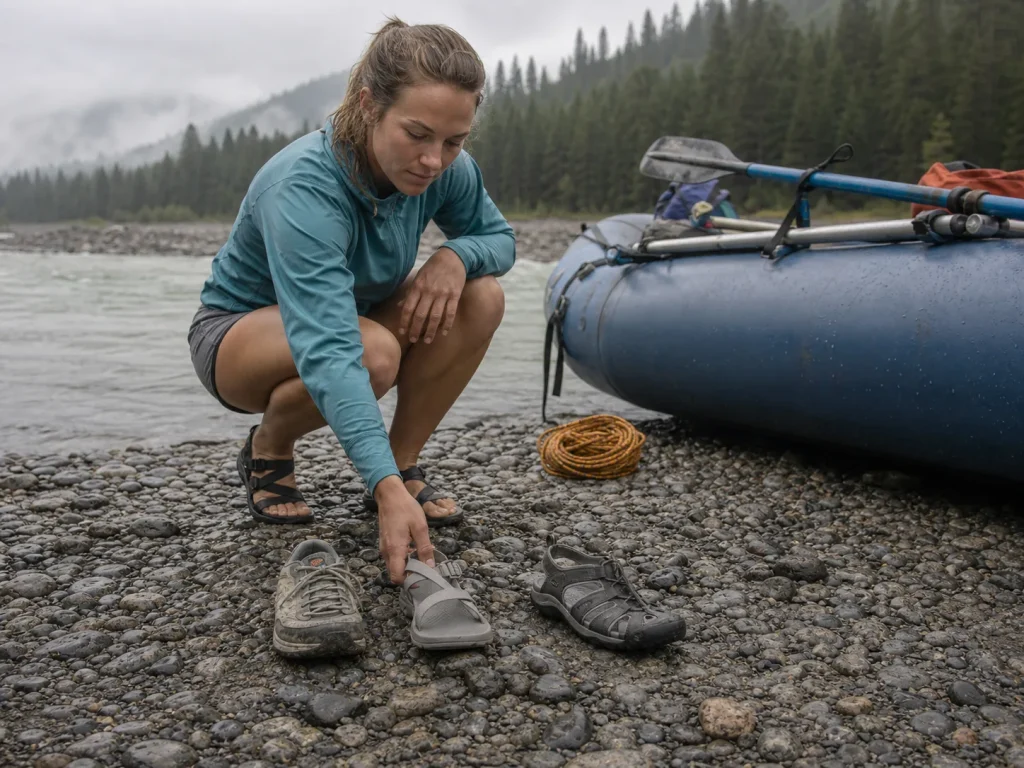
What Actually Works on Your Feet
Picture the takeout conversation where a first-timer holds up their gym sneakers and asks if they’ll do. The honest answer is “sometimes,” and it depends entirely on what water you’re running. There are really only three types of footwear worth putting on for a river day, and knowing why each one earns its place saves you from either overspending or losing a shoe.
Closed-Toe Water Shoes
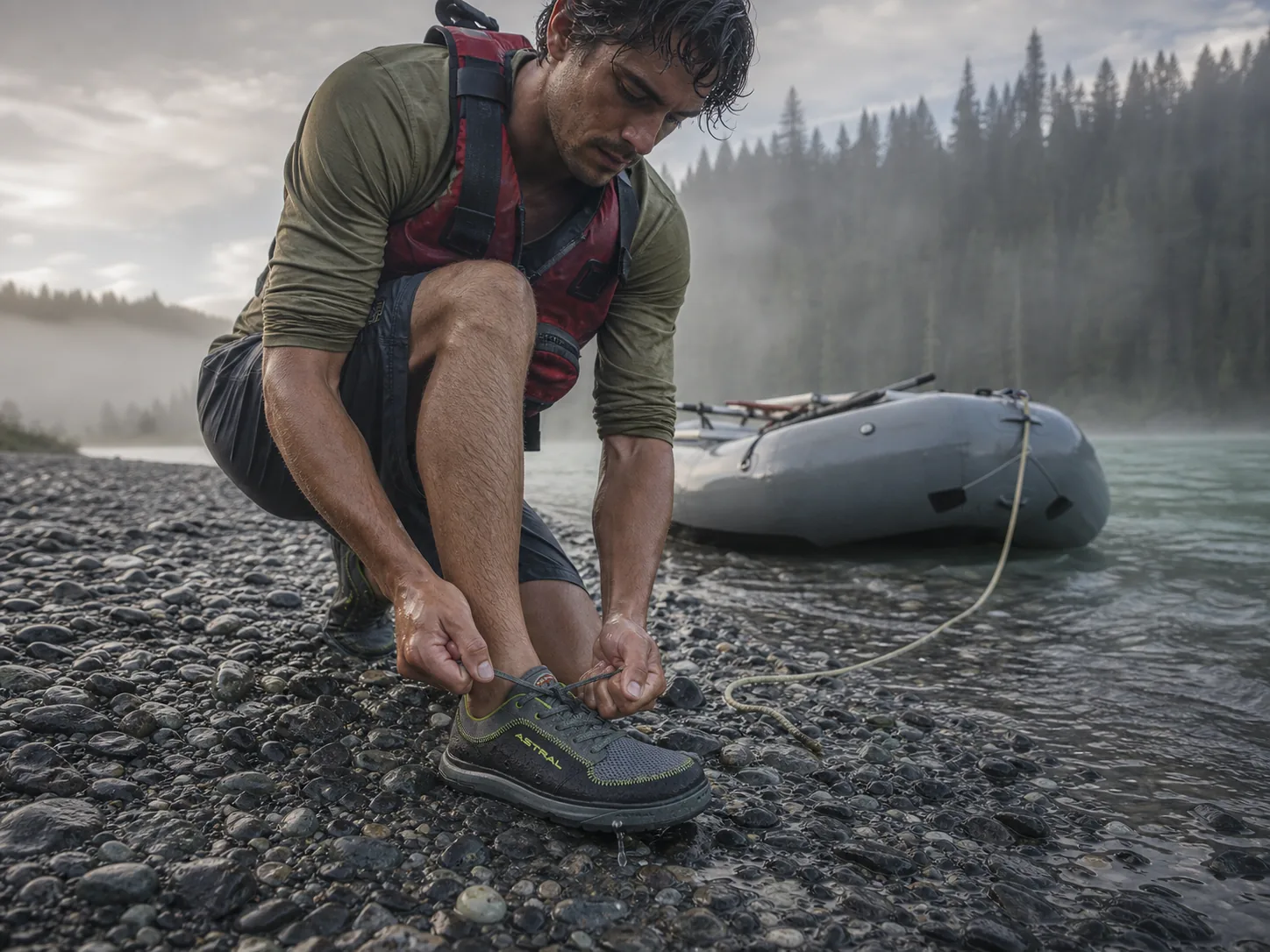
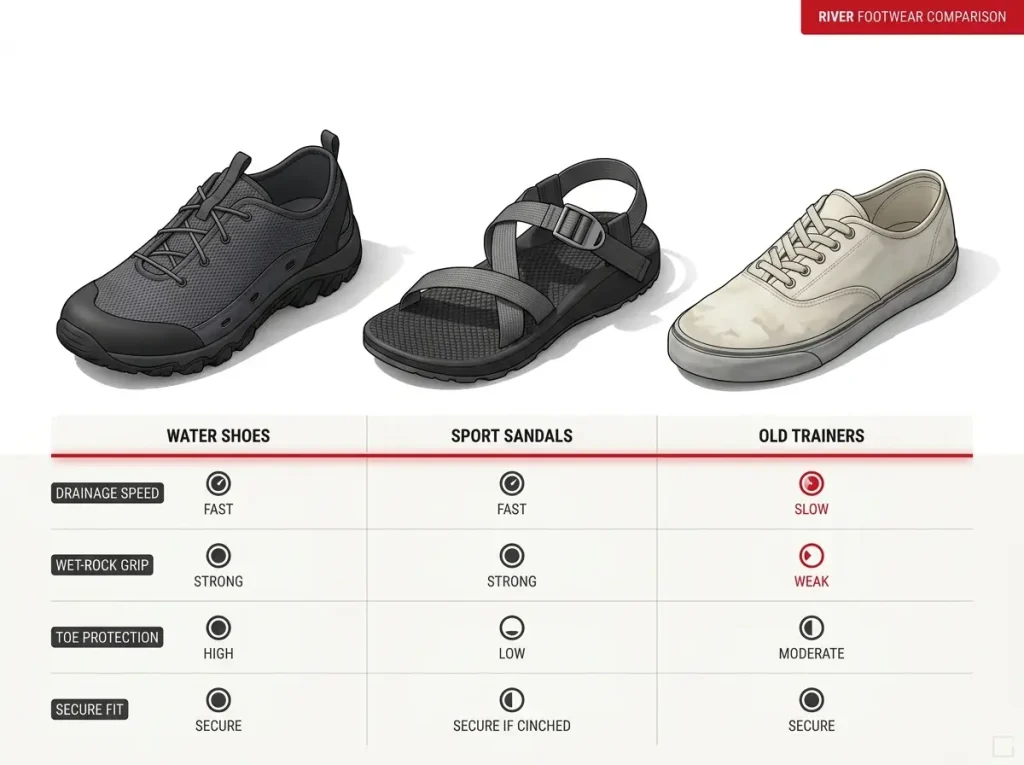
A closed-toe water shoe is the shoe that does everything. Enclosed mesh uppers and open drainage holes shed water fast, so it drains and stays quick-dry, while a reinforced toe cap saves your feet when you’re scrambling over submerged rocks at the put-in or scouting a line from shore. A snug lace-up fit over a grippy rubber sole means the current has nothing to grab.
This is the pick for anyone running Class III and up, and it’s the only category that pairs cleanly with a neoprene sock for cold water. If you’re going to own one pair, own this kind.
Sport Sandals With a Heel Strap
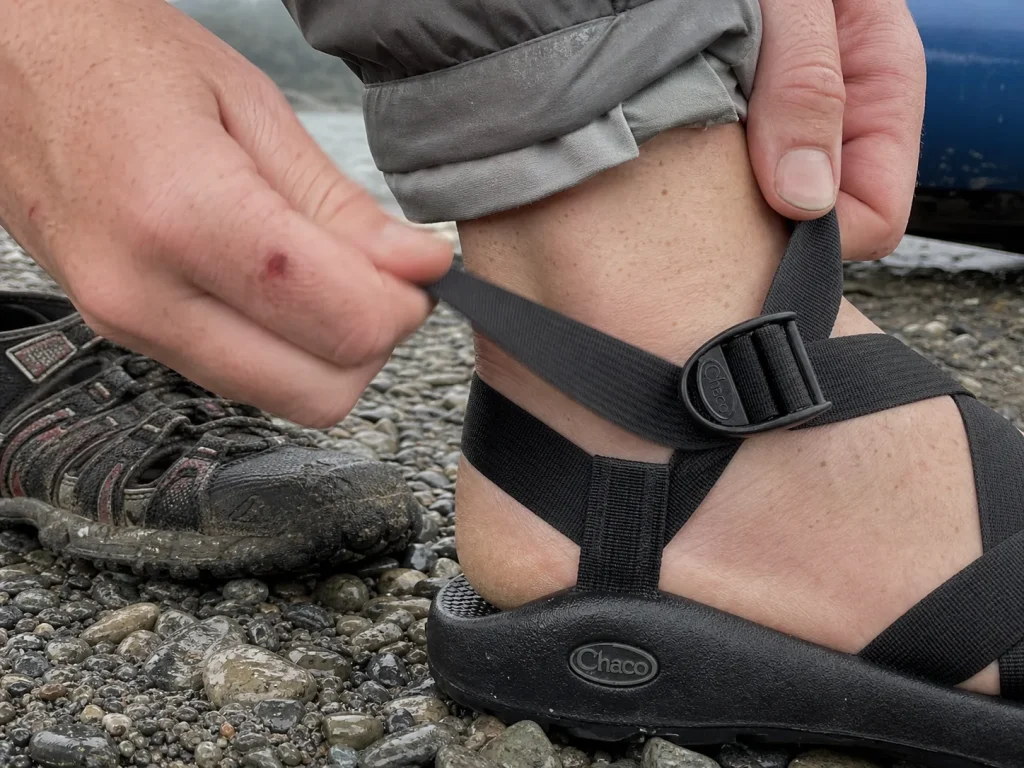
Sport sandals with a proper heel strap are the open-air alternative. They breathe on hot days, they drain instantly because there’s barely anything to hold water, and a cinched strap system holds them on through real whitewater. The catch is the strap itself. An unbuckled or sloppy-strapped sandal is no better than a flip-flop, so the security lives in how tight you cinch it, not the brand on the footbed.
The Old-Sneakers Budget Move
Nearly every guide will tell you the same thing about mellow water: an old pair of lace-up trail running shoes you don’t mind soaking works fine for a Class II float. They protect your feet and they stay on. What they don’t do is drain well or grip slick stone, so they’re a compromise, not a win. For a once-a-year float, that compromise is completely reasonable, and it’s a smart move to pair it with a look at what to pack by river class before you go.
What to Leave in the Car
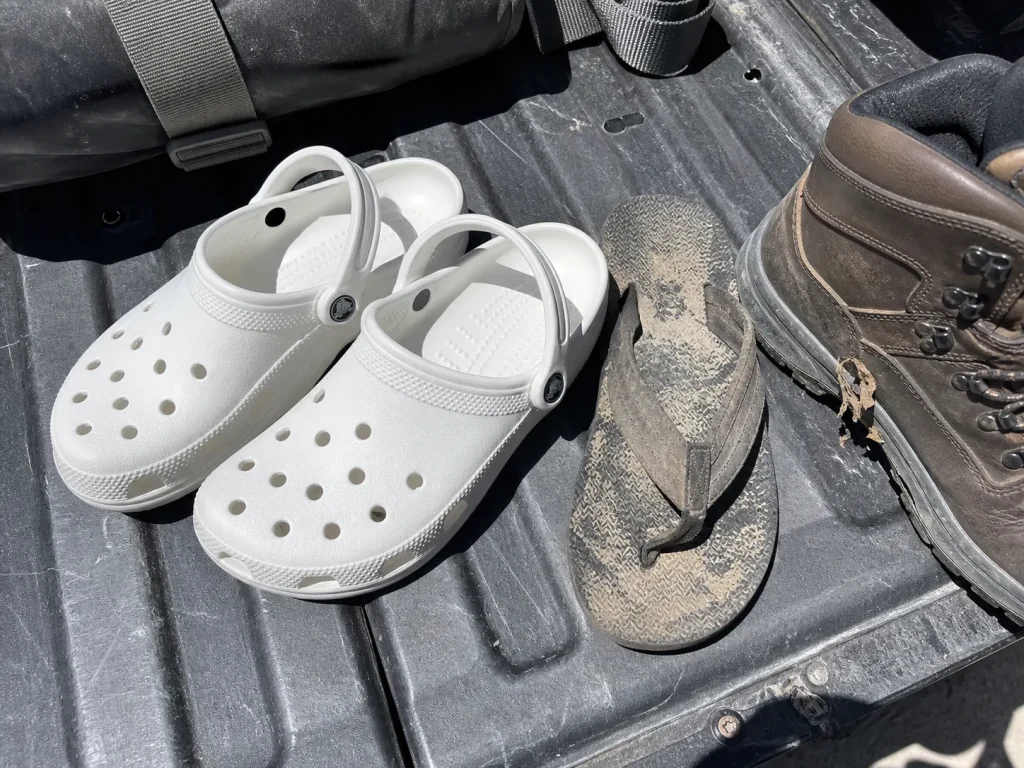
Some footwear looks perfectly fine sitting on the gravel bar and then disappears the moment you’re in the water. This is the short list of what not to wear, and the reasons matter more than the rules.
Flip-Flops and Loose Sandals
Flip-flops and any toe-loop or single-strap sandal have no business on a river above the mellowest water. Forum reports are full of toe straps failing mid-swim, and the failure mode is predictable: anything held on by one thin point of contact gets ripped off the instant the current loads it. Annoying in Class II, a real problem in Class IV and up. Old canvas shoes and dress shoes belong in the same leave-it pile for a different reason, since they give up all grip and structure the moment they’re soaked.
Bare Feet and Why the Riverbed Wins
Going barefoot feels natural for about ten seconds. Then you meet the riverbed, which is some mix of sharp rock, broken glass, and slick stone you can’t grip. You lose all traction on wet surfaces and you have zero protection during a swim or a scramble. There’s no upside worth the exposure.
Heavy Boots That Become Anchors
Heavy hiking boots seem protective, which is exactly the trap. Soaked, they turn into dead weight that fights every kick when you’re trying to swim, and your self-rescue mobility is the thing that matters most when you’re getting yourself back to the boat after a swim, or hauling it around a portage. Save the boots for the approach hike, not the boat.
Why a Loose Shoe Gets Ripped Off
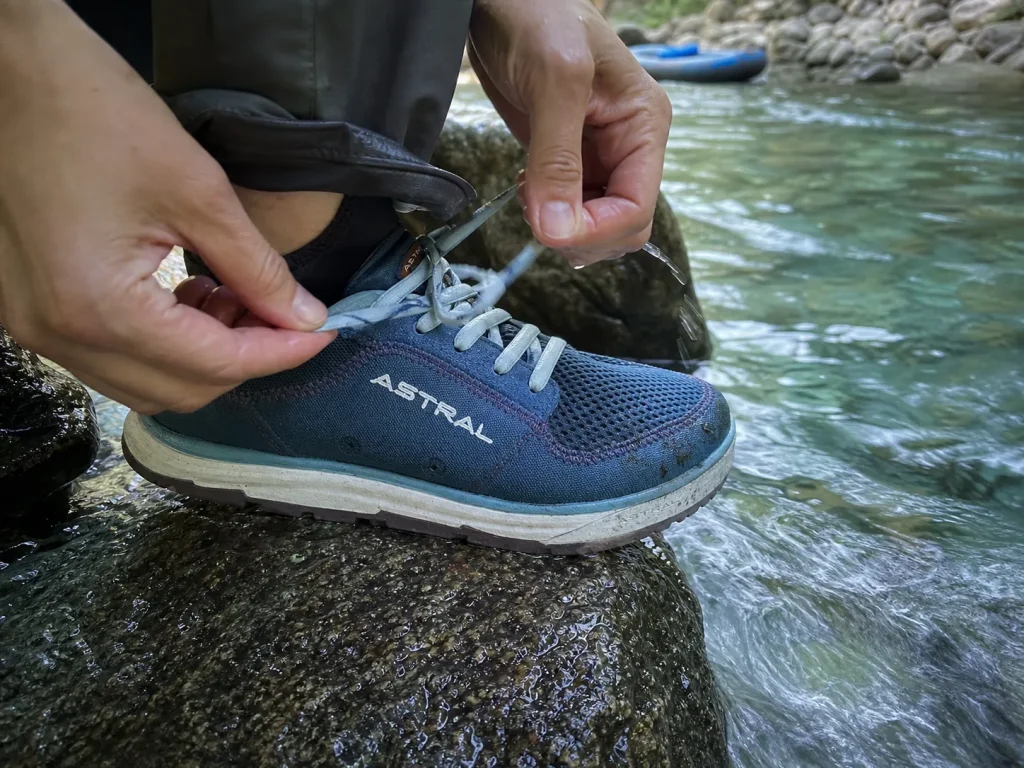
Every competitor tells you to “make sure it’s secure” and stops there. Nobody explains what’s actually happening to your foot underwater, and once you understand the mechanism, the whole checklist makes sense on its own.
How Current Levers a Shoe Off
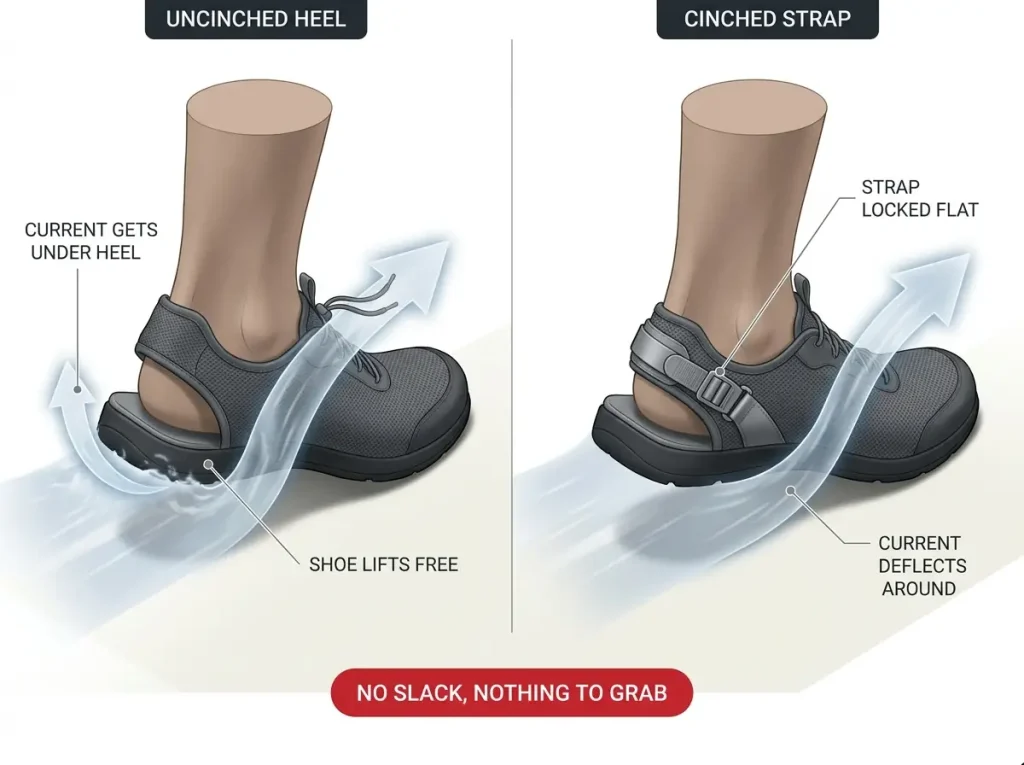
Moving water pushes against every surface it can reach, and a shoe that isn’t cinched down is basically a scoop. Water gets under the heel, catches the loose material, and levers the shoe off your foot with a mix of current force and suction. In a recirculating current, it’s worse, because the churning water grabs anything loose and works it free. The shoe doesn’t come off because it’s cheap. It comes off because there was slack for the river to grab.
Laces, Bungee, or Strap — Removing the Slack
Every good fastening system does the same job a different way. Laces on a closed-toe shoe, a bungee lace-lock, a hook-and-loop heel strap: each one exists to pull the slack out so the current has nothing to lever against. None of them work if you leave them loose. The mechanism is identical across all three, which is why the discipline matters more than the design.
Cinch every strap tight before you’re in the water, not after. The moment you’re swimming is the worst possible time to notice a loose buckle, and by then it’s already too late to fix it one-handed. Do it at the put-in, every time, like clipping your PFD.
The Four Things a River Shoe Has to Do
Once you see the mechanics, the feature checklist writes itself. A river shoe needs heel retention so it stays cinched, wet traction so you don’t slip on the scramble, toe protection for rocks and swims, and quick-drain construction so you’re not hauling waterlogged bricks between rapids. It’s the same idea behind the American Canoe Association’s safety guidance, which calls for paddling gear that’s fitted properly to the paddler, not just present.
Even a well-built closed-toe shoe has been lost mid-swim by someone who didn’t cinch it, which tells you everything: the feature list is only half the job, and the other half is you tightening it down. Footwear that fails also drags on your recovery, which is worth understanding alongside the right swim position when you’re in the current.
The Shoes Worth Buying
If you’re going to own one pair, these are the two rafting shoes that keep coming up for the right reasons. One closed-toe shoe, one strap sandal, so you can choose by preference instead of hype. Both do the same three jobs: stay on, grip wet rock, drain fast.
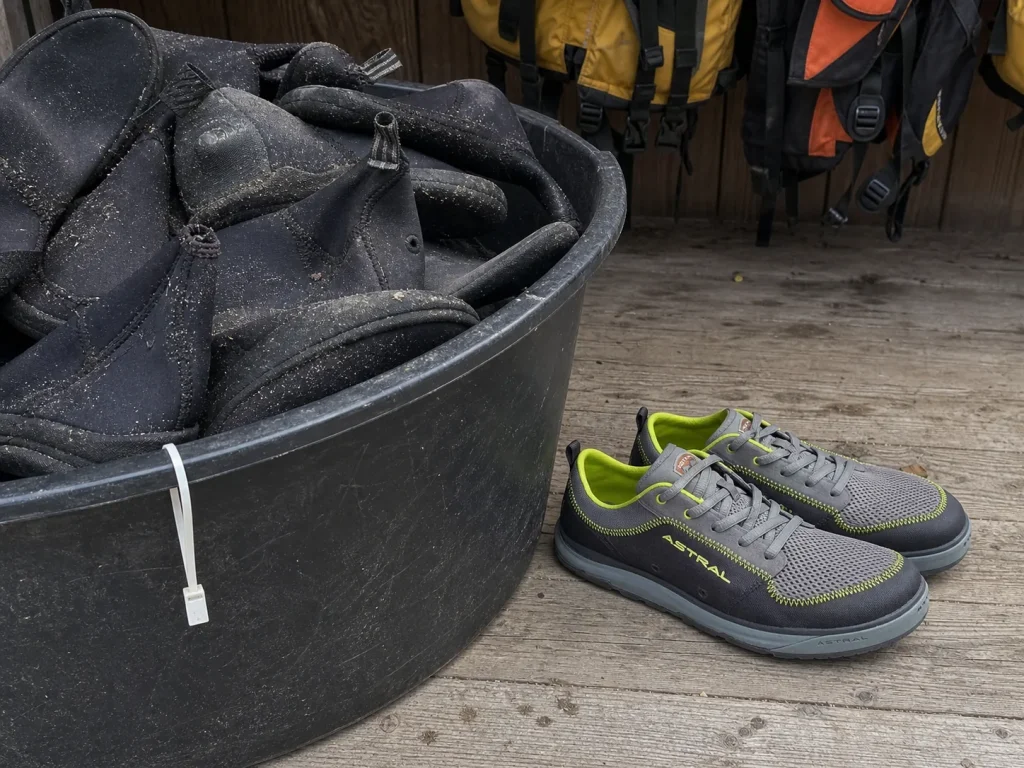
The Closed-Toe Pick — Astral Brewer 2.0
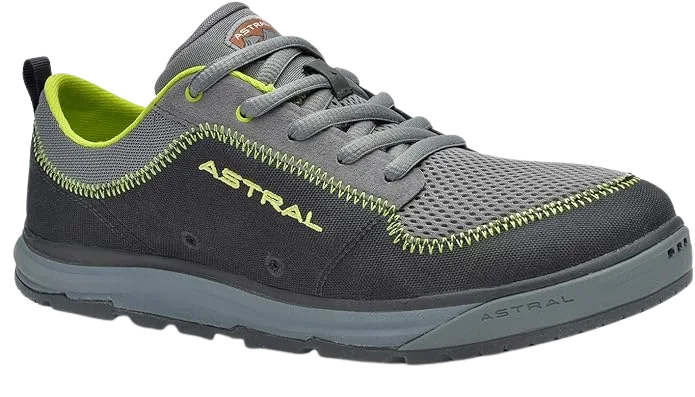
The Brewer is the pick when protection matters, which on rocky rivers and cold water is most of the time. The enclosed upper keeps sharp riverbed material off your skin, and because it’s a real shoe rather than a sandal, it takes a neoprene sock without fuss when the snowmelt is running. It costs more than a pair of old sneakers, but it’s the closest thing to a shoe that does everything on a river.
The Strap-Sandal Pick — Chaco Z/1 Classic
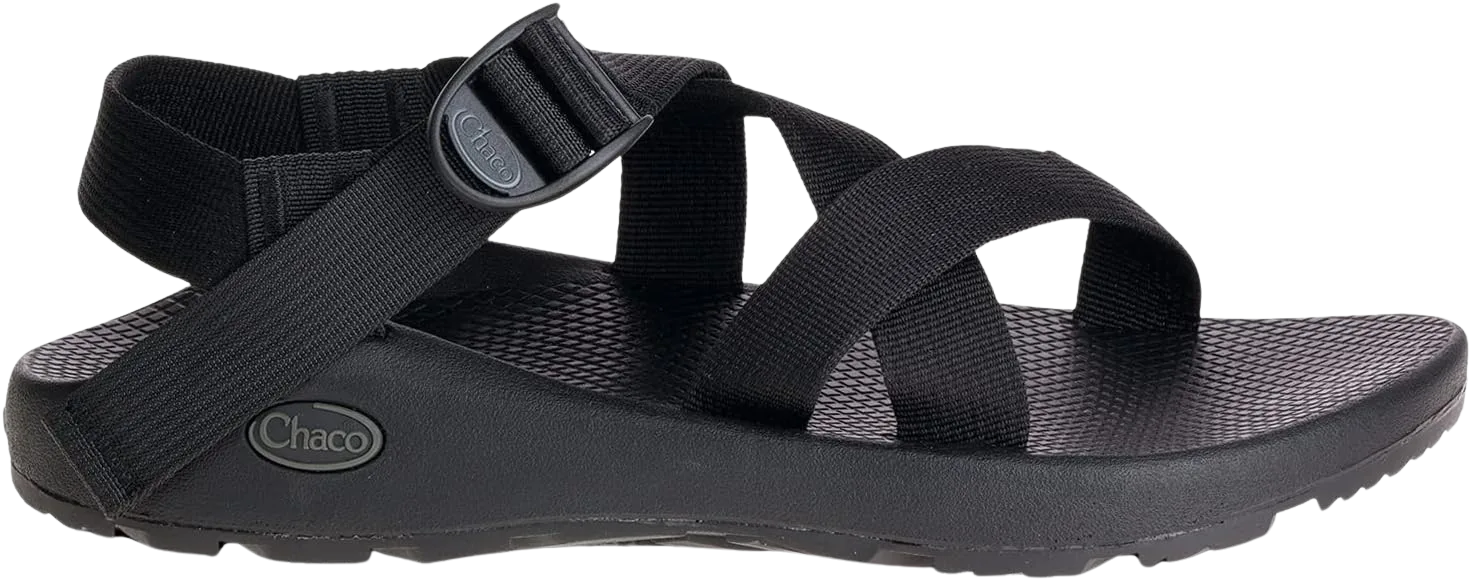
The Z/1 is the pick for hot water and hot days, when a closed shoe feels like a sweatbox and instant drainage is worth more than toe coverage. The trade-off is honest: your toes are exposed, so on shallow rocky runs you’ll bang them. Cinch all eight straps snug before you launch and it stays locked to your foot through real whitewater. Think of the choice as closed-toe for protection and cold, open sandal for drainage and heat, not one brand beating another.
The Second Pair Nobody Tells You to Pack
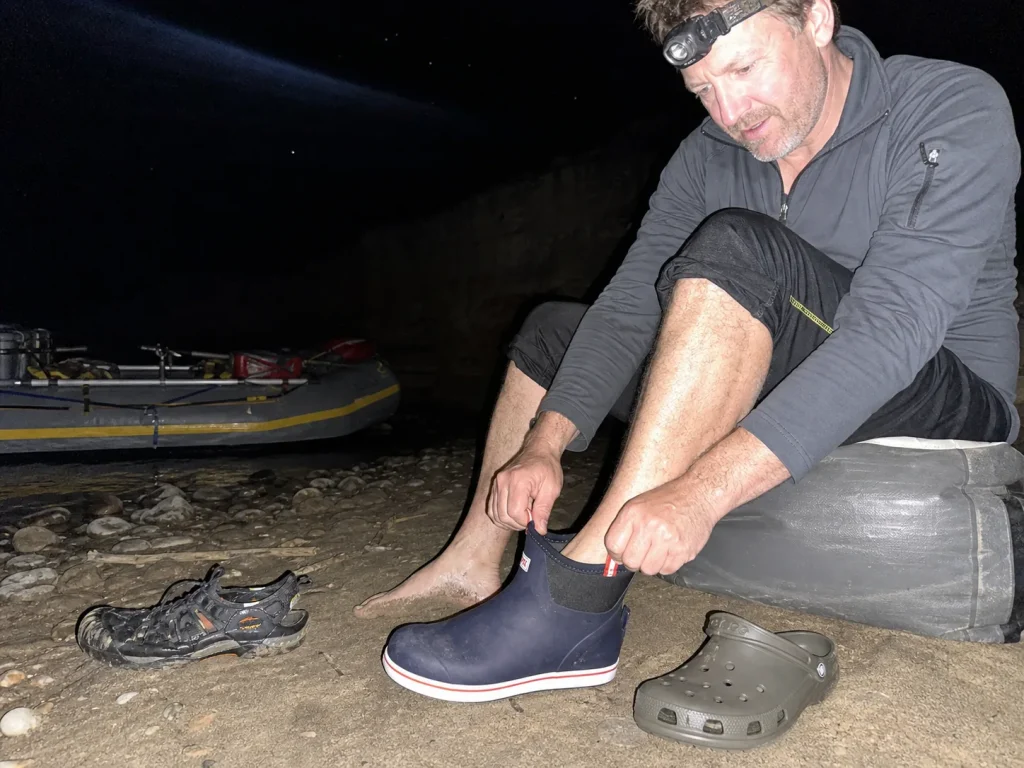
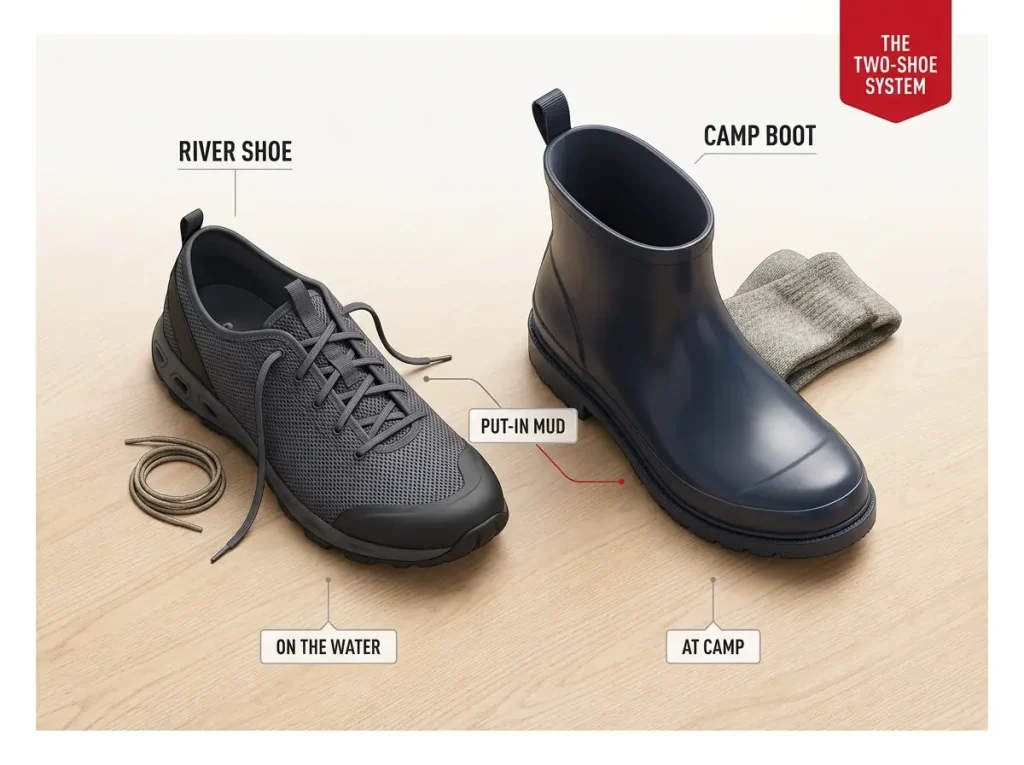
Here’s the thing multi-day boaters figure out fast: you want your feet out of a wet river shoe the second you hit camp, and standing in put-in mud in your good shoes is how they start to rot. Most private boaters end up running a two-shoe system, one pair for the water and a separate dry boot for everything else, which fits into the rest of the multi-day layering kit you’re already hauling.
Why Your River Shoe Shouldn’t Also Be Your Camp Shoe
A river shoe that never dries out is a river shoe that stinks and falls apart early. Camp is where your feet recover, and a dry, easy-on boot with a pair of wool socks waiting at river camp keeps your water shoes from living in silt all week. A dedicated camp boot like the XTRATUF Ankle Deck Boot (men’s · women’s) is 100% waterproof rubber with a non-marking, slip-resistant outsole, built for exactly the muddy put-in, take-out, and camp job that chews up river shoes.
Rubber Boots vs Clogs for Camp
If a rubber boot is more than you want to pack, a clog works, with one rule. The Crocs Classic Clog is the cheapest legitimate camp shoe going, but only when you wear the heel strap down in what boaters call “Sport mode.” Worn loose in slide mode, Crocs are the single most common shoe guides recover from the river. Day-trippers can skip this whole section, since the second pair is a multi-day comfort and gear-longevity thing, not a safety item.
If you’re bringing Crocs on the river at all, flip the strap to the back of your heel before you leave the house and leave it there. A Croc in Sport mode stays on your foot at camp and through shallow wading. A Croc in slide mode is a gift to the riverbed.
Socks and the Cold-Water Problem
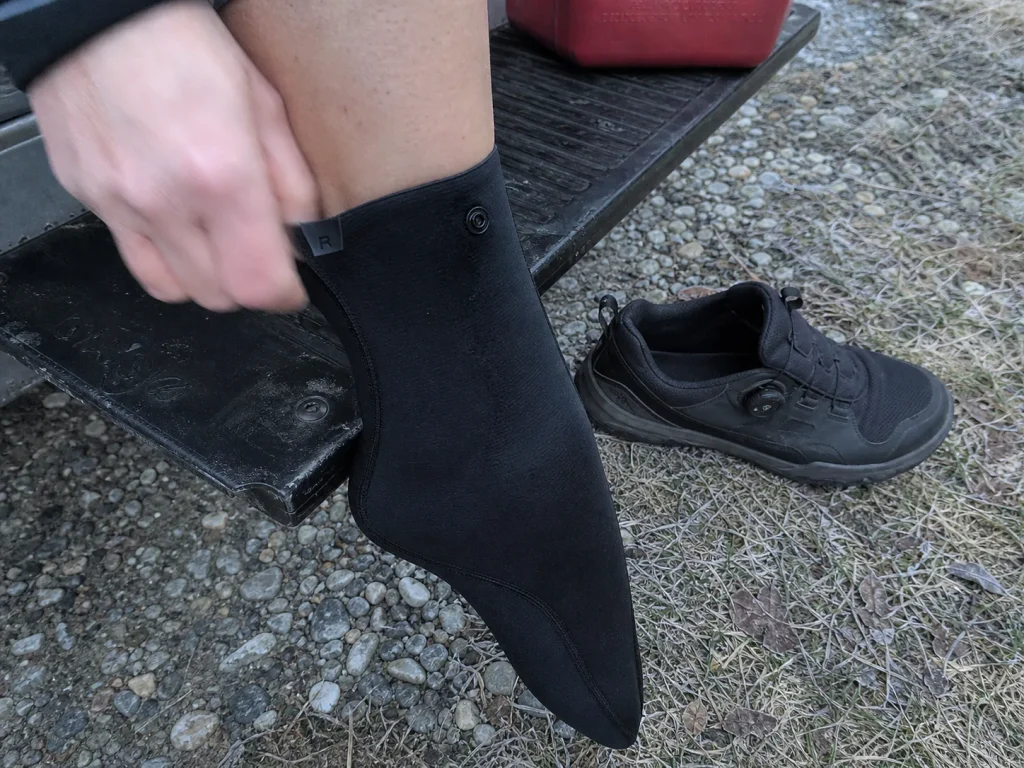
There’s a specific spring-runoff day the guidebooks skip: the air is warm, the sun is out, and the snowmelt is cold enough that your feet ache and go numb between rapids. That’s the “too warm for dry socks, too cold to go bare” window, and it’s where a thin neoprene sock earns its keep.
When You Actually Need Neoprene Socks
Neoprene socks let a summer-weight shoe keep working deep into cold water. You don’t need a full 3mm bootie or a drysuit for most shoulder-season days, just enough insulation to stop your toes shutting down. The NRS HydroSkin 0.5 Wetsocks are built for exactly this, a 0.5mm neoprene core under a DWR nylon-spandex exterior, thin enough to slip inside a closed-toe shoe. Your footwear choice should follow the water temperature, not the air temperature, which matters most in spring when the CFS climbs with snowmelt and the same logic drives layering for a cold-water run. Cold water pulls strength and coordination out of you fast, and the real stakes of cold water immersion are why the seasonal sock call is a safety call, not a comfort one.
The Half-Size-Up Rule
The classic mistake is buying water shoes dry and barefoot in a store, then discovering on the river that a neoprene sock won’t fit inside them. Standard rafter consensus is to size up half a shoe size if you plan to wear any sock system, especially on cold-water and shoulder-season trips.
Buy your river shoes to fit over a neoprene sock, not to fit your bare summer foot. If you already own the sock, bring it to the fitting. If you don’t, go half a size up and you’ll have room for one later without buying shoes twice.
Matching the Shoe to the Water You Run
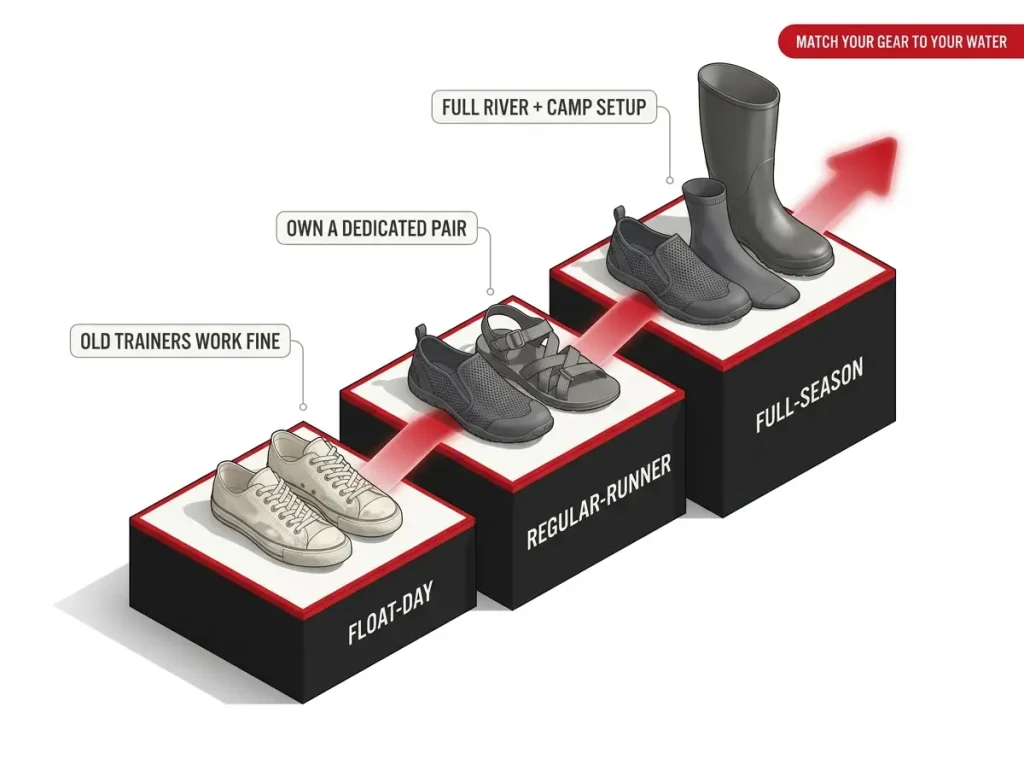
The real answer to “how much do I need to spend” is another question: what water are you running, and how often? Spend follows use, not the other way around.
For mellow summer floats or a once-a-year guided Class II, the old-trainers move is genuinely fine and you shouldn’t buy anything at all. For regular Class III weekend paddling, it’s worth owning a dedicated closed-toe shoe or a strap sandal, which is where the two picks above come in. For cold water, Class IV and up, or multi-day private trips, you want the full setup: a purpose-built river shoe sized for a neoprene sock, plus a camp boot for the shore. Buy for the water you actually run, not the water you dream about, and let the river class you’re running fill in the rest.
Rent the Booties or Buy Your Own
Every other article dodges this question because they’re either selling you a trip or selling you shoes. Here’s the honest calculus instead.
When Rental Booties Are Genuinely Fine
On a guided trip, the outfitter’s provided neoprene booties are genuinely fine for most first-timers. You don’t need to buy anything for a single day on the water, and anyone telling you otherwise probably has product to move. If you’re still figuring out whether you even like this sport, rented footwear is the right call, and it’s worth knowing what a first guided trip actually involves before you spend a dime.
When Owning a Pair Pays Off
The break-even comes fast once you’re going more than a couple of times a season, or once you’ve bought your own raft. Your own well-fitted pair beats rental booties that never quite fit, don’t smell like a hundred other feet, and are sized for your sock system. Owning your footwear is part of the private-boater habit of owning your own kit, and it’s less about gear pride than about never fighting a shoe that isn’t yours in the middle of a swim.
The Bottom Line on River Footwear
The only test that actually matters is whether your footwear stays cinched to your foot when you go for a swim. Match the shoe to the water and the season instead of the marketing, and you’ll spend right: rent the booties for a first float, own a real pair once you’re a regular. Cinch every strap tight at the put-in on your next trip and you’ll never think about your feet again, which is exactly the point.
Frequently Asked Questions
01Can you wear regular sneakers for whitewater rafting?
On a mellow Class II float, old lace-up trainers you don’t mind soaking work fine. The catch is drainage and grip: sneakers hold water and slip on wet rock, so above Class II a dedicated river shoe is worth it.
02Are Crocs okay for rafting?
Only as a camp shoe, and only with the heel strap worn down in Sport mode. Worn loose, Crocs are the most-lost shoe guides recover from the river. Fine at camp, not for the water itself.
03Do you need special shoes for rafting or can you go barefoot?
Never barefoot. Submerged rocks and sharp riverbed material will find your feet, and you get zero grip on wet stone. You don’t need anything expensive, but you need something that laces or straps on securely.
04What is the difference between water shoes and sport sandals for rafting?
Closed-toe water shoes give more protection and pair with neoprene socks for cold water. Strap sandals drain faster and breathe on hot days. Both stay on if cinched, so pick by climate and how much toe protection you want.
05What shoes do you need for a multi-day rafting trip?
Two pairs: a river shoe for the water and a separate dry rubber boot or clog for camp and the muddy put-in. Keeping river shoes out of camp mud makes them last and keeps your feet from living in a wet shoe all week.