
In this article
The raft is upside down in the meat of the rapid, your gear is somewhere in the current, and the only thing standing between you and a cold walk-out is whatever you trusted to stay sealed. That is the moment a dry bag actually gets tested, and it is the exact moment most of them fail. Private boaters have a phrase for packing with that moment in mind: you rig to flip, meaning you pack and strap everything as if the boat will go over, not as insurance in case it does. The best dry bags for whitewater are the ones built for that assumption, and this guide picks winners the way you should shop, around surviving a real flip and a real swim, not just rain and splash.
What “Whitewater-Ready” Really Means (And Why a Flip Is the Real Test)
Here is where most buyers go wrong: they read “waterproof” on a tag and think the job is done. On a river, waterproof is three different promises wearing the same word, and only one of them matters when the boat goes over.
Water-Resistant, Waterproof, and Submersible Aren’t Synonyms
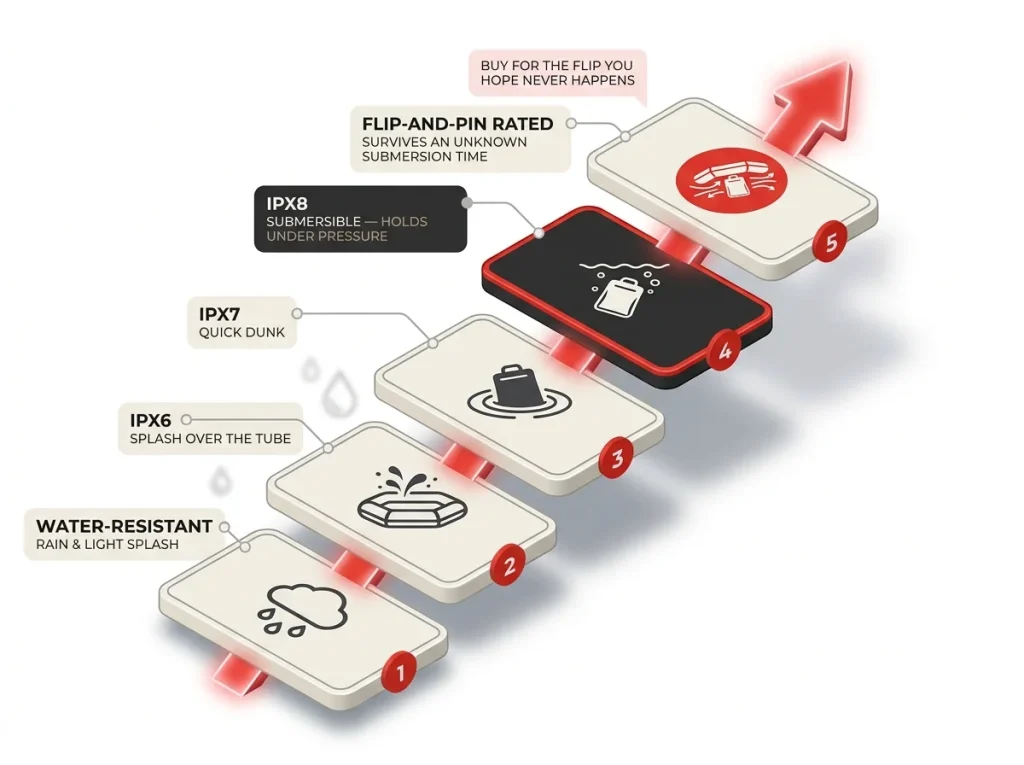
A water-resistant bag shrugs off rain and the odd splash over the tube. A waterproof bag keeps a quick dunk out. A submersible bag is the only one built to stay dry when it is held underwater for real time, which is what a wrap or a recirc does to your gear. The generalist roundups treat these as a spec ladder. On whitewater they are a decision about worst case, and your worst case is not a rain shower. It is your bag pinned under the boat in a hole while you sort out the swim.
The plain version: buy for the flip you hope never happens, not for the average sunny float. The bag that only needs to handle spray is your clothes bag. The bag that has to stay dry no matter what is a different animal, and it costs more for a reason we will get to.
IPX7 vs IPX8 and the Rating That Actually Matters on a River
The rating you will see quoted is the IPX scale. IPX7 means submersible to one meter for thirty minutes without leaking. That sounds like plenty until you picture the actual scenario. IPX8 means continuous submersion beyond one meter, which is the rating built for boats, diving, and anything that can hold your gear down for minutes instead of seconds. A flipped raft does not politely submerge your dry bag for thirty seconds and let go. It can pin it underwater far longer than any lab test runs.
Most gear reviewers land on the same split, and it is a good one: IPX7 is fine for your general whitewater, surf, and canyon-swim use, but you want IPX8 specifically when you are carrying irreplaceable electronics on a raft. Your food and spare layers can ride in an IPX7 bag. Your phone, which is your map, your camera, and your way to call for help, rides in the higher-rated one.
How Roll-Top, Welded Seam, and ZipDry Closures Hold and Fail
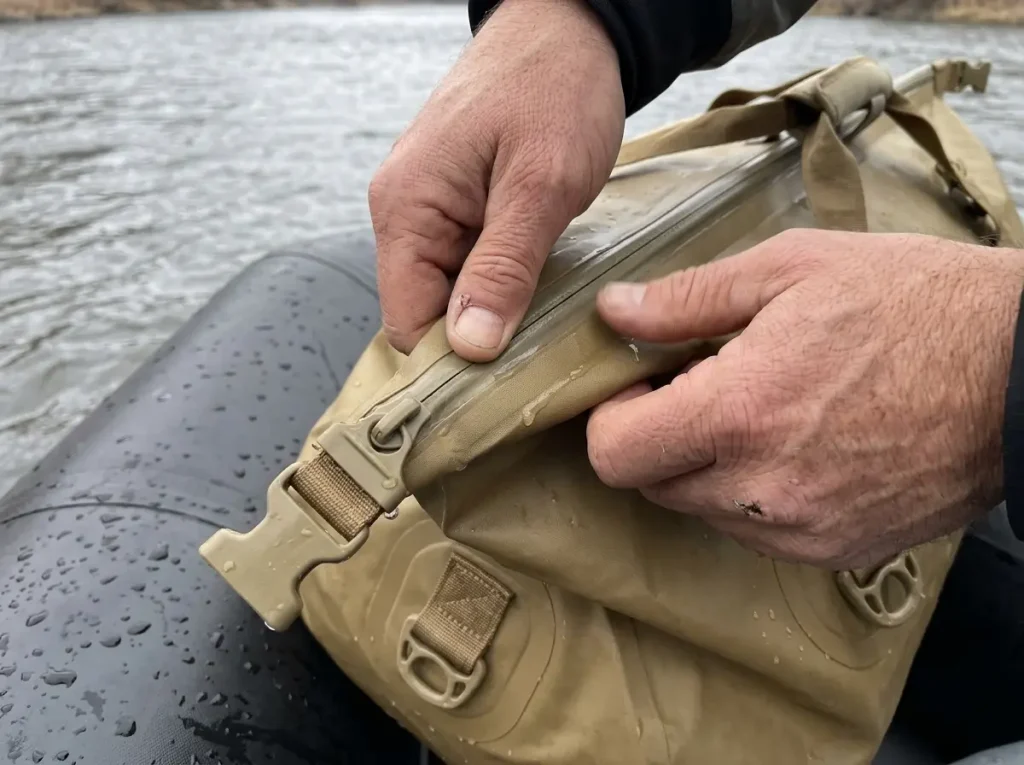
The closure is where dry bags actually live or die, so it is worth knowing how each one seals and how each one lets go. A roll-top folds the opening over itself and clips it shut. It is simple, cheap, and genuinely good, right up to its limit. The catch is that the seal is only as good as your technique, and a roll-top can start seeping after just 15 to 20 minutes fully submerged even when you roll it correctly. That is not a flaw so much as a design ceiling. It was never built for a flip-and-wrap.
A welded-seam bag with a ZipDry or HydroLok-style airtight zipper is the next tier. Instead of relying on folds, it seals along a continuous zipper and RF-welded seams, which is what gives it the headroom to sit underwater and stay dry. This is the video worth watching before you spend a dollar, because seam construction and closure mechanics are the kind of thing text specs flatten and a side-by-side comparison makes obvious.
The number one reason a “waterproof” roll-top leaks on a flip is a lazy roll. You need three clean turns, folded flat, with the air purged first. Two turns and a bulging top is not a seal, it is a wick. If you can still squeeze air out after you have clipped it, unclip and roll it again.
Best Overall for Whitewater, the Watershed Colorado Duffel
There is a story that still gets traded on the private-boater forums: a raft flipped and stayed pinned under a strainer for more than two days, and when it was finally recovered, only the Watershed bags on board came out completely dry. Everything else, including other bags marketed as waterproof, was soaked through. That is the stress test no lab number captures, and it is why this bag is the pick when you cannot know how long your gear might stay under.
Why Guides Reach for It When a Pin Is Possible
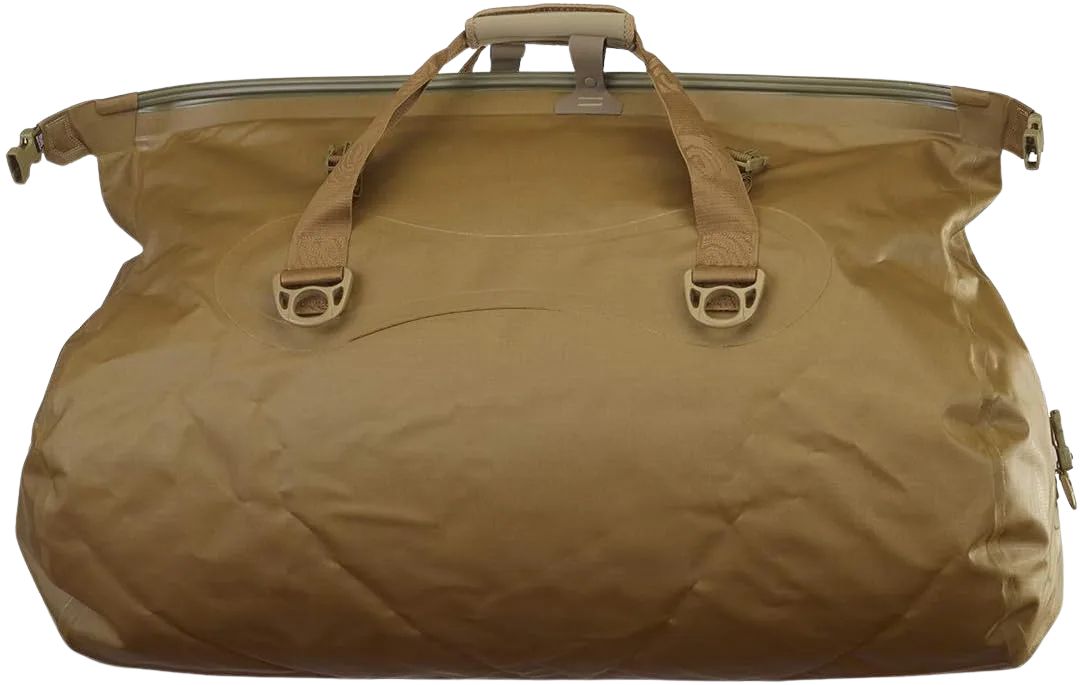
The Watershed Colorado Duffel builds its seal from RF-welded seams and the airtight ZipDry closure, which is closer to a submarine hatch than a fold. Where a roll-top depends on you getting three clean turns every single time, the ZipDry seats the same way whether you are fresh at the put-in or cold and clumsy at camp. That consistency is the whole point. The manufacturer’s submersion claims run far past any dunk you would design a bag around, and the reason boaters believe them is exactly that forum story: this is the bag that survives the scenario no one plans for.
You do not buy this for capacity, and you do not buy it because it is the biggest. You buy it because when your gear ends up underwater for an unknown stretch of time, this is the one that treats that like a Tuesday.
The Maintenance Trade-Off Nobody Mentions
Here is the honest part the marketing skips. The ZipDry seal needs occasional care with a 303 Protectant, especially after gritty, sandy put-ins, or the zipper gets stiff and starts fighting you at the take-out. That is a real cost a cheap roll-top does not carry. If you never run anything past Class II, never expect a swimmer, and never haul anything you could not replace, this is more bag than you need, and there is no shame in saying so.
Best Premium Duffel, the YETI Panga 75
Some boaters do not want a roll-top at all. They want to grab gear fast at camp without unrolling anything, and they want a duffel that opens like a duffel. That is the YETI Panga’s whole pitch.
Zip Access vs Roll-Top at Camp
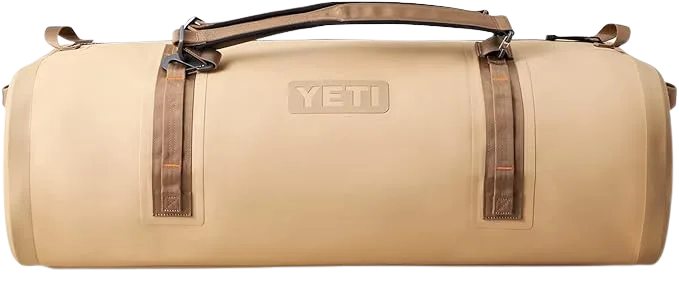
The YETI Panga 75 runs a HydroLok zipper across a wide mouth, so at camp you unzip the whole top and see everything at once instead of digging down through a roll-top tube. If you have ever knelt in the dark feeling around the bottom of a 110-liter roll bag for one dry sock, you understand why some boaters pay for zip access. Welded construction and MOLLE-style lash points round it out for tying down on a frame or a deck.
When the Weight and Price Are Worth It
This is a premium haul bag, and it is heavier than a comparable roll-top duffel. That weight is the trade for the submersible zipper and the burly build. If you want that volume without the submersible zip, the NRS Bill’s Bag below covers similar space for a lot less. The Panga earns its keep for the boater who wants marine-grade sealing and duffel-style access in one bag, and does not blink at carrying both the weight and the cost.
Best Big Camp-Gear and Frame Bags, NRS Bill’s Bag and Mustang Greenwater
Multi-day trips live or die by the big bag on the frame. This is where your sleeping system, your camp clothes, and the bulk of your kit ride, and there are two very different right answers depending on whether you are optimizing for volume or for staying dry no matter what.
NRS Bill’s Bag 110L, the Camp-Gear Workhorse
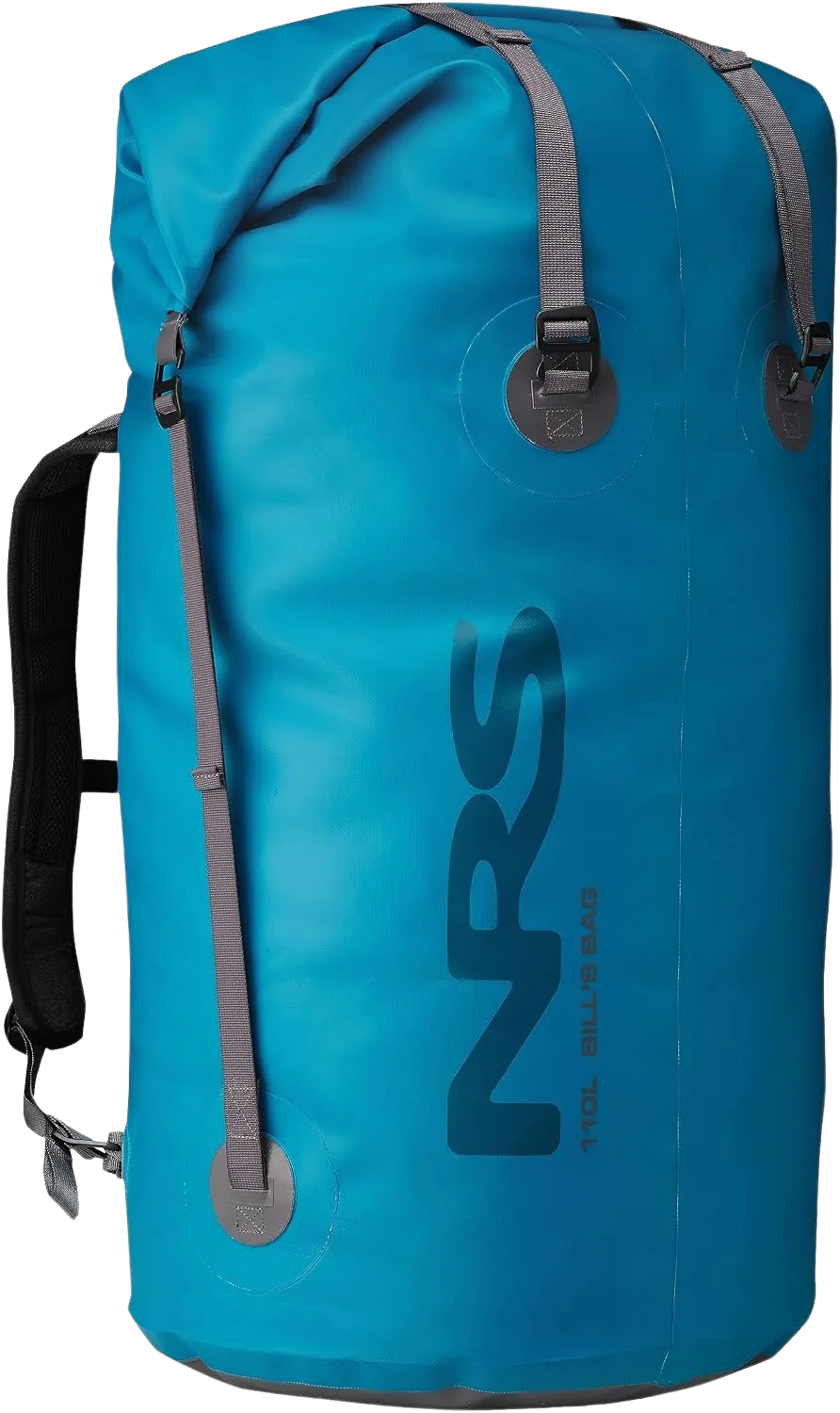
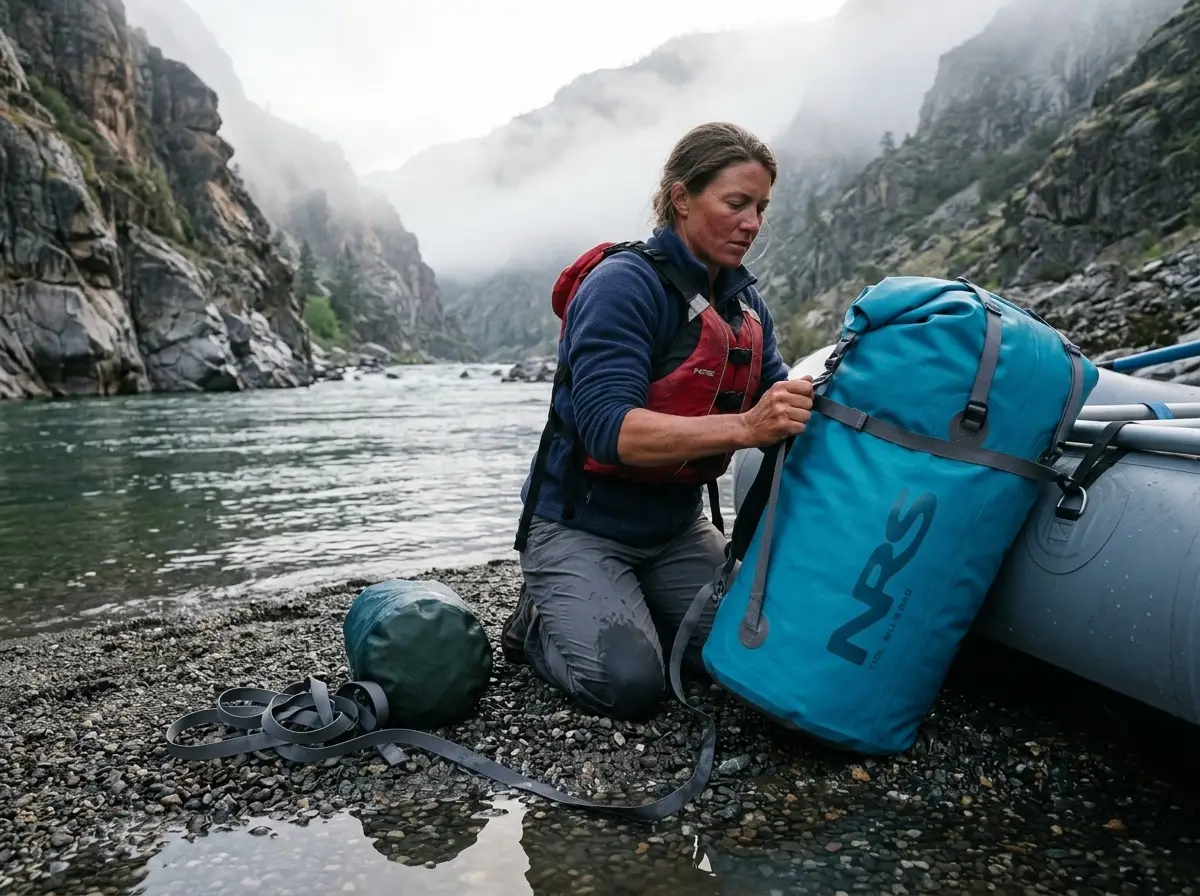
The NRS Bill’s Bag has been on the back of frames for decades because it was built for that job specifically. The heavy 18-oz vinyl shrugs off the abuse of a put-in gravel bar, the roll-top has a purge valve so you can flatten it against your straps, and the D-rings sit where cam straps actually cross the bag. That last detail is the difference between a bag that rides tight and low and a generic duffel you fight to keep centered. For camp gear that can handle a splash but does not need submarine-grade sealing, this is the honest workhorse.
Mustang Greenwater 65L, the Submersible Frame Bag
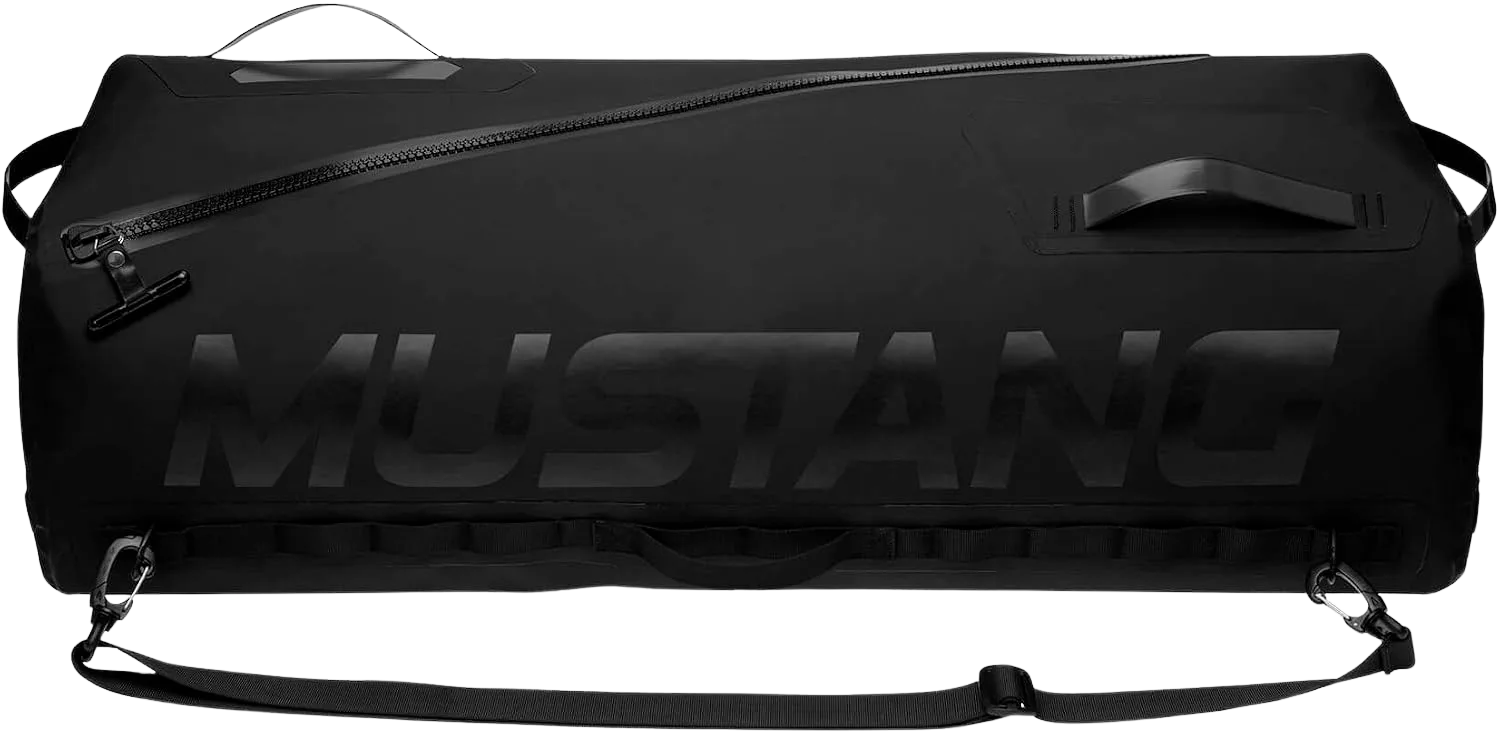
The Mustang Greenwater is the answer when your frame bag holds gear that cannot afford a leak. The 420D Hypalon and welded construction put it in the same submersible conversation as Watershed, but in a deck-bag shape meant to mount on a frame rather than a duffel meant to be lashed on top. It is a niche, premium pick, and it is not where a first-time boater should start. It is where you land when you have decided the big bag on your frame is going to stay dry through a flip, full stop.
Volume vs Submersible Security, Which One You Actually Need
The choice between these two is really a question about what lives in the bag. Sleeping bag, camp clothes, and food that would survive getting damp? The Bill’s Bag gives you more volume for less money, and its splash resistance is plenty. Gear that genuinely cannot get wet on a multi-day, run in cold water where a soaked sleeping bag becomes a safety problem? That is when the Greenwater’s submersible zipper earns the premium.
Purge the air before you cinch a big roll-top duffel. An over-inflated bag rides high, fights your straps, and rounds off so the cam straps want to slide off the ends. Kneel on it, push the air out through the purge valve, then roll and strap. A flat bag sits low and centered, which is exactly where you want the weight when the boat gets squirrelly.
Best Budget Bag That’s Still Rated for Whitewater, the SealLine Black Canyon 30L
Here is the anti-sell moment this whole site is built on: you do not always need to spend big, and pretending otherwise is how gear blogs lose your trust. The trick is knowing exactly where the budget bag’s limit sits so you do not find it the hard way.
What You Give Up vs a Premium Bag (And What You Don’t)
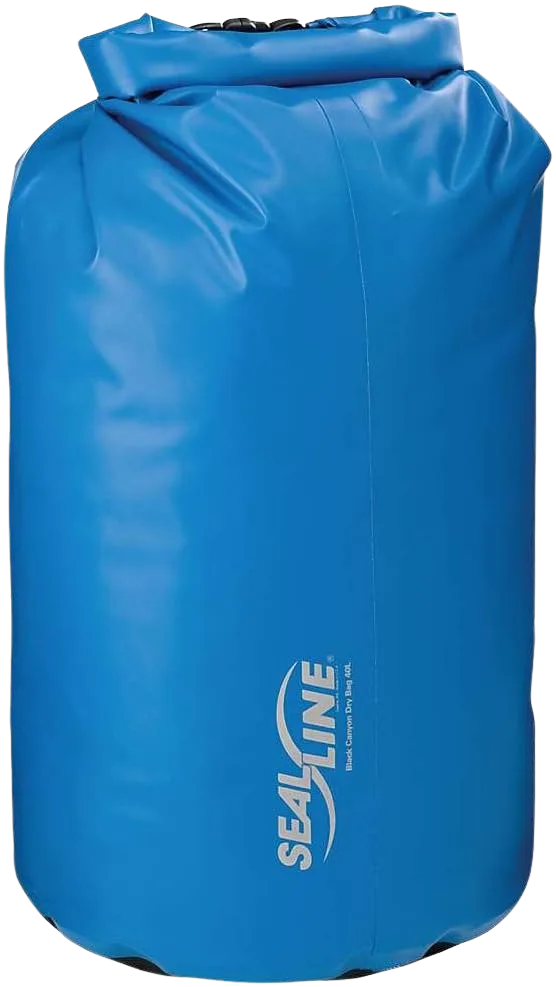
The SealLine Black Canyon is 300-denier nylon with a TPU-coated finish, a roll-top, PVC-free construction, and an IPX7-class rating. Read that again: it carries a real whitewater rating at a budget price. What you give up against a Watershed is the flip-and-pin headroom. This is a bag rated to handle a dunk, not to stay sealed while it is pinned under the boat for minutes. What you do not give up is honest construction. It has welded seams and a purge valve, which is exactly what separates it from the bargain sack that fails after one season of UV and grit.
The Right Job for a Budget Bag
Give this bag the job it is good at and it will never let you down: clothes, food, camp layers, the stuff that would be a bummer to get wet but not a serious risk. Do not make it your last line for your phone or your dry insulating layer. Match the bag to the worst thing that happens if it leaks, and a 30-liter Black Canyon is genuinely all most day boaters and weekenders need.
Best Day, Backpack, and Ultralight Bags
Not every bag lives strapped to the frame. Some ride in the boat with you, come out at every lunch stop, and get carried on the portage trail. These are the grab-and-go bags, and the right pick depends on how you are moving them.
Sea to Summit Big River 20L, Best All-Rounder Day Bag
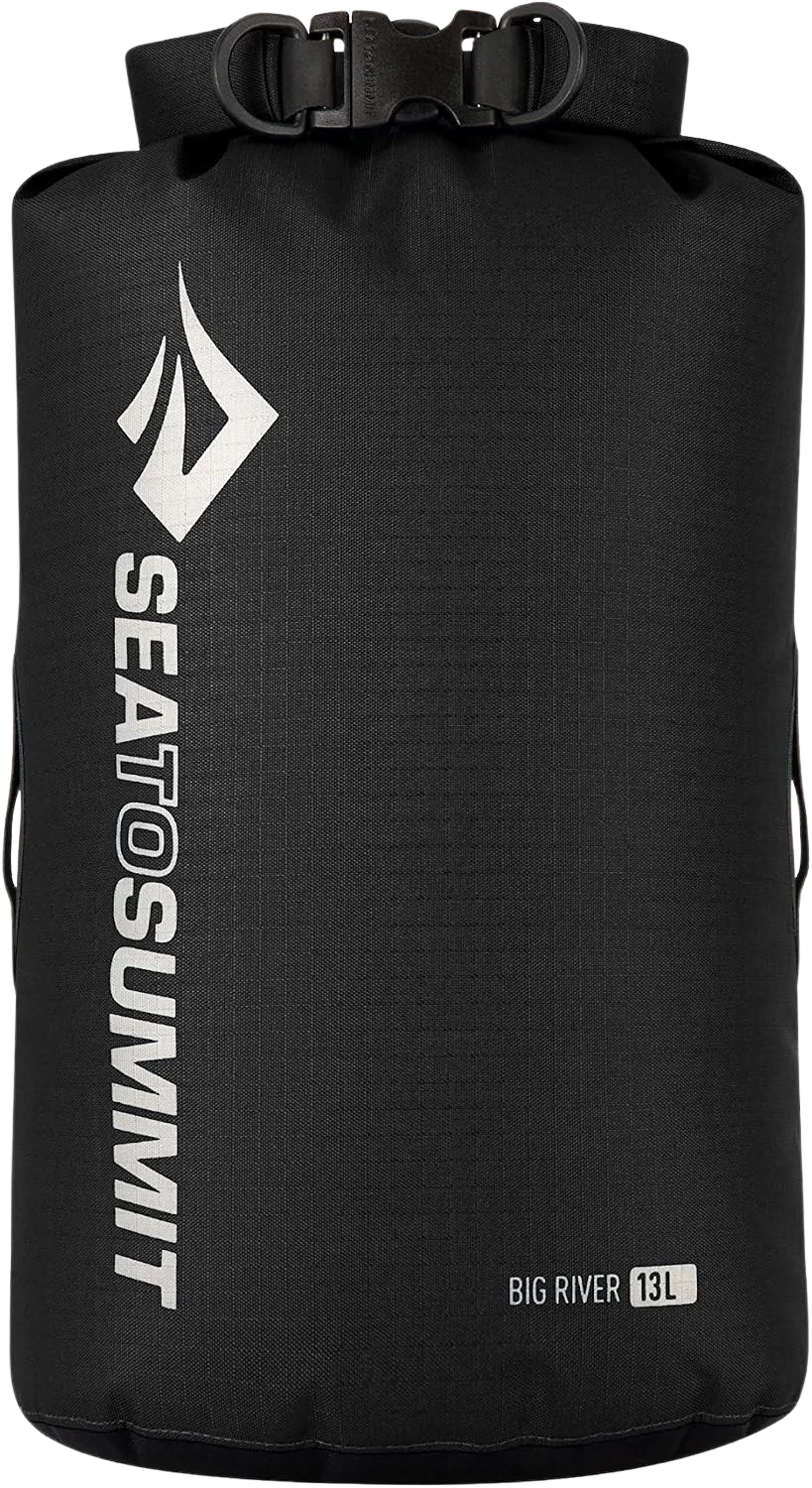
The Sea to Summit Big River 20L is the mid-size bag most boaters reach for by default, and for good reason. The 420-denier fabric is heavier than the flyweight sacks, and the reinforced base is the detail that matters when you drop it on the sharp cobble at a rocky put-in. It is not trying to be the submersible pin bag, it is trying to be the tough, reliable 20-liter you grab without thinking, and it nails that.
Sea to Summit Big River Backpack 50L, Best Backpack-Style Carry
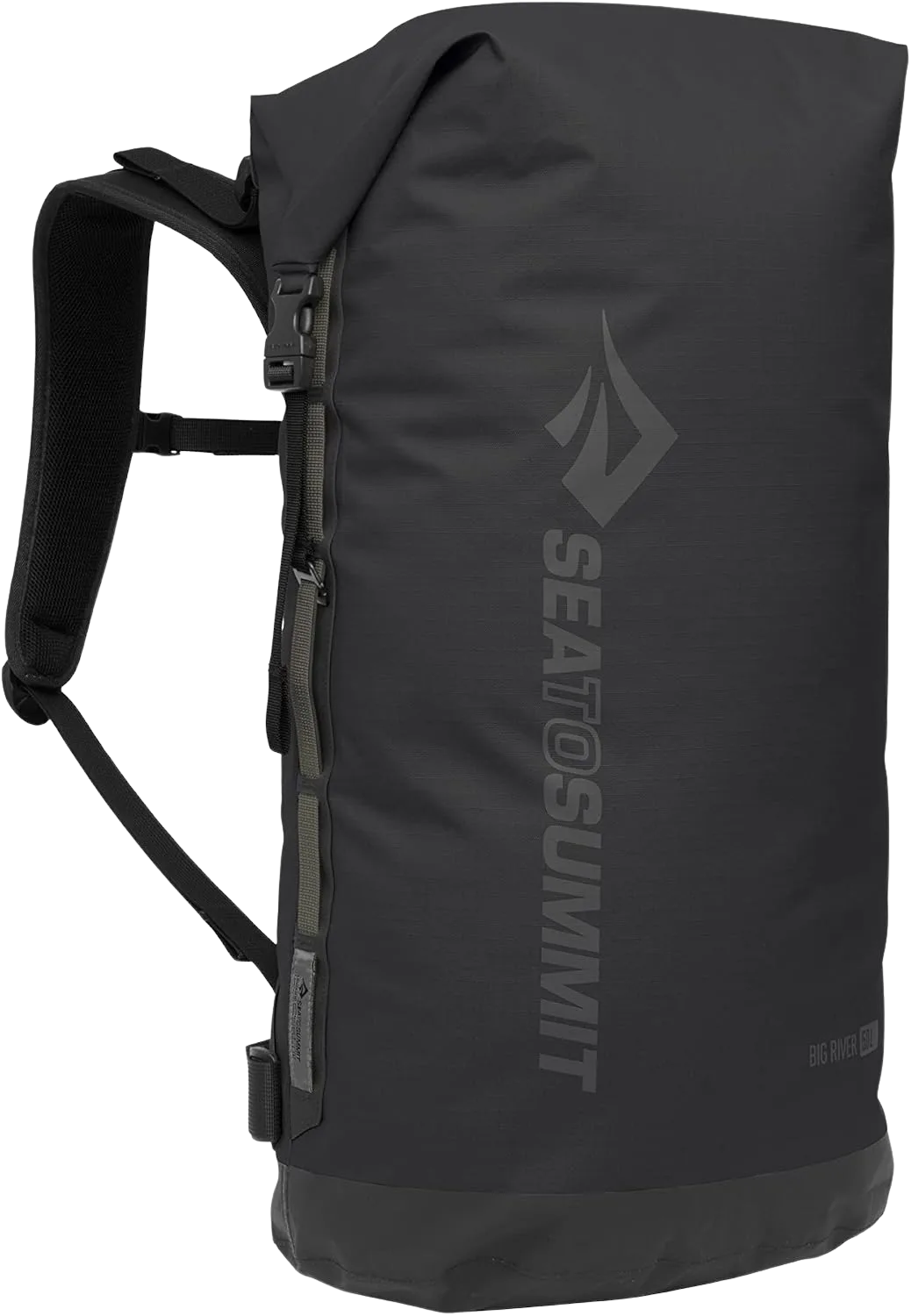
When you have to carry gear any real distance, around a portage, up from a canyon take-out, or on a shuttle walk, a bag with actual pack straps changes the day. The Sea to Summit Big River Backpack 50L adds a proper harness and a hip belt so a loaded 50 liters rides on your hips instead of biting into your hands. Most backpack-style dry bags charge a premium for that convenience. This one is the value pick in the category, which is exactly why it makes the list.
Osprey Ultralight 20L, Best Liner Sack
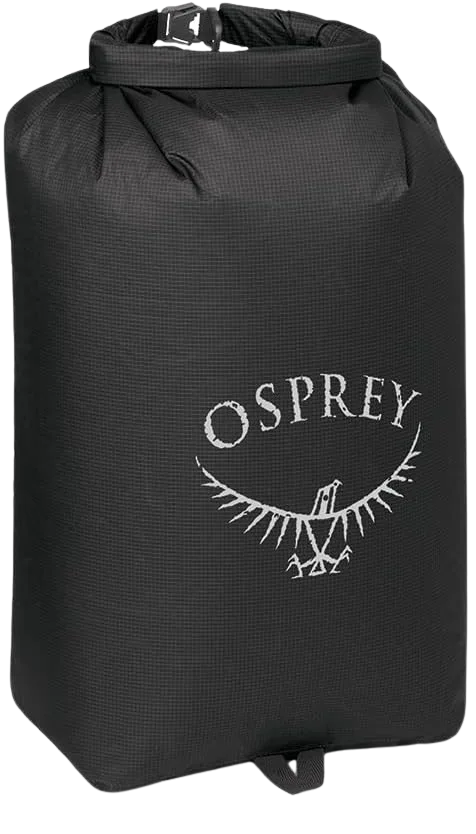
The Osprey Ultralight 20L is the bag everyone misunderstands, so here it is straight: this is a liner, not a last line. The siliconized nylon is light and packs to almost nothing, which makes it perfect for keeping one item dry inside a larger rigged bag, or for splash and rain protection on a mellow float. It is not built to survive a swim on its own, and treating it like it is will cost you. Used for the job it is designed for, sorting and protecting gear inside a bigger sealed bag, it is genuinely great and worth the small space it takes.
Best Bag for Cameras and Electronics, the Fishpond Thunderhead
This is the one bag you do not gamble on. Your phone is your map, your camera, and, on a bad day, your only way to call for help. Electronics get treated differently from everything else you pack, and the difference is not one bag, it is two layers.
Why Electronics Get Two Layers, Not One
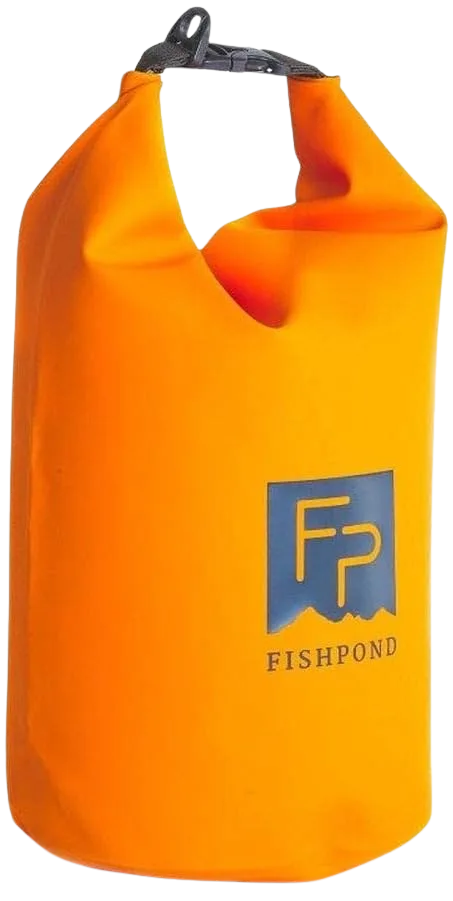
Reviewers and river forums keep landing on the same advice for anything irreplaceable: use double-protection, a dry bag plus a hard case like a Pelican case inside it. A single roll-top is not enough for a phone or a camera, not because roll-tops are bad, but because a puncture or an imperfect seal is common enough that you do not want it to be the only thing between the river and your electronics. The Fishpond Thunderhead is the outer layer in that system: a tough roll-top that keeps water off the hard case that keeps water off your gear.
Clip your electronics bag to a D-ring inside the boat, never just toss it in. In a flip, an unclipped bag is gone downstream with everything else loose in the current. A phone that stayed dry does you no good if it is three rapids away. Short leash, inside the tube line, where you can reach it but the river cannot take it.
Abrasion Resistance for a Bag That Lives on the Floor
The reason a 900D TPU-coated fabric matters here is that an electronics bag does not sit politely in a corner. It rides on the boat floor, gets stepped on, slides across cobble at every stop, and takes the grit that wears a lighter bag thin. The Thunderhead’s heavy fabric is built for that life. If the budget for a dedicated electronics bag is not there yet, the Osprey Ultralight can serve as the inner liner, but only inside a sealed outer bag, never as the outer layer itself.
How to Size Your Bags and Rig a Two-Bag System
Ask “what size dry bag do I need” and most guides will answer with backpacking liter math. That is the wrong frame. On a raft you do not size one bag to hold everything, you split your load the way the boat is actually rigged, and that changes both the sizes and the strategy.
Sizing by Trip Length, Day to Multi-Day
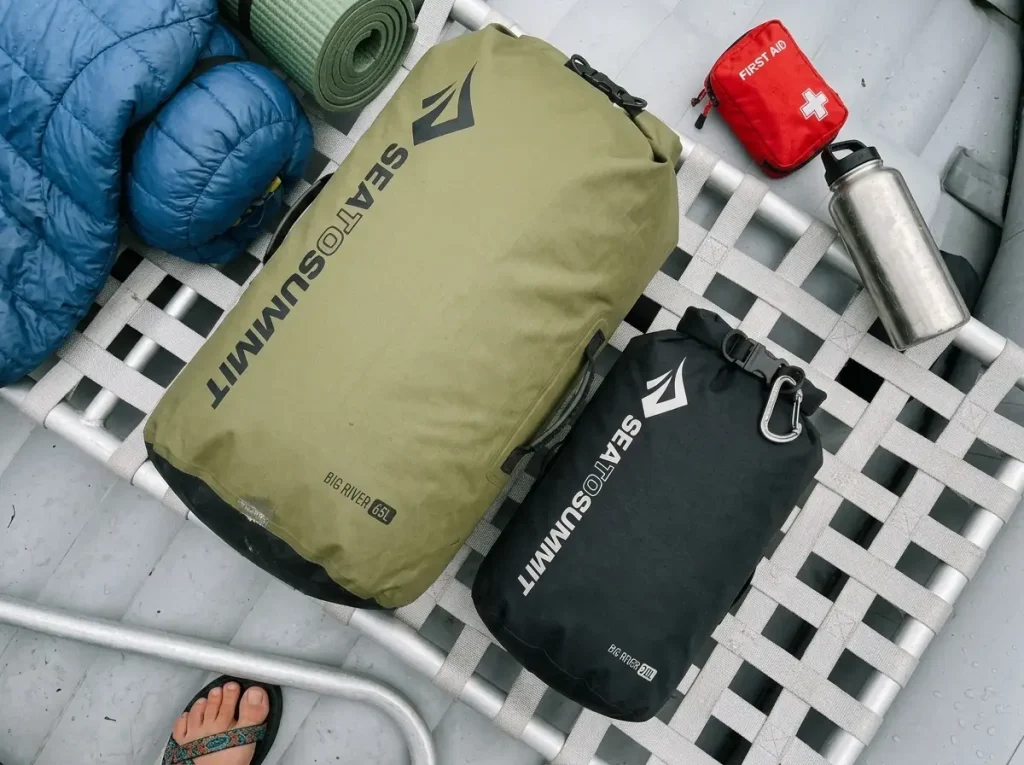
The rough numbers are worth knowing. A day trip runs 5 to 20 liters for the essentials you want dry: a layer, lunch, a first-aid kit, your phone. An overnight bumps you to around 30 liters once a sleeping bag and camp clothes enter the picture. A multi-day with a full camp duffel of sleeping system, camp kitchen, and clothes pushes you into the 65 to 110-liter range, which is why the big frame bags above exist. Those are starting points, not rules. What actually decides your sizes is how you divide the load.
The Two-Bag System Private Boaters Actually Use
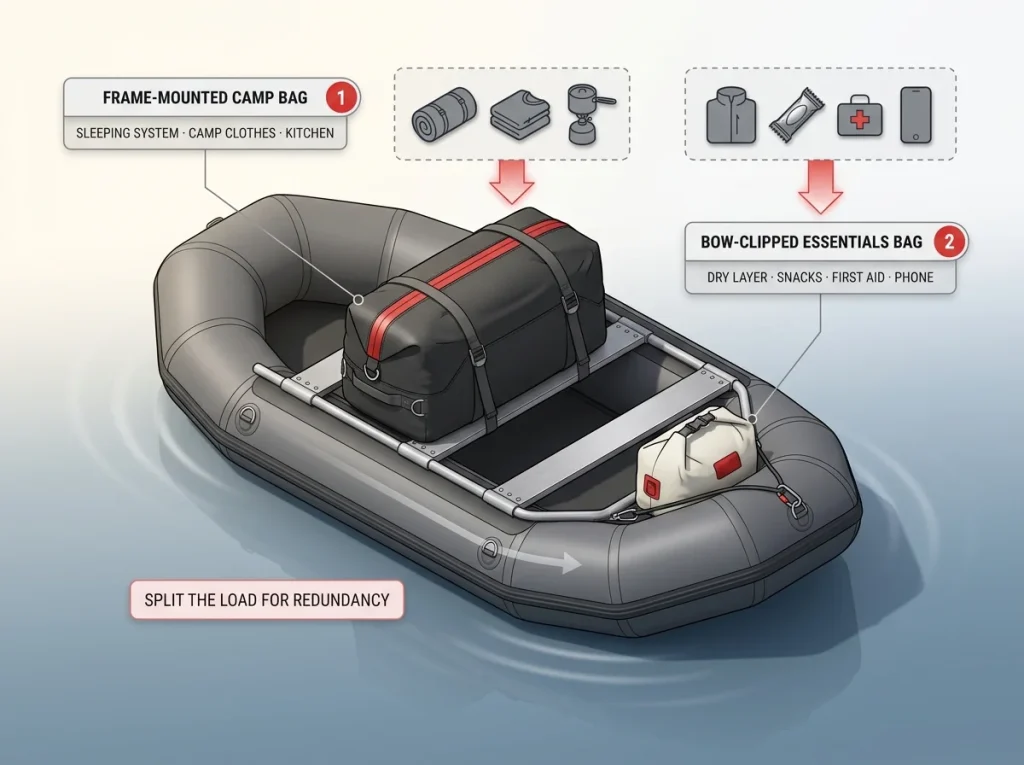
The move that separates experienced boaters from beginners is the two-bag system. You run one large, frame-mounted bag for camp gear, the stuff you do not need until you stop, and one small, accessible bag clipped to the bow line for the essentials you need mid-run without unstrapping the frame. Your dry layer, snacks, sunscreen, and phone live in the little bag you can reach from your seat. Everything else rides locked down on the frame.
There are two reasons this beats one giant bag. First, access: you are not tearing apart your entire rig to grab a granola bar at an eddy. Second, and more important, redundancy. Splitting gear across two bags means one puncture or one bad seal does not cost you everything. If the big bag takes a hit, you still have your essentials. That is not organization for its own sake, it is insurance built into how you pack. Sizing your camp bag also means knowing the frame you’re lashing all this to, because a smaller cataraft frame carries volume very differently from a big paddle-raft setup.
For the small bow bag half of the system, you do not need to spend much. The NRS Tuff Sack (check it on Amazon) is a rugged, compact roll-top that does exactly this job: the budget essentials bag you clip up front and forget about until you need it. It will not survive a pin the way a Watershed does, but that is not its job. Its job is to keep your snack and your spare layer dry and stay clipped where you can reach it.
Packing So the Seal Actually Seals
The most common way to leak a good bag is to overstuff it. A roll-top needs room to fold flat three times, and a bag crammed to the brim bunches at the opening and channels water right through the seal. Leave yourself the top few inches. Purge the air, roll three clean turns, clip it, and check that it stays flat. A properly rolled 20-liter bag with a little headroom beats an overstuffed 30-liter bag every time the boat goes over.
Rigging Dry Bags to Your Frame So They Survive the Flip
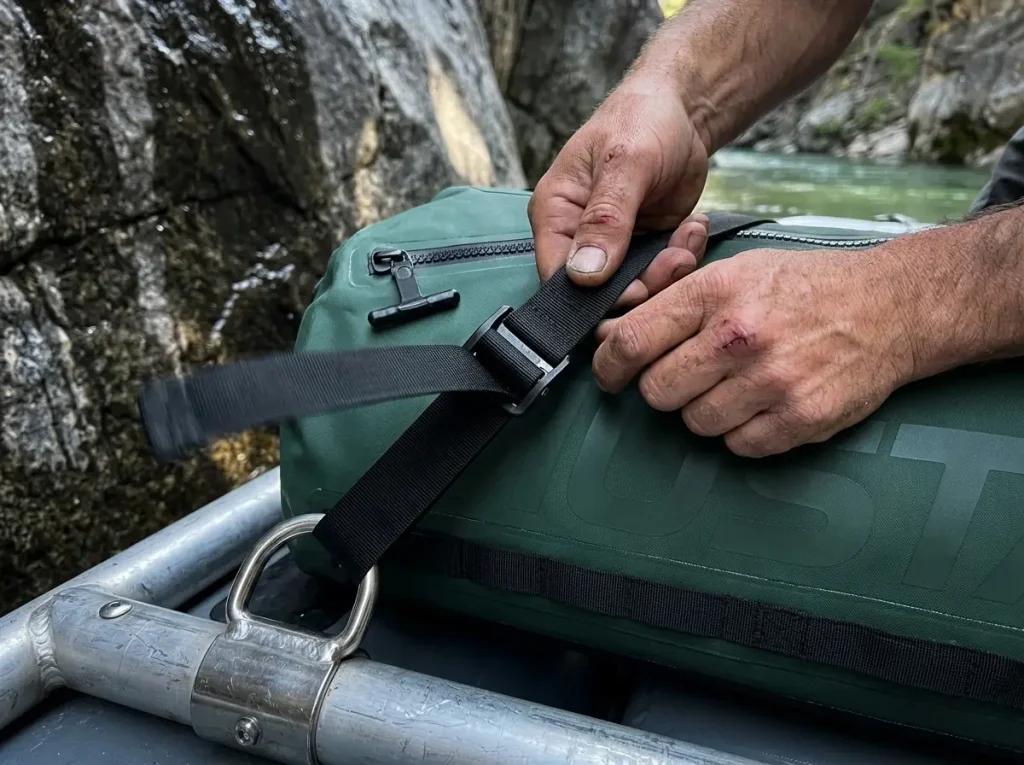
This is the part every generalist roundup skips, and it is the part that actually keeps your gear with the boat. A bag that is just clipped on is a bag that works loose exactly when you need it secured, mid-rapid, post-flip. Rigging is a skill, and the difference between “clipped on” and “rigged” is the difference between finding your gear at the take-out and watching it flush downstream.
The Girth-Hitch Anchor That Won’t Slip
The single most useful rigging move is the girth-hitch. You loop the buckle end of the cam strap through the D-ring, then feed the whole strap through that loop and pull it tight. What you get is a fixed anchor point that will not slide along the strap under load. Most beginners just run a strap through a D-ring and cinch it, and that setup creeps and works loose as the bag shifts through a rapid. The girth-hitch does not. It bites down on itself and stays put. This is standard practice among riggers and raft guides, not a nice-to-have, and it is the first thing worth learning before you trust a frame with your gear. It is the same principle behind rigging a hard dry box that stays put through a flip, just applied to a soft bag instead of a box.
Counter-Tension So the Load Rides Through a Flip
One strap is never enough. The practice that keeps a load centered through a flip is counter-tension: run at least two straps per side, pulling from opposite angles, so the bag cannot rotate or shift. A single strap lets the bag pivot on its one anchor, and a bag that pivots becomes a bag that works free. Opposing tension pins it in place from both directions. This is what boaters mean when they say a load is rigged to flip, it is strapped so that turning the whole boat upside down does not change where the gear sits. Getting the strap tension right depends on knowing the working load limit and length of your cam straps, because an under-spec or too-short strap undoes all the technique.
Dry Box or Dry Bag, Rig Either One Low and Tight
Weight placement matters as much as the strapping. Keep the bag low and centered on the frame, because a high, loose load changes how the boat handles and can become a hazard if it comes free in current. Some boaters run a hard dry box for the same job, especially for kitchen gear and anything crushable, and the rigging logic is identical: girth-hitch the anchors, counter-tension the straps, keep it low. Which one you build on depends a lot on which raft frame type you’re building on, since the frame is the foundation every bag and box gets rigged to. Box or bag, the rule is the same. Low, tight, and anchored so it rides through the flip with you instead of leaving without you.
The Cold-Water Truth Behind Keeping One Layer Dry
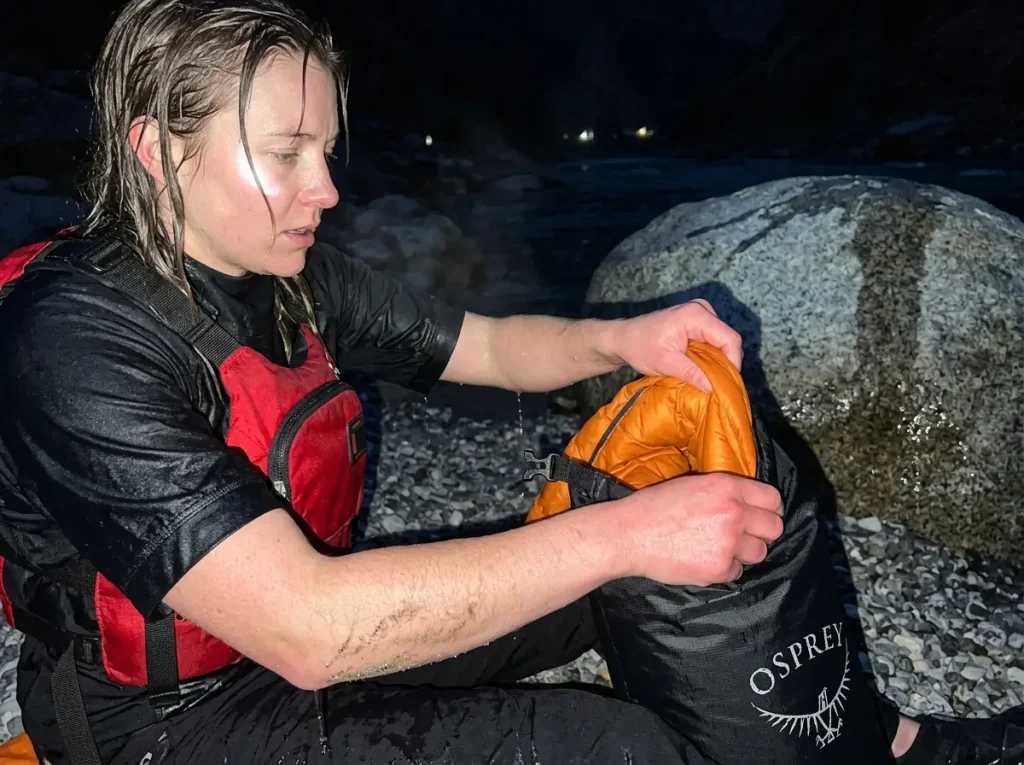
Here is the part that turns a gear choice into a safety one. The water that “isn’t that bad” from the bank is often exactly the range that triggers the worst reaction when you go in, and a damp puffy after a swim is a safety failure, not a comfort one.
Why 55°F Water Is More Hazardous Than It Feels
Cold shock does not wait for near-freezing water. According to the National Weather Service’s cold water safety guidance, cold shock can hit in water as warm as 77°F, and its peak intensity lands in the 50 to 60°F range, the temperature of most spring and early-summer runoff. Water below 70°F officially counts as cold water. That covers most Class III and IV rivers people run from April through June, even on a warm, sunny day when the air feels fine. The gasp reflex that cold shock triggers is what makes an easy swimmer situation turn serious, because the first thing that cold water does is make you inhale at the worst possible moment. This is where self-rescue skills and a rescuer’s throw bag matter as much as the gear in your boat. Swimming smart is its own discipline, and how to swim aggressively out of a cold-water flush starts with not panicking through the initial shock.
The One Layer That Has to Come Out Dry
Cold shock is the immediate risk. Hypothermia is the slow one. Core temperature starts dropping toward trouble around 95°F, and here is the part people miss: the drop keeps going even after you are back in the boat. Staying wet in cold air and wind keeps pulling heat out of you. That is why a dry base layer and an insulating puffy that are genuinely dry after a swim are safety gear, not comfort items. This is the real reason the premium, higher-rated bag matters, and not only for your camera. The layer that has to keep you warm after a cold swim is exactly the thing that cannot be allowed to get wet.
Packing the Safety Bag You Hope You Never Open
Treat one small bag as the layer that comes out dry no matter what, and pack it accordingly: a dry base layer, an insulating puffy, and a reliable way to warm up if it comes to that. Put it in your best-sealing bag, clip it where you can get to it fast, and do not raid it for convenience on a nice day. It is the bag you hope you never need to open, which is exactly why it has to work the one time you do.
The Bottom Line
Three things carry this whole guide. First, match the bag to the worst case, a flip-and-pin, not the average sunny float, which is why a submersible Watershed and a splash-rated budget bag are both correct answers for different jobs. Second, rig it low, tight, and girth-hitched so it survives the flip with you instead of flushing downstream without you. Third, one layer always comes out dry, and on cold water that is a safety decision, not a comfort one.
Before your next run, rig your frame at home and dunk-test the bag that holds your dry layer in the bathtub. Better to find the leak in your driveway than in the middle of a canyon with the water coming up cold.
Frequently Asked Questions
01What size dry bag do I need for a rafting trip?
Day trips run 5 to 20 liters, overnights around 30 liters, and multi-day camp gear 65 to 110 liters or more. On a raft, split the load into a large frame bag plus a small bow-clipped essentials bag rather than sizing one bag for everything.
02Are dry bags actually waterproof if my raft flips?
Only submersible-rated bags with welded seams or a ZipDry closure are built for a flip. A basic roll-top handles splash and a quick dunk but can start seeping after 15 to 20 minutes fully underwater, which is why a pin is its weak point.
03How do you keep gear dry when a raft flips?
Rig a submersible bag low and tight to the frame with a girth-hitched cam strap, and split your gear across two bags for redundancy. Keeping the load anchored and centered is what keeps it with the boat through a flip.
04Do I need a special dry bag for a phone or camera?
Yes. Use double protection for anything irreplaceable, a dry bag plus a hard case like a Pelican inside it. A single roll-top can be punctured or sealed imperfectly, so electronics get two layers, not one.
05How do you attach a dry bag to a raft frame?
Girth-hitch a cam strap to the D-ring by feeding the strap through its own looped buckle end, then run counter-tension straps from opposite angles. Keep the bag low and centered so it rides through a flip instead of working loose.