

In this article
The experience begins not with a choice, but with a sound—a jarring, grating shriek of hypalon against granite that cuts straight through the roar of the rapids. The raft, a dynamic vessel just a moment ago, lurches to a sudden, violent halt. The full, relentless force of the river begins to accumulate against the upstream tube, pressing tons of water against a single point. This is the moment of a pin: a precise and dangerous state of equilibrium that can escalate from inconvenience to catastrophe in seconds for any paddler. Being pinned in a river is one of the most serious situations in all of whitewater sports.
This guide deconstructs that moment. It’s not just a list of rules, but a deep dive into river physics and practiced responses that transform abstract knowledge into wilderness instinct. We’ll provide a comprehensive framework to understand, prevent, and respond to river pins, taking you on a journey from abstract fear to a clear, hierarchical understanding of how to stay safe. You’ll finish feeling empowered, not intimidated.
Here’s the core of what you’ll master:
- The Physics of Force: Understand the pin mechanics and dynamics of pinning—how river gradient and volume exponentially increase the pinning force and create predictable, dangerous hydraulic features.
- A Taxonomy of Trouble: Learn to identify the five major types of pins—from the common Center Broach to the severe Vertical Pin—to inform your prevention and rescue strategies.
- Prevention as the Best Rescue: Master proactive techniques like reading water, high-siding, and strategic scouting that are the cornerstones of safe river safety.
- The Rescue Escalation Protocol: Follow a step-by-step pin rescue plan, starting with immediate self-rescue and simple on-boat maneuvers before escalating to advanced mechanical advantage systems like the Z-drag.
What is a River Pin and What Forces Cause It?
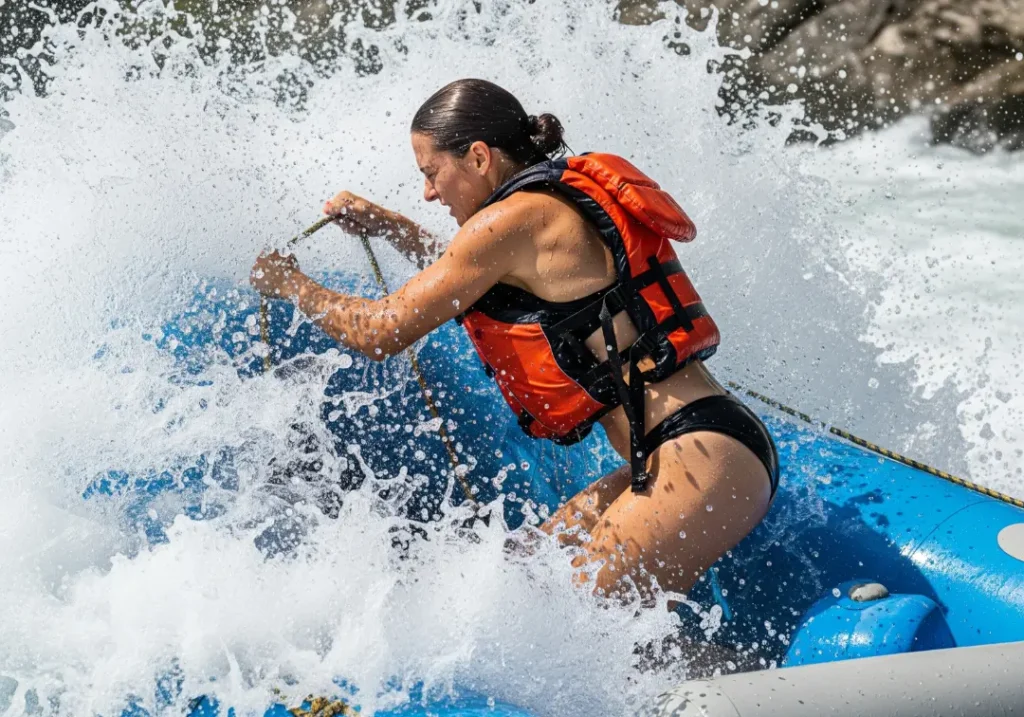
To understand how to defeat the river’s power, you must first respect its source. This section breaks down the fundamental hydrological principles that create the immense force of a river system and the specific features that turn that force into a pinning hazard.
How do gradient, volume, and current combine to create pinning force?
Think of a river’s engine as having two primary controls: Gradient and Volume. Gradient is the steepness of the riverbed, the drop over distance. Volume, measured in cubic feet per second (cfs), is the amount of water moving past a point. Together, these variables determine the river’s velocity and its raw power, especially at high water levels. This raw power from a strong water current is what can pin a boat, whether it’s a large commercial raft, a solo kayak, or even a tandem canoe.
In an open, unobstructed channel, water moves in what is known as Laminar Flow. The molecules travel in relatively straight, parallel lines. The fastest current, which we call the “tongue,” is typically found just below the surface in the center of the channel. It’s a smooth, predictable force. But whitewater is defined by its immovable obstructions. When rocks, ledges, and trees disrupt this smooth flow, they create the turbulent, chaotic environment where the potential for a pin becomes a reality for all boaters.
The critical concept to internalize is that the force exerted by this moving water is not linear; it increases exponentially with its speed. This isn’t just a vague idea; it’s physics. Doubling the current’s velocity results in a fourfold increase in the force it exerts on an object. This is why even a moderately fast current can hold a multi-ton, water-logged raft immovably against a rock. This physical reality is the foundation for understanding the true danger of a pin. For a more academic look at the fundamental principles of fluvial systems, this document from Frostburg State University offers an excellent resource.
Understanding these raw forces is the first step. Next is learning to recognize how those forces manifest around the specific river features that can stop a raft cold. This foundational physics is the key to a deeper dive into river dynamics, connecting the raw power to the currents, eddies, and waves you see on the surface.
What are the primary river hazards that cause pins?
A pin doesn’t just happen; it’s caused by a specific interaction between the raft and a river feature. Learning to identify these hazards from a distance is a core skill of river running.
Water piling up on the upstream face of a large, visible obstacle creates what we call a Pillow or Cushion. This feature has a dual nature: a well-formed pillow can deflect a boat safely around a rock, acting as a hydraulic buffer. However, it’s this same immense, sustained pressure that initiates a broach pin if you hit it sideways.
Strainers are among the most lethal hazards on any river. These are features like a fallen tree, logjams, or even rebar from old bridges that allow water to pass through but trap objects—and people. They often appear in deceptively calm-looking water, hiding their immense danger. Functionally identical to strainers are Sieves, which are formed by rocks. They create gaps large enough for the current to pour through but too small for a boat or a person to pass. A notorious example is a feature literally called The Sieve in Apple Pie Rapid on Arkansas’s Richland Creek.
Then there are the more insidious hazards. Undercut Rocks are pure treachery. Here, the river’s current flows under the rock rather than around it. The most important visual cue for an undercut is the absence of a pillow. Where you expect to see water piling up, you see nothing but the river disappearing at the rock’s base. This means there is no hydraulic cushion to deflect a boat, making a pin against an undercut almost certain and extraction extremely dangerous.
Pro-Tip: Train your eyes to look for what isn’t there. The lack of a pillow or splash on the upstream side of a large boulder is a louder alarm bell than the biggest wave. That visual silence means the water is going underneath, and you absolutely must stay away.
Finally, while not a traditional pin, a powerful recirculating Hydraulic (also known as a Hole or a Keeper) can trap and hold a raft indefinitely, creating an equally dangerous entrapment situation. As whitewater safety expert Charlie Walbridge has documented extensively, true expertise lies not just in navigating the obvious chaos, but in recognizing these subtle signs of extreme danger.
Recognizing these hazards, from the obvious strainer to the subtle undercut, is the key to avoidance. According to The National Park Service’s river safety guidelines, understanding these features is a cornerstone of responsible boating. When contact is made, however, the specific orientation of the boat determines the type of trouble you’re in. For a more extensive breakdown, check out our complete field manual on river hazards.
What Are the Major Types of River Pins?
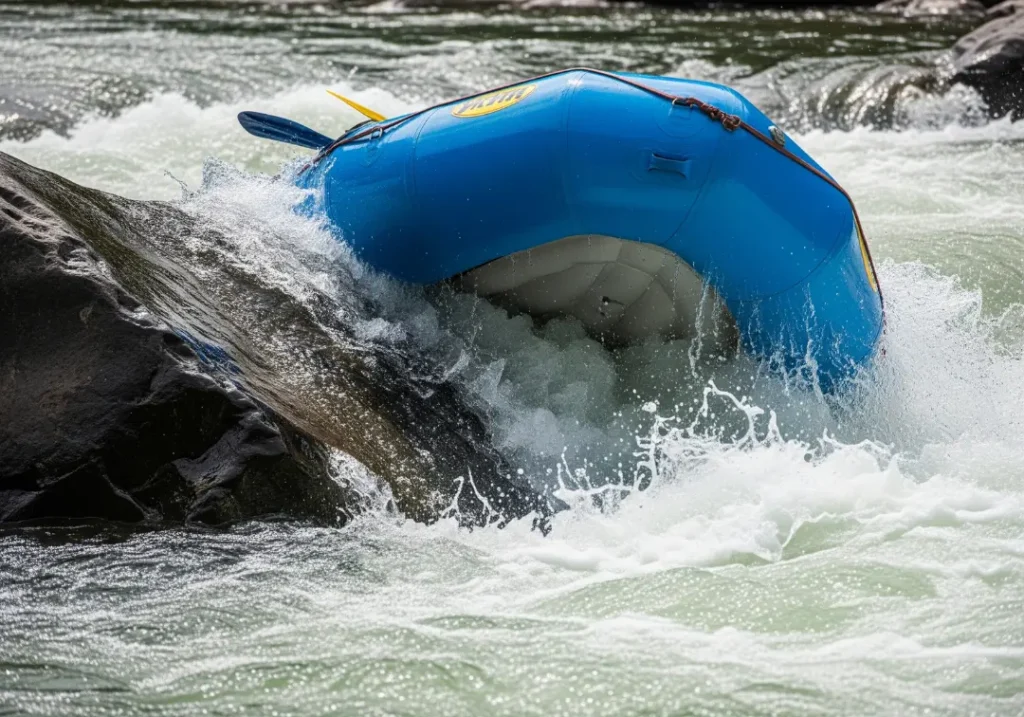
Knowing the name of your problem is the first step to solving it. This systematic classification of the five most common river pins allows you to quickly identify a scenario, understand its specific dangers, and formulate a plan.
How are the five main types of river pins classified?
The orientation of the boat against the obstacle(s) defines the type of pin. The Center Broach Pin is the classic and most common scenario. Here, the boat is broached on an obstacle, pushed sideways, perpendicular to the current, against a single large obstacle like a boulder. The primary danger is the immense force of the water against the upstream side, which can cause the boat to “wrap,” or fold around the obstacle, potentially trapping its occupants.
An End-to-End Pin occurs when both the bow and stern of the raft become simultaneously wedged between two separate obstacles. The river’s current then pushes against the side of the boat, creating immense pressure in the center. The danger here is the boat bending like a bow or breaking under the strain. A Vertical Pin is a true worst-case scenario in whitewater kayaking, often occurring when a paddler misses a boof stroke while navigating a waterfall or steep ledge, like those found on the Rio el Salto. The bow of the kayak gets wedged, and the full force of the falling water pours onto the kayak deck, submerging the paddler. For a raft, this is exceedingly rare but equally catastrophic. A pinned canoe, especially an older fiberglass canoe, can snap under these forces.
Two less common but severe types are the Pinch Pin and the Flat Pin. A Pinch Pin occurs when the bow drives into a narrow, “V” shaped crack between rocks and becomes tightly wedged. The force of the current then causes the boat to fold vertically around this pinch point. A Flat Pin is deceptively simple. It happens when the flat bottom of a raft lands on a gently sloped, submerged rock or gets plastered against a smooth cliff wall. The combination of high surface area, friction, and constant water pressure can hold the boat with surprising and overwhelming force. Many modern boats, especially kayaks with a flat planning hull, are also particularly susceptible to this type of pin compared to rounder displacement hull boats.
This classification is not just academic; it is the first step toward developing targeted and effective rescue strategies. The solution for a broach is very different from that of a vertical pin. The safety codes developed by American Whitewater provide foundational principles that help prevent these situations, lending credibility to the importance of understanding them.
Knowing what can go wrong is crucial, but the true expert focuses their energy on the proactive skills that prevent these scenarios from ever happening.
How Can Rafters Proactively Prevent Getting Pinned?
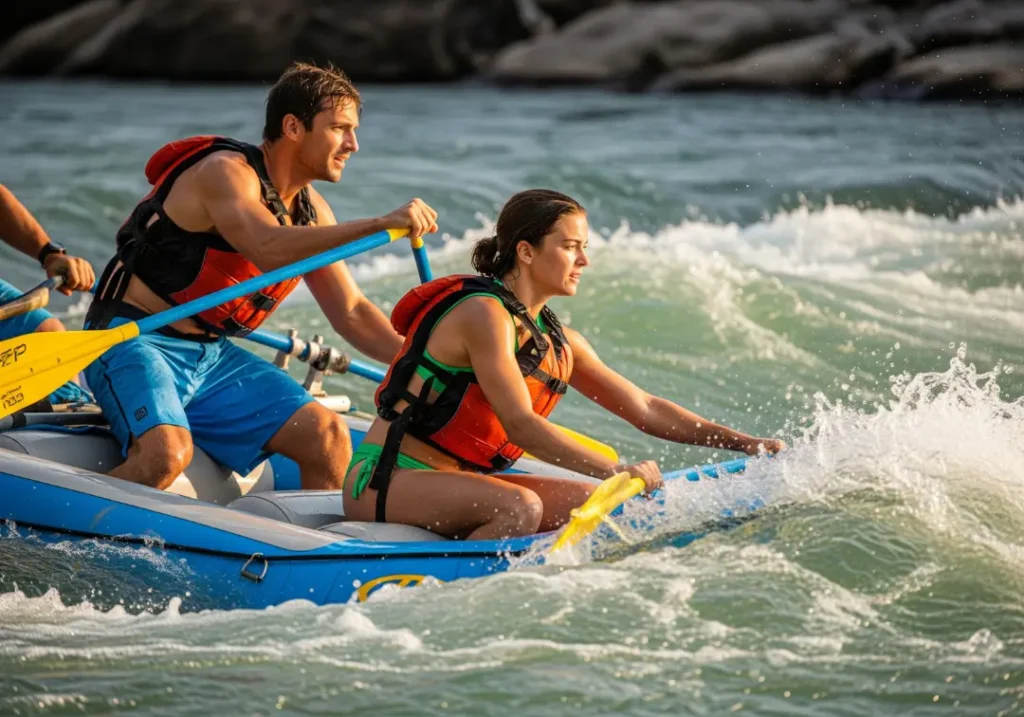
The best rescue is the one that never has to happen. This section shifts our focus from hazard identification to proactive avoidance, covering the essential defensive maneuvering and strategic decision-making skills that define expert-level rafting.
What is “high-siding” and why is it the golden rule of obstacle collision?
When a sideways collision with a rock becomes unavoidable, your crew’s immediate reaction will determine the outcome. The correct, albeit counter-intuitive, response is to High-Side. This command means shifting all crew weight towards the obstacle—to lean into it—placing your weight on the “high side” of the boat.
The physics are simple but profound. Shifting weight to the high side lifts the opposite, upstream tube. This action breaks the seal between the river and the boat, allowing the powerful current to flow underneath the raft’s floor rather than piling up against the side of the upstream tube. It turns the boat into a ramp, letting the water slide under and push you away.
Contrast this with the most dangerous mistake: leaning upstream. This natural, instinctive reaction to an impact is catastrophic on the water. This incorrect body position drops the upstream tube deeper into the water, effectively creating a dam. The current will instantly gain purchase, piling against the tube, and initiating a wrap or a flip in seconds. High-siding isn’t just a technique; it’s a conditioned reflex that must be practiced to overcome instinct. It’s a critical piece of muscle memory. The ACA, the governing body for paddlesports, validates the importance of such techniques in The American Canoe Association’s safety curriculum.
This split-second physical reaction can prevent a pin, but sometimes the best move is a strategic decision made long before you even approach the obstacle. For a more detailed breakdown, see our tactical guide to the high-side command, which covers the command, team coordination, and physics.
What is the “language of the river” for identifying safe passage?
Long before you need to react, you need to read. “Reading the water” means interpreting surface features to understand the unseen currents and obstacles below. The most fundamental vocabulary in this language involves two “words”: the Downstream V and the Upstream V.
The Downstream “V” (The Tongue) is your sign for “come here.” It’s a “V” shape on the water’s surface with the point aimed downstream. This feature indicates the main channel of current flowing between two obstacles. The tongue is generally the deepest, fastest, and least obstructed path, making it the desired route through a rapid or fast-water section.
Conversely, the Upstream “V” is your sign for “stay away.” This is a “V” shape with the point aimed upstream. It’s a clear signal of a submerged or semi-submerged obstacle. The water is splitting as it flows around the object at the point of the “V”. This feature should always be avoided, as it marks a direct path to a potential pin. Connecting these two “words” forms the fundamental vocabulary for proactive navigation, allowing a guide to choose a safe line long before entering a rapid. Educational resources like those referenced by Boreal River Rescue on how to read a river support these core concepts.
Reading the water allows you to plan your route. But if you become pinned despite your best efforts, the clock starts ticking on a new set of life-saving protocols. You can integrate these concepts into our Hazard Identification System for rafters for a broader, systematic framework.
What is the Protocol if a Pin Occurs?
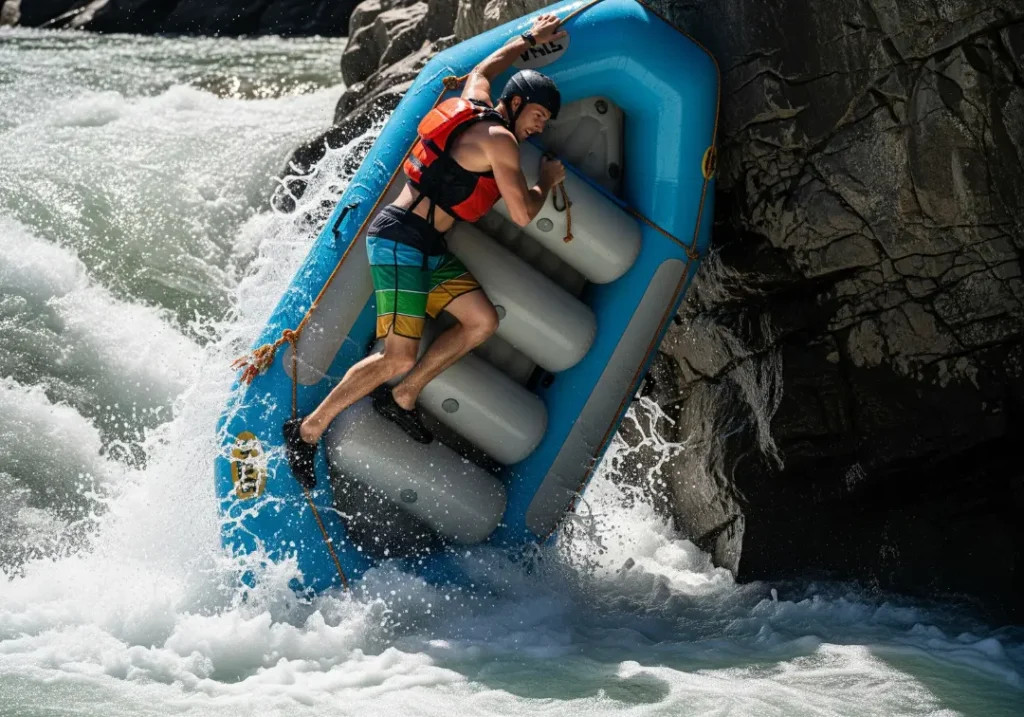
When prevention fails, a clear, escalating action plan is essential. This protocol begins with immediate, critical self-rescue actions and progresses to simple, low-risk team-based techniques.
What are the first life-saving actions for occupants of a pinned raft?
In the first few seconds, there are only two questions that matter.
First: 1. Assess Airway. Can everyone breathe? If anyone is trapped underwater, their situation is critical and dictates all subsequent actions. They are the immediate priority. Second is the 2. Decision Point (Stay In vs. Get Out). If the raft is stable and not taking on water, there’s a brief window to attempt to free it. Aggressive high-siding or pushing off the obstacle might work. However, this window is small. If the raft begins to wrap, take on water, or become unstable in any way, the immediate priority is to get out of your boat on the downstream side. This act of bailing out is almost always the correct protocol before the craft collapses and traps you.
Once in the water, swimmers must immediately adopt the Defensive Swimming (Whitewater Floating Position). Get on your back with your feet up and pointed downstream to absorb any impacts with your legs. Keep your head up to see where you’re going, and use your arms to maneuver, working to swim to an eddy or safer water. This position protects you from head trauma and, most importantly, prevents the deadliest of all whitewater hazards: foot entrapment. This is a different challenge than for a kayaker, who must first exit a tight keyhole cockpit, often while dealing with a spray skirt. A swamped canoe presents yet another set of challenges.
This brings us to the number one rule of swimming in current: Never attempt to stand up in water deeper than your shins. If your foot gets wedged between rocks, the force of the current against your downstream body will pin you face-down, and you will drown. These self-rescue steps are corroborated by resources like these state-level whitewater safety guidelines from Idaho State Parks. You can learn more about defensive vs. aggressive swim positions to understand the specific scenarios for each.
Once all swimmers are safe and accounted for, the focus shifts to the rescue team, who must begin a deliberate and methodical process to retrieve the raft.
How should a rescue team begin the extraction process simply and safely?
A panicked rescue is a dangerous rescue. Professional teams adhere to a strict order of operations to maintain control. This is the foundation of the raft rescue protocol.
First, adhere to Rescue Priorities. The universally accepted order is 1. Self, 2. Team, 3. Bystanders, 4. Victim. A rescuer who becomes a victim only complicates a bad situation. Next, follow the L.A.S.T. Protocol: Locate the victim/hazard, Access them safely, Stabilize the scene, and Transport to safety. This framework prevents a panicked response and ensures a methodical approach. The Initial Assessment is to stop, take a breath, and analyze the situation: what type of pin is it? How strong are the forces? What are the downstream hazards?
Pro-Tip: The most important rescue skill is patience. In all but the most critical life-or-death scenarios, taking 60 seconds to stop, breathe, and form a solid plan is faster and safer than an immediate, disorganized reaction.
The first attempts to free the boat should be the simplest and lowest risk. On-Boat Maneuvers are the best option if crew are still safely in the raft. Methodically move them to the downstream side of the boat to shift the center of gravity. This act of unbalancing the boat is often enough to free it. If an external pull is needed, or if you need to rescue a swimmer, throwing a rope from the shore is the primary tool. The shore-based throw rope is a staple of swiftwater rescue. Proper technique is crucial: make eye contact with your target, throw the bag beyond them, and position yourself to take the force of the current. In a small creek or gorge, sometimes a long pole from the shoreline can be used to nudge a boat free.
These simple techniques should always be the first line of response. When they are insufficient against the immense weight of a waterlogged raft, the team must escalate to systems that multiply their force. This systematic approach is a core part of any swiftwater rescue curriculum framework, like the one outlined by JHU Student Affairs. Before you ever need it, you should know the principles of selecting a raft-rated rescue throw bag that can handle heavy loads.
How is an Advanced Mechanical Advantage System Used for Severe Pins?
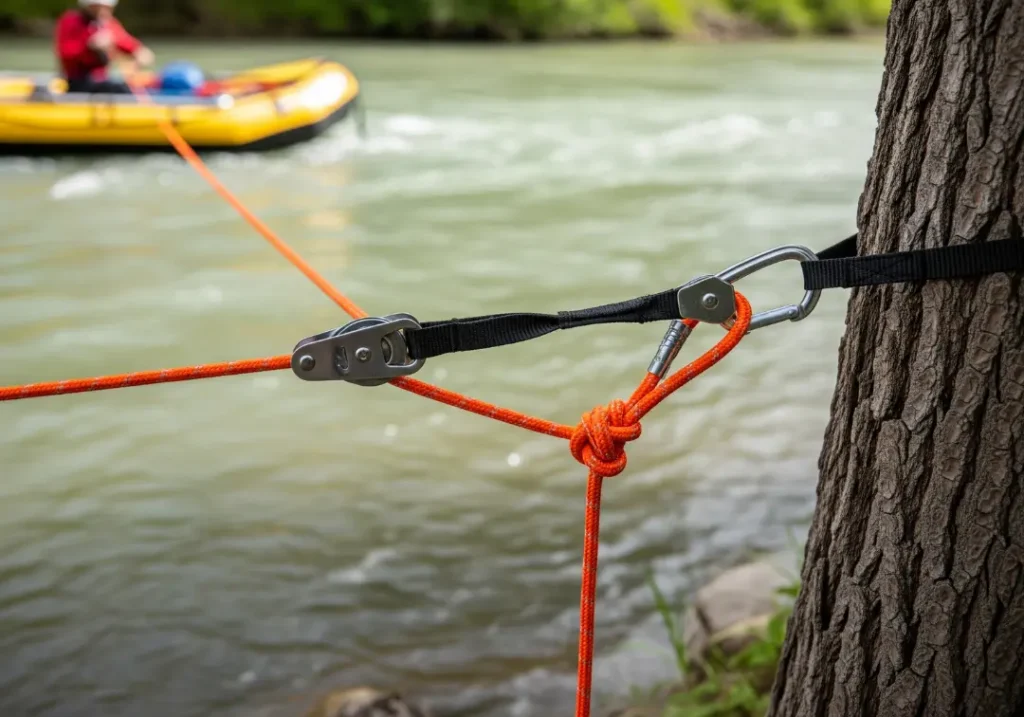
When a multi-ton raft is thoroughly pinned by exponential hydraulic forces on a powerful river like the Gauley River or the Cheat River, human strength alone is not enough. This is where we turn to physics, using a mechanical advantage system to multiply our force. The Z-drag is the fundamental system in whitewater rescue—a high-force, last-resort technique for when you’re in a tight spot.
How do you set up and execute a Z-drag rescue for a pinned raft?
A Z-drag should only be used when a boat is “totally, truly, and properly stuck.” It introduces significant risks from high-tension ropes, and it should only be employed after simpler, lower-force methods have failed.
The power of the Z-drag comes from The Physics of 3:1. It is a mechanical advantage system configured to triple the force applied by the haul team. For every one unit of force you pull, three units are applied to the pinned raft. This is typically enough to move even the most stubbornly pinned boat.
Setting it up requires a precise rope arrangement and sequence:
- Step 1 & 2 (Anchor & Load): First, establish a “bomber” anchor—a massive, unmovable object like a large tree or boulder—using wide webbing to distribute the load. Second, attach the main rope to the raft using a load-distributing bridle across multiple D-rings to prevent a single point of failure. You must have enough rope for the system and for safety margins.
- Step 3, 4 & 5 (Running the “Z”): Run the rope from the raft to a pulley at the anchor. Then, attach a “traveling prusik” knot and a second pulley to the line. Finally, run the free end of the rope through this traveling pulley to create the distinctive “Z” shape of the system.
- Step 6 (Progress-Capture): Attach a second “brake” prusik to the rope near the anchor. This friction knot slides freely as the team hauls but bites down hard on the rope if they stop, automatically capturing progress and preventing the raft from sliding back into the pin. A high-quality, sure rope like a static nylon rope is critical.
Throughout the operation, Team Roles & Safety are paramount. There must be clear roles (Leader, Anchor, Haul team, Safety) and everyone must adhere to the absolute rule: stay out of the direct line of tensioned ropes. A damper, like a PFD (Personal Flotation Device) or a coiled throw bag, should always be hung on the line to absorb energy in the case of system failure. Mastery of such systems is a key qualification for any professional, including a Swiftwater Rescue Team Leader position at the federal level.
These technical skills are the final tool in the toolkit. Having the right components is critical, which is why we’ve created a guide for Assembling your trip-specific river rescue kit.
Conclusion
The power of a river is an awesome and unforgiving force. Its strength increases exponentially with its speed, meaning even moderate currents can create inescapable pins. But that force is governed by the laws of physics, and understanding those laws is the key to your safety.
Remember these core principles:
- Proactive prevention through water reading and the counter-intuitive “high-siding” maneuver is vastly superior to any reactive rescue.
- In a pin, the crew’s immediate priority is their own safety; getting out of an unstable boat to the downstream side is almost always the correct self-rescue protocol.
- Team rescue must be a methodical escalation, starting with the simplest, lowest-risk techniques before employing high-force systems like the Z-drag as a last resort.
Master these principles on the water. Start by practicing the defensive swim position and high-siding with your crew in a safe, controlled environment. Explore our full library of whitewater safety guides to continue transforming your knowledge into pure, life-saving instinct.
Frequently Asked Questions about River Pinning
What is a river pin?
A river pin is a situation where a watercraft becomes immobilized against an obstruction like a rock or tree by the force of the river’s current. The hydraulic forces of the current become perfectly balanced against the craft, transforming it from a moving vessel into a fixed object.
What is the difference between a strainer and a sieve?
Functionally they are identical, but a strainer is typically formed by organic material like trees or logs, while a sieve is formed by rocks. Both allow water to pass through but are notorious for trapping boats and people, making them extremely dangerous river hazards.
What is the very first thing I should do if my raft gets pinned?
Your first priority is to assess if everyone can breathe and then determine if the raft is stable or becoming unstable (wrapping, filling with water). If the raft is unstable, the immediate life-saving action is for all occupants to exit the boat on the downstream side before it collapses and traps them.
How does a Z-drag work?
A Z-drag is a rope-and-pulley system that provides a 3-to-1 mechanical advantage, meaning it triples the pulling force applied by rescuers. It uses a specific “Z” configuration with two pulleys (or carabiners) and two friction knots (prusiks) to create three strands of rope pulling on the pinned boat simultaneously.
Risk Disclaimer: Whitewater rafting, kayaking, and all related river sports are inherently dangerous activities that can result in serious injury, drowning, or death. The information provided on Rafting Escapes is for educational and informational purposes only. While we strive for accuracy, the information, techniques, and safety advice presented on this website are not a substitute for professional guide services, hands-on swiftwater rescue training, or your own critical judgment. River conditions, including water levels, currents, and hazards like strainers or undercut rocks, change constantly and can differ dramatically from what is described on this site. Never attempt to navigate a river beyond your certified skill level and always wear appropriate safety gear, including a personal flotation device (PFD) and helmet. We strongly advise rafting with a licensed professional guide. By using this website, you agree that you are solely responsible for your own safety. Any reliance you place on our content is strictly at your own risk, and you assume all liability for your actions and decisions on the water. Rafting Escapes and its authors will not be held liable for any injury, damage, or loss sustained in connection with the use of the information herein.
Affiliate Disclosure: We are a participant in the Amazon Services LLC Associates Program, an affiliate advertising program designed to provide a means for us to earn advertising fees by advertising and linking to Amazon.com. As an Amazon Associate, we earn from qualifying purchases. We also participate in other affiliate programs and may receive a commission on products purchased through our links, at no extra cost to you. Additional terms are found in the terms of service.