
In this article
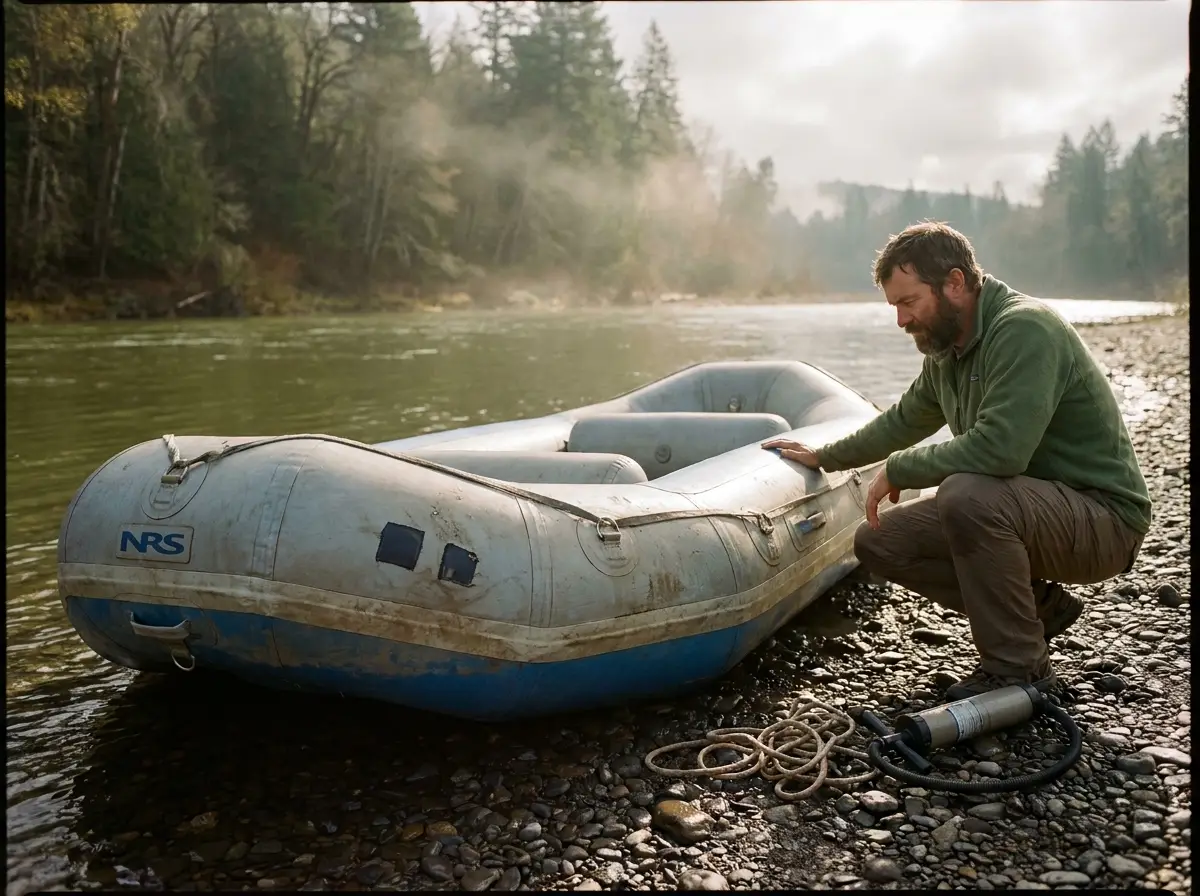
You’re standing at the takeout with your thumbnail pressing a soft spot on the tube, wondering if the boat that just carried you through the canyon has another season left in it. It’s a fair question, and the answer you’ll find online is usually wrong, or at least badly incomplete. The year-numbers everyone repeats, five to ten years, are the floor, not the ceiling. Real boats on real rivers routinely pass twenty-five and keep going. Here’s how long a raft actually lasts by material, what wears one out early, and how to tell whether yours is fine, worth patching, or finally done.
How Long a Raft Really Lasts, by Material
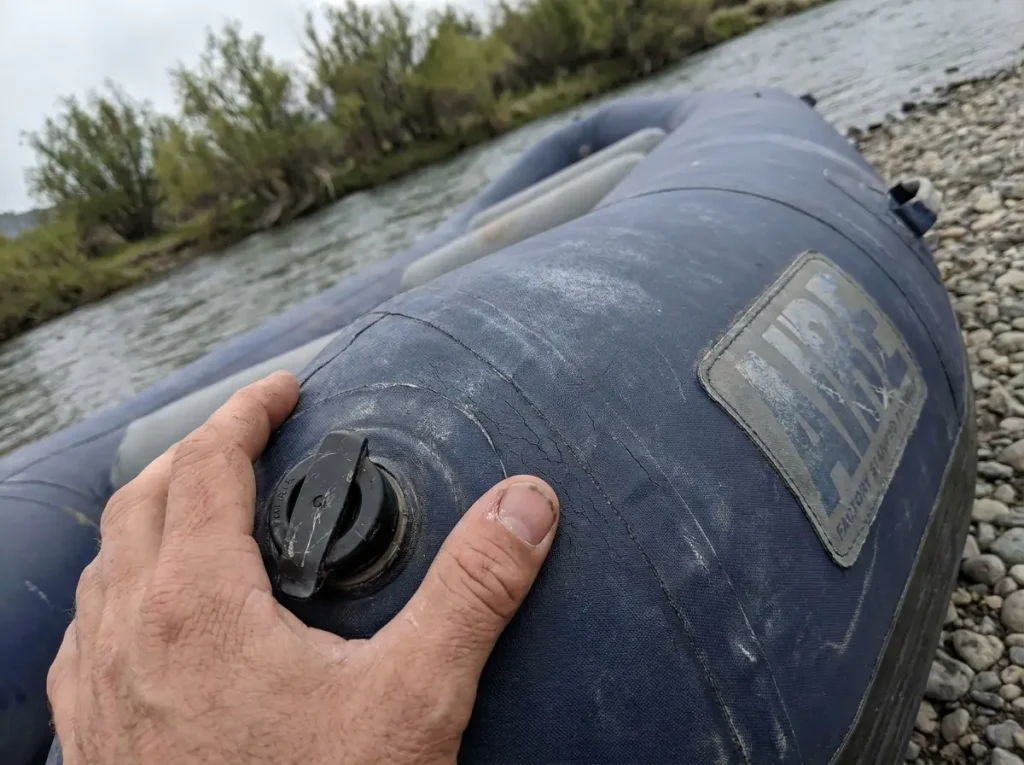
The straight answer first, because that’s what you came for. A whitewater raft lifespan breaks down by material more than anything else, and the spread is wider than the snippets admit.
Budget PVC boats run about five to seven years before the seams start telling on them. Quality PVC that’s kept out of the sun stretches to eight to fifteen, and some high-quality PVC passes twenty-five. Hypalon (the rubber-coated stuff) gives you fifteen to twenty-plus with reasonable care, and urethane, the toughest of the bunch, can run twenty to thirty years and beyond.
| Material | Typical Lifespan | What Decides It |
|---|---|---|
| Budget PVC | 5–7 years | Glued seams letting go |
| Quality PVC | 8–15 years | Welded seams, sun exposure |
| Hypalon (CSM) | 15–20+ years | UV care and patching |
| Urethane | 20–30+ years | Abuse level, storage |
Why the “5 to 10 Years” Snippet Is Misleading
That short number assumes a cheap boat, hard use, and lazy storage. Change any one of those and the math changes with it. Ask anyone who’s owned a rubber boat for a decade and they’ll tell you the same thing: these things don’t really die of old age, they die of neglect.
What a Long-Lived Raft Has in Common
The boats that go the distance share a story, not a brand. Mountain Buzz boaters talk about a twenty-seven-year-old NRS Otter still running rivers, and a quality boat at twenty years that could easily give you another ten or twenty. What those survivors have in common is simple: they got shaded, they got cleaned, and they got patched when they needed it. Material sets the range. Care decides where in that range you land.
Before you take any of this as gospel for your boat, it helps to know how to match a raft to the river you actually run, because the right boat for your water tends to be the one you keep long enough to wear out honestly. That’s covered in our whitewater raft buyer’s guide.
Why the Material Sets the Clock
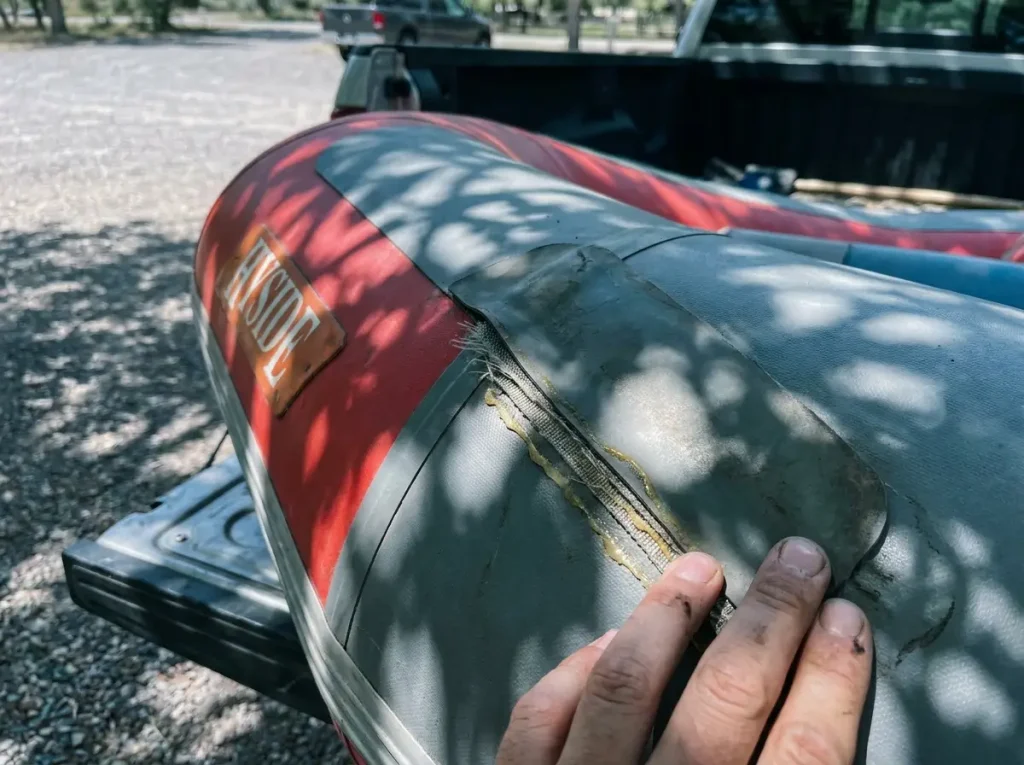
Everyone says “PVC bad, Hypalon good” and stops there. The real story is how the boat is built, and which failure is waiting for each material.
PVC — Light, Cheap, and Seam-Dependent
PVC is polyvinyl chloride: lighter, cheaper, and it holds color well. The weakness isn’t the fabric, it’s the seams. Cheap PVC boats are hand-glued, and when that adhesive gives out the seam lets go. As one veteran put it, once the glue starts giving out on a PVC boat’s seams, it’s pretty much a throwaway. Welded PVC, where the seams are heat-fused instead of glued, is a different animal and lasts far longer.
Hypalon and CSM — The Rubber That Ages Slowly
Hypalon (technically CSM, chlorosulfonated polyethylene) is a rubber coating bonded over a woven fabric base. It’s heavier and the seams are hand-glued, but the rubber shrugs off sunlight and abrasion in a way PVC can’t. It ages slowly, patches easily, and forgives a lot of bad storage before it complains.
Urethane — The Abrasion King
Urethane is the toughest abrasion layer you can put on a tube, which is why boats built with it routinely outlast everything else on the gravel bar. It costs more upfront and it’s worth it if you run rocky, low-water rivers that sand a hull down over the years.
Welded vs Glued — The Detail That Decides Lifespan
Here’s the part most articles skip. Construction, not just material name, drives lifespan. Cheap glued PVC dies young because the adhesive and the phthalate plasticizers that keep it flexible break down and attack the seams. Welded PVC and properly maintained rubber soldier on for decades. So “what’s it made of” is only half the question. “How was it put together” is the other half. If you want the full material-by-material breakdown on cost, repair, and resale, our PVC versus Hypalon comparison digs into exactly that.
You can use PVC glue on a Hypalon boat, but never Hypalon adhesive on PVC. It matters most when you’re eyeing a used commercial boat and trying to figure out what the last owner patched it with. Mismatched glue is a patch that’s already failing.
What the Warranty Quietly Tells You About Lifespan
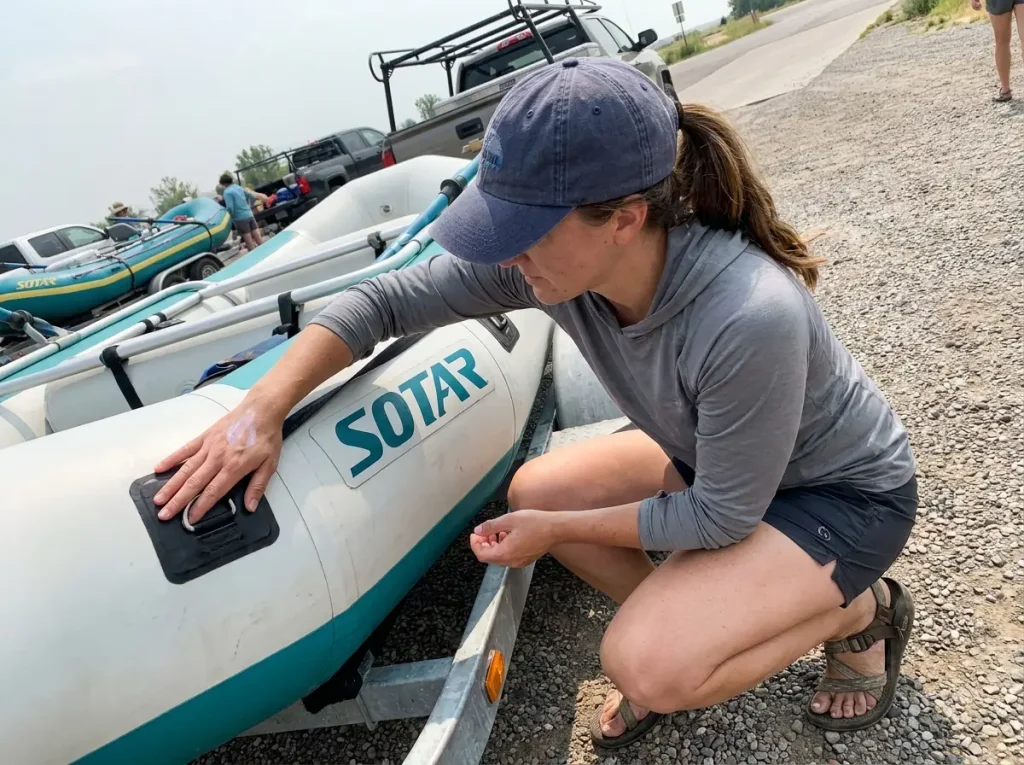
A manufacturer’s warranty is the maker’s own honest bet on how long the boat survives. Read it that way, because a company staking ten no-questions years on a hull is telling you what it expects that boat to live through.
Reading a Warranty as a Lifespan Estimate
Warranty length tracks material tier almost perfectly. A short warranty usually means entry-level PVC. A long one means premium urethane or rubber. It’s the cleanest shortcut you have for guessing lifespan before you’ve owned the boat a single season.
The Big Brands Side by Side
The numbers line up with the materials in a way that’s hard to argue with.
| Brand | Warranty | What It Signals |
|---|---|---|
| AIRE | 10-yr no-fault | High confidence in the hull |
| Maravia | 10-yr personal / 5-yr commercial | Use intensity halves lifespan |
| SOTAR | 6-yr (newer up to 10) | Premium build, long horizon |
| NRS | 1–10 yr by material | Tier depends on the model |
| Hyside | ~5-yr | Solid mid-tier expectation |
AIRE staking a ten-year no-fault warranty (its thinner-PVC Tributary line gets five) tells you plenty. So does Maravia’s split between ten personal years and five commercial ones, which previews the next section better than we could. For the full brand-by-brand picture, here’s an honest verdict on NRS, AIRE, Hyside, and Star.
What the Warranty Doesn’t Cover
A warranty covers manufacturing defects, not sunlight and not a wrap on a midstream boulder. It’s a lifespan signal, not a promise you’ll get those years no matter how you treat the boat. Plenty of warrantied rafts die early because the owner left them folded in the sun. The paper doesn’t save you from that.
How Hard You Run It Changes Everything

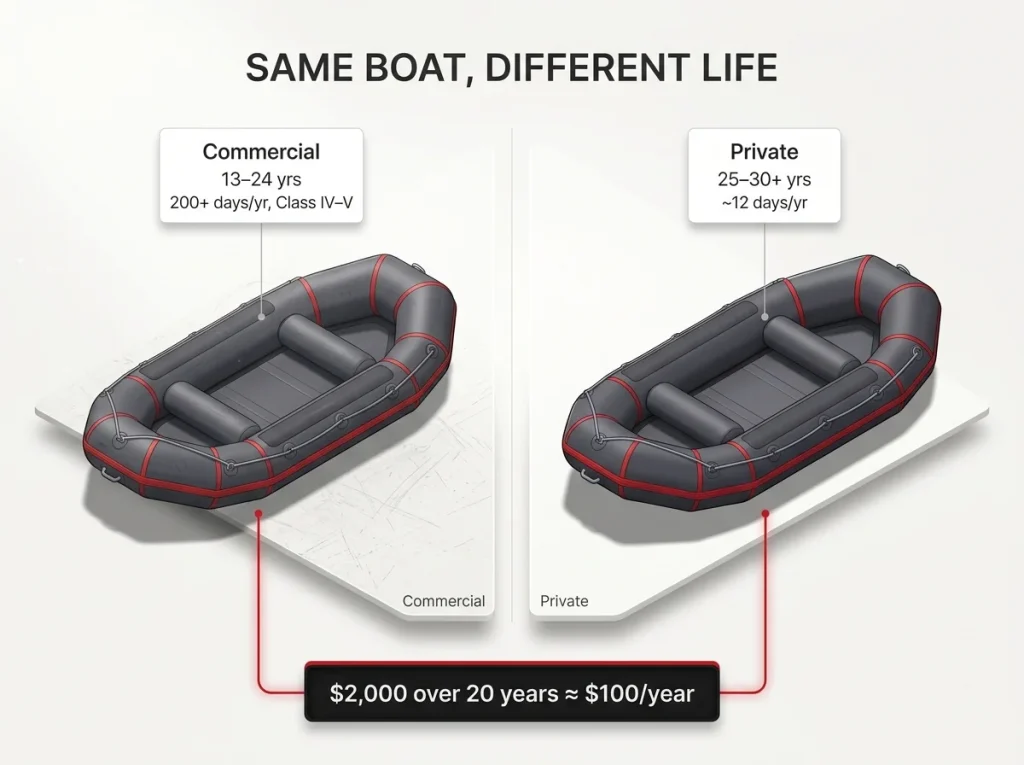
Outfitters and private boaters quote wildly different lifespans for the identical hull, and both are telling the truth. The difference isn’t the boat. It’s how many hard days a year you put on it.
The Commercial Boat vs the Private Boat
Commercial outfitters retire Hypalon boats after roughly thirteen to twenty-four years of daily Class IV–V abuse. Black Canyon Anglers, for one, gets about thirteen to fifteen years out of a commercial Hyside boat. That same hull in private hands, running a dozen days a season, routinely passes twenty-five or thirty. Same boat, completely different life, and the only variable is mileage.
Why Class IV–V Days Age a Raft Faster
Big, technical water means more rock contact, more pressure cycling, more sun hours, more drag over gravel at the takeout. Every one of those is a small withdrawal from the boat’s account. A guide running two laps a day all summer makes those withdrawals fast. A weekend boater barely touches the principal.
The Cost-Per-Year Math Nobody Runs
Here’s the reframe that changes how you shop. A boat that costs around two thousand dollars and runs twenty years works out to roughly a hundred dollars a year. Once you stop thinking of a raft as a one-time price and start thinking in dollars per season, the premium boat is often the cheaper one, because it lasts long enough to spread the cost thin.
Before you balk at a premium boat’s sticker, do the per-year math against the cheap one you’d otherwise replace twice. A rubber boat that runs three times as long usually wins, and you skip the hassle of buying twice.
The Sun Ruins More Rafts Than the River
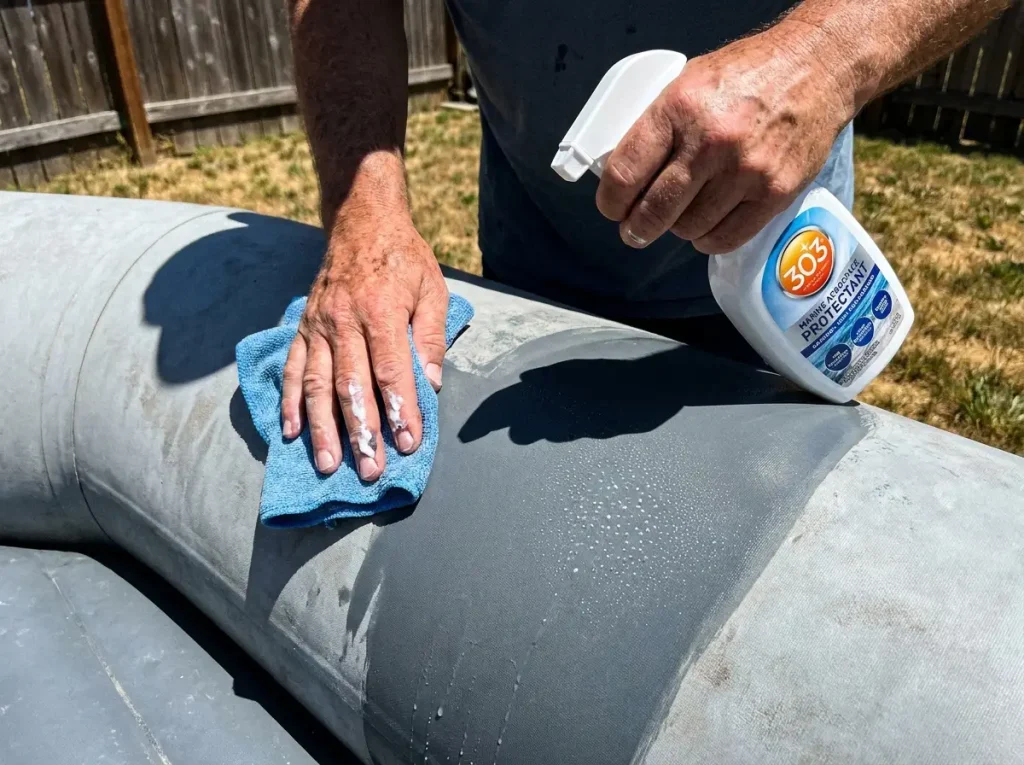
Boaters baby their boat on the water and then cook it in the backyard. The river barely ages a well-built tube. Sunlight destroys it. If you do one thing for your boat’s lifespan, it happens on land, not on the water.
Why UV Is the Real Enemy
Ultraviolet light breaks PVC down at the molecular level. You see it as discoloration, embrittlement, surface cracking, and a chalky bloom on the fabric. The sun degrades a raft faster than any rapid ever will, which means shade is the single highest-leverage move you have. Keep a boat out of the UV and you’ve already won most of the longevity battle.
The “Solar Oven” Mistake
The classic blunder is throwing a black tarp over the boat in the yard, thinking you’re protecting it. A dark tarp in the sun becomes a solar oven that traps heat and cooks the material faster than open sun would. The other common miss is drying only the outside. Water trapped inside the chambers breeds mildew and stagnant-water rot over a long winter. Dry it inside and out, or you’re storing a problem.
The Off-Season Storage Routine That Buys You Years
The routine that adds a decade is short and dull, which is probably why people skip it. Clean the boat, dry it completely inside and out, treat the tubes with a UV protectant like the 303 Marine Aerospace Protectant, store it partially inflated and off the ground, and keep it out of the sun. Hit it with 303 protectant at least once a year, sparingly for PVC and more often for rubber. The maintenance, not the material spec, is what actually sets the lifespan. For the deeper version, here are the off-season storage mistakes that quietly ruin a raft, and NRS has a solid walkthrough for cleaning and storing an inflatable boat worth following step by step.
Store the boat partially inflated rather than crammed into a tight fold. Hard creases that sit all winter become permanent stress lines, and those lines are exactly where the coating cracks first when you air it back up in spring.
Signs Your Raft Is Finally Done
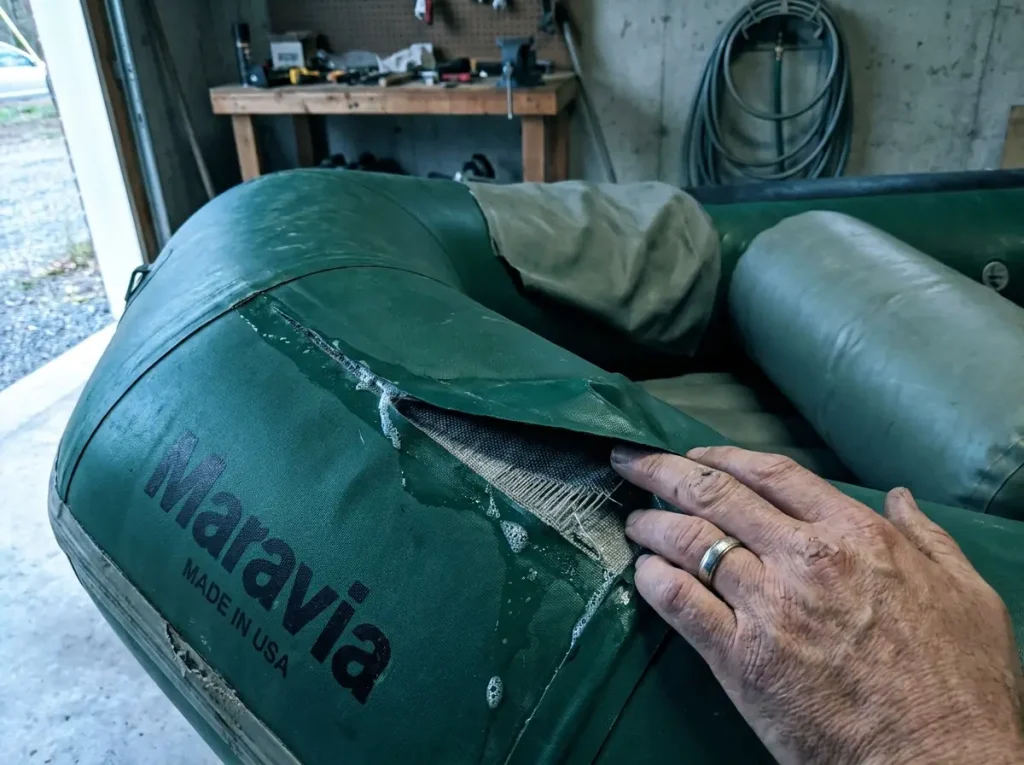
Some leaks are a patch-kit afternoon. Others mean the boat is structurally finished and trying to warn you before the wrong rapid does. Knowing which is which keeps you from replacing a good boat, or trusting a dead one.
Leaks You Can Live With
Isolated pinholes are nothing. A small puncture, a single worn abrasion spot, a valve that seeps, all of those are fixable in an afternoon. Before you panic over a slow leak, run a real leak test: bring the boat to full pressure and leave it twenty-four to forty-eight hours, then brush soapy water over the seams and valves and watch for bubbles. Most “dying” boats are just a loose valve. NRS has a clear walkthrough for tracking down a boat valve leak that’ll save you from retiring a perfectly good raft.
The Structural Failures That Retire a Boat
The terminal signs are different in kind, not degree. A broad field of pinholes everywhere means the fabric coating itself is spent, and that boat is done. So are delamination (the coating bubbling off the base fabric), a blown baffle or torn floor I-beam, leaking self-bailer holes, threads showing through the base fabric, PVC seam glue letting go, or a chamber that simply won’t hold air overnight. These are load-bearing or air-chamber failures you can’t field-patch, and paying a pro to fix them usually costs more than the boat is worth.
When a Failing Boat Becomes a Safety Problem
This is the part nobody connects, and it matters most. Your raft’s separate air chambers are your margin. A multi-chamber boat keeps floating when one chamber goes soft, which is the whole point of the design. When a baffle blows, you lose that redundancy without knowing it until you’re already in the rapid. A soft baffle isn’t just an annoyance, it’s a flip waiting for the wrong wave. A structurally failing boat is a water-safety issue, not only a money one, which is why it’s worth understanding how a sudden loss of tube pressure plays out in real whitewater before it happens to you.
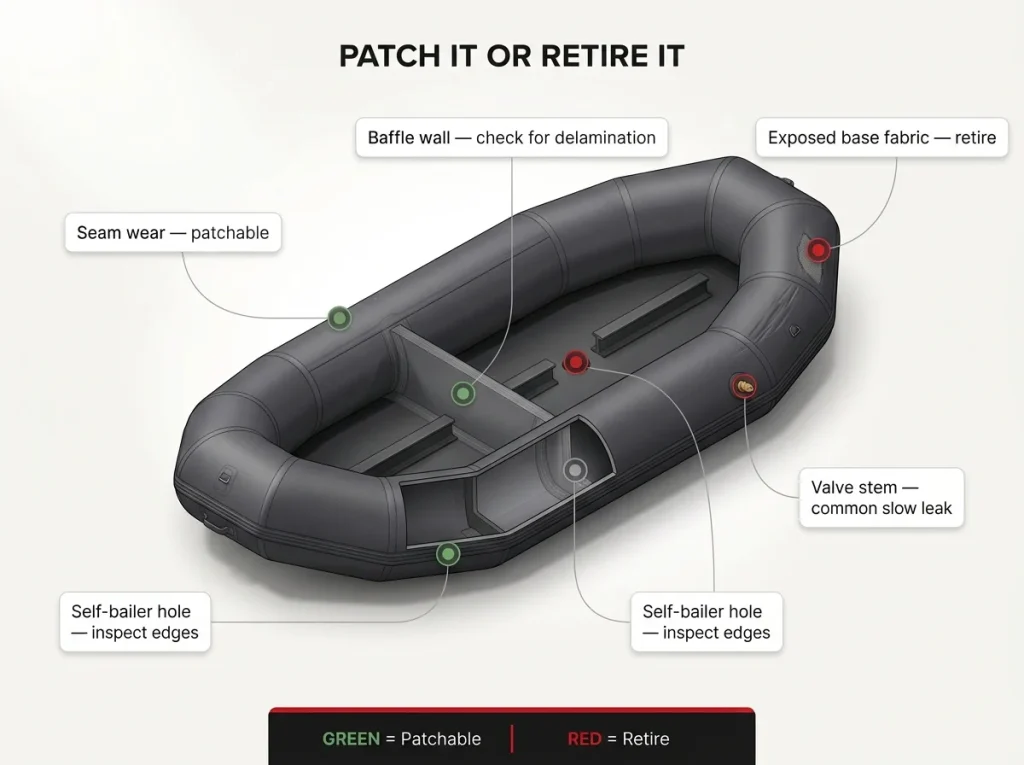
Patch It, Send It, or Retire It
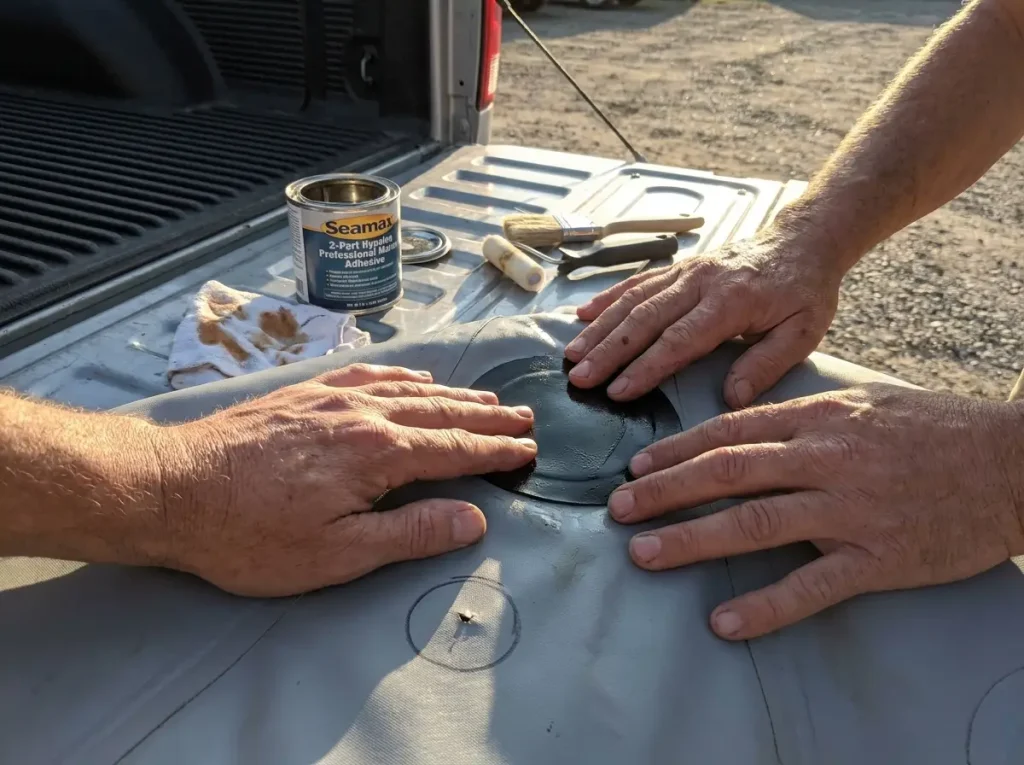
This is the real question behind “how long does a raft last.” You’re at the takeout, a buddy is poking at the pinholes asking “is she done?”, and what you actually need is a repair versus replace decision tree. Here it is.
The Patch-It Pile (Afternoon Fixes)
If the damage is an isolated pinhole, a small puncture, a loose valve, or a single abrasion spot, you patch it and keep boating. For a rubber or Hypalon boat that means a proper two-part adhesive like the Seamax 2-Part Hypalon Repair Kit. A good patch kit handles the small punctures and seam touch-ups that would otherwise scare someone into buying a whole new boat. Remember the glue rule: PVC adhesive can go on Hypalon, never the reverse. If you’ve never done it, our step-by-step Hypalon repair that actually holds air walks the whole process from finding the leak to the cure window.
The Retire-It Pile (Structural Failures)
Delaminated seams, blown baffles or I-beams, leaking self-bailer holes, and failing PVC seam glue all land in the retire-it pile. These aren’t afternoon fixes. They’re air-chamber and load-bearing failures, and a pro repair on them often exceeds what the boat is worth on the resale market. At that point you’re not repairing a boat, you’re pouring money into a hull that’s telling you it’s finished.
The Dollar-Bill Rule and When a Pro Isn’t Worth It
Field rule of thumb: damage bigger than a dollar bill, or anything touching the floor, keel, or an air chamber, goes to a professional. And once it’s a pro job, do the cost-per-year math before you commit. If the repair runs more than half what a replacement costs, you’re usually better off retiring the boat.
For the slowest, sneakiest leaks, mix glycerin with water instead of dish soap. It makes a tougher, longer-lasting bubble that clings to a weeping seam and shows you the pinhole that plain soapy water keeps missing.
Buying Used Without Inheriting Someone’s Worn-Out Boat
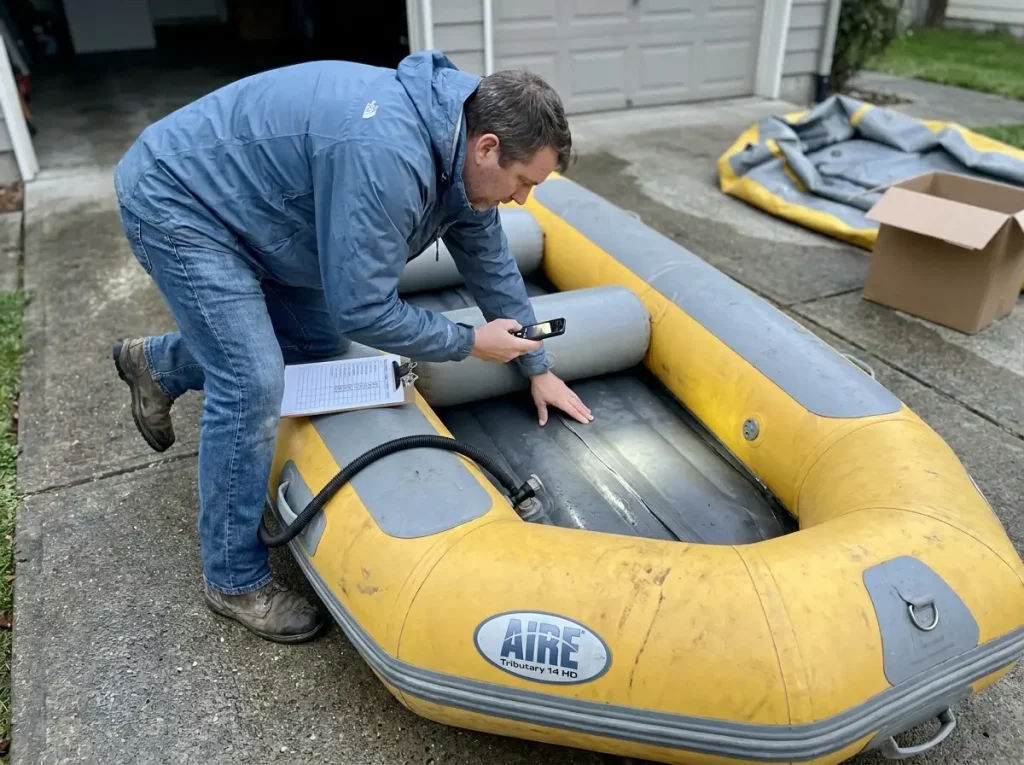
A used raft can be the deal of the season or someone else’s problem you just paid for. The difference comes down to whether you aired it up and crawled over every inch before handing over cash.
Inflate It Before You Believe It
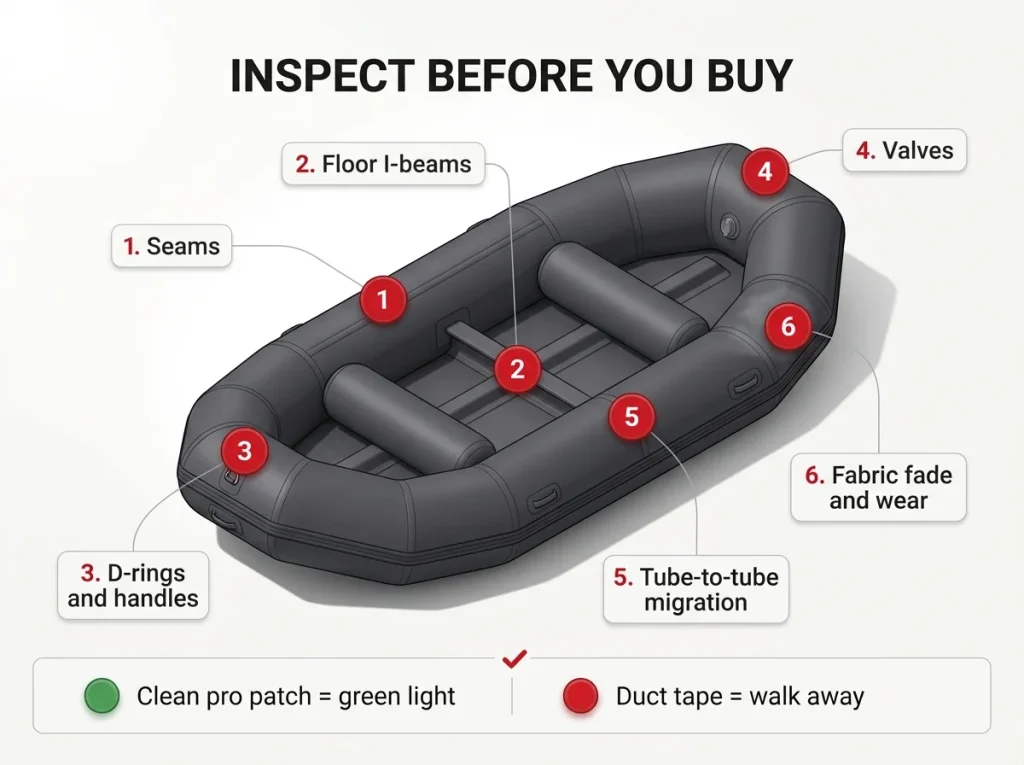
Never buy a used boat off photos. Inflate it and inspect every inch, and if you can, inspect it in the water. Torn floor I-beams and tube-to-tube air migration only show themselves when the boat is at full pressure. American Whitewater’s guide to buying used rafting equipment is a good pre-purchase read before you go look at anything.
Green Lights and Instant Walk-Aways
A clean, professional patch is a green light. Somebody cared enough to fix it right. Duct tape is an instant walk-away, because it tells you the owner cut corners and there’s likely more they didn’t mention. Check the floor I-beams (torn ones are costly), the D-rings and handles (expect to replace a few), and listen for air migrating from one tube to the next.
Used Bargain vs New Entry Boat
A well-cared-for fifteen-year-old Hypalon boat can have another decade in it. A cheap-glued PVC boat past its seams does not, no matter how good the price looks. When the used options near you are all sketchy, a new entry boat like the AIRE Tributary 14-foot HD self-bailing raft is the honest alternative, and its warranty doubles as a lifespan promise. If you want to spend less, the Saturn 13-foot whitewater raft is a budget-friendly starting point that still runs real water. Either way, our roundup of budget self-bailing rafts that beat dressed-up pool toys and the most forgiving first rafts ranked by ease will point you at boats worth keeping long enough to wear out.
Conclusion
Material sets the range, but UV exposure and how hard you run the boat set the actual number. Learn the patch-it versus retire-it line so you never replace a boat that needed a fifteen-dollar afternoon, or trust one that’s structurally done. And a cared-for raft is cheaper per year than most people think, whether you buy it new or used and inspected.
Before you store your boat this season, dry it fully, hit it with 303, and get it out of the sun. That one habit is the difference between a seven-year boat and a twenty-seven-year one.
Frequently Asked Questions
01How many years does a whitewater raft last?
A whitewater raft lasts 5 to 15 years for PVC and 15 to 30-plus years for Hypalon or urethane with reasonable care. Storage and use intensity move that number more than the material itself.
02Do Hypalon rafts really last longer than PVC?
Generally yes, Hypalon resists UV and abrasion better and patches more easily. But a welded, well-stored PVC boat can outlast a neglected rubber one. Care often beats chemistry.
03How do I know when my raft needs replacing?
Retire it when you see delamination, a blown baffle, a broad field of pinholes, or failing seam glue. These are air-chamber and structural failures you cannot field-patch, and a pro repair usually costs more than the boat.
04Does storing a raft out of the sun actually make it last longer?
Yes, hugely. UV is the number-one cause of raft aging. Shade, a yearly coat of 303, and full drying before storage can roughly double a boat’s working life compared to leaving it in the sun.
05Is it worth buying a used whitewater raft?
Often yes, if you inflate and inspect it first. Clean pro-shop patches are fine, but duct tape, torn floor I-beams, and tube-to-tube air migration are walk-aways. Never buy off photos alone.