


In this article
You air the boat up until it looks full, then back off a few pumps because you’re scared of popping a seam. That instinct is backwards, and it’s quietly costing you lines in the rapids. Ask the people who build raft valves and field repair floors: most boaters run their boats too soft, not too hard, and a soft tube is the floppy one that tacos in the first real hole, not the safe one. This guide puts both halves of the question on one page for once. How to tell which valve you’ve got, and exactly how hard to pump it (tubes, floor, and drop-stitch), how to measure it honestly, and how to manage raft pressure all day so the afternoon sun doesn’t cook your seams.
How Much PSI a Raft Actually Needs
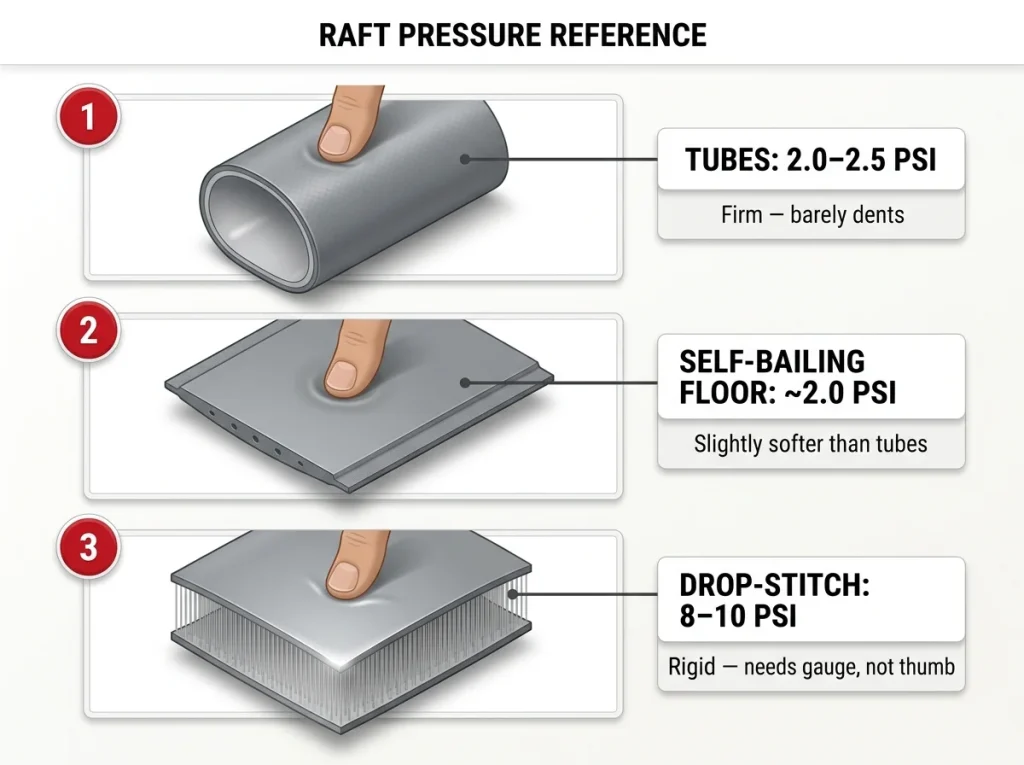
Start with the number everyone wants, because the rest of this only makes sense once you know the target. Most makers want raft tubes at 2.0 to 2.5 psi, and some allow up to 3.0 psi in the tubes. That depends partly on how the raft you bought (or are about to) is built, which is its own rabbit hole worth reading before you obsess over a tenth of a psi.
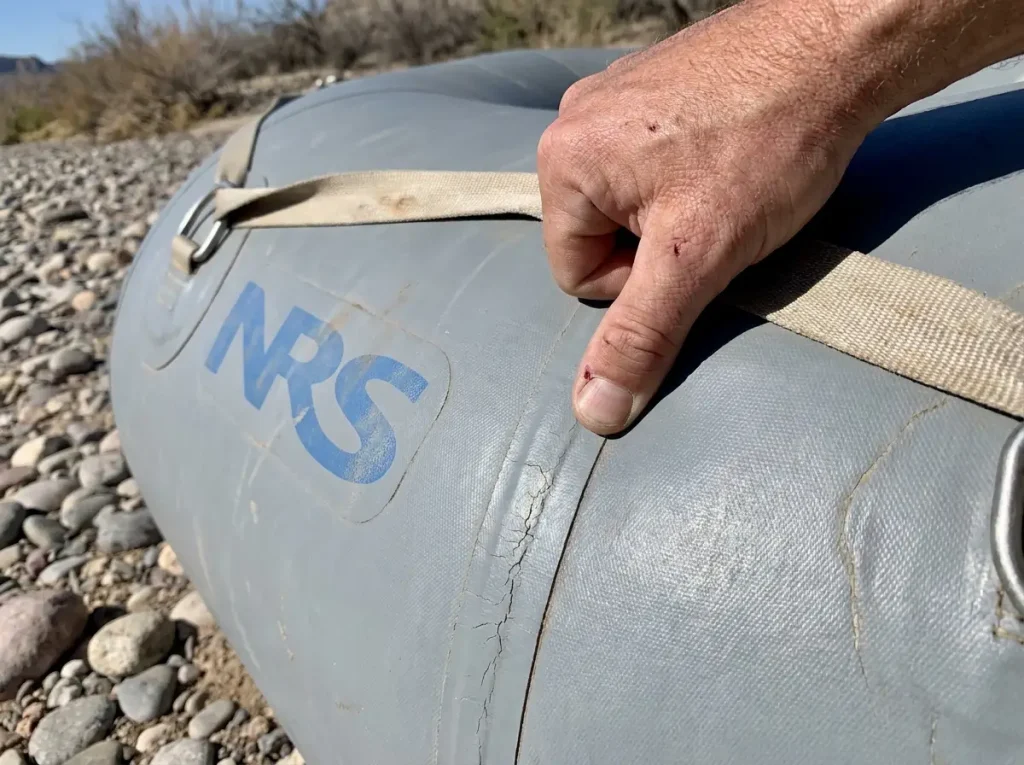
The word “firm” does a lot of work here, and it trips people up. A properly aired tube barely gives under a hard thumb push. If your thumb sinks in easily, you are soft, full stop.
Tube Pressure and the 2 to 2.5 PSI Sweet Spot
This is the working range for the big side tubes and thwarts that give the boat its shape. Air them all to the same number. A drum-tight tube next to a mushy one strains the baffle wall between them, and that is a slow way to wreck a boat from the inside. Firm tubes hold their shape when you slam a wave train, so the hull pushes water instead of folding into it.
Self-Bailing Floors Run Lower
The inflatable floor in a self-bailing boat sits around 2.0 psi, a touch lower than the tubes, and that is on purpose. It needs enough pressure to stay flat underfoot without over-stressing the floor seams, which take a beating every time you drop off a ledge. Whether your boat even has this kind of floor depends on the floor type under your feet, and the differences matter more than most first-time owners expect.
Drop-Stitch Decks Are a Different Animal
If your boat runs a drop-stitch floor insert, throw the tube numbers out. Drop-stitch panels live at 8 to 10 psi, four times the tube pressure, because thousands of internal threads let them go rigid like a real floor instead of a balloon. You cannot pump a drop-stitch deck with a low-volume tube pump and a thumb check. It needs a high-pressure pump and a gauge that reads to at least 15 psi, or you will never get it stiff and you will never know how close you are.
Know Your Valve Before You Pump
Here is where the SERP falls apart. Every valve maker only explains their own valves, retailers just list part numbers, and nobody walks you through “look at the thing on your boat and figure out what it is.” So look at the thing on your boat. That bit of valve identification takes thirty seconds and saves you buying the wrong part, and you almost certainly have one of two families.
Leafield Valves (C7, D7, A6, A9)
Leafield valves are the gray-and-black recessed valves on a lot of modern rafts. The C7 and D7 are the inflation valves you actually pump through. The A6 and A9 are pressure relief valves that live in the floor and do a different job entirely (more on those next). If you need to replace a worn inflation valve or just want a spare in the repair kit, a genuine Leafield C7 valve two-pack with a hose adapter is the Amazon-available part for the job. The A6 relief valve is a dealer item, not something you will find on Amazon, so source that one from a raft shop.
Halkey-Roberts and Military Valves
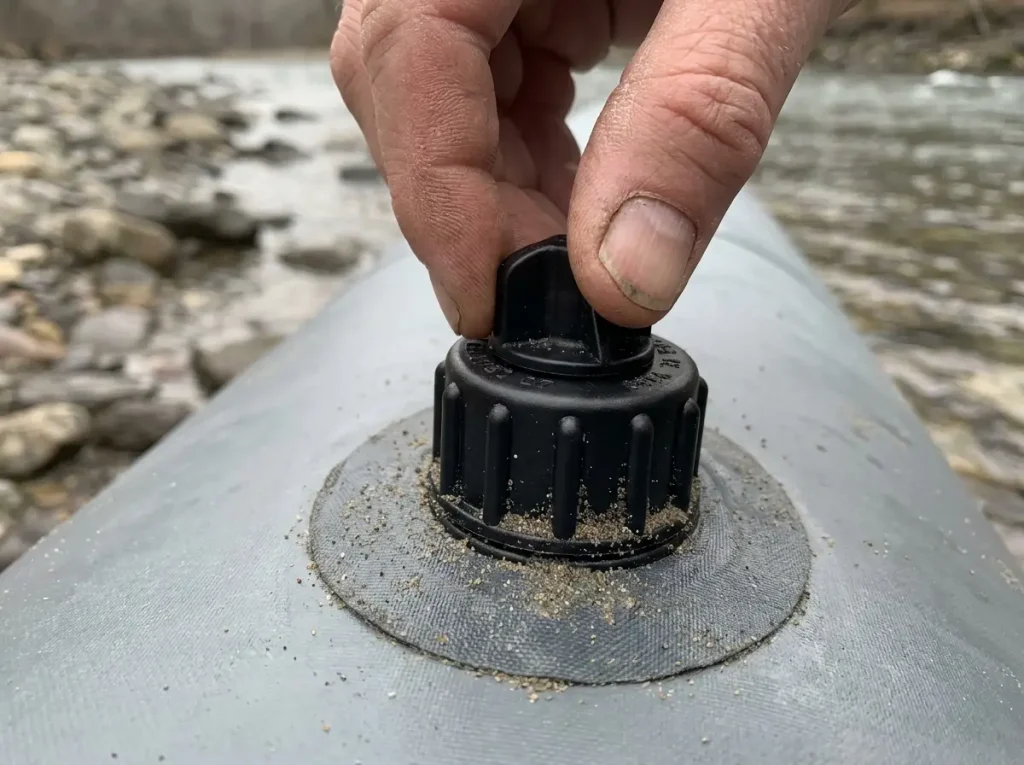
The other big family is Halkey-Roberts, often called military valves or MMV. These are the high-pressure valves you find on drop-stitch panels and a lot of inflatable kayaks. The trick that tells you which mode you are in is how the valve operates: push-twist clockwise locks it open so air dumps out for deflation, and a light push plus an anticlockwise turn seals it to hold air for inflation. Get that backwards and you will swear your pump is broken while the boat quietly empties.
The Old-School Boston and Summit Valves
Older and budget boats show up with Boston valves (a two-part screw cap that lets air in but not out) and Summit valves. They are simpler and lower pressure, fine for what they are, but don’t expect a Boston-valve boat to hold the firm pressure a whitewater tube wants. Which family you have often tracks with which brand built your boat, since the major makers spec different valves from the factory.
The Pressure Relief Valve on Self-Bailing Floors
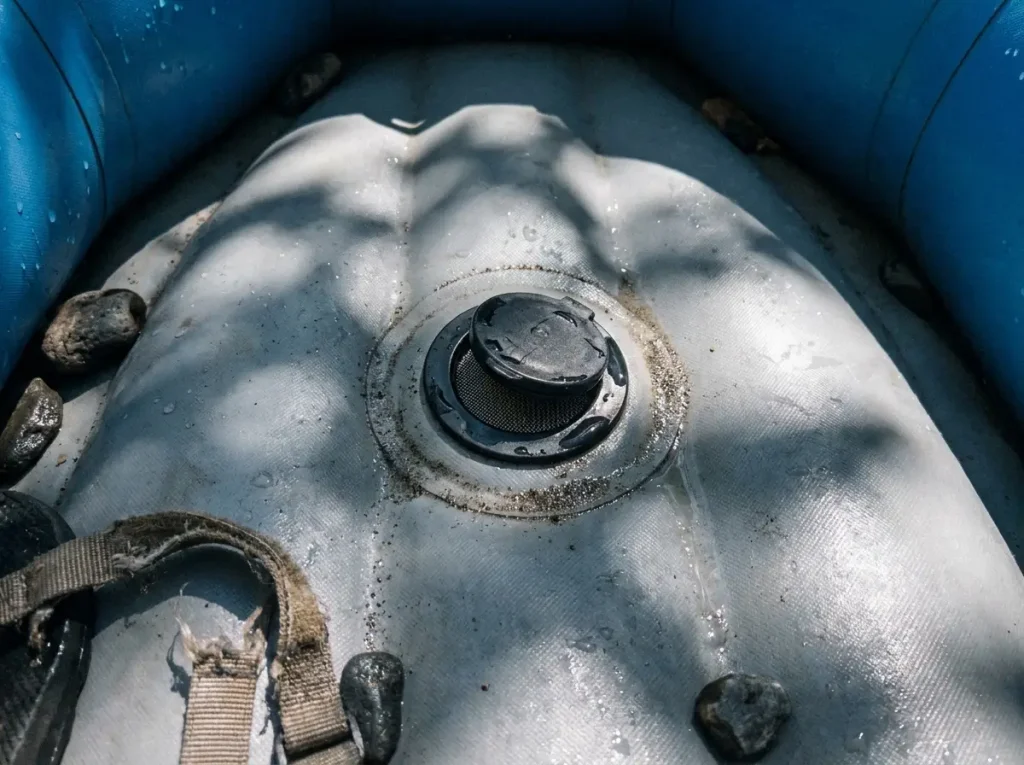
If you run a self-bailing floor, there is a valve down there working for you that you probably never think about. The PRV, or pressure relief valve, is the floor’s built-in safety. It is worth understanding because when it fails, it fails expensive.
What the PRV Actually Does
The PRV auto-vents, or “burps,” once the floor reaches its set pressure. That means the floor protects itself. When you hit a rock hard and the floor spikes for a split second, the valve dumps the excess instead of letting the pressure blow a seam. You set it and it manages the ceiling for you, which is exactly what you want when both hands are on the oars.
Why It Burps Air on Impact
The release pressure is preset, but it varies by model, so know your floor’s number. Hyside spec runs around 2.0 psi while AIRE and Leafield versions release closer to 3.25 psi, and you can read the Leafield A6’s pre-set, repeatable relief pressure straight from the valve maker’s own spec page. The point is not to memorize a chart. The point is to know your floor has a hard ceiling it will defend, and that ceiling is lower than you might guess.
On a day with a lot of big hits, you can cap the PRV to stop air loss through it during the meat of the run, then uncap it for normal floating. Just don’t forget you capped it, because a capped relief valve on a hot day is no relief valve at all.
Where Sand Gets In
The PRV sits low on the floor, right where river water and sand pool. That location is the whole problem. A fine mesh screen stops the big particles, but fine grit gets through and settles into the valve seat. A plugged PRV is the number-one floor failure boaters deal with, and you usually find out mid-run when the floor goes soft for no obvious reason.
How to Actually Measure Pressure
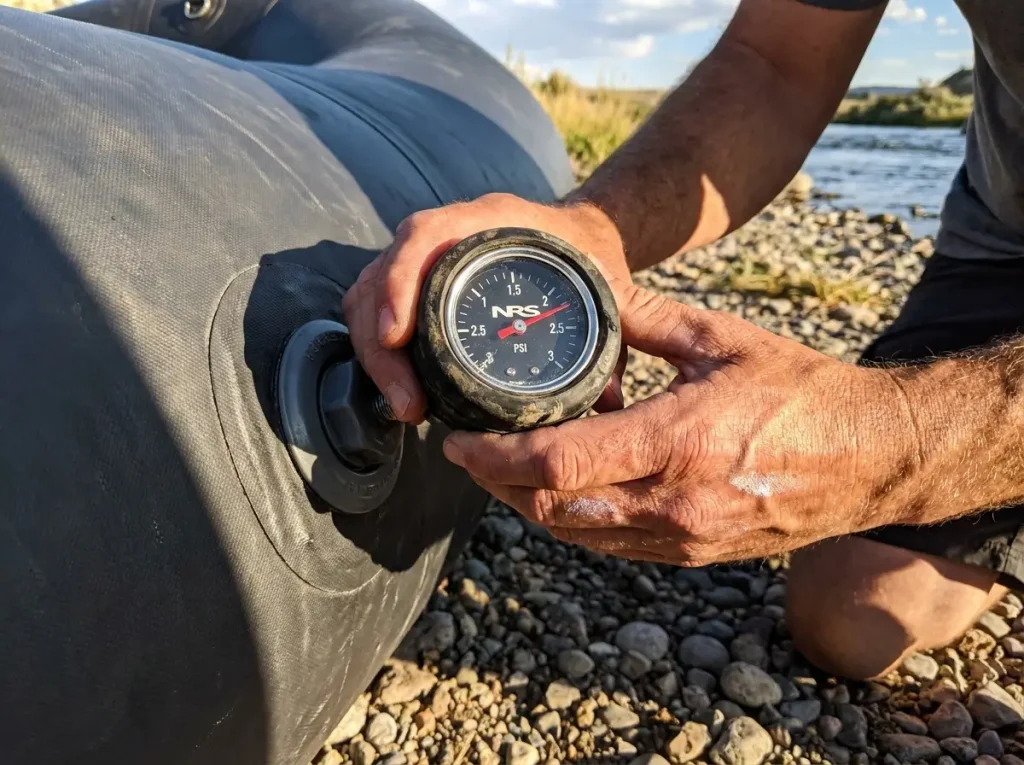
Now the honest part nobody selling you a valve wants to say plainly. You have two ways to check pressure: your thumb and a gauge. Both have a place, and knowing when to trust which one is the difference between a boat that runs right and a boat that bites you on a cold morning.
Why the Thumb Test Lies to You
The classic thumb test, sometimes called the punch test, says when you can press the material in about half an inch, you are near 2.5 psi. It is a real reference, and it is also unreliable. It is far too easy to leave one chamber soft and overdo the next, which puts uneven load on the baffles.
Your thumb has no memory and no calibration. On a cool morning especially, a tube that feels right to your hand can be well under pressure, because cold rubber feels firmer than it is.
Calibrate Your Thumb on a Gauged Boat
Here is the move that actually makes the thumb test useful instead of a guess.
Air one chamber to the right pressure with a gauge, then press it with your thumb and burn that exact feel into memory. Now your thumb is calibrated for the rest of the day, and you can spot-check every other chamber without dragging the gauge out at each one. Recalibrate any morning the temperature is way off from last time.
When You Really Need a Gauge
For everyday tube checks, a calibrated thumb gets you close. For a cold-morning fill, mismatched chambers, or any drop-stitch floor, you want a real reading, and a basic mechanical raft pressure gauge is the cheap honest answer to the thumb test. It earns its spot on the pre-trip checklist next to your other safety gear, costs very little, and ends the argument about whether the boat is actually up to pressure. The thumb tells you “about right.” The gauge tells you the number.
How to Inflate It Right
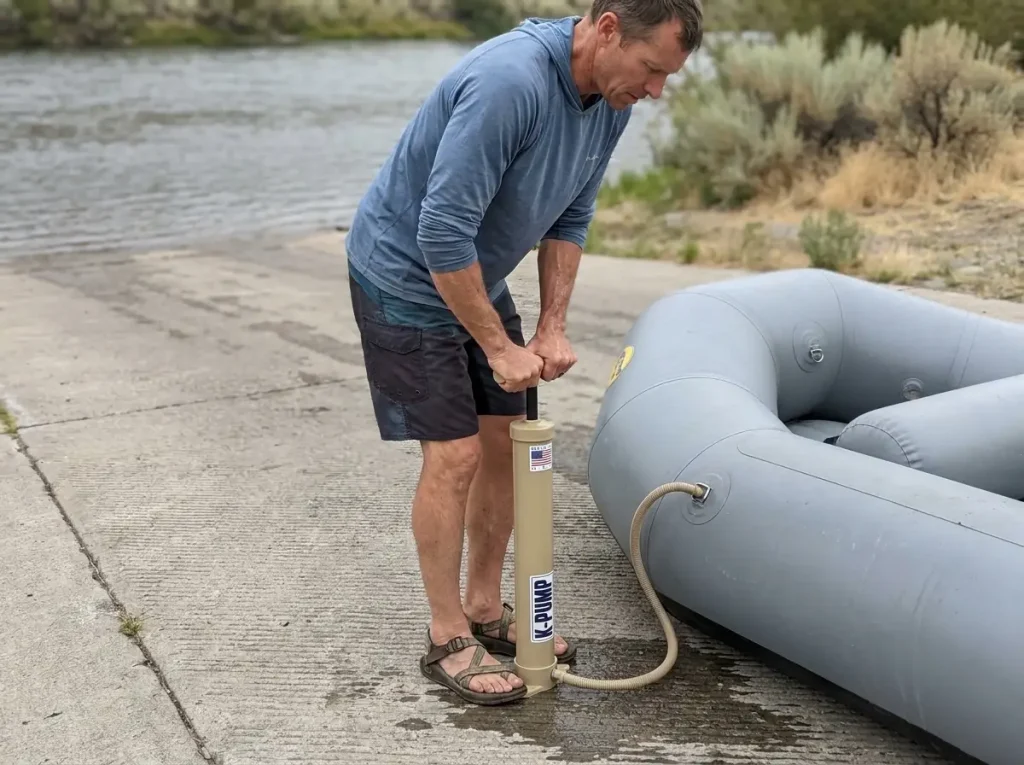
The order matters more than the muscle. Most people grab a pump and start hammering the first valve they reach, then wonder why the boat looks lopsided. There is a sequence that gets you to firm and even with less effort.
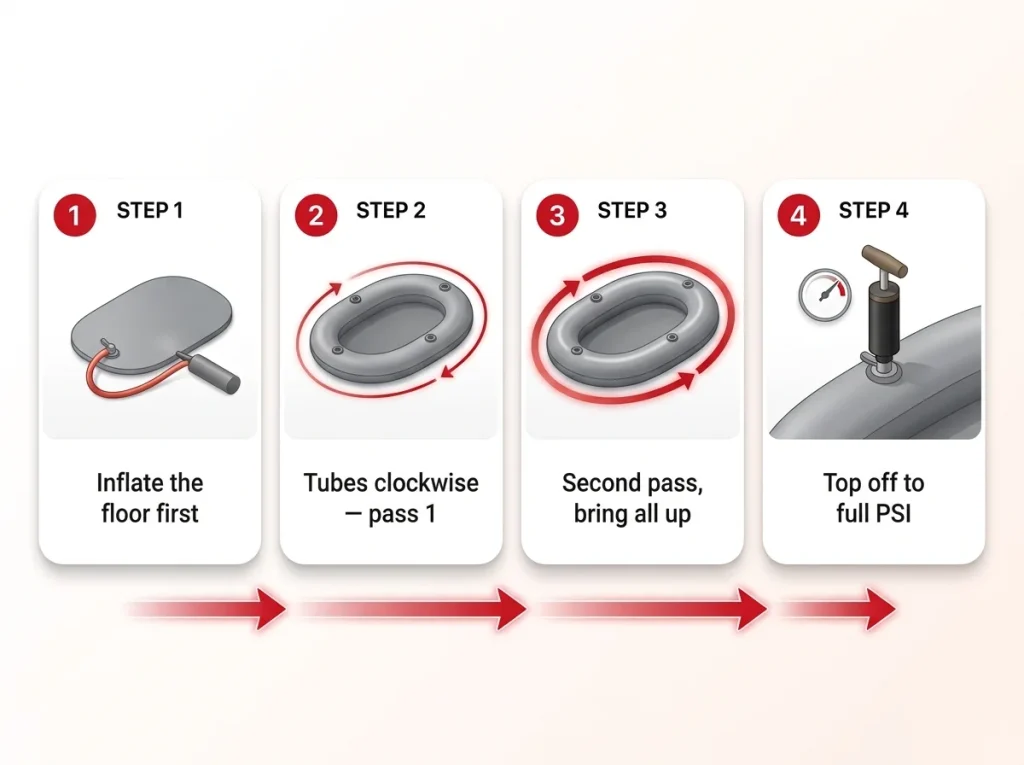
Floor First, Then Tubes in Passes
Air the floor first so the boat takes its shape from the ground up. Then do the tubes in passes: go clockwise around the boat bringing every chamber up partway, then come back around and bring them all up again. Air settles and redistributes between passes, so a chamber that felt done on the first lap will take more on the second. The goal is every chamber at the same pressure, which keeps the load off those internal baffles.
Top Off to Full Pressure
The first fill never gets you all the way there. After the bulk of the air is in, you top off each chamber to full pressure, and this is where a good finish pump earns its keep. A barrel-style top-off pump like the K-Pump K-200 brings tubes up to that last firm bit after a big-volume pump does the grunt work. This two-pump approach, a high-volume pump for the bulk and a hand pump to finish, is the system most private boaters settle on once they have rigged a few times.
If you own a drop-stitch floor, a cheap low-pressure pump will never finish it. You’ll pump until your arms quit and still be at half pressure. A pump with a gauge that reads high enough, like the integrated-gauge NRS Super Pump that fills and reads as you go, tells you exactly when the floor is actually rigid instead of just tired.
Match Your Pump and Adapter to the Valve
The most common “my pump won’t fit” headache is a missing adapter, not a broken pump. Pump hoses and valve threads don’t always mate without the right fitting, and a screw-in adapter for Leafield-style valves is the small part that saves the whole morning. Keep the adapters your valves need in the kit. Nothing kills launch-time momentum like a hose that won’t seal on a valve while the rest of the crew waits.
Temperature, Sun, and Altitude Change Everything

This is the part that separates people who set their boat once from people who manage it all day. Pressure is not a number you dial in at the ramp and forget. It moves, sometimes a lot, and it moves on its own.
Why Heat Spikes Your Pressure
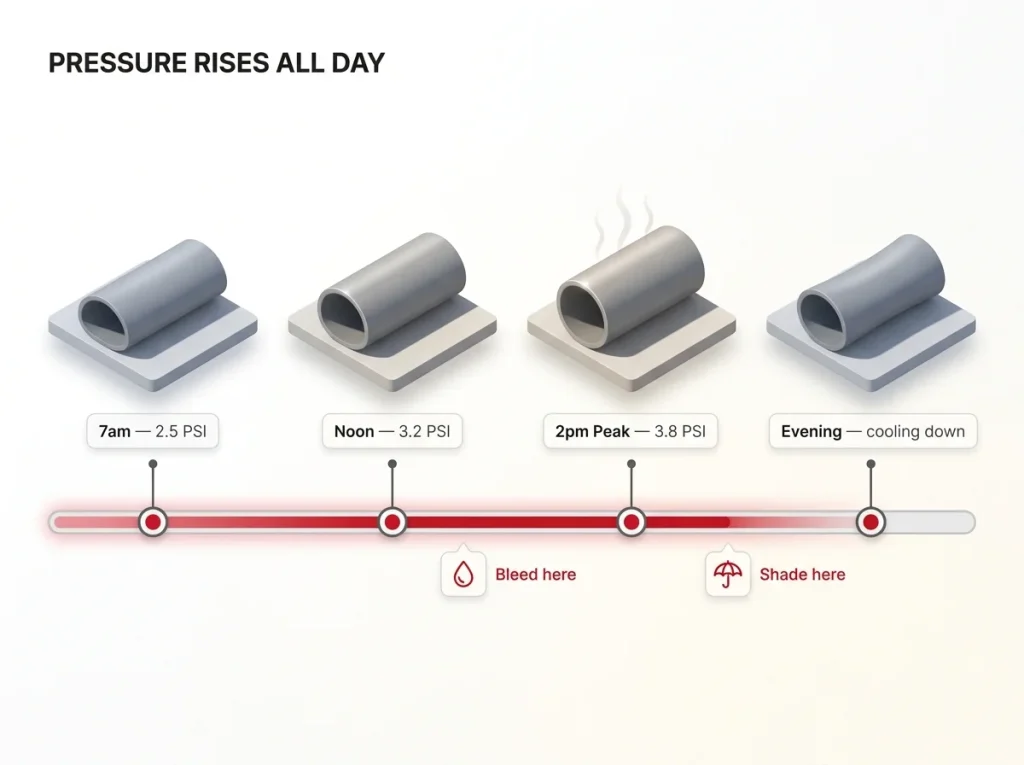
Heat is pressure. The technical name is thermal expansion, and on a raft it works fast. A raft aired to 2.5 psi in a cool warehouse climbed to somewhere around 3.0 to 3.4 psi sitting in mid-90s afternoon sun, and a fill done on a cold morning can spike toward 4.0 psi fast once the sun gets on it.
The boat you aired up rock-hard and proud at the 7am put-in is genuinely over-pressure by the 2pm lunch eddy, baking on a sandbar with nobody watching the seams. Your boat’s material handles heat and UV differently, which is one more reason the same fill behaves differently on a PVC boat than a Hypalon one.
The Morning Fill vs the Afternoon Bleed
The routine is simple once you know to do it. On a cold morning, fill firm but not maxed, and leave room for the climb you know is coming. Through the day, bleed a little air before the boat sits out of the water for a long lunch or rides home on a hot trailer. Park it in shade when you can, or splash water on the tubes to cool them. None of this is hard. It just takes knowing the pressure is rising while you are looking at the river.
What Altitude Does on the Drive Up
Less obvious: elevation changes pressure too. Air the boat at low elevation and drive up to a high put-in and the internal pressure rises with the altitude gain, same as a bag of chips puffing up on a mountain pass. The fix is to check at the ramp, not in the driveway. If you topped off at home and drove up four thousand feet, give it a look before you launch.
Over-Inflated vs Under-Inflated
Two ways to get pressure wrong, and they are not equally common. The boating world frets about one and quietly suffers the other. Let’s name both.
Why Too Soft Is the More Common Mistake
Under-inflation is the silent error, and it is the one most boaters actually make, because the fear of blowing up the boat pushes them to run soft “to be safe.” A soft boat is not the safe boat. It tacos in the first decent hole, folding around the obstacle instead of pushing through, and a folded boat loses the shape it needs to track.
That is how you blow a line everyone else in the group made clean. The performance cost of soft is real and it shows up exactly when you need the boat to hold.
The Real Risk of Over-Inflation
Over-inflation is the louder fear, and it is not nothing. Too much pressure strains the seams, and a hard boat that smacks a sharp rock has no give, which is where seam strain and explosive decompression become real possibilities. But notice when this actually happens: it is usually not your pump arm, it is the afternoon sun pushing a firm morning fill past the ceiling. Manage the heat and you manage most of the over-inflation risk.
Spotting and Fixing a Plugged PRV
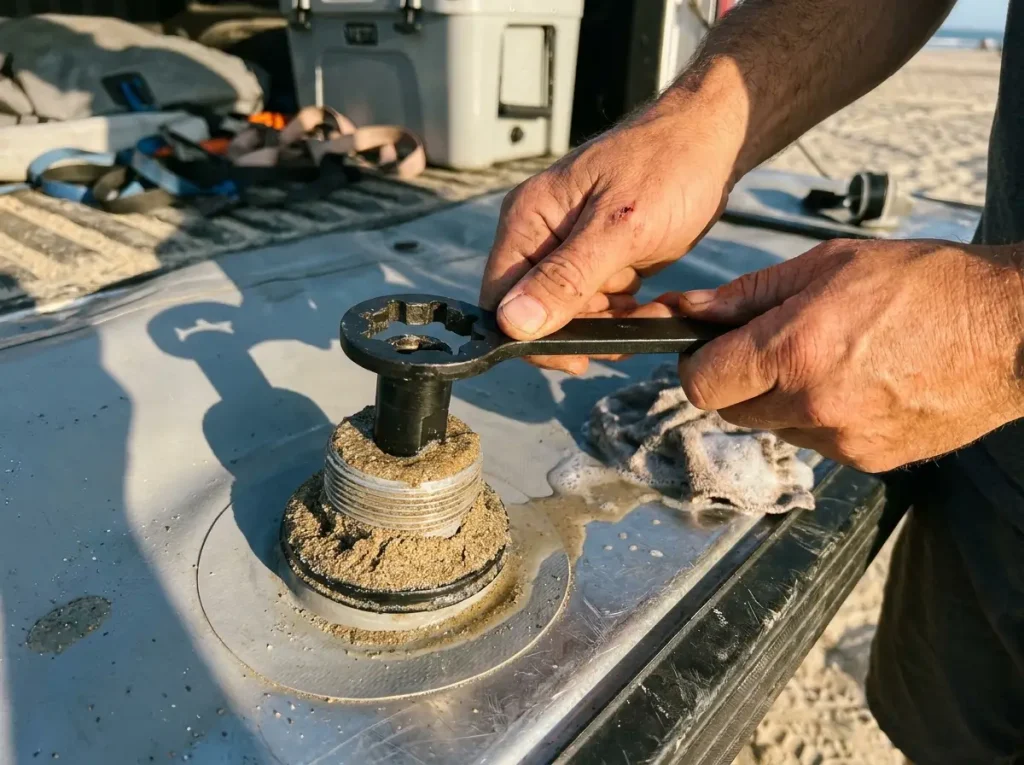
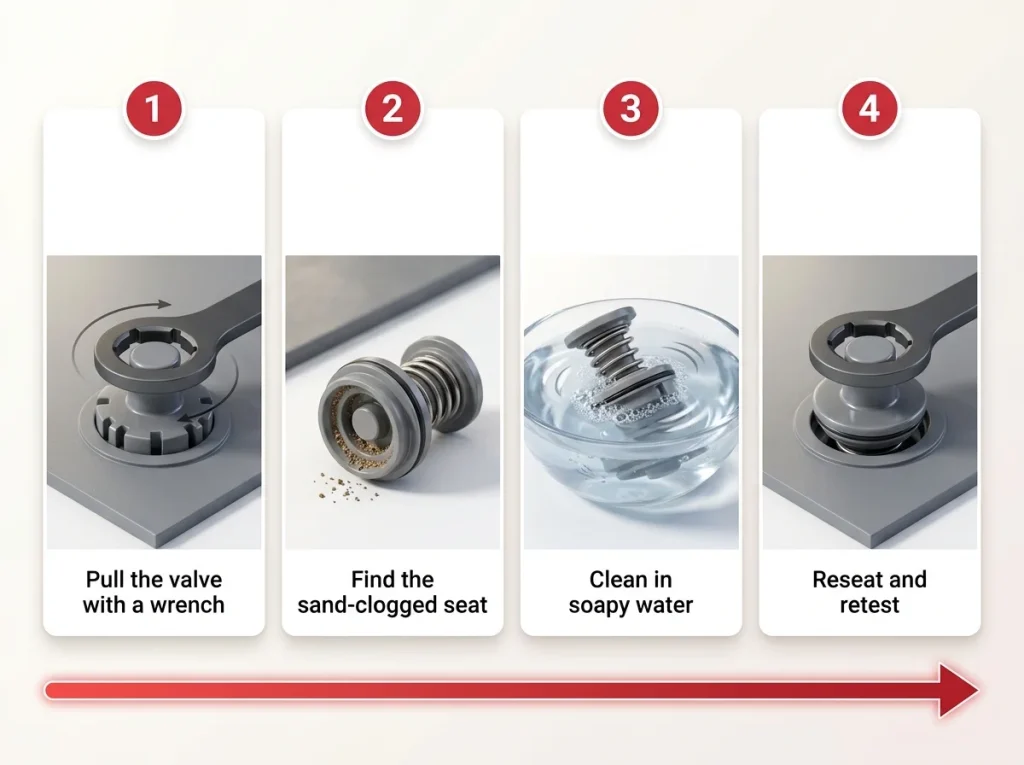
When a self-bailing floor goes soft for no reason, suspect the PRV. Grit in the seat keeps it from sealing, so it vents air it should be holding. The fix is cheap and you can do it at home. Pull the valve and clean it, working it back and forth in soapy water until the seat is clear, and if it still won’t hold after cleaning, replace it before it strands you, because a failed PRV can blow an I-beam floor and that is a roughly $300 repair, not a five-minute one.
Pulling the valve takes a six-slot valve wrench sized for Halkey-Roberts and relief valves. This is the same field-repair mindset that saves a torn tube on the river: a small tool and ten minutes beats a ruined day.
Running a high-volume electric pump straight into a self-bailing floor can push air in faster than the PRV can vent it, and that overpressures the floor even with a perfectly good valve. Back off and let the relief valve catch up instead of forcing the last bit in.
Conclusion
Three things to carry to the ramp. Firm beats soft, because most boats run too floppy and pay for it in folded lines, not too hard. Identify your valve once so the gauge, adapter, and any replacement fit the first time instead of at the worst time. And treat pressure as a day-long job, not a one-time fill, because the sun will keep adding air whether you watch it or not.
Next trip, calibrate your thumb on a gauged chamber at the put-in, air the boat firm, and check it again after an hour in the sun. You will feel the difference the first time the boat holds a line a soft one would have blown.
Frequently Asked Questions
01How much PSI should a whitewater raft be inflated to?
Inflate the tubes to about 2 to 2.5 psi, with some makers allowing up to 3.0 psi, and a self-bailing floor to roughly 2.0 psi. A drop-stitch floor insert is a separate class at 8 to 10 psi.
02How do I know what type of valve my raft has?
Most modern rafts use Leafield or Halkey-Roberts valves. Leafield valves are recessed gray-and-black units, while Halkey-Roberts or military valves push-twist to lock open. Older or budget boats often use Boston or Summit valves.
03Can you overinflate a raft, and what happens if you do?
Yes. Too much pressure strains the seams, and a hard boat hitting a sharp rock has no give, which risks seam failure. Most over-inflation comes from afternoon sun raising the pressure of a firm morning fill, not from the pump.
04How can I check raft pressure without a gauge?
Use the thumb test: a properly firm tube barely dents under a hard push, about half an inch near 2.5 psi. It is rough, so calibrate your thumb once on a gauged chamber, and recheck on cold mornings when rubber feels firmer than it is.
05Why does my raft floor keep going soft?
The usual cause is a pressure relief valve clogged with sand. The PRV sits low where grit collects and stops sealing, venting air it should hold. Pull it, clean it in soapy water until the seat is clear, and replace it if it still won’t hold.