

In this article
A calm, scenic float erupts into chaos—a raft pins against a submerged boulder, the river’s power immense and unyielding. The easy laughter of your crew vanishes, replaced by the roar of water and the sudden, cold weight of reality. In that instant, your value as a guide is no longer measured by your storytelling but by a deep well of training that kicks in instinctively. This article reveals that the foundation of that instinct isn’t a single certificate, but a “Certification Tripod”—a strategic blend of technical skill, rescue proficiency, and medical preparedness that turns a good professional river guide into a great one.
To get started on one of the many available career paths in the whitewater rafting industry, you must understand the essential pillars of professional qualification. We’ll explore the difference between Technical Guiding certifications from bodies like the International Rafting Federation (IRF) and domestic programs, dedicated swiftwater rescue training from providers like Rescue 3 International, and the critical role of a Wilderness First Responder (WFR) Course. You will learn to navigate the key certifying bodies and understand the various certification types. Finally, you’ll discover how regulatory compliance and a strong ethical framework like Leave No Trace are non-negotiable employment prerequisites for any modern guide.
What Are the Foundational Pillars of a Professional River Guide’s Credentials?
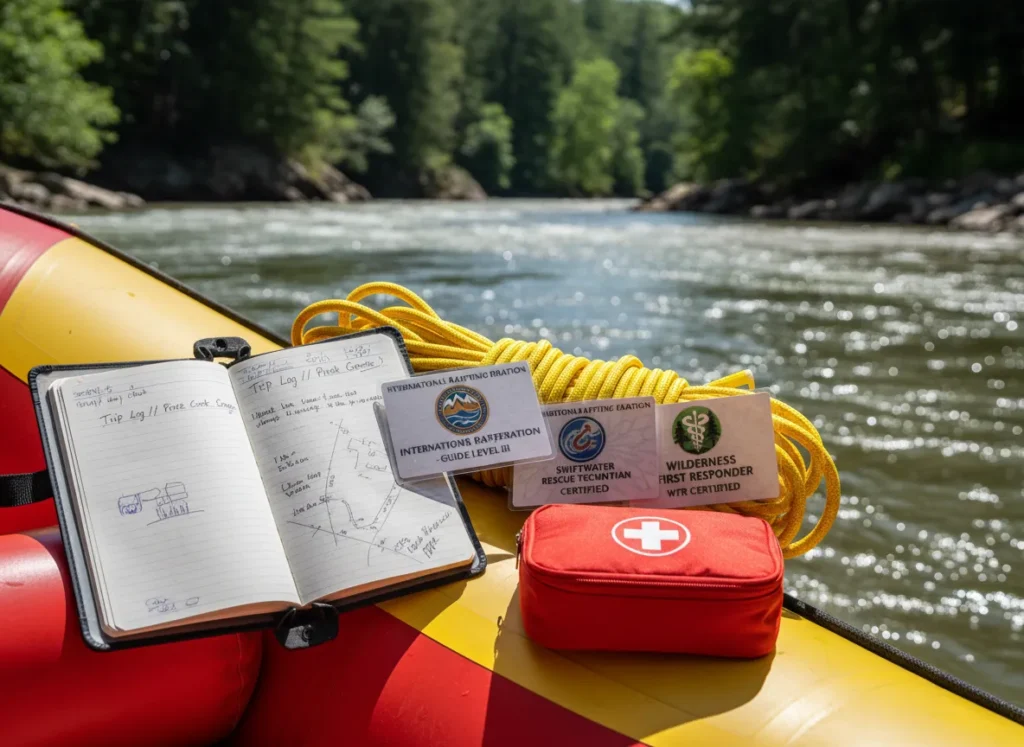
A professional river guide is not defined by a single piece of paper. Their competence is a composite of three distinct, yet deeply interdependent, domains of expertise. This is the core of the Certification Tripod: technical skill, rescue capability, and medical preparedness. For any aspiring river guide, understanding this structure is the first step. Each leg of this tripod is essential; without one, the entire structure of professionalism collapses.
Why Are Technical River Skills the Bedrock of Guiding?
This first pillar is the absolute bedrock of the profession—it represents your primary job function, from basic paddle guiding to complex maneuvering. It’s the art and science of safely navigating a watercraft, managing passengers, reading river hydrology and identifying river hazards, and making sound, proactive decisions in a constantly moving environment. The preeminent global standard for this is the International Rafting Federation’s (IRF) Guide Training & Education (GTE) Award System. The IRF assesses core competencies from boat handling and knowledge of paddling strokes to the delivery of a clear, concise safety briefing. On the domestic front, national bodies like the American Canoe Association (ACA) provide robust, multi-level certification pathways that are highly respected within the United States.
These certifications are the fundamental proof of your ability to perform your job. They are hierarchical, often tied directly to the river difficulty levels you are qualified to guide—an IRF Level 4 Raft Guide, for instance, has proven their skills on Class IV rivers. This pillar is focused entirely on incident avoidance. It’s about having the skill to put the boat exactly where it needs to be, anticipating challenges, and preventing problems before they can begin. Without this foundational skill, all the rescue and medical training in the world is irrelevant, because you are not yet qualified to lead a trip in the first place. You must first master the fundamentals of how to guide a raft before you can effectively manage the consequences of something going wrong. With a solid foundation in navigating the river, the professional guide must also be prepared for when things inevitably do.
How Does Advanced Safety & Rescue Proficiency Elevate a Guide?
If technical skill is about avoiding incidents, this pillar of river safety and rescue is about responding effectively when they occur anyway. It represents a critical shift in mindset from guide to rescuer. The dominant providers in this field are Rescue 3 International and the American Canoe Association (ACA), both of which offer professional training programs that go far beyond what is covered in a standard guide course. Rescue 3’s Whitewater Rescue Technician – Professional (WRT-Pro) course, for example, is designed specifically for professional river users. This formal swiftwater training emphasizes fast, low-tech, and improvised techniques appropriate for in-the-field scenarios where you have limited gear and must rely on your immediate team.
This training is not the same as your guide certification. It focuses on the worst-case scenarios: managing pinned boats, executing complex river rescues using knots and rescue ropes, and handling swimmer situations that have escalated beyond a simple throw bag toss. The ACA offers a tiered safety and rescue curriculum that culminates in its Level 4 Swiftwater Rescue course, serving as a comprehensive domestic alternative. This pillar is non-negotiable. It transforms a guide from a simple navigator into a capable safety professional who is truly responsible for their group. A guide certified only in technical skills, without formal river rescue training, is unprepared for a major incident. This is not just a gap in training; it is a critical professional deficiency. Once a rescue is complete, the guide’s responsibility shifts again, this time to managing the human element in an environment far from help, often involving technical skills like the Z-Drag rescue system.
Pro-Tip: In a rescue, calm is contagious. Before you act, take one full, deliberate breath. It forces a mental reset, slows your heart rate, and allows you to shift from reactive panic to decisive action. Your crew will mirror your composure, which is often the most important rescue tool you have.
Why is Wilderness Medical Preparedness the Final Pillar?
This pillar addresses the stark reality that commercial river trips operate in remote environments where definitive medical care is significantly delayed. The unequivocal industry gold standard is the Wilderness First Responder (WFR) Course, a certification far exceeding the scope of a standard urban first aid and cpr certification. A WFR is an intensive 70- to 80-hour program designed for outdoor professionals, with a curriculum built around extensive practical scenarios. Many reputable organizations operating under the standards of the Wilderness Medical Education Collaborative, such as NOLS Wilderness Medicine, SOLO Wilderness Medicine, and Aerie Backcountry Medicine, offer this critical training.
A WFR is crucial because it trains you to manage complex medical and trauma emergencies far from a hospital. The scope of practice covers everything from long-term wound care and fracture/dislocation management to life-threatening environmental emergencies like severe hypothermia or heat stroke. This training is so fundamental that certifying bodies like the IRF mandate a current, valid, and IRF approved First Aid Certificate simply for their guide awards to remain valid. It is the synthesis of all three pillars—technical skill to avoid the wreck, rescue skill to solve the wreck, and medical skill to manage the aftermath—that creates a competent, employable, and truly professional river guide. Understanding the principles of river trip first aid is the final piece of the puzzle.
How Does the International Rafting Federation (IRF) Standardize Guiding Skills Globally?
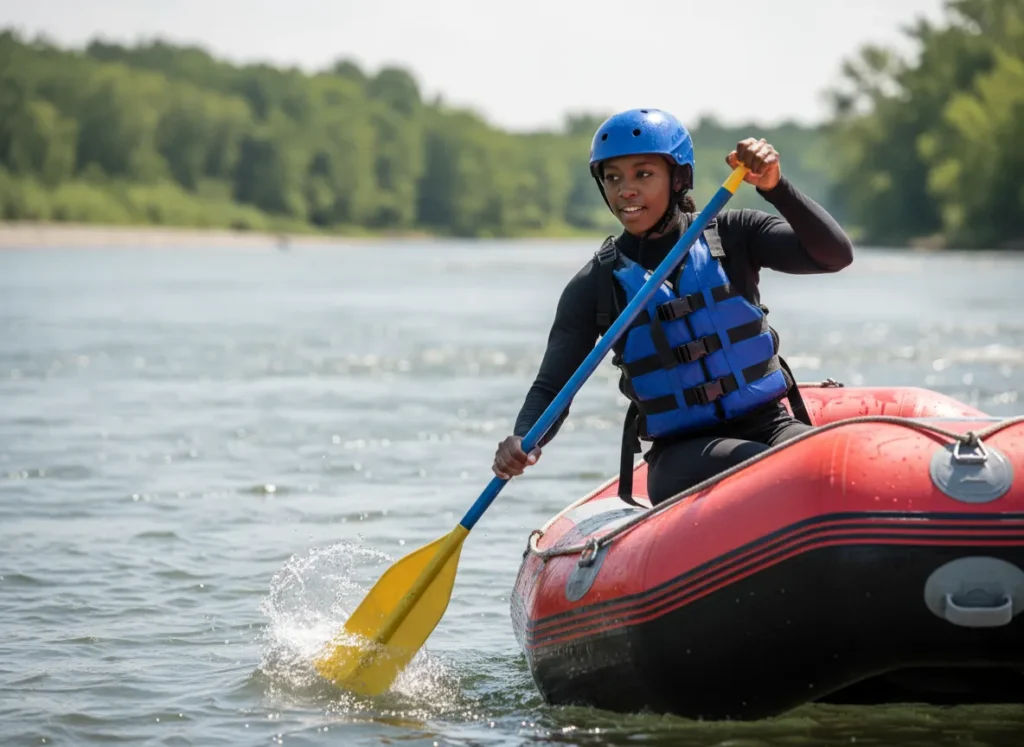
Now that we understand the “Certification Tripod,” let’s dissect the most globally recognized technical award: the IRF GTE. This system is the benchmark for technical guiding certifications worldwide, providing a common language of competence that is understood from the Zambezi to iconic US whitewater rivers like the American River in California.
What is the Architecture and Purpose of the IRF GTE System?
The IRF GTE system was created to establish a common, trusted standard for whitewater professionals, recognized by operators, federations, and regulators across the globe. Managed by the IRF’s GTE Committee with logistical support from the GTE administration, it ensures consistent oversight, lending it a level of credibility that is unmatched. Its primary purpose is to reliably recognize guides who meet rigorous international standards of competence. This global recognition is its most powerful attribute and is endorsed by major bodies like the Adventure Travel Trade Association (ATTA) and acknowledged by authorities like the “United Nations World Tourism Organization (UNWTO) standards”.
For a guide seeking to work internationally, the IRF GTE Award is often the only certification required to prove their technical ability. The system defines a clear hierarchy of roles, including the Raft Guide, the Raft Trip Leader, the Instructor, and the Instructor Trainer. It uses a “Level” system (e.g., Level 4) that directly correlates a guide’s assessed skill to the river classification they are qualified to run commercially. To even be considered for an award, every candidate must meet critical prerequisites: be a minimum age of 18, present a logbook of their experience, and hold a current, valid First Aid certificate. Understanding the system’s structure is one thing; passing the assessment is another. To do so, you’ll need to start by mastering essential rafting terms.
Pro-Tip: Your logbook is your professional resume. Don’t just list dates and rivers. Add a brief note for each trip: “High water, one swim,” or “Practiced Z-drag with crew.” This detail shows assessors your commitment to continuous learning and provides talking points that demonstrate your experience goes beyond just floating downstream.
What Does the IRF Assessment Process Involve?
It is critical to understand that an IRF event is an assessment of existing skills, not an instructional course. You are expected to arrive prepared. The format requires candidates to perform a series of practical tasks which are graded on a 1-to-5 point scale against specific assessment criteria, with a 3 (“Satisfactory”) being a pass. The assessment begins before you even touch the water, with the Pre-departure Safety Demonstration, where your ability to communicate clearly about topics like Personal Protective Equipment (PPE) is rigorously tested.
From there, the core on-water skills are evaluated: Raft Guiding & River Running (testing boat control, eddy turns, peel-outs, and hazard recognition) and Personal Whitewater Swimming. Assessors then move to Rescue Skills, which include the proficient use of a throw bag, basic rope work, and the Flip Drill. A final exam tests theoretical knowledge to round out the practical skills. A successful certification has a certification validity period of three years, contingent on you maintaining a current First Aid certificate. The certificate renewal process requires providing proof of meeting requirements within six months of expiration to avoid having to go through a more stringent re-assessment, ensuring that skills remain sharp and current. Successful guides are often listed on the IRF’s public Certified Guides List. One of the most foundational of these skills is the Proficient use of a throw bag, which is a pass/fail component of any legitimate assessment.
What Makes Swiftwater Rescue Training a Non-Negotiable Skill?
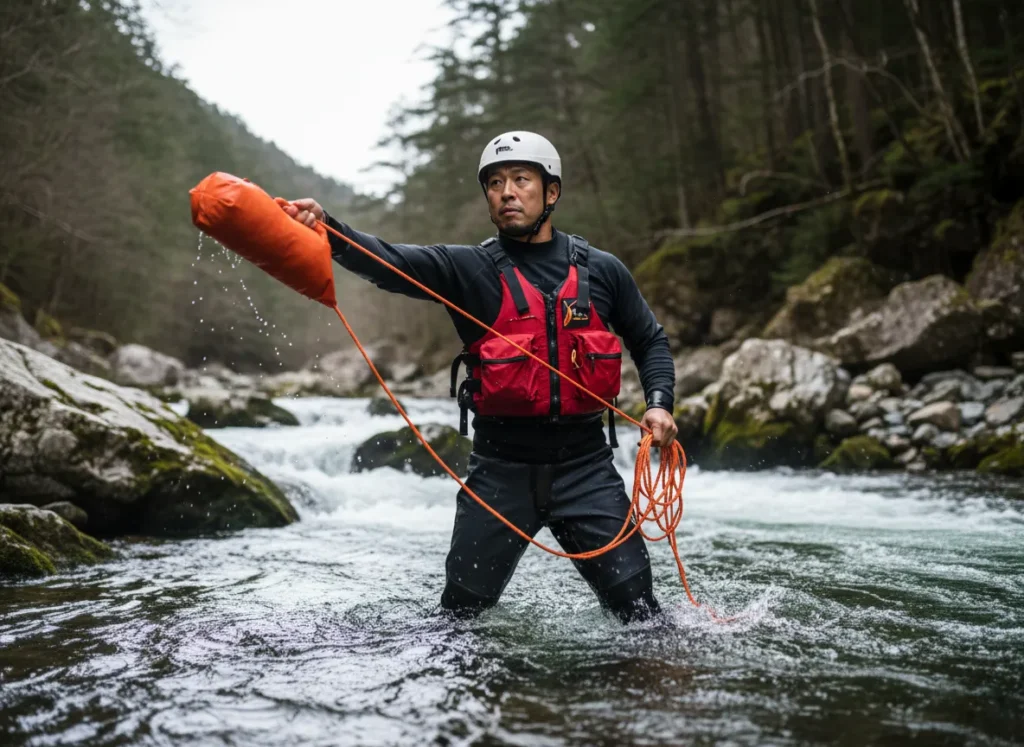
While the IRF sets the standard for guiding, a different ecosystem of organizations sets the global standard for rescue. This section details the critical discipline of swiftwater rescue, differentiating between courses designed for professional guides who are already on scene, and those designed for external emergency services who are responding from afar.
How Does Rescue 3’s WRT-Pro Course Target Professional Guides?
Rescue 3 International is the globally recognized leader in standardized technical rescue training, and their Whitewater Rescue Technician – Professional (WRT-Pro) course is the definitive standard for our industry. It is engineered specifically for professional river users—guides, Safety Rafters, and Safety Kayakers who already possess significant river experience. The course structure reflects this: it’s an intensive, multi-day program conducted almost entirely on the river, intentionally omitting the basic classroom sessions that a novice would need. The core philosophy is the application of fast, low-tech, and improvised techniques that reflect the reality of an in-group, immediate response where you only have the gear and people on your trip.
The WRT-Pro covers advanced rescue skills far beyond a guide certification, including live bait rescues, managing pinned rafts with complex rope systems, and entrapment extrications. It is crucial to contrast this with the Swiftwater and Flood Rescue Technician (SRT) course, which is designed for external agency responders like fire departments. The operational difference is night and day: WRT-Pro is for an in-group, immediate response with limited gear, while SRT is for a deliberate, external agency response with extensive resources. The WRT-Pro provides the contextually relevant skills a guide needs to solve their own problems, solidifying their place within the river rescue hierarchy.
| WRT-Pro vs. SRT | ||
|---|---|---|
| Attribute | WRT-Pro (For Guides) | SRT (For Agencies) |
| Target Audience | Professional river users (guides, kayakers) | External agency responders (fire, search & rescue) |
| Core Philosophy | Fast, improvised, low-tech, in-group rescue | Systematic, deliberate, resource-intensive response |
| Typical Scenarios | Pinned raft, entrapped swimmer on a remote trip | Urban flood, vehicle in water, large-scale incidents |
| Key Skills Emphasis | Minimalist gear, simple mechanical advantage | Complex rope systems, incident command structure |
With both guiding and rescue skills established, we turn to the final pillar: the ability to provide medical care when help is a long way off.
How Do Regulatory and Ethical Frameworks Complete the Professional Picture?
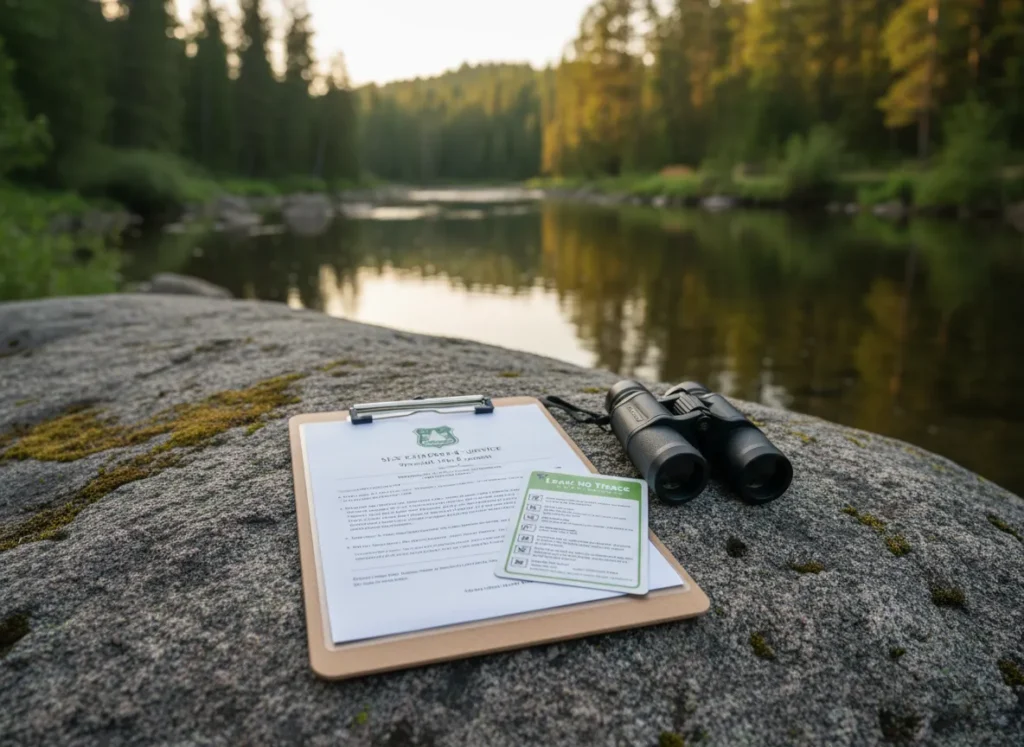
Possessing the “Certification Tripod” makes you a highly skilled individual. But to be a true professional, you must operate within the legal and ethical frameworks that govern our industry. This section moves beyond personal certifications to cover the responsibilities that define a professional in the outdoor world.
Why is Navigating the “Regulatory Web” of Permits Essential?
In the United States, a complex regulatory framework governs all commercial river operations on public lands. Outfitters must be licensed by state boards and operate under permit from federal agencies. The key federal land management agencies—the U.S. Forest Service (USFS), the Bureau of Land Management (BLM), and the National Park Service (NPS)—all have their own permitting systems, like the USFS “Special Use Permit” or the NPS “Commercial Use Authorization (CUA).”
On top of this federal layer, many states—like Colorado, Washington, and Oregon—have their own state-level licensing requirements which are often a prerequisite for getting federal permits. This multi-layered system creates high barriers to entry, which serves to filter out unprofessional or under-capitalized operators. For you, the individual guide, this system dictates that legitimate employment opportunities will almost exclusively be found with established, licensed, and permitted outfitters like OARS, Northwest Rafting Company, or the U.S. National Whitewater Center (USNWC). It also comes with critical mandates, such as the USFS requirement that all guides be legal employees, not independent contractors. Fulfilling these legal requirements is the floor, not the ceiling, of professionalism; the pinnacle is a deep commitment to environmental stewardship. For a direct look at the source, you can review the official “U.S. Forest Service Special Use Permit requirements” to understand the depth of this framework. For a broader overview, you can explore the complexities of U.S. river permits.
How Does the Leave No Trace Ethic Define a True Outdoor Leader?
The pinnacle of professionalism extends beyond technical skill into river conservation practices and environmental stewardship. The universal standard for minimum-impact sustainable practices in the outdoors is the Leave No Trace (LNT) framework. For river runners, the Seven Principles are applied with specific focus. “Plan Ahead and Prepare” means repackaging food to minimize trash before the trip even starts. “Travel and Camp on Durable Surfaces” means setting up kitchens and tents on sand, gravel, or rock to avoid damaging fragile riverside vegetation. “Dispose of Waste Properly” is a non-negotiable commitment to packing out all waste, which on a river trip includes solid human waste in portable toilets.
The list continues with “Leave What You Find,” “Minimize Campfire Impacts,” and “Respect Wildlife.” This ethical commitment is not just a personal preference; it is a professional requirement, explicitly mandated by land managers. The LNT Center offers formal training, with the two-day “Level 1 Instructor Course” being the professional standard. Integrating these ethics is what differentiates a competent technician from a true outdoor leader—one who practices eco-friendly guiding and fosters a genuine conservation ethic in their clients. The definitive source for this framework is “The Seven Principles of Leave No Trace”, and every professional guide should know them by heart.
Conclusion
By integrating all these elements—technical skill, rescue, medicine, legality, and ethics—we can synthesize a complete roadmap to professional excellence. The journey to becoming a top-tier professional raft guide is not about finding a single, magic certificate. True competence is a comprehensive portfolio built on the “Certification Tripod”: technical skill, rescue capability, and medical preparedness.
The International Rafting Federation (IRF) provides the global benchmark for technical guiding, while Rescue 3 International’s WRT-Pro course is the specific standard for in-field, professional rescue. The Wilderness First Responder (WFR) is the non-negotiable medical certification for any guide operating where medical care is delayed. This foundation of personal skill is then made legal through adherence to the complex regulatory framework of federal and state permits, and it is guided by the ethical compass of Leave No Trace principles. Your path is clear. Begin building your own professional portfolio by exploring our in-depth guides on specific rescue techniques and river safety protocols.
Frequently Asked Questions about River Guide Certifications
Do I need certifications to be a raft guide?
Yes, at a minimum, a valid first aid and cpr certification is required by nearly all commercial outfitters. While not always legally mandated in every jurisdiction, certifications in swiftwater rescue and technical guiding (like from the IRF or ACA) are the professional standard and are required by most reputable companies to ensure a high standard of safety and competence.
What is the best river guide certification?
There is no single best certification. The professional standard is a combination of three distinct types that form the minimum standards: technical guiding (to control the craft), swiftwater rescue (to manage incidents), and wilderness medicine (to care for patients). When considering IRF vs. national programs, the IRF GTE award is the most globally recognized for technical skills.
How long does it take to become a river guide?
Initial training can often be completed in a whitewater guide school lasting one to two weeks, though the exact course duration varies. However, becoming a truly proficient guide takes a full season or more of consistent, on-the-job training. Acquiring the full suite of professional certifications can take several additional weeks of intensive courses.
How much does river guide training cost?
The course price can vary significantly. An outfitters internal guide school might cost a few hundred dollars, while independent programs can be over $1,000. Some schools even offer scholarships or reduced tuition. The additional required certifications fees are a separate investment: a swiftwater rescue course typically costs between $400-$800, and a Wilderness First Responder (WFR) course can range from $700-$1000.
Risk Disclaimer: Whitewater rafting, kayaking, and all related river sports are inherently dangerous activities that can result in serious injury, drowning, or death. The information provided on Rafting Escapes is for educational and informational purposes only. While we strive for accuracy, the information, techniques, and safety advice presented on this website are not a substitute for professional guide services, hands-on swiftwater rescue training, or your own critical judgment. River conditions, including water levels, currents, and hazards like strainers or undercut rocks, change constantly and can differ dramatically from what is described on this site. Never attempt to navigate a river beyond your certified skill level and always wear appropriate safety gear, including a personal flotation device (PFD) and helmet. We strongly advise rafting with a licensed professional guide. By using this website, you agree that you are solely responsible for your own safety. Any reliance you place on our content is strictly at your own risk, and you assume all liability for your actions and decisions on the water. Rafting Escapes and its authors will not be held liable for any injury, damage, or loss sustained in connection with the use of the information herein.
Affiliate Disclosure: We are a participant in the Amazon Services LLC Associates Program, an affiliate advertising program designed to provide a means for us to earn advertising fees by advertising and linking to Amazon.com. As an Amazon Associate, we earn from qualifying purchases. We also participate in other affiliate programs and may receive a commission on products purchased through our links, at no extra cost to you. Additional terms are found in the terms of service.