


In this article
You’re standing in the shop (or three tabs deep in listings at midnight), stuck between a 13 and a 14, terrified you’ll drop serious money on the wrong boat. I’ve been there, and I’ve owned the boats I later regretted — one too small for the trips I actually wanted, one too big for the river I actually ran. This raft size guide is the conversation I wish someone had walked me through before I bought either one: how to size by the three things that truly decide it, and how to dodge both classic mistakes, the obvious one and the one nobody warns you about.
Here’s the short version before we get into the why. Match this table to your real trips, not the someday-trip in your head.
| Raft Length | Best For (paddlers) | Gear / Trip Length | Typical River Use |
|---|---|---|---|
| 9–11 ft | 2–4 paddlers, 1–2 anglers, or a solo rower | Day trips and short overnighters | Low-volume, technical, playful runs |
| 12–13 ft | Comfortable max of 5–6 on a day trip | Day trips; tight for multi-day with 2 | The do-everything family and day boat |
| 14–15 ft | Up to 7–8 on a day trip, or 3–4 with gear | The multi-day workhorse | High-volume and big-water Class III–IV |
| 16 ft+ | Big crews or oar-rigged gear hauling | Long expeditions, full camp loads | Big-water expeditions; sluggish in tight lines |
The Three Things That Actually Decide Your Raft Size

Don’t ask “what size raft should I buy.” That question has no answer until you’ve answered three others: how many people are in the boat, how many nights you sleep on the river, and what water you actually run. Settle those and the size mostly picks itself. Skip them and you’re shopping by gut, which is how regret-boats get bought.
The trap I see most often is sizing for the crew you’ll someday have instead of the trips you run ninety percent of the time. You picture the eight-person family float that happens once a year and buy a boat that’s wrong for every other weekend. Capacity should be driven by the biggest of your three real answers, not the average and definitely not the fantasy.
Who’s In the Boat (Crew and Paddle Power)
Headcount is the obvious lever, and it cuts both ways. More paddlers means more weight and more boat, but it also means more muscle to move that boat through a rapid. Two people in a big raft are passengers; six people in the right raft are a crew.
If your usual run is just you and one other person — what boaters call R-2 — you want a smaller, lighter boat you can actually steer, not the biggest thing you can afford. And if you’re a solo paddler eyeing hike-in or ultralight trips, a packraft might be the smarter call than a full raft you’ll need a trailer to haul.
How Long You’re Out (Day vs Nights)
Nights change the math more than people do, and we’ll spend a whole section on why. For now, hold onto the principle: a day boat is sized for paddlers, a multi-day boat is sized for gear. The same four people who fit happily in a 13-footer for an afternoon will overflow it by the second night of an expedition.
What You’re Running (River Character)
A boat that’s perfect on a tight technical creek is the wrong tool on big pushy water, and the reverse is just as true. Low-volume and rocky rewards a smaller, nimble hull that slips the lines. High-volume Class IV rewards length and buoyancy that punch through waves instead of folding into them. Pick the boat for your home water first, then check that it can stretch to the trips you take a few times a year.
Write down the trip you actually ran most often last season — crew, nights, river class. Buy for that boat. The once-a-year epic can rent a bigger raft or borrow a friend’s; the every-weekend run is the one you live with.
Raft Size by Length — What Each Boat Actually Carries
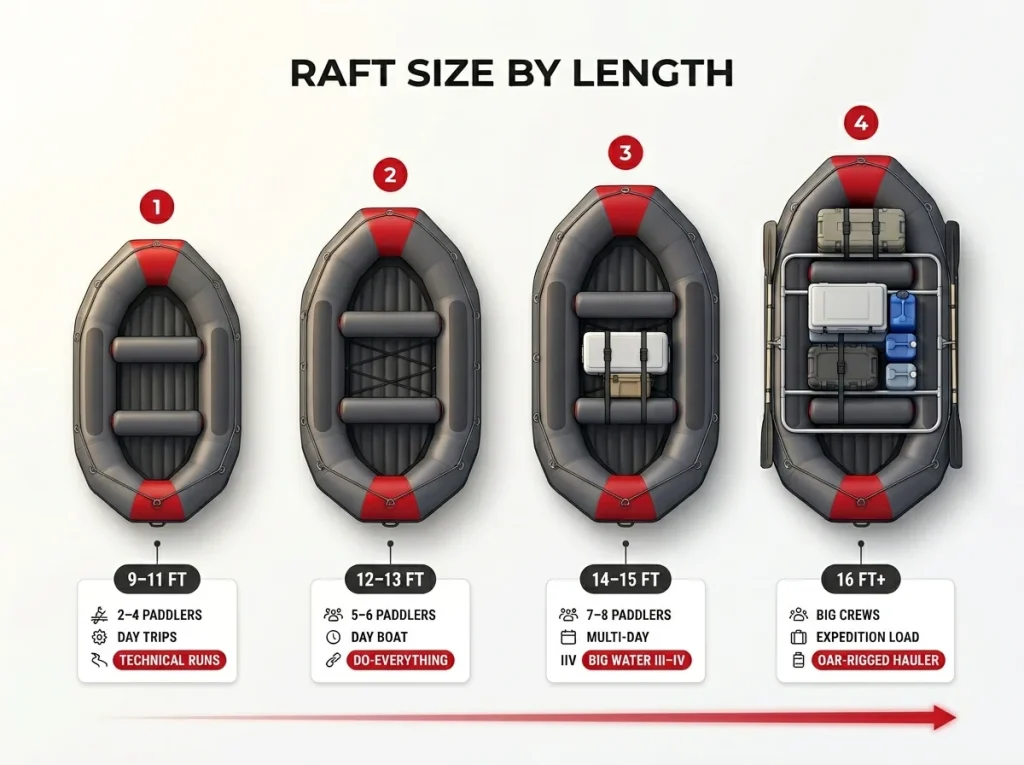
Length is the number on the spec sheet, so it’s where everyone starts. It’s a useful shorthand as long as you read it as “what this boat realistically carries,” not “the most I can cram in before it sinks.” Capacity ratings are comfortable maxes. Plan to leave margin, because a boat loaded to its rated limit handles like a barge and bails like a bathtub.
9 to 11 Feet — The Nimble Minimalist
This is the small-and-playful end. A 9 to 11 foot raft handles up to three paddlers, one or two anglers, or a solo rower, and it feels almost kayak-like — quick to spin, easy to read, forgiving when you blow a line. It’s a brilliant day boat and a workable choice for short overnighters if you pack light. The catch is space: the moment real gear shows up, this boat fills fast and you’re stacking dry bags on your feet.
12 to 13 Feet — The Do-Everything Day Boat
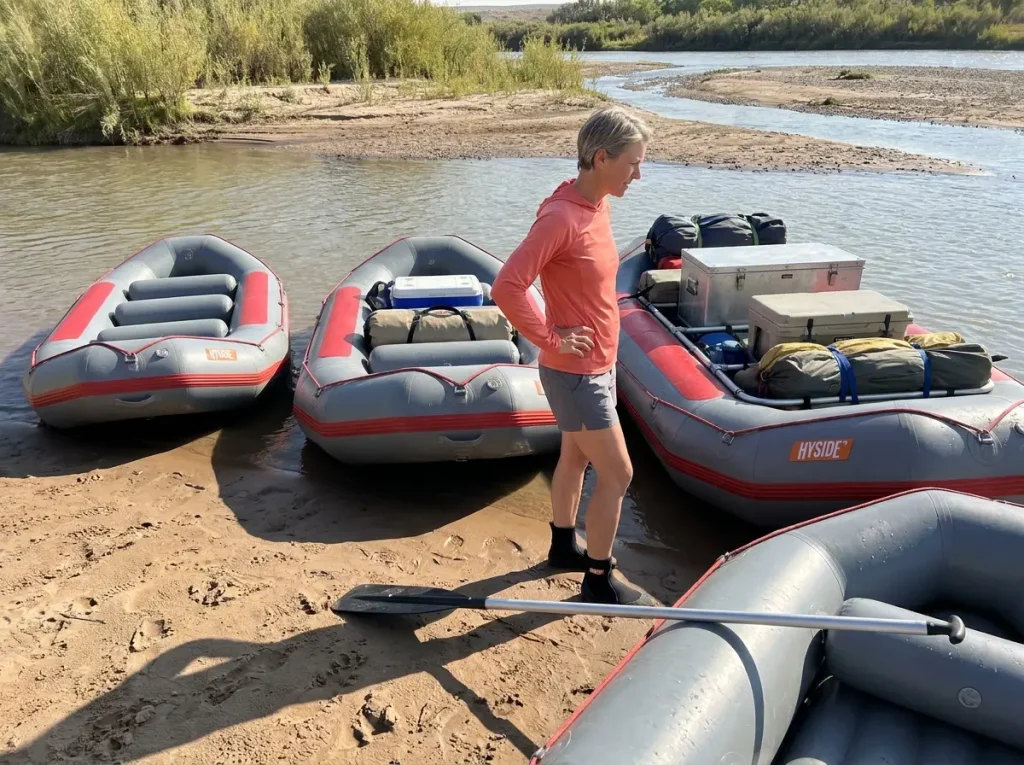
The 12 to 13 foot band is where most families and casual crews land, and for good reason. It comfortably maxes out around five or six paddlers on a day trip, stays stable in genuine whitewater, and still slides through technical lines without bullying you. If your paddling is mostly day runs with friends, this is the size that does the widest range without asking you to learn a new boat. Where it gets tight is multi-day: two people can squeeze a week out of a 13, but it’s the floor of what works, not the comfort zone.
14 to 16 Feet and Up — The Gear Hauler
Once you cross into 14 feet, you’re buying capacity. A 14 to 15 foot raft carries up to seven or eight paddlers on a day trip, or three to four people with a full multi-day load of coolers, dry boxes, and camp kit. This is the band where most of these boats run a self-bailing floor as the whitewater standard, draining the water that comes over the tubes instead of trapping it — and if floor construction is new to you, it’s worth understanding how a self-bailing floor changes the boat before you commit.
Push past 16 feet and you’re into expedition-hauler territory: big crews, big loads, almost always oar-rigged as a gear boat. Wonderful on a long desert river, a slow pig on a tight one.
Day Trips vs Multi-Day — How Gear Load Changes the Math

Here’s the part the spec sheets bury. Adding people to your boat bumps the size up a notch. Adding nights can blow past a whole size class, because what fills a multi-day raft isn’t bodies — it’s gear volume. Most first-time buyers size for headcount, take the boat on their first real expedition, and discover the problem somewhere around day two when there’s nowhere left to put the kitchen.
Day Trips — Size for Paddlers
On a day run, the math is simple and forgiving. Count your paddlers, pick the length band that carries them comfortably, leave a little margin. You’re hauling lunch, layers, a throw bag, and a first-aid kit — not much. This is the only time headcount alone is a fair guide to size, which is exactly why it traps people: it works right up until the first overnighter, and then it doesn’t.
Multi-Day — Size for Gear, Not Heads
Multi-day sizing flips the whole equation. Two people on a trip up to about seven days need a 13-foot raft as the minimum, or a 13 to 14 foot cataraft — and minimum is the operative word, not roomy. Bump it to three or four people with a week of gear and you’re looking at a 14 to 16 foot raft, or a 16 to 18 foot cataraft, just to fit the load. Notice the boat grew two full feet while the crew barely changed. That’s the whole lesson: on multi-day water, capacity outruns paddler count every time.
The Gear That Quietly Eats Your Space
The stuff that fills a boat isn’t the stuff people picture. It’s the groover (the river toilet system, and yes it counts as volume), the water jugs, the kitchen box, the firepan, the tables, the spare oar, the repair kit, and the cooler that somehow weighs more on day five than it did at the put-in. None of it is optional on a real expedition, and all of it has to ride somewhere.
Before you trust a size, lay out your actual camp gear in the garage and look at the pile. That pile is what you’re buying a boat for. When you’re itemizing it, a full gear checklist by river class keeps you honest about what’s really coming, and the volume reality feeds straight into planning a multi-day river trip down to which boat hauls the groover.
Count gear days, not just people. The jump from a 13 to a 14 feels small on paper and huge on the water once the camp load goes in. If multi-day is in your future at all, size for the gear now — you can paddle a big boat light, but you can’t stretch a small one.
Sizing for Your River Class — From Mellow Floats to Class IV

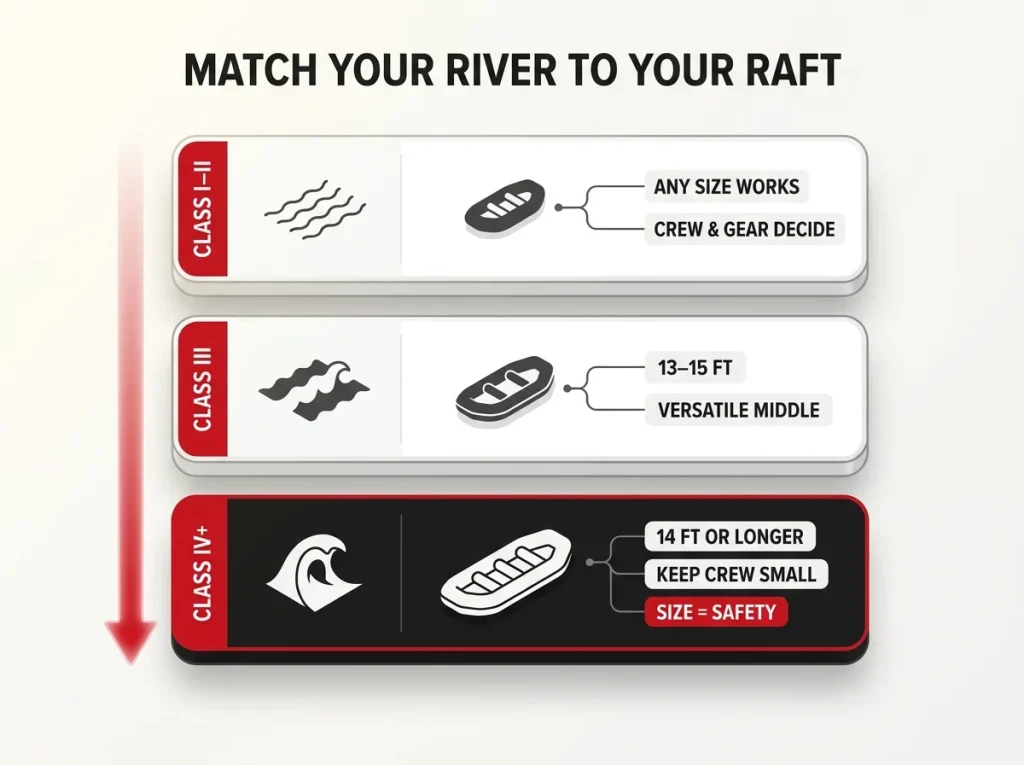
Same crew, two different rivers, two different right answers. The water you run should shape the boat as much as the people in it, and getting this one wrong isn’t just uncomfortable — on pushy water it’s a safety problem. Class ratings come from the recognized standard, the International Scale of River Difficulty, and they’re the cleanest shorthand for matching a hull to the water.
Class I–II — Mellow Floats and Flexibility
On easy water you have the most freedom and the least penalty for getting it wrong. Almost any size works, so let crew and gear decide. If your runs are mostly mellow and you sometimes paddle solo or with one other person, an inflatable kayak can be a more fun, more nimble tool than a full raft for those small-crew days. Save the big boat for when the water or the load actually demands it.
Class III — The Versatile Middle
Class III is where most private boaters spend their lives, and it’s where the 13 to 15 foot range earns its reputation. You want enough length to stay stable in wave trains but enough agility to make the moves a III throws at you. This is the sweet spot the do-everything sizes were built for. Keep the crew coordinated and the boat does the rest.
Class IV and Up — Length, Buoyancy, and Crew Limits
Big, pushy Class IV is where size becomes safety instead of preference. Lean toward 14 feet or longer here. The buoyancy and length let the boat punch holes and ride over big water rather than getting tossed and folded by it; go too small on high-volume water and the river throws the boat around with you in it.
There’s a crew dimension too that nobody mentions: above Class III, keep the crew small enough that the boat stays steerable, because a too-full boat is sluggish exactly when you need it to respond now. Match the boat to your river, not the spec sheet — and if you’re sizing for something like a big-water trip like the Grand Canyon, that’s precisely when the 14 to 16 foot reasoning pays off.
When Bigger Is the Wrong Call — The Oversizing Trap
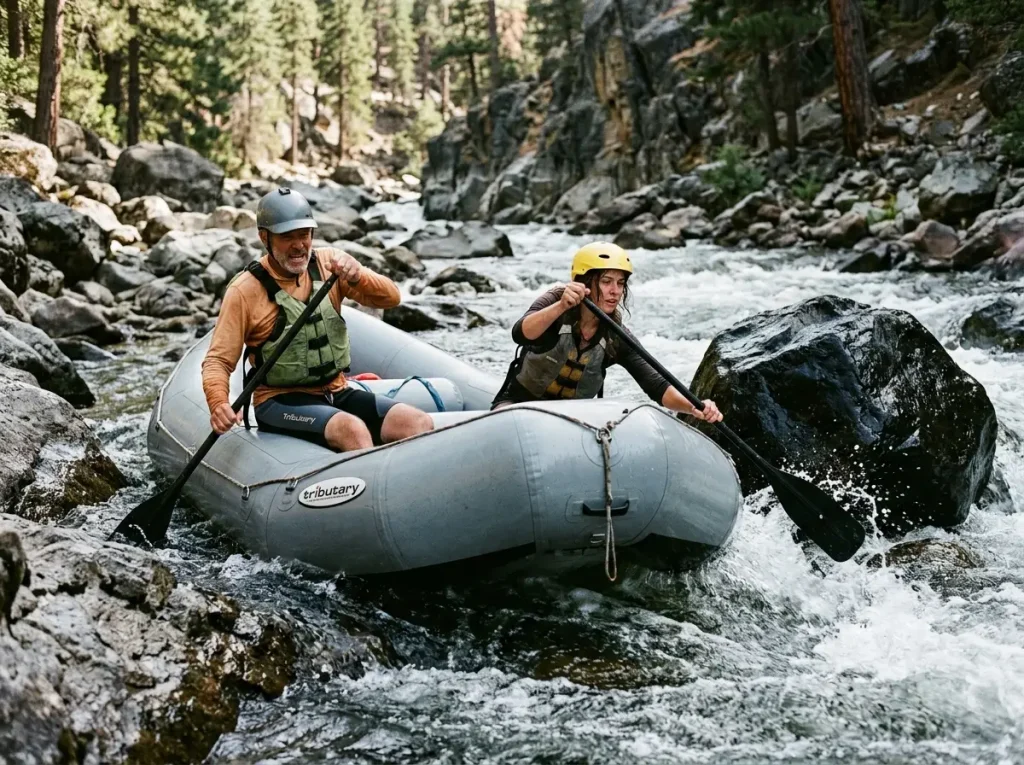
Almost every guide you’ll read warns you against buying too small. Far fewer tell you the opposite mistake is just as real, often more expensive, and harder to undo. “Buy big to be safe” feels smart in the shop. On the water it’s how you end up the slowest, clumsiest, hardest-to-rescue boat in the group.
I’ve watched a guy buy a 16-foot expedition hauler for day runs and spend an entire season trailing the pack, fighting his own boat through water everyone else danced down. So before you round up “just in case,” understand exactly what too much boat costs you.
Sluggish, Heavy, and Hard to Steer
An oversized or overloaded raft carries momentum, and momentum is the enemy in technical water. The boat wants to keep going straight when you need it to turn now, so it drifts into the rock you meant to miss. Square-cornered, big-tubed boats add drag the instant you try to spin them, which means your corrections land late. A small crew makes it worse — there simply aren’t enough paddles to break that inertia in time.
Two people trying to muscle a 16-footer through a tight Class III slot don’t pilot the boat; they negotiate with it and lose. The river hands them a line and they ride out whatever it gives, because correcting it fast enough is off the table. That’s the oversizing trap in one sentence: too much boat turns paddlers into passengers, and a big boat offers zero paddleboat advantage in the tight, technical water where you’d actually want the help.
The Self-Rescue Problem (Flipping a Big Boat)
Here’s the part that should genuinely shape your decision, because it’s the one with teeth. Every boater goes for a swim eventually, and every boat flips eventually — the question is what happens next. Flipping a loaded 16-footer back upright with a small crew is brutal, sometimes impossible, work. You’re in moving water, the boat is heavy and slick, the gear is dragging it down, and the same shortage of hands that made it hard to steer now makes it hard to right.
A smaller boat you can flip from the water with a flip line and a hard lean; a big one can pin you against the clock in conditions where the clock matters most. This is the real argument for sizing down when your crew is small: for R-2 paddling, 12 feet or smaller isn’t just easier to steer, it’s safer to recover when it all goes sideways. Buying big “for safety” can quietly hand you a boat you can’t self-rescue, which is the opposite of what you paid for.
The Trailer-and-Garage Tax
The last penalty is the slow one: the big raft you can’t be bothered to use. A 16-footer plus frame doesn’t roll up into a truck bed and live in a closet. It wants a trailer, a place to store that trailer, and twenty extra minutes of rigging and de-rigging every single trip.
The boat that’s a hassle to load is the boat that stays home, and the best raft in the world does nothing for you in the garage. The most-used boat in most quivers isn’t the biggest — it’s the one that’s easy enough to grab on a Tuesday whim.
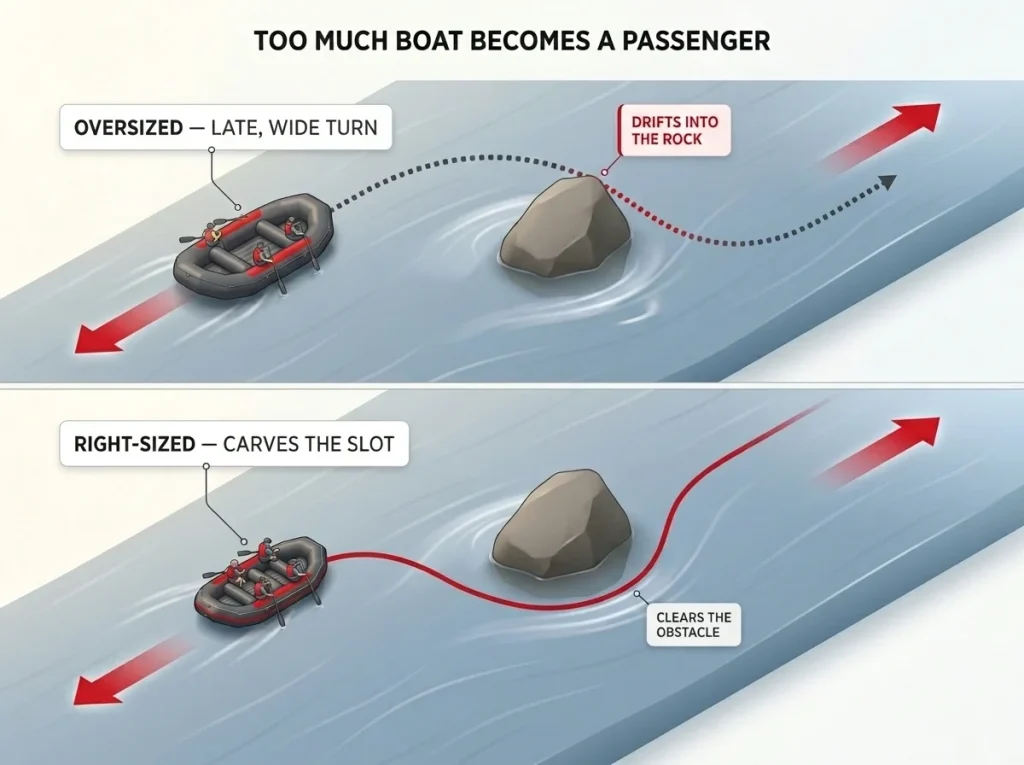
Before you size up “for safety,” ask the harder question: can your usual crew flip this boat back over in current? If the honest answer is no, you’ve sized up into a bigger risk, not a smaller one.
Beyond Length — Tube Diameter, Shape, and the One-Boat Answer
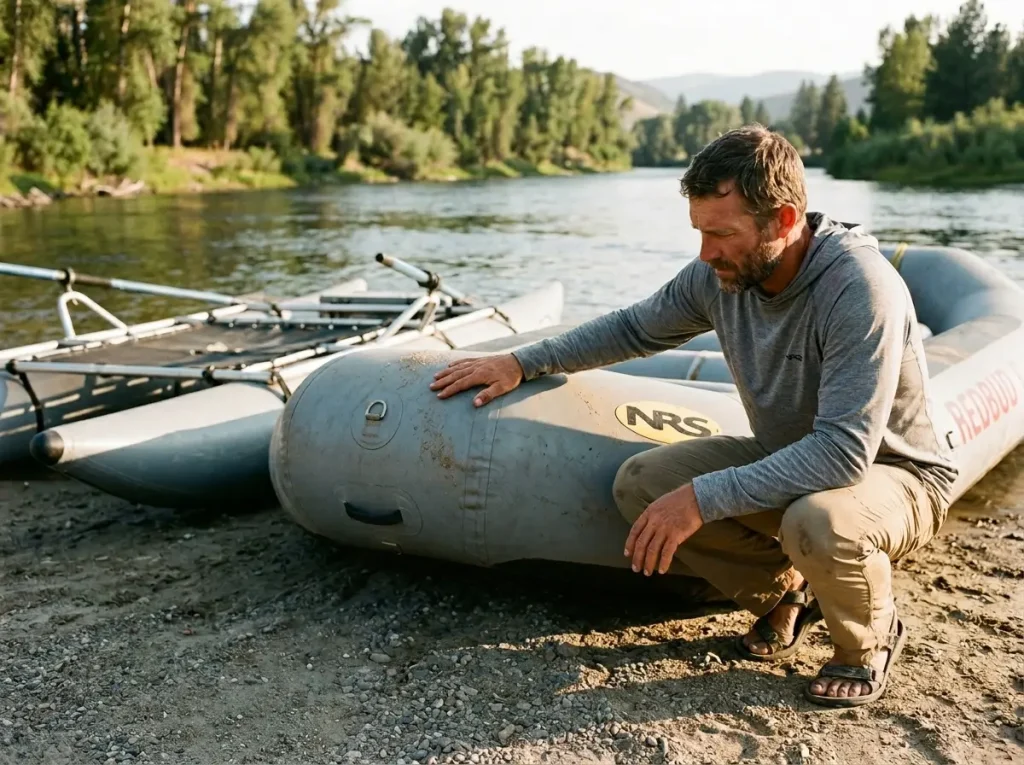
Length is only half the spec, and it’s the half everyone reads. Two boats both stamped “14 feet” can carry completely differently depending on the part nobody studies: the tubes. Once you understand that, you can stop obsessing over a single number and make the call like someone who’s owned a few boats.
Why Tube Diameter Matters as Much as Length
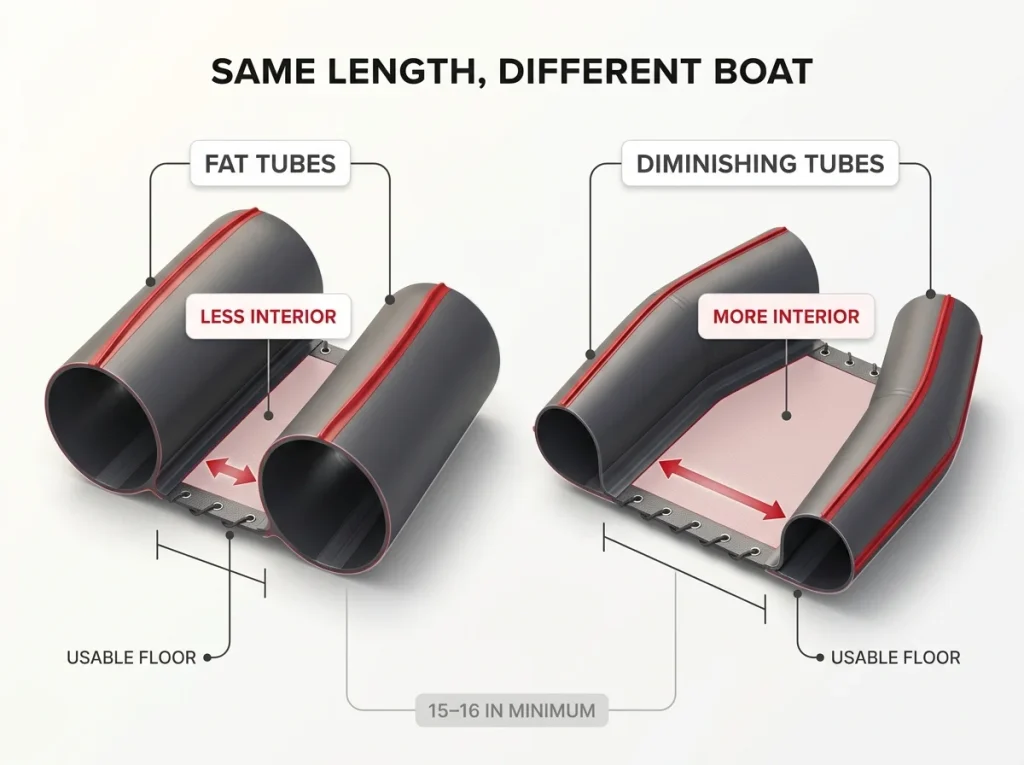
Tube diameter sets how much load the boat floats before it sits low in the water, and the minimum you want for real whitewater is roughly 15 to 16 inches. Fatter tubes displace more, so they carry more weight at the same draft — but that flotation comes out of the interior. Bigger tubes either push the boat wider, which costs you nimbleness, or they steal room inside at the same footprint.
This is why two 14-footers can feel like different boats: one with fat tubes and a wide stance hauls like a truck and turns like one; one with tapered, diminishing tubes recovers interior space and punches waves better without going wider. When you compare boats, put your hand on the tubes and read the diameter, not just the length on the tag.
Round Raft vs Cataraft at the Same Size
A round raft and a cataraft of the same nominal length are different animals. The round boat wraps a continuous tube around a full floor — more interior, more crew positions, the standard paddleboat shape. A cataraft is two pontoons on a frame with an open deck: it sheds water, tracks hard, and rows beautifully on big water, but it’s a rower’s boat, not a paddle crew’s.
Neither wins outright. The round boat is the more versatile single purchase for most people; the cataraft is the specialist’s pick for oar-driven gear hauling and high-volume rowing.
The One-Boat Answer for Most Private Boaters
If you’ve read this far and just want the answer, here it is, and it’s the same one the experienced crowd repeats: for most private boaters, a 13 to 14 foot round self-bailer is the boat that does the most. Fourteen feet, in particular, is the compromise that does it all — day trips, short multi-days, and a wide span of river classes, without becoming a barge. It’s big enough to haul a reasonable camp and small enough that a normal crew can still steer and flip it.
When you’re ready to put names to that size, our roundup of the best whitewater rafts walks through specific boats in this band. Size settled, the next decision is material, and PVC vs Hypalon comes down to your river and budget more than anything else. If you’re leaning toward a cataraft or rigging for oars, you’ll also want the right frame for your boat, and remember longer boats need longer oars to get real leverage on the water.
The Bottom Line on Sizing Your Raft
Three things decide your raft size, and none of them is a hunch: your real crew, your real nights on the river, and the real water you run. Size for the trips you actually take, not the one you daydream about. Remember that bigger is a genuine mistake, not just smaller — a too-big boat is sluggish, hard to rescue, and easy to leave in the garage. And when you’re truly torn, a 13 to 14 foot round self-bailer does more than any other single size.
Answer the three questions for the trips you run most, then go look at boats in that band with confidence — not at the biggest one in the showroom.
Frequently Asked Questions
01What size raft do I need for 4 people?
For a day trip, a 12 to 13 foot raft comfortably handles 4 to 6 paddlers. Add multi-day gear for those four and you’ll want 14 to 16 feet, because the gear, not the headcount, drives the size.
02Can a raft be too big?
Yes, and it’s a more common mistake than people think. An oversized boat is sluggish in technical water, carries momentum into obstacles, needs a trailer, and is hard to flip upright with a small crew.
03What size raft for Class IV rapids?
On high-volume Class IV, lean toward 14 feet or longer for the buoyancy and stability to punch big waves. Keep the crew manageable so the boat stays steerable when it counts.
04What’s the best all-around raft size?
For most private boaters, a 13 to 14 foot round self-bailer is the do-it-all size. It handles day trips, short multi-days, and a range of river classes without becoming a barge.
05Does tube diameter matter more than length?
Not more, but it matters as much. Two 14 foot rafts can carry very differently — bigger tubes add flotation but can shrink interior room, while diminishing tubes recover space and punch waves better.