
In this article
The quiet, rhythmic dip of wooden oars echoing off canyon walls carved two billion years ago—a stark counterpoint to the thunder of a nearby rapid. This is the Martin Litton Dory, an anachronism that feels more alive than any modern craft. It’s a ghost from the age of sail, one of the spectacular dories dancing through the world’s most formidable whitewater. This article will deconstruct that dory’s anatomy, revealing how every curve of its hull and every choice in its design is a deliberate statement from its champion, the late Martin Litton—a lesson in how the right tool can become a powerful voice for wilderness.
Before we dive in, let’s chart our course. We’ll start with the visionary himself, Martin Litton, the uncompromising “Guardian of the Grand Canyon” whose life gave the dory its purpose. Then, we’ll explore the dory boat design, tracing its technical boat evolution from an ocean fishing boat to a masterclass in whitewater naval architecture. We’ll see how that design translates into a unique on-water “dance” of physics and poetry, and finally, discover the enduring conservation legacy of these beautiful boats, floating memorials that continue to serve as a call to action for modern river conservation.
Who Was Martin Litton, the Dory’s Champion?

To comprehend the dory, you must first comprehend its architect—not of the boat itself, but of its purpose and legend. You can’t separate the two. The boat’s elegant lines are a direct reflection of the man’s unbending will. Martin Litton was the dory’s champion, a river running pioneer whose life provides the essential context for its place in the pantheon of rivercraft.
How was a “Homegrown Environmental Warrior” forged?
Clyde Martin Litton’s life (February 13, 1917 – November 30, 2014) spanned an incredible 97 years, and for more than 80 of them, this homegrown environmental warrior was a tireless writer, photographer, and advocate. His professional life wasn’t a separate track from his conservation work; it was the engine. As travel editor for Sunset Magazine from 1954 to 1968, he didn’t just report on destinations; he practiced a kind of alchemy, transforming ink and film into a deep, protective love in the hearts of his readers. His work was also featured in publications like the Los Angeles Times and National Geographic.
His own love affair with the Grand Canyon began in 1939. But it was his first river trip in a fiberglass cataract boat in 1955 that sealed his fate. He saw the canyon from its most intimate angle and recognized the threats lining its rims. The crucial moment came in 1962. Disgusted by the utilitarian ugliness and clumsy handling of the inflatable rafts of the era, he imported the first wooden Oregon drift boats to the Grand Canyon for commercial trips. The “dory era” had begun. For Litton, aesthetics were a strategic tool. He understood that to save a place, you must first make the public value its beauty. He needed a protagonist for his story, and the dory, a stark contrast to a utilitarian rubber raft, was it.
What was Litton’s core conservation philosophy?
Litton’s activism was born of loss and defined by an uncompromising, often cantankerous, opposition to the dam-building agenda of the U.S. Bureau of Reclamation. An early, significant conservation victory against proposed dams in Dinosaur National Monument proved the Bureau was not an unstoppable monolith. But this was immediately followed by the devastating loss of Glen Canyon beneath the rising waters of Lake Powell after the completion of the Glen Canyon Dam. That trauma forged a “never again” resolve in Litton and his allies. The dams Martin Litton opposed became the defining battles of his life.
His most famous campaign was against the proposed Bridge Canyon Dam and Marble Canyon Dam, which would have flooded parts of the Grand Canyon itself. This was an unthinkable desecration, and Litton became its most ferocious opponent. He found a crucial ally in the quintessential David Brower, the executive director of the Sierra Club. It was a perfect partnership: Brower commanded the national stage, while Litton provided the on-the-ground truth, the stunning photographs, and the impassioned prose from the heart of the canyon. Serving on the Sierra Club board from 1964 to 1973, Litton, alongside giants like writer Edward Abbey and photographers Philip Hyde and Ansel Adams, helped wage the battle on a cultural front. He knew the fight for wilderness had to be won in art and literature as much as in the halls of Congress. For more context, you can explore the Sierra Club’s historical records on dam fights.
Litton’s fight for the canyon needed more than just words and pictures; it needed a physical symbol. This is where the dory’s anatomy becomes a reflection of his philosophy.
What Defines the Anatomy of a Grand Canyon Dory?

This section deconstructs the dory’s physical form, connecting every design choice to its function in the formidable whitewater of the Colorado River. Every curve and angle of these whitewater dories tells a story of adaptation and purpose.
How did the dory evolve from the ocean to the river?
The dory’s DNA traces back to the seaworthy ocean fishing boats of Portugal and New England. These original dories were characterized by a narrow flat bottom, a sharp, wave-piercing bow, and flared sides—traits that gave them stability in ocean swells. The critical evolutionary leap, however, happened far from the sea, on the McKenzie River in Oregon. Here, boat builders adapted the design for river travel, creating the “McKenzie River Drift Boat.” They introduced the single most important feature for whitewater handling: a significant “rocker.”
Rocker is the continuous curve of the hull from bow to stern, like the shape of a banana. This innovation lifted the bow and stern out of the water, dramatically reducing the wetted surface area and creating a natural pivot point. Suddenly, the boat could spin with incredible ease, a vital trait for dodging rocks in shallow, technical rivers like those in Idaho.
Martin Litton took this design and adapted it for the massive, high-volume rapids of the Colorado, creating what we now call the “Grand Canyon Dory.” These were larger than fishing dories, scaled up to handle immense waves and increasing their cargo capacity for multi-week expeditions. He refined the hull geometry and added watertight hatches for supplies, enhancing its “self-righting almost” characteristic. A capsized dory floats high on the surface, full of trapped air, making it far easier to recover—a critical safety feature in the lethally cold water of the Grand Canyon. This evolutionary journey resulted in a highly specialized craft, distinct from many of the different types of rafts used in whitewater.
What are the key technical components of the hull?
To truly understand the dory, we have to look at its core components and technical specifications. They work together in a perfect synthesis of form and function.

- The Rocker Profile: As we’ve mentioned, the rocker is the longitudinal curve of the hull’s bottom. It’s the boat’s soul. This is the source of its legendary maneuverability, a key dory characteristic that allows a skilled rower to pivot the boat on a dime to line up for a complex rapid.
- Flared Sides: The sides of the dory flare outwards dramatically from the chine (the corner where the bottom meets the side) to the gunwale (the top edge). This flare serves two critical functions. First, it provides immense secondary stability. While a dory can feel “tippy” on flat water (initial stability), as it leans over, more and more of that wide, flared surface engages with the water, making it incredibly sturdy and resistant to capsizing. Second, the flare provides dynamic lift. When a wave hits the angled side, its energy is channeled downwards, lifting the boat up and over the crest. This is why dories are famous for their dry, buoyant ride.
- The Flat Bottom: Originally designed for sliding over shallow rocks on coastal shores, the narrow flat bottom serves a different purpose in the deep Colorado. It provides some initial stability and, more importantly, allows the boat to “skate” sideways across current differentials with precision, a key technique for navigating powerful eddy lines.
This combination of features is what sets the dory apart. A heavily loaded inflatable raft, with its long, flat waterline, tends to track straight but responds sluggishly. It often punches through the center of waves, getting swamped. The dory, by contrast, is a responsive and stable craft that dances over the waves, a testament to a design that prioritizes grace and agility. For a broader look at how different designs perform, see our guide on how raft design dictates on-water performance.
How are these dories constructed and outfitted?
The performance of this hull depends entirely on the materials and construction techniques used to build it. These boats are not just tools; they are works of art.
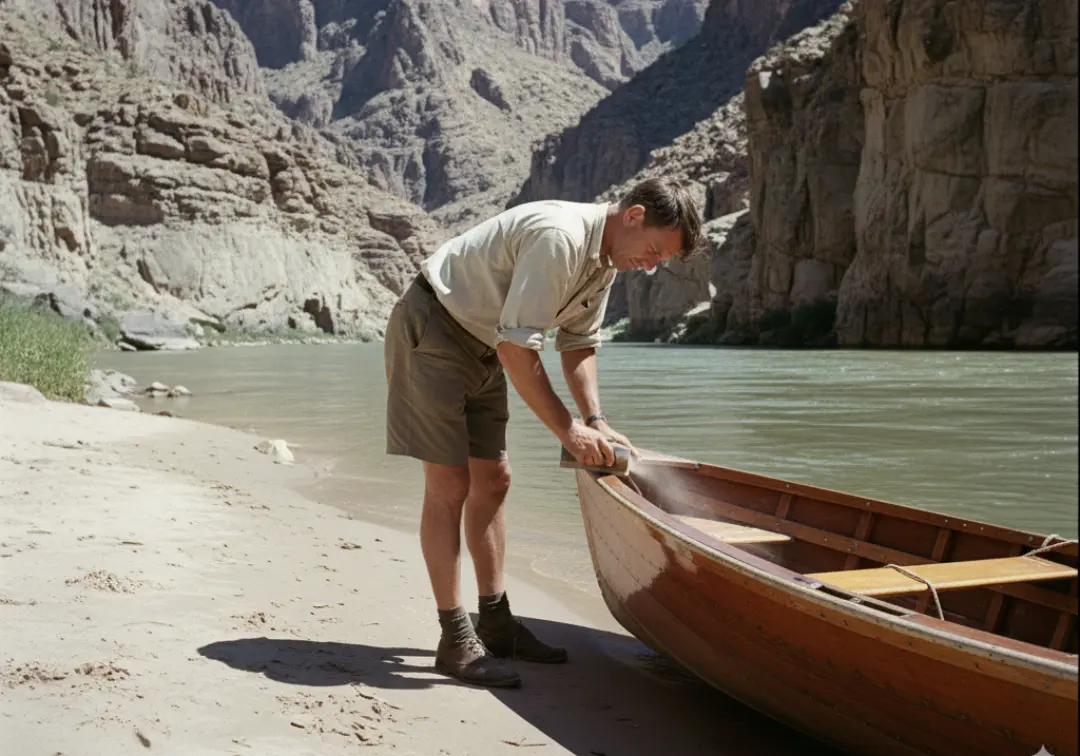
- Materials & Construction: The primary material is marine-grade plywood, chosen for its exceptional strength-to-weight ratio. This is reinforced with strong, flexible woods like Douglas fir for key structural elements like the gunwales (the top edge, providing stiffness) and chine logs (the high-stress bottom corner). Most are built using a “stitch and glue” technique, where plywood panels are temporarily stitched together with wire, then permanently bonded with epoxy fillets. The entire hull is then sheathed in fiberglass cloth and saturated with epoxy resin, creating a tough, waterproof composite shell that is both incredibly strong and surprisingly light.
- Outfitting & Features: The outfitting is spartan but purposeful. Robustly mounted oarlocks hold long, 9- to 10-foot oars that provide the leverage needed to control the boat. A footwell gives the rower a solid bracing point. But the most defining feature is the watertight compartments in the bow and stern. These sealed chambers keep gear dry and, crucially, provide the immense buoyancy that keeps the boat floating high if swamped or capsized.
- Aesthetic Rebellion: You cannot look at a dory and ignore its beauty. The choice of shimmering varnished wood and elegant, flowing lines was a deliberate aesthetic rebellion against the stark, industrial ugliness of concrete dams. Warrior Martin Litton knew this. The dory’s beauty was not an indulgence; it was a strategic weapon in the conservation war.
How Does a Dory Perform on the River?

With a complete picture of the dory’s anatomy, we can now explore how this unique vessel performs in its element. Rowing a dory isn’t just pulling on oars; it’s translating the river’s language through a finely tuned instrument.
What is the “Dory Dance” in whitewater?
The experience of rowing a dory is often called a “dance,” and for good reason. It’s a partnership between the rower and the river, with the boat as the medium. The pronounced rocker that allows for such unparalleled maneuverability comes at a price: the boat doesn’t want to track straight. It requires constant input. The same hard chines that provide such incredible secondary stability can also be “trippy,” catching cross-currents if the rower isn’t paying attention. It’s a craft that is far less forgiving than an inflatable raft, as the oarsman is responsible for every move.
Pro-Tip: Rowing a dory demands a shift in mindset from reactive to proactive. In a raft, you often muscle your way through features. In a dory, you must anticipate the water’s movement. You use the boat’s momentum and agility to place it in the perfect spot before you enter a wave train or eddy line, letting the river’s energy work for you, not against you.
A skilled oarsman uses the dory’s rigid hull and momentum as a tool, punching through powerful waves or slicing across eddy lines that would stop a flexible raft dead in its tracks. The flared bow and sides provide that famous lift, allowing the boat to ride up and over wave crests for a remarkably dry and exhilarating ride. Litton made this philosophical choice deliberately: he wanted to facilitate an engaged, skillful journey, not a simple “bus ride.” Rowing a dory forces an intimate connection between the participant and the river. The boat becomes an extension of the rower’s will. To learn more about the fundamentals, check out our guide on mastering the art of how to row a raft.
Case Study: Why was rowing Lava Falls at age 87 so significant?
The ultimate testament to this symbiotic relationship is the Martin Litton story of rowing Lava Falls late in life. Let’s set the stage. Lava Falls is one of the most feared and respected rapids in the world—a violent crucible of powerful currents, a massive ledge hole that can swallow boats whole, and boat-shredding rocks. Martin Litton was the man who pioneered the first runs down Lava Falls in dories. The classic “dory line” is a delicate and powerful sequence: enter on the right, use powerful ferry strokes to pull away from the Ledge Hole, navigate the towering “V-Wave,” and avoid the submerged “Cheese Grater” rock at the bottom. It demands precision, power, and courage.
In 2004, at the age of 87, Martin Litton successfully guided a dory through this maelstrom, becoming the oldest person to row the entire Grand Canyon.
This feat demonstrates the dory’s genius. In a dory, experience and technique can compensate for the diminished strength of age. Litton’s run was possible only because the dory is a craft that is responsive to oars and deep knowledge, not brute force. He didn’t fight the river; he danced with it. He placed the boat in the perfect position to let the river’s own energy do the work. It was the ultimate expression of the dory’s potential and the culmination of a life spent in communion with the river. It proved, definitively, that the dory and a skilled rower are an inextricably linked system, a partnership capable of achieving the extraordinary. For a tactical look at handling such features, see our guide on tactics for punching through large hydraulic holes.
What is the Enduring Legacy of the Litton Dory?

This single, extraordinary run was the culmination of a legacy Martin Litton, the “grandfather of dories,” had been building for decades—a legacy etched in both wood and water. His influence extends far beyond his personal trips, creating an enduring institution and a powerful tradition that continues to shape Grand Canyon river culture.
How did Grand Canyon Dories change river running?
In 1971, founder Martin Litton formalized his vision when he founded Grand Canyon Dories, the first commercial outfitter dedicated exclusively to running wooden dories through the canyon. This was a radical departure from the prevailing trend of larger, motorized pontoon rafts that could carry more passengers more quickly. His business philosophy was an extension of his conservation ethic. Trips were intentionally slower, more intimate, and focused on historical education and appreciation. By eschewing motors, he fostered a deeper connection to the canyon’s silence, beauty, and rhythms.
He proved that this high-quality, low-impact model was not only viable but desirable. The company became a platform for his advocacy, a way to convert ordinary tourists into passionate advocates for the canyon’s protection. The business sale/transition details are that in 1988, the company was sold to OARS and its founder, George Wendt, who has honored his legacy, continuing to operate the dory fleet and the traditions he established. He created an enduring institution that has introduced thousands to the canyon in the intimate, oar-powered style he championed. His principles are a great benchmark when you’re looking for how to vet a rafting outfitter today.
Why are the dories named after lost places?
Perhaps even more powerful than the company itself was the boat naming tradition Martin Litton started. He began naming his dories after imperiled natural places—those lost, damaged, or threatened by human development. Boats were christened with names like the Glen Canyon, the Music Temple, and the Marble Canyon boat, whose maiden voyage was famously documented in the film Martin’s Boat by Pete McBride. The core idea was simple and devastatingly effective: to ensure that the places destroyed by dams would not be forgotten.
This was a brilliant act of perpetual protest. It imbued physical objects with powerful political and emotional resonance. Every time a guide introduced the dory named Glen Canyon, it created a natural opportunity to tell the story of that magnificent, drowned canyon. The dory’s very existence on the river became an act of remembrance and a quiet defiance against the forces that destroyed its namesake. The boats themselves became keepers of memory, constant, mobile reminders of what was at stake. This tradition ensures the ghosts of these lost wild places continue to haunt the river, inspiring future generations to fight for what remains.
How Does the Dory Fit in the Modern Era?

This powerful conservation legend continues today, but how does the classic wooden dory itself fit into the modern ecosystem of contemporary river equipment? While the technical differences are clear, the most important legacy of Martin Litton is not the boat itself, but the ethos of stewardship it represents.
Dory vs. Raft: A Comparative Analysis
The choice between a dory and a modern inflatable raft isn’t about which is “better,” but about what kind of experience you seek. Each has its strengths.
| Feature | Martin Litton Dory | Modern Inflatable Raft |
|---|---|---|
| Maneuverability | Superior; pronounced rocker allows for rapid pivoting. | Good; tracks straighter but is less nimble. |
| Stability | Low initial, high secondary. Feels tippy but very hard to capsize. | High primary. Very stable and forgiving. |
| Cargo Capacity | Sufficient; requires careful packing in watertight compartments. | Superior; offers more volume and flexibility. |
| Dryness of Ride | Generally drier; flared bow lifts the boat over waves. | Generally wetter; tends to punch through waves. |
| Skill Required | High; demands proactive rowing and deep water-reading skills. | Low barrier to entry; very forgiving of mistakes. |
| River “Feel” | Intimate and connected; rigid hull transmits every current. | Isolated and muted; inflatable tubes absorb energy. |
| Durability | High maintenance (wood/epoxy); susceptible to impact damage. | Low maintenance; modern fabrics are tough and easy to patch. |
Ultimately, the dory offers a dynamic, engaging, and aesthetically rich journey that rewards skill. The raft offers a more forgiving, stable, and utilitarian platform that is accessible to all. For more on raft materials, see our guide comparing modern raft materials like PVC and Hypalon.
How can modern river runners continue the legacy?
The most important legacy is not the boat, but the ethos of stewardship it represents. To honor Martin Litton is for modern river enthusiasts to become active participants in protecting wild rivers. The dory is a symbol; the real work lies in modern conservation action steps.
- Support Key Organizations: Contribute to and volunteer for groups on the front lines of river conservation like American Whitewater, Grand Canyon Trust, American Rivers, or the Glen Canyon Institute.
- Practice Impeccable Ethics: Adhere to the highest standards of Leave No Trace principles on every trip to leave the wilderness pristine. This is the foundation of mastering the code of river etiquette.
- Stay Educated and Engaged: Learn about current threats facing rivers, from dams and diversions to climate change, and share this knowledge.
- Choose Outfitters Wisely: Support companies with strong environmental track records that contribute to conservation efforts.
- Advocate for Protection: Use your voice. Support the designation of more rivers under The Wild and Scenic Rivers Act, the primary legislative tool for protecting our waterways.
Pro-Tip: When vetting an outfitter, go beyond their safety record. Ask them specific questions: “What percentage of your profits do you donate to conservation groups?” “What specific Leave No Trace practices do your guides emphasize on trips?” “How does your company advocate for the protection of this watershed?” Their answers will reveal if their commitment to stewardship is as deep as their commitment to commerce.
These actions are the modern equivalent of Litton’s fight. We must become active guardians—to experience the river with intention, understand its threats, and pull on the oars of advocacy.
Conclusion: The Enduring Wake
The Martin Litton dory is a rare object that transcends its function. It is the physical embodiment of a fiercely held conservation philosophy. Its anatomy is a story of adaptation, with a rockered hull and flared sides creating a unique combination of stability and maneuverability perfect for large-volume whitewater. Martin Litton, often called the “grandfather of dories,” chose this demanding, beautiful boat as a rebuke to mechanization and as a tool to make people fall in love with the places he was fighting to protect.
The ultimate lesson of the dory is not in its construction or handling, but in the call to action it represents. It is a call for all who love wild rivers to become active guardians, to recognize that every paddle stroke and every choice we make contributes to the enduring wake left by those who came before us.
Explore our complete series of guides on river history and conservation to continue your journey from enthusiast to advocate.
Frequently Asked Questions about Martin Litton Dories
Who was Martin Litton?
Martin Litton (1917-2014) was one of the 20th century’s most effective environmental activists, a writer, photographer, and river runner known as the “Guardian of the Grand Canyon.” He founded Grand Canyon Dories in 1971, led successful campaigns to prevent dams from being built in the Grand Canyon, and was a 2023 Hall of Fame inductee at the John Wesley Powell River History Museum.
What is so special about a Grand Canyon dory’s design?
A dory’s special design combines a heavily “rockered” hull for extreme maneuverability with flared sides that provide dynamic lift and secondary stability in large waves. This creates a responsive, dry, and sturdy ride that requires significant skill but offers an intimate connection to the river.
Why are the dories named after places like “Glen Canyon”?
Martin Litton started the tradition of naming dories after natural places that were lost, damaged, or threatened by development, like the drowned Glen Canyon. This turns each boat into a “floating memorial” and a catalyst for telling the stories of these places to new generations of river runners.
Are dories better than rafts?
Neither is “better”; they offer different experiences. Dories provide a more dynamic, engaging, and skillful ride that connects the rower intimately to the water, while modern rafts offer a more forgiving, stable, and utilitarian platform with a lower barrier to entry.
Risk Disclaimer: Whitewater rafting, kayaking, and all related river sports are inherently dangerous activities that can result in serious injury, drowning, or death. The information provided on Rafting Escapes is for educational and informational purposes only. While we strive for accuracy, the information, techniques, and safety advice presented on this website are not a substitute for professional guide services, hands-on swiftwater rescue training, or your own critical judgment. River conditions, including water levels, currents, and hazards like strainers or undercut rocks, change constantly and can differ dramatically from what is described on this site. Never attempt to navigate a river beyond your certified skill level and always wear appropriate safety gear, including a personal flotation device (PFD) and helmet. We strongly advise rafting with a licensed professional guide. By using this website, you agree that you are solely responsible for your own safety. Any reliance you place on our content is strictly at your own risk, and you assume all liability for your actions and decisions on the water. Rafting Escapes and its authors will not be held liable for any injury, damage, or loss sustained in connection with the use of the information herein.
Affiliate Disclosure: We are a participant in the Amazon Services LLC Associates Program, an affiliate advertising program designed to provide a means for us to earn advertising fees by advertising and linking to Amazon.com. As an Amazon Associate, we earn from qualifying purchases. We also participate in other affiliate programs and may receive a commission on products purchased through our links, at no extra cost to you. Additional terms are found in the terms of service.