


In this article
You bolt the frame together, cinch it down on the trailer, and then it hits you: you have no idea what length oars to order. That number matters more than most first-time boaters think, and getting it wrong shows up on the very first stroke, when your knuckles clip the tubes or the blade barely bites. Every rigger at the ramp uses the same piece of math to size oars, plus one adjustment they rarely bother explaining to you. This guide walks through the oar length formula, when to bend it, how to rig it, and how to pick a blade size that fits the water you actually run.
Here is the fast version: run the Rule of Thirds by halving your lock-to-lock frame width and multiplying by three, then match the result against the chart below.
| Frame Width (Lock-to-Lock) | Rule-of-Thirds Oar Length | Common Setup |
|---|---|---|
| 54 in | 7 ft | Small oar cataraft |
| 60 in | 7.5 ft | 12–13 ft raft |
| 66 in | 8 to 8.5 ft | 13–14 ft raft |
| 72 in | 9 ft | 14–15 ft raft |
| 78 in | 9.5 to 10 ft | 15–16 ft raft |
| 84 in | 10.5 ft | Large gear boat |
Measure Your Frame to Get the Right Oar Length
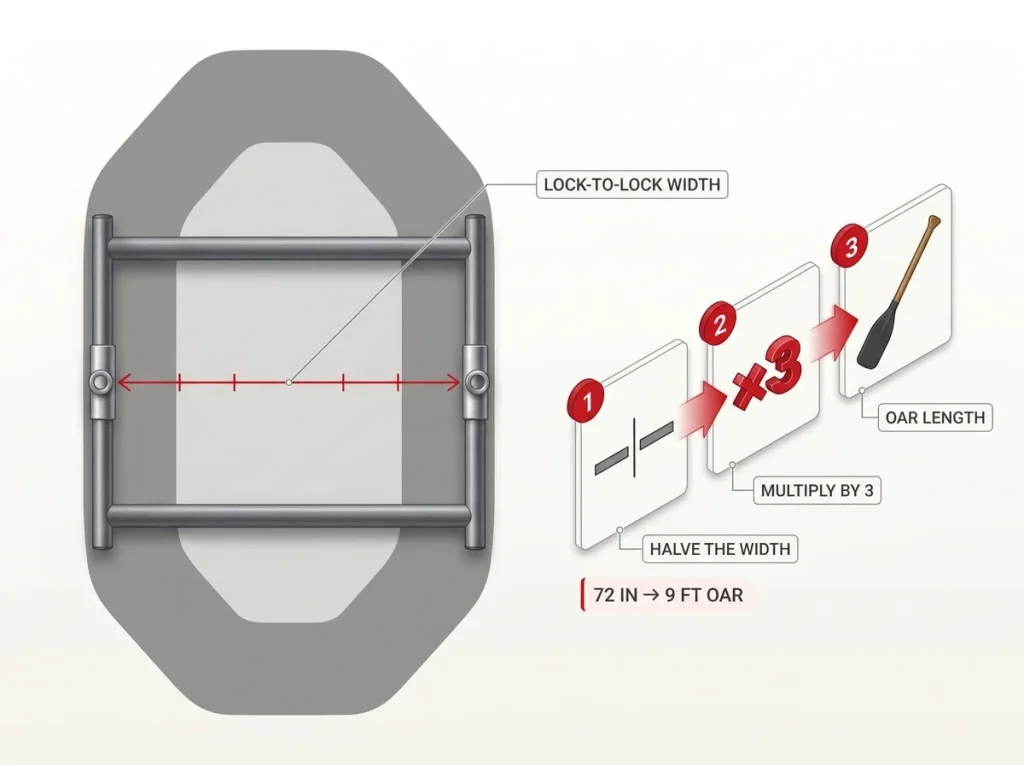
Here is where most people go wrong before they even pick up a tape measure: they size oars off the boat. A 14-footer needs 9-foot oars, the internet says, so that is what they buy. Then the oars feel off, and nobody can explain why. The number that actually matters is your lock-to-lock frame width, not the length of your raft, because frame widths vary enough between brands and models that the boat-length shortcut lands you in the wrong ballpark.
So measure it. Hook your tape on the face of one oarlock and pull it straight across to the face of the other. That distance is the only input the formula needs. If you are still deciding on a frame, the width you choose there dictates everything downstream, which is why it helps to understand the different oar frame builds and how wide they run before you commit.
The Rule of Thirds does the rest. Take half your lock-to-lock width, multiply by three, and you have your overall oar length. A 72-inch frame gives you 36 inches halved, times three, which lands on a 9-foot oar. NRS runs a slight variant, subtracting two inches from half the span before multiplying, so the handles do not collide when you hold both oars level. Either way, you are building toward the same target: roughly one-third of the oar inboard of the lock, two-thirds outboard.
A correctly sized 9-footer is a good thing to picture while the math is abstract. The Sawyer Polecat Oar with Duramax blade is a common mid-length build that lands right in that 72-inch-frame window, so if your number comes out near 9 feet, that is the kind of oar you are shopping for. Use the sizing chart as a sanity check, too. Mid-size rafts almost always settle into the 9-to-10-foot range no matter which formula you run, so if your math spits out a 7-footer for a 14-foot boat, you measured something wrong.
If you paddle instead of row, the logic carries over but the numbers change, and sizing a paddle follows its own guide worth reading before you buy.
The 1.63 Formula and When to Trust It

You will eventually meet the boater who runs slightly longer oars than everyone else and swears the Rule of Thirds is holding you back. He is not making it up. There is a second formula, and it is worth knowing when to reach for it.
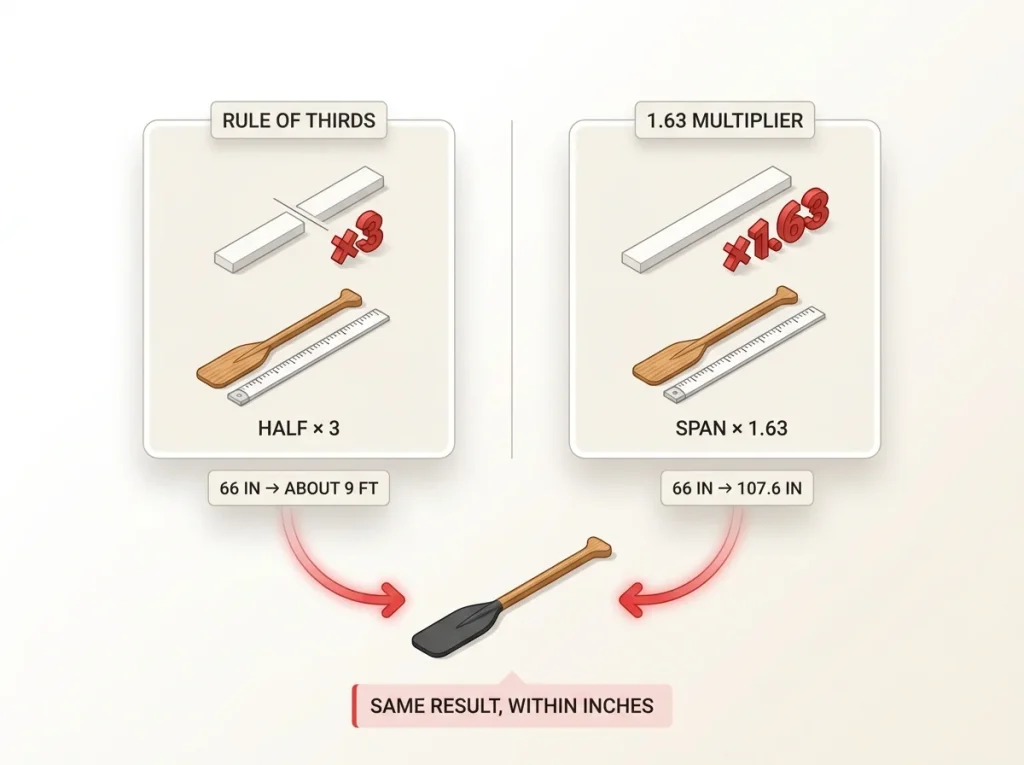
The math is simpler than the classic one. Take your oarlock span in inches and multiply by 1.63, give or take a six-inch window for personal preference. That single multiplier bakes the inboard-to-outboard split (an 11:27 ratio) straight into one step, so you skip the halving. It leans toward slightly more outboard leverage, which is the whole argument for it: rowers who want more bite per stroke feel the traditional split leaves power on the table.
Here is the part nobody tells you. The two formulas are not rival answers fighting over your money. Run them side by side and they land within inches of each other. A 66-inch span times 1.63 comes out to about 107.6 inches, which is essentially the same 9-foot oar that riggers already bolt onto that frame width. They are two roads to the same number, and the divergence only shows up at the edges, where you might round one direction instead of the other.
None of this replaces the bigger picture of picking oars and paddles for your boat, which our full guide to choosing rafting paddles and oars covers end to end. Treat both formulas as a starting line, not gospel.
Do not stand in the parking lot arguing formulas. Run whichever one is faster in your head, then trust the chart to catch a bad number. If both methods point at the same length, you are done. The oar you can order today beats the perfect oar you are still calculating.
Rounding for Big Water, Heavy Loads, and Your Rig

The formula almost never hands you a clean number. It lands you between sizes, and then you have to decide which way to round. This is where one calculation stops being enough for the whole season.
Round up when you row big-volume water or sit high in a captain’s chair. A longer oar keeps more blade buried on the power stroke, and in pushy water that submerged blade is what actually moves the boat. Round down for technical, shallow runs, lower seating, and lighter day rigs, where a shorter oar is quicker to swing and less likely to catch on a rock you are trying to slide past.
Then there is load, which competitors barely mention. A boat packed for a multi-day trip sits lower in the water than the same boat on an empty day run. Lower boat, less freeboard, and suddenly the same frame wants a touch less oar to keep your geometry honest. If you run one number all season, it will feel right on exactly one kind of trip and slightly off on the rest. Matching your whole kit to the water works the same way, which is why it helps to think in terms of gear scaled to the river class you are running rather than a single fixed setup.
Rower height and reach nudge the number too, but treat them as a tiebreaker, not the main driver. Frame width and water type decide the length. Your arms just break the tie.
Setting Your Oar Stops Once You Know the Length
Every guide does this step, and almost no article explains it. You calculated a length, ordered the oars, and now you are standing at the put-in wondering why they still feel wrong. The oars are probably fine. The stops are not set.
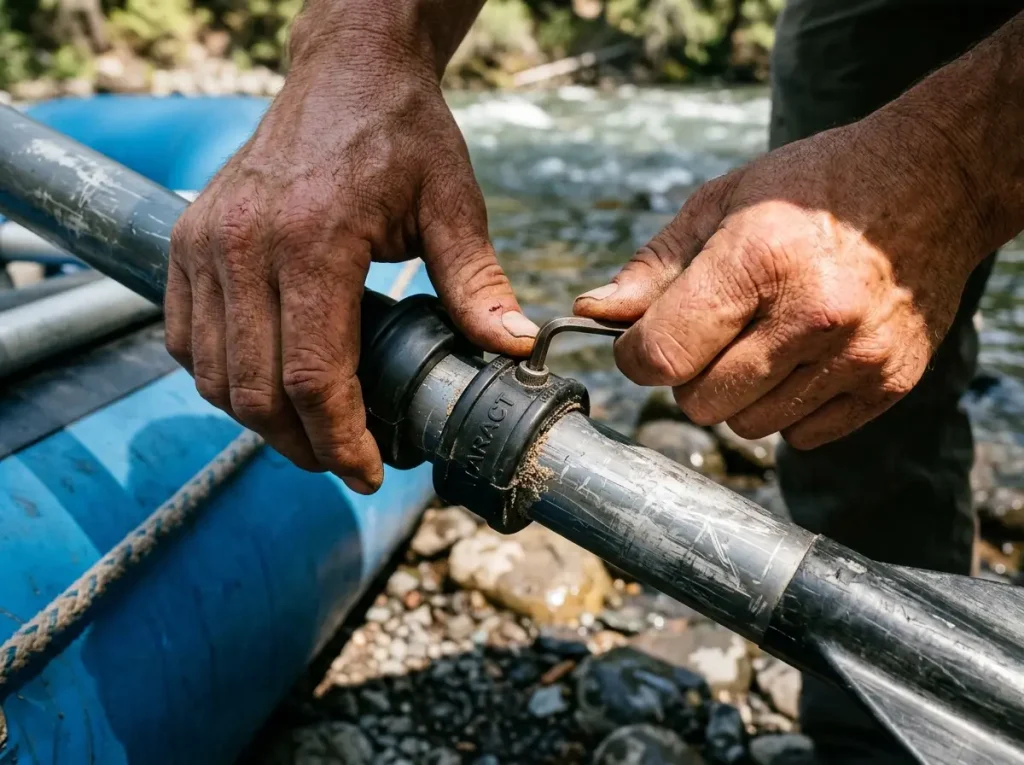
Oar stops, sometimes called collars, clamp onto the shaft and fix how far the oar can slide through the lock. They are what actually holds your one-third inboard, two-thirds outboard split in place under load. Straight out of the box, they sit wherever the factory left them, which is rarely where you want them.
Setting them is a two-person job that takes about a minute. Rest both oars level in the locks, hands relaxed on the grips, and look at the gap between the handle ends. You want them sitting roughly one to four inches apart, depending on your frame and how you like your pull. Slide the stops toward the blade until the gap looks right, then lock the collar down. That is the whole trick, and it is the reason a correctly sized oar can still row like garbage if you skip it. A part built for exactly this job, like the Cataract SGG/SGX oar stop, clamps clean and holds its position instead of creeping under a hard day of pulling. This is one piece of the larger rigging picture that the full rigger’s method for setting up an oar frame walks through in order.
Adjust the stops, not the oar. If your handles feel too close or too far apart when the oars are level, the fix is sliding a collar an inch, not returning your oars for a different length. Nine times out of ten the length was right and the rigging was wrong.
Why Oversized Oars Fail (And Why It’s Often Your Towers)

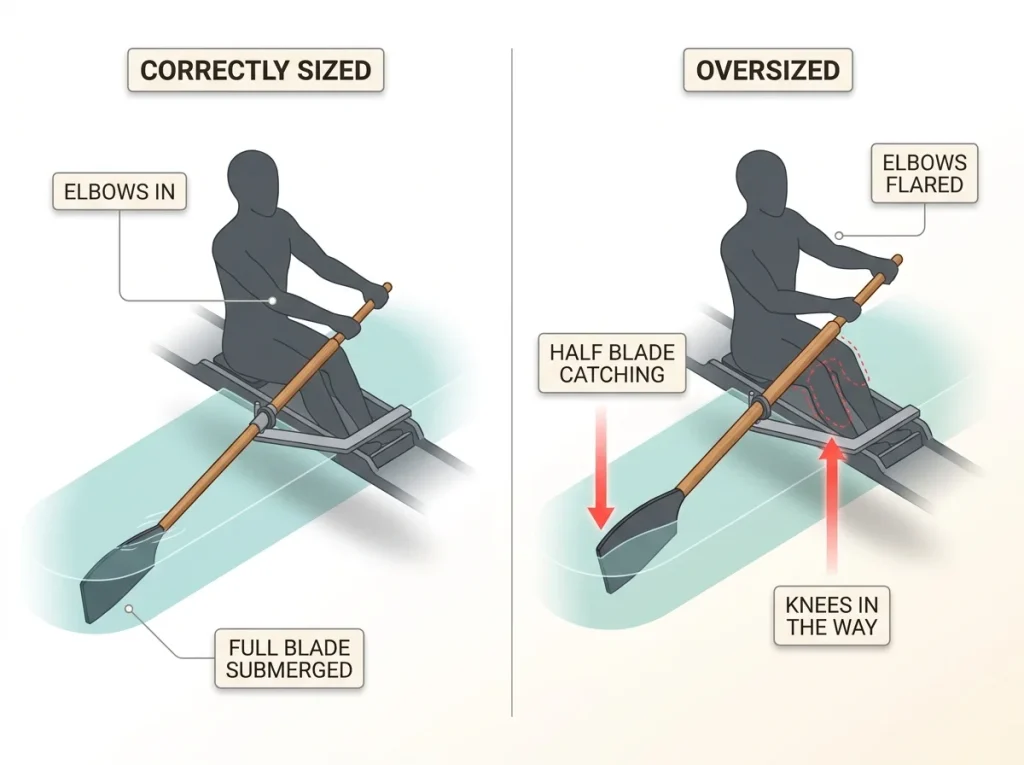
Longer sounds like more power, so plenty of boaters size up on purpose and end up worse off. Here is what actually happens when the oar is too long for the rig. Your handles ride high and your elbows flare out wide, so instead of a clean level pull you are rowing from your armpits. Only part of the blade catches the water, so you lose the mechanical advantage and the very purchase you were chasing. And the extra leverage magnifies every bit of slop in a loose oarlock, so the boat feels vague right when you need it crisp.
But before you blame the oar length, look down at your oar towers. A huge share of “my oars feel cramped” complaints trace back to towers that are too short, usually the stock six-inch ones. Your knees end up in the swing path, you bang them on every recovery stroke, and you assume the oars are wrong. The forum-standard fix is bumping to eight-inch towers, which lifts the whole geometry and buys back the knee clearance you were missing without touching the oar length at all. Sort out which problem you actually have before you spend money solving the wrong one, and if the stroke itself feels awkward, the mechanics of an efficient oar stroke explains where the power really comes from.
Once the length and towers are right, shaft weight is the next thing you feel. A counterbalanced shaft like the Cataract SGG oar shaft carries weight toward the handle so the oar rides lighter in your hands over a long day, which is a genuine upgrade if you row big miles. If you are not ready to spend there, the Carlisle extra heavy duty aluminum shaft is the budget-friendly workhorse that has been surviving rock strikes on rental fleets for years. A heavier oar is not automatically a worse oar, but weight you are not carrying is weight you do not fight, and balance ties directly into getting your whole oar rig trimmed and balanced.
Choosing Blade Shape for the Water You Row
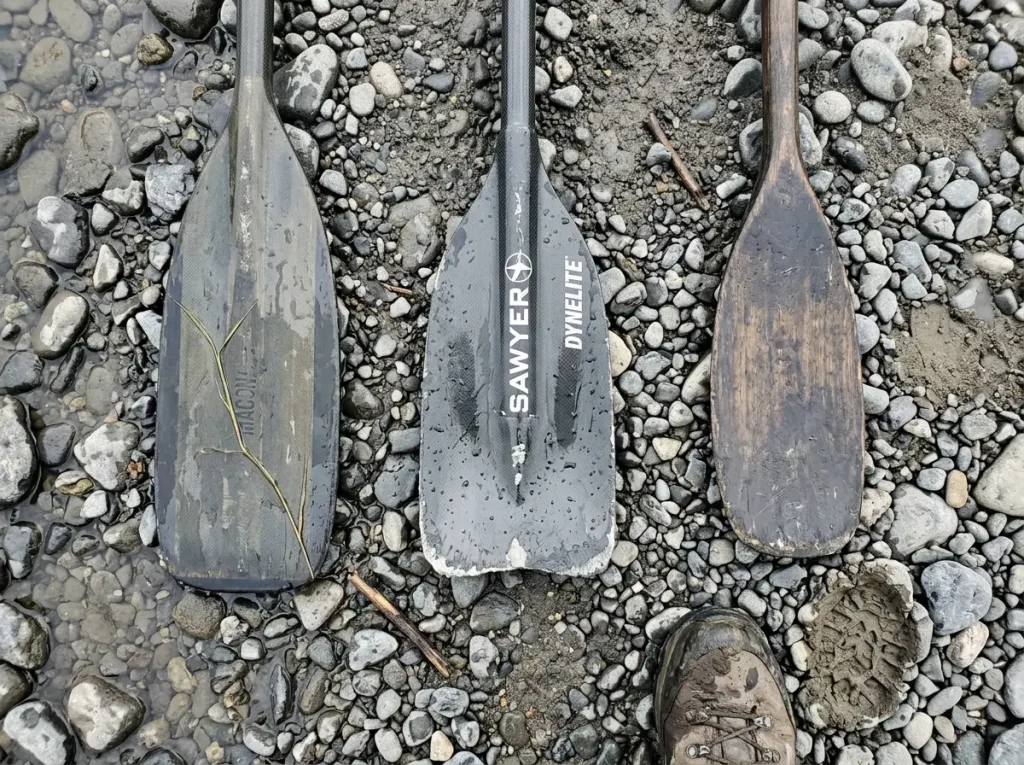
Length gets you halfway. The blade on the business end decides how that length behaves in the water, and shape is not cosmetic. Stand in the shop holding a wide blade and a narrow one and the difference feels like nothing. On the river it is the difference between a boat that fights you and one that goes where you point it.
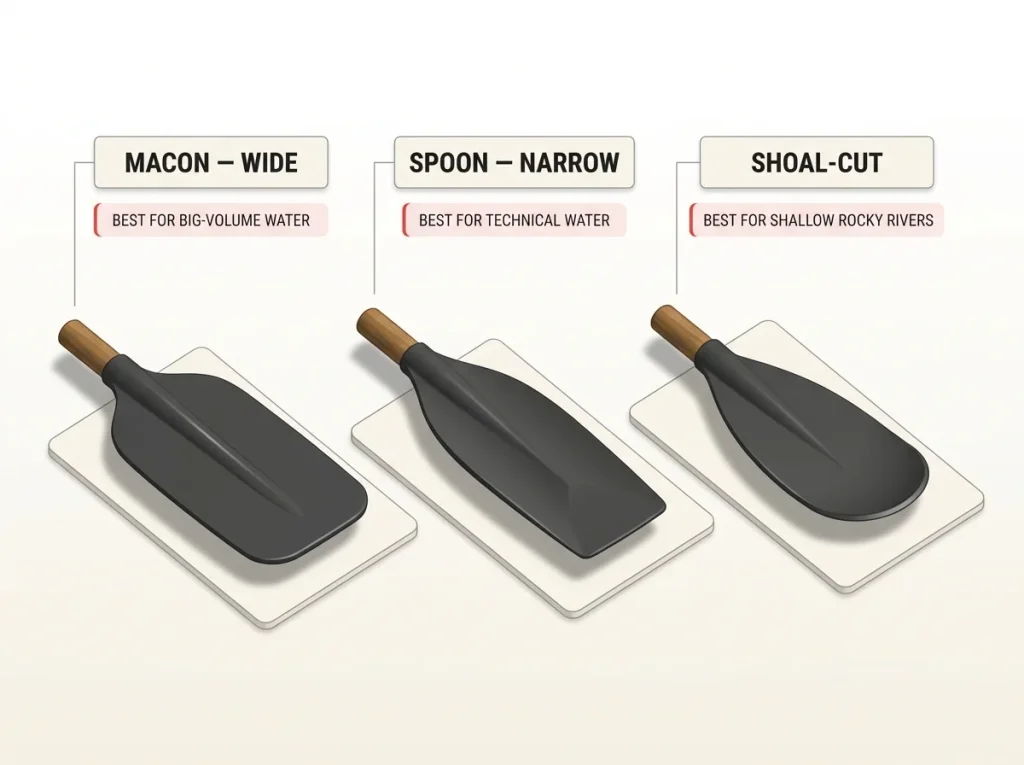
Wide, Macon-style blades displace more water per stroke. That is straight-line power, and it is what you want in high-volume water where you need to move a loaded boat across a fast current before the horizon line arrives. Narrow, spoon-style blades give up some of that grunt for lower drag, which pays off in tight technical water where you are making quick, constant corrections and do not want a big blade catching every time you feather. Shoal-cut blades are the specialist: a scooped, oval tip that sheds surface area so it slips over shallow cobble instead of clipping every rock in a skinny river.
The rule is to pick the blade for the water you row most, not the water you row twice a year. A big-water blade fights you through a technical rapid, and a narrow blade feels gutless when you are trying to punch a loaded boat across a wave train. For skinny, rocky rivers, a purpose-built shoal blade like the Sawyer DyneLite shoal blade takes the abuse a square-tip blade would not survive. For tight technical work where precision matters more than raw power, a narrow profile like the Cataract Cutthroat oar blade slices clean and feathers without grabbing. Once you know which shape you want, which brands are actually worth your money is the next call to make.
If you genuinely split your season between big water and technical creeking, buy the blade for your harder, scarier days. You can muscle a technical line with a big blade, but you cannot fake the power a narrow blade does not have when a hole is bearing down on you.
How Blade Size and Weight Change Every Stroke

Shape is the headline. Blade area is the fine print, and it is the thing that quietly taxes you at hour six when your shoulders are cooked. Two blades of the same shape can carry different surface area, and that area sets your catch power, or how much water you grab on every stroke. More area means more purchase, which is great when you need it and a slow drain when you do not, because that same blade drags harder every time you feather or ship it.
Over a single rapid you will never notice. Over a multi-day trip you feel it in your back. A larger, heavier blade compounds stroke after stroke, so the right move is to size the blade for the mileage you are putting in, not just the biggest rapid on the run. A strong rower on a loaded boat can justify more area. A lighter rower on a long, flat float will be happier with less.
Material plays into this only through weight. Composite and foam-core blades run lighter than plastic, and lighter out at the tip is where you feel it most. That is as far as the material conversation goes here, because the full breakdown of shaft and blade materials deserves its own space, and the complete wood-versus-carbon oar material guide handles that comparison properly. Match blade area to your strength and your load, and let the material choice follow the weight you actually want in your hands.
The Safety Side of Oar Sizing Nobody Talks About

Everything so far has been about comfort and control. There is a harder edge to this that no competitor bothers to mention: a badly sized oar is a control problem, and control problems on moving water get expensive fast.
The classic scenario is the downstream oar catching a rock at speed. When that blade grabs, the handle can kick back hard into the rower, or the oar can wedge and start to spin or wrap the boat. An oversized oar makes this worse on two fronts. It is slower to ship or feather clear of an obstacle because there is more oar to move, and its extra leverage feeds every bit of oarlock slop right when you need the boat to respond. The wrong length is not just tiring. In the meat of a rapid it can cost you the line, and it helps to understand how the hazards stack up by river class.
None of this argues for the longest oar or the biggest blade. It argues for the right one, rigged correctly, that you can actually control. A correctly sized oar you already own beats a longer one you talked yourself into. Size it, set your stops, clear your knees, and pick a blade that matches your water. Do that and the oar disappears from your mind, which is exactly where it belongs when the horizon line drops out of sight ahead of you.
Final Word
Three things carry the whole job. Measure your frame lock-to-lock and run the Rule of Thirds or the 1.63 shortcut, because both land on the same number anyway. Remember that the length is only half done until your stops are set and your towers clear your knees. And pick blade shape and area for the water you row most and the miles you put in, not the one big rapid you brag about later.
Before your next order, measure your own frame and run both formulas yourself. When the two methods agree, you stop guessing and start trusting the number, and that confidence shows up on the very first stroke off the ramp.
Frequently Asked Questions
01What size oars do I need for a 14-foot raft?
Most 14-foot rafts run 9 to 10-foot oars, but measure your frame lock-to-lock and apply the Rule of Thirds to be sure. Boat length is only a rough guide, since frame width is the real input that decides your oar length.
02How do I measure my raft frame for oar length?
Measure oarlock to oarlock, halve that number, and multiply by three. That lock-to-lock frame width, not the length of your boat, is what the Rule of Thirds uses to set your oar length.
03What is the difference between narrow and wide oar blades?
Wide blades displace more water for straight-line power in big volume, while narrow blades cut drag for quick, technical maneuvering. Shoal-cut blades add a scooped tip that sheds rocks in shallow water. Pick the blade for the water you row most.
04Can oars be too long for a raft?
Yes. Oversized oars force your elbows high, bury only part of the blade, and add slop through the oarlock. Often the real culprit is short oar towers, not the oar length, so check your tower height before sizing up or down.
05How far apart should my oar handles be when the oars are set right?
With both oars held level in the locks, the handle ends should sit roughly one to four inches apart. If the gap is off, slide your oar stops to fix it rather than changing the oar length.