
In this article
You have pitched this tent a hundred times in the woods. Then you push a stake into a sandbar and it comes back out in your hand, and the whole thing you thought you knew about camping stops applying. Ask around any boat ramp and you will hear the same story from people on their first river camping trip, and it almost never has anything to do with tent quality.
The gear is fine. The ground is different, the packing budget is different, and the weather shows up differently in an open canyon. Here is what a river-worthy tent and sleep system actually needs, which specific pieces meet that bar, and how to pitch the thing so it is still standing at 2 a.m.
Why River Camping Breaks the Tent Rules You Already Know
Every “best camping tent” roundup on the first page of Google is written for one of two people: someone loading a trunk in a campground parking lot, or someone counting ounces on their back. Neither of those is you on a river trip. The raft has its own math, the ground is loose, and the sky is wide open above you. That combination is why gear that has performed flawlessly for years can suddenly feel like a mistake by night two.
The ground is sand, not dirt
River camps happen on sandbars and gravel bars because that is what a river gives you: flat, open, breezy deposits along the bank. There is no forest duff, no established tent pad, no packed dirt to bite into. A standard six-inch stake driven into dry sand is close to decorative, and the load a guyline puts on it in a gust pulls it straight back out.
Sand also moves. Wind pushes it along the ground in a low, constant stream, and that stream goes straight through mesh panels. The mesh that makes an ultralight backpacking tent breathe so beautifully under a hardwood canopy is an open door on a bar.
By the second morning you find grit in the sleeping bag, in the pad valve, in the zipper teeth. Nothing failed. The tent was just built for a different floor.
Your pack size budget is a dry bag, not a trunk or a backpack
Car-camping tents solve for trunk volume, which is effectively unlimited for one tent. Backpacking tents solve for grams on a shoulder strap. A raft solves for neither. What a raft actually gives each person is a fixed slice of dry-bag space that has to hold a tent, a pad, a bag, and everything else personal, all while sharing the boat with kitchen gear, water, and group equipment.
That is why the tents dominating the generic roundups are the wrong answer here almost by default. Six- and eight-person family tents weighing fifteen to twenty-five pounds win those tests on livability and setup speed, and they lose badly the moment they have to fit in a boat. The same trap that catches people moving from a car to a raft catches people going the other direction too, which is exactly the friction covered in the way backpacking gear assumptions break down on a river.
No trees means no wind break and no shade
A canyon corridor has no canopy. Afternoon wind funnels down the corridor with a predictability locals learn to plan around, flash weather builds and arrives faster than a forecast checked at the put-in suggests, and there is nothing between your tent and any of it.
Car-camping guides tell you to check the weather. Backpacking guides talk about treeline and exposed ridges. Neither describes a camp sitting in the open at the bottom of a rock corridor with a river running past it.
This is one piece of a larger kit, and it fits alongside everything else you haul downstream. If you are still assembling the whole camp, the full river camping and kitchen gear picture covers how the sleep system slots in with cooking, storage, and the rest of the load.
What Makes a Tent River-Worthy
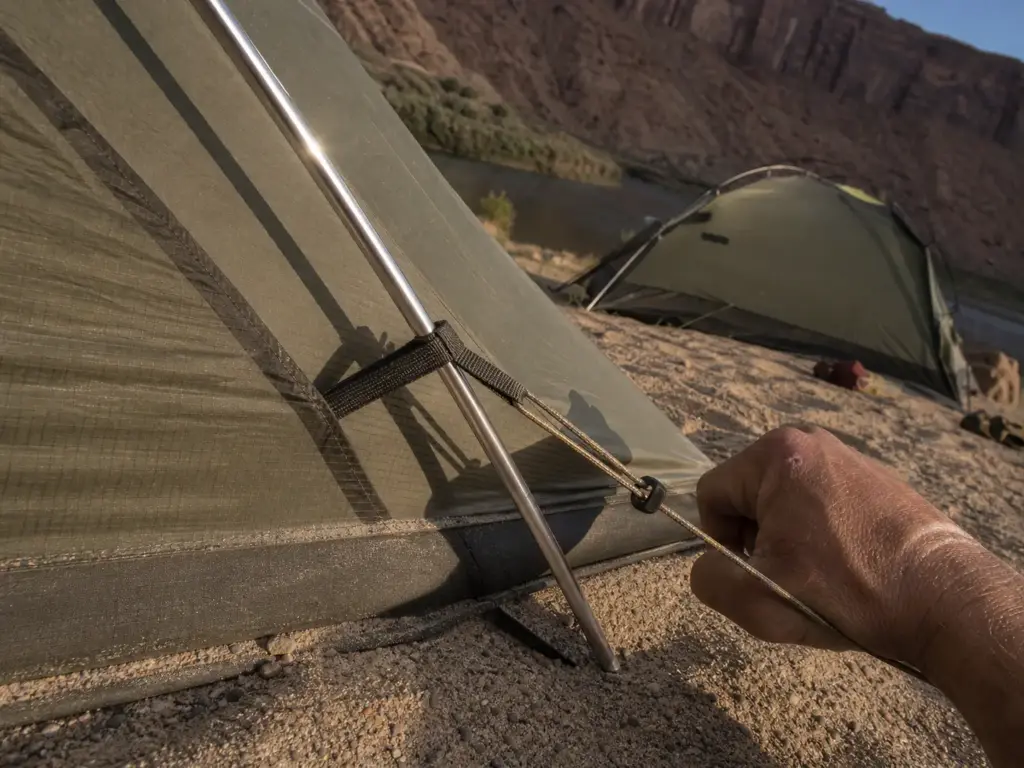
A tent spec sheet has about forty numbers on it. Four of them decide whether the tent works on a sandbar. Here is which four, and what the rest are actually for.
Freestanding vs. stake-dependent — the one that isn’t negotiable
A freestanding tent holds its own shape. The poles form the structure, and stakes only keep it from sliding or flapping. A stake-dependent design, most tunnel tents and a lot of the ultralight trekking-pole shelters, needs ground purchase to even stand up. On a sandbar, that difference is the whole ballgame.
Pitch a freestanding dome tent or hub-style tent on sand and you can set it up, weight the corners with dry bags or rounded river cobbles, and slide the whole thing three feet upslope when you realize you misjudged the water line. Try that with a tunnel design and you are re-anchoring the entire structure from scratch.
Pole material matters here for the same reason. Aluminum poles, particularly DAC-grade, flex under wind load and spring back. Fiberglass poles are cheaper and heavier and they take a set or splinter after enough seasons of hard flexing.
Wind resistance in an open corridor comes down to pole geometry and how many guy-out points spread the load across the structure, not to how heavy the fabric is. A heavier tent is not automatically a more wind-worthy tent.
Fabric, denier and waterproof ratings that hold up
Two numbers on the spec sheet are worth memorizing. A three-season tent is the right category for almost every river trip, and its rainfly should carry somewhere around a 2,000mm waterproof rating with the floor closer to 3,000mm. A four-season tent buys snow-load strength you will not use and costs you the ventilation you badly need on a hot canyon night.
Below those ratings, a hard afternoon storm can push water through the fabric, and a bathtub floor sitting in a shallow puddle on packed sand is exactly the condition that tests it. Check the mm rating before you check the person count.
Denier tells you how heavy the yarn is, and the number climbs as the fabric gets burlier. Ripstop polyester in the lighter denier range is standard for a rainfly, while floors run much heavier, often oxford polyester on tents built for abuse. Heavier floor denier is worth paying for on a river trip because sand is abrasive in a way forest duff is not, and a floor that gets ground into grit every night for two weeks wears differently than one used a dozen weekends a year. It is the same denier scale printed on raft floors and dry bags, and it means the same thing everywhere it appears.
The last fabric decision is how much of the tent is mesh, and it is really a decision about sand infiltration. Full-mesh inner tents are the norm in backpacking design because they save weight and manage condensation. For sand, you want more solid fabric low to the ground, ideally a solid band running up from the floor with mesh reserved for the upper panels and the door. That band is the difference between weatherproofing that works in a forest and weatherproofing that works on a bar.
Sizing for a raft, not a trunk
The river size is a two- or three-person freestanding tent, even for two people who could technically fit in something smaller. That extra bit of floor is where sandy gear goes so it does not end up in the sleeping bags, and a vestibule or two takes the rest. Two doors and two vestibules is genuinely better than one on a multi-night trip, because it means nobody crawls over anybody at 3 a.m.
What you skip is everything above that. The six-person cabin tents that win the generic tests are excellent products solving a problem you do not have.
Best Overall River Tent Pick
The honest version of this section: there is no tent built specifically for river trips sold at a normal price, so the pick is the one that does the four things that matter on sand without asking you to pay for an expedition shelter you will never need.
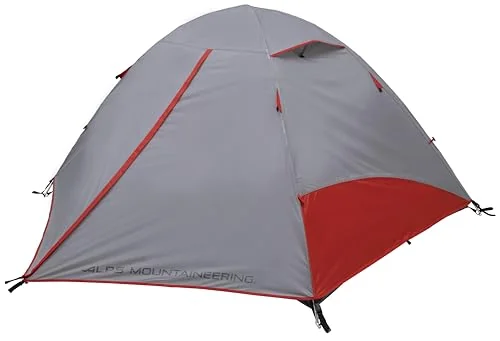
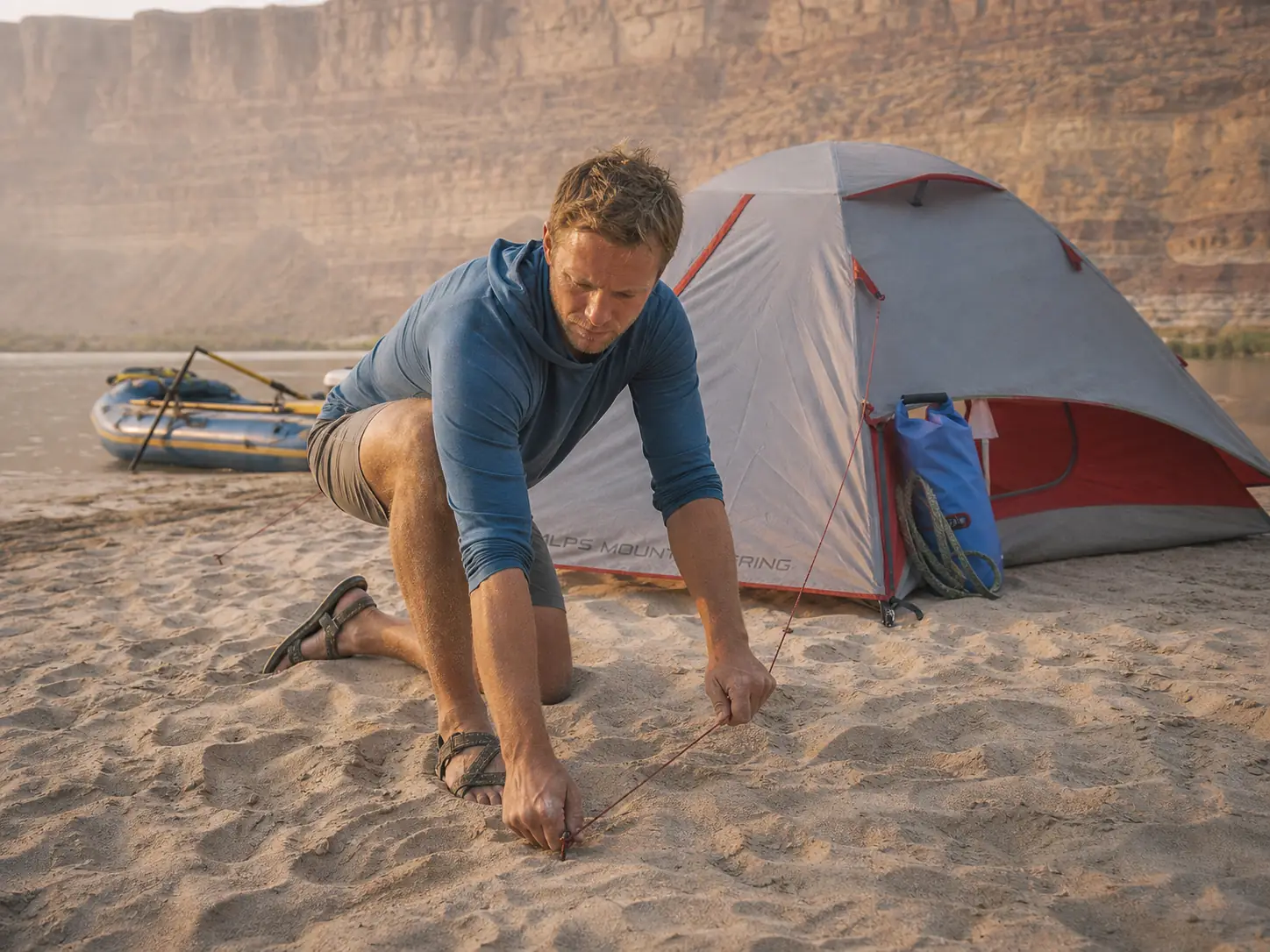
The ALPS Mountaineering Taurus 2-Person earns the slot on structure. It holds its shape as a freestanding dome before any stake goes in, so you can pitch it, weight it, and reposition it while you are still figuring out where the camp actually wants to be. The two doors and two vestibules matter more on a river than they do in a campground, because sandy dry bags and wet river shoes need somewhere to live that is not the sleeping area.
The fabric mix leans more solid than a comparable ultralight, which is the trade you want here. You give up some airflow on a hot canyon night and you gain a wall that blowing sand cannot pass through at ground level. And it packs small enough to share a dry bag with the rest of a sleep kit, which the six- and eight-person tents topping the generic roundups simply cannot do.
What it is not: a premium shelter for sustained bad weather. The pole set is adequate rather than bombproof, and if your trips are consistently in high-wind shoulder season you will eventually want more tent. For the typical three-to-five-night float in reasonable conditions, paying more buys features that do not change the outcome. That is the honest version.
Best Sleeping Pads for River Camping
The pad is where most people under-buy, and the reason is that sand behaves nothing like the ground people are used to sleeping on. It holds cold, it conducts heat away from you all night, and on a spring runoff trip it stays cold long after the daytime canyon heat has convinced you otherwise.
R-value for cold sand and shoulder-season nights
R-value measures how well a sleeping pad resists heat moving from you into the ground. A summer backpacking pad sits somewhere around R 2 to 3, which is fine on warm forest soil in July and genuinely miserable on cold sand in May. The insulated self-inflating pad category that gets marketed as four-season sits in the 9 to 9.8 range at the thick end of the mainstream catalog, and that is the neighborhood you want for a river trip that touches shoulder season at all.
Rate your pad for the coldest night of the trip, not the average one. A canyon that reads 95 degrees at 3 p.m. can drop hard after dark, and the sand under you has been shaded and losing heat since mid-afternoon. Warm days say nothing about the ground you sleep on.
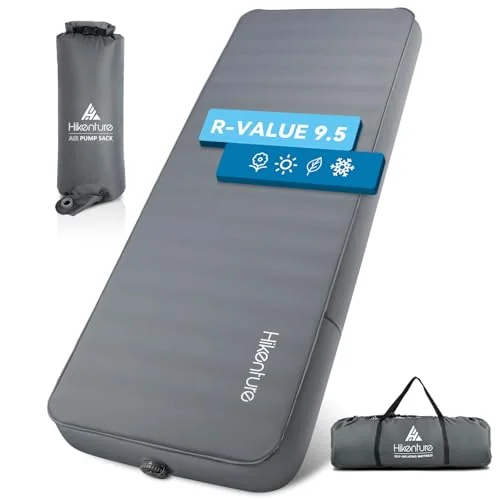
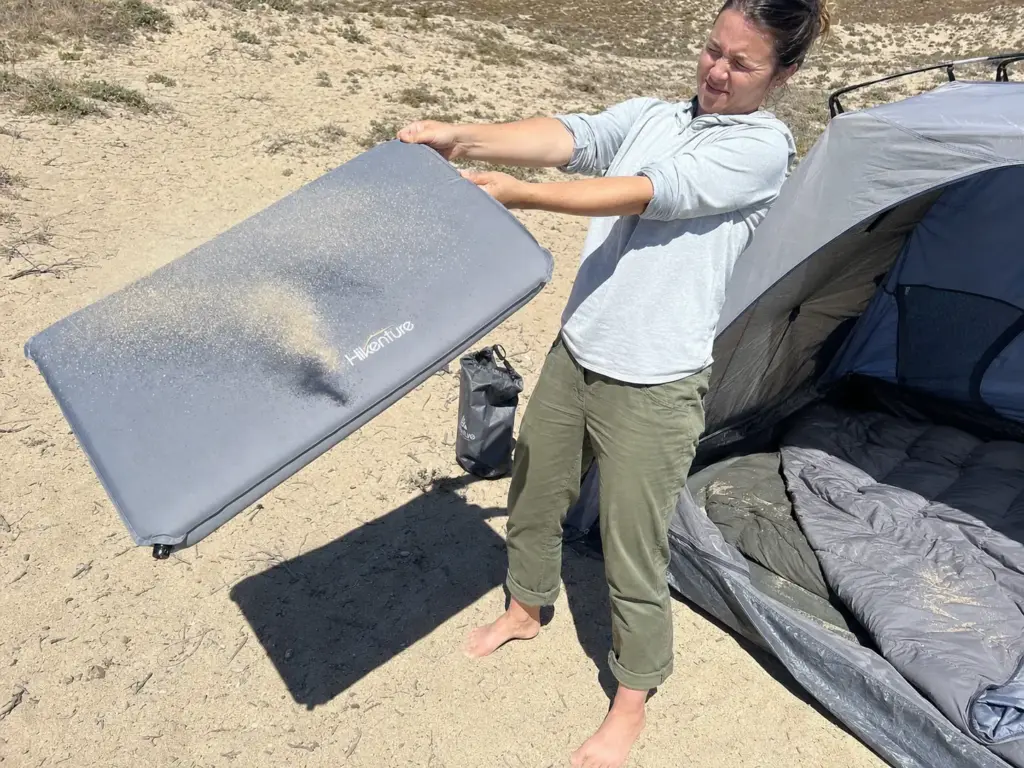
The Hikenture 4 inch self-inflating pad is the buyable pick because it puts a 9.5 R-value and four inches of foam under you without asking you to source a specialty river product. Self-inflating matters more than it sounds like it should. After a long day rowing, the difference between opening a valve and standing in camp squeezing a pump sack is the difference between setting up camp and dreading it.
Self-inflating foam vs. air pads on a sandbar
An ultralight air pad packs smaller and weighs less, and on a sandbar it carries a risk profile that does not exist in a meadow. The ground is abrasive grit, sharp gravel hides in it, and a puncture on night one of a six-night trip means five nights on cold sand. Foam-core self-inflating pads fail more gracefully. A slow leak on a self-inflating pad still leaves you sleeping on foam.
There is also the matter of what the pad does during the day, which no backpacking pad advice accounts for.
The pad that doubles as raft furniture
River people love thick foam pads because they work all day, not just at night. Rolled and strapped, a thick pad becomes a seat on the raft, a cushion over a dry box, or a cover on a cooler lid. That is a real argument for buying more pad than a backpacker would.
The name that comes up in every conversation about this is the Paco Pad from Jack’s Plastic Welding, the river industry’s own durability benchmark. Its PVC-free TobaTex shell and high-density polyurethane foam core are built for the exact abuse of a multi-week permitted trip, and outfitters have been running them hard for decades. It is a direct-order river-industry product rather than a mainstream retail item, so treat it as the standard to understand rather than the thing to click. If you want the comfort without chasing down a specialty order, the Hikenture above covers the same ground.
Best Sleeping Bags and Temperature Ratings for River Trips
Backpacking culture is down-obsessed, and for backpacking it is right. Down gives you more warmth per ounce and per liter than anything else. Every one of those reasons weakens the moment your bag spends eight hours a day strapped to a boat.
Why synthetic beats down on the water
Wet down clumps, loses loft, and stops insulating almost entirely, and it takes a long time in the sun to come back. Wet synthetic fill keeps a meaningful amount of its insulation and dries fast.
On a forest trail, a soaked bag is a rare accident. On a river, water is the environment: a dry bag that did not get rolled properly, a splash in a rapid, a storm that finds the one seam in your setup, or a boat that goes over. Down is a bet that nothing goes wrong with your dry protection for the whole trip. Synthetic does not require that bet.
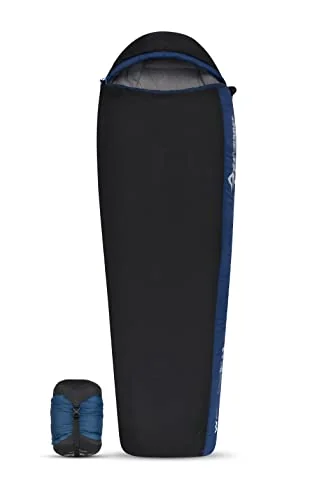
The Sea to Summit Trailhead 20-degree is the default recommendation because the rating lands in the right window for most river seasons and the fill type matches the environment. It is heavier and bulkier than a down bag of the same rating. That is the trade, and on a boat it is the correct trade.
Reading a temperature rating for canyon nights
Temperature ratings describe survival more than comfort in most rating systems, so treat a 20-degree bag as comfortable somewhere north of 20 rather than at it. A sleeping bag liner is the cheapest way to buy back the difference, and it packs down to nothing. A canyon amplifies the daily swing: rock walls dump stored heat after sunset, cold air sinks and pools along the corridor, and the water itself pulls the ambient temperature down. Rate for the night you might get, not the afternoon you are having.
The budget trade — warmth per dollar vs. warmth per liter
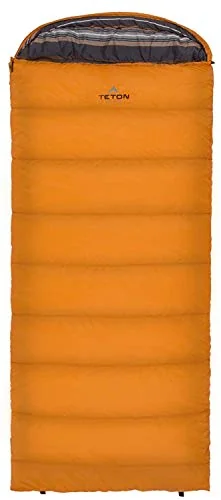
The TETON Sports Celsius Regular 0-degree buys you more cold margin for less money than anything comparable, and it costs you space. On a day trip or a well-loaded gear boat with room to spare, that is a fine deal. On a tight per-person allotment it is a problem, because packed size is a sleep-system decision rather than a bag decision. Every liter the bag takes is a liter unavailable to the pad, the tent, and everything else, which is the same calculation that drives soft storage that lives on the boat all day.
Dry-Bag Protection for the Whole Sleep System
Three separate items competing for boat space is a bad system. One grab-and-go dry unit per person is a good one. The difference is a compression dry bag and about ten minutes of thinking at home before you ever get to the ramp.
How a compression dry bag actually shrinks a synthetic bag
A synthetic sleeping bag is bulky because it is mostly trapped air. A roll-top compression dry bag with an air-permeable base solves both problems at once: you press the bag down and air escapes through the permeable panel while water cannot get back in through it, then the compression straps cinch the whole load smaller than the roll-top alone could manage.
That mechanism is what makes a synthetic bag viable on a river trip at all. Without it, you are choosing between down you cannot afford to get wet and a synthetic bag that eats your entire allotment.
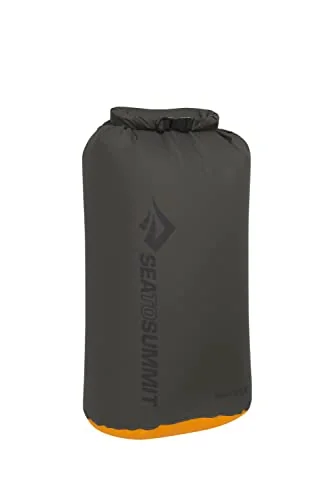
The Sea to Summit eVac 20L does the job with a 10,000mm waterhead rating, which is the difference between a bag that keeps out rain and one that keeps out a full swim. Size it to swallow the sleeping bag with a little room, and put the tent in a second bag rather than fighting to force both into one.
One unit, not three items
Here is the framing shift that makes river camping easier: your sleep system is one object, not four purchases. Tent, pad, bag, pillow. At each camp you want to grab one thing off the boat, walk up the bar, and have everything you need to sleep in your hands.
Pack the sleep system as one unit, not three loose items. Size the compression dry bag to swallow the sleeping bag and pillow, put the tent and pad in a second bag, and label both. At camp you carry two things up the bar instead of hunting for a pad strapped somewhere under the kitchen boxes in the dark.
Rounding it out costs almost nothing. The TREKOLOGY ALUFT 2.0 camp pillow packs down to about the size of a soda can and weighs under four ounces, and it is the difference between sleeping and rolling a fleece into a lump every night for a week.
Rigging the sleep kit to survive a flip
River people talk about rigging to flip, meaning you pack and strap gear on the assumption the boat will go over at some point, not on the hope that it will not. That standard applies to the sleep system as much as to anything else on the boat.
Practically: the dry bag gets closed properly with at least three full roll-downs before the buckle clips, it gets strapped to a frame or D-ring rather than tucked under something, and it gets checked at every stop rather than at the end of the day. The same discipline behind rigging gear so it survives a flip is what keeps a sleep kit dry, and the failure mode is identical when it slips: a bag that was never really sealed, or one that was never really tied.
Pitching and Anchoring a Tent on Sand
This is the skill nobody teaches you and everybody learns at 2 a.m. It is also completely free to learn, and it separates a camp that holds through a windy night from a camp you spend that night chasing.
Why standard stakes fail in sand
A stake works by friction and by the resistance of packed material along its length. Loose dry sand offers almost none of either. Push a standard six- to nine-inch stake into a bar, tension a guyline, and the sand simply shears around it.
It does not fail dramatically at first. It creeps, the guyline goes slack, and then the first real gust takes the whole thing.
Deadman anchors work on a completely different principle. Instead of relying on friction along a thin shaft, you bury something wide and let the mass of sand sitting on top of it do the work. The load spreads across the buried object’s whole surface area and the sand column above it, which is why the same material that will not hold a stake will hold a deadman all night.
Building a deadman anchor with gear you already have
You need roughly 12 to 18 inches of burial depth in loose dry sand, with at least a foot of sand covering the buried anchor, before it holds reliably under wind load. Shallower than that and you are just pre-loosening the sand.
The free deadman: fill a spare stuff sack with sand, cinch it, and bury it 12 or more inches deep with only the drawcord showing above the surface. Clip or tie your guyline to that drawcord with a trucker’s hitch so you can re-tension it without digging. One spare stuff sack per guy-out point and you have anchored a tent on a bar for nothing.
The sequence is simple enough to do in the dark once you have done it once in daylight. Dig the hole, fill and cinch the sack, set it in with the drawcord up, backfill and stomp the sand down firmly, then tie off and tension. Stomping matters more than people expect: compacted sand over the anchor holds substantially better than loosely shoveled sand.
Screw-in sand stakes — when the upgrade is worth it
Building deadmen at four guy-out points every night for two weeks gets old. Screw-in sand stakes are the shortcut: a spiral shaft that threads into loose sand and engages a much larger volume of material than a straight stake, which is why they hold when a conventional stake will not.
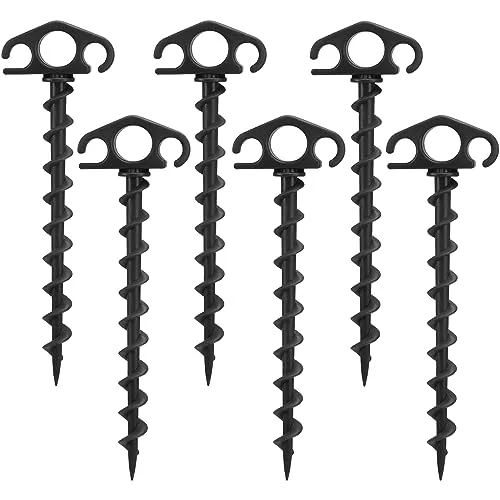
The COBARYEN screw-in sand stakes are the version most people should carry. Six is enough for a two-person tent’s corners plus the main guy-outs. If you run a bigger tent or want every guyline anchored, the 10-pack covers it for a marginal amount of extra weight.
Worth being honest about the limits: screw-in stakes hold well in damp or moderately packed sand and less impressively in the driest, loosest stuff high on a bar. Carry a couple of spare stuff sacks anyway. When conditions call for it, nothing beats a properly buried deadman.
Orienting the tent to canyon wind
The last piece is free and most people get it backwards. Point the door away from the prevailing corridor wind, not toward the view. Canyon wind often funnels down-corridor with real consistency in the afternoon, and the side with the best view of the water is usually the exposed side. A door facing into that wind turns the tent into a scoop every time you open it, and the vestibule fills with sand.
Then weight the corners. This is where the freestanding argument from earlier pays off: dry bags, rounded cobbles, or the loaded pad itself inside the tent all reduce how much the anchors have to do in the first place.
Choosing the Campsite — Above the High-Water Line
The flattest, prettiest spot at 6 p.m. is often the one you will be dragging gear off of at 2 a.m. Site selection on a river is a genuinely different skill than site selection anywhere else, because the ground level itself changes overnight.
Reading the high-water line
Gravel and sand bars are the standard river campsite for good reasons. They are open, flat, and breezy enough to keep insects down, with clear sightlines for weather and wildlife. The catch is that you have to pitch above the current water level, because the river can come up while you sleep. NPS guidance on choosing and pitching a gravel-bar campsite is explicit about it, and it is the one rule on a bar that has no flexible interpretation.
The high-water line is your reference, not the water’s current edge. Look for the stain on the bank, the line of stranded twigs and bleached driftwood, the point where vegetation changes character. That mark is where the river has recently been, and it is telling you where it can be again. Pitch above it with margin.
Why the flattest spot is often the wrong spot
The flattest, softest, most inviting sand on a bar is usually the lowest, because that is where fine sediment settles when the water is higher. It is genuinely more comfortable and it is the first place to go under.
The rise most often comes from something happening far away from your camp. An upstream dam release, a storm over a tributary you never see, snowmelt spiking with a warm afternoon. There is no signal at your tent that any of it happened until the water is closer than it was, which is why the rule is a margin rather than a judgment call. Understanding how river conditions shift with flow and weather makes the reasoning stick better than the rule alone does.
Wind and storm exposure in an open corridor
Once you are above the line, pick within that zone for wind and storm exposure rather than for the view. A slight bench behind a boulder cluster or a stand of tamarisk breaks the corridor wind meaningfully. Open bar in the middle of the corridor catches everything.
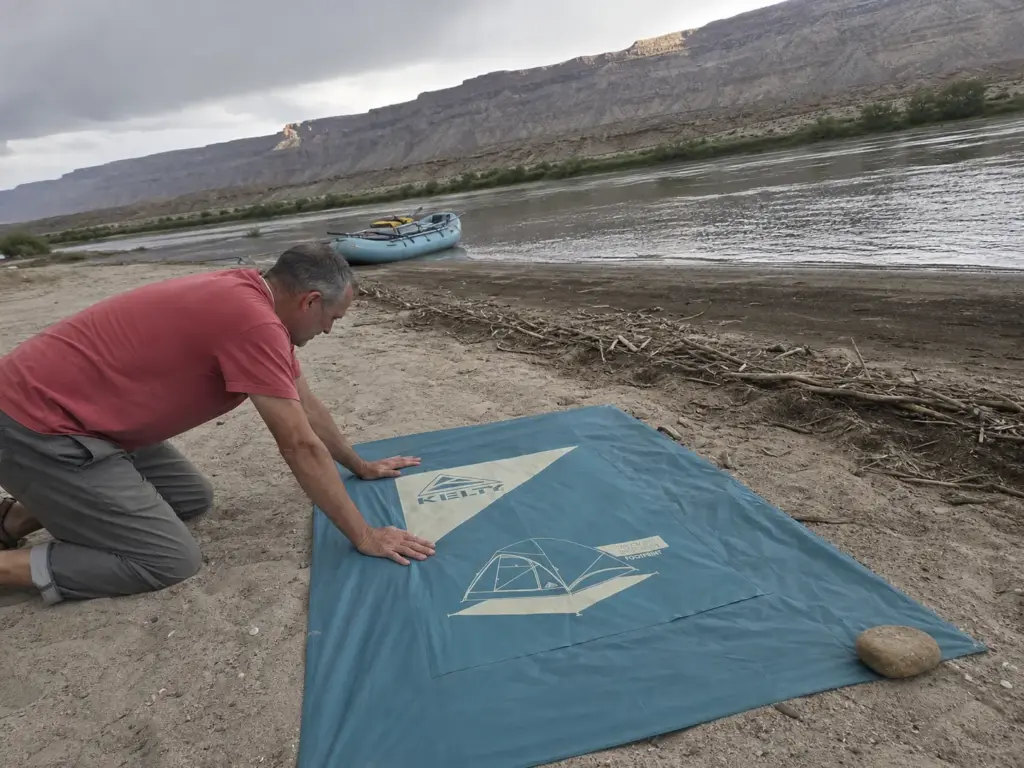
A footprint is the cheap durability insurance for the site you end up with. The Kelty Discovery Basecamp footprint puts a sacrificial abrasion layer between your tent floor and coarse sand, and a contractor-grade ground tarp cut a couple of inches smaller than the floor does the same job for less if you would rather build it yourself. Cut it smaller, not larger: a footprint extending past the tent floor collects rain and channels it underneath you.
Camp placement drives more than the tent, too. Where the boats land, where the kitchen sets up, and where the fire goes all follow from the same decision, which is why fire pans and the rest of the leave-no-trace camp setup belongs in the same planning conversation.
Permit Weight Limits and Multi-Week Durability
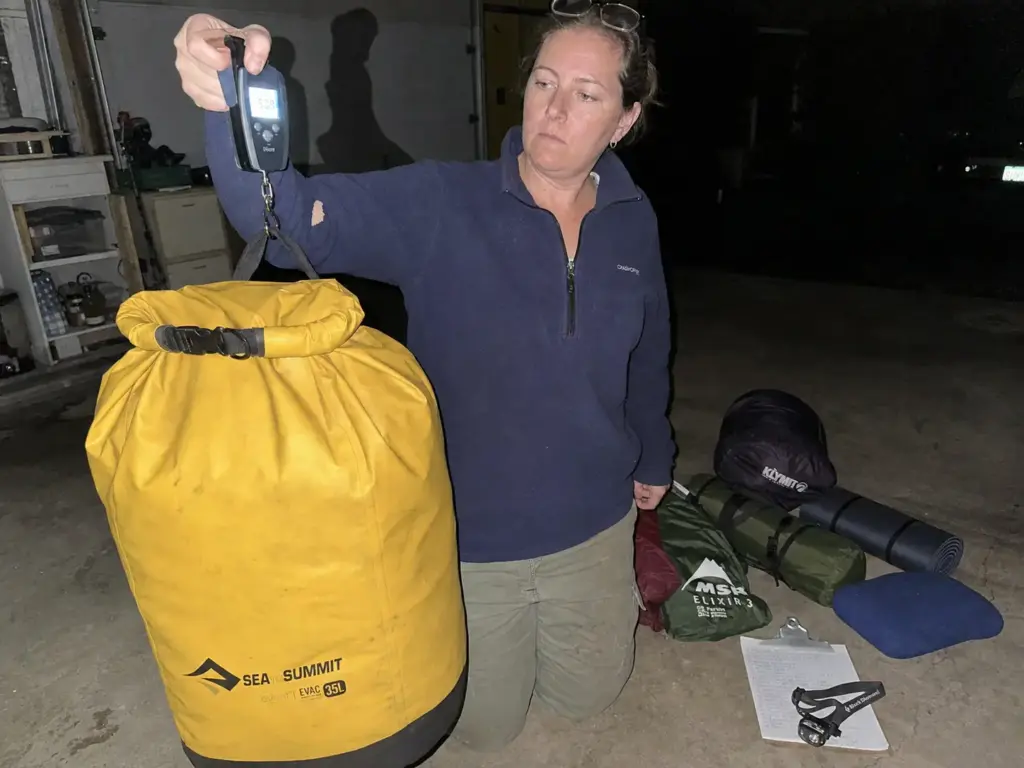
This is the gear math nobody does until the week before launch, when the sleep system turns out to eat most of a personal gear allowance that sounded generous on paper.
The 20-pound personal gear reality
Commercial Grand Canyon outfitters commonly cap personal gear around 20 pounds excluding beverages. That is not a National Park Service rule, it is a raft-space limit set by the outfitter, and it is a useful benchmark for anyone packing a multi-day trip because the underlying constraint is the same everywhere: boats hold what boats hold.
Twenty pounds sounds like plenty until you list what is in it. A tent, a pad, a bag, a pillow, the dry bags they live in, plus clothes, rain gear, camp shoes, headlamp, and toiletries. The sleep system alone can take half of it if you bring car-camping choices. Working out scoping the rest of your gear by river class before you shop is a better use of an evening than repacking three times at the ramp, and how much per-person space your boat actually has turns an abstract weight number into your specific boat.
What a private permit means you’re packing yourself
On a noncommercial permit the whole thing is on you. Under the National Park Service’s noncommercial river permit rules for Grand Canyon, sleeping gear, dry bags, and personal camping equipment are not provided. There is no rental fleet, no gear boat stocked by an outfitter, no backup if a pad fails on night two.
That changes how you buy. On a commercial trip a marginal pad is an uncomfortable week. On a private permit, gear that fails is gear that stays failed for the length of the trip, which argues for buying the more durable version of anything you cannot improvise a replacement for.
Sand abrasion over a two-week trip
A one-to-three-week trip subjects a tent floor to daily grit contact in a way weekend use never does. Sand works into zipper teeth and grinds the coating off floor fabric where you kneel, sit, and drag gear across it. A footprint absorbs most of that, and shaking the tent out each morning before packing keeps the grit out of the zippers, where it does its slow damage.
This is exactly the durability question the Paco Pad’s reputation is built on. River outfitters run those pads through repeated multi-week seasons, which is why they are the benchmark people name even when they buy something else. You do not need to own one to take the lesson: for a long permitted trip, choose the version of every piece built to be abraded daily rather than the version built to be light.
Conclusion
Freestanding beats everything else on sand. If the ground will not hold a stake, the tent has to stand on its own, and every other decision follows from that one.
Buy the sleep system as one unit. High R-value for cold sand, synthetic fill for wet-boat reality, and one compression dry bag that carries all of it as a single thing you grab off the boat at camp.
Pitch above the high-water line, point the door away from the corridor wind, and bury a deadman before you need it.
The single best thing you can do before your next trip: build a sand deadman once at the put-in beach or in your backyard, in daylight, when nothing depends on it. It takes five minutes, and it is the difference between sleeping through a windy night and chasing a tent across a bar in the dark.
Frequently Asked Questions
01What is the best tent sleeping system?
On a river trip the sleep system is four parts: a freestanding tent, an insulated pad with a high single-digit R-value, a synthetic-fill bag, and a compression dry bag carrying all of it. The system matters more than any single item, because a raft budgets space per person rather than per item.
02What is the 200 rule for camping?
The 200 rule is the Leave No Trace guideline to camp, wash, and bury waste at least 200 feet from water. River trips work differently: camps sit on the bar by necessity, placement is governed by the high-water line and permit rules, and human waste leaves in a groover.
03How do you stake a tent in sand?
Mostly you do not stake it, you bury a deadman instead. Fill a spare stuff sack with sand, bury it 12 to 18 inches deep with only the drawcord showing, and tie your guyline to that. Screw-in spiral sand stakes are the buyable shortcut for the same job.
04Do you need a special tent for river camping?
Not a special category, but a specific feature set: freestanding construction, solid fabric low to the ground rather than all mesh, aluminum poles, and a packed size that fits your boat allotment. A two or three-person freestanding dome covers it. The six to eight-person tents in generic roundups do not.
05Down or synthetic sleeping bag for a river trip?
Synthetic, on almost every river trip. Down stops insulating when damp and dries slowly, and a river puts your bag on a boat all day where a compromised dry bag is a normal outcome rather than a rare accident. Synthetic is heavier and bulkier, which is why a compression dry bag matters.