
In this article
Every camping-table roundup on the internet is written to sell you one table. Ask a river crew what they actually run and the answer is never one: a tall counter for the stove, a second one for the wash line, and a light roll-up table for drinks and appetizers so nobody is reaching across the cook. The loadout consensus on rafting forums lands on at least two counter-height river tables plus one or two roll-ups, a shape no generic roundup arrives at, because none of them are testing on a sandbar. This compares 10 roll-up tables and camp kitchen setups you can actually buy, then covers the four things a river camp does to a table that a campground never will: sand, all-day canyon sun, a boat that is already full, and wind on an open beach.
Here are the five picks most river kitchens end up built around.
| Pick | Category | Why it earns the slot |
|---|---|---|
| Mountain Summit Gear Heavy Duty Roll Top (Large) | Best Overall Roll-Up | Aluminum top takes a hot pot straight off the stove, steel frame is the sturdiest of the packables |
| Mountain Summit Gear Deluxe Roll Top Kitchen | Best Full Camp Kitchen | Side tables plus a 2-shelf cabinet, and adjustable legs for uneven sand |
| Coleman Compact Roll Top Aluminum Table | Best Budget Roll-Up | Cheapest honest way into a heat-tolerant aluminum top |
| Portal Lightweight Aluminum Roll Up Table | Best Seated Dining Table | Square dining-height top for four, rolls to the same slim bundle as a prep table |
| Helinox Table One Hard Top Large | Best Ultralight | 3.4 lb and a bundle that fits inside a dry bag, for a boat already at its limit |
Why a River Table Isn’t a Camping Table
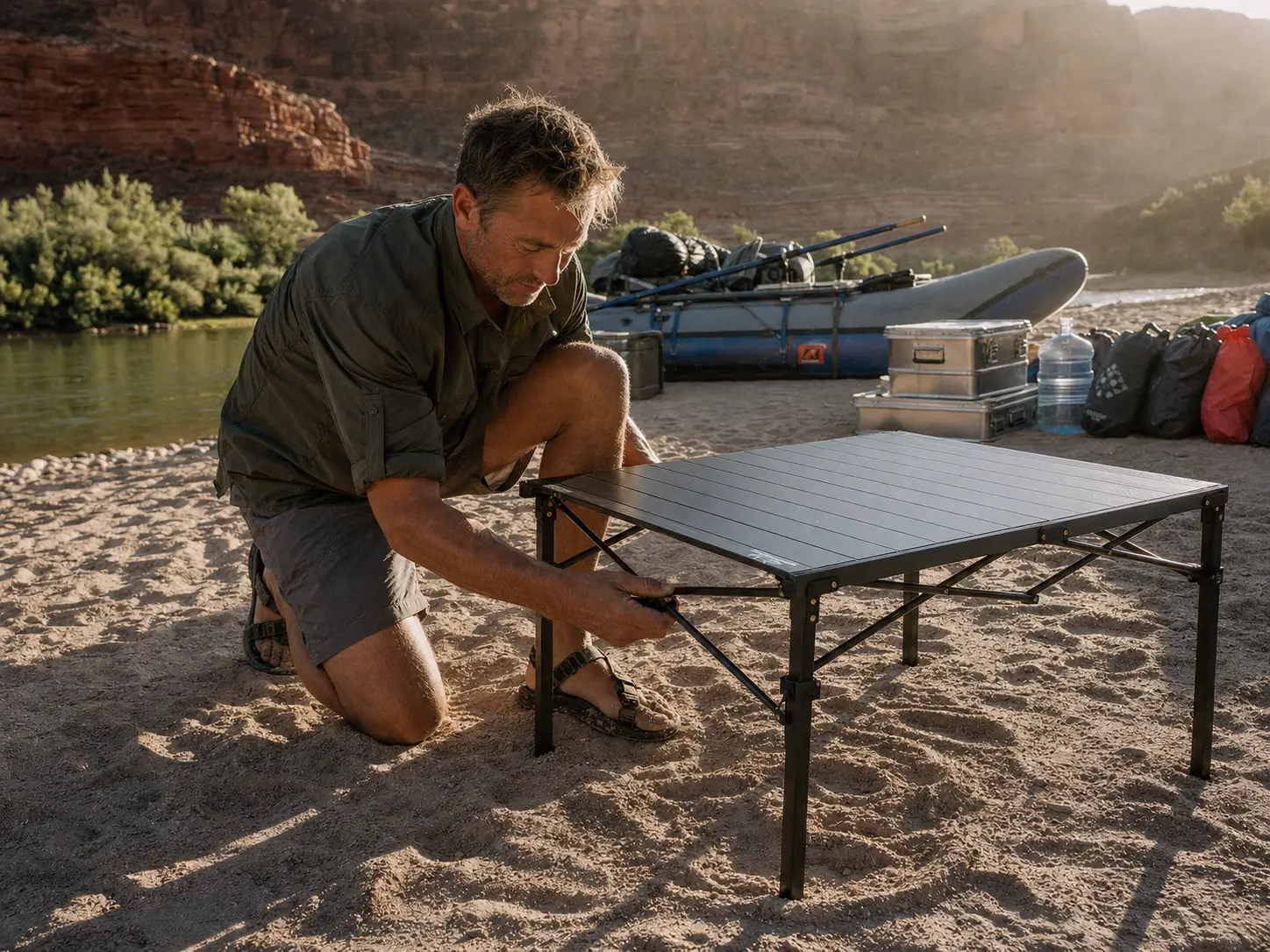
The folding table in your garage is almost certainly 28 to 31 inches tall, because that is dining height and dining height is what the whole consumer table market builds. A river table is 35 to 40 inches tall, because that is where your hands sit when you stand up straight and chop, stir, or wash. That single spec is the entire difference between the two categories, and it is the one no camping-table roundup measures against a human being.
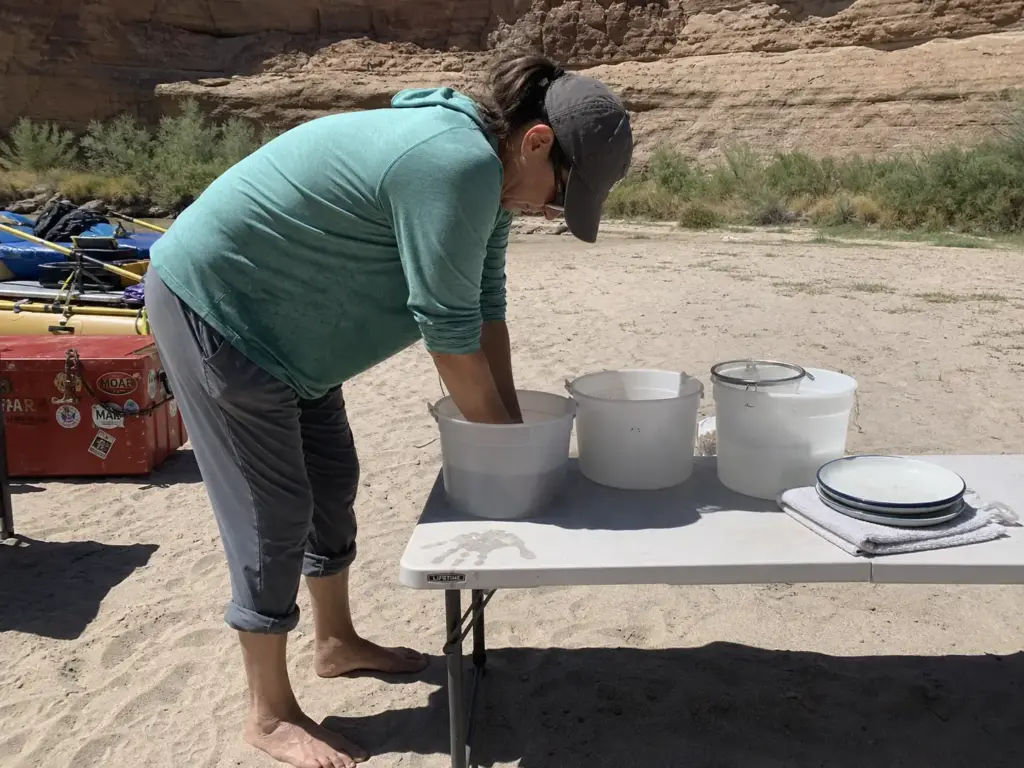
Picture day three of a twelve-person trip with the dish line running off a 29-inch table. Everybody who takes a turn washing stands up with a sore lower back, because they spent twenty minutes bent at the waist over a bucket. The height question reads as trivial in a product listing and stops being trivial on the second night.
River runners have been saying this out loud for years. One Mountain Buzz build thread opens on exactly the problem: “at a height of 29.5 inches, it’s not ideal as a counter top. Ideally I’d like something in the 35-to-40 inch range.” That thread exists because the poster could not buy what he wanted from a camping brand.
The three heights and the jobs they do
There are really only three useful working height bands for a river kitchen, and each one owns a job:
- Around 40 inches. Standing prep, the stove, and the wash line. This is the counter, and generic roundups ship almost nothing this tall.
- 28 to 31 inches. Seated dining. A crew eating on a beach needs one of these, and it is a different table, not a compromise.
- 15 to 19 inches. A ground-level platform for a two-burner stove, a cooler lid, or a beer table.
Once you see the three bands, the second river-camp mistake becomes obvious: bringing one table. The consensus loadout on the forums is at least two counter-height tables plus one or two roll-ups, so the stove, the wash line, and the appetizer spread each get their own surface and the cook is not fighting six people to reach a pot.
It helps to borrow the vocabulary the community already uses, because it keeps the categories straight for the rest of this guide. A river table is the tall, rigid, HDPE-topped counter built to strap to a raft frame. A camp table is the generic folding thing. A roll-a-table or roll-up is the slat-top table that packs down to a tube or a thin slab.
One last reason the height matters more on a river than anywhere else: a permitted kitchen has a defined footprint. The required-gear list private boaters actually check against before a launch assumes a tarp under the cooking area and another under the dishwashing setup, which means the table is not a standalone purchase at all. It is the anchor of a layout you already have to build, alongside the rest of the river kitchen your permit expects you to carry.
The Five Kinds of Table That Ride on a Raft
Stand at any busy put-in for twenty minutes and you can sort every table in the parking lot into five groups. One boater has a rolled tube lashed along a frame rail like a spare oar. Another crew is unfolding a hardware-store plastic table. And one boat has a real counter bolted into the frame bay, which is the one everybody else notices at camp.
Roll-up or roll-top. A slat top, usually aluminum, that rolls into a tube or folds into a flat slab. The category is defined by its packed size, not by its footprint set up. The original river version, the Camp Time Roll A Table, rolls to a 32-inch bundle 5.5 inches across; the Mountain Summit Gear roll-tops pack to roughly a 32 x 20 x 4-inch slab. Those two shapes stow in completely different places on a boat.
Rigid folding. HDPE fold-in-half tables. Heavier, far steadier under a corner load, and the surface you want under a knife. The better ones have adjustable legs that get within reach of prep height.
Cook station or camp kitchen. One-piece setups with integrated side tables, shelving, and hanging storage. The river argument for these is simple: no loose legs, poles, or shelf pins to lose in the sand at breakdown.
Ultralight packable. Two to three and a half pound ground tables that live inside a dry bag. These are stove platforms, not counters, and that is not a criticism.
Frame-mount river counter. The category no generic roundup names, because none of these tables are sold by a camping brand. It gets its own section below.
The Camp Time Roll A Table deserves a paragraph even though you probably cannot buy one right now. It is the original river roll-up: 10 lbs, sets up 32 x 32 x 28 inches, rolls to that 5.5-inch bundle, carries 100 lbs, and uses an 11-segment laminated wood top made in Spokane.
Camp Time’s own claim is that the packed table takes up under four percent of its set-up volume. It was designed to ride inside a Zodiac without chewing the tubes, which is exactly why forum boaters still name it first. Every Amazon listing for it is currently unavailable, so treat it as the category’s origin story and buy a Mountain Summit Gear roll-top instead. The build is different, the packed shape is close, and it is in stock.
There is a zeroth category worth naming before you spend anything, too. The lid of a kitchen box is the work surface you already own, and it sits at roughly frame height with a cooler next to it. Measure that lid first, because every table you buy gets sized against it.
Best Roll-Up Tables for Rafting
The roll-up is the table you buy when the boat is already rigged and the only space left is a slot along the frame rail, the same place your spare oar rides. Aluminum slat tops are the river default for one reason: you can set a hot pot straight down on them. That same conductivity is what turns them into a burn surface after six hours of canyon sun, which is its own section further down.
Two numbers decide which roll-up is right for you, and neither one is the number in the headline. The first is weight capacity. Seventy pounds sounds generous until a full five-gallon water jug (over forty pounds on its own) and a loaded propane stove are both sitting on it, at which point you have almost nothing left.
The second is packed thickness, not packed weight. A four-inch slab straps flat to a box lid. A 5.5-inch tube lashes along a rail. Those are different boats.
As a category, packable roll-tops run roughly $60 to $150, and the spread inside that band buys you frame stiffness and better legs rather than a bigger top.
Individually adjustable legs are the sandbar feature, not a luxury. No river beach is level, and none of them stay level once twelve people have walked past the kitchen. A table with four fixed legs and one leg in a scoop is a table you spend all week bracing with your hip.
Best Overall Roll-Up for a Raft: Mountain Summit Gear Heavy Duty Roll Top Table (Large)
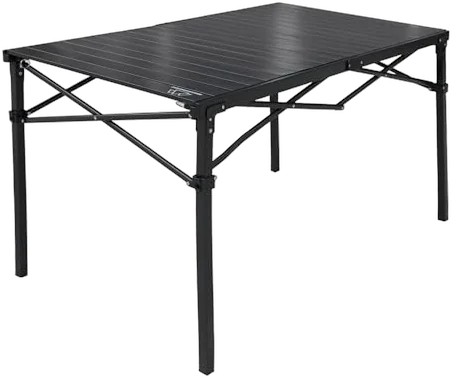
This is the table to buy if you are only buying one, and the reason is the frame rather than the top. Aluminum slats are close to universal in this category, so what separates a good roll-top from a wobbly one is how much the frame twists when you lean on a corner. The steel frame here gives up some weight and gains rigidity, which is the right trade for a boat that already carries a cooler and a groover.
Read the 70 lb capacity as a real constraint. It is plenty for a two-burner stove and a cutting board. It is not enough to be your water station and your prep counter at the same time, which is a good argument for pairing it with something rigid rather than buying a second roll-up.
The honest weakness is height. Like every packable roll-top, it lands in dining-to-slightly-taller territory rather than a true 40-inch counter, so it works best as the stove and appetizer surface while a taller rigid table takes the dish line.
Best Compact Roll-Up: Mountain Summit Gear Heavy Duty Roll Top Table (Medium)
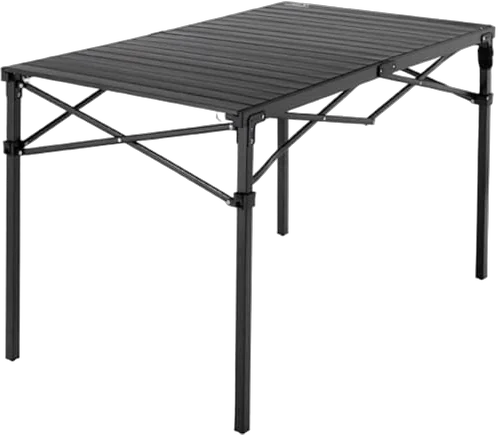
Buy the Medium as your second table, or as your only table if you row a 14-footer with a full frame. The build is the same, so you are trading working surface for a smaller packed slab, which is the trade that matters when the last thing to find a home is the table.
It is also the better bar table of the two. Setting the appetizer spread well clear of the cook is the single easiest fix for a crowded kitchen, and a smaller top actively discourages people from parking a cooler on it.
Best Budget Roll-Up: Coleman Compact Roll Top Aluminum Camping Table
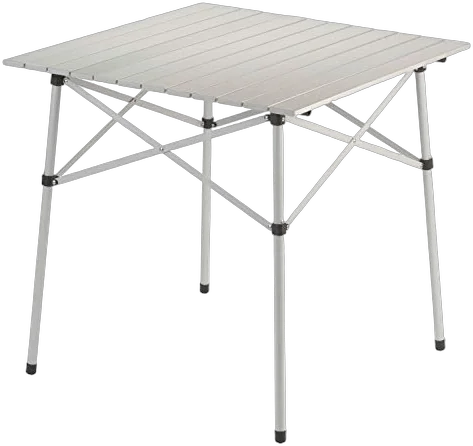
Budget picks in this category usually get recommended with an apology. This one does not need it, because the thing you actually want from a roll-up (a metal surface you can set a hot lid on) is present at the bottom of the market. What you give up is frame stiffness and leg adjustment, both of which matter more on the dish line than at the bar table.
Treat it as the third table. Buy something rigid for the wash station, buy one of the Mountain Summit Gear roll-tops for the stove, and let the Coleman be the surface that lives near the chairs and takes the beating nobody is careful about.
The snap-together legs are the part to watch. Sand in a snap fitting is the wear mechanism here, and rinsing the leg ends in the river before you break camp costs ten seconds and buys you seasons.
Best Seated Dining Table: Portal Lightweight Aluminum Folding Square Roll Up Table
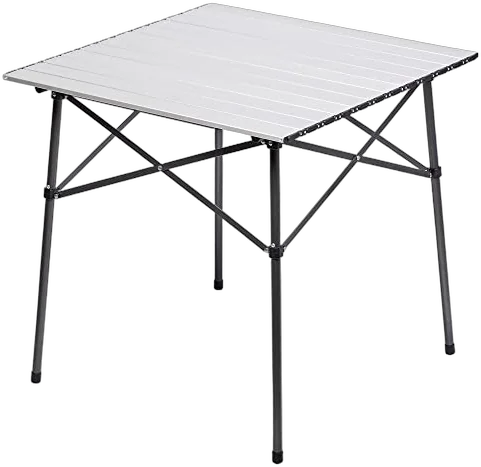
Most river kitchens solve dining by handing everyone a plate and pointing at a rock, which works right up until the trip has a couple of kids or a long lunch stop in the wind. Portal Outdoors sells this as a camping table, and the square dining-height top fixes the seating problem without adding a second stow problem, because it packs like the prep tables.
Rectangular counters push people into a line facing the same direction. A square top puts four people around it, which changes the feel of a camp more than the spec sheet suggests. Set it away from the stove and the wash line so the eating surface is not doubling as staging.
Best Camp Kitchens and Cook Stations
The difference between a table and a camp kitchen is where the spatula goes while you are stirring. In a kitchen there is a side table or a hook for it. On a plain table you set it down, and on a beach “set it down for a second” means picking sand out of it later.
That is the whole river case for a cook station. Integrated side tables and hanging storage keep utensils, the strainer, and the wash bins off the beach, which is also the practical version of the Leave No Trace point at the end of this guide. The second river case is breakdown: a one-piece setup has no separate legs, poles, or shelf pins to lose in dry sand at seven in the morning.
Shelving is where this category either fits your workflow or fights it. A portable kitchen table with a cabinet is only as good as what fits under it, and a river kitchen already has kitchen box dimensions baked into it, so match shelf height and clearance to your box rather than to the photo on the listing. A cabinet that cannot swallow your stove is storage you carry and never use.
One more framing point before the picks. A single cook station is one arm of the kitchen, not the whole kitchen. The layout that works on a beach is an L or an island, with the stove on one leg and prep and serving on the other, so buy a cook station expecting to put a table next to it.
Best Full Camp Kitchen: Mountain Summit Gear Deluxe Roll Top Kitchen Table
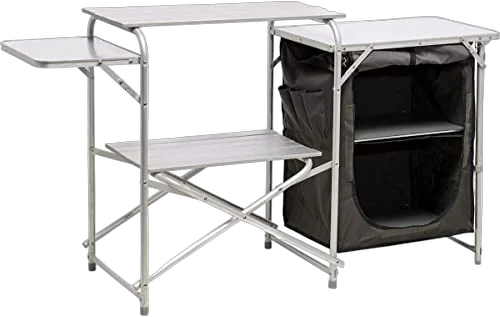
This is the pick that ranks organically as a bare Amazon listing for this keyword, which tells you the demand is real and not manufactured by reviewers. What it gets right for a river trip is that the whole assembly still packs to roughly a 32 x 20 x 4-inch slab at about ten pounds, so a full kitchen with shelving lashes flat to a dry box lid.
The adjustable legs deserve their own sentence. Every other feature on this table is convenience; the legs are the difference between a usable prep surface and a table you shim with driftwood. Set the two downhill legs long before you load anything on it.
Stock on this one moves. If it is unavailable when you go looking, the GCI cook station below covers the same job with a different shape, and it is not a downgrade.
Best Cook Station: GCI Outdoor Slim Fold Cook Station
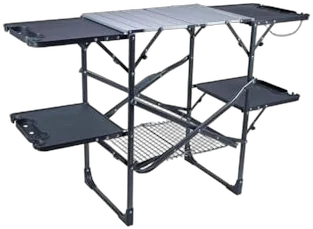
The Slim Fold is the cook station every camping-table roundup ranks, and for once the generic pick translates cleanly to a river. One-piece setup means the only thing you can lose at breakdown is the whole table, and the side tables keep the working clutter off the beach without a separate bin.
The trade is stow shape. It folds slim but it does not roll, so it wants a frame bay or a flat spot on a load rather than a rail. Measure before you commit, because a cook station that has nowhere to ride is the most annoying kind of gear to own.
Best Kitchen-Box Companion: Camp Chef Sherpa Camp Table and Organizer
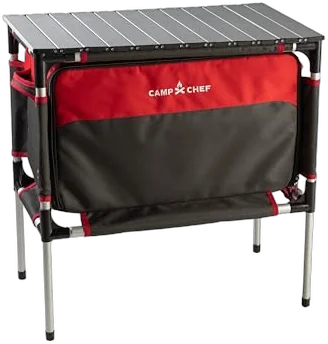
River kitchens are already organized around boxes, so a table that ships with its own four-compartment organizer slots into an existing habit instead of asking you to build a new one. The 27 by 17 inch top is small, which is the right size for the spice, utensil, and coffee station that always ends up crowding the stove counter.
The packed-in-its-own-bag detail matters more than it reads. Anything hard and loose in a frame bay makes noise and works itself out; a table that lives in a sack stays put and does not scuff a dry box lid.
Best Rigid Counters, Prep Tables and Ultralight Picks
This is the honest section. A four-foot HDPE fold-in-half from the hardware aisle, strapped to the frame, is what an enormous number of private trips are actually running, and on plenty of those trips it is the right call. It is also the surface you want if you cut anything, because HDPE is a cutting board and aluminum is not.
The catch nobody photographs is staining. Half-inch HDPE holds color permanently once you have cleaned fish or game on it, and no amount of scrubbing brings it back to white. That is a year-two problem rather than a reason to avoid the material, but you should know it is coming.
Adjustable-height rigid tables are the cheapest route toward prep height, and the fair version of that claim is that they get close without arriving. A hardware-store fold-in-half at its tallest setting is not a 40-inch counter. There is a well-known Mountain Buzz thread where a boater prices out a cheap conference table plus rust paint plus wood risers to reach counter height, then works out that the modifications cost more than the purpose-built river table he was trying to avoid buying.
Leg hardware is the other thing to get right. Painted or plain steel legs rust after a couple of trips of sand, river water, and dish soap, which is the first worry on every do-it-yourself river table thread. Anodized aluminum and powder coat are the finishes that survive.
Best Budget Rigid Counter: Lifetime Fold in Half Adjustable Folding Table (4 Foot)
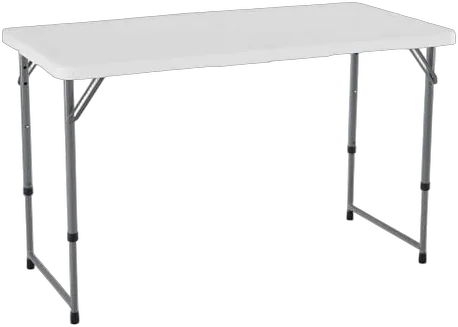
Buy this one for the wash line. It is heavier than any roll-up here, it does not care if somebody leans on a corner while reaching for a pot, and the HDPE top takes a knife and a hot pad without complaint. Folded in half it makes a flat slab that straps to a box lid, which is the same stow slot the roll-tops want.
Two honest limits. The height at its tallest setting is closer to a tall work table than a true river counter, so if your crew is over ten people you will still want something taller for the dish line. And the leg hardware is where a hardware-store table shows its price, so rinse it and let it dry before it goes back in the garage.
The upside is that nothing about it is precious. That is worth something on a boat.
Best Small Prep Table: HYMnature Folding Camping Table
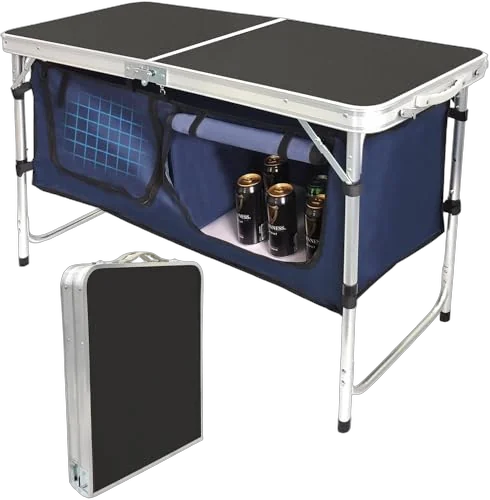
Small tables get dismissed in roundups because reviewers score surface area. On a river the small table is the one that ends up working hardest, because it becomes the coffee station in the morning, the spice and utensil shelf at dinner, and the drying rack for a wet strainer.
The storage compartment is the reason it earns the slot over a cheaper pad-and-legs design. Anything that keeps small metal objects off a beach is worth carrying, since a fork in dry sand is a fork you find in November.
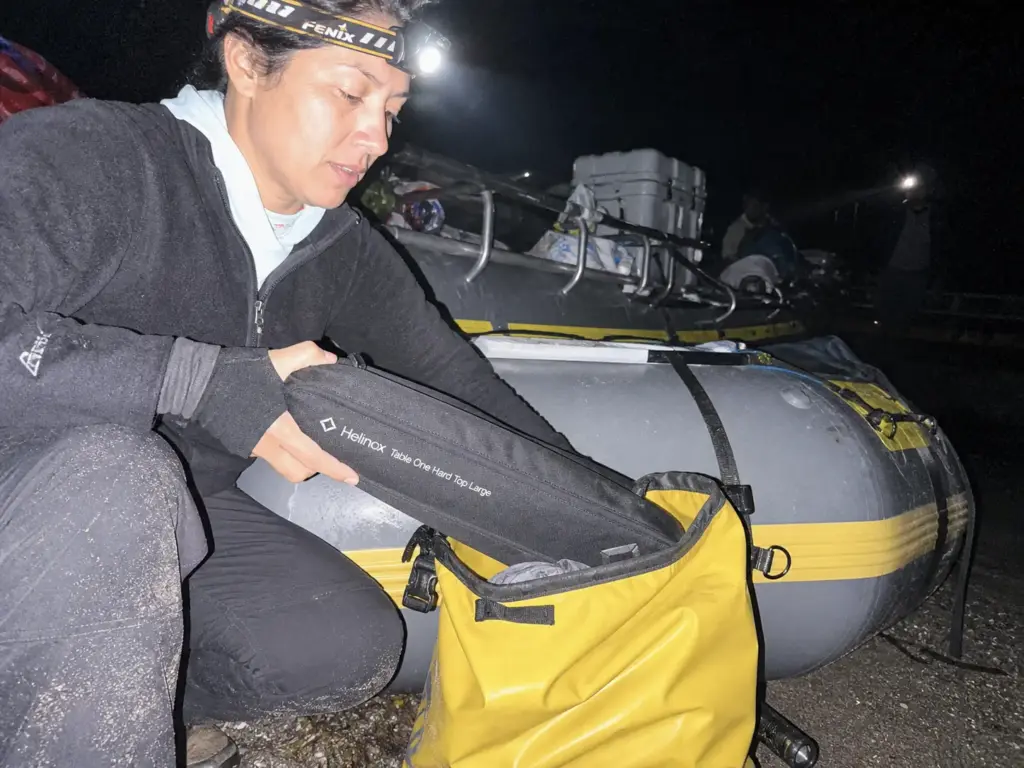
Best Ultralight / Dry-Bag Packable: Helinox Table One Hard Top Large
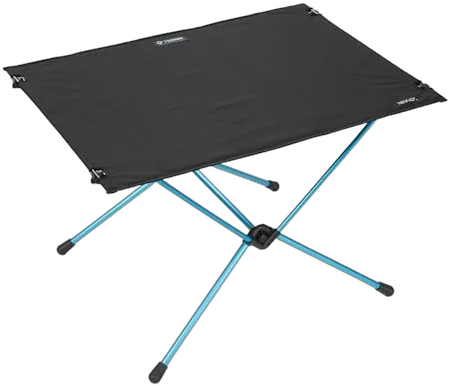
Ultralight is a different question from everything else on this page. Nobody buys a 3.4-pound table because it is a better work surface; they buy it because the boat has nothing left to give. A packraft, a cataraft with no spare frame bay, or a 16-footer already at its weight limit are all the same problem, and this is the answer to it.
Because the packed bundle is 6.5 by 4.5 by 23.5 inches, the table lives inside your soft gear rather than on the frame. That only works if the bag itself works, so pair it with a dry bag that actually keeps its seal when the boat goes over and stop thinking about it.
Be clear-eyed about the height. At 19.5 inches this is a platform for a two-burner stove, a place to set a cooler lid, or a low table for drinks. Trying to use it as a prep counter puts you right back in the bent-over posture the first section was about.
Frame-Mount River Counters and What They Actually Cost
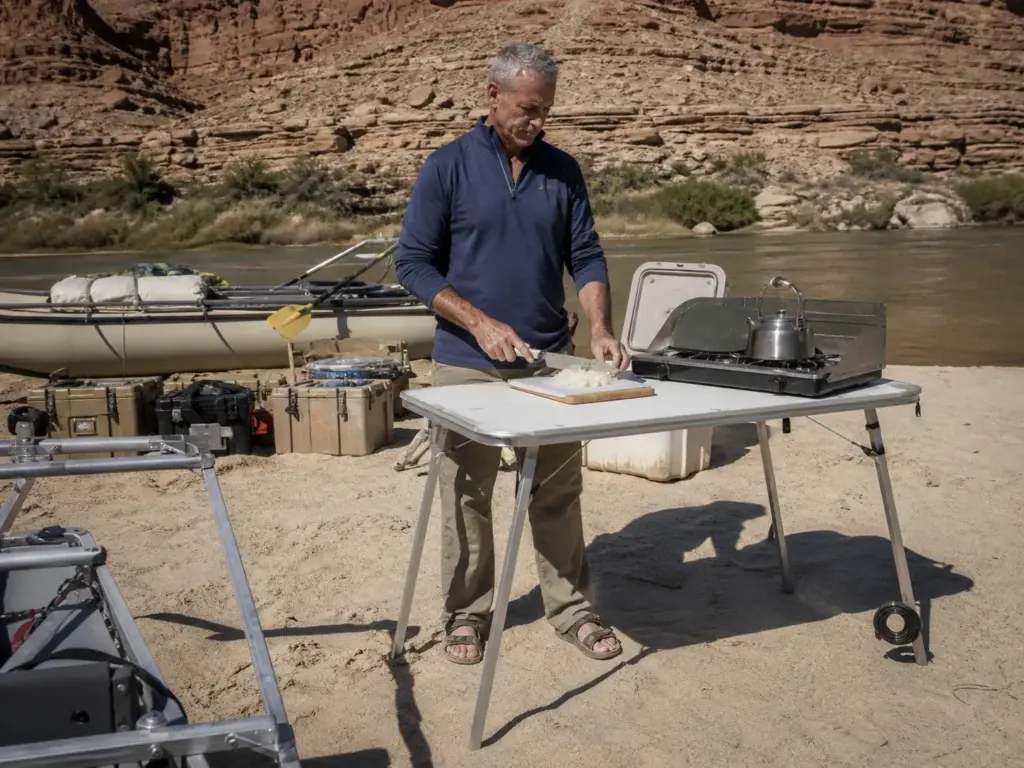
You notice these boats at camp before you notice anything else. The kitchen goes up in about ninety seconds, because the counter was already part of the frame all day and nobody had to dig it out from under a load. This is the product category that real river runners argue about by name, and not one generic camping-table roundup acknowledges that it exists.
Start with the reference standard so the numbers are concrete. The NRS Campsite Counter is 68 inches long, 18 inches wide, and 40 inches tall, weighs 38 pounds, and puts a half-inch ripple-textured HDPE top on 6063 aluminum square tubing, shipped with a heavy-duty tiedown strap.
NRS also builds a wide version at 48 by 24 inches and 31 inches tall for 35 pounds, which is a dining and serving table rather than a prep counter. Same brand, same materials, and the nine-inch height difference changes what the table is for. Height is the whole decision, again.
Two details in that spec sheet are worth pulling out, because they are the parts a camping-gear reviewer would skip. The top is ripple-textured rather than smooth, which gives spilled water somewhere to go and keeps a wet cutting board from sliding when the table is not perfectly level. And the counter ships with a one-inch heavy-duty tiedown strap in the box, which tells you the manufacturer considers strapping it to a frame part of the product rather than an accessory.
The 18-inch width is the other quietly deliberate number. It is narrow for a kitchen counter and exactly right for a table that has to lie flat against a frame bay all day without stealing rowing space or catching a knee. Length gets you working surface; width gets you a table that fits the boat.
The pair boaters actually compare every season is the NRS 68 by 18 against a Salamander 72 by 20 that runs roughly ten pounds lighter. On Mountain Buzz the two price out within a few dollars of each other, so the argument turns entirely on features, and specifically on the Salamander’s adjustable leveling straps.
Those straps solve a problem that only exists on a boat. A frame-mount counter usually spans two gear boxes or a box and a cooler, and those are almost never the same height. Leveling straps let the table sit square across the mismatch instead of rocking on the taller one. That is a rigging problem rather than a camping problem, which is exactly why no consumer reviewer has an opinion about it.
The rest of the category
Down River Equipment builds a half-inch HDPE poly deck on anodized aluminum pipe, designed to fasten to the bay of any rowing frame and match their poly decks. The important idea there is that the tabletop is structural deck space while you row and a counter when you land. Anodized aluminum pipe rather than painted steel is the other tell that this was designed for a river, since anodizing is one of the two finishes that survives repeated sand and dish soap.
SDG River Gear makes all-aluminum nesting kitchen tables in Oregon, and the forum verdict on those is consistently that they cost a lot and are expected to last decades. Nesting is the feature worth understanding there: two tables that stack into one another take up close to one table’s stow footprint, which is how a crew gets both a stove counter and a wash counter onto a boat that only has room for one.
Now the quiet part. None of these are sold on Amazon. They are specialty-direct, they run roughly $280 to $550 as a category, and a 38-pound table is only worth carrying if it earns its weight twice. Worth knowing before you fall in love with a spec sheet: NRS and Down River Equipment build the frames these counters bolt into, so frame compatibility is a real question to answer before you order.
It does earn its weight twice, though, and that is the argument for the whole category. A counter-height river table straps to the frame during the day, where it becomes passenger seating or a gear-loading deck. At camp it becomes the only surface in your kitchen tall enough to run a dish line standing up.
Carrying 38 pounds of table that does nothing all day is a bad deal. Carrying 38 pounds of table that is also your deck is a different calculation.
Who actually needs one
Crew size is the honest threshold. Below about six people, one adjustable rigid table and one roll-up cover the whole kitchen, and a 38-pound counter is weight you are carrying for the look of it. Past eight or ten, the dish line becomes a job that runs for forty minutes after every dinner, and the person doing it is either standing up straight or wrecking their back.
Trip length is the second filter. On a three-day float you can tolerate a compromise; on a two-week Grand Canyon permit you are setting up and breaking down the same kitchen thirteen times, and the ninety-second setup starts compounding. That is the calculation, and it has nothing to do with how the table scores in a review.
The last filter is your frame. A counter designed to fasten into a bay needs a bay of roughly the right rectangle, and a cataraft or a small paddle-frame may simply not have one. Measure the opening and the rail spacing before you order, because frame-mount is a fit question first and a table question second.
If you want the frame-mount result on an Amazon budget, the closest approach is a stack rather than a single purchase: the adjustable-height rigid counter from the section above for the wash line, plus an aluminum roll-top for the stove. That gets you a knife surface and a heat surface at two different heights, which is the two-table answer this article’s title promises and about a third of the outlay.
The DIY option nobody in a roundup mentions
There is a third path between a $90 roll-up and a $450 counter, and it is the one that actually fills a lot of river kitchens: a DIY camp table cut to your own frame. The build is a marine-grade plywood or half-inch HDPE deck on anodized aluminum or powder-coated tube legs, sized to the bay you measured earlier, and the whole reason it exists is that nobody sells a 40-inch counter dimensioned to your specific frame.
The forum threads on these all open on the same worry, which is leg hardware rather than the top. Painted steel legs and unsealed plywood edges are the two failure points, so the build details that matter are anodized or powder-coated tube and epoxy on every cut edge of the ply. Get those two right and a shop-built table outlives the boat.
Be honest about the price tier it lands in, though. Marine ply and aluminum tube are not cheap, and by the time you have bought stock and hardware you are usually inside a hundred dollars of the Salamander. The DIY case is fit and height, not savings, which is exactly why it wins for a boat with an odd frame and loses for anybody with a standard bay.
What Canyon Sun, Sand and Grit Do to a Table
Every camping-table review answers “which material should I get?” from a campground, and campgrounds have trees. Here is the river answer, which is different in four specific ways.
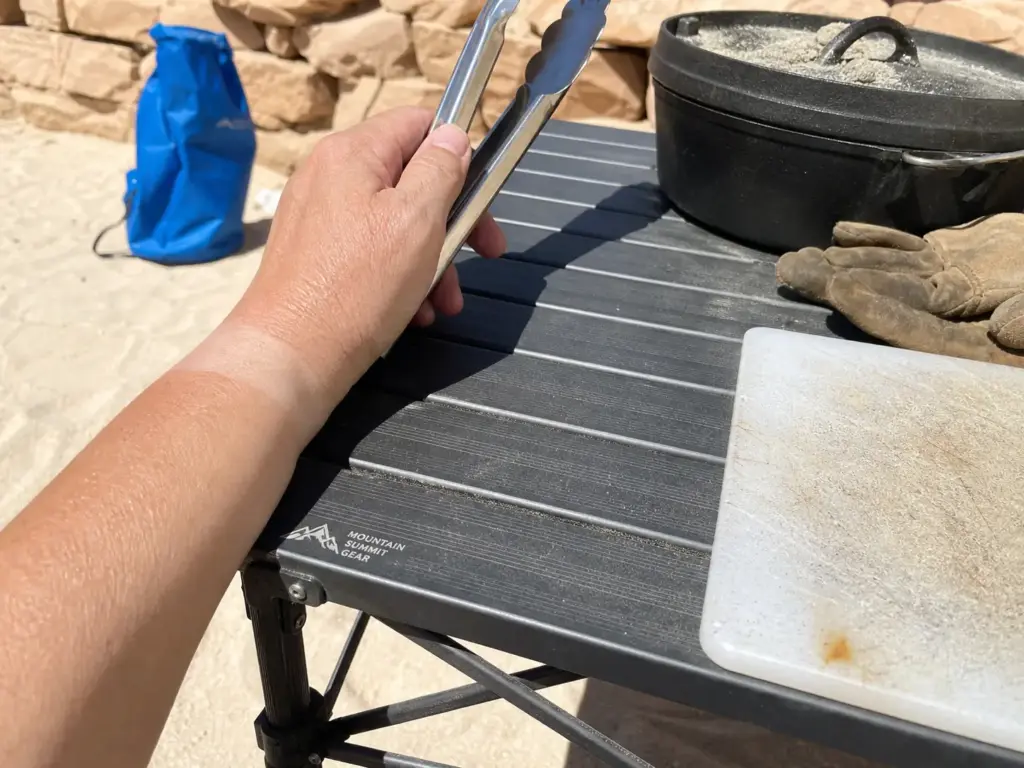
Third night on a desert canyon trip. The aluminum top has been in direct sun since ten in the morning, and you reach across it for the tongs with a bare forearm. No gear review has ever mentioned that a table can burn you, because no gear reviewer has left one in unshaded canyon sun for six hours. Aluminum is chosen precisely because you can set a hot pot or a Dutch oven straight down on it, and that same conductivity is what makes it a hot surface long before dinner.
It is not a reason to avoid aluminum. It is a reason to know which of your two tables is the one you lean on.
The protocol is simple once you have named the problem. Put the aluminum table on the shade side of the kitchen if the camp gives you any shade at all, and if it does not, throw a wet dish towel or a spare dry bag across the section people reach over. Reserve the aluminum for the stove and the hot-pot landing zone, and do the actual food handling on the other table.
The same conductivity that burns you at four in the afternoon is genuinely useful at seven. A Dutch oven comes off the coals with nowhere good to go, and an aluminum slat top absorbs that without scorching, warping, or off-gassing the way a plastic top would. Read it as a specialized surface with a schedule rather than a flaw.
The four tops, ranked by what a river does to them
Four surfaces show up in this category and they sort cleanly once you rank them by heat resistance rather than by looks. An aluminum tabletop takes the hot pot and gets hot in the sun. Half-inch HDPE takes the knife and stains. A bamboo tabletop photographs beautifully and is the worst of the four here, because bamboo is a laminate held together with glue and a week of wet-dry cycles on a sandbar is exactly the load that opens a laminate seam.
The fourth is wood slats, and the original river roll-up used tamarack wood slats for a reason: wood does not conduct heat into your forearm and does not go soft in the sun. It also does not take a Dutch oven straight off the coals, so it is a serving and dining surface rather than a stove landing zone.
Frames sort the same way and the finish matters more than the metal. Powder-coated steel and anodized aluminum are the two finishes that survive repeated sand, river water, and dish soap, and painted steel is the one that does not. That is the single spec to read on a budget table, because the top is rarely what fails.
Weather-resistant is a word every listing uses and none of them define. On a river it means one specific thing: the table gets rolled up wet, stays in a carry bag on a hot boat for six hours, and comes out without a delaminated seam or a rust bloom at the leg ends. Bamboo and painted steel both fail that test; aluminum and powder coat both pass it.
HDPE stains, and it is permanent
Half-inch HDPE is the cutting-board surface, and the trade for that is color. Clean fish or game on it through a week-long trip and it never comes back to white, no matter what you scrub it with. Boaters find this out in year two, usually while apologizing to somebody about the state of the table.
Nothing about the surface is compromised, which is the part worth holding onto. HDPE is a cutting board precisely because it takes a knife without dulling it and without opening a groove that traps food, and a stained board does that exactly as well as a new one. Treat the color as cosmetic, keep the staining on the table you already designated for knives, and stop scrubbing.
The half-inch thickness is doing real work here too. A thin poly top flexes under a chef’s knife and a thin top on a cheap table telegraphs every leg wobble into your cut. Half an inch of HDPE is stiff enough that the surface stays a surface, which is why the purpose-built river counters all specify it.
Legs and hardware are where sand actually wins
The tabletop is rarely what fails. Painted or plain steel legs rust after repeated cycles of sand, river water, and dish soap, which is why anodized aluminum and powder coat are the river-durable finishes and why every do-it-yourself table thread opens on leg hardware. Grit in folding-leg joints and roll-top hinges is the second mechanism, and it is one generic reviews cannot model: a campground table gets set on grass a few times a year, and a river table gets set on sand twice a day for eight days straight.
The particle size matters too. Coarse beach sand shakes out of a hinge; fine silt off a spring runoff bar packs into the joint and turns to grit paste as soon as it gets wet. A folding camp table that lives on silty bars needs its hinges worked open and rinsed more often than the same table on a clean sand beach.
The maintenance version of all this takes two minutes. Rinse the leg ends and the hinges in the river before the table rolls up, and let the bundle dry in the sun at lunch rather than packing it wet. Do the same rinse at the take-out, before the table goes in the truck for a month. Sand that leaves the joints at camp is sand that never grinds.
Carry one heat surface and one knife surface. Aluminum for the stove side, half-inch HDPE for the prep side. That is the material argument for two tables, and it is the same conclusion the height argument reaches from the other direction.
What a campground reviewer cannot test
The gap between a camping-table review and a river table is not effort, it is exposure. A campground table gets unfolded on grass in dappled shade a handful of times a season, wiped down, and put back in a garage. A river table gets set on abrasive sand twice a day for eight days straight, rinsed in silty water, and rolled up damp.
That difference explains almost every failure boaters actually report. Rust on painted legs shows up because the leg ends spend a week alternating between wet sand and dish soap. Hinge stiffness shows up because grit gets into a joint that was designed to pivot in clean air. Neither one is in the product description, and neither one is a defect the manufacturer would recognize.
It also explains why river runners weight materials so differently from reviewers. Anodized aluminum and powder coat are not premium finishes on a river, they are the entry requirement, and a table with painted steel legs is a table with a known expiry date no matter how good the top is.
The charcoal question belongs here too, because it is the one place the heat story turns into a real hazard rather than an inconvenience. A tabletop is not a fire pan. Keep the coals off it and keep the charcoal in a fire pan where it belongs, then use the aluminum top for the Dutch oven once the lid comes off and the pot needs somewhere to land.
Wind, Wobble and Uneven Sand
There is a moment on every beach camp when an upcanyon wind comes through and takes an empty roll-up off the sand. Everybody watches it go, and everybody learns the same thing at once: a table with nothing on it is a sail.
Write that down as the operating rule, because it is more useful than any stability rating. An empty table is a sail. A loaded table is furniture. Never leave a light table standing unloaded on an open beach, either weight it or strike it, and the decision takes about four seconds once you have seen it happen.
The load that holds a table down is whatever is already heavy in your kitchen. A full water jug is the best single object for the job, and a closed kitchen box or a cased stove works nearly as well. What does not work is a stack of plates and a bag of chips, which is exactly what tends to be on the table at the moment the wind arrives.
The pattern to build is a habit, not a decision. When the kitchen goes quiet, either something heavy goes on every standing table or the light ones come down. Upcanyon wind in a desert sandbar camp tends to build in the afternoon and again at dusk, so the two moments people wander off to swim or set up tents are the same two moments the tables are empty.
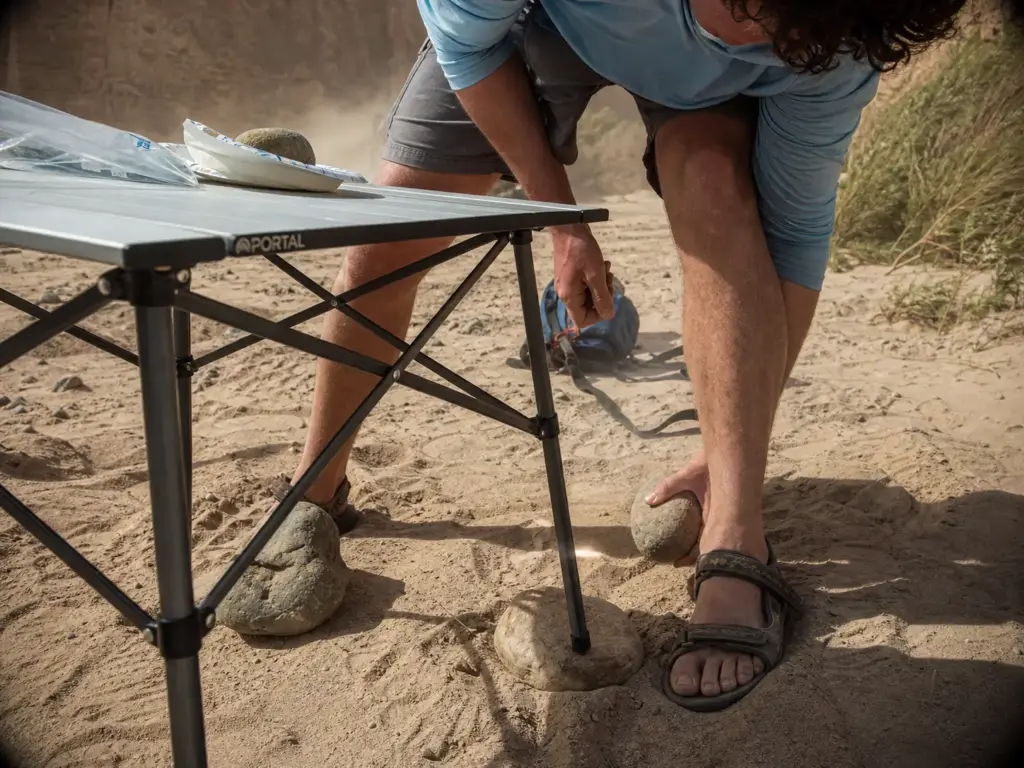
Wedge rocks behind and inside the legs. On the NRS-style counter, boaters put it flatly: it is expensive, but once it is set up with some rocks wedged behind the legs it will hold in strong wind. Free, works, and it appears in exactly zero product reviews.
How the rock trick actually works
The rocks are not decoration and the placement matters. Put them behind the legs on the downwind side, so the leg has something to push against instead of skating, and wedge a second set inside the leg frame where the wind wants to lift and pivot the whole table. A table fails by sliding first and tipping second, and the two rock positions address the two failure steps separately.
Size beats quantity. Two rocks you can barely lift do more than a dozen fist-sized ones, because small rocks just bury themselves in dry sand under load. Set them, then push the table hard from the upwind side and see whether anything moves before you trust it with dinner.
When the camp has no rocks, and plenty of sandbars do not, the substitutes are worse but real. Dig the downwind legs four or five inches into the sand so the leg ends sit below the surface, then load the top. Hanging a full water jug from the frame with a strap is the other option, and it works because it puts the weight low instead of on the sail.
Weight inverts on an open beach
Every generic roundup scores lighter as better, because every generic roundup is thinking about a trunk and a walk from the parking lot. On an exposed sandbar the ranking flips. A 38-pound table is the one still standing when the wind comes up, and that is the honest argument for carrying something heavy on a boat that is already heavy.
The corollary is that the ten-pound roll-ups are the known weak point in this whole category. The Camp Time Roll A Table is genuinely loved and openly described as rickety in a stiff wind, and both of those things are true at once. A light roll-up is the correct table for appetizers and a poor table to leave standing while everyone goes swimming.
The capacity gap tells the same story from the load side. Roll-ups cluster at 70 to 100 pounds of rated capacity, while a rigid river counter takes what a boater would call massive loads by comparison, and that gap is the actual buying decision in this category. Packability on one side, and the ability to hold a Dutch oven plus a water jug plus somebody leaning on the corner on the other.
Read that as an argument for owning both rather than picking a winner. The roll-up is the table you can physically get onto the boat; the heavy one is the table that behaves when the beach turns hostile.
Level beats sturdy, and adjustable legs get you level
Wobble on a beach is usually a leveling problem rather than a build problem. No river beach is flat, none of them stay flat once twelve people have walked past the kitchen, and sand under a loaded leg keeps moving all evening. Individually adjustable legs, or leveling straps on a frame-mount, turn a wobbly table into a usable one in about ten seconds.
The test that actually predicts a table’s behavior is a corner load, not the centered capacity number on the listing. Push down on one corner the way somebody does while reaching across for a pot. If the frame twists or a leg lifts, the number on the box is describing a laboratory and not your camp.
Rated capacity is measured with weight spread evenly over the middle of the top, and nothing in a river kitchen is spread evenly over the middle of the top. A cooler goes on one end, a stove on the other, and a person’s forearm lands on whichever corner is closest. A table that passes the corner test at half its rated number is more useful than one that passes the centered test at full.
Sequence matters on sand too. Level the legs first, load the table second, and check it again ten minutes later, because dry sand keeps settling under a leg that just picked up thirty pounds. Setting the two downhill legs long before anything goes on top is the whole trick, and it takes less time than fixing it after a pot slides.
How a Table Rides on a Boat That’s Already Full
Rigging morning. Everything has a home except the table, and the table is the thing you bought last. This is the question every competitor answers with “does it fit in your trunk,” which is useless to a boater, so here are the numbers in raft terms.
Packed bundle geometry is the make-or-break spec. A Camp Time rolls to a 32-inch bundle 5.5 inches across. The Mountain Summit Gear roll-tops pack to a roughly four-inch-thick slab of about 32 by 20 inches.
The Helinox Table One Hard Top packs to 6.5 by 4.5 by 23.5 inches at 3.4 pounds. Those three shapes do not compete for the same space on a boat, which is the point.
Inside the ultralight category the sizing choice is real as well. The Regular version of that table sets up at 23 by 15 inches, weighs about two pounds, and packs down to roughly 4 by 5 by 16.5 inches, which is small enough to disappear into a half-full dry bag. The Large gives you a genuinely usable stove platform for the cost of a bundle about seven inches longer. Decide that one on how much of the bag you are willing to spend.
The three stow options that actually exist
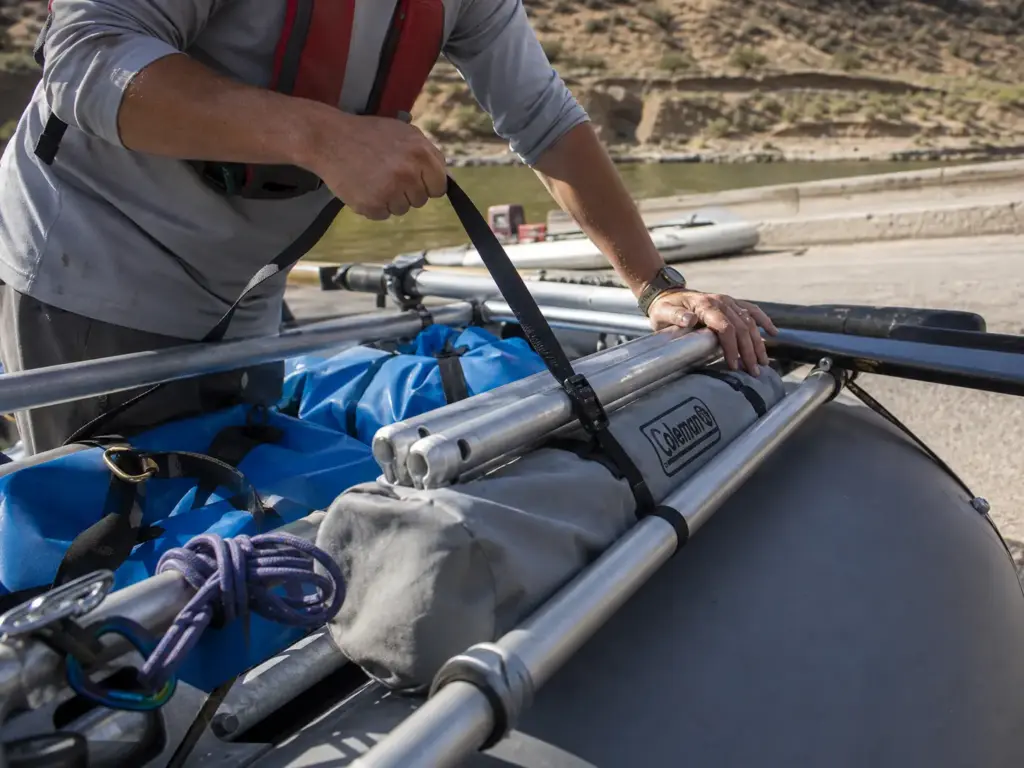
- Rolled bundle along a frame side rail. On an oar rig a 5.5-inch tube lashes parallel to the rail like a spare oar, out of the way of your feet and clear of the bay. This is why bundle diameter matters more than bundle weight.
- Flat slab on a box lid. A four-inch slab straps to the top of a dry box or kitchen box and adds almost no height to the load. It also means the table and the box come off together at camp.
- Small table inside a dry bag. A 2 to 3.4 pound table disappears into soft gear, which is the only option left on a packraft or a cataraft with no free bay.
Whichever one you use, the table gets strapped like everything else. Nothing on the boat is loose, and that includes a rolled table: a tube that comes free mid-rapid is a snag and a swim hazard, not just lost gear. Use the straps that hold a rolled table flat against a frame rail and cinch it the same way you would a dry box.
Two strap details are worth getting right on a table specifically. Run the strap over the bundle in two places rather than one, because a single mid-span strap lets a rolled table pivot and work its way out. And keep the buckle on the outside of the rail where you can reach it standing next to the boat, since the table is often the first thing you want off at camp and the last thing you want to fight for.
Match the hardware to the job while you are at it. Two short lashing straps hold a rolled bundle against a rail better than one long cargo strap run over the whole load, because the long strap is doing three jobs at once and the table is the piece that slips when any one of them shifts. And leave the table in its storage sack if it came with one, since the sack keeps the slats from clattering against the frame all day and keeps sand out of the roll.
The drift boat version of this problem is worth naming, because a lot of river kitchens ride in one. There is no frame rail to lash to and no bay to fill, so the answer collapses to the flat slab on a dry-box lid or the small table inside a bag. That is the boat where packed thickness stops being a preference and becomes the only spec that matters.
Measure the boat before you buy the table
Three numbers on your own rig decide this purchase, and almost nobody writes them down before shopping. The clear length of a frame side rail tells you the longest bundle you can lash there. The outside dimensions of your dry box or kitchen box lid tell you the biggest flat slab you can strap on top. And the open rectangle of any spare frame bay tells you whether a rigid table is even a candidate.
Take those three numbers with a tape measure on a dry driveway, not from memory at the put-in. Then compare them against the packed dimensions in the product listing rather than the set-up dimensions, which is the number every listing leads with and the number that tells you nothing about rigging.
There is a bonus in the tall-table option that the packed-size math misses. A counter-height river table strapped into a frame bay earns its weight twice, because it is deck space and passenger seating on the water before it is a counter at camp. The roll-ups cannot do that, which is part of why a lot of experienced boats carry one of each.
Match the stow plan to the boat before you buy, not after. A cataraft with no free bay, a packraft, and a 16-foot gear boat with a full frame are three different answers to the same shopping question, and the table is the piece of kitchen gear most likely to be bought without checking.
Building the Kitchen Around Your Tables
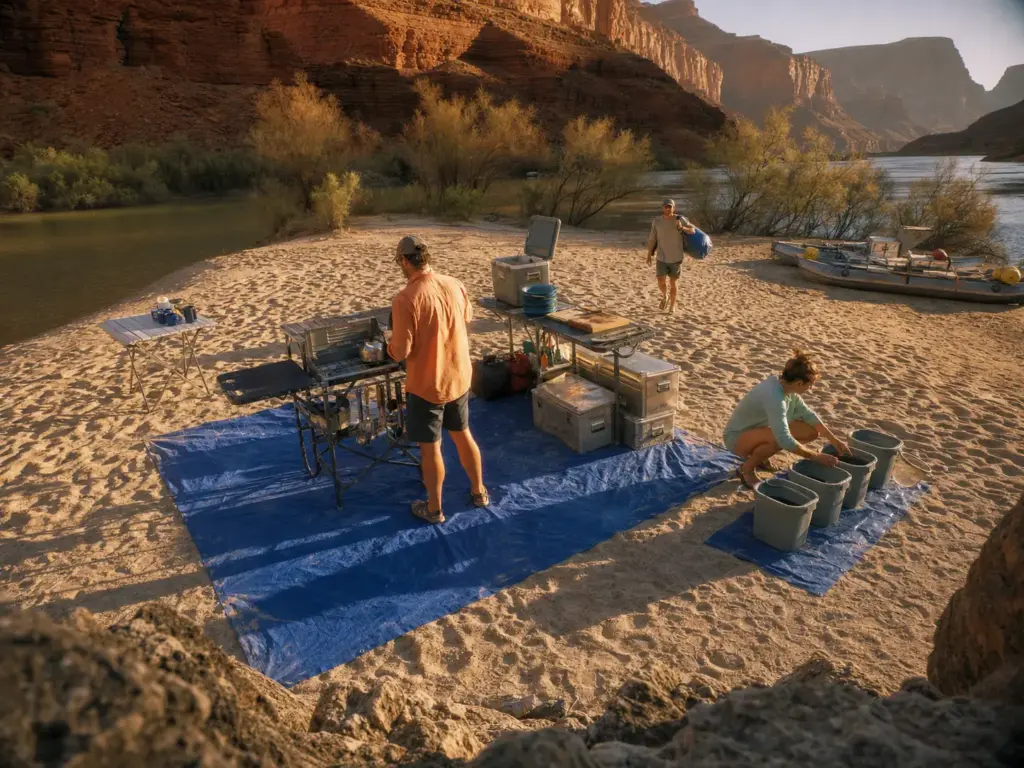
Camp goes up in the same order every night on a well-run trip, and the tables go down first because everything else hangs off them. That order is the reason this guide keeps arriving at two tables instead of one, and it is worth seeing the finished kitchen before you buy anything.
Build the kitchen as an L or an island. Stove counter on one leg, prep and serving on the other, and the appetizer and bar table pulled well clear so the cook is not fighting through six people to reach the Dutch oven. A straight line puts everybody in the same aisle.
The permit sets your footprint
Grand Canyon noncommercial regulations require a tarp in the kitchen area and another under the dishwashing setup, plus a food strainer, and the Park Service’s noncommercial river trip regulations require a tarp under the kitchen and dishwashing area in writing rather than as a suggestion. The recommended dish standard there is a four-bucket line. That combination sets a minimum footprint, so pick a table length and height that lets a tarp and the buckets live under and beside it instead of discovering the geometry at camp.
Worth reconciling a number our own guide uses: our river camping and kitchen gear article teaches a three-bucket wash line, and the Grand Canyon standard adds a fourth. Both are common and both work. The three-bucket version is wash, rinse, and sanitize; the fourth adds a pre-rinse or a second rinse depending on who taught you. Say which one your trip is running at the put-in so the bucket order does not get invented nightly.
The food strainer is the small required item that changes where the table goes. Every bit of solid food out of the wash water has to be caught and packed out, which means the strainer needs a home at the end of the bucket line and a bag next to it. Give the wash counter about a foot of clear surface past the last bucket for exactly that, and the whole line runs without anyone shuffling gear.
The loadout that actually works
Here is the system the forums keep arriving at, stated plainly. Two counter-height tables plus one or two roll-ups, per boat or per trip depending on crew size. One tall table takes the stove and prep, the second tall table takes the wash line, and the roll-ups handle appetizers, drinks, and the coffee station in the morning.
The reason it is two tall tables and not one long one is traffic. A single counter forces the cook and the dish crew into the same three feet of space at the same time, which is the argument that ends every night with somebody reaching over a hot pan. Splitting the two jobs onto two surfaces on different legs of the L solves it with no extra gear beyond the table you were going to buy anyway.
The roll-ups exist to move people. An appetizer table set fifteen feet from the stove pulls the crowd out of the kitchen without anyone having to ask, and that single placement does more for a cook’s evening than any product on this page.
Food safety drives the layout, not just the menu
The same regulations put real numbers on it: hot food held above 140°F, cold food below 45°F, and leftovers reheated to 165°F. On a 105-degree sandbar the working window between those temperatures is short, which makes a counter run that goes cooler, then prep, then stove in one motion a safety feature rather than a nicety. It is also the reason a long table beats two short ones set apart, and it depends on the cooler temperatures those numbers depend on holding through day six.
The mat, the boxes and the groover
A sand or mesh catch mat under the kitchen is standard river practice, and the table and the mat are one system. A table set straight on the beach with no catch surface is micro-trash waiting to happen, which is the practical reading of Leave No Trace’s waste-disposal principle on a beach camp: crumbs and spills land on something you can pick up and shake out downstream.
Kitchen boxes finish the layout. They set the height of the surfaces they sit under, they hold the stove, and their lids are the surface you already own. Put them at the inside corner of the L so both counters can reach them.
Camp geometry beyond the kitchen matters for the same reason the L does, which is traffic. The kitchen goes where the crew flows past it rather than through it, and how far the groover sits from the kitchen is the other distance to settle before anyone unrolls a sleeping pad. Get those two placements right and the tables stop being furniture and start being a kitchen.
The Two-Table Answer
Height decides everything. Forty inches is a prep and dish counter, twenty-eight to thirty-one is a dining table, and buying for the photo instead of the job is how a kitchen ends up with three of the same surface.
Carry one heat surface and one knife surface. Aluminum takes the hot pot, half-inch HDPE takes the blade, and that split is why the answer to this keyword is two tables rather than a single best pick.
Weight is a feature on an open beach. The table still standing in a stiff upcanyon wind is the heavy one with rocks behind its legs, and lighter only wins on the walk from the truck.
Before the next trip, set your table up in the driveway with a full water jug on it and lean on a corner the way you actually will at camp. You will know inside ten seconds whether you own a counter or a card table.
Frequently Asked Questions
01What size camp table do I need for a multi-day river trip?
For the prep and dish station, look for a table around 35 to 40 inches tall and at least 4 to 6 feet long. That is the height river runners keep asking for on forums, and the length that lets a wash line and a stove share one counter. Dining tables run 28 to 31 inches.
02Can you mount a camp table to a raft frame?
Yes. Frame-mount river counters are a real product category built for it. Down River Equipment tables fasten into the bay of any rowing frame, and Salamander uses adjustable leveling straps to sit square across uneven gear boxes. None are sold on Amazon, so plan on ordering specialty-direct.
03What is the difference between a roll-top table and a river counter?
A roll-top packs to a tube or a thin slab and carries roughly 70 to 100 lbs. A river counter is a rigid 38-lb table about 40 inches tall that straps into your frame and takes real load. Roll-tops win on packing, counters win on height and wind. Most river kitchens carry both.
04How do you keep a camp table from blowing over on a sandbar?
Load it or strike it, because an empty table on an open beach is a sail. The standard river fix is wedging rocks behind and inside the legs, which boaters report holding a counter steady in strong wind. Adjustable legs help too, since an unlevel table tips long before a level one.
05Do you need a tarp under your camp kitchen?
On a Grand Canyon noncommercial permit, yes. The regulations require a tarp in the kitchen area and under the dishwashing setup, plus a food strainer. Even where it is not required, a tarp or mesh sand mat is standard practice on beach camps so crumbs and spills stay out of the sand.