
In this article
Night three of a six-day trip. The wind is coming up the canyon, six people are waiting on dinner, and the igniter on your two-burner clicks and clicks and gives you nothing. Every river guide has watched some version of that evening happen, and it is the reason river stoves get judged on completely different criteria than the ones you’d apply to a car-camping stove. What matters is what survives being strapped to a frame, soaked, and run twice a day for a week straight while feeding a full crew. Here’s the fuel math, the burner math, the rigging, the permit rules that can override all of it, and the eight stoves actually worth your money.
Why a River Stove Is a Different Animal
You have probably already read a backpacking-stove roundup or two, and you’re wondering whether a river trip really changes the criteria. It does, in four specific ways almost nobody writes down.
The first is duty cycle, and it’s the hidden spec on every listing. A car-camping stove gets used maybe a dozen times a season, on dry ground, with a garage twenty minutes away. A river stove runs breakfast and dinner for six days straight and then goes back into a rocket box still wet. Parts that hold up fine over a dozen weekend uses start showing their weakness on trip three.
The second is that the stove lives on a moving boat. It rides strapped to aluminum frame tubing or lashed flat to a table, which means the design has to tolerate compression from cinched straps, constant vibration through rapids, and the real possibility of a swim. The third is water. Nothing on a raft stays dry, so the useful question is never how to keep the stove dry but what still works after it isn’t.
The fourth is crew scale. A stove that makes one person’s dinner beautifully can be functionally useless in front of eight hungry people at 8 p.m.
Pack the stove where it comes out first and goes in last. Setting up a river kitchen already runs 15 to 20 minutes per camp once you unstrap, unfold tables, hang the dish line and rig handwash. A stove buried under three rocket boxes turns that into thirty, twice a day, for the whole trip.
That framing matters because the stove is one component in a larger system, and buying it in isolation is how people end up with a great stove and no way to use it. If you’re still assembling the rest, start with the full river camping and kitchen kit your permit expects you to have and slot the stove into it.
Fuel Type for Multi-Day River Trips
On a raft you are not counting grams. You’re counting cubic inches, cold mornings, and how many failure points sit between you and hot coffee. That inverts the usual backpacking logic in a way most river gear writing never corrects for, because the fuel that wins on a river trip is frequently the heavy one.
Start with the raw numbers, then ignore half of what they imply. Propane carries roughly 90,000 BTU per gallon. White gas carries about 125,000, so it packs meaningfully more heat into the same volume.
But stove design moves real-world boil time more than fuel chemistry does, so a bigger-BTU fuel in a badly designed burner still loses to a well-built propane stove. Buying on BTU-per-gallon math alone is how people end up with a stove that looks better on paper than it does on a beach.
Cold-start behavior is where the decision actually gets made. Propane stays usable down to roughly -43°F with nothing required of you but a valve turn. White gas has a flashpoint near -7°F and needs priming, which means a small pre-burn ritual performed on a windy gravel bar with cold hands before you get a usable flame.
That’s one more step and one more failure point at exactly the hour of the day when the crew has the least patience. It’s a fair trade for a solo boater who values field repair over convenience, and a bad one for a group cook.
Weight, the deciding factor in every backpacking comparison, barely registers here. A one-pound propane cylinder and a 12-pound two-burner are both trivially rowable, which is precisely why propane cylinders and heavy steel two-burners dominate river kitchens while backpackers avoid them on principle. Reading river gear through a backpacking lens gets this exactly backwards.
Canister fuel, the isobutane-propane blend in the small screw-top cans, is the backup and personal fuel. It lights instantly, burns clean, and has almost nothing to go wrong. The catch is that canisters are discrete units you can’t top off, so you’re guessing at consumption and carrying partial cans home. Wood-biomass stoves are the fourth option, the one that requires no rigged fuel at all, and they run headfirst into fire restrictions in a way that deserves its own section below.
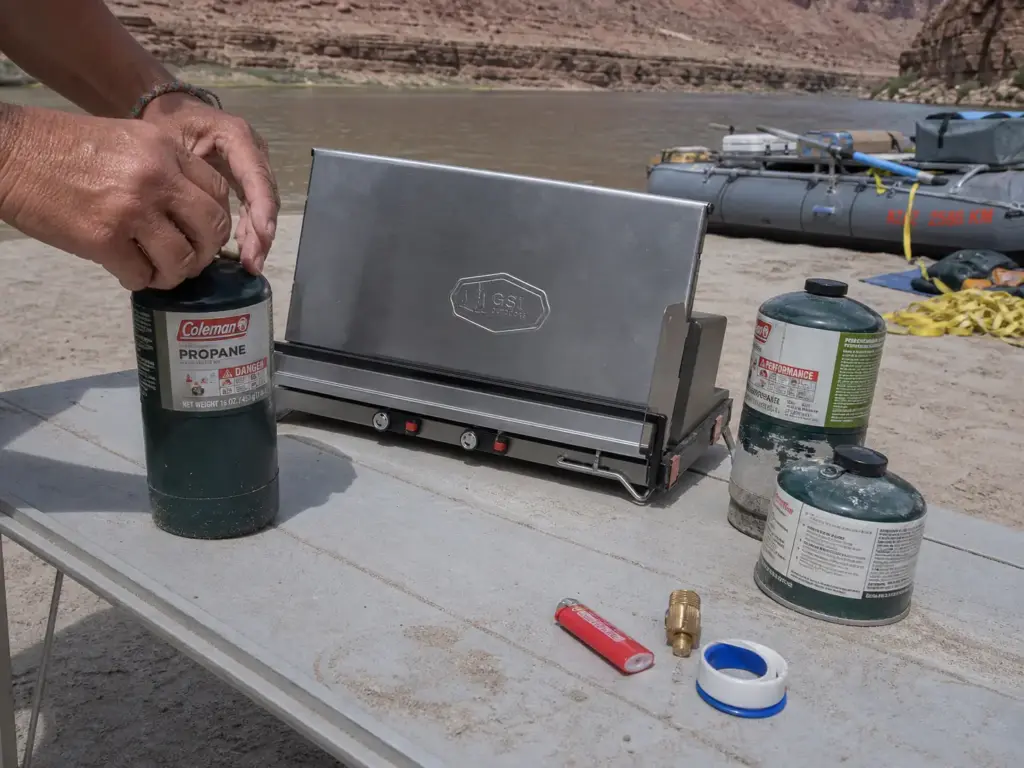
Wherever the fuel ends up, it doesn’t ride loose. Fuel and ignition both want hard-sided protection, and a hard-sided dry box is where fuel and ignition actually belong rather than a dry bag that gets crushed under a cooler. One more thing worth internalizing: almost nobody gets trip fuel planning right the first time. A windy beach burns through propane noticeably faster than a sheltered campsite, so bring more than the arithmetic says.
Burner Count and the Crew-Size Math
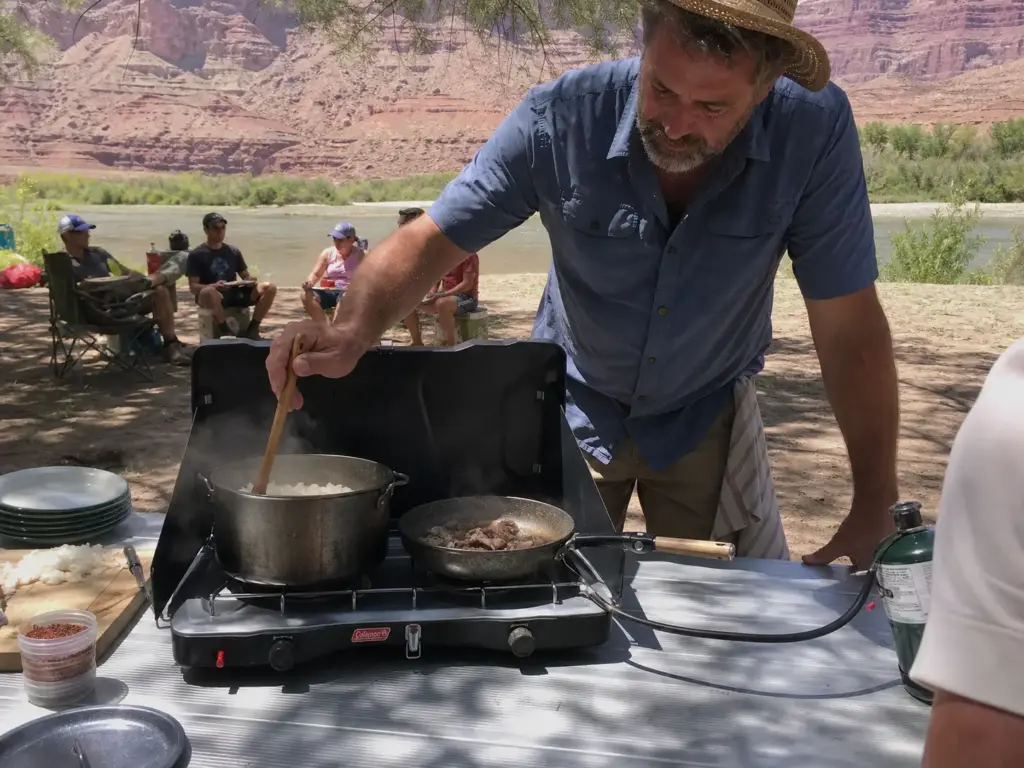
Somewhere near the top of most “best camping stoves” lists sits a single-burner canister stove the size of a fist, and anyone shopping for a group trip is quietly wondering whether that thing can feed six people. It can’t. Almost no one says so plainly, so here’s the math.
What you plan to cook sets the requirement before any spec does, and what you plan to cook decides how much burner you need. Dutch oven lasagna for eight and a week of one-pot pasta ask completely different things of a stove.
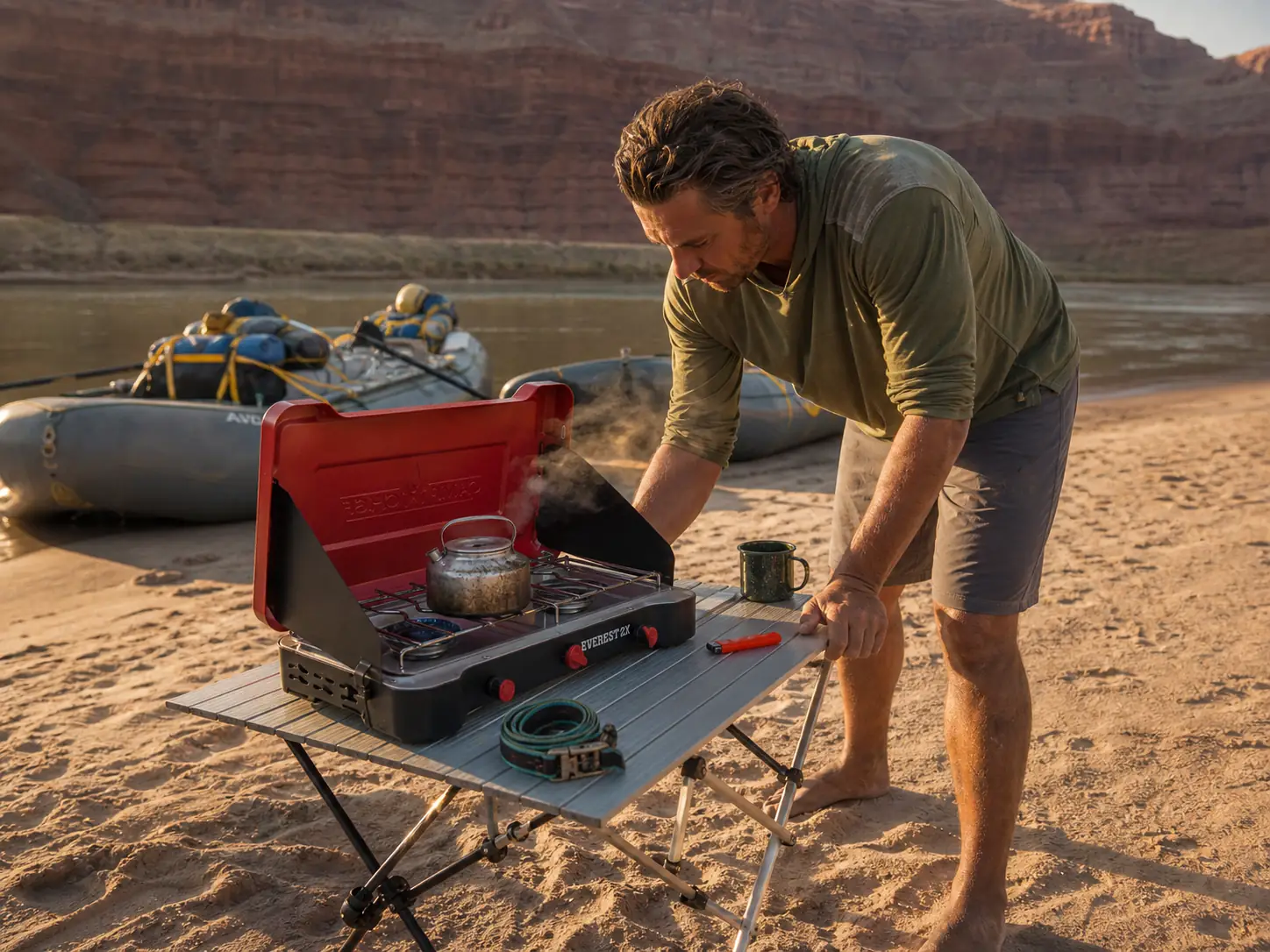
For a crew of six to eight, camp cooking guidance lands on either multiple burners in the 10,000 to 20,000 BTU range or a stove rated 20,000-plus BTU per burner. That number is the line between a crew-primary stove and a personal one. The Camp Chef Explorer sits well above it at 30,000 BTU per burner, 60,000 total, which is genuine feed-eight territory with a stockpot and a griddle running side by side. The Camp Chef Everest 2X runs 20,000 per burner, 40,000 total, with independent control on each side.
The Everest’s lower total output makes it the better cooking stove for most crews, which sounds contradictory until you’ve cooked on both. Independent burner control means rice simmers on the left while water rolls on the right. Raw BTU only wins when boil time is your actual bottleneck, which happens at altitude, on cold shoulder season mornings in March or late October, or when you’re melting a lot of water.
Single-burner canister stoves live on the other side of that line entirely. A PocketRocket 2 puts out 8,200 BTU, roughly a quarter of one Explorer burner. It’s an excellent stove and a terrible crew stove, and conflating those two facts is the most common error in generic roundups.
| Stove | Burners | Total BTU | Fuel | River Role |
|---|---|---|---|---|
| Camp Chef Explorer EX60LW | 2 | 60,000 | Propane | Crew primary, 6–8 |
| Camp Chef Everest 2X | 2 | 40,000 | Propane | Crew primary, all-around |
| GSI Pinnacle Pro | 2 | 25,000 | Propane | Crew primary, tight box |
| Coleman Triton+ | 2 | 22,000 | Propane | Crew primary, 4–6 |
| MSR WhisperLite Universal | 1 | Varies by fuel | White gas or canister | Field-repairable backup |
| MSR WindBurner Personal | 1 | Enclosed burner | Canister | High-wind personal |
| MSR PocketRocket 2 | 1 | 8,200 | Canister | Backup, personal |
| BioLite CampStove 2+ | 1 | Wood-fed | Found wood | Supplement only |
The trap on the other side is buying one excellent two-burner and nothing else. No second stove for whoever wants coffee an hour before the main cook fires up, and no redundancy at all when an igniter quits on night three. Two stoves beat one bigger stove on any multi-day trip, and the reasoning has nothing to do with total output. It’s about what your kitchen looks like when one unit stops working and the nearest hardware store is a two-day float away.
The Two-Burner Stoves Worth Rigging
Four two-burners, four different binding constraints: raw output, cooking control, budget, and how much room is left under the rocket box lid. The right pick depends entirely on which of those is actually limiting you, and every one of these runs on propane, which keeps a single fuel across the whole crew-primary tier.
Best Overall: Camp Chef Everest 2X
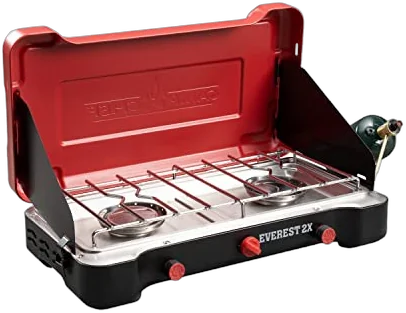
If you want one stove and you want to cook real food on it, this is the answer. The Camp Chef Everest 2X gives you 40,000 BTU across two burners you control separately, and that second detail does more for dinner quality than another 20,000 BTU would. Rice that doesn’t scorch while the pasta water comes up is the difference between cooking and heating.
It’s also the least intimidating stove in this group for someone rigging their first multi-day kitchen. Nothing to prime, nothing to pump, a lid that folds up into a partial wind block, and a footprint that sits cleanly on a camp table.
Best High Output: Camp Chef Explorer EX60LW
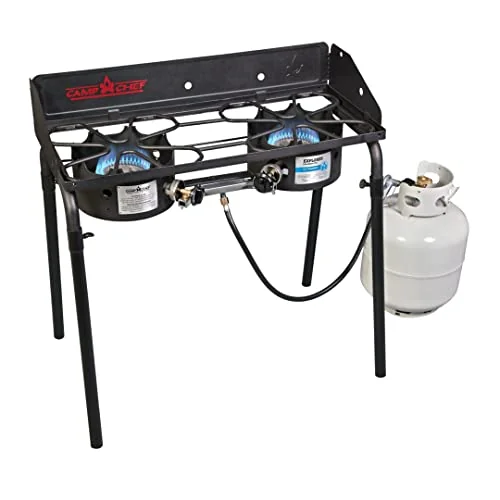
When the crew hits eight and the menu involves large volumes of anything, the Camp Chef Explorer is the honest pick. Cast-aluminum burners and a three-sided windscreen come standard, and the detachable legs matter more than they sound like they should, since a stove that stands alone frees your one good table for prep.
It’s the premium choice in this group, and it’s also the closest thing on Amazon to the output level outfitters actually run. That comparison gets its own section further down.
Best Budget: Coleman Triton+
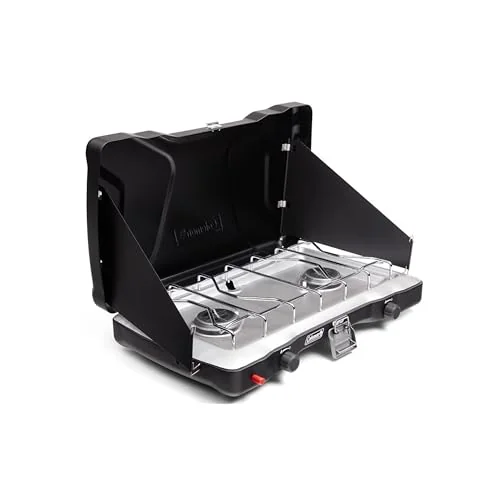
You do not need an outfitter stove for your first private trip. The Coleman Triton+ puts 22,000 BTU across two burners, which comfortably handles four to six people eating normal camp food, and it leaves budget for the backup stove that actually saves your trip.
One caveat, stated plainly because the marketing won’t: that push-button piezo ignition is exactly the component that dies after repeated soakings. Carry stormproof matches and treat the button as a convenience rather than a system.
Best Packability: GSI Pinnacle Pro
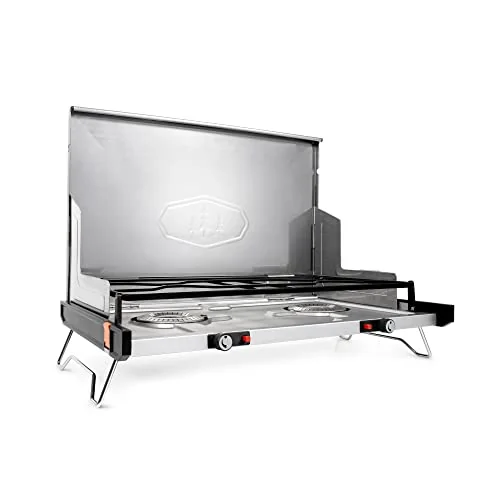
Once your kitchen box is full, footprint beats output, because a stove that doesn’t fit is a 0 BTU stove. The GSI Pinnacle Pro folds thinner than anything else here while still delivering 25,000 BTU and its own windscreens, which puts it ahead of the Triton+ on output and behind the Everest on cooking control.
Pick it when the tape measure, not the spec sheet, is what’s telling you no.
Set the kitchen up so the stove goes from strapped-to-the-frame to cooking-ready in one motion rather than an unstrap-then-place two-step. Rigging it on top of the roll-up table the stove actually sits on means the whole cooking surface comes off the boat as one unit.
Backup, Personal, and Fuel-Alternative Stoves
The second stove is the one nobody budgets for and everybody wishes they had by night three. It’s also the cheapest insurance on the entire boat, and on a river trip redundancy isn’t gear maximalism. You cannot drive to a store from river mile 60.
Field-Repair Pick: MSR WhisperLite Universal
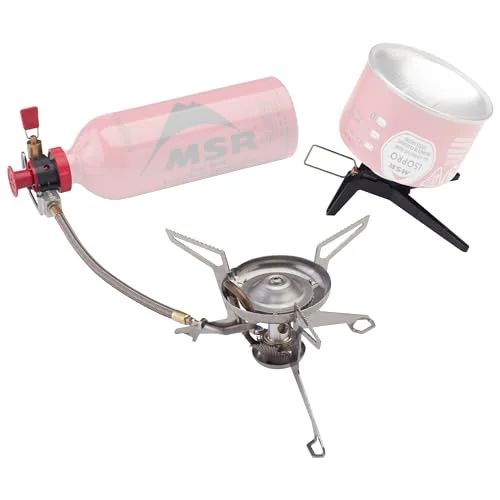
If your top criterion is “can I fix this at camp with basic tools,” the MSR WhisperLite Universal is the answer, and at river mile 60 field-repairability beats warranty coverage every time. Warranties are great in a garage and worthless on a sandbar.
Be honest with yourself about the trade. This stove asks for priming, occasional maintenance, and a user who’s willing to learn it. Nobody should be figuring out white-gas priming for the first time in the dark with a crew watching.
Redundancy Pick: MSR PocketRocket 2
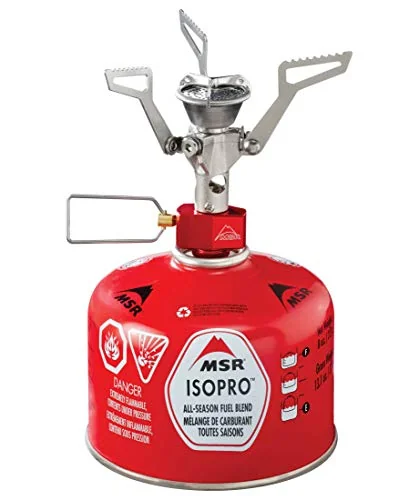
Of everything on this page, the MSR PocketRocket 2 delivers the most trip-saving value per dollar. It weighs 2.6 ounces, boils a liter in about three and a half minutes, and takes up less room in the kitchen box than a coffee mug.
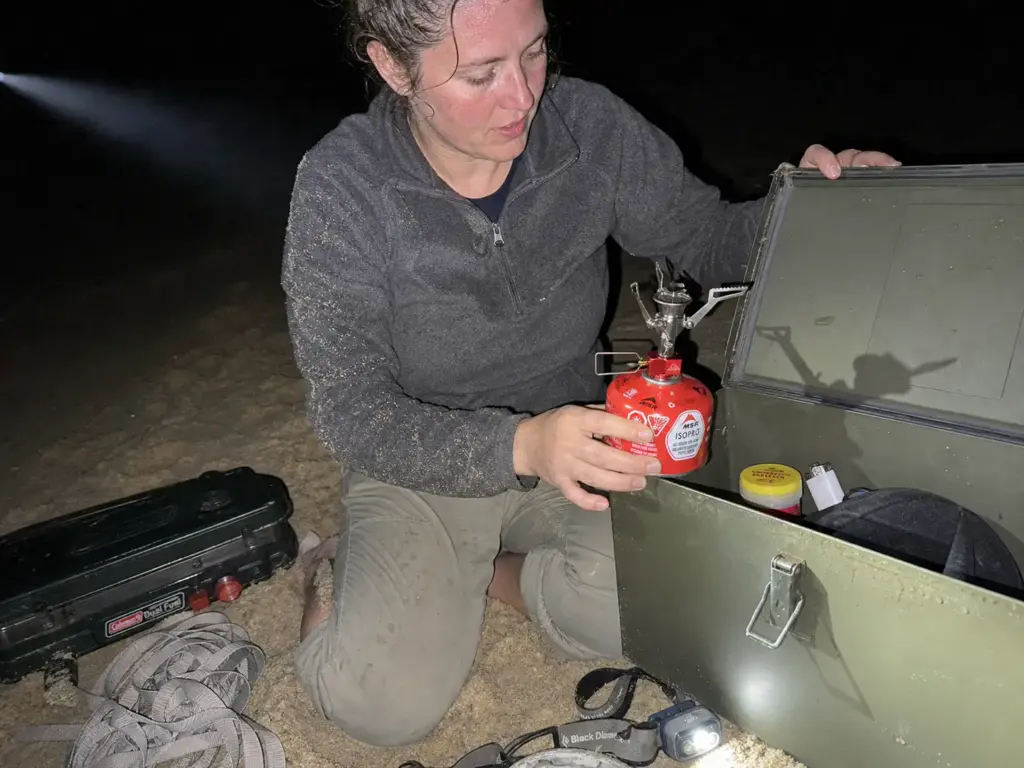
Seal your backup ignition in a dry box, not a pocket. A lighter that swam through a rapid in your shorts is not a backup, and the dry bag your backup matches actually need to be in should be the one you can find in the dark without unstrapping the boat.
High-Wind Pick: MSR WindBurner Personal
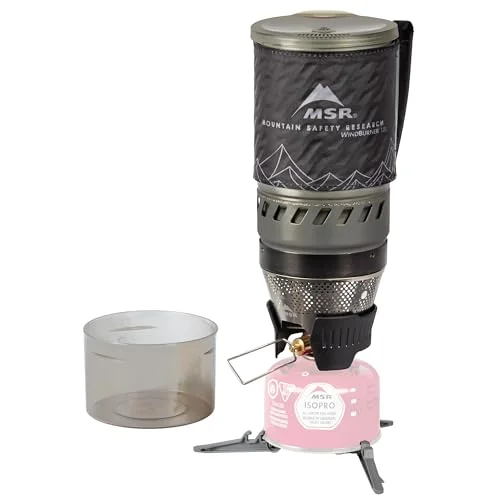
Wind resistance is a design property far more than an accessory you bolt on, and the MSR WindBurner Personal is the clearest example on this list. The burner sits enclosed inside the system, so there’s no exposed flame for the canyon to snuff out.
It’s a personal unit, not a crew stove. But on an exposed beach with the afternoon wind coming up, it’s the thing that reliably produces hot water while everyone else re-lights their two-burner.
Wood-Burning Pick: BioLite CampStove 2+
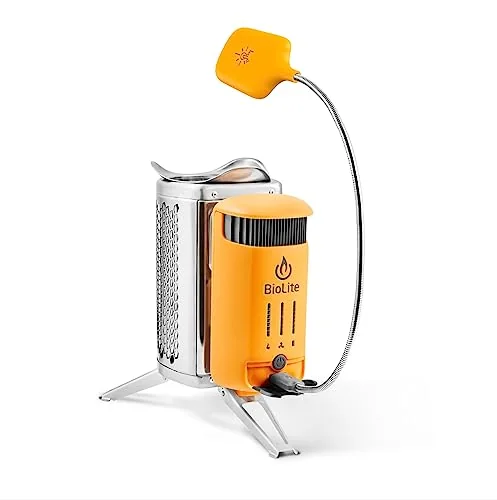
The appeal of the BioLite CampStove 2+ is obvious the first time you rig a boat: nothing to strap down, nothing to inventory, no partial canisters rattling in a box. The 3W USB output is a genuine bonus when headlamps start dying on day four.
That same appeal is what makes it fragile on a permitted trip. It runs on solid fuel, which puts it squarely inside the fire-restriction rules covered next, so treat it as a supplement and never as your only cook system. Worth noting on the buying side: Amazon’s Complete Cook Kit bundle is currently unavailable, so the live listing is the stove on its own.
Rigging, Wind, and the Wet-Gear Reality
This is the part every roundup skips, because every roundup quietly assumes the stove lives in a car trunk between uses. Yours lives strapped to aluminum tubing on a boat that might flip, and that single difference drives more real-world stove failures than any spec on any listing.
Strapping a Stove to a Frame That’s Going to Move
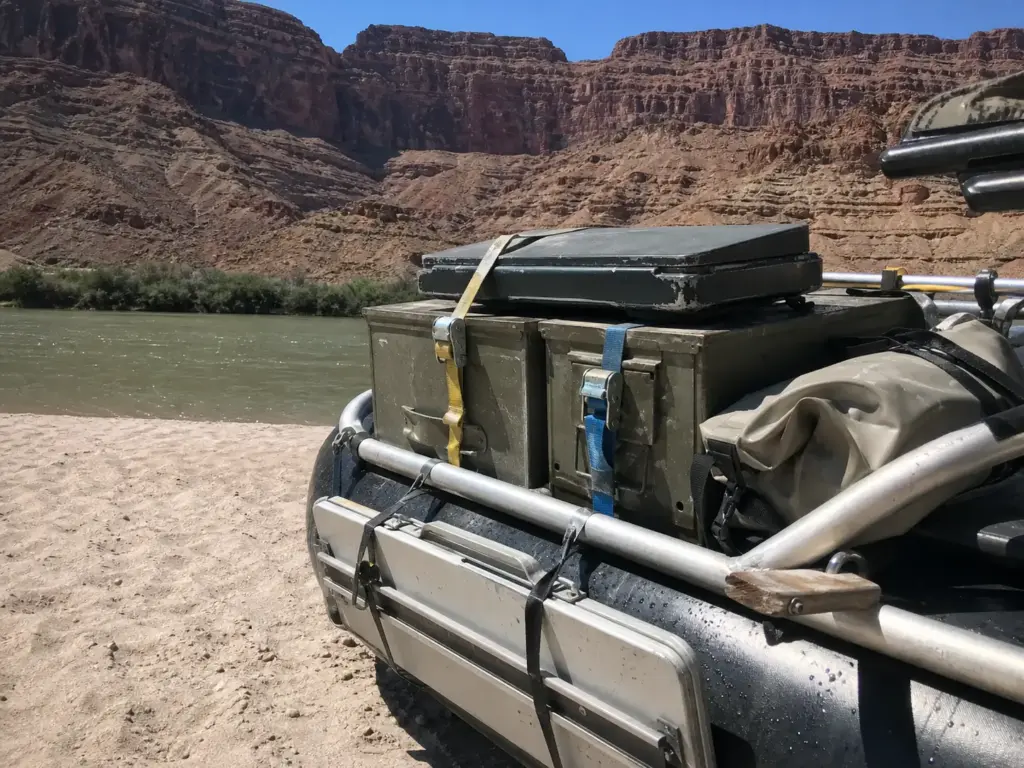
The method that holds up is boring and specific. Run a cam strap around the frame crossbar with a backup hitch, and mount the stove on a table that’s strapped to the frame rather than letting it ride loose in the pile. Loose gear in a pile is gear that grinds against other gear for six days.
What fails when you get this wrong is predictable: hinges first, then legs, then the thin sheet-metal windscreen panels. Anything that flexes under a cinched strap will eventually stop flexing back. Getting real tension without crushing the stove body is a function of the hardware, and the cam straps doing the actual work of holding it down are worth more attention than most people give them.
Ask around any boat ramp and someone has a story about the trip where an under-strapped stove went for its own swim, and somebody two miles downstream pulled a bent burner assembly out of an eddy. It’s a cheap lesson to learn from someone else’s trip. If you’re still working out how the whole setup comes together, how the frame itself gets rigged is the foundation everything else straps to.
Windscreens, Done Right (and the One Way That’s Unsafe)
The correct setup is a three-sided shield on the upwind side only. That blocks the wind that’s actually snuffing your flame while leaving the rest of the stove open to air.
What you must not do is wrap the screen all the way around a canister stove to “block more wind.” Fully enclosing it traps heat against the fuel canister, and an overheated canister can rupture. This is a safety limit, not an efficiency preference, and it’s one of the most common mistakes on private trips. It looks like the thorough version of the right idea, which is exactly why it keeps happening.
If wind is your consistent problem rather than an occasional one, solve it with construction instead of technique. An enclosed-burner design like the WindBurner never needs a screen at all.
Igniters Corrode, So Plan for It
Piezo and push-button igniters are the most commonly reported failure point after repeated river-water exposure on multi-day trips. Not the burners, and not the hose and regulator, which are the parts people worry about and which usually just keep working. It’s the little spark button that everyone relies on and nobody thinks about until it clicks with nothing behind it, in the wind, on night three, with six people watching.
The fix is cheap and prescriptive. Carry redundant ignition sealed in a dry box: stormproof matches plus a spare lighter, stored away from the stove so one bad hatch doesn’t take out both. Then rinse and dry the burner assembly at the takeout rather than three weeks later in the garage, because salt, silt and standing water do their worst work while the stove sits closed and forgotten.
The larger point behind all three of these subsections is that nothing on a raft is truly waterproof. The stove is going to get wet. The question worth asking of any stove you’re considering is not how to keep it dry but what still works once it isn’t. A stove that stows cleanly with no loose parts also saves you real minutes twice a day, every day of the trip.
Fire Pans, Fire Bans, and What Your Permit Says
On a managed permit corridor, “best stove” stops being purely a gear question. Part of it is legal, and the answer can flip depending on which month you launch.
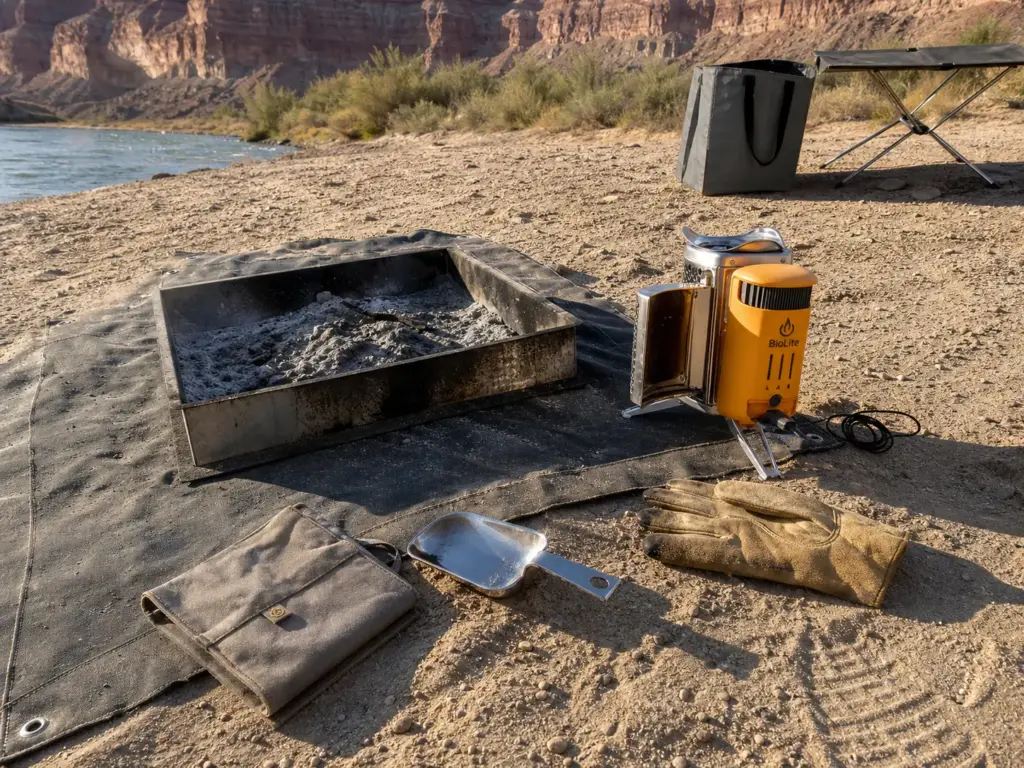
Grand Canyon’s noncommercial river permit spells this out in detail. Wood and charcoal fires require a fire pan sized to contain the fire, plus a fire blanket at least 20% larger than the pan or dutch oven placed underneath it. What sits under and around your cook setup is regulated gear, not optional gear, and rangers do check. You can read the fire pan and fire blanket requirements Grand Canyon’s noncommercial river permit spells out rather than taking a gear blog’s word for it, and once you know the spec, the fire pan that passes a ranger check is a straightforward purchase.
The seasonal layer catches people out. In Grand Canyon, fire pans are required from November 1 through the end of February, and gathering firewood is banned corridor-wide, so the wood you burn has to come in with you. Combine those two rules and a wood-burning stove starts looking less like a clever fuel-free solution and more like a haul-your-own-firewood commitment.
Work that through and the storage math changes too. Firewood for a week of evening fires is bulky, awkward cargo that competes for the same frame space as your kitchen boxes, and it gets soaked in the first big wave train unless it’s bagged. Nobody advertising a wood-burning stove mentions that the fuel supply is a rigging problem.
Here’s the connection almost nobody makes explicitly: a propane or canister stove sidesteps fire-ban season entirely. That is a genuine trip-timing factor. If your permit window falls in a restriction period, gas fuel isn’t just more convenient, it’s the difference between cooking and not cooking.
Which is why, on any permitted corridor, a wood-burning stove is a supplement and never the primary cook system. Plan the trip around a gas stove that always works, and treat wood as the pleasant bonus it is on the nights when the rules allow it.
The pan is also a hauling problem, not only a cooking one. Ash and fire waste come out with you, so the kitchen box has to be planned around carrying dirty ash containment for the length of the trip. That means a sealed ash-out container that rides where a leak won’t matter, which in practice means low, upright, and never inside a box holding food or dry clothes.
That constraint sits directly on top of the Leave No Trace practices these rules are built on, and understanding the ethic makes the regulations feel less arbitrary. A beach that a hundred trips use every season only stays usable because every one of those trips carried its ash out.
One last caution, and it matters more than any spec on this page. Rules differ by corridor and they shift mid-season in both directions, as you can see in how fire-restriction stages actually get lifted and reinstated mid-season. A stage-two restriction announced three weeks before your launch can invalidate the cook plan you built the whole menu around. Read your own permit packet close to launch instead of trusting a gear article, including this one.
What Guides Run, and What You Actually Need
There’s a stove nearly every outfitter in the country runs, and the honest answer about it is more useful than another product recommendation.
Partner Steel builds the Cook Partner stoves, hand-welded from 5052 aluminum, field-repairable, and effectively the river industry’s standard in 18-inch and 22-inch widths. If you’ve eaten on a commercial trip, you’ve probably eaten off one. That’s the real answer to “what do guides run,” and it comes with two caveats that matter more than the spec sheet.
The first is economics. Outfitters run their stoves weekly through a full season, so a professional-grade purchase amortizes over hundreds of meals. Amortized instead over a private boater’s two or three trips a year, that math stops working, and how often you’ll realistically be cooking on a beach depends a lot on how often you’ll realistically be on a multi-day permit. Permit odds are the input to this decision more than budget is.
The second is availability. Right now it isn’t a one-click purchase at all. The Amazon listings for both widths are unavailable, so these move through river-specialty shops instead.
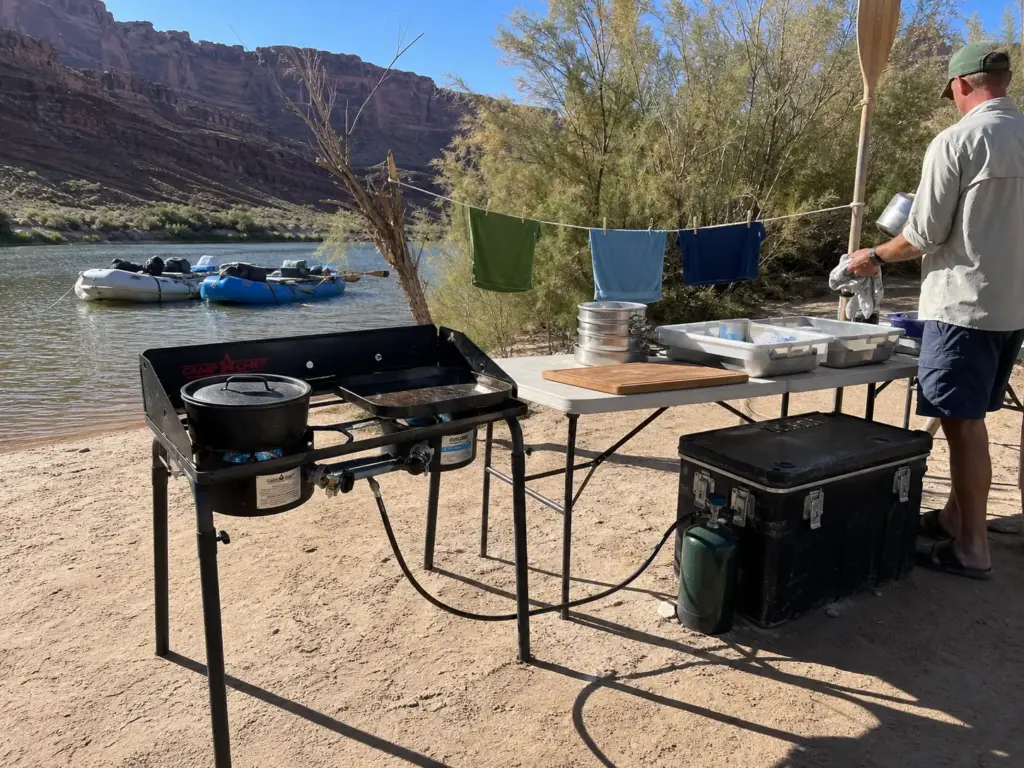
Worth knowing before you spend an evening looking for a listing that doesn’t exist. If you want comparable output you can actually buy today, the Camp Chef Explorer at 60,000 BTU total is the closest thing, or the Everest 2X if you’d rather have burner control than raw heat. Neither is hand-welded aluminum, and neither needs to be for three trips a year.
Which brings us to the part that will save you the most money. If you already own a working two-burner, take it on your first multi-day trip and find out what actually annoys you.
Maybe it’s the wind. Maybe it’s the igniter. Maybe it’s that the thing doesn’t fit the box and you spent every morning repacking around it. Maybe nothing, and you saved a few hundred dollars. Buy the fix for the problem you had, not the upgrade path somebody else wrote for a reader who isn’t you.
And if you’re buying from zero, the ladder is simple: a budget two-burner like the Triton+ plus a cheap canister backup like the PocketRocket 2 beats one expensive stove with no redundancy. Two stoves, two ignition sources, one fuel type for the crew burner.
That kit has fed more private trips than any premium single purchase ever has, and it leaves money for the parts of the kitchen people forget to budget for. A second table, a decent wash-bin setup, and enough propane to stop rationing heat all improve dinner more than another 20,000 BTU will.
Conclusion
Buy for duty cycle and crew size, not for the spec sheet. A 40,000 BTU two-burner with independent control feeds a real crew better than a bigger stove you can’t simmer on.
Carry two stoves. A cheap canister backup costs less than one night of cold dinners and one dead igniter, and it’s the single best-value item in any river kitchen.
Check your permit before you check reviews. Fire-pan season and burn restrictions can decide which fuel is even legal the week you launch.
Before your next multi-day, rig the stove exactly the way you plan to run it, strap it down, and cook one full dinner in your driveway with the wind blowing. You’ll find the annoying part on your terms instead of on night three, standing on a beach a long way below the put-in.
Frequently Asked Questions
01What fuel type is best for a multi-day river trip: propane, white gas, or canister?
Propane for the crew stove, canister for the backup. Propane lights reliably down to roughly -43°F with no priming, and one fuel across the crew keeps resupply simple. White gas packs more heat per volume and is field-serviceable, but priming on a cold wet beach adds a failure point.
02How many burners do you need to cook for a full raft crew?
Two burners rated at least 20,000 BTU each for a crew of six to eight, plus a single-burner backup. Camp cooking guidance for that group size points to multiple 10,000 to 20,000 BTU burners or 20,000-plus per burner, which is why a single-burner backpacking stove is a personal unit rather than a crew stove.
03Can you use a camp stove on a river trip when a fire ban is in place?
Usually yes for propane and canister stoves, and often no for wood or charcoal. Restrictions generally target open flame and solid fuel, so a gas stove keeps you cooking. Stages change mid-season and rules vary by corridor, so read your permit packet instead of assuming.
04How do you keep a camp stove from failing after it gets wet?
Assume it will get wet and plan for the igniter, because that fails first. Piezo and push-button igniters are the most commonly reported failure point after repeated river-water exposure, so carry stormproof matches and a spare lighter sealed in a dry box, and rinse and dry the burner assembly at the takeout.
05Do you really need a windscreen, and can you wrap it around the stove?
You need one on an open beach, and no, never wrap it fully around a canister stove. The correct setup is a three-sided shield on the upwind side only, because enclosing the stove traps heat against the fuel canister and can rupture it. Enclosed-burner designs solve wind by construction instead.