
In this article
I watched a guy unroll a $1,450 expedition boat at the takeout last summer, right next to a friend of mine who’d run the same Class II all season in a hull that cost half as much. Both of them had grins. Only one had spent the price of a used kayak on a boat he babies on flatwater. I’ve paddled enough of these things, and swum out of a couple in cold water I’d rather forget, to tell you straight: most best packraft lists push you toward the priciest boat you’ll rarely use. This guide matches the packraft to the trips you actually do — flatwater floats, backpacking, beginner whitewater, or burly Class IV — and it tells you when the cheap boat is the right call. Here’s the short version before we get into the why.
| Packraft | Best For | Weight | Whitewater Class |
|---|---|---|---|
| Kokopelli Hornet-Lite | Ultralight backpacking | ~5.2 lb | Flat to mild |
| Kokopelli Rogue-Lite | Do-it-all flatwater & touring | ~5.5 lb | Up to Class I |
| Kokopelli Nirvana SB | Beginner whitewater | 9.7 lb | Class I–III |
| Kokopelli Recon SB | Burly whitewater | 18 lb | Class IV |
| Klymit LiteWater Dinghy | Budget try-first | ~2.75 lb | Flatwater only |
You Probably Don’t Need the $1,500 Boat
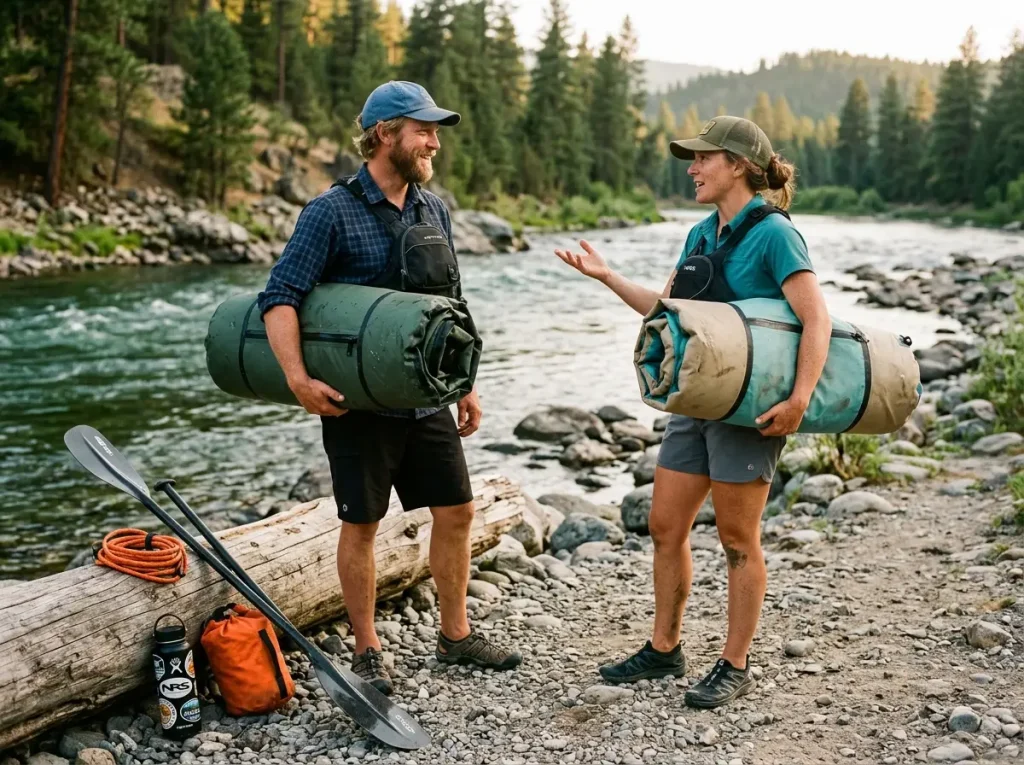
The takeout conversation I started with isn’t rare. It happens every weekend on rivers all over the country: someone who saved up for the flagship expedition hull, paddling next to someone running the exact same water in a boat that cost a third as much, and neither of them having more fun than the other. If you’re choosing between a packraft and a full-size whitewater raft, the same honest math applies — buy for the river day you actually do, not the one you fantasize about on the drive home.
Here’s the thing nobody selling boats wants to say out loud. A packraft is a set of compromises, and you can’t dodge them by spending more. You can only move the compromise around.
The Performance Triangle (Pick Your Corner)
Picture a triangle with three corners: portability, durability, and whitewater performance. Every packraft on the market sits somewhere inside that triangle, and no boat lives at all three corners at once. The featherweight that vanishes in your pack gives up the thick fabric that survives a rock garden. The bombproof whitewater boat that laughs off boulders weighs three times as much and never gets carried ten miles to an alpine lake. The do-it-all middle boat does everything at a B+ and nothing at an A.
That’s not a flaw in the boats. That’s physics. Once you accept it, the buying decision gets a lot simpler, because the only real question is which corner matches your trips.
Match the Boat to the Trip You Do 95% of the Time
Most people buy for the trip they wish they took, not the one they actually take. They picture themselves dropping into a remote Class IV canyon, so they buy the Class IV boat, and then they spend two summers paddling flatwater laps and easy riffles in a heavy hull that’s overkill for every single one of those days.
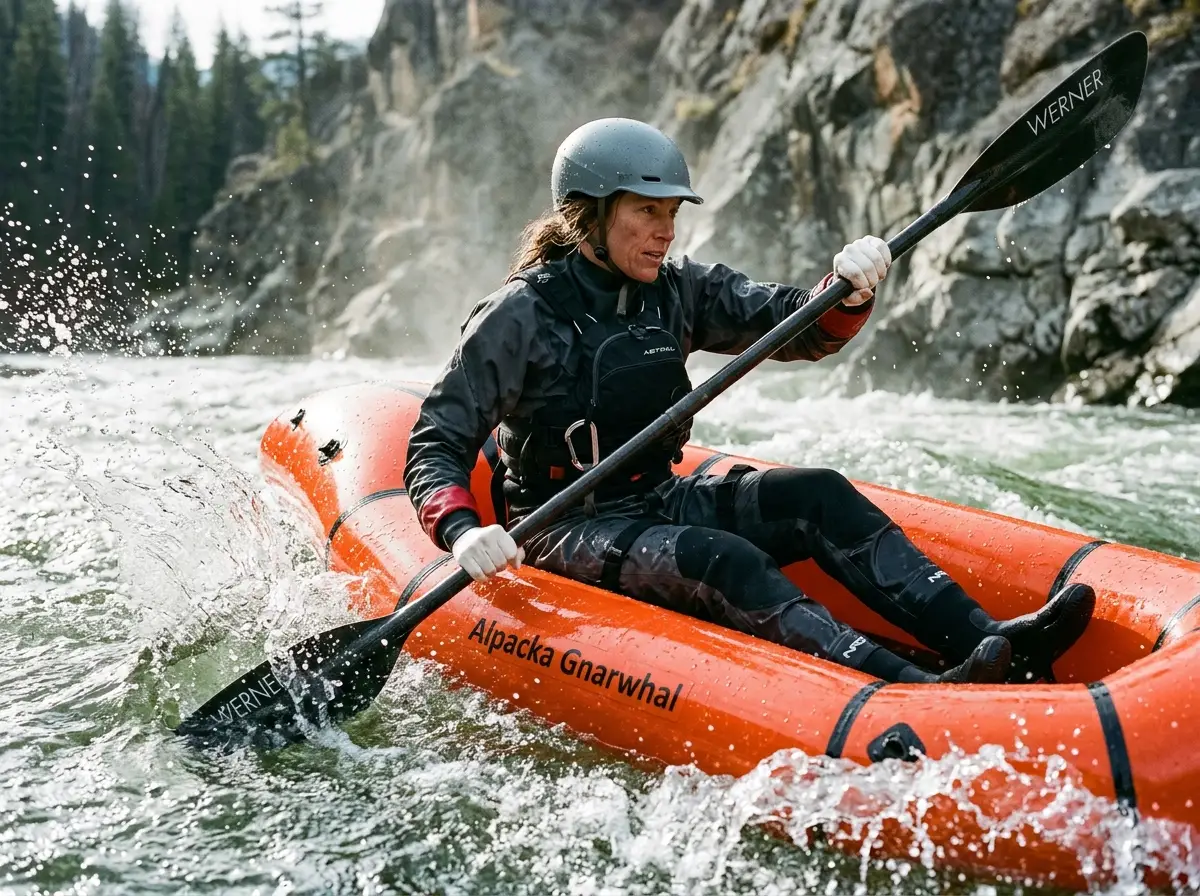
Be honest about your 95%. If most of your water is lakes, mellow floats, and the occasional Class II, a do-it-all boat or even a budget flatwater hull covers it. The famous Alpacka Gnarwhal — the boat everyone points to as the forgiving beginner-whitewater benchmark — runs around $1,450 dealer-direct, and it’s a genuinely great boat. It’s also more boat than most weekend paddlers need. A 9.7-pound self-bailing hull that handles Class III, or a stable touring boat for everything up to Class I, covers the river day most of us actually run. And if you’re not sure you even like floating yet, a budget boat is a real answer, not a consolation prize. Sometimes the most useful packraft is an inflatable kayak that fits your river days better than a packraft does — worth knowing before you commit.
Sizing It Right Without Oversizing
The other money-and-misery mistake is sizing up “to be safe.” A boat that’s too long for you tracks poorly and turns like a barge, which is the last thing you want when you’re trying to thread a line through rapids. Length should match your weight plus the gear you carry, not the expedition daydream. It’s the same sizing logic that applies to full-size rafts: freeboard and trim matter more than raw size, and an oversized boat sits high, catches wind, and wanders.
Count your real load. Your own weight, sure, but also the dry bags, the camp kit, the water, and the cooler if it’s a multi-day. Then pick the size that keeps you under the capacity rating with a little room, not the size that lets you haul a refrigerator.
Spend the money on a swiftwater course before you spend it on the premium boat. A weekend with a good instructor is the best money you’ll put into your paddling, and it’ll do more to keep you safe than any hull upgrade. The fanciest boat in the world won’t read the river for you.
Before you get attached to a spec sheet, this is the boat-sizing walkthrough I wish someone had played for me when I started — a practitioner going through the portability, durability, and whitewater tradeoff on camera, showing how a too-big boat tracks badly in a way no spec table can.
Spray Deck, Self-Bailing, or Open Deck
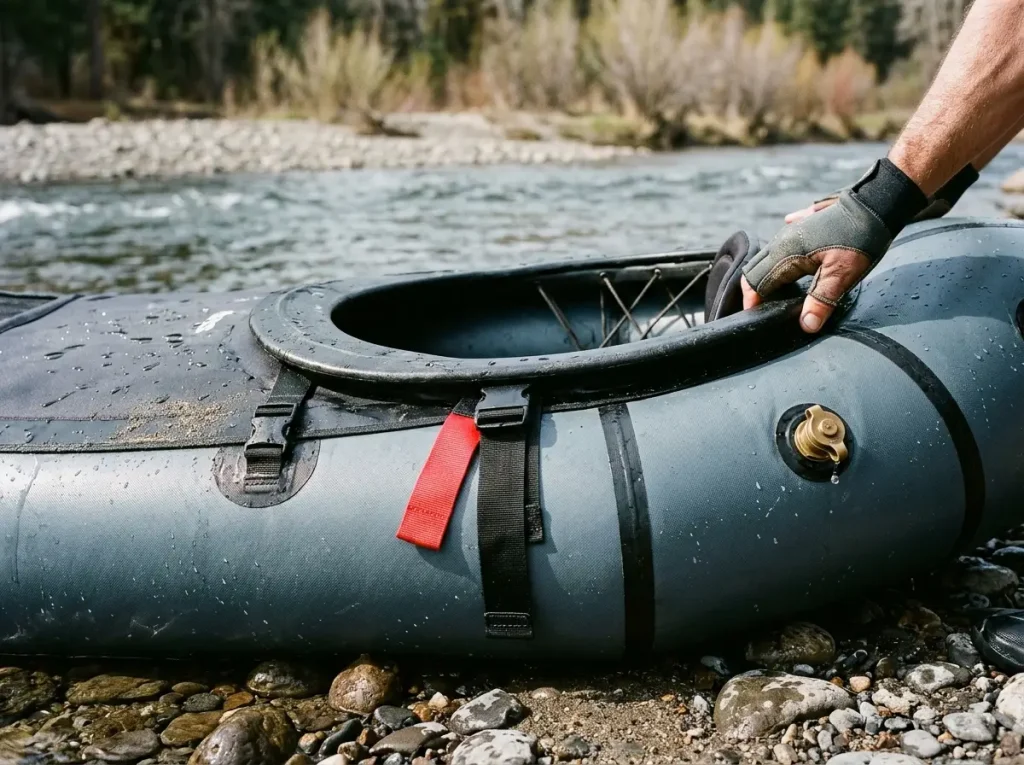
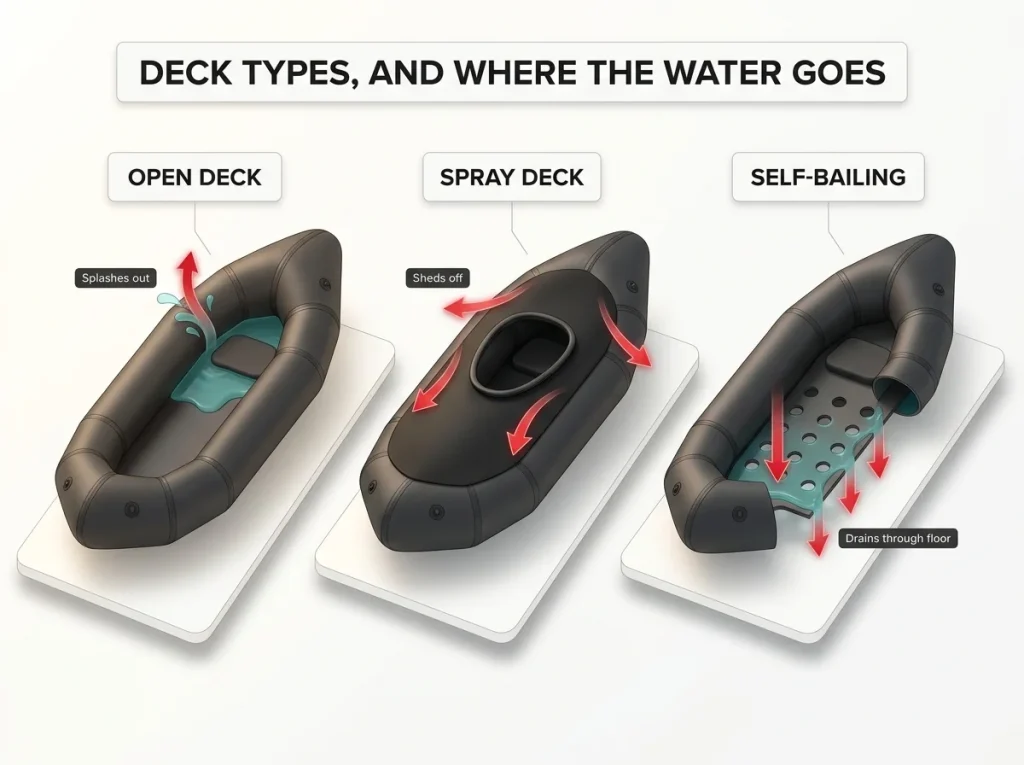
If there’s one construction choice that decides what water a packraft can actually run, it’s the deck. Get it wrong and you either swamp in the first real wave or you sit in a cold puddle all day on water that never needed a self-bailing floor. Most lists rattle off the three types and move on. The part they skip is which one is wrong for your water, and that’s the part that costs you a miserable day.
Open Deck — Light and Simple
An open deck is exactly what it sounds like: no cover, you sit in the tub. It’s the lightest and simplest setup, and for lakes, mellow floats, and easy Class I it’s all you need. Splash that comes in mostly sloshes back out or gets sponged, and there’s nothing to climb out of if you flip.
The catch is obvious the first time you hit a real wave train: an open boat takes on water fast, and a swamped packraft is sluggish and squirrelly. Open decks are a flatwater and mild-water tool. That’s not a knock — it’s most of the paddling most people do.
Spray Deck — Dry and Warm for Whitewater
A spray deck closes the cockpit with a fitted nylon-and-neoprene top, the way a kayak skirt does. It sheds splash, keeps you dramatically warmer in cold conditions, and keeps the boat from filling in whitewater. For cold touring and serious moving water, it’s the difference between a long comfortable day and a shivering one.
The trade is that you have to be able to get out of it. A closed deck means practicing a wet exit until it’s automatic, because the day you flip is the wrong day to learn. More on that in the safety section, but file it now: a spray deck buys you warmth and dryness in exchange for a skill you have to own.
Self-Bailing — Drains Fast, Sits Wet
A self-bailing floor has holes that let water drain out as fast as it comes in, so a swamped boat empties itself instead of turning into a bathtub. For whitewater that’s gold — you punch a hole, take on a wave, and the boat sheds it without you doing a thing.
Here’s the part the spec sheets bury: a self-bailing floor always carries some standing water, which means you’re sitting in it. On warm whitewater that’s fine, even welcome. On a cool flatwater paddle it’s a wet, cold seat for no reason at all. Experienced paddlers will tell you not to buy a self-bailing boat unless you actually run whitewater in a warm climate or you always wear a wetsuit or drysuit. Buying self-bailing for a mostly-flatwater life is one of the most common mismatches I see, and people don’t figure it out until they’ve spent a season cold and damp. The floor type under you — how bucket, I-beam, and drop-stitch floors actually behave — changes stiffness and tracking too, so it’s worth understanding before you commit.
Weight, Denier, and What Holds Up on Real Water
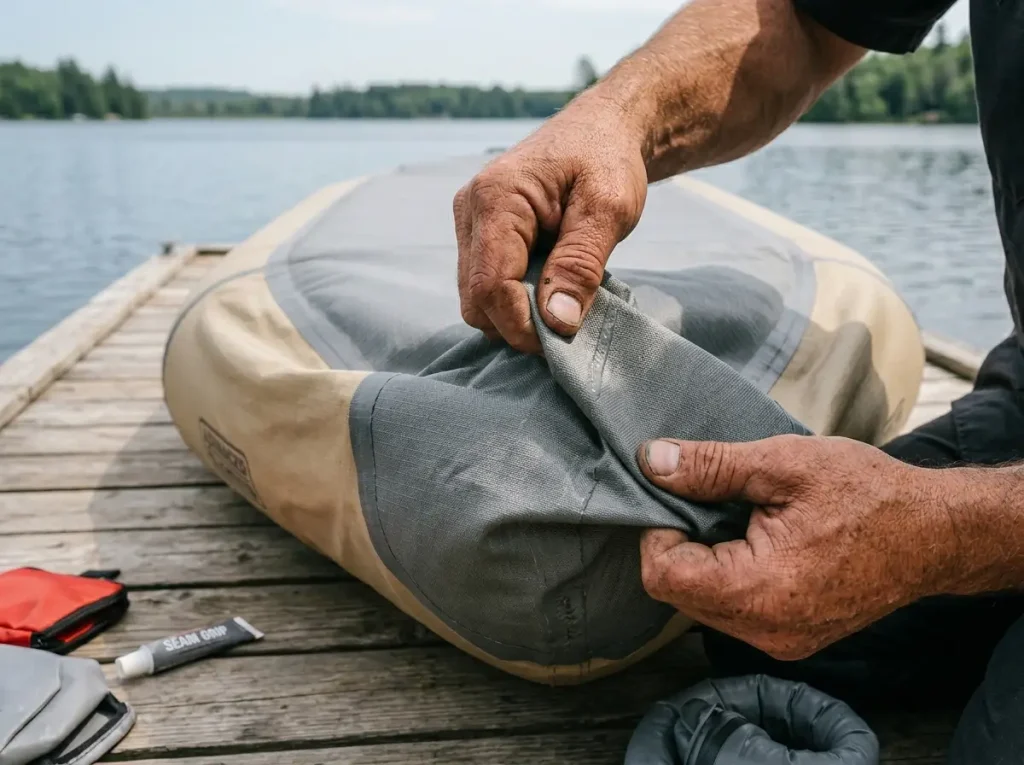
Spec sheets love to lead with weight because it’s the easy number to brag about. But the lowest weight isn’t the spec that matters most. What matters is whether the hull survives the rock garden you actually run, and that comes down to the fabric and how it’s built.
TPU-Coated Nylon vs. PVC
Most quality packrafts — Alpacka, Kokopelli, and the like — use TPU-coated nylon. It’s light, it welds into clean airtight seams, and it packs down small. The premium boats live here because TPU gives you the best weight-to-strength ratio money can buy right now.
PVC is the other camp. It’s heavier and packs bulkier, but it’s tough and abrasion-resistant, which is why you see it on burly whitewater boats and recreational hulls meant to get dragged over gravel bars. The tradeoff is the same one that plays out in full-size raft fabrics: you’re choosing between low weight and brute durability, and the right call depends entirely on whether you carry the boat far or bash it hard.
Denier and Floor Construction, Explained
Denier sounds like jargon, but it just measures how thick the threads in the fabric are. Higher denier means thicker, tougher, heavier material. You’ll see numbers from around 70D on the ultralight sidewalls up to 1,000D on the abuse-it whitewater floors.
Almost every good packraft mixes denier on purpose: thinner, lighter fabric on the side tubes where abrasion is low, and a thick double-layer floor where you’re constantly grinding over rocks and gravel. That’s not a corner being cut — it’s smart design. When you read a spec sheet, look at the floor denier separately from the tube denier, because the floor is where boats actually wear out. And check the weight capacity while you’re at it: most boats run 300 to 400 pounds, and you count your gear toward that number, not just yourself.
The Failure Modes Nobody Puts in the Spec Sheet
Here’s what twenty trips teaches you that the spec sheet won’t.
Cheap “pool toy” boats — the Intex and Tucktec-style stuff you see at big-box stores — fold in half in current. Paddlers call it a “taco,” and it’s exactly as bad as it sounds: the boat buckles, you’re suddenly swimming, and there’s no real outfitting to climb back into. Those things are fine for a pond. In moving water they’re a hazard, full stop.
Valves are the other surprise. A new paddler will inflate a tube rock-hard in warm air, then panic an hour later when it feels soft and assume there’s a leak. Nine times out of ten the screw-top valve just needs to be backed off a touch and reseated. A genuine pinhole takes a long time to soften a big tube — if your boat went mushy fast, look at the valve before you look for a puncture.
Carry a patch kit and a small tube of seam sealant on every trip, even day trips. A pinhole found at camp is a ten-minute fix with the boat dry; the same hole found at the put-in with no kit is the end of your paddling. Tape the kit to the inside of your pump bag so you never leave it home.
Best Packrafts for Flatwater and Backpacking
This is the boat most people should actually buy, so let’s start here. Flatwater, lakes, easy floats, and multi-sport backpacking trips are where the majority of paddling happens, and the boats below are light enough to carry far and stable enough to enjoy when you get there. If you’ve ever wondered how a packraft changes a backpacking route, these are the hulls that make it work — they turn a dead-end lakeshore into a crossing and a long road walk into a float.
Best Ultralight — Kokopelli Hornet-Lite
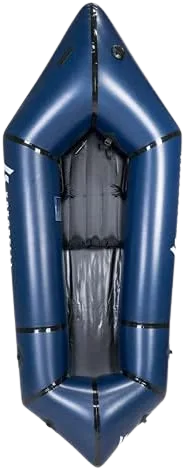
The Hornet-Lite earns its spot by being the boat you’ll actually bring. The hard truth about ultralight gear is that the boat you leave home because it’s too heavy does you no good, and at the size of a paper-towel roll there’s no excuse to leave this one behind. I’ve thrown it in a daypack for a “maybe I’ll paddle” hike and been glad every time the trail crossed water.
Don’t ask it to be something it isn’t. The thin, light fabric that makes it pack so small is the same fabric you don’t want to drag across a rock garden or push into rapids. For alpine lakes, mellow crossings, and packraft-curious day trips, it’s the Kokopelli Hornet-Lite and not much else in its weight class. Match it to calm water and it’s a joy.
Best Do-It-All Touring — Kokopelli Rogue-Lite
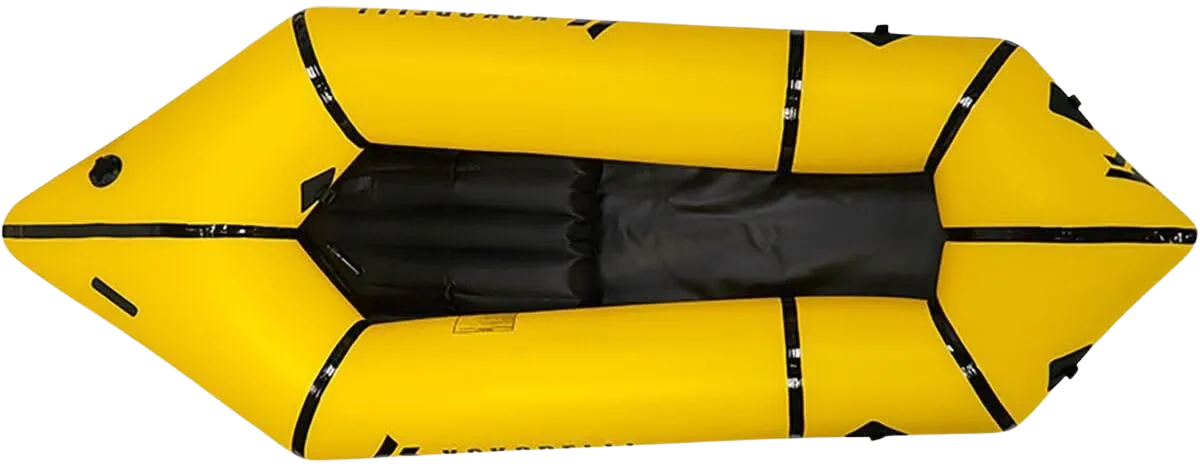
If someone asks me for the one boat that does the most for the most people, this is usually my answer. The Kokopelli Rogue-Lite is light enough to carry up a trail, stable enough to spend a whole day on a lake without fighting it, and the Kevlar-blend floor takes the gravel-bar abuse that eats thinner hulls alive. It’s a best-seller for a reason, and the reason is that it quietly handles the flatwater-and-touring life that most paddlers actually live.
Where it stops is rapids. This is a flatwater and easy-water boat, rated up to Class I, and pushing it past that is asking for the swamp-and-swim day nobody enjoys. Know that going in and you’ll never be disappointed. Try to make it a whitewater boat and you’ll be shopping again by fall.
Best Budget Try-First — Klymit LiteWater Dinghy
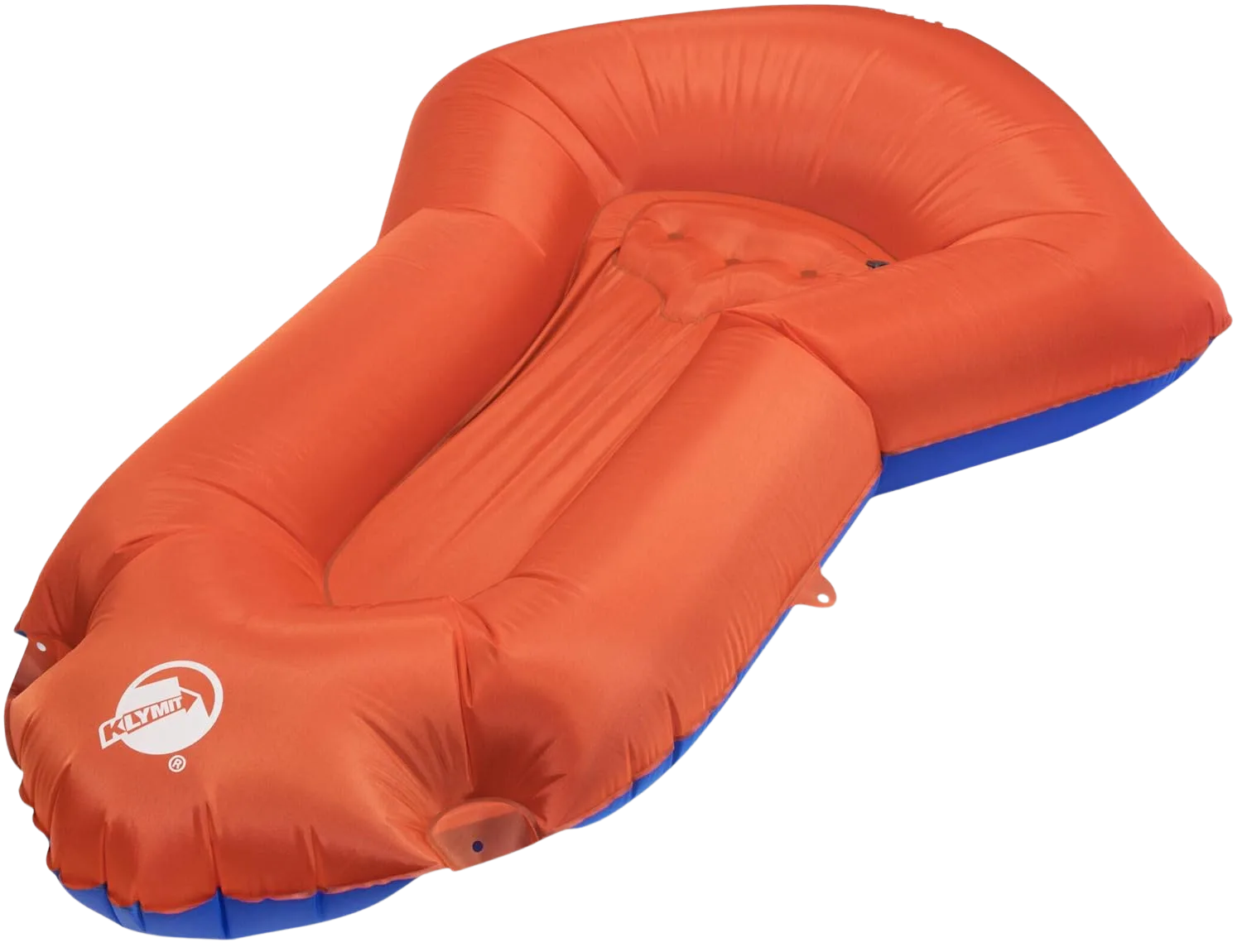
This is the anti-sell pick, and I mean that as the highest compliment. Not everyone reading this is sure they’re going to fall in love with packrafting, and dropping serious money to find out is a great way to end up with an expensive boat in the garage. The Klymit LiteWater Dinghy lets you test the whole idea for the price of a decent dry bag. It packs to the size of a water bottle and weighs less than three pounds, so it’s a legitimately fun thing to toss in a pack for a calm pond or a flat float.
The honesty has to cut both ways, though. This is flatwater only. It is not a river boat, it has no real outfitting, and you should not take it into current. Treat it as the cheap, smart way to discover whether you want a real boat, and it’s perfect. Treat it as a whitewater hull and it’ll let you down exactly when you can’t afford it to.
Best Whitewater Packrafts
Now we’re into moving water, and the gap between a real whitewater boat and a flatwater hull with thigh straps glued in is enormous. A true whitewater packraft is built around staying upright and dry in pushy water: self-bailing or spray-decked, reinforced where it grinds rock, and outfitted so you’re locked in enough to control it. As you step up through the classes, be honest about the risk that comes with each river class — the boat handles more, but so does the water, and that’s a different conversation than picking a lake boat.
Best Beginner Whitewater — Kokopelli Nirvana Self-Bailing
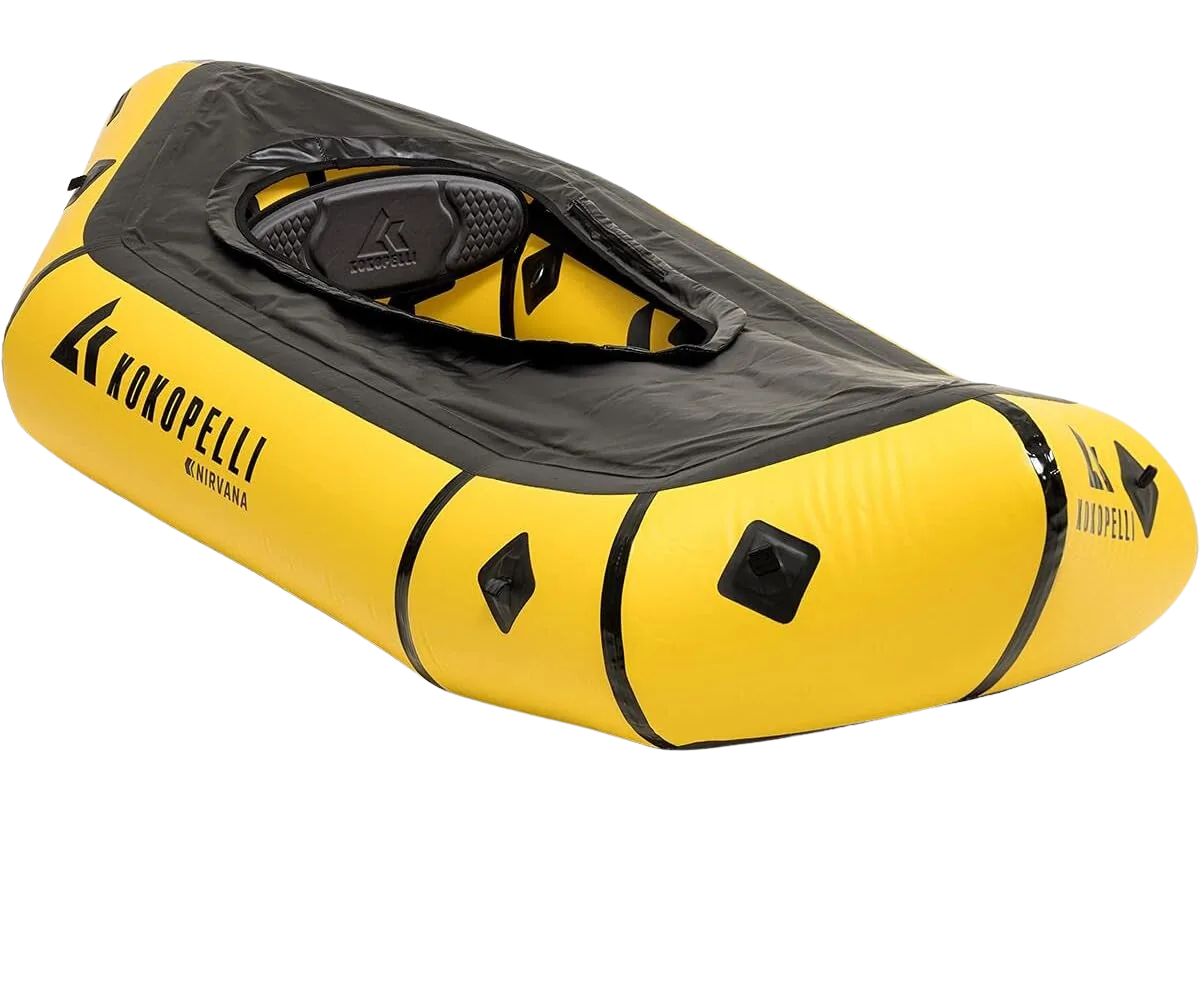
The Alpacka Gnarwhal gets called the most forgiving whitewater packraft for good reason, but it’s a dealer-direct boat that runs around $1,450. For a lot of beginners, the Kokopelli Nirvana Self-Bailing covers the same ground at a friendlier price and stays easy to find. At 9.7 pounds with an 840-denier Kevlar-blend floor, it’s a real sub-10-pound whitewater boat you can still throw on your back, and it handles solid Class III without making you feel like you’re wrestling it.
The self-bailing floor is the right call here because you’re running whitewater, where draining fast beats staying dry. Just remember what that floor means on the flat sections between rapids: a wet seat. If your days are mostly mellow with a little whitewater, that’s a fair trade. If they’re mostly flat, you bought the wrong boat — go back to the touring section.
Best Burly Whitewater — Kokopelli Recon Self-Bailing
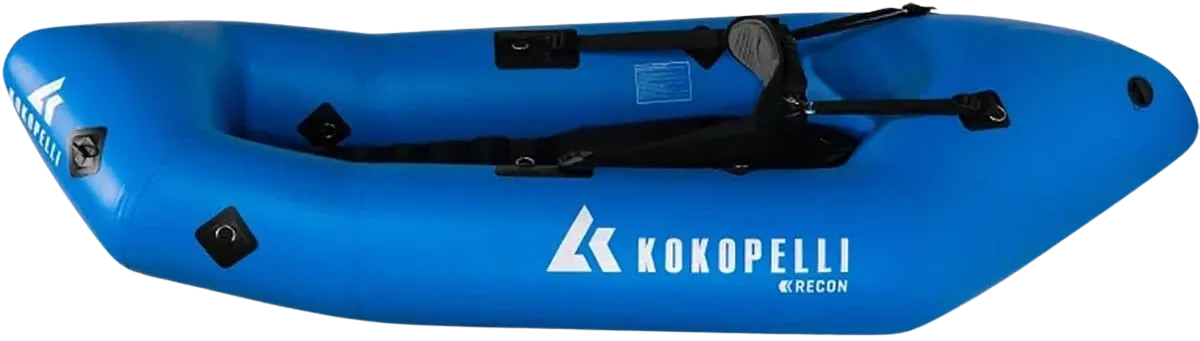
There’s a point in your paddling where you stop flinching every time the boat scrapes rock, and the Kokopelli Recon Self-Bailing is the boat that gets you there. The 1,000-denier reinforced PVC is built to be abused, which is exactly what you want when the run is a steep rock garden and the consequence of a thin hull is a patch job mid-trip. It’s rated to Class IV, and it feels planted in pushy water in a way the ultralight boats don’t.
The cost is weight. At 18 pounds this is not a backpacking boat, and carrying it any real distance is its own kind of misery. That’s the deal you’re making: brute durability in exchange for portability. For hard whitewater where the boat takes a beating, it’s worth every ounce. For a long hike to a quiet lake, grab the Hornet-Lite instead and save your back.
Before you buy any whitewater boat, this short clip is worth your time — it ranks the top whitewater packrafts and shows the outfitting (thigh straps, spray deck) in actual use, which makes the gap between a flatwater boat and a true whitewater rig obvious.
Best Spray-Deck Expedition — Kokopelli Rogue Spraydeck
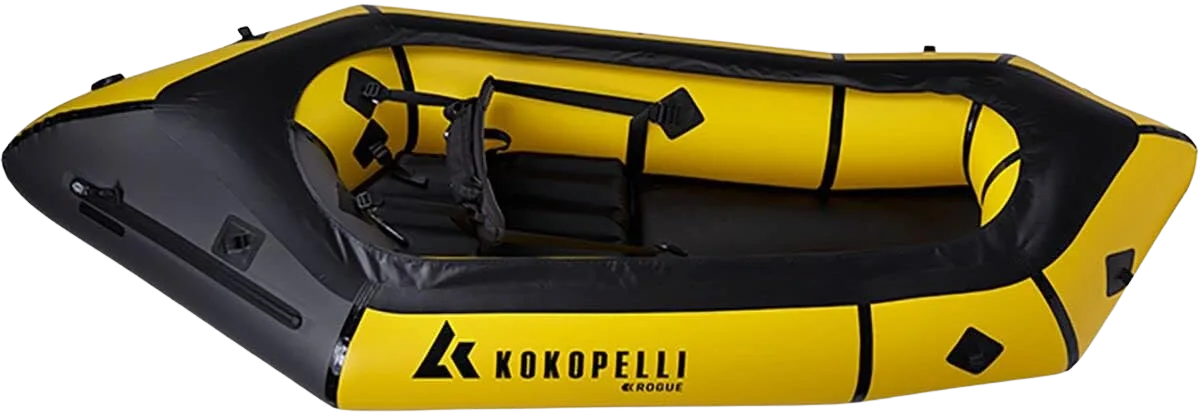
For cold-water touring and multi-day trips, a closed deck changes the whole experience. The Kokopelli Rogue Spraydeck sheds splash and keeps you noticeably warmer than an open boat, which matters a lot when you’re out for days and the water is cold. The airtight TiZip cargo zipper — paddlers call it a cargo fly — lets you stash gear inside the tubes, which both keeps it dry and lowers your center of gravity so the loaded boat handles better.
The honest caveat with any closed deck is the exit. You have to be able to get out of it fast and without thinking, which means practicing the wet exit on calm water until it’s reflex. It’s not a hard skill, but it’s a non-negotiable one. Own that, and this is the boat for expedition touring in cold climates without paying dealer-direct prices.
Best Specialty Packrafts
A couple of jobs fall outside the solo flatwater-or-whitewater split, and the boats below cover them. One is the modular, load-it-up rig for recreational and car-to-water paddling; the other is the two-person boat for when you’re not paddling alone. Neither is a whitewater boat, and both fill a slot a lot of roundups ignore.
Best Modular Recreational — Advanced Elements PackLite+
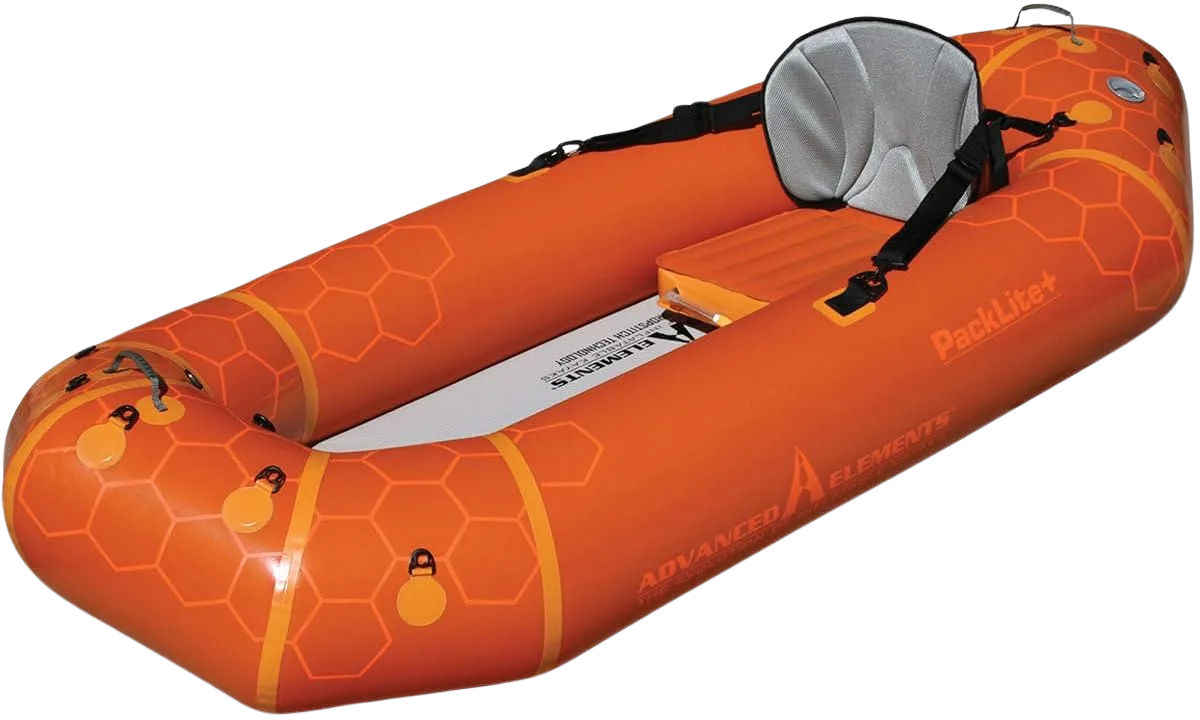
The Advanced Elements PackLite+ is the boat for people who don’t want to commit to a single configuration. Pull the drop-stitch floor and the seat and you’ve got a stripped-down hull that packs small and light; leave them in and you’ve got a comfortable, stiffer-riding rec boat for a loaded day on flatwater. The TiZip cargo zipper adds dry internal storage, which is handy for overlanding and car-to-water trips where you’re hauling more gear than a backpacking purist would.
It’s not pretending to run rapids, and you shouldn’t ask it to. Where it shines is versatility: one boat that adapts to a calm-water day trip, a fishing float, or a gear-heavy basecamp paddle. When you’re loading it up for a multi-day, lean on the gear checklist that scales with your river class so nothing essential gets left in the truck. If your paddling is recreational and varied rather than focused on whitewater, the modularity is genuinely useful instead of a gimmick.
Best Tandem — Kokopelli Moki-Lite
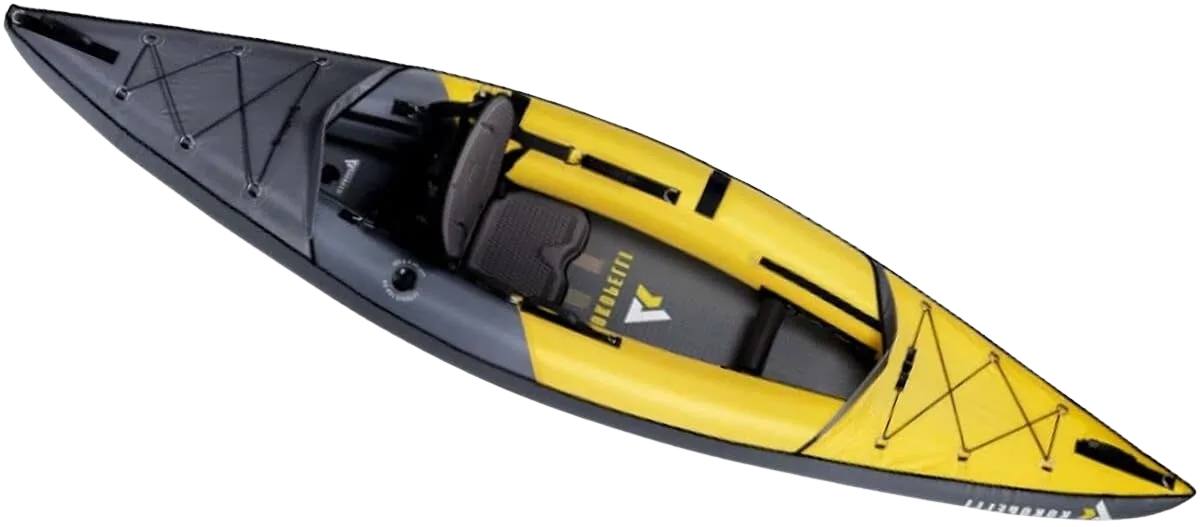
Not everyone paddles solo. If you’ve got a partner, a kid, or a dog who insists on coming along, the Kokopelli Moki-Lite covers the two-person slot that most ultralight lineups skip entirely. It’s the most accessible tandem you’ll find without chasing a dealer-direct boat, and it’s a genuinely fun way to share a calm-water day. If you’d rather have a backup option, the Kokopelli Twain is a close tandem alternative worth a look.
Set your expectations for how a tandem handles, though. Two people in one boat means it tracks slower, turns lazier, and rewards a partner who actually paddles instead of sightseeing. Keep it on mellow water — this is a flat-to-mild boat, not a whitewater rig — and sort out who steers before you launch, not mid-river.
The Safety Gear and Skills That Actually Keep You Alive
Here’s the part I care about most, and the part most best packraft lists barely touch. A packraft puts you in the exact same cold, pushy water as a full-size raft. The river doesn’t know or care that your boat is small and light. Which means the boat is the cheap part of staying safe — the gear and skills below are what actually matter, and they’re worth more than any hull upgrade you’ll ever make.
PFD and Helmet — The Floor, Not the Ceiling
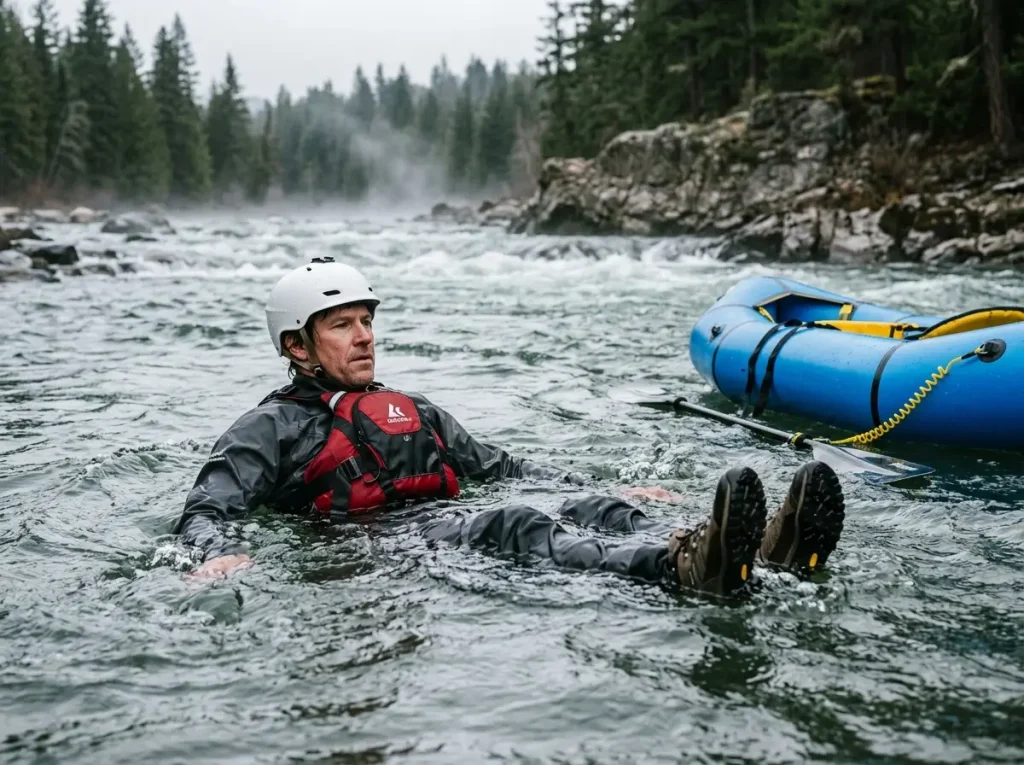
A PFD is not optional and it’s not a seat cushion. Wear it, zipped and cinched, every time you’re on moving water. The one that works is the one that rides high and stays put. You want a PFD that rides high and won’t ride up over your chin in a swim, because a loose vest that floats up around your ears in current is worse than useless when you actually need it.
For anything Class II and up, add a helmet. Rocks don’t move, and your head does. Get a whitewater helmet rated for the class you run and make sure it fits snug enough that it doesn’t spin or slide when it gets hit. These two pieces are the floor of river safety, not the ceiling — they’re the baseline you build on, not the whole plan.
Cold Water Is the Real Hazard (1-10-1 and the 120 Rule)
This is the thing that gets people into serious trouble, and it’s almost never the rapid itself. Cold water pulls heat out of you roughly 25 times faster than air, and the timeline is brutally short. Paddlers learn it as the 1-10-1 rule: about 1 minute to get your breathing under control through the initial gasp, about 10 minutes of useful muscle movement to self-rescue before your hands and arms stop cooperating, and roughly 1 hour before cold incapacitation sets in. If you want the full picture of how fast cold water strips away your warmth under the 1-10-1 rule, it’s worth reading before your next cold-water day. The practical takeaway is simple: when you flip in cold water, you have about ten minutes of working hands. Use them to get back on the boat, not to swim for a far shore.
The matching rule for what to wear is the 120 rule. Add the air temperature and the water temperature in Fahrenheit; if the total is 120 or less, or the water is below 60°F, you wear a wetsuit or drysuit. A sunny 70-degree afternoon over 45-degree snowmelt adds up to 115 — which means the drysuit goes on, even though the air feels great. This is the American Canoe Association’s 120-degree rule for cold-water dress, and the reason it works is that the air lies and the water doesn’t. Dress for the swim you might take, not the launch you’re standing in. Dialing in a temperature-specific layering system for cold water takes the guesswork out of it.
Do the 120-rule math at the put-in, not in your head the night before. Water temps swing with snowmelt and shade, and a run that was warm last month can be cold this week. The first cold-water swim teaches you the gasp reflex is real and the ten-minute clock starts the second you go in. Believe it before you have to live it.
Quick-Release Thigh Straps and Foot Entrapment
Quick-release thigh straps are the single most useful control upgrade you can add to a whitewater packraft. They lock your lower half to the boat so you can edge it, brace, and actually steer instead of just bouncing down the rapid. Even flatwater paddlers gain control from them. But — and this is the part that matters — they have to be the quick-release kind.
A fixed strap you can’t kick out of turns a flip into a trap. The whole point of the three-point release version is that you can punch out of the boat instantly when you’re upside down. Never rig fixed straps you can’t escape. That’s not a control upgrade; it’s a hazard you bolted in yourself.
The related rule lives in your feet: never stand up in moving current. If a foot wedges between rocks, the current folds you forward and pins you, and that’s foot entrapment — one of the real ways rivers hurt people. Keep your feet up until the water is genuinely calm and shallow enough to stand.
Self-Rescue When You Flip
Everyone swims eventually. What separates paddlers who walk away is swimming smart. The defensive self-rescue position is on your back, feet up near the surface and pointed downstream, head up so you can see where you’re going, arms sculling at your sides. Feet downstream means you bounce off rocks with your boots instead of your skull. When the water mellows out, roll onto your front and swim aggressively to the eddy — roll, don’t stand.
And get back on the boat. In cold water, do not try to swim a swamped packraft to a distant shore — remember the ten-minute clock. Climb back on or grab it and ride it to the nearest eddy. This is the same swiftwater respect that keeps full-raft crews safe, and it’s worth practicing on purpose before you need it. Find a safe, easy spot with friends and flip yourself on purpose a few times. The first time you do it for real in 48-degree water, with the gasp reflex hitting and your hands already going clumsy, you’ll be glad the moves are already in muscle memory.
Getting Your Packraft on the Water
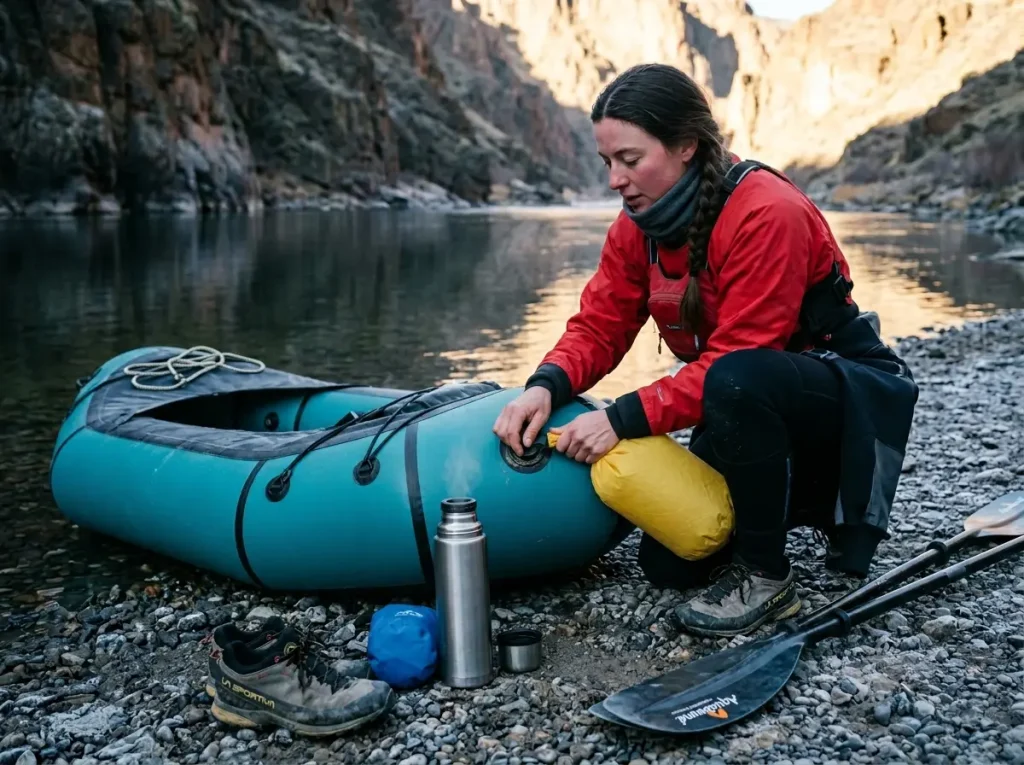
The setup steps are where competitors wave their hands and move on, and they’re exactly where new paddlers get caught out. A little know-how here is the difference between a boat that performs and one that goes squirrelly on you halfway through the day.
Inflation and the Pressure-Temperature Trap
Inflate with the rolled nylon inflation bag until the tubes are firm, then top off after the boat has had a few minutes to sit. This is the step people skip, and it bites them. A raft pumped firm in warm air goes soft as the air inside cools and the cold water leaches heat through the floor — and a soft boat is mushy and squirrelly in current right when you need it stiff. I’ve launched a firm boat at a sunny noon put-in and found it noticeably soft an hour later in a shaded canyon, purely from the temperature drop.
The trap runs the other way too. A boat left fully inflated in direct sun on a hot day can over-pressurize as the air expands, stressing the seams. The habit that covers both: inflate firm, let it acclimate, top off, and re-check pressure before you commit to moving water.
Give the boat a quick squeeze-test right before you drop into anything pushy. Tubes should feel firm, like a ripe melon, not soft enough to dent with a thumb. Ten seconds of topping off on a gravel bar beats a soft, wandering boat in the meat of a rapid.
Outfitting It So You Stay in Control
A bare boat and an outfitted boat handle like two different craft. The short list of what actually earns its place: quick-release thigh straps for control, a back band so you’re not slumping and losing power, and bow and stern lines for grabbing and securing the boat. Carry a throw bag where you can reach it, and for whitewater add a pin kit sized for rafts, kayaks, and packrafts so you can deal with a wrapped or pinned boat.
None of this is about gadgets. It’s the difference between a boat you ride and a boat you control, and it’s the gear that gets you and your boat back when something goes sideways.
Your First Few Sessions
Before you take a new boat into current, take it somewhere calm and boring. Practice a wet exit and a re-entry on flatwater until both are automatic. Get a feel for how the boat tracks, how hard it turns, and how it responds when you edge it. It’s tedious. Do it anyway.
The paddlers who get into trouble are almost always the ones who launched into moving water on day one, learning their boat and the river at the same time. Separate those two learning curves. Know your boat cold on easy water, then go meet the current with one less unknown.
The Bottom Line
Buy for the river day you actually do, not the expedition fantasy you daydream about. A do-it-all touring boat or even a budget flatwater hull covers most paddlers better than a premium whitewater rig they’ll rarely uncork.
Match the deck and floor to your water. Open deck for flat and mild, spray deck for cold and dry, and self-bailing only if you genuinely run whitewater in a warm climate or always wear a wetsuit or drysuit — otherwise you’re buying a cold, wet seat.
And remember the boat is the cheap part. Cold-water dress, a PFD that rides high, a helmet for Class II and up, quick-release thigh straps, and a swiftwater course do more to keep you safe than any hull. Pick the boat from the table that matches your real river day, then go practice a wet exit on calm water before your first run in current.
Frequently Asked Questions
01How much does a good packraft cost?
A capable packraft ranges from budget-friendly flatwater boats to premium whitewater and expedition rigs. You can get a legit flatwater boat at the budget end and a true whitewater boat in the mid-to-upper range, with expedition hulls costing the most. Buy for your real river day, not the priciest tier.
02What is the best packraft for beginners?
A stable, forgiving boat matched to your water beats jumping straight to an expedition hull. The Kokopelli Rogue-Lite is a great do-it-all flatwater pick, and the Nirvana Self-Bailing is a forgiving entry into whitewater. Start easy and build skill before you upgrade.
03How much weight can a packraft hold?
Most packrafts carry 300 to 400 pounds of capacity. Count your weight plus all your gear toward that number, not just yourself, and stay comfortably under the rating so the boat keeps its trim and tracks well instead of sitting low and wandering.
04Are packrafts safe for whitewater?
Yes, with the right boat and skills. You want a self-bailing or spray-deck hull, quick-release thigh straps, a PFD and helmet, cold-water dress, and swiftwater self-rescue practice. The boat alone is not enough — the gear and training are what keep whitewater manageable.
05What is the difference between self-bailing and a spray deck?
A spray deck closes the cockpit to shed splash and keep you dry and warm; a self-bailing floor drains a swamped boat through holes but leaves standing water you sit in. Choose a spray deck for cold or dry comfort, and self-bailing for warm whitewater.