
In this article
Your raft doesn’t wear out on the river. It wears out in your garage, over a quiet winter, under a tarp, on a cold concrete floor while a mouse decides the tube tastes great. Pull it out in April and the damage is already done: a pancake-sized hole chewed through a tube, a black mildew streak down a seam, or a crease that splits the first time you air it up. The boaters who’ve opened a ruined boat in spring all tell the same story, and it’s never the rapid that got it. Here’s how to store and clean a whitewater raft so the only surprise next season is how good it still looks, starting with the one fact that changes every other decision.
Know Your Raft’s Material Before You Store Anything
Before anyone tells you how to put your boat away, the real question is whether you know what it’s built from. A raft is either PVC or Hypalon (often sold as Pennel Orca), and that single fact flips half the storage rules. Get it wrong and the careful thing you do all winter becomes the thing that wrecks the boat.
Hypalon (Pennel Orca) vs PVC — what each one tolerates
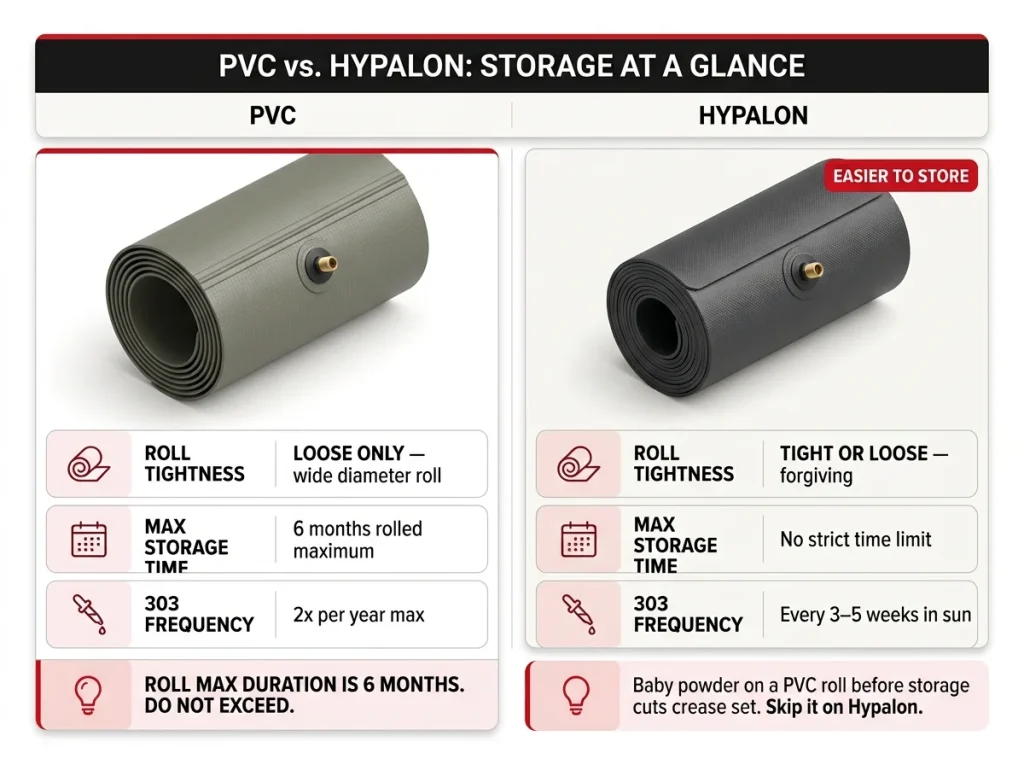
PVC is the more common, more affordable coating, and it has a temper. It creases, it suffers crease fatigue at the folds, and it stiffens if you over-treat it. Hypalon is the easier-living material: it rolls without complaint, shrugs off repeated protectant, and forgives the kind of storage that would crack a PVC boat. Neither is fragile on the water. They just want different things in the off-season.
How to figure out which material you own
Most rafts list the material on the spec sheet or stamp it near the valve, and a quick model lookup settles it fast. If you’re still shopping or want to know exactly what you bought, our whitewater raft buying guide breaks the materials down by model. For a side-by-side on how the two coatings actually behave, the full PVC vs Hypalon breakdown is worth five minutes before you store anything.
Why the material decides your whole storage plan
PVC stores rolled for about six months at the outside, wants a loose roll with the fold lines rotated, and takes 303 no more than twice a year before the plasticizers that keep it flexible start to break down. Hypalon rolls freely with far less crease risk and can be treated as often as it looks dull. Lead with this, because everything below changes depending on which boat is sitting in your garage.
A light dusting of baby powder or talc on a PVC boat before you roll it keeps the coating supple and cuts down on crease set over a long winter. Skip it on Hypalon, which doesn’t need the help.
How to Clean a Whitewater Raft Step by Step
The clean-and-store routine isn’t complicated, but the order matters and so does what you put on the rubber. Done right, the wash doubles as your end-of-season inspection.
Rinse off the grit before you scrub
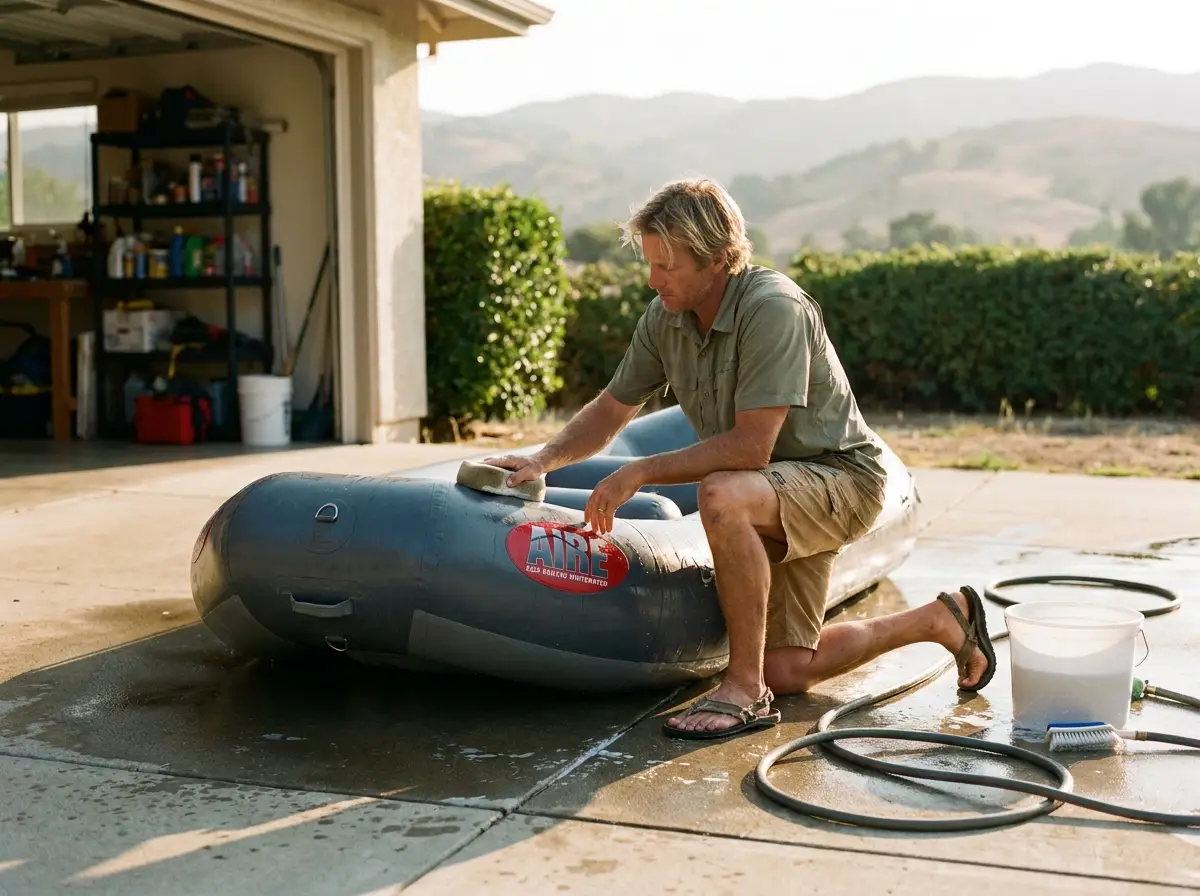
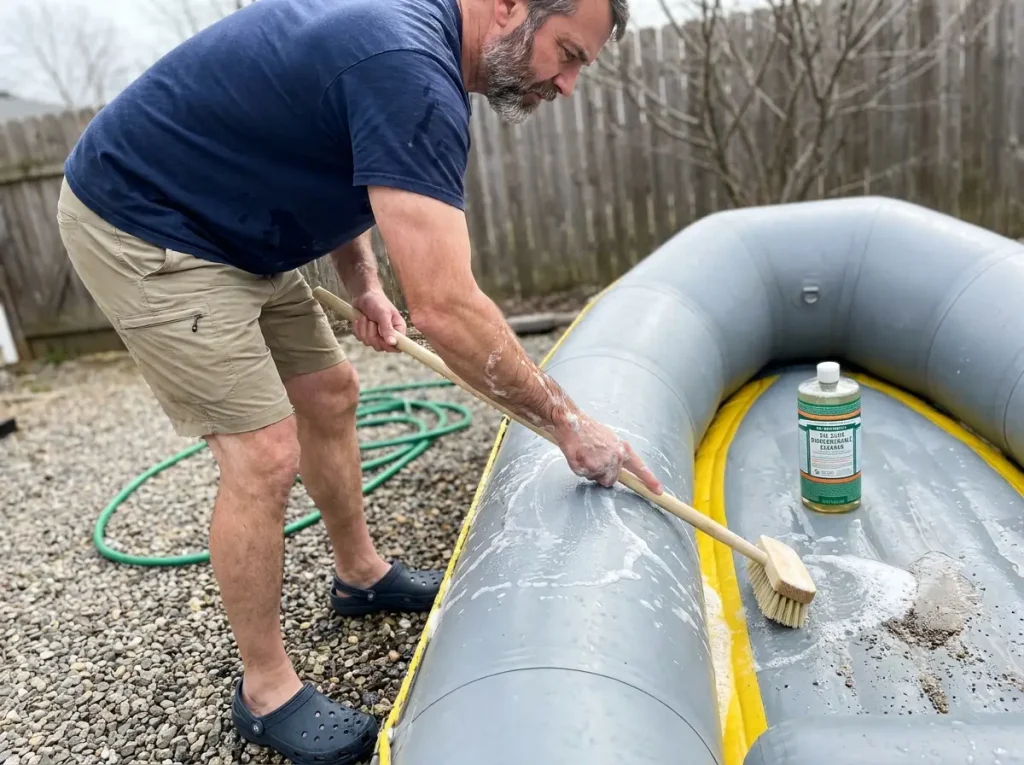
Start with a hose and knock off the loose dirt, sand, and grit, paying attention to the seams and the crevices where the floor meets the tubes. That’s where grit hides, and grit left under a scrubbing brush is just sandpaper on your coating. Get it wet, get it off, then start washing.
Section-by-section wash (and what to clean with)
Work the boat in sections: floor and edges first, then the tubes, then flip and repeat. Use a soft brush and a mild, biodegradable cleaner. NRS makes a purpose-built inflatable boat cleaner if you want the boat-specific option, but the honest budget route is Dr. Bronner’s Sal Suds, which dilutes way down and won’t attack the coating. Plain Dawn works in a pinch too. Take it slow enough to actually look at every panel as you clean it, because keeping a small battery shop-vac in the rig to flatten the boat at the takeout means you’re already in the habit of handling it gently.
Lifting frame marks and silvering
Frame rafts and catarafts pick up grayish rub marks where the frame and straps ride the tubes, and a Mr. Clean Magic Eraser lifts most of that silvering without harsh chemicals. Wet it, work it gently, and don’t grind on one spot. It’s a cosmetic fix, not a structural one, so ease off if the mark won’t budge.
What Never to Use on a Raft (and What to Fix First)
Here’s where people quietly ruin good boats with good intentions. The cleaners that feel strong are the ones that do permanent damage.
The cleaners and tools that permanently damage rubber
Never put bleach, Ajax, or any abrasive cleaner on a raft. They degrade the coating for good, and no amount of 303 brings it back. Skip the close-range power washer too. Mild soap and a soft brush is genuinely the whole job, and anything stronger trades next season’s boat for a slightly faster wash today.
Inspecting as you clean (scrim shots, silvering, D-rings)
Since you’re already looking at every inch of the boat, this is your inspection. Hunt for scrim shots (abrasions worn through the coating to the fabric scrim underneath), check that the D-rings and seams are solid, and note any silvering from frame rub before it becomes a leak. Cataraft owners especially should check the tube-and-frame contact points, and our cataraft guide covers where those boats wear. Confirm every valve is fully closed before the boat goes away, so humid air stays out of the chambers.
Patch it now, not in spring
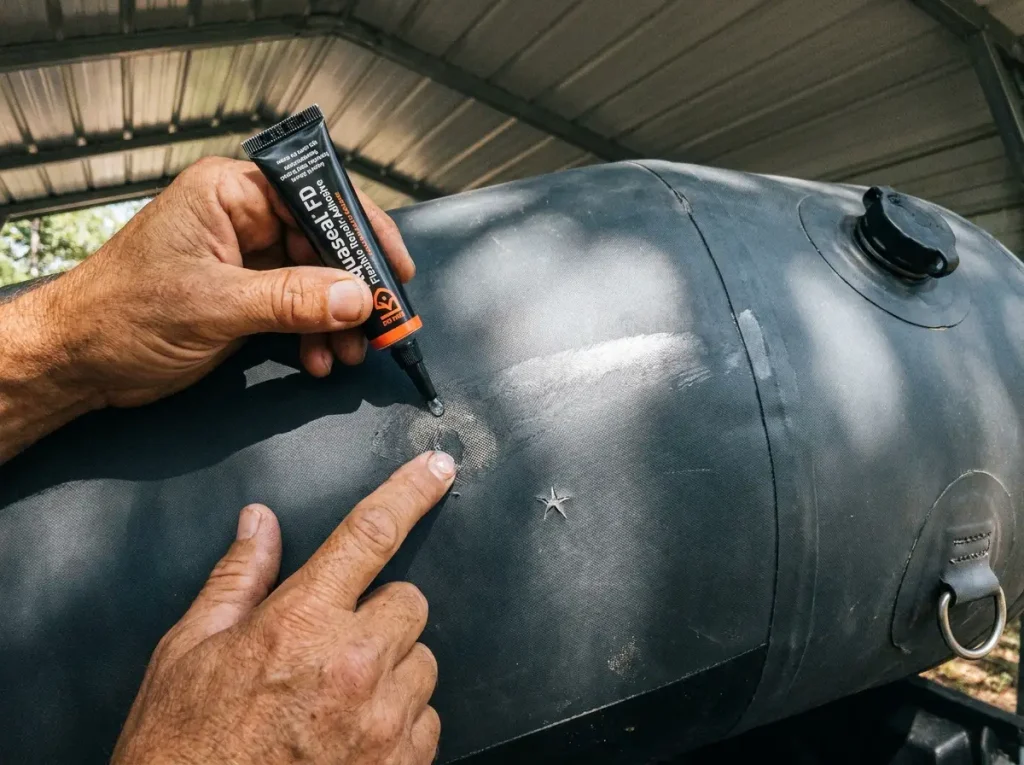
Catch a small abrasion now and it’s a five-minute fix; ignore it and it’s a seam leak by spring. A flexible repair adhesive like Gear Aid Aquaseal FD handles most field-grade abrasions, and a no-glue patch like Tear-Aid Type A is a fine budget backup. For anything deeper than a surface scuff, our step-by-step Hypalon raft repair walks through a patch that actually holds. The mistake is always the same: people store the boat with damage they will deal with later, and later it’s worse.
Dry It Completely — the Step Everyone Rushes
This is the boring step that quietly saves the boat, and the one everyone shortcuts because they’re tired and want to be done.
Why a damp boat fails over winter
A boat rolled up even slightly damp is a science experiment by February. Trapped moisture grows mold and mildew, and worse, it works into the seams and delaminates the adhesive that holds them together. That slow delamination is how a stored boat reaches outright seam failure, and most of those stories start with a boat that went away wet.
Drying the inside, not just the outside
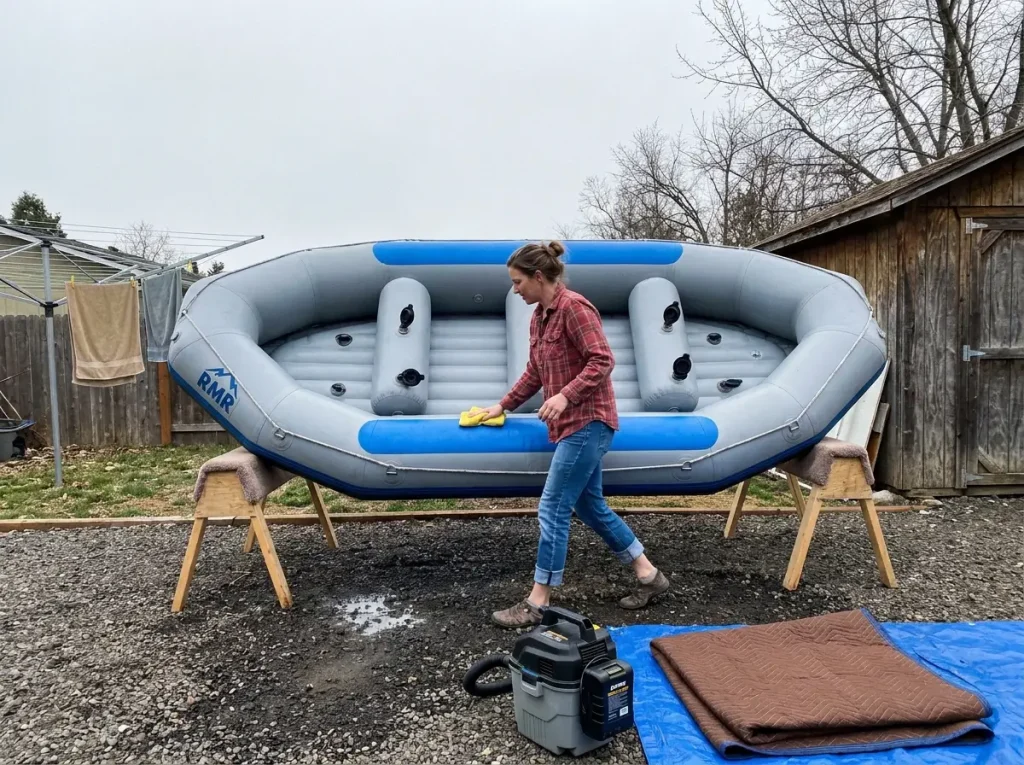
The outside dries fast in the sun; the inside of the chambers is what people forget. The goal is to dry completely, not just dry on the surface, so open the valves, let air move through, and wipe down the floor where water pools. Brief sun-drying is fine, but don’t bake it in full sun for days, because that’s a UV problem you’re about to solve in the next section.
The fast way to dry and deflate
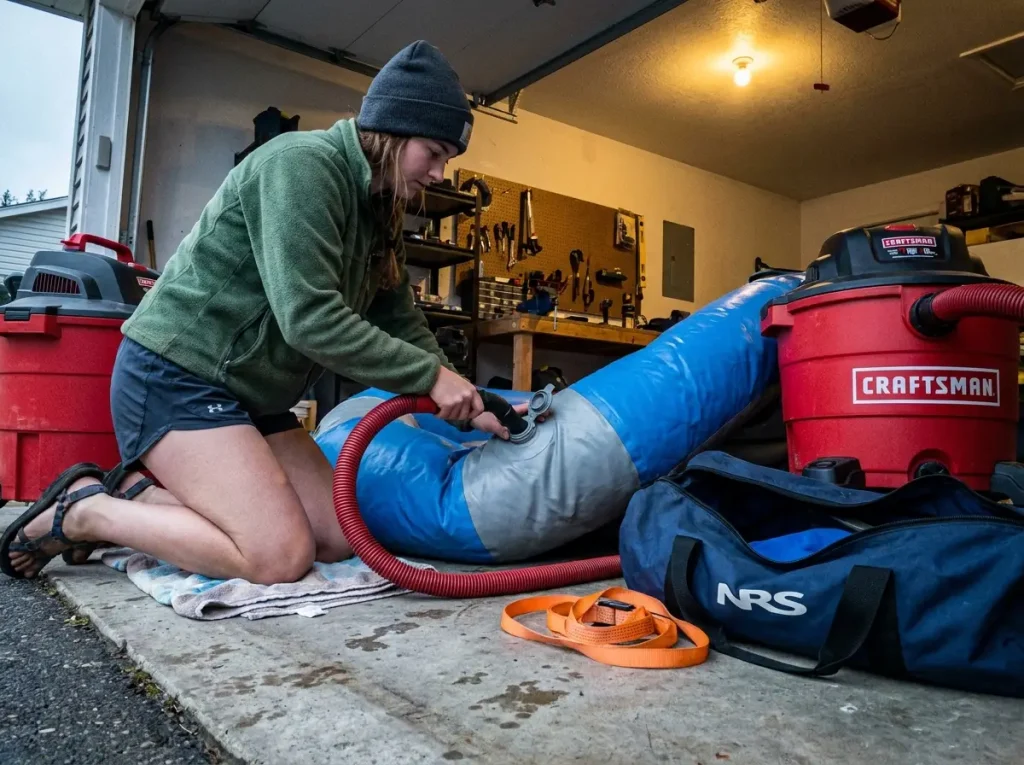
A shop-vac on its reverse or blow setting pushes air through the chambers and speeds up the interior drying, then flips to suck the boat flat for rolling. Just don’t vacuum it bone-dry and slam the valve shut, which stresses the material at the worst possible moment.
Close the valves the moment the boat is flat, not after you’ve wrestled it into the bag. An open valve on a deflated chamber pulls humid garage air straight into the boat, and that trapped moisture is where off-season mildew starts.
303 and UV Protection (What Really Ages a Raft)
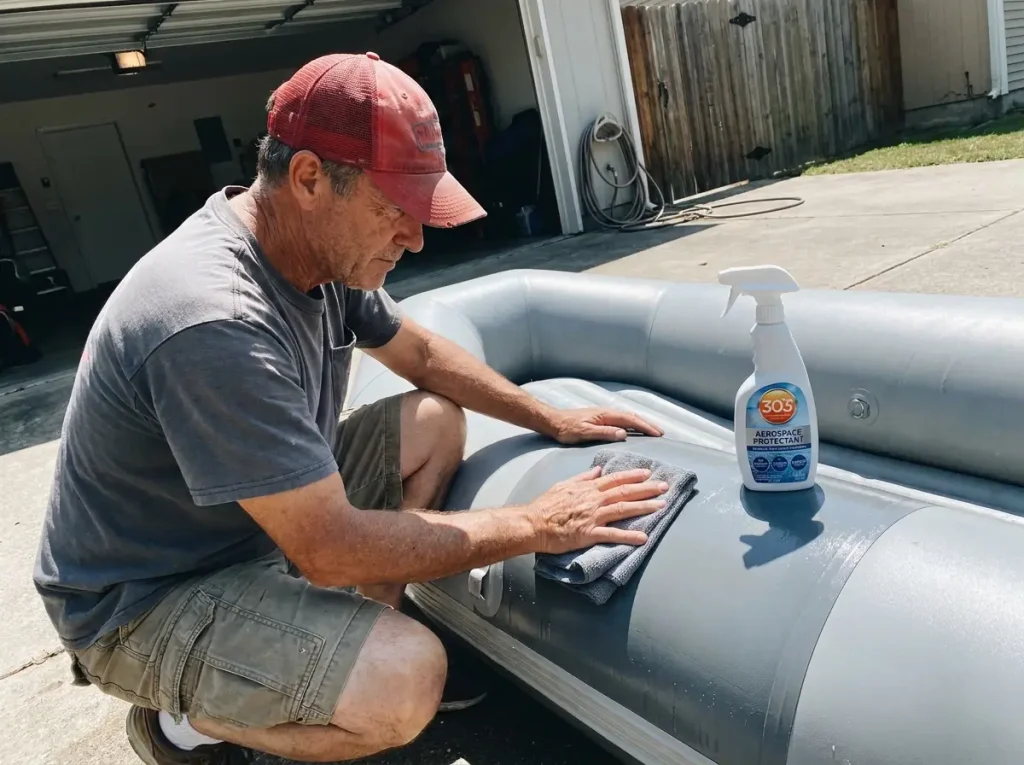
Sunlight is what actually ages a raft. Not the rocks, not the swims, just the slow UV bake that turns rubber brittle and chalky until the seams and fabric give out.
Why UV is the boat’s worst enemy
UV degradation breaks down the coating’s mechanical properties: it fades the color, then chalks the surface, then embrittles the rubber until it cracks. According to 303’s manufacturer, the protectant blocks the UV that causes that embrittlement and chalking. Think of it as sunscreen for a boat that can’t move itself into the shade.
How to apply 303 the right way
Apply 303 Marine Aerospace Protectant to a clean, dry boat, wiping it on with a damp cloth and letting it set. It’s the hero product here for a reason, and when boaters say 303 Aerospace Protectant, this is the bottle they mean. Every serious cleaning guide names it because there’s no real substitute for UV defense, and a thin, even coat does more than a heavy soak.
How often (and the PVC limit that surprises people)
Here’s the catch most guides bury: on a PVC boat, 303 goes on no more than about twice a year, once before storage and once when you pull it out. Over-applying it degrades the plasticizers that keep PVC flexible, so chasing more protection quietly stiffens the boat you’re trying to save. Hypalon has no such limit, and a boat that lives in the sun all season wants a fresh coat roughly every three to five weeks.
Storing It Inflated, Deflated, or Rolled
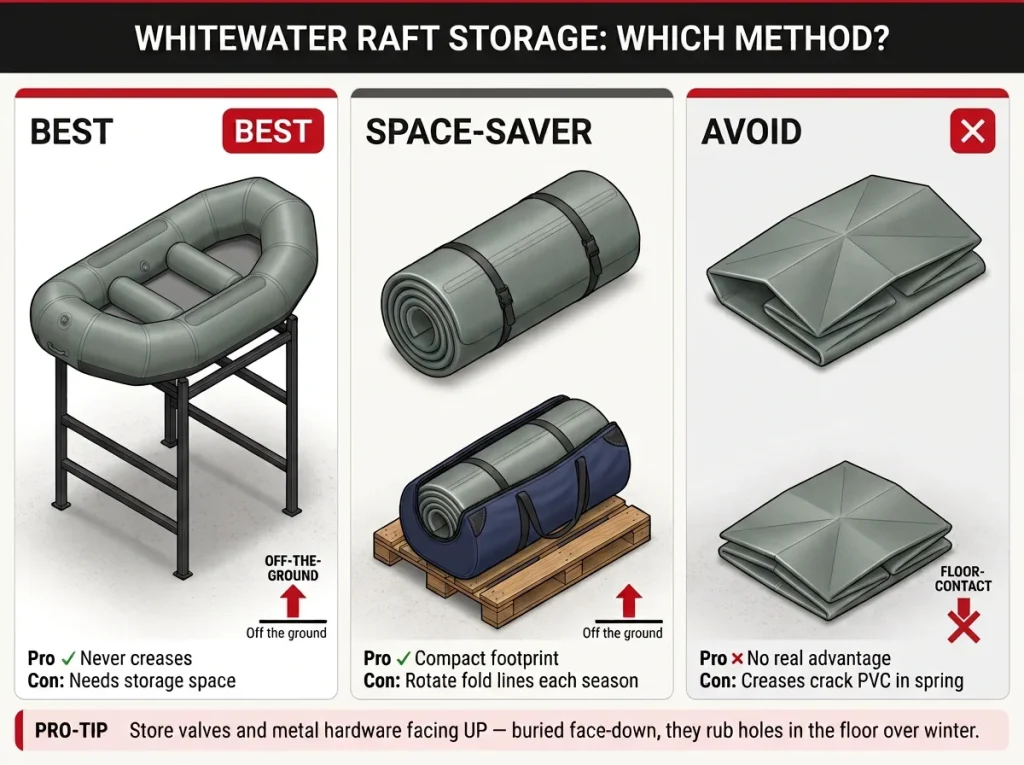
There’s a best way, a space-saving way, and a way that quietly creases your boat. Pick based on the room you actually have.
Best method — softly inflated, out of the sun
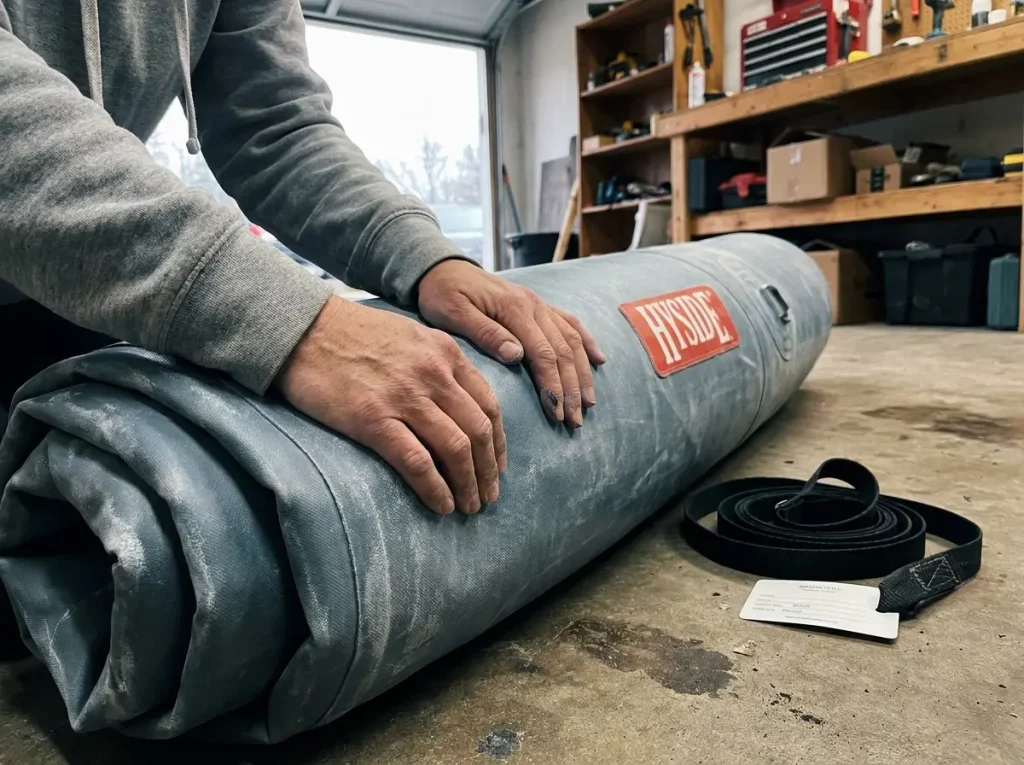
If you have the space, store the boat softly or partially inflated, just enough positive pressure to hold its shape, and out of direct sun in a cool, dry place. It never creases, the seams stay relaxed, and it’s ready to go in spring. Hyside’s owner’s manual lays out the same off-the-ground, out-of-the-sun rules most makers agree on. Don’t store it fully aired-up in a hot garage, though, because a pressurized boat baking all afternoon can blow a seam.
Deflating and loose-rolling without creasing it
Tight on space? Loosely roll or fold it, and rotate the fold lines from last season so you’re not setting the same pinch points and creases over and over, which matters double on PVC. A CRAFTSMAN wet/dry shop vac flattens the boat fast and even reverse-blows it roughly back to shape in spring. When it’s time to re-inflate, the right pump to bring it back to pressure makes the spring relaunch painless, and your floor type changes how it deflates and stores.
Keeping the rolled boat protected and off the ground
A rolled boat still needs a barrier from the floor and a little protection from abrasion. An NRS boat bag keeps the roll contained and off the concrete, and a clean moving blanket is a fine budget wrap. Get it up on a pallet or a shelf either way.
When you pack the boat, point the floor valves and any cam-strap metal UP, not down against the floor. Buried face-down in a roll or a rig, that hardware will quietly rub a hole in the floor over a winter.
Covers, Climate, the Ground, and Rodents
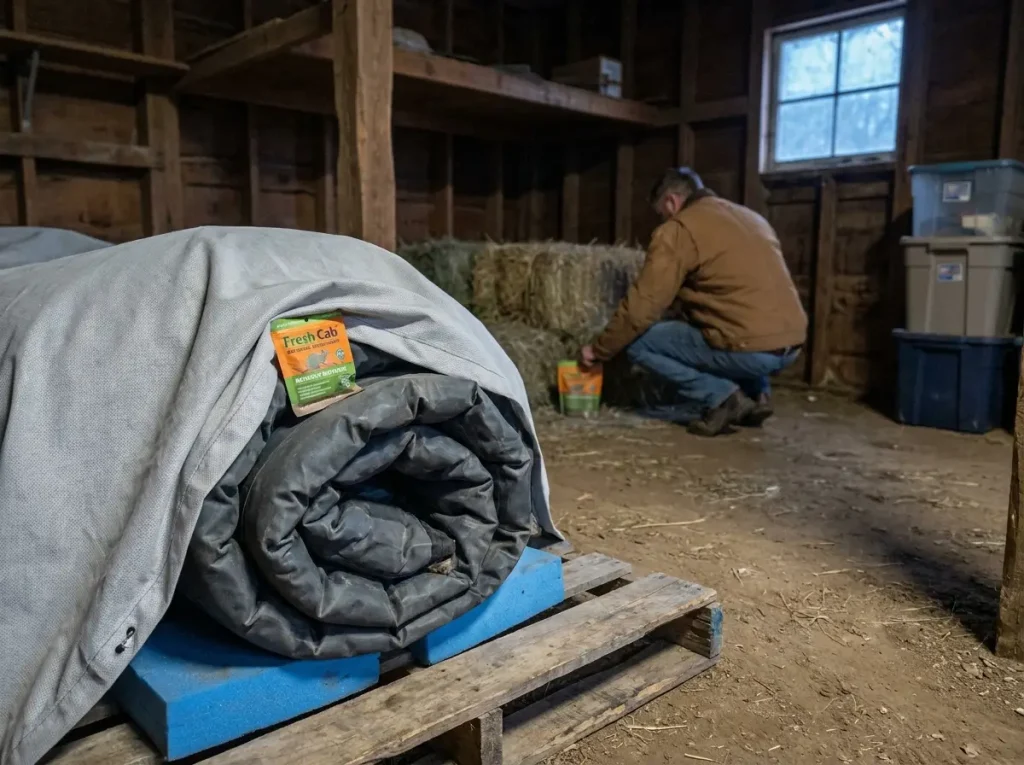
If you can’t store the boat inside, this is how not to make things worse. Two cheap mistakes ruin more rafts in off-season storage than weather ever does.
The tarp trap (the solar-oven mistake)
The classic rookie move is throwing a waterproof hardware-store tarp right over the boat. It blocks the sun, sure, but it traps heat and moisture underneath with no airflow, creating a solar oven that grows mold and cooks seams until they fail. A sealed tarp laid on the boat is worse than no cover at all. If you need a cover, it has to breathe.
Climate, covers, and keeping it off the ground
What you’re protecting against depends on where you live. In dry, high-UV country, sun is the enemy, so a breathable UV cover or an out-of-sun spot matters most, and purpose-built breathable covers like the Over It Raft Cover and the Whitewater Designs Raft Cover are the honest upgrade if you truly must store outside. In the wet Pacific Northwest or Alaska, moisture is the enemy, so complete drying and airflow beat any cover, and a sealed tarp is the worst case. Everywhere, keep the boat off bare concrete, which wicks cold and damp up into the rubber and stains it; a rack, raft trailer, pallet, or set of foam blocks fixes that for almost nothing.
Rodent-proofing the storage spot
A mouse can do more damage in one winter than a season of Class IV, and boaters routinely find chewed, pancake-sized holes in tubes that wintered in a barn. Store the boat in as sealed a space as you can and add a repellent: Fresh Cab botanical rodent repellent is the pest repellent pros reach for over mothballs, which are cheaper and harsher and only last a few months. While you’re set up for off-season care, the rest of your kit needs the same attention before it goes into storage.
The Bottom Line
Know your material first, because a PVC boat and a Hypalon boat want different things all winter. Clean it gentle, dry it completely, and give it a coat of 303, and those three stay non-negotiable. Then store it off the ground, out of the sun, under a breathable cover or none at all, and rodent-proofed.
Spend the extra twenty minutes before you put the boat away this season. The raft you protect now is the one still running rivers in ten years, and the only surprise in spring should be how good it still looks.
Frequently Asked Questions
01Should you store a whitewater raft inflated or deflated?
Softly inflated and out of the sun is best, because the boat never creases that way. Deflated and loosely rolled is the space-saving second choice. Either way, keep it off the ground and do not roll it tight, especially with PVC.
02How often should you apply 303 to a raft?
On a PVC raft, no more than about twice a year, once before storage and once when you pull it out. Over-applying degrades the plasticizers that keep PVC flexible. Hypalon takes it as often as it looks dull, and a sun-exposed boat wants a coat every three to five weeks.
03Can you store a PVC raft rolled up for the winter?
Yes, but roll it loosely and ideally for no longer than about six months. Tight folds left all winter can go brittle and crack along the crease on the first spring inflation. Rotate the fold lines and keep it off the cold floor.
04Is it okay to put a tarp over a stored raft?
Not a sealed waterproof tarp laid right on the boat, because it traps heat and moisture into a solar oven that grows mold and fails seams. Use a breathable cover instead, or store the boat inside with no tarp at all.
05How do you keep mice out of a stored raft?
Store it in a sealed space and add rodent repellent, like botanical pouches or mothballs in a pinch. Rodents will burrow into a stored tube and chew a hole big enough to end a boat, so this is cheap insurance.