
In this article
Here’s the honest gut-check no drysuit roundup wants to lead with: a good rafting drysuit is a serious chunk of money you might wear three days a year, and for a lot of boaters the smart first move is renting one, not buying it. Ask around any cold-water put-in and you’ll hear the same split among private boaters and guides about who actually needs to own a suit versus who’s fine borrowing the outfitter’s. So before we rank the best drysuits for rafting, we’ll settle the real question first: do you even need to buy one yet? Then we’ll cover what makes a rafting suit different from a kayak or dive suit, how it should fit for an actual swim, our top picks by category and budget, and how to keep a suit alive through a multi-day trip.
Do You Actually Need a Drysuit for Rafting, or Can You Rent One
Before we rank a single suit, let’s make sure you need to own one. The rule that decides it isn’t how warm the day feels on the bank, it’s the water. The American Canoe Association’s cold-water immersion threshold kicks in when water temperature drops below 60°F, or any time the combined air and water temperature is under 120°F.
A 75°F spring afternoon over 40°F snowmelt is 115°F combined, which still calls for a drysuit even though you’re sweating in the parking lot. Dressing for the water, not the air, is the whole foundation of what to wear rafting, and it’s where most first-timers guess wrong.
The reason that line matters so much is what cold water does to you in the first few seconds. Cold Water Shock can trigger an involuntary gasp reflex, a spiked heart rate, and disorientation within seconds of going in at 50 to 60°F, even for strong swimmers, and it’s the on-ramp to hypothermia if you stay in. That’s the window where a suit either keeps you functional or fails you. It’s also why this isn’t a comfort decision, it’s a safety one, and why the fit and seal we’ll cover later actually matter mid-swim.
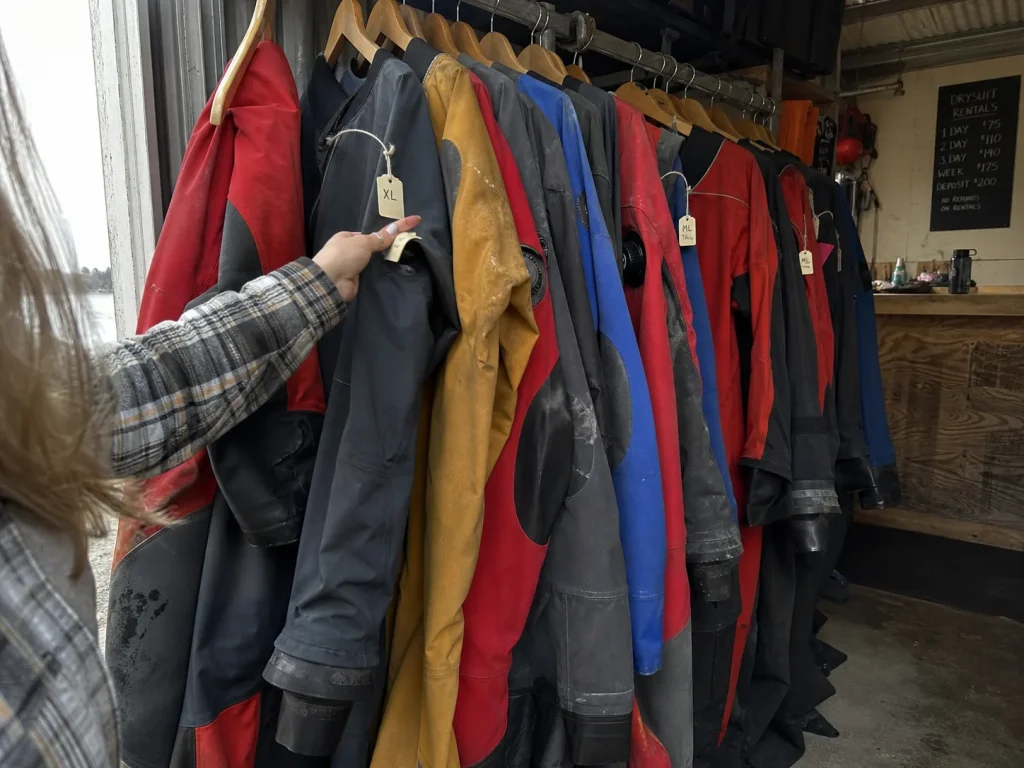
Now the honest part. If you’re a first-timer on a guided trip, or you run cold water once or twice a season, dropping premium money on a suit you’ll wear a handful of days may not be the smart call. Many guided cold-water outfitters provide or rent suits as part of the package, and plenty require them.
Ask the outfitter what’s included before you buy, the same way you’d check the gear the outfitter provides by river class. The private boater running cold water regularly is who a suit purchase pays off for. Everyone else has a cheaper path worth checking first.
If you land somewhere between wetsuit weather and full drysuit conditions, that’s its own decision, and the wetsuit-vs-drysuit call breaks down where the line actually sits.
Rent the same suit twice before you buy. Two rental days cost a fraction of a new suit and tell you what size you actually take over your layers, so when you do buy, you’re not guessing on fit through a screen.
What Makes a Drysuit Rafting-Specific, Not Just a Kayak or Dive Suit
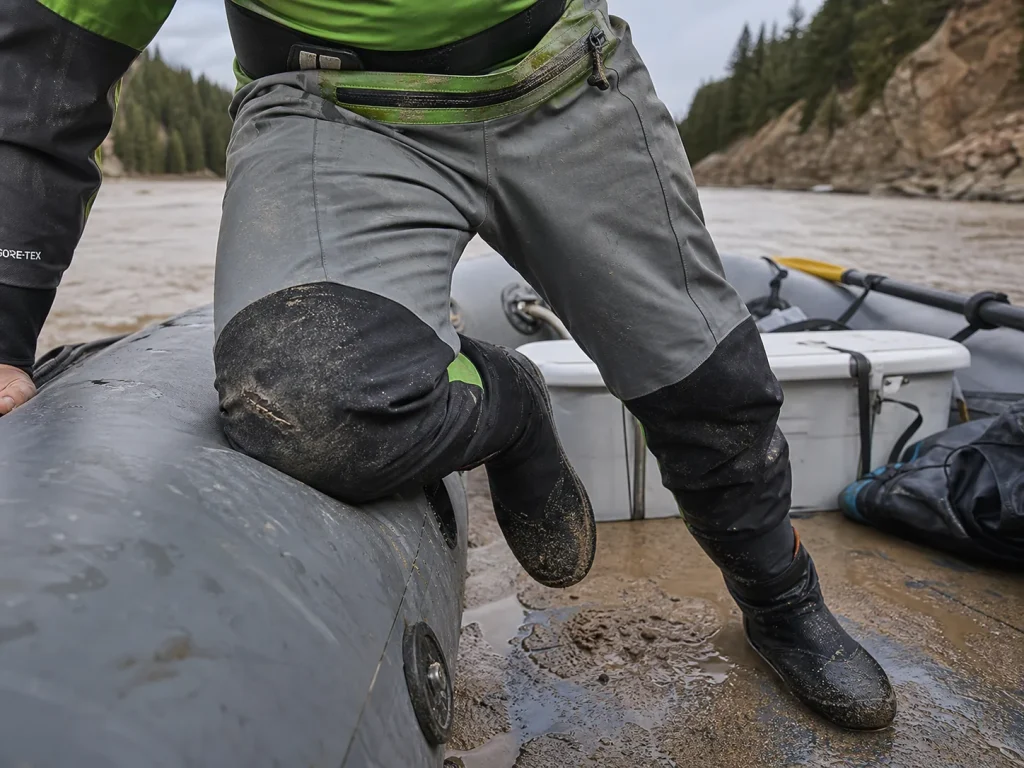
Here’s where a lot of money gets wasted. A drysuit is not a drysuit is not a drysuit, and the “dry suit” you find cheapest online was probably built for a diver or a flatwater kayaker. On a raft the abuse is different, and it lands in different places.
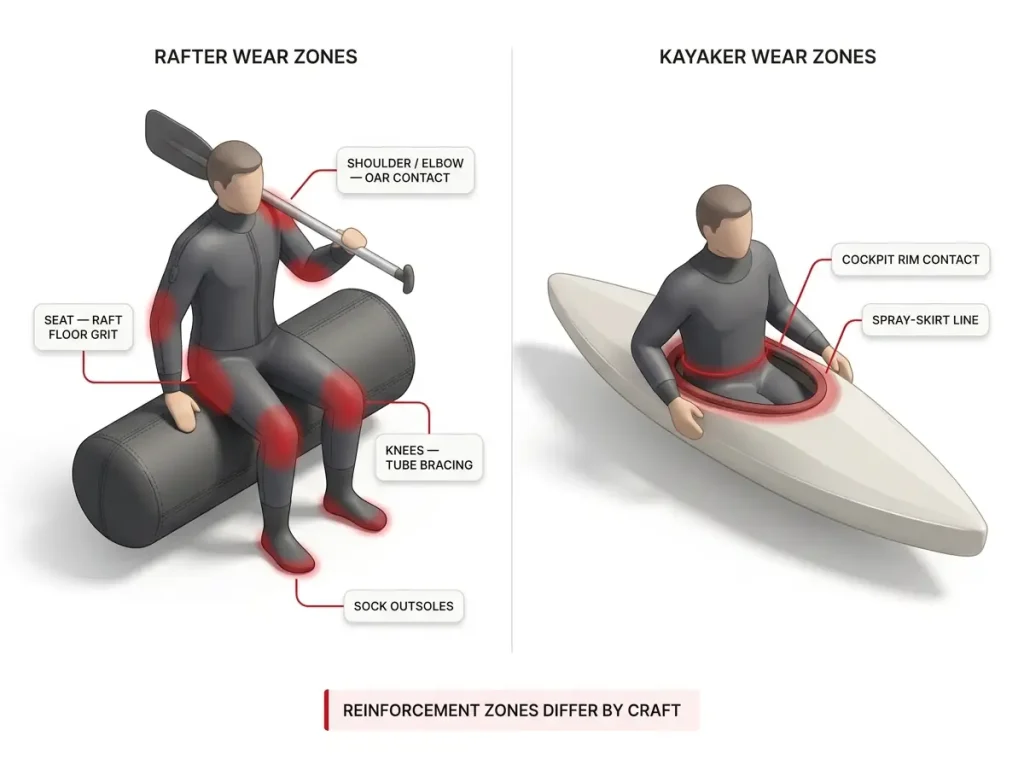
Oar shafts ride your shoulder and hip all day. You scramble over inflated tubes and the raft frame. You kneel and sit on a floor loaded with grit and sand, and you high-side onto abrasive fabric when the guide yells for it.
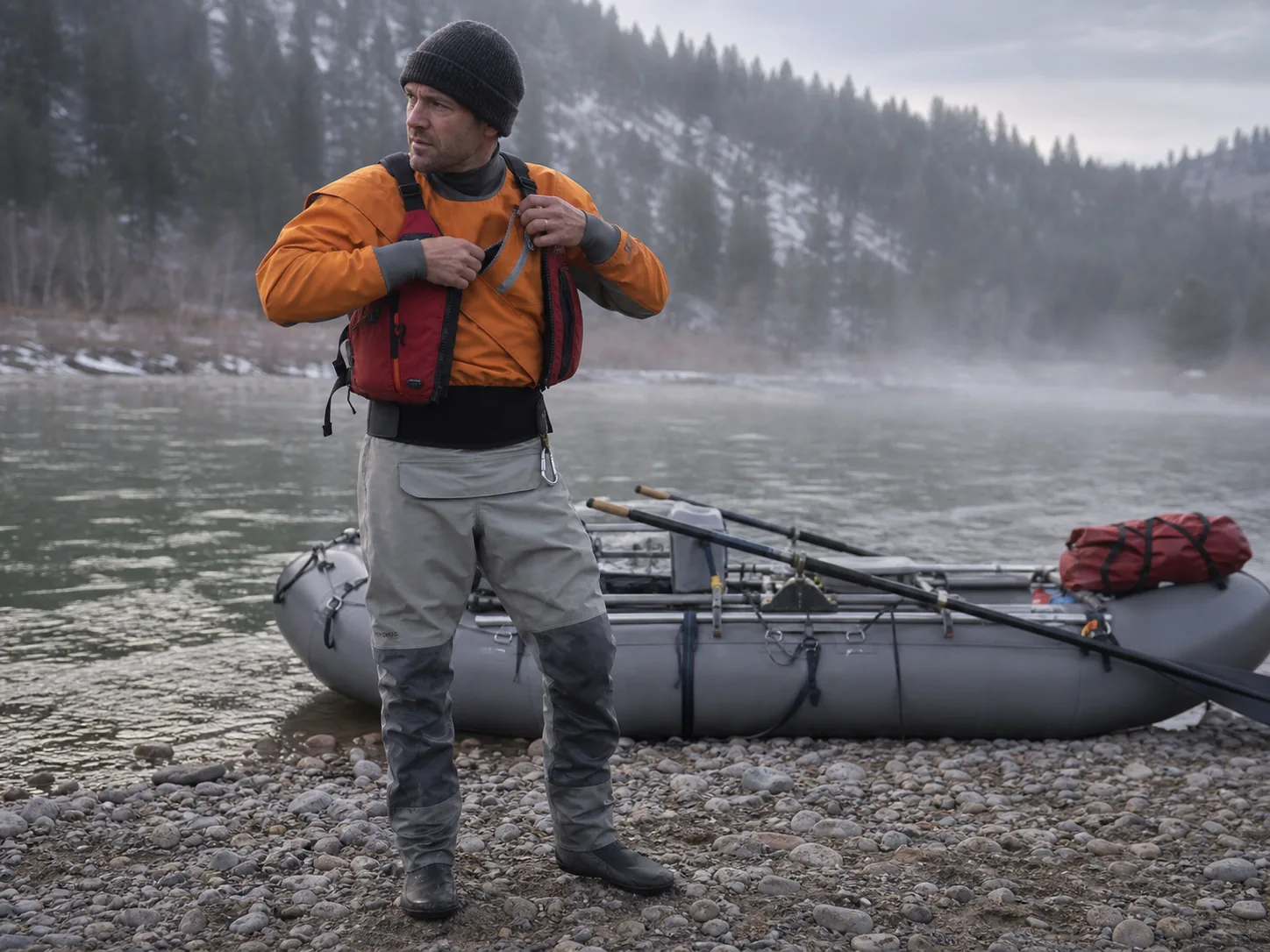
That’s why rafting-specific suits like the Kokatat Meridian and Icon or the NRS Jakl and Foray add Cordura reinforcement at the elbows, knees, seat, and sock outsoles on top of the base Gore-Tex Pro or Hydrus 3L shell. The base fabric is what keeps water out. The Cordura patches are what stop an oar-shaft scrape or a slide over the tube from turning into a pinhole two days into a trip.
On a kayaker the wear map centers on the cockpit rim and the spray-skirt line. On a rafter it’s the shoulders, the seat, and the knees, so that’s where the armor needs to be.
The common mistake is buying on the base fabric spec alone. A suit can carry a beautiful Gore-Tex Pro rating and still wear through early if it has no reinforcement where a rafter actually grinds it. Check the reinforcement zones before the fabric name, because that’s the part a raft punishes hardest.
Fabric and Waterproofing, Gore-Tex Pro vs Hydrus and the Rest
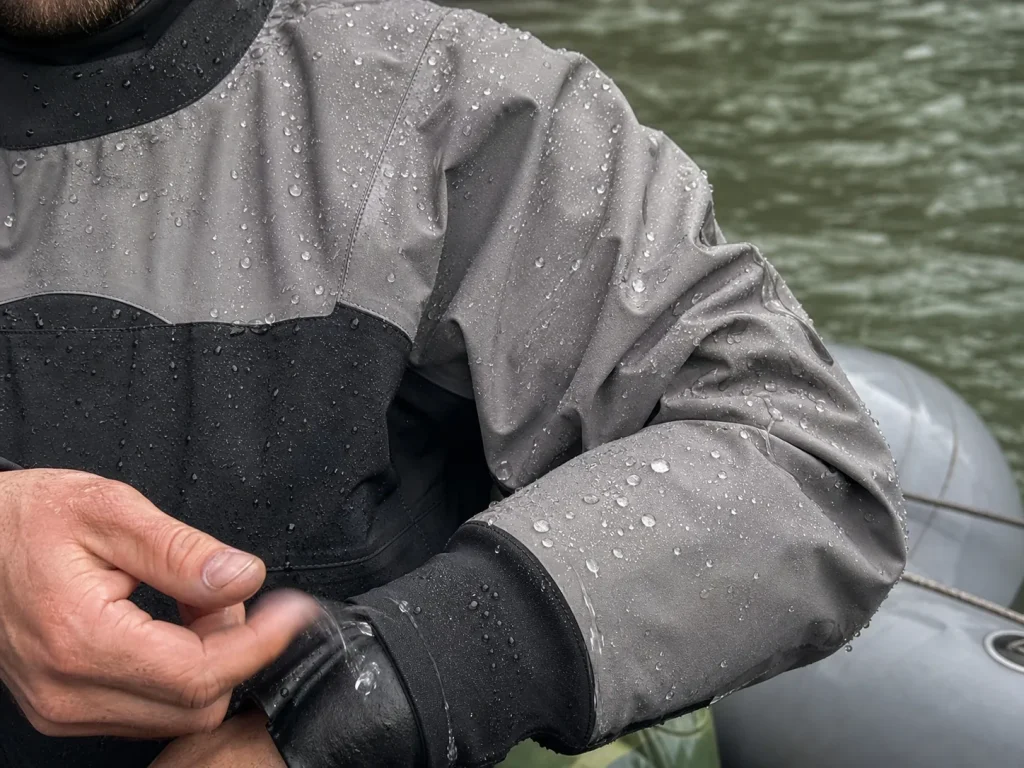
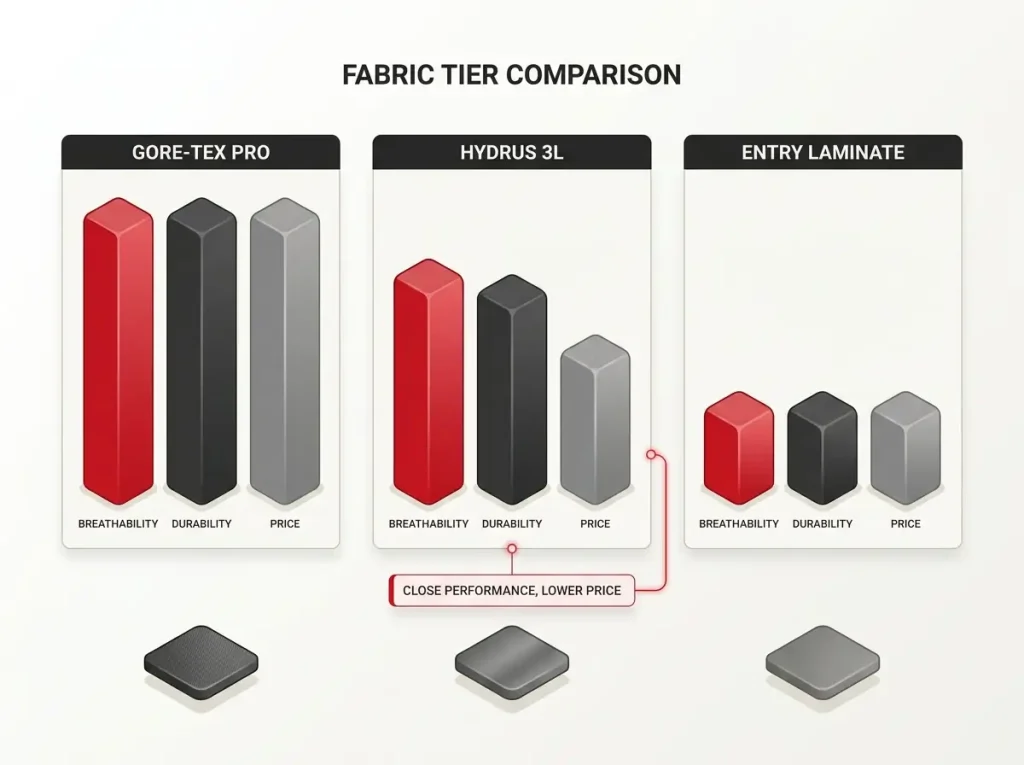
The spec sheets throw a lot of laminates at you: Gore-Tex Pro, Hydrus 3L, Eclipse, generic trilaminate. Most of it comes down to two numbers and one trade-off. Gore-Tex Pro is the most breathable and durable shell on the market, and it’s priced like it.
Hydrus 3L, Kokatat’s own laminate, sits one tier down in breathability and longevity but runs close to half the price of a comparable Gore-Tex Pro suit. That’s the real budget lever in this whole category.
A Hydrus suit isn’t the “worse” choice, it’s a deliberate trade. You give up some breathability and some seasons of lifespan for a materially lower price, which is exactly the right call for someone rafting a handful of cold days a year.
The two numbers to understand are waterproofness, measured in mm H₂O, and breathability, measured in g/m²/24h. Waterproofness keeps the river out. Breathability keeps your own sweat from soaking you from the inside, which is what actually ruins a warm-air, cold-water day. On a Hydrus suit you trade a slice of that breathability for the lower price, and on a full Gore-Tex Pro suit you’re paying for the best of both.
A suit that seals perfectly but doesn’t breathe turns a sunny shoulder-season float into a clammy sauna under your PFD, and you’ll swear you sprung a leak when it’s just trapped sweat. If your days are genuinely warm-air over cold water, that’s also the moment to ask whether you need a full suit or just a splash top over a base layer.
Gaskets, Entry Style, and the Relief Zipper That Saves Your Day
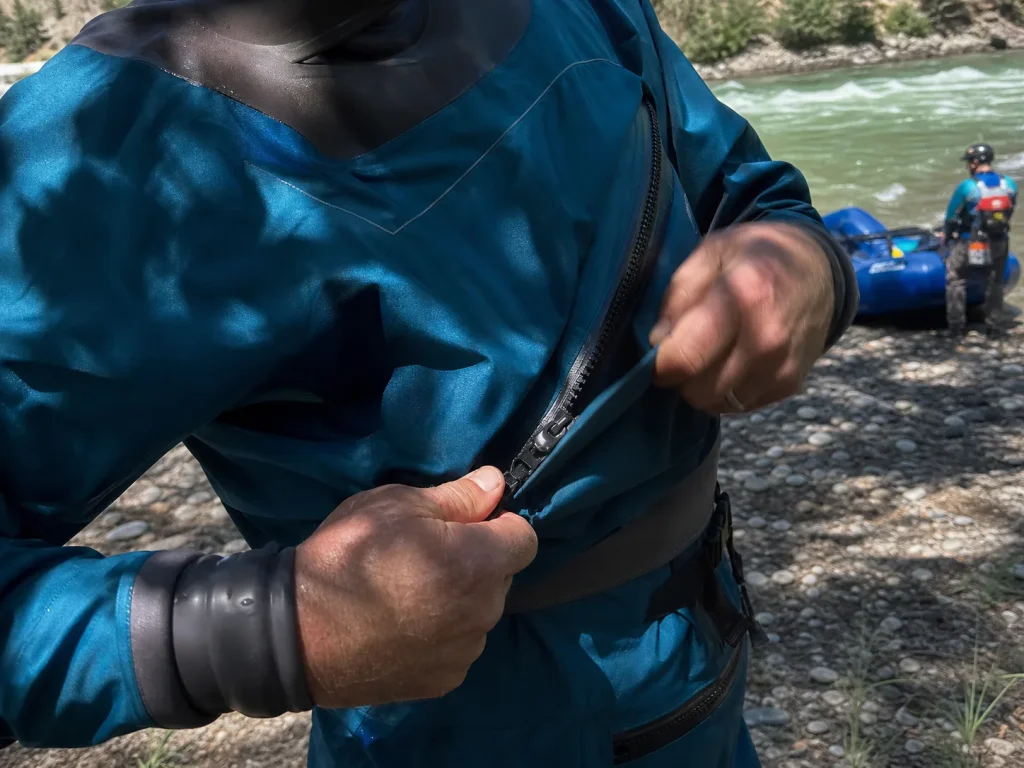
The gaskets are where seal and comfort fight each other. A full latex gasket at the neck seals best and lets in the least water. A neoprene gasket neck, what makers call a semi-dry suit, is more comfortable but lets in “a few teaspoons” on an occasional swim.
Treat that as a real choice, not a downgrade. If you swim rarely rather than rolling and scouting rapids all day, a semi-dry neck is a legitimate, more comfortable pick that costs you almost nothing in practice.
And a gasket you don’t love is a fix, not a dealbreaker. Several drysuit makers convert a latex neck to neoprene for a modest fee, so a choking stock gasket isn’t a reason to return the suit. A snug new gasket can also be pre-stretched at home before a trip so it stops feeling like a chokehold on day one.
Entry style is the other big call. Front-entry suits, like the Immersion Research 7Figure, let you get in and seal up solo at the put-in without a buddy zipping your back. For a private boater rigging alone, that’s a genuine daily convenience, not a spec-sheet bullet. Rear and shoulder-entry suits usually need a hand to close.
Then there’s the relief zipper, the feature nobody explains until you need it. Picture the real rafting day: an early put-in, layered under a PFD and maybe a splash top, a multi-hour float with no easy way to strip down. The relief zipper is what turns a miserable hold-it situation into a non-event.
On an all-day cold-water trip it earns its place more than almost any other feature, and reaching it under a PFD is a fit detail worth checking in the store. NRS covers the gasket and zipper handling well in NRS’s own fitting walkthrough.
If a latex neck gasket chokes, seat a coffee can inside it for a few days before your trip. The gentle stretch takes the edge off without stressing the latex, and it beats white-knuckling a too-tight seal all weekend.
Getting the Fit Right for a Real Swim, Not the Fitting Room
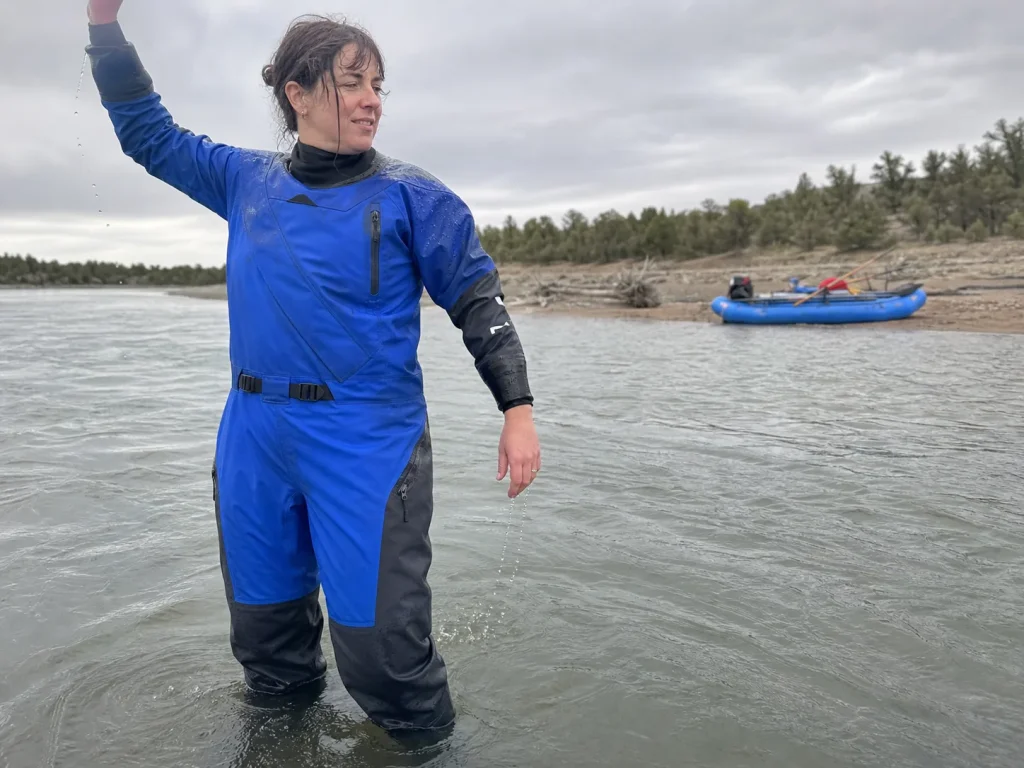
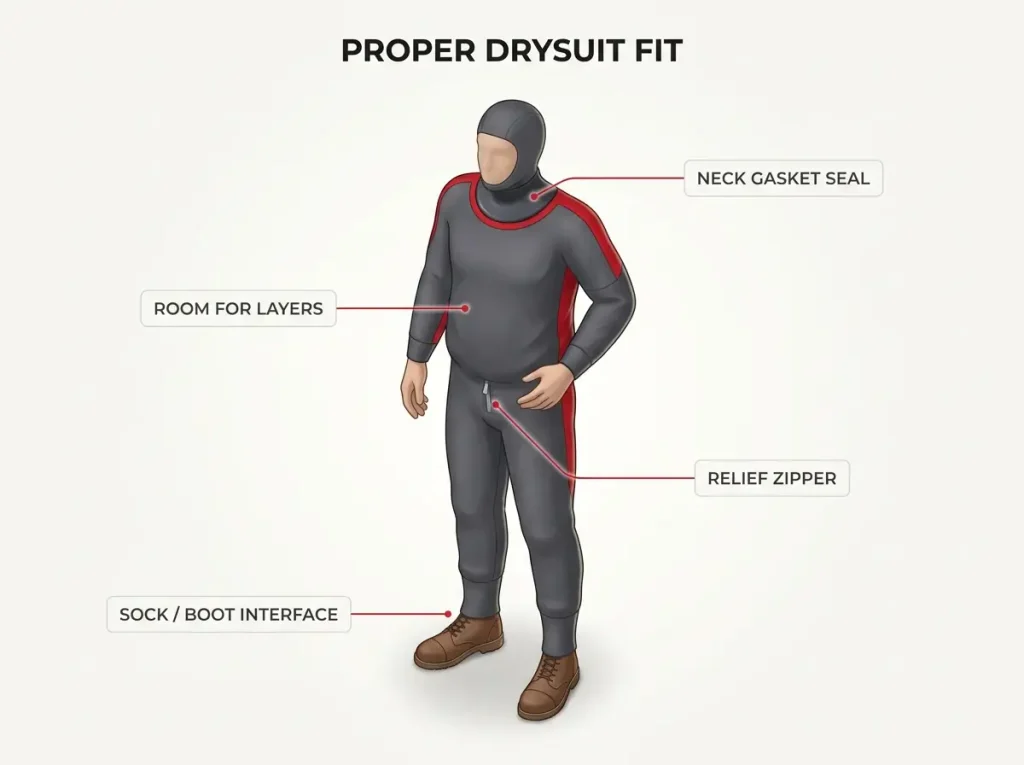
A drysuit fits differently than a jacket because it has to work in the water, not just on a hanger. The first rule is to size for your layers.
The whole point of a dry suit is the insulation layer underneath, so a base layer plus a mid layer is the baseline, and a suit that only fits over a T-shirt is too small for cold-water reality. Get the layering right and the suit is just the shell over it. Try it on over what you’ll actually wear, then reach, squat, and raise both arms like you’re setting an oar.
Here’s the part competitors skip. Fit and seal are swim gear, not comfort features. A loose neck gasket floods the suit in a swim, and a flooded suit becomes a weight instead of insulation, which makes the feet-up, nose-downstream swim position harder exactly when you need it to work.
The reason that matters ties straight back to what cold water actually does to you in the first seconds. A suit that seals right keeps you buoyant, mobile, and warm enough to self-rescue. A suit that floods works against you.
Don’t forget the feet. Some suits have integrated Gore-Tex socks, others use separate wetsuit booties, and either way you size your footwear to go over them, not under. Cramming a wading boot over a sock-footed suit that’s already snug is how people end up with cold, numb feet on a long day.
The gut-check story rafters tell is the first spring flip, where a stock latex neck floods a few teaspoons during the swim. For someone in a semi-dry setup that’s nothing. For someone whose gasket didn’t seal, it’s the difference between a quick swim and a long, heavy one. Sizing for layers under the suit is the other half of the picture, which is why how to layer under the suit is worth reading alongside this.
Best Drysuits for Rafting, Our Top Picks
These are the suits that hold up to raft abuse and earn their keep for someone actually running cold water often. They’re ranked by who each one is for, not by hype, and every one of them carries the reinforcement that separates a river suit from a repackaged kayak or dive suit. If you’re above the 60°F line and don’t need a full suit, a wetsuit setup instead covers that ground.
Best Overall: Kokatat Meridian
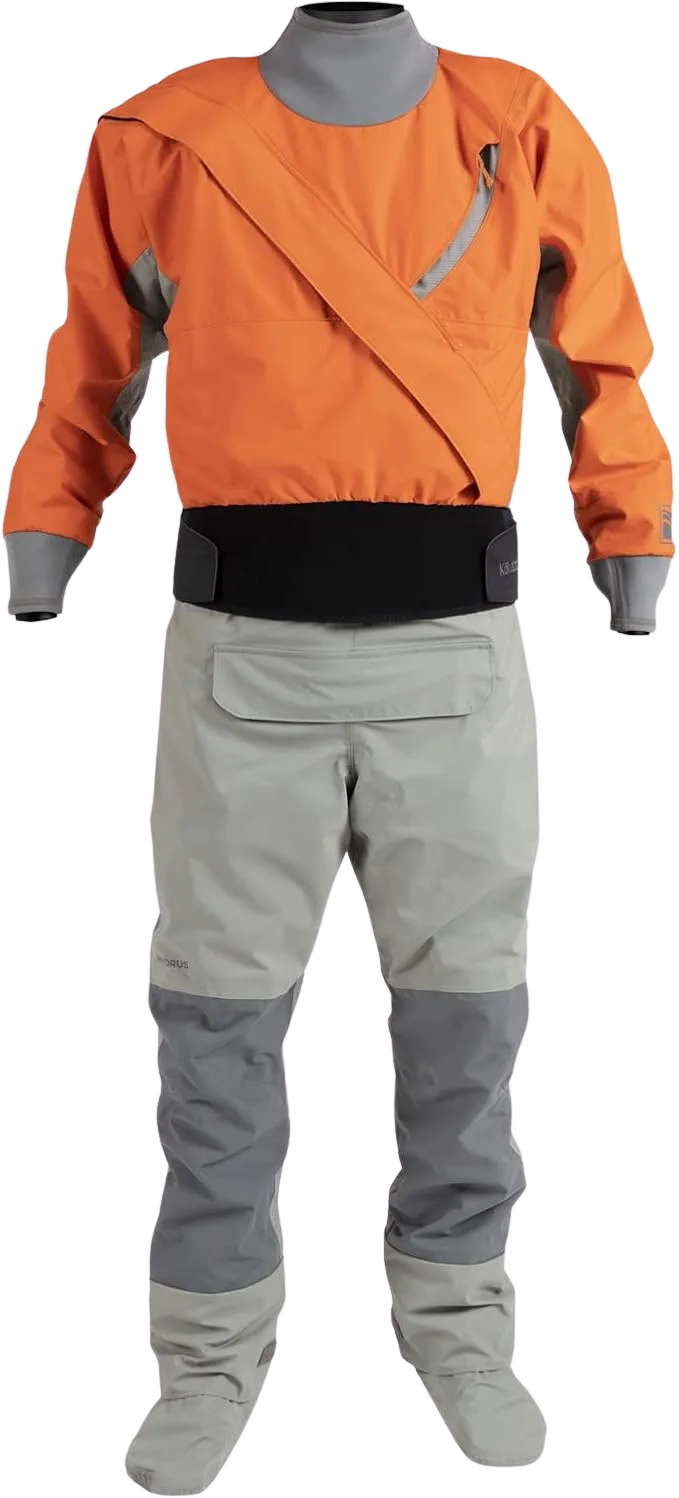
The Meridian is the pick that makes the fewest compromises for the money. You get true rafting reinforcement, a relief zipper, and integrated socks, without paying the full Gore-Tex Pro premium on the men’s version. The trade is that the men’s Hydrus laminate won’t breathe quite like top-tier Gore-Tex on the hottest-air days, which most cold-water rafters never notice. If you want one suit that covers the widest range of trips, start here.
Best for Frequent Boaters: NRS Jakl and Foray
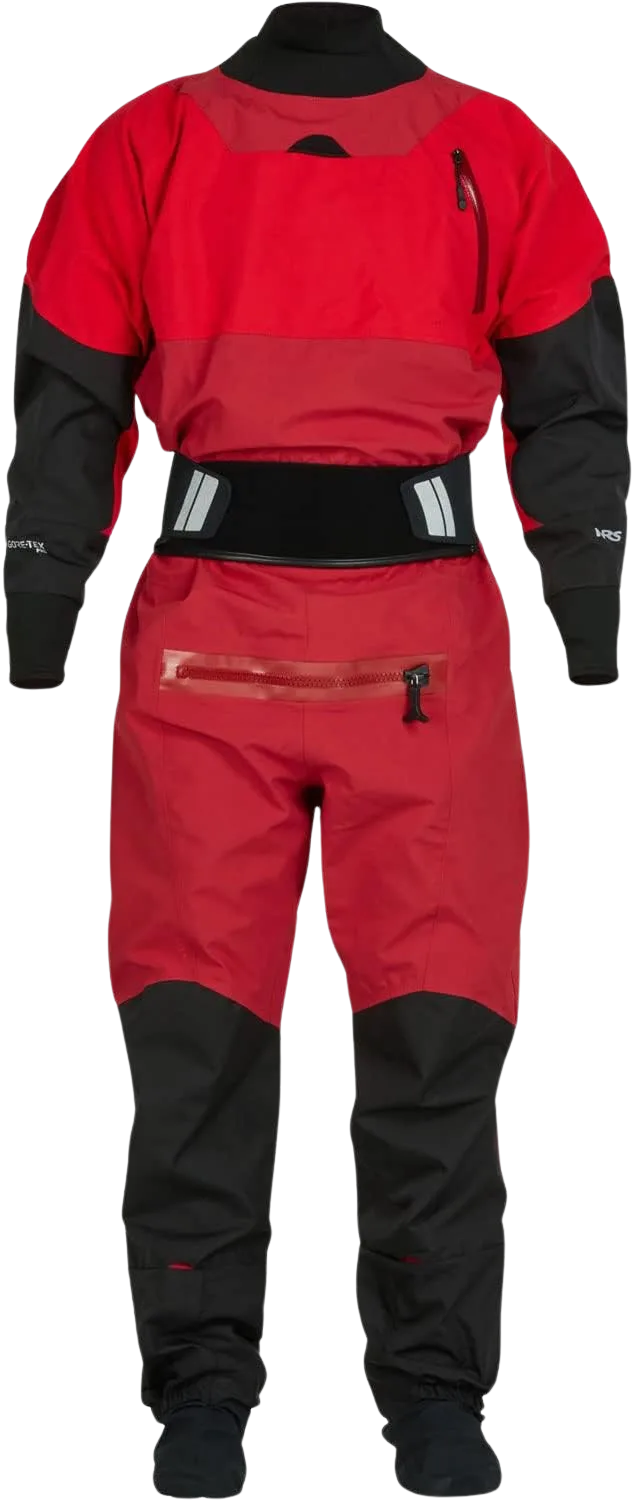
If you boat cold water often, the Jakl and Foray are worth the step up. The full Gore-Tex Pro shell breathes better and lasts longer than a mid-tier laminate, which pays off when you’re logging real days instead of a weekend a year. The reinforcement is placed for a rafter, and the relief zipper is right where you want it under a PFD. The only reason to skip it is if your season is short enough that the Meridian’s value makes more sense.
Best Front-Entry: Immersion Research 7Figure
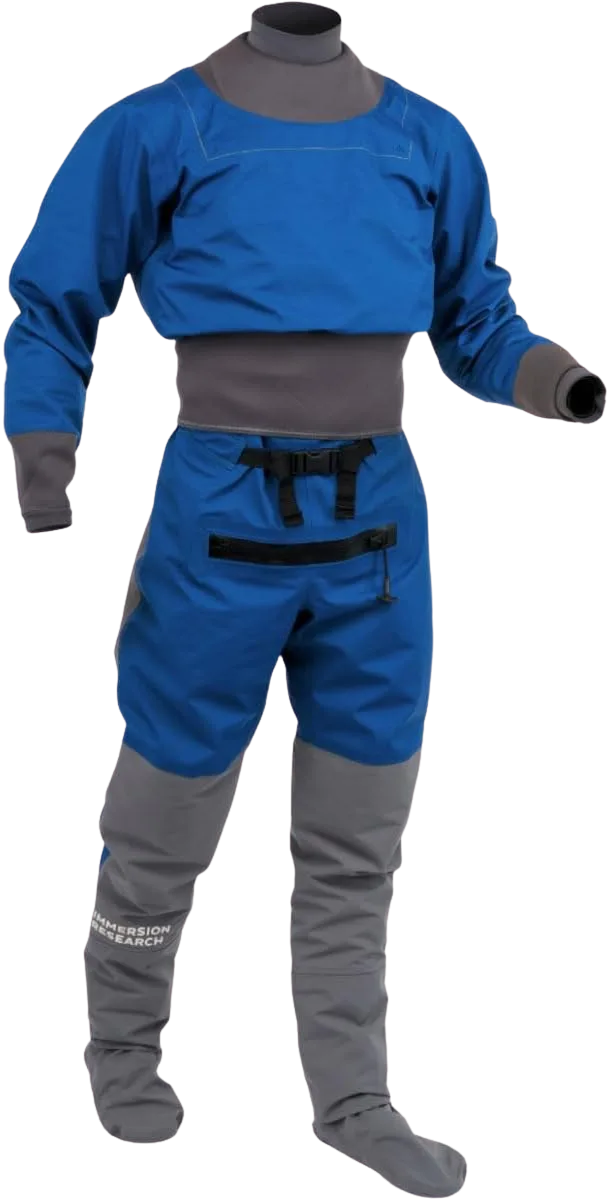
Front-entry is one of those features you don’t think about until you’re standing at the put-in with nobody to zip you up. The 7Figure lets you get in, seal the neck, and close the suit by yourself, which is a daily win for private boaters who often rig solo. It’s a premium suit, so the price reflects the Gore-Tex build, and if you always paddle with a partner who can reach your back zipper, a rear-entry suit will save you some money.
Best for Expeditions: NRS Phenom
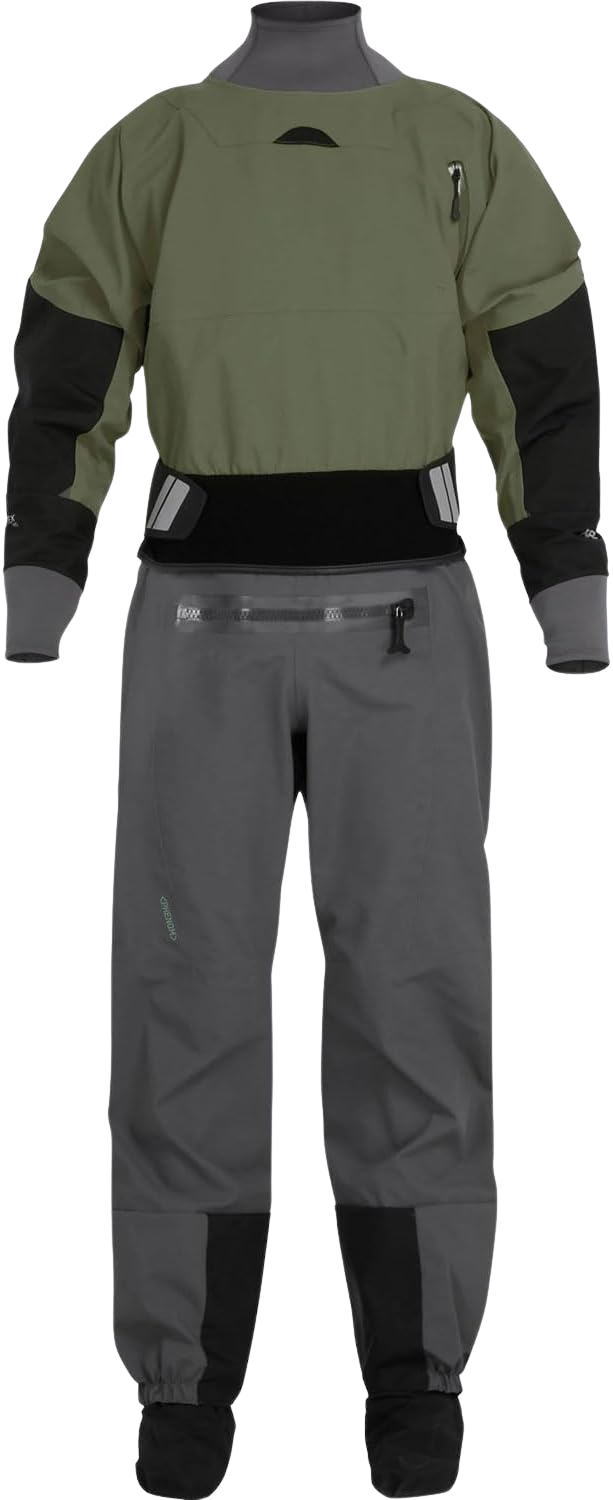
For multi-day and self-support trips, durability stops being a nice-to-have. The Phenom pairs the best fabric on the market with the reinforcement a rafter needs, so it shrugs off the repeated tube scrambles, gear hauling, and gritty camps that wear a lesser suit thin. If most of your boating is day trips close to home, this is more suit than you need, and the Meridian or Jakl will serve you for less.
A same-tier alternative worth a look is the Mustang Survival Hudson Dry Suit, which uses Mustang’s 4L Marine Spec BP fabric with a CCS neck seal and a YKK Aquaseal zipper; it’s a solid non-NRS, non-Kokatat option if you want to shop across brands. You can compare the Mustang Hudson on Amazon against the Phenom.
Best All-Rounder: Kokatat Icon
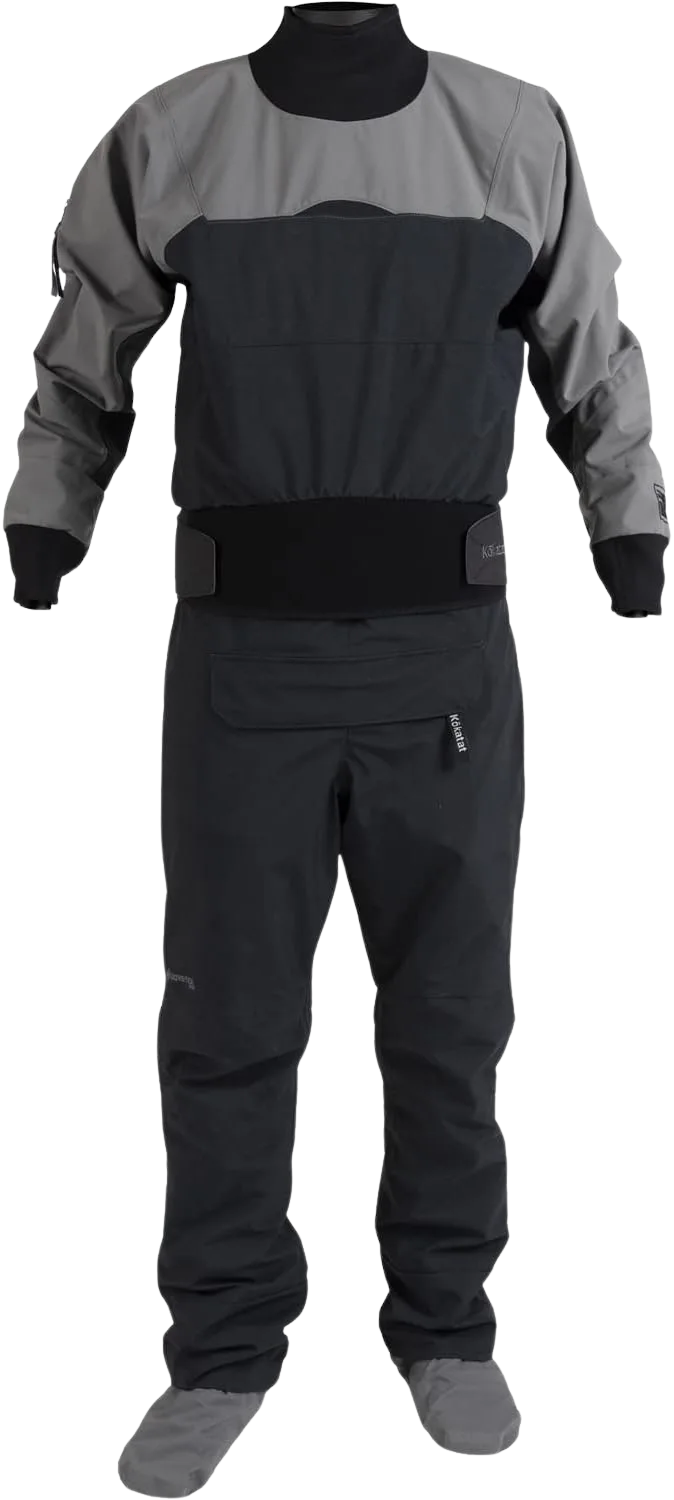
The Icon is the suit you buy when you want top-tier fabric and don’t want to overthink it. It’s widely stocked, consistently well-reviewed, and built to Kokatat’s usual standard, so it’s a low-risk premium pick. The catch is simply price: you’re paying for full Gore-Tex Pro, and the Meridian delivers most of the real-world performance for less if the budget is tight.
Value, Budget, and Women’s-Specific Picks
Not everyone needs a top-tier expedition suit. If you boat a few cold days a year, or you need a real women’s cut instead of a downsized men’s pattern, these are the honest picks. And if you’re eyeing the budget slot for two or three days a season, circle back to the first section and price out a rental before you buy.
Best Mid-Tier Value: Level Six Loki
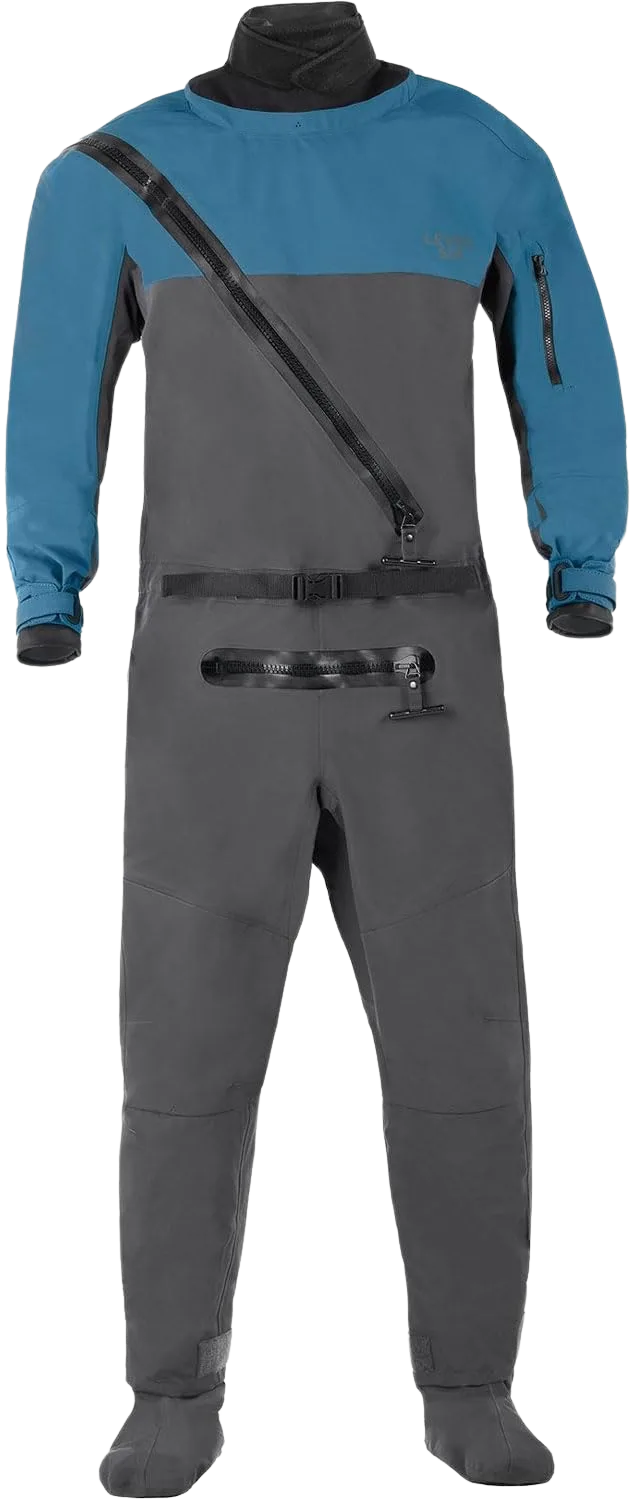
The Loki hits the tier most recreational rafters actually want: enough suit to boat cold water confidently, without the top-shelf price. You give up some breathability and lifespan against a Gore-Tex Pro suit, which is a fair trade if you boat regularly but not hard. It’s the pick for someone graduating from rentals to their own gear.
Best Budget: Stohlquist EZ
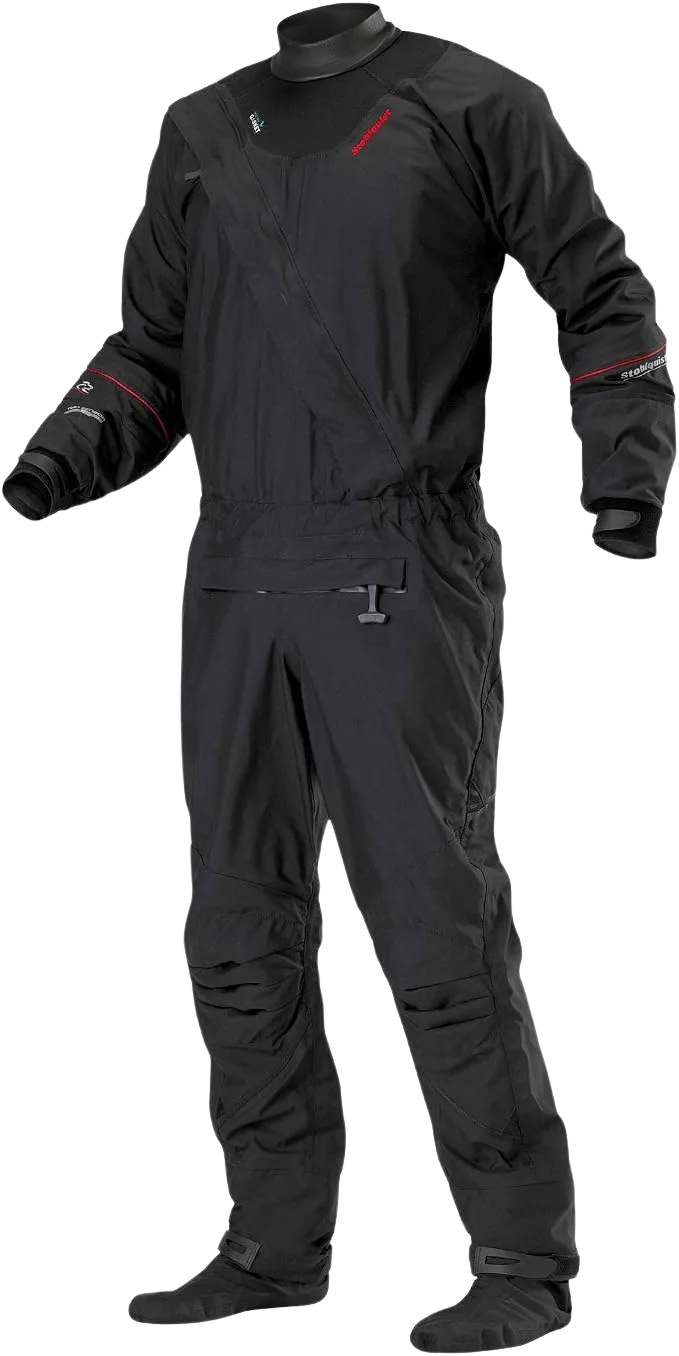
Most roundups flag their budget suit as a warning. The EZ is different: for a boater who runs cold water only a few days a year, it’s a real drysuit that seals and keeps you safe without the premium spend. The honest limits are breathability and lifespan, so if you start boating cold water often, you’ll outgrow it and want a reinforced Gore-Tex or Hydrus suit. For occasional use, it does the job.
Best Women’s-Specific Fit: Gill Verso
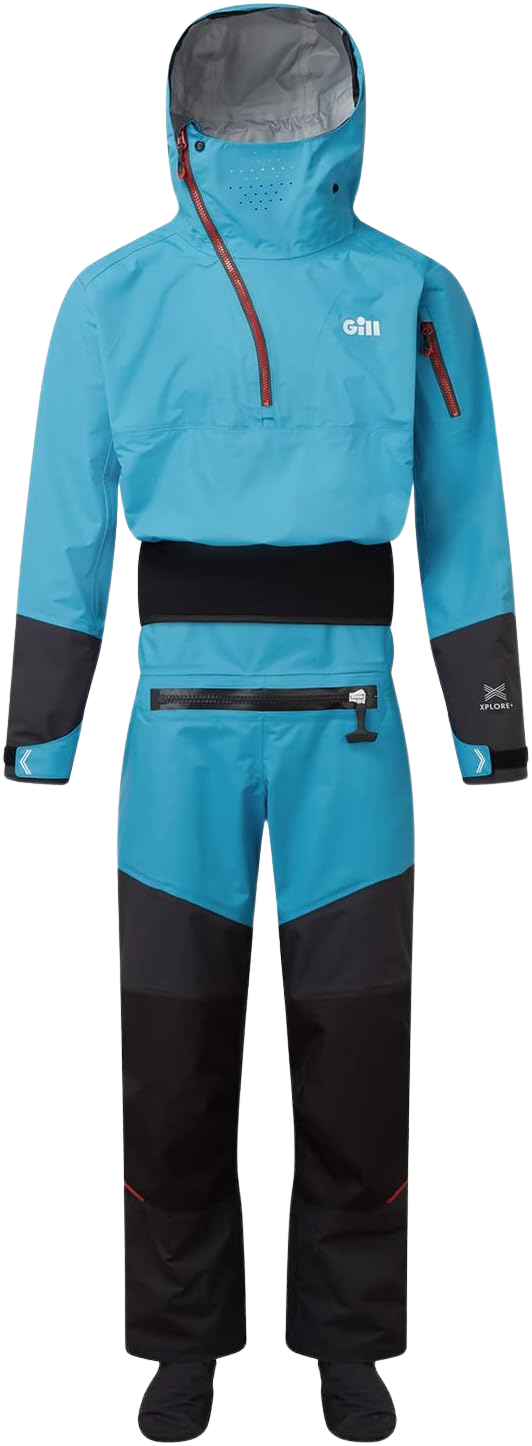
Women’s-specific fit isn’t a marketing label, it’s a seal-and-mobility issue. A men’s suit sized down often leaves gaps at the neck and wrists, exactly where you can’t afford a poor seal in a swim. The Verso is cut on a real women’s pattern, which is why it’s the standalone women’s pick here. At the premium tier, the women’s Kokatat Meridian and the NRS Foray from our top picks also deliver a true female fit, so a woman boating hard cold water has good options at both price points.
Caring for Your Drysuit So It Survives the Season
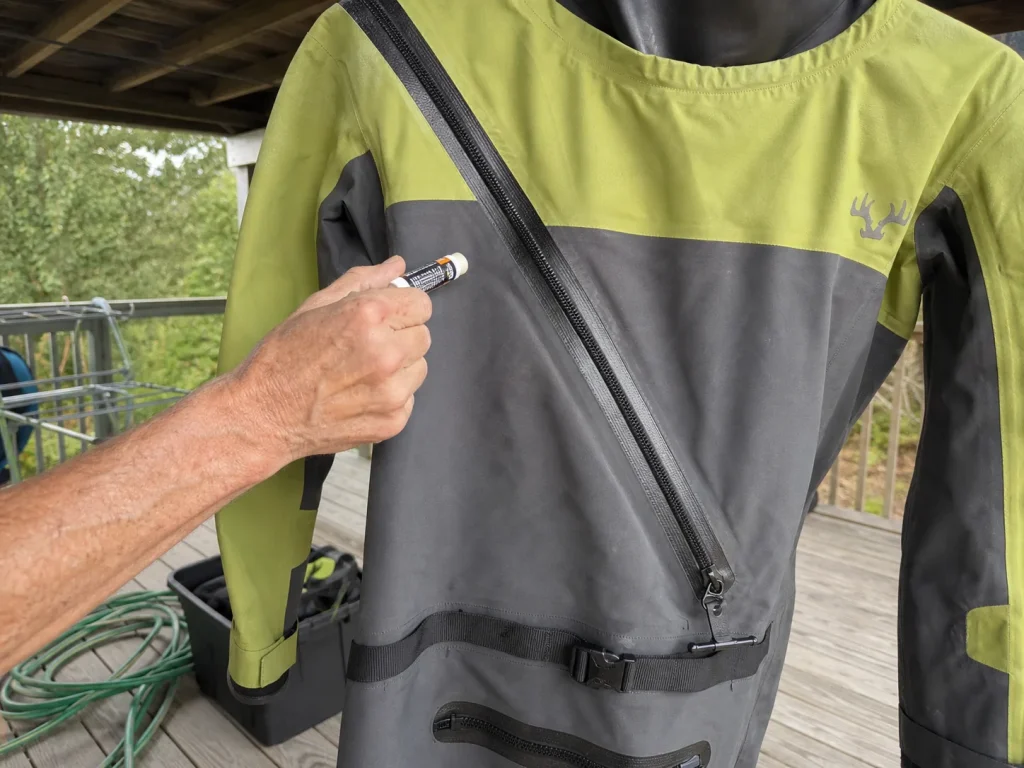
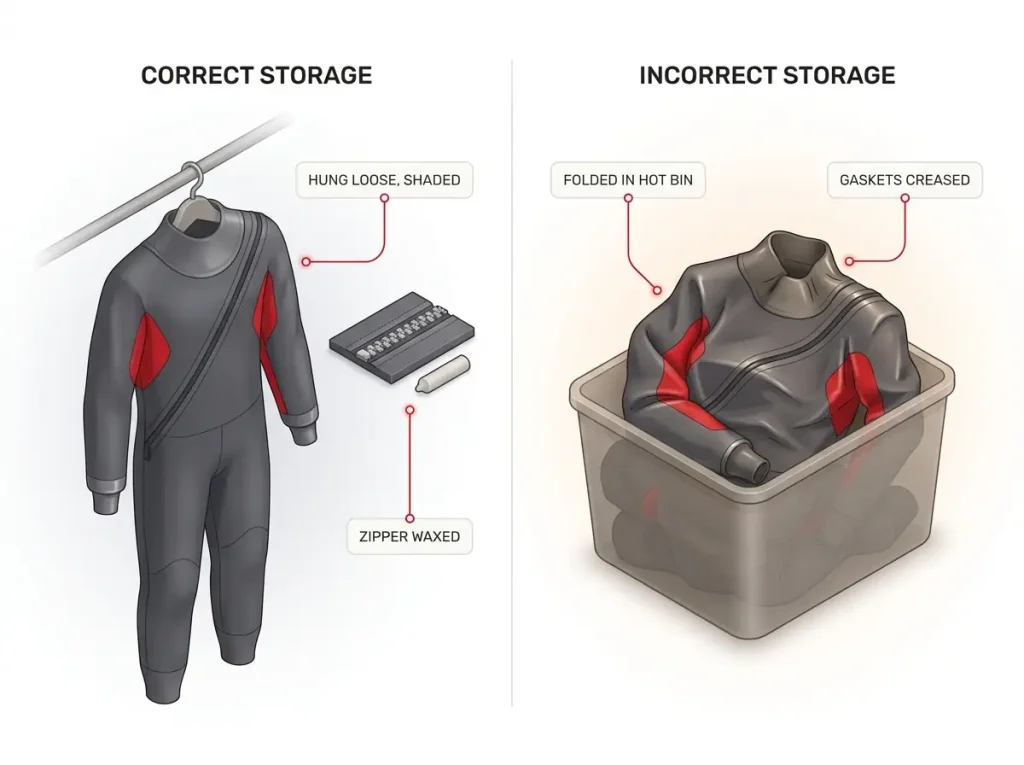
A drysuit is the most expensive apparel you’ll buy for the river, and it dies from neglect faster than from use. The good news is the routine that keeps it alive is low-effort. The single most expensive failure point is the zipper, so zipper care isn’t optional: keep it clean and lubricated with a wax stick like the McNett Max Wax zipper lubricant so grit doesn’t chew the teeth. A blown drysuit zipper is a repair that can cost more than a budget suit.
Gaskets are the next thing to baby. Latex hates UV, heat, and sharp creases, so store the suit loose and cool, hung on a wide hanger rather than stuffed in a hot gear bin in the garage. Folding a suit along the same crease every time is how gaskets and taped seams start to fail. Rinse the suit in fresh water and let it dry fully before storage, because trapped moisture, salt, and grit quietly shorten gasket and zipper life.
And if a stock gasket chokes or chafes to the point you dread putting the suit on, get it professionally converted rather than shelving an expensive suit. Several makers swap latex for neoprene for a modest fee. The full seasonal routine, including how often to run through each step, is covered in the full gear-maintenance rhythm.
Field Repair When a Gasket Blows on Day Two of a Trip
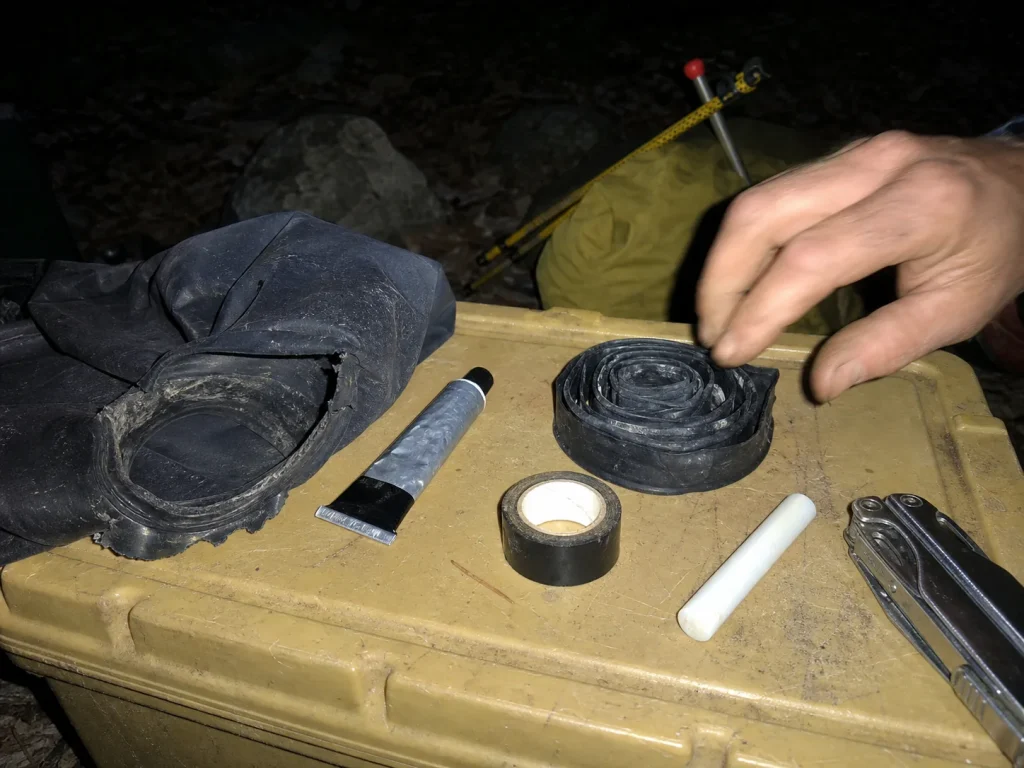
Here’s the scenario nobody else plans for. Your suit blows a wrist gasket on day two of a five-day trip. You’re not driving to a shop, and you’ve still got three days of cold water ahead.
What you packed decides whether that’s a trip-ender or an annoyance. Competitors mention pinhole repair as a maintenance footnote, but on a multi-day river trip it’s trip-saving triage, and it deserves real thought before you launch.
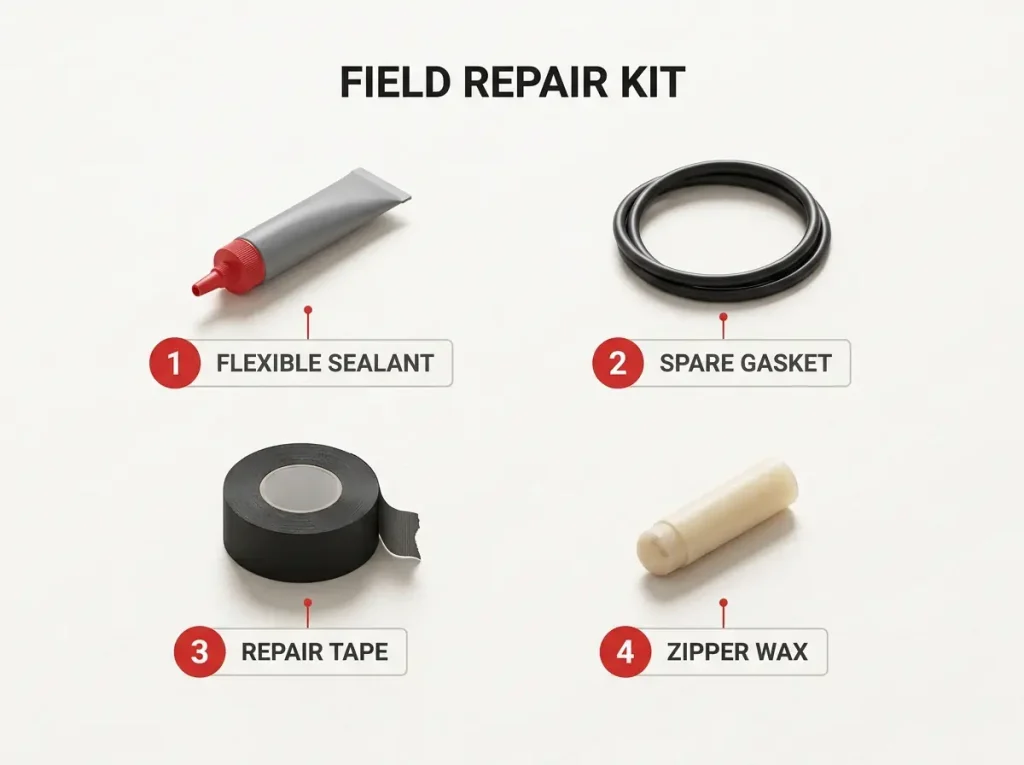
The kit that gets you through is small. Carry a tube of flexible urethane sealant for pinholes and small tears, a spare wrist gasket, a roll of tough repair tape, and the same zipper wax from your care kit. Build it into your trip repair kit so it’s already in the boat, not on a shelf at home. The triage order is simple: a small pinhole gets a dab of sealant and an overnight cure, a torn wrist gasket can be temporarily sealed or the arm tucked and taped, and a blown main zipper is the real trip-ender, which is exactly why the wax-it-every-trip habit matters more than any field fix.
The failure people don’t see coming isn’t the fabric, it’s a gasket torn during a rushed put-in-morning donning, when a ring or watch snags the latex on the way through. Most gasket tears happen on the bank, not on the water, which is why the slow, careful donning below matters more than any patch in your kit.
Clear every ring, watch, and bracelet before you pull a gasket over your hand or head, and feed it slowly. Ninety percent of gasket tears happen on the bank during a rushed put-in, not out on the water.
The Bottom Line on Rafting Drysuits
Match the suit to the water, not the day. The combined air-and-water number decides whether you need a drysuit at all, and the sunshine on the bank has nothing to do with it. If you do need one, buy rafting-specific reinforcement, because a kayak or dive suit pinholes on raft abuse. And if you’re a few-days-a-year boater, rent before you buy, then let the fit and the gasket care do the real work of keeping you dry in a swim.
Before your next cold-water trip, run the combined-temp number for your put-in and decide honestly: buy, rent, or layer. Then whatever you wear, size it for the swim, not the fitting room.
Frequently Asked Questions
01Do I need a drysuit or is a wetsuit enough for rafting?
Below about 60°F water, or when combined air and water temperature is under 120°F, a drysuit is the safer call, while a wetsuit works for milder cold-water days. The colder the water and the higher the swim risk, the more a fully sealed drysuit earns its cost.
02What temperature water requires a drysuit for rafting?
The American Canoe Association’s line is water below 60°F, or any time air plus water temperature is under 120°F combined. A warm-feeling spring day over cold snowmelt still qualifies, which is why you dress for the water, not the air.
03How should a rafting drysuit fit?
Snug at the gaskets, roomy enough in the torso and limbs for a base layer plus a mid layer, with the relief zipper reachable under a PFD. Size for the insulation you will wear and for what happens in a swim, not for a T-shirt in the fitting room.
04How long does a rafting drysuit last and how do I maintain one?
A well-cared-for suit lasts many seasons, but neglect kills it faster than use. Wax the zipper, rinse and dry it fully before storage, keep latex gaskets out of UV and heat, and convert a chafing gasket rather than shelving the suit.
05Can you rent a drysuit for rafting instead of buying one?
Yes, and many guided cold-water outfitters provide or rent suits, which often makes buying unnecessary for the once-or-twice-a-season rafter. Ask the outfitter before spending on a suit you will wear only a handful of days a year.