
In this article
The sun is out, the parking lot is warm, and the river is running 48-degree snowmelt straight off the peaks. That gap between the air on the bank and the water you’re about to sit in is the single thing most first-timers get wrong, and it’s the reason knowing what to wear rafting starts with the water, not the forecast. Outfitter packing lists gloss over it because they hand you a wetsuit at check-in, but if you’re running your own trip, nobody’s checking your layers but you. Here’s how to dress for the water you’re actually on, from a warm summer float to a cold spring run.
Dress for the Water Temperature, Not the Air
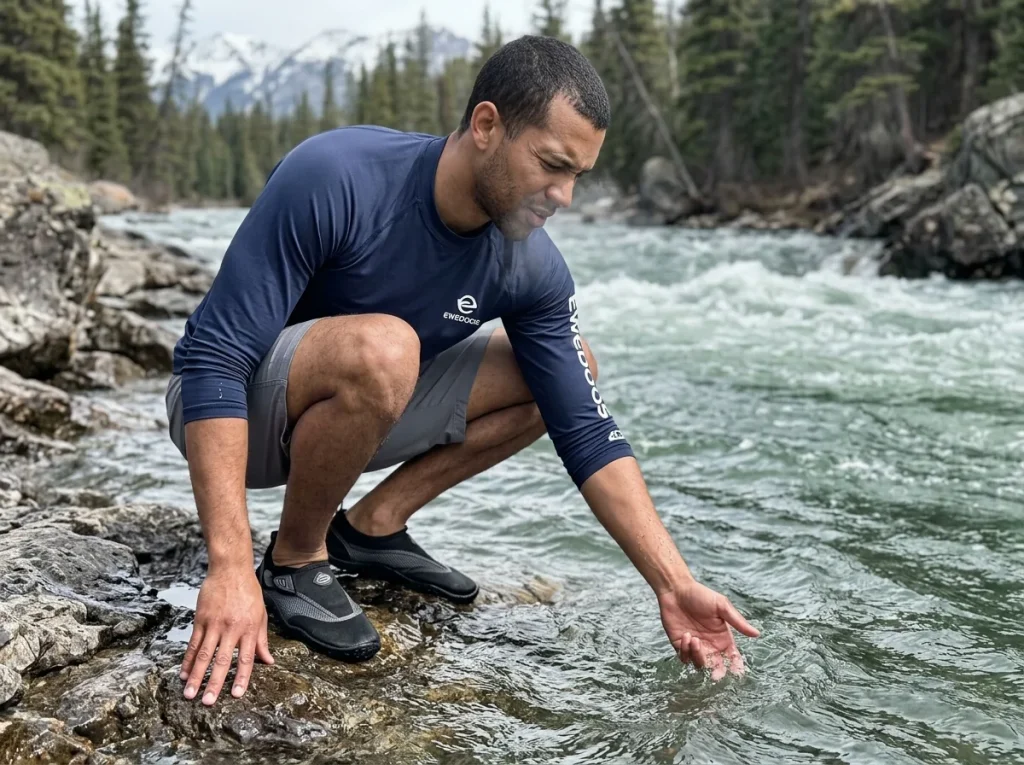
Ask any boater who’s been on the water a few seasons and they’ll tell you the same thing before anything else: you dress for the water temperature, not the air temperature. A bright 80°F afternoon feels like a swimsuit day right up until you go over the side into runoff still in the 40s. Around 70°F water is the line most people use, where quick-dry layers stop being enough and neoprene starts earning its place.
The reason isn’t comfort, it’s the first five minutes of a swim. Sudden immersion in water below 59°F triggers cold shock within three to five minutes, the involuntary gasp-and-hyperventilate response that drops your swimming ability off a cliff right when you need it. The National Weather Service’s cold water safety guidance lays out why that early window matters more than any hour-long hypothermia timeline. Dressing for the water is about staying functional in those first minutes, not staying cozy for the afternoon.
That’s why the warm-air trap catches so many people. The forecast on your phone describes the drive to the put-in. The river describes what happens when you’re in it. On a shoulder-season run, those two numbers can be forty degrees apart.
For warm-water days when the swim risk is low, a snug, moisture-wicking quick-dry top over board shorts does the base-layer job and adds sun protection at the same time. Something like the Ewedoos UPF Rash Guard (men’s · women’s) is the kind of synthetic layer that dries fast and blocks sun without holding water against you. When the water gets colder, that same layer becomes the base under a wetsuit, which is exactly how a temperature-specific layering system is meant to stack.
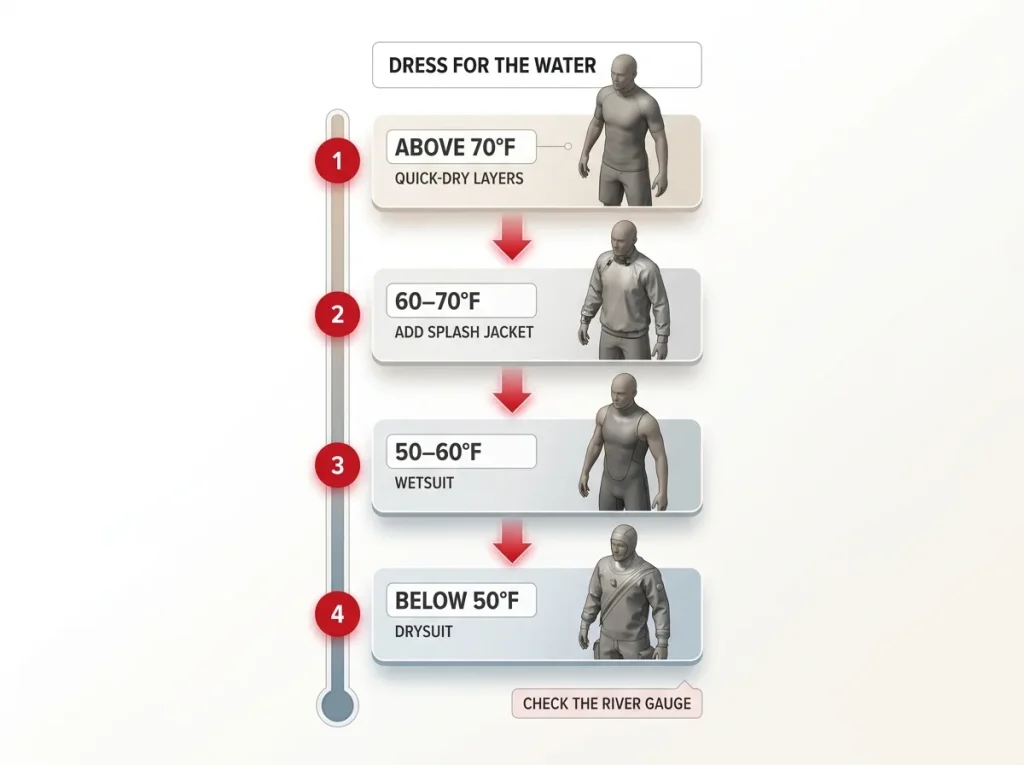
Get the real water temp before you pack, not the air temp. Check the river gauge, ask the outfitter, or dip a hand in at the put-in. If it makes your fingers ache in ten seconds, you’re dressing for neoprene no matter how warm the parking lot feels.
Cotton Is the Enemy, and Here’s the Actual Reason
Everyone says avoid cotton. Almost nobody tells you why, which means the rule slides right off first-timers who show up in a cotton hoodie because it’s comfortable. The why is what makes it stick.
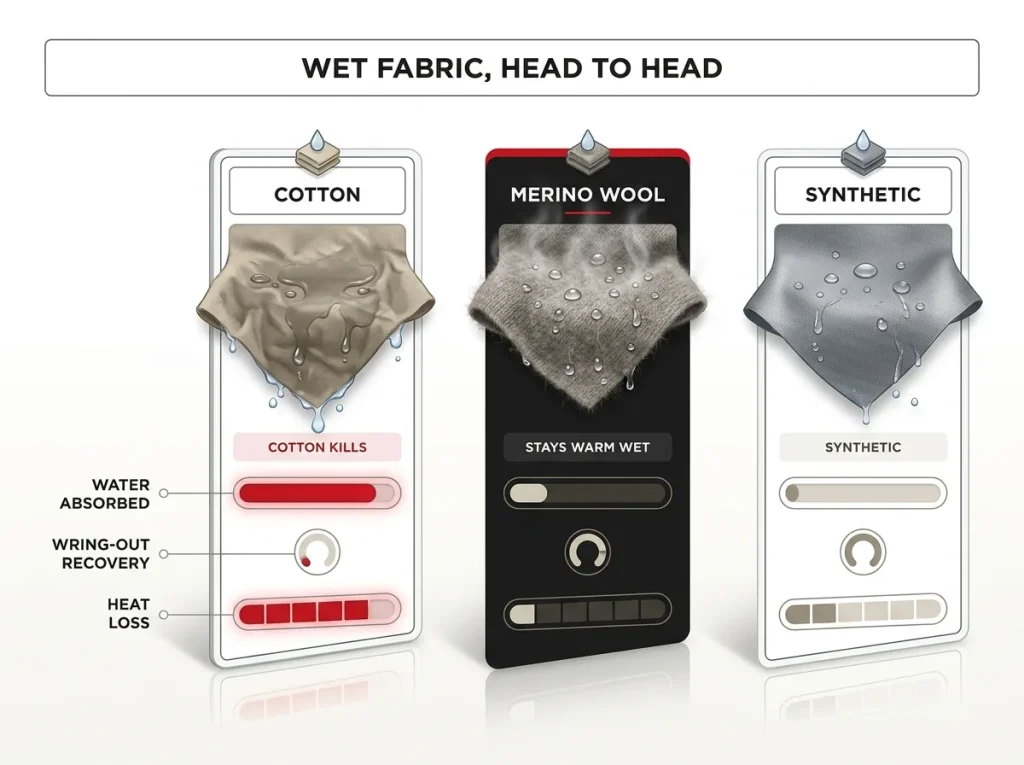
Cotton soaks up close to 27 times its own weight in water, and wet fabric conducts heat away from your skin roughly 25 times faster than dry air. Once a cotton shirt is soaked, it stops being clothing and turns into a cold, heavy heat-sink pressed against you for the rest of the run. That’s the physics of why wet cotton pulls heat off your skin faster than the air ever could.
Wool and synthetics like polyester win because they keep working wet. Both can be wrung out and recover much of their insulating value, and merino wool even gives off a little heat as it takes on moisture. Cotton does neither. Put a number on it and the gap gets serious: in a worst-case cold exposure, fabric choice alone can swing survival time from around three hours in cotton to eight or more in wool or synthetic.
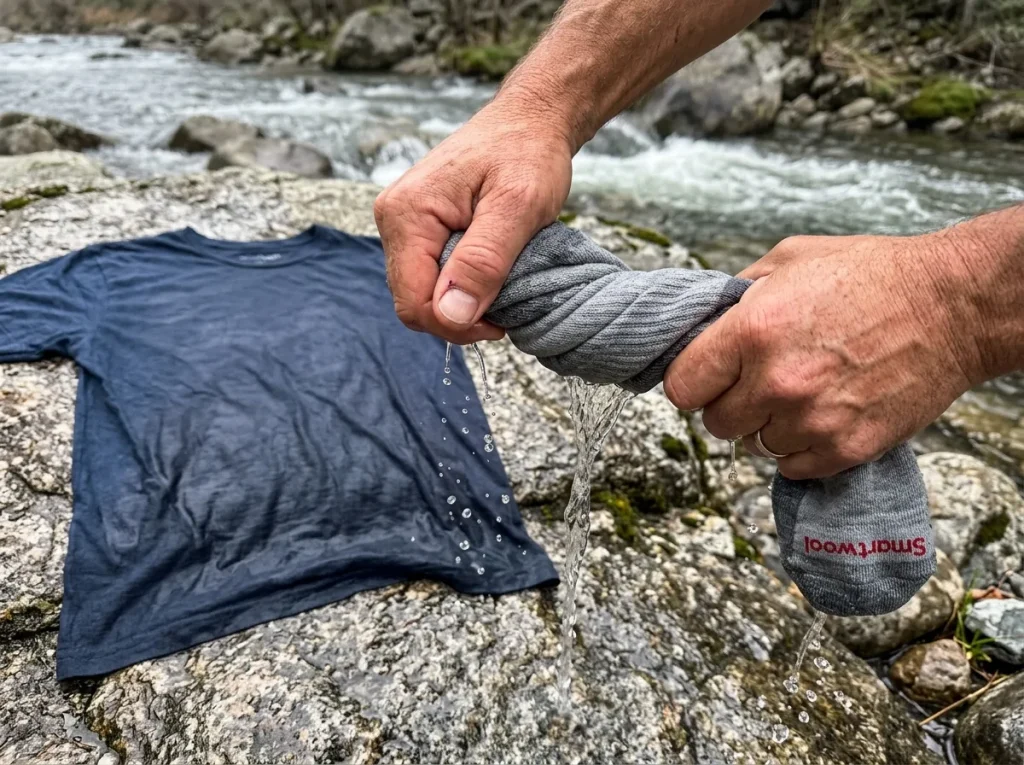
This is where a good pair of wool socks quietly earns its keep. Something like the Smartwool Hiking Crew Socks (men’s · women’s) keeps insulating after it’s soaked, which cotton socks never do. Same logic runs top to bottom: base layer, mid layer, socks, all of it synthetic or wool.
The wring test tells you everything. Soak a layer, wring it out, and put it back on. If it still holds a little warmth, it’s doing its job. If it just sits cold and clammy against your skin, it’s cotton, and it belongs in the car with the dry clothes.
The Layering System for Cold and Shoulder-Season Water
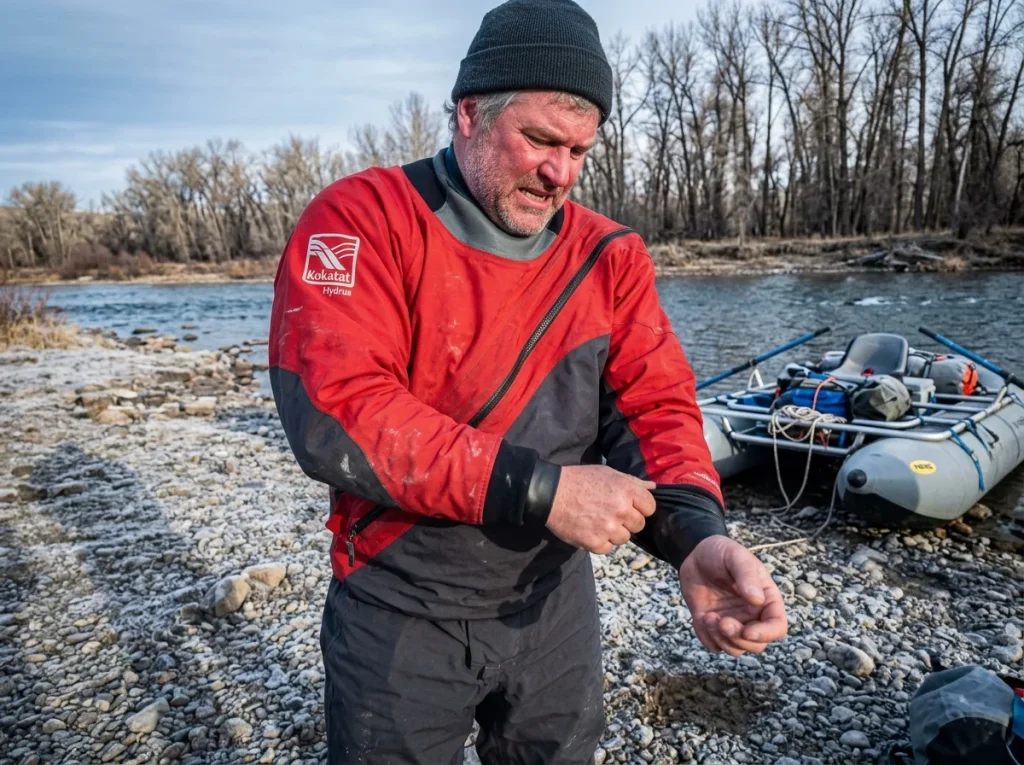
Layering on a river works like it does for skiers and climbers, base, mid, shell, except the shell might be neoprene and the water is trying to take your heat the entire time. Think of it as a system, not a single garment decision. A moisture-managing base layer moves sweat and splash off your skin, an insulating mid layer holds warmth, and an outer layer keeps the water and wind from stripping it all away.
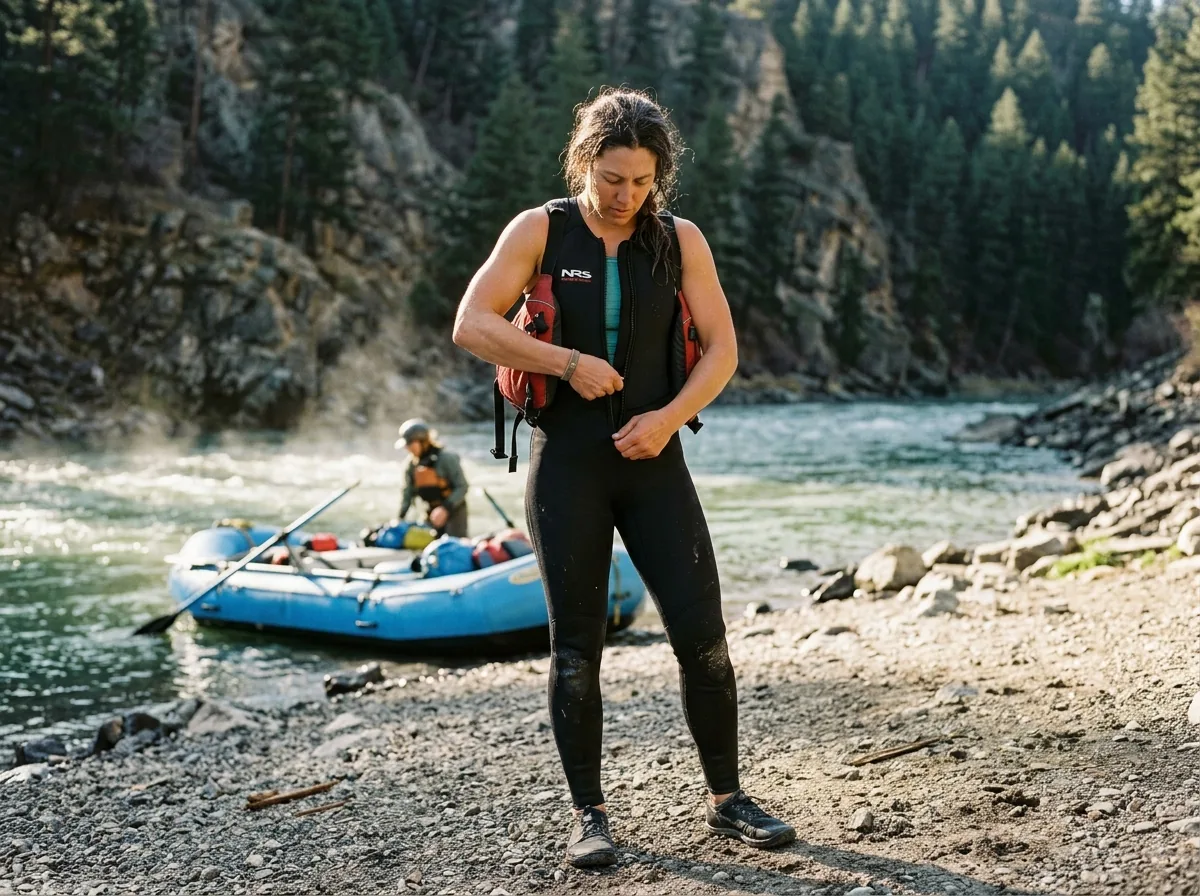
That outer barrier is where the wetsuit comes in. Once the water drops under about 70°F, most boaters step from quick-dry layers into neoprene. A sleeveless farmer-john or farmer-jane cut is the rafting standard because it keeps your core warm while leaving your shoulders free to paddle. The NRS Farmer John / Farmer Jane 3.0 Wetsuit (men’s · women’s) is a solid example of that cut, 3mm neoprene that handles cold water without locking up your stroke.
For spring runoff, late fall, and private trips where a long swim is a real possibility, a drysuit is the warmest option going. Unlike a wetsuit, it keeps you fully dry and goes on over your insulating layers, so you control the warmth underneath. The Kokatat Meridian Hydrus / Legacy Drysuit (men’s · women’s) sits at the premium end of that call. It’s a step-up piece, not a first-trip default, and the full wetsuit-vs-drysuit breakdown is worth reading before you spend on one. The cold-water immersion timeline in Washington State Parks’ cold-water safety briefing is a good gut-check on when the water crosses from wetsuit territory into drysuit territory.
When a wool or synthetic mid layer soaks through on a long cold day, wring it out at the next eddy or lunch stop. Both partially recover their loft once the standing water is gone. That five-second habit is the difference between miserable and functional by mid-afternoon.
Splash Jackets and Rain Layers
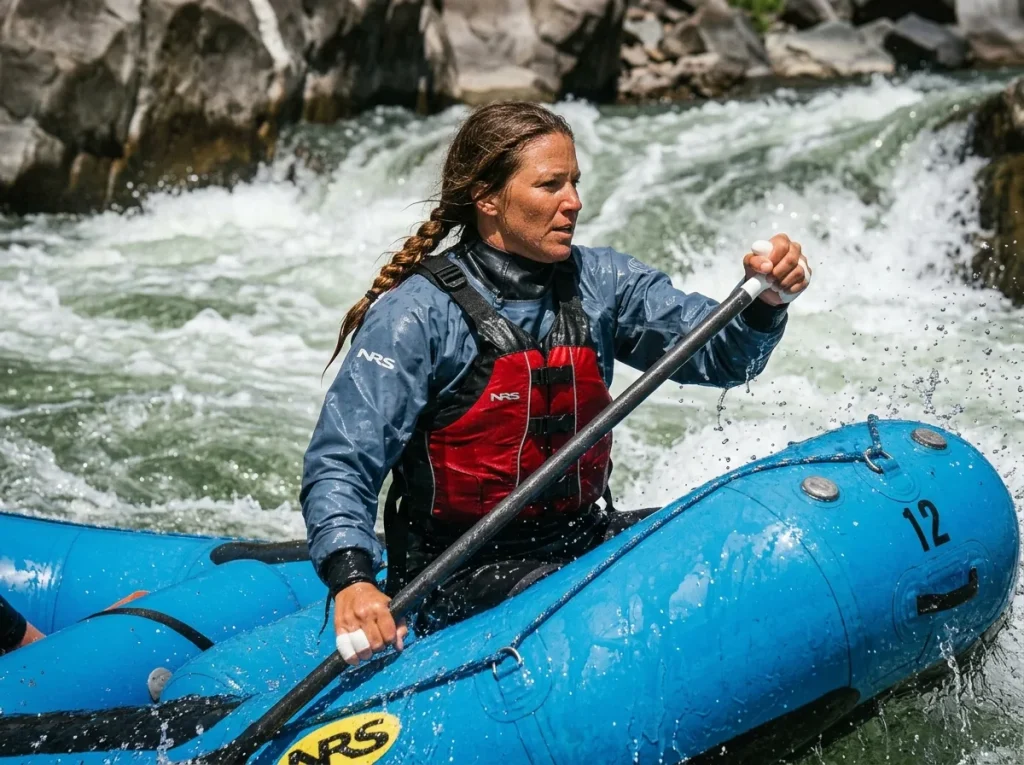
On a warm day you don’t think about a splash jacket until the first big wave train soaks you to the base layer and the wind picks up in the canyon shade. A splash jacket is a light nylon waterproof shell with sealed closures at the neck and wrists, and its whole job is to keep wind and wave splash off your insulating layers so they can keep insulating.
It earns its spot on cold mornings, in shaded canyons, on rainy runs, and on any day where repeated splash would soak you through. On a hot Class II float it can stay in the dry bag. The fit matters more than the branding: it goes over your insulating layer and works with your PFD (personal flotation device), and the closures are the part that actually keeps water out. Cinch them down. Plenty of people bring the jacket and leave the neck loose, and the first wave funnels straight down the collar.
The NRS Endurance Paddling Jacket (men’s · women’s) is a good reference point for what sealed closures should feel like. If you’re comparing models and want the deeper rundown, the guide to outfitter-tested splash jackets goes further than this overview can.
Footwear That Actually Stays On
The river will try to pull your shoes off, in a swim and in the sucking mud at the put-in. Whatever goes on your feet has to survive that and still be there at the takeout. Three requirements sort the good options from the bad: secured with a heel strap or closed heel, closed-toe or toe-protected, and quick to drain. That rules out flip-flops, slip-on Crocs, and bare feet in one line, and it’s why closed-toe shoes edge out open sandals on colder, rockier runs.
Secured matters more than people think. Lose a shoe mid-swim and you’re barefoot on sharp rock for the rest of the day, and a gashed or jammed toe against a foot-entrapment rock is a genuine hazard, not a stubbed-toe nuisance. Strapped sandals like Chaco, Teva, and Keen all work; closed water shoes add toe protection and a little warmth. The giveaway at any put-in is the first-timer in flip-flops losing one in the mud before the boat’s even rigged.
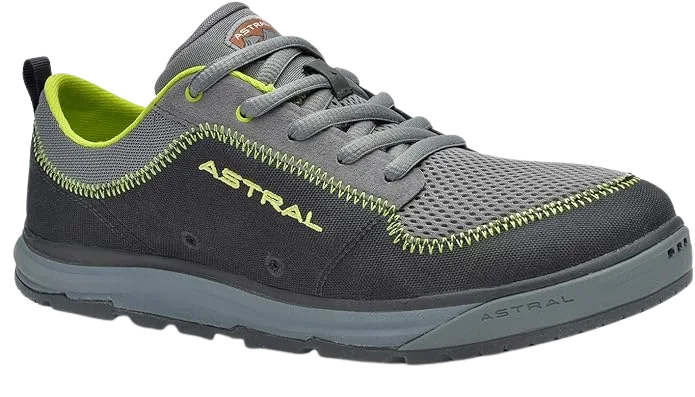
Whether you land on strapped sandals or closed shoes comes down to water temperature and how much toe protection your run demands. For the full breakdown by river type, the risk-and-thermal water-shoe guide compares the options in more detail than a hub page should.
Hands, Eyes, and Sun
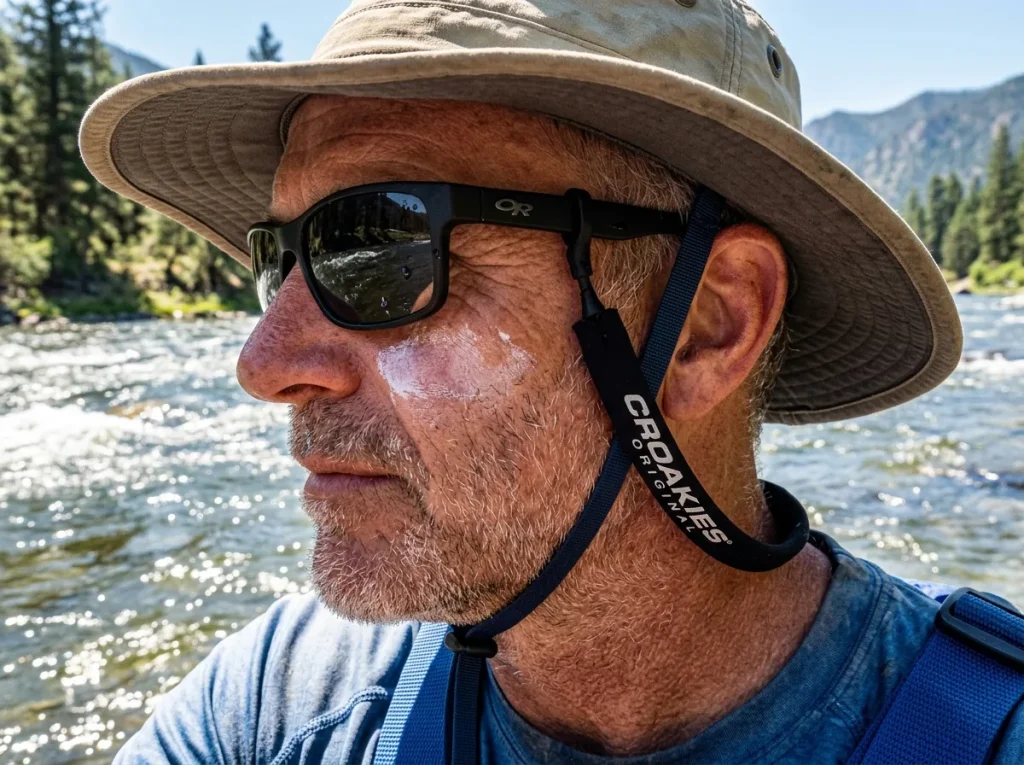
Nobody plans their rafting outfit around sunglasses, and then the glare off the water gives them a headache by lunch and their good pair is somewhere on the bottom of a Class III. The small stuff is where comfortable days and rough ones part ways.
Polarized sunglasses cut the glare so you can actually read the water, but they’re gone in one wave without a retainer strap. A cheap neoprene retainer like the Croakies Original Eyewear Retainer is the least expensive insurance on the boat, and it pairs naturally with a set of polarized sunglasses built for impact and retention. A retainer from Croakies or Chums does the same job. Sun is the other quiet factor: the water doubles your exposure, so a paddling hat or wide-brim cap under the helmet, sunscreen, and UPF layers matter more on a river than they do on a trail.
Your hands take a beating too. A full day of rowing or paddling raises blisters fast, and gloves help on oar trips and in cold water. If you’re rowing your own rig, the deeper look at rafting gloves for oar control and grip is worth a read before your knuckles make the decision for you.
Almost everyone loses one pair of sunglasses to the river before they start clipping a retainer on every trip. Skip the tuition and put the strap on the first day. A floating retainer is even better, since a dropped pair rides on the surface instead of sinking straight to the bottom.
What to Leave at Home
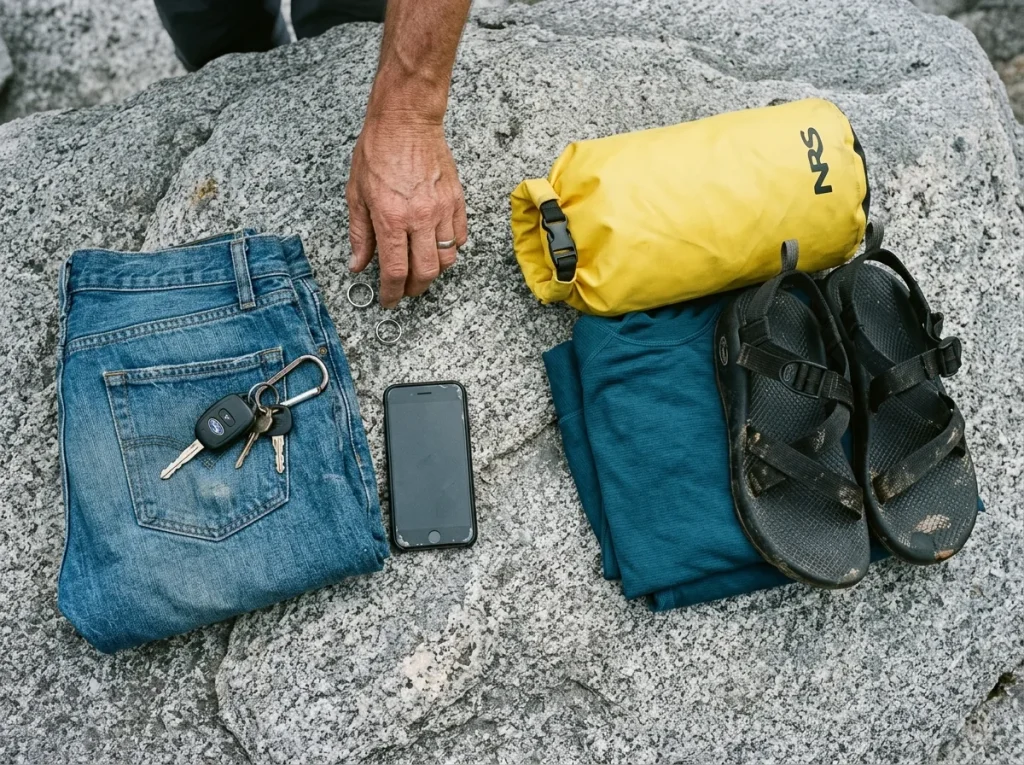
Half of dressing right is not wearing the wrong thing. Most of these are comfort calls. One of them can injure a finger badly enough to end your paddling season.
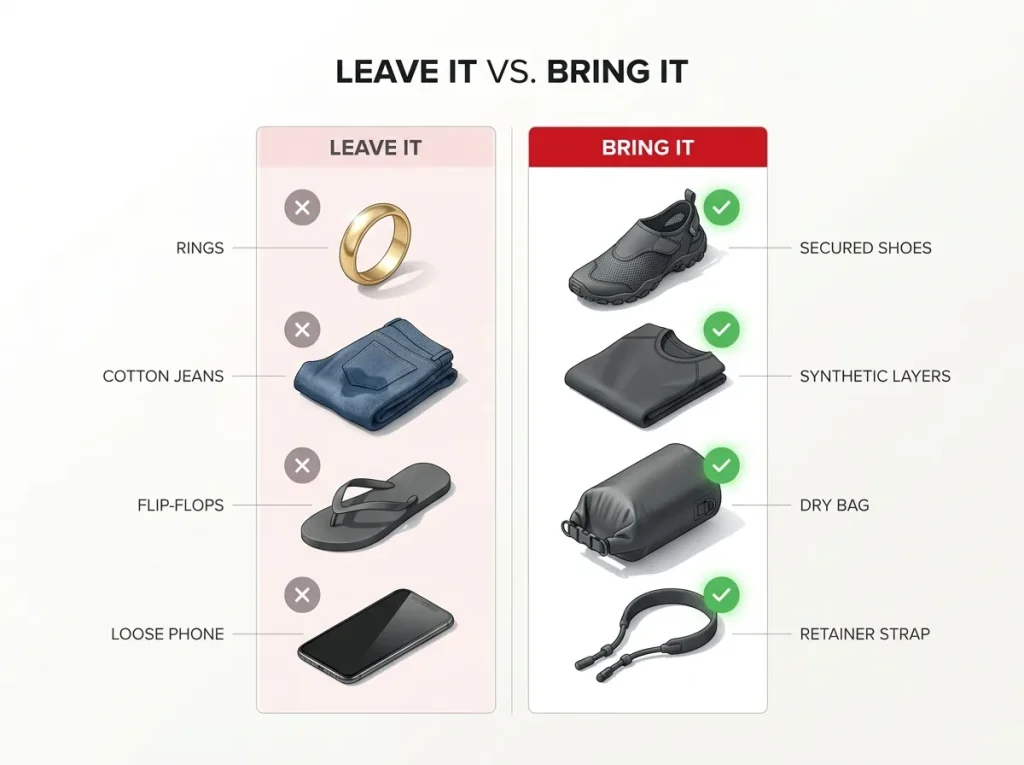
Rings are the one to take seriously. A ring that catches on a frame tube, an oarlock, or a D-ring can cause a ring-avulsion injury with as little as about 18 pounds of catch-force, and full degloving-level damage has happened around 35 pounds. That’s not a lost-jewelry problem, it’s a reach-to-fend-off-a-rock-and-your-hand-pays problem. Pull your rings off before you rig and put them in the same dry bag as your keys.
The rest of the leave-it list is simpler. Cotton anything stays home, jeans included, because wet denim goes heavy, cold, and stiff exactly when you need to move in a swim. Electronics like phones and keys ride in a waterproof case or a dry bag that survives a flip, not a pocket. And anything loose or dangling near your hands is a snag risk if a throw bag line or an oar comes across the boat in a rescue.
Dressing by Trip Type — Float vs. Whitewater, Guided vs. Private
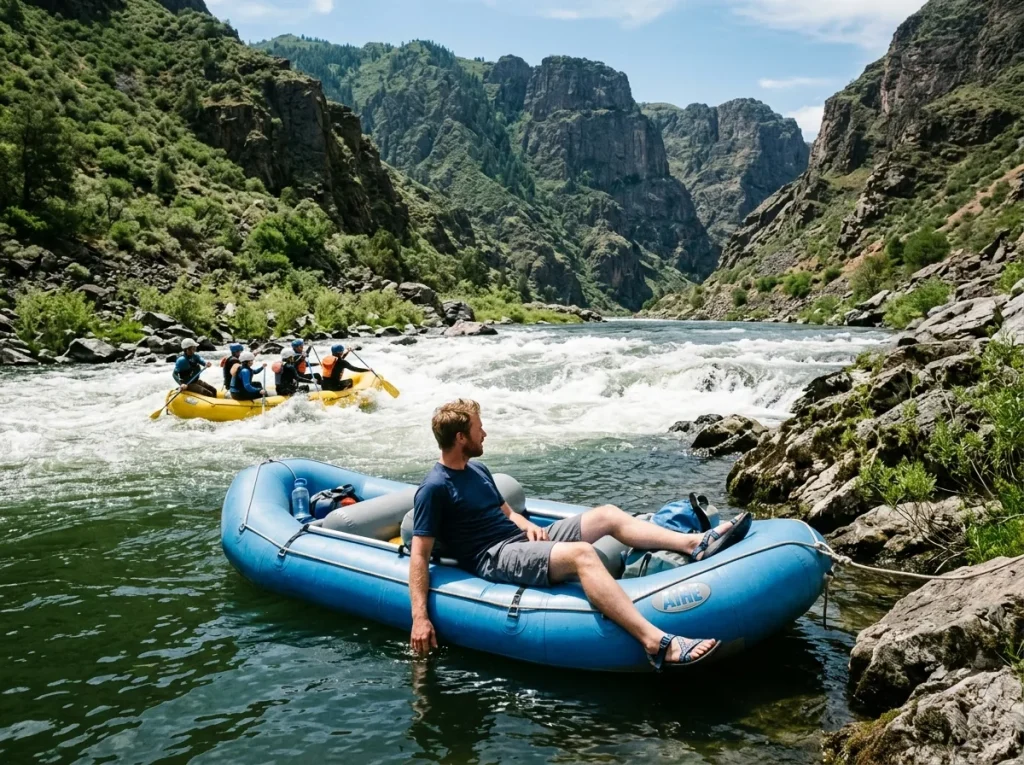
A mellow scenic float and a technical Class IV run are not the same clothing problem, and a guided client and a private boater aren’t packing the same bag. Nobody separates these clearly, so here it is.
Start with the water and the swim odds, which track the class rating. A Class II float has margin, you’ll rarely go for a swim and the splash is light, so on a warm day quick-dry layers and secured shoes cover it. A Class IV-plus run means real swim probability, and cold water compounds it: grip strength and manual dexterity can drop 60 to 80 percent within minutes of immersion. Your clothing has to preserve full mobility for self-rescue in exactly that window, which is why a technical cold run pushes you toward neoprene and away from anything bulky or binding. How risk scales with river class is worth understanding before you dress for a run above your usual grade.
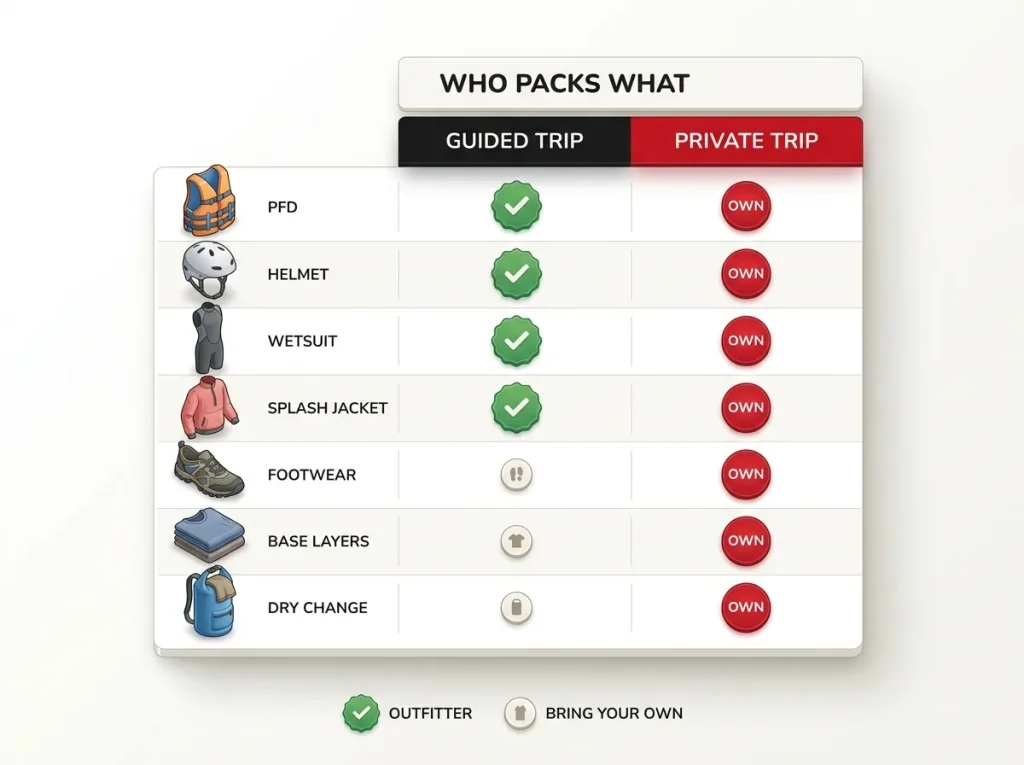
The bigger blind spot is guided versus private. On a guided trip, the outfitter typically supplies the PFD, helmet, paddle, and seasonally a wetsuit, splash jacket, and booties, so your job is base layers, secured shoes, sun protection, and a dry change. A private boater owns and packs every one of those items, because running Class IV-V privately requires zero certification and no one is checking your kit at the ramp. That freedom is exactly why getting your own apparel right matters more, not less, and it’s a core piece of the private-boater side of the sport. Building out that full personal kit is where a full rafting gear checklist by river class does the heavy lifting.
After the Run — Dry Clothes and Camp Comfort
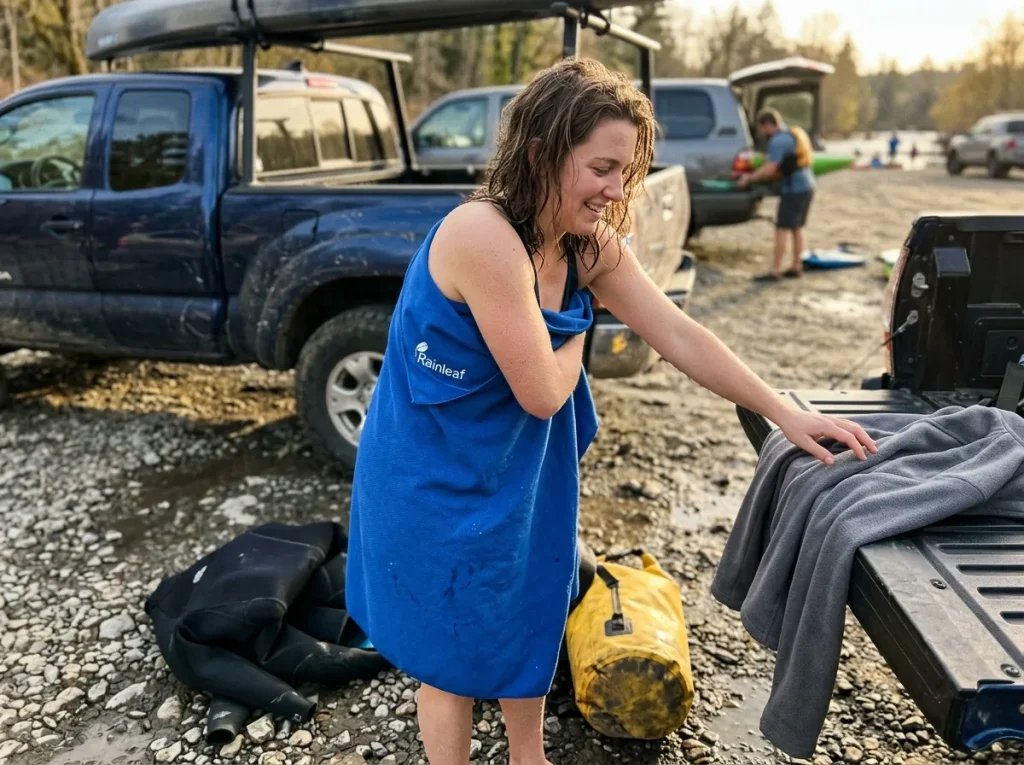
The run ends, you’re soaked, and the tailgate at the takeout is a whole lot better with a dry shirt than standing there dripping in the wind. The dry change is the layer people forget until they’re shivering next to the shuttle rig.
Pack a full dry change of clothes sealed in a dry bag and leave it at the takeout, or in the boat for a multi-day trip. Even a warm afternoon turns cold once you stop paddling and the breeze hits wet skin. A quick-dry towel beats a cotton bath towel every time, since it packs down small, wrings out, and dries between stops. The Rainleaf Microfiber Quick-Dry Towel is a cheap, packable one that lives in the dry bag without taking up room.
On multi-day trips the same logic stretches into camp: dry camp layers, a warm hat for the evening, and keeping your wet river gear separated from the dry stuff so it doesn’t soak everything else. A good cooler for the takeout and camp makes the tailgate better, and a little gear maintenance discipline about keeping your wet gear from turning into a science project saves you from a moldy wetsuit before the next trip.
Conclusion
Get three things right and the rest of your rafting wardrobe falls into place. Dress for the water temperature, not the sunny air on the drive in. Ditch cotton for wool or synthetic in every layer, because wet cotton pulls heat off you faster than the cold ever could. And secure everything that can float away or snag, from your shoes to your sunglasses to the rings on your fingers.
Before your next trip, do the one thing every experienced boater does without thinking: find out how cold the water actually is, then build your outfit up from there. Once you’ve got the system, each piece has a deeper guide above when you’re ready to dial it in.
Frequently Asked Questions
01What should you not wear whitewater rafting?
Skip cotton anything, flip-flops or slip-on shoes, and jewelry, especially rings. Cotton pulls heat off you when wet, loose shoes disappear in a swim, and a ring can catch on a frame or oarlock and injure your finger.
02Do you need water shoes for rafting?
Yes. You need secured, closed-toe water shoes or strapped sandals that won’t come off in a swim or the mud at the put-in. A heel strap is the key feature; bare feet and flip-flops leave you exposed on rock.
03At what water temperature do you need a wetsuit for rafting?
Around 70°F and below is the common line where quick-dry layers stop being enough and a wetsuit earns its place. For spring runoff, late fall, or long-swim potential on a private trip, a drysuit over insulating layers is the warmer step-up.
04Can you wear jeans or regular clothes rafting?
No. Jeans are cotton, so they soak through, go heavy and cold, and restrict movement in a swim. Wear quick-dry synthetic or wool layers instead, and save the cotton for the dry change at the takeout.
05What do you wear under a wetsuit for rafting?
A thin synthetic or wool base layer, or a swimsuit or rash guard, never cotton. The base layer manages moisture and adds a little warmth, and the wetsuit traps a thin layer of water against it that your core heats.