


In this article
Most people researching their first raft hear the same three words and stop listening: “get a self-bailer.” It’s good advice for almost everyone, and it quietly skips the one situation where a bucket boat is still the smarter buy, plus a wet-feet reality nobody warns first-timers about. The questions that fill every raft-buying thread are always the same, so the honest answer has to cover both floors, not just crown a winner. Here’s what the two floors actually are, how the draining works, which one fits your water, and how to make the call without getting burned. Here’s the short version before we get into the details.
| Floor Type | How It Handles Water | Trade-Offs | Best For |
|---|---|---|---|
| Self-Bailing Floor | Drains on its own through perimeter holes; the boat floats high | Heavier, costs more, your feet stay wet by design | Class III and up, big water, multi-day trips |
| Bucket (Sealed) Floor | Holds every splash until you hand-bail it out | Cheaper, lighter, drier on calm water; sluggish once swamped | Class I–II, low water, a tight budget |
What Actually Separates a Self-Bailer From a Bucket Boat
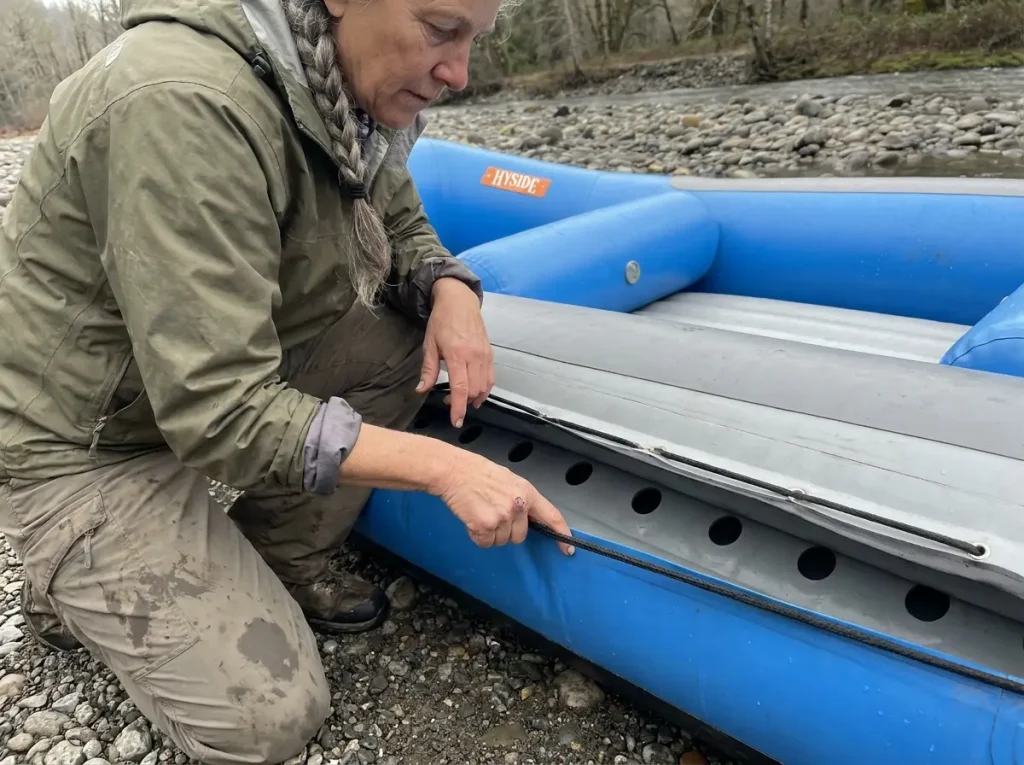
Forget the brochure language for a second. Under your feet, these two boats are doing opposite things with the water that splashes in, and once you see the difference you can spot it from the bank.
The sealed (bucket) floor explained
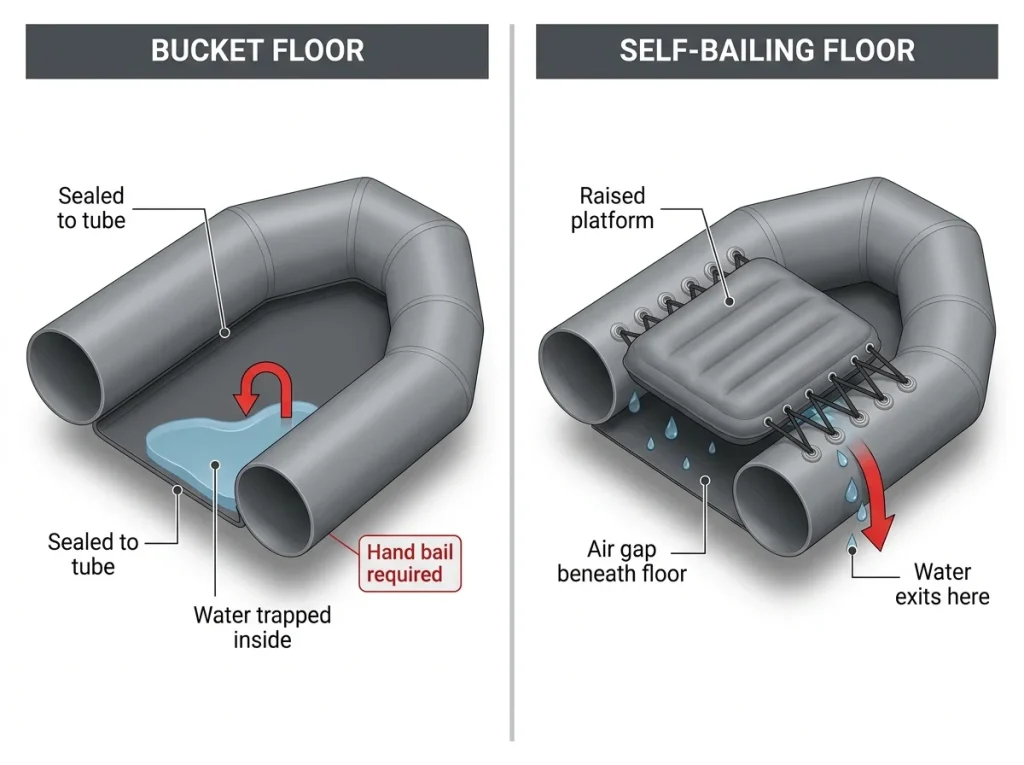
A bucket boat (also called a sealed-floor or non-bailing raft) has a floor sealed straight to the tubes. Whatever water comes over the side stays in the boat until you scoop it out with a bail bucket. It’s a bathtub, plain and simple, and that’s not an insult. For generations that was the only kind of raft there was, and plenty of them are still sold and still running rivers today. The community even named it for the obvious reason: you bail it, by hand, with a bucket.
The suspended, self-draining floor explained
A self-bailing floor is an inflatable floor roughly four to five inches thick, an elevated floor suspended inside the tubes and laced to the perimeter. The floor you stand on sits high; the drain holes sit lower, in the extra fabric where the floor laces to the tube. Water that splashes aboard runs across the raised platform, over the lower edge, and out through the lacing in seconds. Think of your foot platform as an island and the drains as a moat that’s lower than the island.
Why both still exist (it’s not just an upgrade)
The easy story is that self-bailers replaced bucket boats the way disc brakes replaced drums. That’s not quite right. A sealed floor is cheaper, lighter, and genuinely drier on calm water, so it still has a job on the right river. Self-bailing is the modern default for whitewater, but “default” and “always better” are two different claims. If you want the full breakdown of how floors are built, our guide to the different raft floor types, from bucket to I-beam to drop-stitch and slatted goes deeper on the construction.
How a Self-Bailing Floor Drains (and Why Yours Might Not)
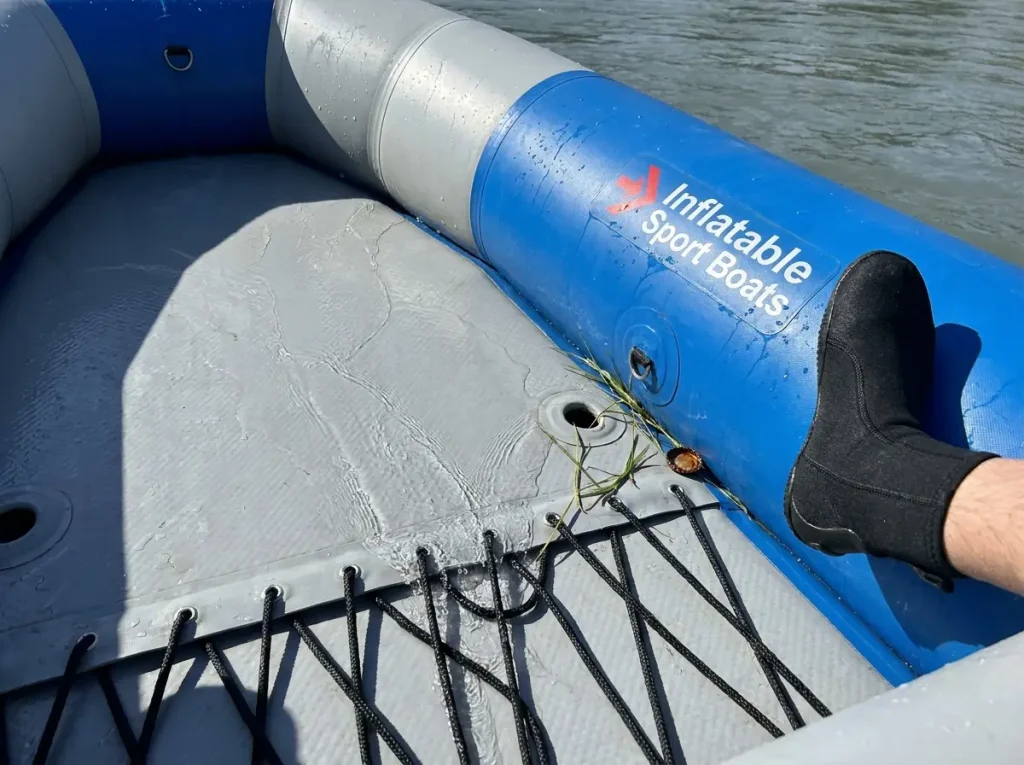
Here’s where a lot of new owners get a nasty surprise: a self-bailer doesn’t self-bail by magic. The floor pressure does the work, and a soft floor turns your fancy self-bailer right back into a bucket boat.
Where the water goes (the moat and lacing)
Water hits the raised floor and immediately starts looking for the lowest point. That low point is the floor lacing around the edge, where the drain holes sit below the platform you’re standing on. The water sheets across, dumps over the side, and clears in a few seconds. You can watch it happen in real time, which makes the whole thing click far faster than any diagram.
Floor pressure, the silent difference between draining and pooling
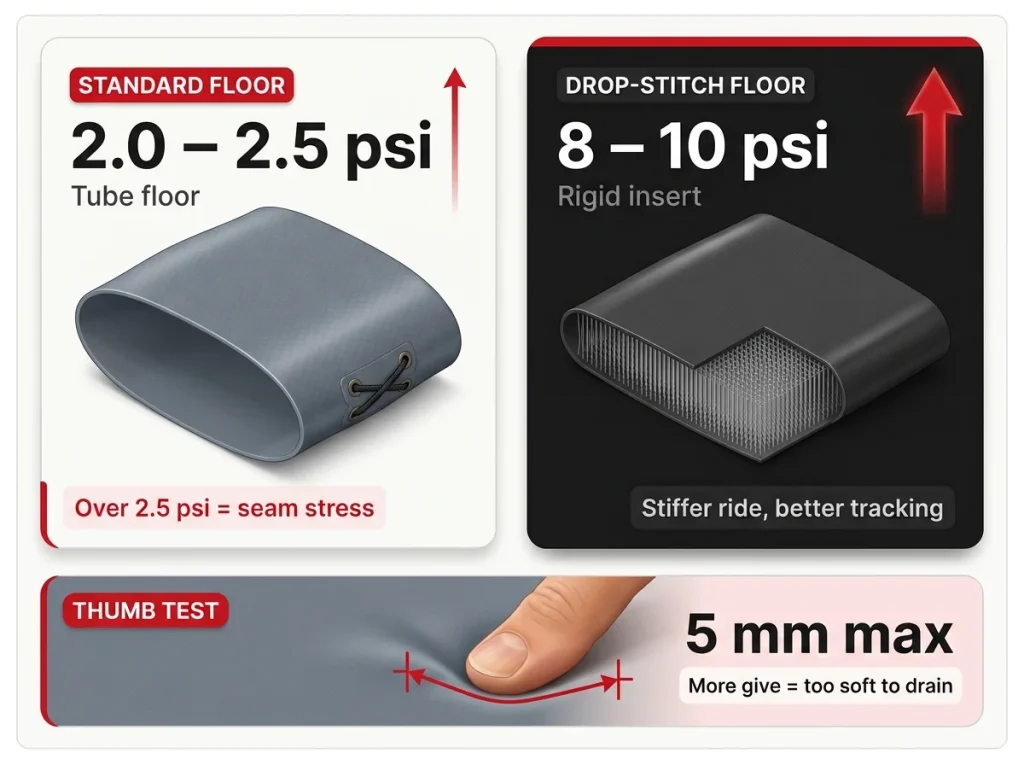
This is the part competitors skip, and it’s the part that actually matters. A standard self-bailing floor runs best right around 2.0 to 2.5 psi. A rigid drop-stitch insert floor is a different animal, pumped hard to 8 to 10 psi for a stiff, responsive ride, which is why modern boats feel so planted. Those numbers aren’t trivia. NRS spells out the same ranges in its own floor inflation pressure guidance, and the gap between them is the gap between a floor that drains and one that pools.
Run the floor soft and it sags below the drain line. Now your feet sit in a puddle that never leaves, the boat “won’t self-bail,” and the owner blames the design instead of the pump. Go the other way and over-inflate a standard floor past 2.5 psi and you’re just cooking the seams for no gain. If you want a stiffer ride, buy a drop-stitch floor; don’t abuse a tube floor chasing it. A concrete example of that rigid-floor approach is the Inflatable Sport Boats 12′ Drop-Stitch Self-Bailing Raft, whose hard floor shows what 8 to 10 psi feels like underfoot.
Thumb-test the floor at the put-in. Press down firm with your thumb, and if any spot gives more than about 5 mm, it’s too soft to drain well. Top it off before you launch instead of standing in a puddle all day.
Grommets, lacing, and the slow way a self-bailer wears out
A self-bailing floor has moving wear points a bucket boat doesn’t. The grommets and lacing that hold the floor to the tube take constant load and abrasion, and over years they fray, stretch, and clog with grit. A neglected floor drains slower and slower until one day it’s barely self-bailing at all. None of that is a deal-breaker; it’s just maintenance. Catch worn hardware early and patch the grommets and lacing before they fail and the floor outlives the rest of the boat.
Bucket Boats — Where They Still Make Sense
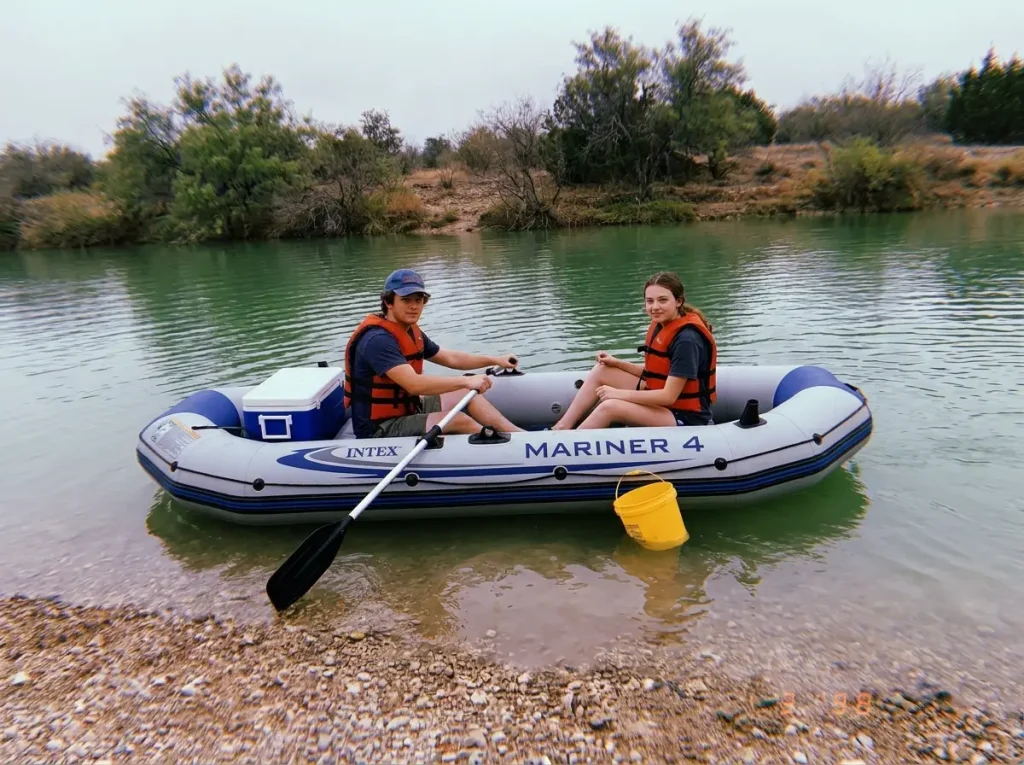
The honest case for the cheaper boat isn’t “settle for less.” It’s that on the right water, a sealed floor is genuinely the better tool, and pretending otherwise just sells boats nobody needs.
The honest upside (price, weight, ballast on big water)
A bucket boat costs less and weighs less than a comparable self-bailer, and on calm or low water it’s actually the drier ride. There’s also a counterintuitive perk on big, pushy water: the water weight sloshing in the bottom acts like ballast and helps keep the boat planted through huge wave trains. Some old hands genuinely prefer that planted feel on high-volume rivers. It’s a real advantage, right up until it isn’t.
The downside (sluggish when swamped, bailing by Class III)
That same water weight is the catch. A swamped bucket boat turns heavy and sluggish, hangs up on rocks that a lighter boat would slide over, and is a real chore to recover after a flip. And the bailing is constant. The rule of thumb boaters repeat is simple: a bucket boat is fine up to Class II, but by Class III you’re taking on a few bucketfuls every rapid, and you spend the flat stretches bailing instead of resting.
Who a bucket boat is actually right for
If you run Class I–II flatwater, mild rivers, or the occasional lake float, a sealed-floor boat is plenty, and so is whatever you already own. This is the budget-friendly entry point that the search results never actually name, so here’s a real one: the Intex Mariner 4 Inflatable Boat is an honest sealed-floor pick for calm water and easy rivers, with enough capacity for a small crew without spending up. If you’re shopping this end of the market, our roundup of the best budget whitewater rafts worth a look lines up the cheaper options side by side.
Self-Bailing Rafts — What You Gain and What You Give Up
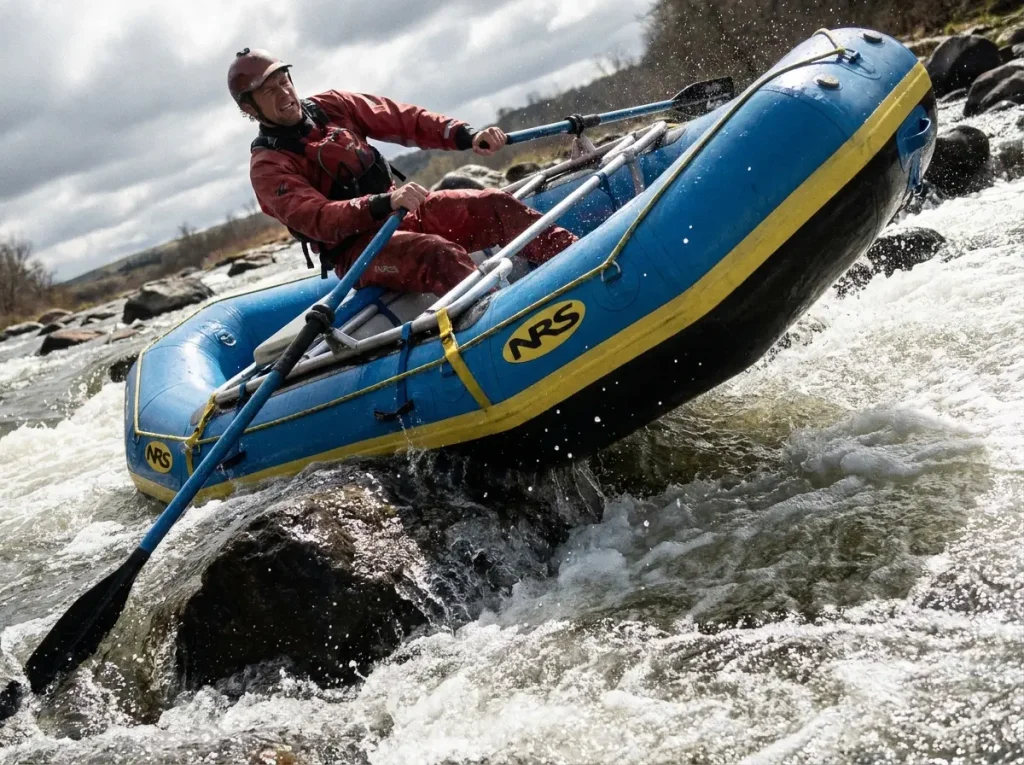
Self-bailing is the right call for most boaters, and I’ll say that flatly. But the gear talk that only lists the upside is the gear talk that gets people to overspend, so here’s both halves.
What you gain (high float, maneuverability, no bailing)
A self-bailer floats higher, turns quicker, and never makes you stop to bail. The rigid floor gives you a stable platform to brace and paddle from, and a stiffer floor, especially drop-stitch, tracks and carves better while folding less when you punch a hole. That’s the “planted” feel everyone chases on modern boats, and on real whitewater it’s worth a lot.
What you give up (weight, cost, and wet feet)
The give-ups are honest ones. A self-bailer is heavier to haul to the put-in, so you give up some portability, and it costs more, with the floor making up most of that price premium. And here’s the one nobody mentions: a self-bailer keeps your feet wet by design. That thin layer of water draining across the floor never fully leaves, so standing water at your ankles is the price of automatic drainage, not a flaw to fix.
The mid-tier sweet spot for most private boaters
You don’t need a top-shelf boat to get all of this. A solid mid-tier self-bailer is the default modern answer for a private boater running Class III–IV, and the NRS Otter 130 Self-Bailing Raft sits right in that sweet spot, with enough boat for real whitewater without the premium of an expedition rig. If you’re newer to buying, our picks for the self-bailers most beginners should start with narrow it down further.
Which Floor to Run by Water Class
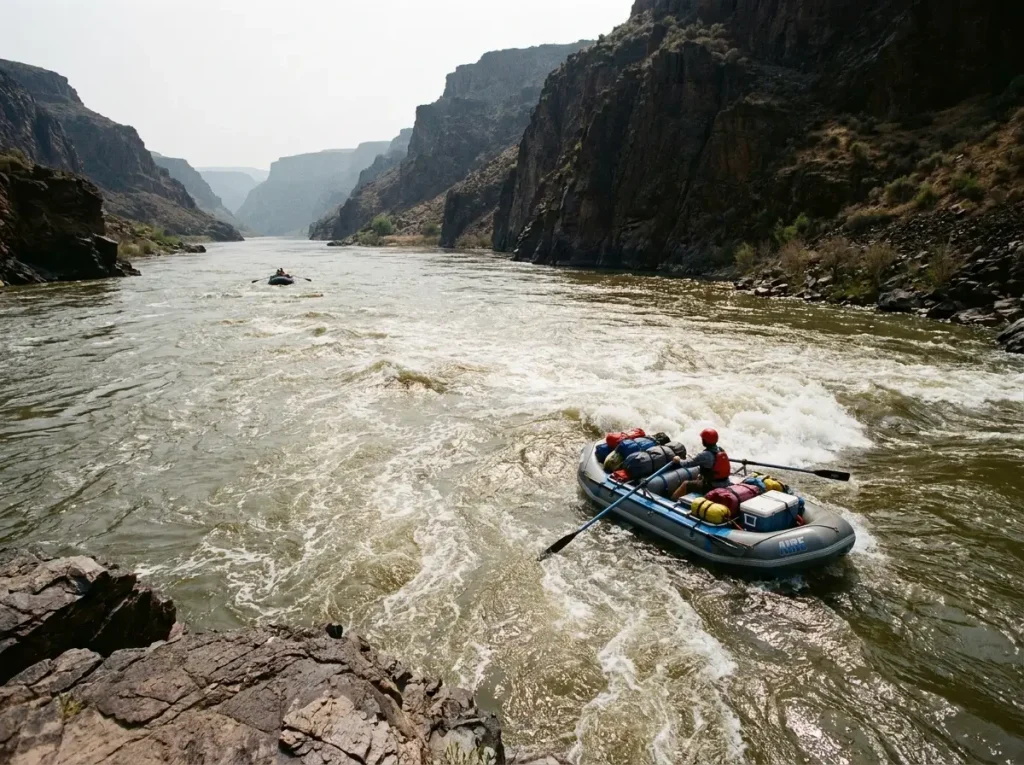
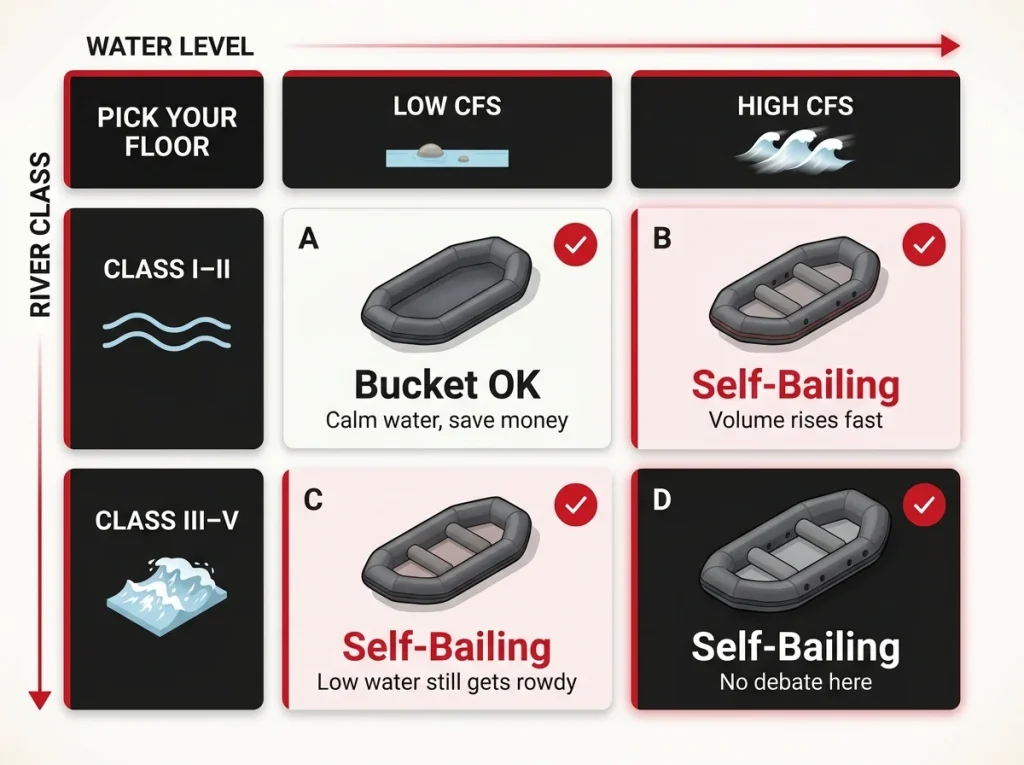
Stop asking which floor is better and ask the only question that matters: what do you actually run, and how big does it get? The answer falls out almost on its own.
Class I–II and low water (bucket is fine)
On flatwater and easy Class I–II, a bucket boat is all the boat you need. A self-bailer won’t hurt you there, it’s just overkill, and you’ll be the driest one on the river anyway. Save the money for a good PFD and a pump.
Class III and up, big water (self-bailing, no debate)
Once you’re running Class III and into Class IV, big volume, or hauling multi-day loads, self-bailing wins outright. Bailing every rapid is no way to run hard water, and a bigger self-bailer floats high on volume and gear. A boat like the NRS E-142 Self-Bailing Raft is built for exactly that, with the length and capacity to carry a loaded camp through big water. Matching that length and capacity to your class and crew is its own decision, and our raft size guide walks through length, class, and crew if you’re not sure where you land.
How water level and crew size shift the call
The same run is a different river at different flows. A mellow Class II at low water can turn into a pushy Class III when the snowmelt kicks the CFS up, and that’s exactly when a self-bailer earns its keep. The water level you run most often should drive the floor choice more than a river’s guidebook rating ever will, so think about your home water at its average flow, not its big-day reputation.
On a tight, rocky creek run, a light self-bailer that floats high is the friend you want. On big, pushy volume, don’t write off a little water weight, plenty of seasoned rowers like the planted feel of some ballast in the boat.
The Wet-Feet Problem Nobody Warns You About
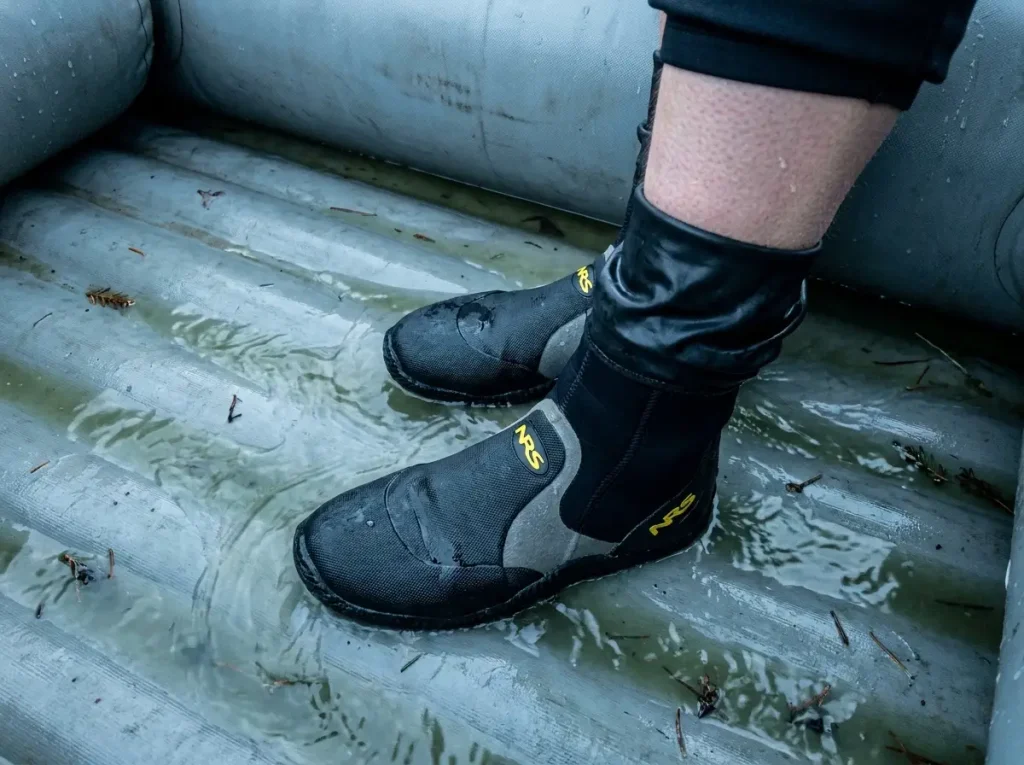
Picture the guided-trip first-timer mid-rapid, looking down and asking the guide why their feet are underwater. The guide laughs because it’s normal. But there’s a version of that question that isn’t funny at all, and it’s the one almost no article answers.
Why a self-bailer keeps cold water at your feet
In a self-bailer, that thin draining layer means you’re standing in river water all day, every day, no swim required. On a warm summer float, who cares. In snowmelt season, that’s cold water sitting on your feet for hours, and prolonged immersion in cold water is how hypothermia creeps in, so it deserves real respect. You’re effectively immersed in the coldest part of the river the entire trip, just from the ankles down.
The 60°F rule (when wetsuit or drysuit stops being optional)
The number to remember comes from the American Canoe Association: dress for thermal protection when the water is below 60°F, or when air plus water temperature is under 120°F combined. That’s not a comfort guideline, it’s a cold-water immersion threshold. According to the National Center for Cold Water Safety’s cold-water gear thresholds, the most intense cold-shock response hits in water between 50 and 60°F, and after 10 to 15 minutes in 50°F water most people lose the hand and arm dexterity they’d need to self-rescue. A self-bailer keeps your feet in that range all day, which is exactly why the dressing call matters more here than people think.
Dressing for standing water, not just the swim
So you dress for the water at your feet, not the air on your face. In cold or snowmelt conditions that means wetsuit booties at a minimum, and a drysuit when the water’s truly cold. A practitioner walks through the same wet-feet and cold trade-off in the video below. For a full breakdown of what to wear by river class, wetsuit versus drysuit, our gear checklist lays out the thresholds so you’re not guessing at the ramp.
Dress for the water, not the weather. A bluebird sunny day with 50°F snowmelt running through the boat still calls for booties or a drysuit, your feet don’t know the sun is out.
Buying One — The Honest Decision Most Guides Skip
Most buying advice ends at “get a self-bailer,” which isn’t a decision, it’s a slogan. The real decision has four parts, plus the question every used-boat shopper eventually asks. For the wider view of what’s out there, from NRS and AIRE to Hyside, our full guide to the best whitewater rafts covers the field; this is how to actually narrow it.
The four things that actually decide it (cost, weight, water, rig)
Four things settle it. First, floor cost, since the self-bailing floor is the single biggest line item in the price gap. Second, the weight you’re willing to haul to the put-in, because a bigger boat is a bigger carry. Third, the water level you run most often, not the one big trip you dream about. Fourth, whether you’re rowing a raft frame on an oar rig or running a paddle raft, which changes how much boat you want under you. Material plays into the cost and durability too, since a urethane-coated or Hypalon hull outlasts cheaper fabric, and our breakdown of PVC versus Hypalon and what it means for cost and lifespan feeds straight into that first decision.
Floor pressure as a buying check
When you’re checking out a used boat, the floor tells you a lot. A standard self-bailing floor should hold a firm 2.0 to 2.5 psi; a drop-stitch insert runs 8 to 10 psi. Press your thumb into it: more than about 5 mm of give and that floor is soft, worn, or under-built, and it won’t drain like it should. NRS covers the same ground in its boat-care guidance on floor pressure, and a floor that can’t hold pressure is a real bargaining point, not a small thing.
Can you convert a bucket boat to self-bailing? (usually not worth it)
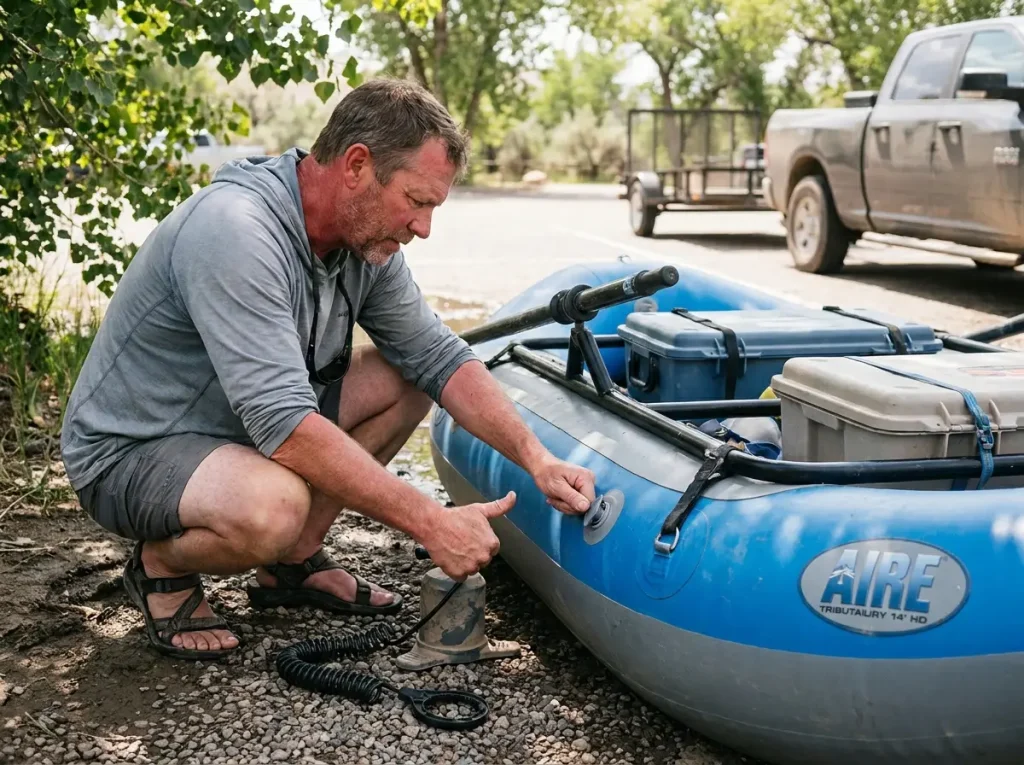
This one comes up constantly: can I just convert my old bucket boat? Sometimes, but it’s rarely worth it. A shop retrofit costs real money, and the DIY routes, like dropping in a drop-stitch insert and punching drain holes, run into a problem: the floor-to-tube attachment geometry is different on a boat that was never built to self-bail, and a bad conversion can damage the hull. On an older sealed boat you’re usually better off selling it and buying a used self-bailer. If you want a boat that earns “buy it once,” a bombproof build like the AIRE Tributary 14′ HD Self-Bailing Raft, with its tough AIRE-cell bladder construction, is the kind of self-bailer that outlasts the hassle of ever retrofitting anything.
The Bottom Line
Self-bailing is the right default for almost everyone running Class III and up, no real argument there. A bucket boat still earns its place on calm water and a tight budget, and it isn’t the embarrassing choice the marketing makes it out to be. And whichever floor you run, the decision is really about your water and about dressing for the cold sitting at your feet.
So before you put money down, go run your home river at the level you actually paddle most. Let the water pick the floor for you, not a forum thread and not a brochure.
Frequently Asked Questions
01Do your feet get wet in a self-bailing raft?
Yes. A self-bailer keeps a thin layer of water moving across the floor by design, so your feet stay wet most of the run. That is the trade for automatic drainage, and in cold or snowmelt water it makes wetsuit booties or a drysuit a real decision, not a comfort upgrade.
02Are bucket boats more stable than self-bailing rafts?
On big, high-volume water the water weight inside a bucket boat can add ballast that makes it feel planted. The catch is that same weight makes it sluggish, prone to hanging on rocks, and harder to recover after a flip, so the stability is situational rather than an outright advantage.
03Can you convert a bucket boat to a self-bailing raft?
Sometimes, but it is rarely worth it. A shop retrofit costs real money, and DIY drop-stitch-insert routes can damage the hull because the floor-to-tube attachment geometry is different. On an older sealed boat you are often better off selling it and buying a used self-bailer.
04Are self-bailing rafts better than bucket boats?
For Class III and up, big water, and multi-day trips, yes, clearly. For Class I–II flatwater and mild rivers on a budget, a bucket boat is still a fine, cheaper, lighter choice. Better depends entirely on the water you actually run.
05What floor pressure should a self-bailing raft run?
A standard self-bailing floor runs best around 2.0 to 2.5 psi, while a drop-stitch insert floor runs a rigid 8 to 10 psi. An under-inflated floor sits low and pools water so it self-bails poorly, and over-inflating a standard floor past 2.5 psi strains the seams.