
In this article
Astral calls a 38 to 44 inch chest an M/L. Kokatat calls 36 to 40 a Medium, and NRS runs the Vector’s M/L closer to 34 to 42 inches. Same letter, three different chests, and not one of those charts is wrong. Ask any boater who has watched somebody discover at the put-in that their usual size lifts past their chin, and you’ll hear the same conclusion: the letter on the tag is the least useful number in the whole transaction. What follows is the cross-brand size chart nobody publishes, plus the second measurement almost no rafter ever takes.
Measure Your Chest Before You Look at a Single Size Chart
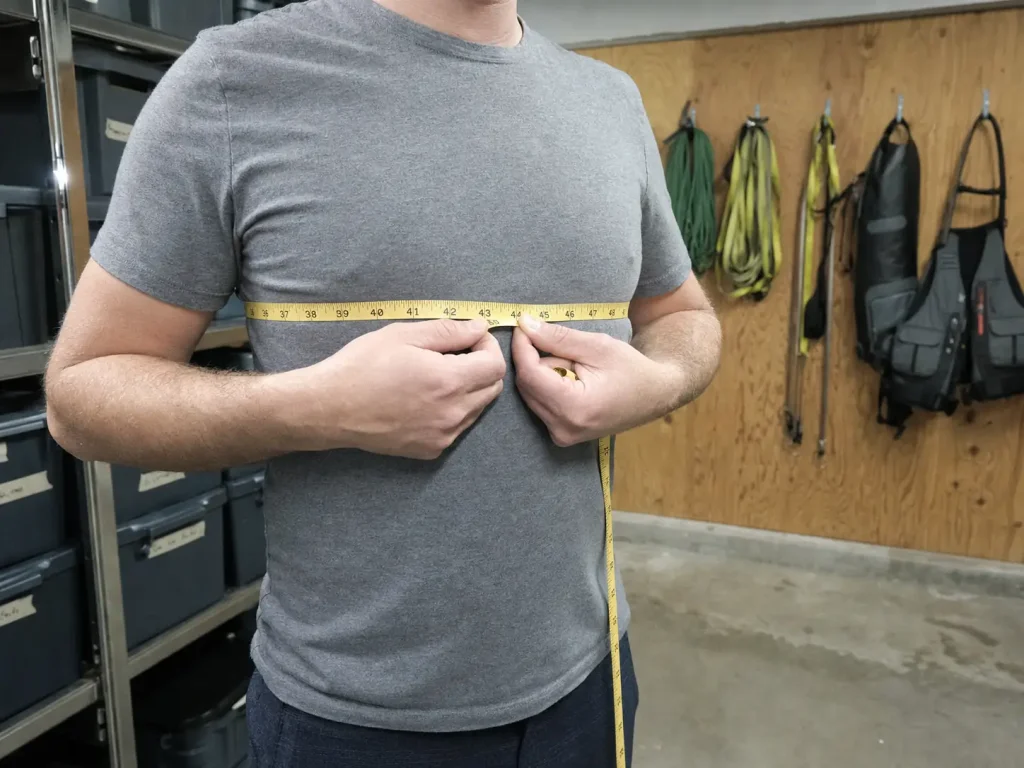
Every PFD sizing decision starts with one number, and most people guess it. Wrap a soft tape around the broadest part of your chest, keep it level all the way around, arms down, breathing normally. Not over a puffy jacket, and not over the fleece you happened to be wearing when you thought of it.
The reason shirt size fails here is structural. Shirts are cut for drape, so an inch either way disappears into the fabric. A PFD is cut to compress a rigid foam panel against your ribs, so an inch either way shows up as slack. Buying true to shirt size is the single most common way rafters land a full size off their actual chest circumference.
Write the number down. You are going to check it against three or four different manufacturer charts before you buy, and you will not remember it accurately by the second one.
One rule to carry into the next section: if your chest lands right on a bucket boundary, size down for whitewater rather than up. A snug fit is the entire point.
What comfortably snug actually means
You should be able to take a full breath and reach straight overhead without the vest riding into your jaw. You should not be able to slide two flat hands under the shoulder straps. Anything looser than that is an oversized pfd with better marketing.
Tight enough that you cannot fill your lungs is an undersized pfd, which is the rarer error but still the wrong answer. The window between the two is narrower than most people expect, and freedom of movement is what tells you when you are inside it.
The Cross-Brand Size Chart Nobody Publishes
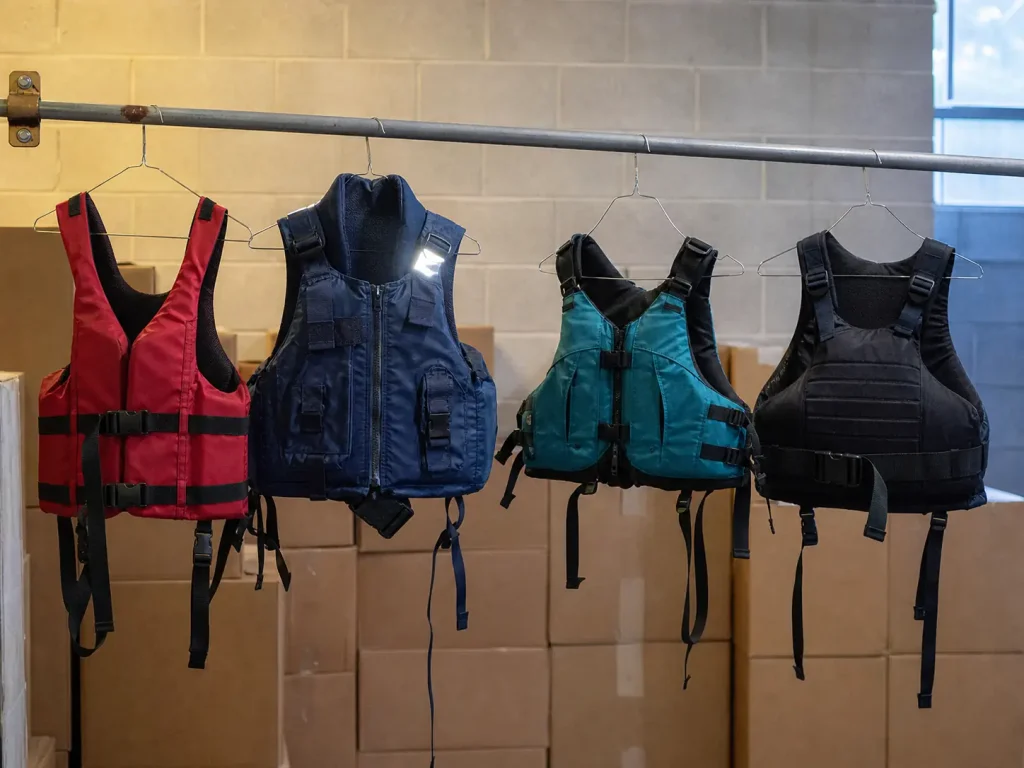
Here is the part every competitor skips. Brands publish their own chart and have no reason to publish anyone else’s, so nobody has ever put the ranges side by side. That is the whole reason a size chart feels reliable right up until you switch brands.
| Brand | Sizing System | Chest Range |
|---|---|---|
| NRS | Graded run, fine steps | 30 to 56 in across the run; Vector M/L about 34 to 42 in |
| Astral | Three broad buckets | S/M 31 to 37 · M/L 38 to 44 · L/XL 45 to 51 in |
| Stohlquist | Graded Sizing, fine steps | 33 to 54 in across the men’s run |
| Kokatat | Four unisex steps, 1 in overlap | S 32 to 36 · M 36 to 40 · L 40 to 44 · XL 44 to 48 in |
| Universal fit | No graded steps at all | One fits-most-adults range |
Read two things out of that table. First, a 40 inch chest is a Kokatat Medium, an Astral M/L, and roughly mid-run on a graded NRS jacket, and those three vests will not feel the same on you. Second, graded sizing puts you closer to your real number than a three-bucket system, which explains most of why two rafters in the same nominal size report completely different tightness.
Kokatat’s deliberate one inch overlap at every boundary is worth noticing, because the brand is quietly telling you the chart cannot decide on its own. The tie-breakers are torso length and layering room, which are the next two sections.
The NRS Vector PFD sits in the middle of that graded approach and covers most average adult chests in its M/L run. If you land near a boundary instead, the Astral GreenJacket shows the widest single-brand spread of the group, which makes it the clearest example of choosing between adjacent buckets. The Kokatat Hustler is here purely to illustrate how Kokatat’s overlapping ladder behaves across its S through XL run.
At the bottom of the table, a universal fit vest asks nothing of you and costs less, and that is the honest trade. You are accepting an approximation instead of a chest-matched fit.
Screenshot the size chart for the exact model you are buying, not the brand’s general chart. Manufacturers revise ranges between product generations, and the Ninja you are looking at may not use the same run the chart on the landing page describes.
Torso Length Is the Second Axis, and Rafters Get It Wrong
Torso length is the PFD industry’s second sizing axis, and it is buried so far under chest circumference that most buyers never learn it exists. One or two gear guides note in passing that long-torso designs feel restrictive on short-torso wearers. None of them tell you how to measure it, and none of them explain why it matters differently in a raft.
Measuring it takes twenty seconds. Sit up straight on a hard chair and measure from your sit bone to your navel. Most adults land somewhere between 16 and 24 inches, and knowing which end of that range you occupy is what breaks a tie at a bucket boundary.
Now the part that matters for rafting specifically. Kayak PFDs are cut against a fixed reference point, because a kayaker is braced into a seatback and a long torso cut has somewhere to sit. A raft gives you none of that. You are perched on a tube, reaching forward and down through an oar or paddle stroke, then hauling yourself back over inflated PVC after a swim. A vest cut long in the torso, perfectly comfortable against a kayak seatback, bunches at the hips on the stroke and digs into the armpits on the raft tube remount, at exactly the right chest size. Hours of that produces chafing that no amount of strap adjustment fixes.
That is why boaters so often finish a trip with sore armpits and blame the brand. The chest measurement was right. The torso length was never checked.
Short torso, long torso, and what to do about it
If you run short torso, look for a shortened cut or a women’s-contoured shell rather than sizing down in the chest, which only makes the vest tighter without making it shorter. If you run long torso, favor a graded-sizing brand so you are not forced into a bucket that splits the difference badly.
Profile is the related lever. A low-profile pfd spreads thinner foam panels wider across the chest and leaves more room under the arms, which is usually the better answer for a short torso. A high-profile pfd stacks thicker foam higher on the chest, and it needs the torso length to sit where it was designed to sit.
For smaller frames, a women’s-specific shell solves the geometry that a chest number alone cannot describe.
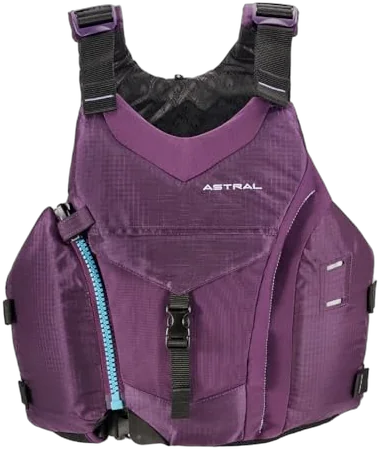
The deeper mechanics of women’s fit, including how contoured panels change strap geometry, get their own treatment in our breakdown of the best PFD for rafting when you are not a guide.
Tighten Bottom to Top, Then Test It
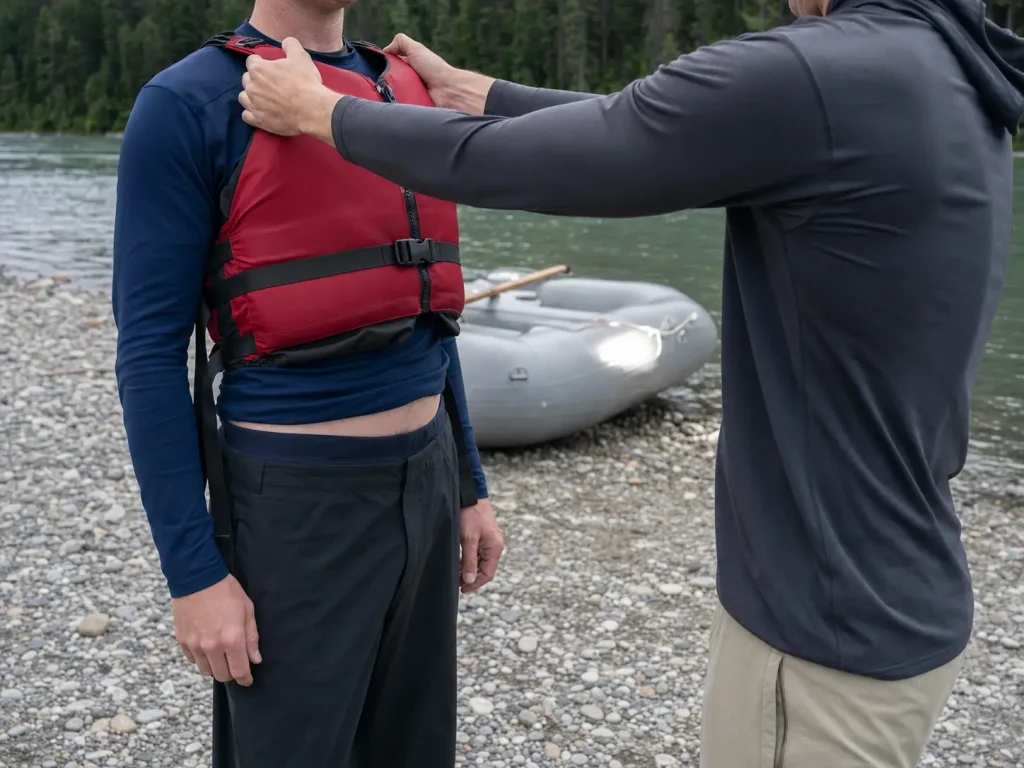
Order matters more than force. Loosen every strap, buckle the bottom or entry closure first, tighten the waist straps, and leave the shoulder straps for last. That is bottom-up tightening, and it is the sequence every fitting guide agrees on.
Reverse it and you leave slack pockets low on the vest. Slack down low is precisely what lets the whole unit migrate upward once you are in moving water. The classic version of this error is cranking the waist tight and leaving the shoulders loose for comfort, which produces a vest that feels great standing on gravel and rides straight up in a swim.
Step five of that sequence is the ride-up test. Straps fully cinched, have a partner grip the shoulder straps and lift straight up. The vest should not clear your chin. If it does, that is a size problem and not a tightening problem, and no amount of extra pull will fix it. The full test protocol lives in our PFD selection guide for private boaters.
While it is on, check mobility: full overhead reach, full forward stroke, no chin contact when you look down at your feet.
The dry-land lift test predicts, and the water test confirms. In flat water at the edge of an eddy, stop swimming and let the vest do the work. Your chin should sit clear of the surface with no effort from you, and the foam should stay at your ribs instead of creeping toward your ears.
Do it on dry land, at home
The put-in is where sizing mistakes get discovered, and it is the one place you cannot fix them. Run the whole sequence in your garage a week out. That is also the moment to sort out what clips to the vest once it fits, starting with a whistle that actually carries over whitewater.
Once the fit is dialed, mark your strap positions with a paint pen or a stitch of thread. Vests get borrowed, adjusted, and handed back wrong, and a marked strap gets you back to your setting in ten seconds instead of ten minutes at the ramp.
How Much Flotation You Actually Need

The baseline is fixed by regulation. Every USCG approved adult inherently buoyant PFD must provide at least 15.5 pounds of flotation, while whitewater-rated Type V special use devices generally run 16.5 to 18 pounds of lift. That figure is the vest’s buoyancy rating.
That gap is not a marketing number. Aerated whitewater holds far more air than flat water, so it supports less weight, and you float lower in it than you do in a lake. The extra flotation rating matters most in exactly the water where a sizing mistake carries the highest consequences.
On the frequently asked 200 pound question, the honest answer is that weight alone does not set your requirement. How much muscle versus fat you carry changes how much lift you need, which is why the standard adult ratings are written as a floor rather than a formula. Most adults are well served by standard adult flotation, and paddlers who are heavier or leaner than average should look at buoyancy numbers rather than assuming the chest size covered it. For the underlying classifications, the BoatUS Foundation’s breakdown of USCG-approved PFD types and their minimum buoyancy ratings is the cleanest reference available.
Types and Performance Levels, Briefly
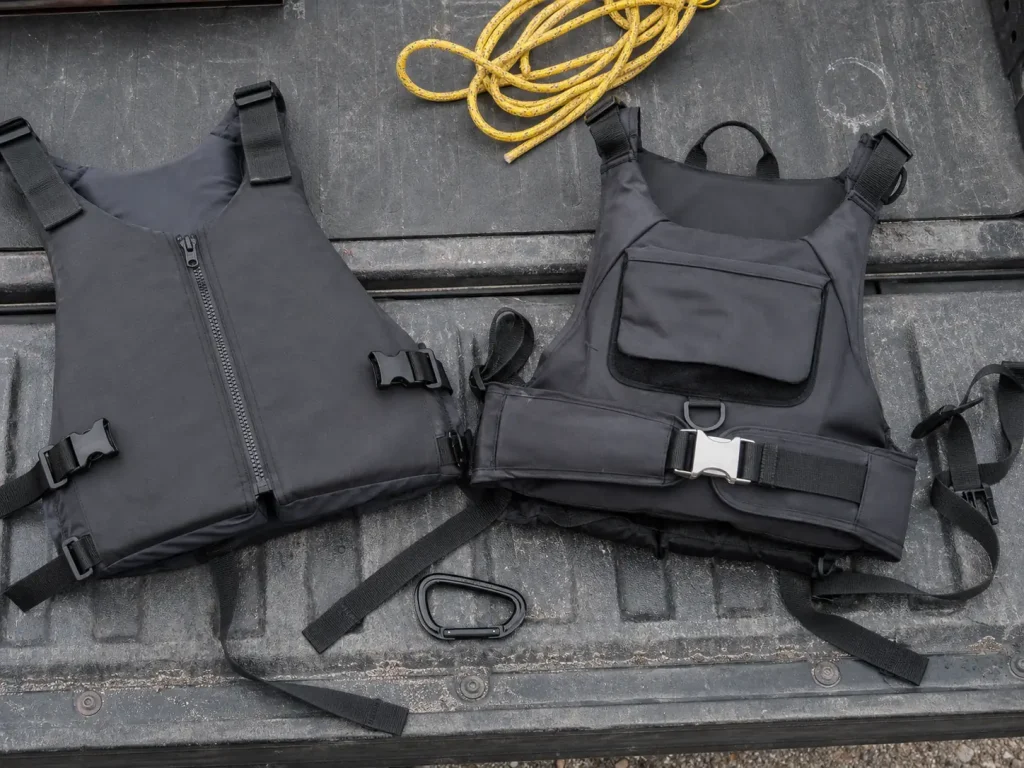
Type III is the general paddling class and covers most rafting use. Type V covers whitewater-specific and rescue-harness designs, which carry a use-condition requirement printed on the label. The newer Level 50, 70, 100 and 150 labels describe the same idea in a different notation, so a performance level number and a Type number are two ways of saying how much lift you get and under what conditions.
Rescue-belt vests add a quick-release harness and belong to boaters with swiftwater training.
That is the whole treatment this article gives the topic on purpose. The full decision between Type III and Type V is covered in our rafting PFD comparison, and how the rest of your kit scales with river class sits in the rafting helmet guide for the class you actually run.
Kids Are Sized by Weight, Not Chest
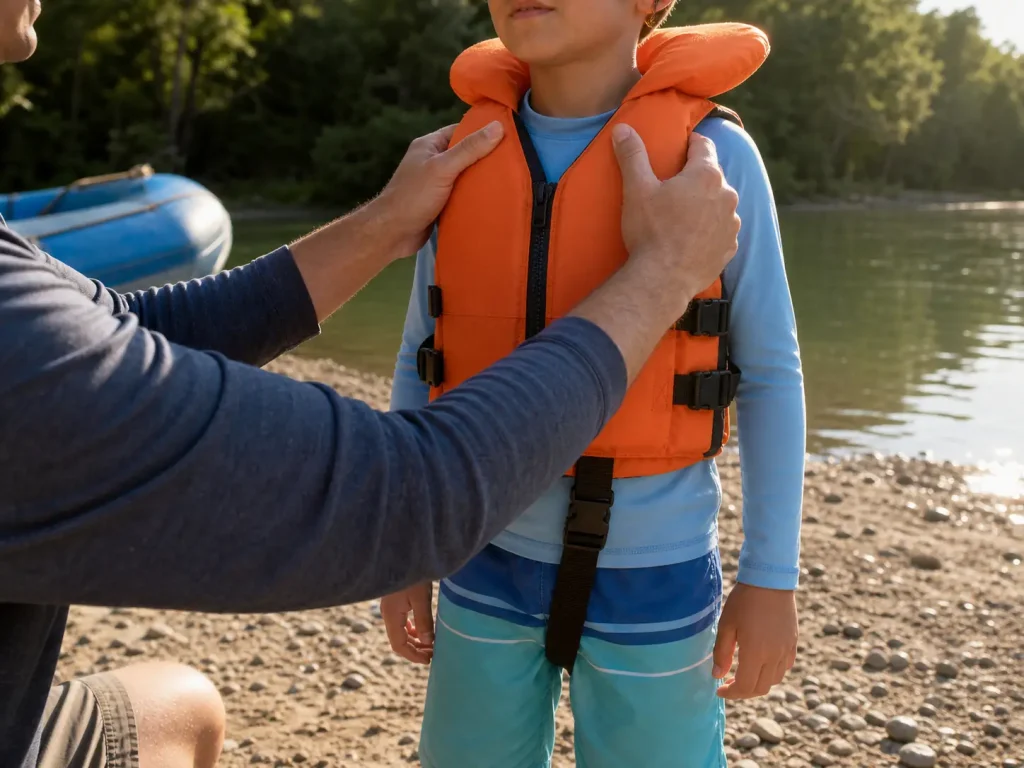
Children’s PFDs use a different system entirely. The label carries a weight range, not a chest measurement, and that range is the rule.
The non-negotiable part: never buy a child a size to grow into. An oversized vest on a small frame rides up over the head in moving water, which is the same failure mode adults get from a too-large vest, arriving faster and with far less ability to self-correct.
Run the child version of the lift test the same way. Grip the shoulders, lift, and watch the chin and ears. If the foam clears either one, the youth pfd is too big regardless of what the sizing sticker promised. Requirements vary by state, and state boating-safety guidance on required PFD types and fit is worth a look before a trip that crosses a line.
The PFD You Sized in July Doesn’t Fit in April
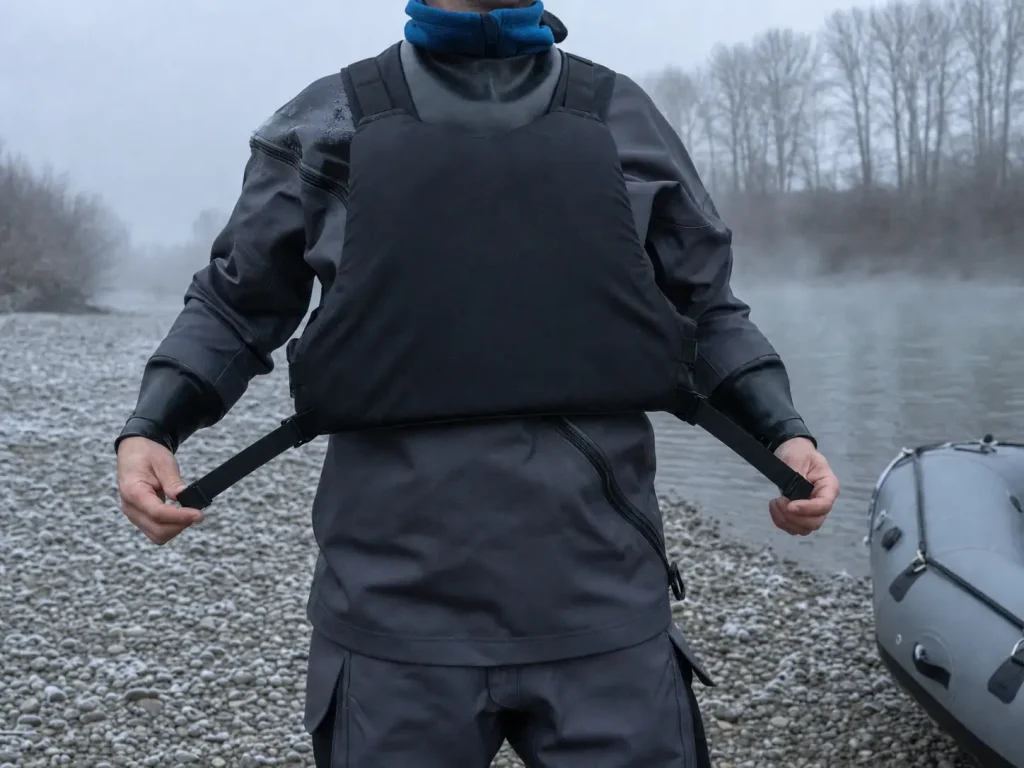
Your effective chest measurement is not a constant. It is your chest plus whatever you are wearing, and a T-shirt in July and a drysuit over a fleece mid-layer in April are two different numbers on the same person.
Two things go wrong when the season changes. Either the vest will not cinch down far enough over the added bulk, or the bulk pushes the whole vest higher on your torso so the foam panel sits at your collarbone instead of your ribs. Neither one announces itself on dry land, and both show up the first time you go over the side.
The mistake is procedural, not a purchase. People size a PFD once, in summer, over a shirt, and never re-check when the layering stack changes for shoulder-season high water.
The fix is equally procedural. Leave usable strap length when you first size the vest, then re-run the bottom-to-top sequence and the lift test wearing the exact layers you will be on the water in. Drysuit layering adds more bulk than people estimate, because the suit itself has to fit loosely enough to layer under and still allow full overhead reach.
Rafters already think in skin-out terms when they plan clothing against water temperature. Apply the same logic one layer further and re-fit the vest when the stack changes. The layering decision itself belongs elsewhere: start with wetsuit versus drysuit for rafting, then how to build a cold-water layering system, and note that drysuit sizing runs by its own rules before you stack anything over it.
When you try a PFD on for the first time, wear your bulkiest realistic layer, then loosen back to your summer setting. Sizing from the thick end down always works. Sizing from the thin end up leaves you with a vest that has no strap left to give in April.
On a Used PFD, the Size Tag Is the Least Reliable Number
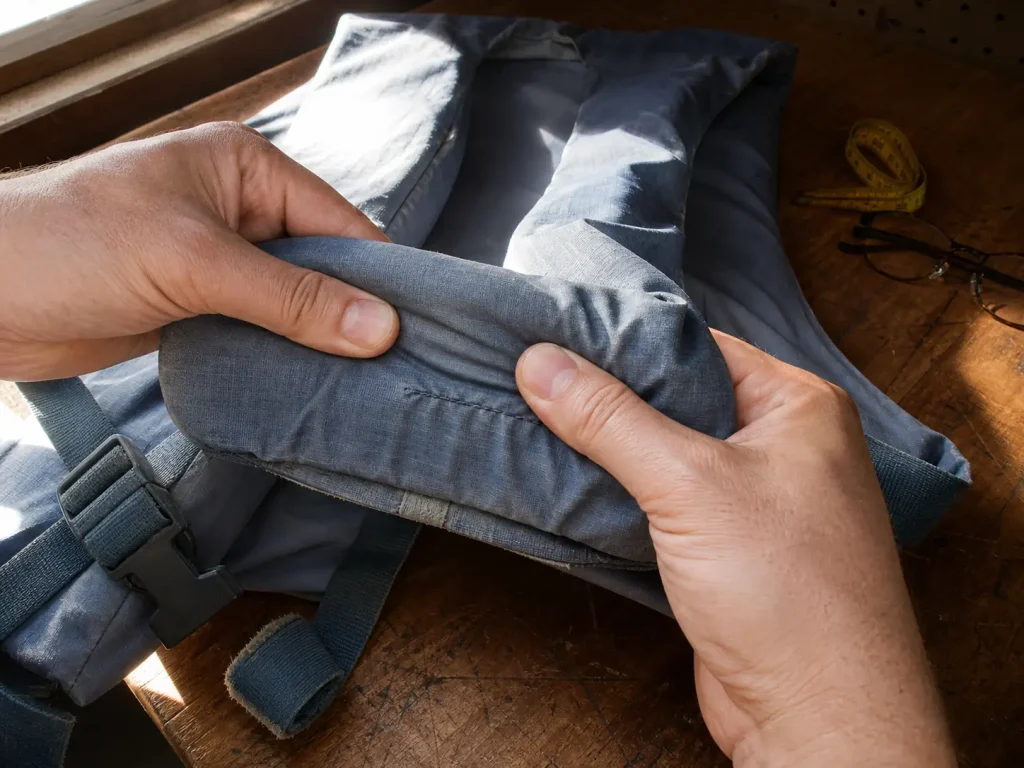
Secondhand gear is normal in the rafting community, and there is nothing wrong with it. The problem is that the size label is the part of a PFD that ages best while the part that actually floats you ages worst.
The check takes thirty seconds. Squeeze the foam panel down to roughly half its resting thickness. Healthy foam springs back. Foam that stays compressed, feels brittle or stiff, or sits under wrinkled and shrunken shell fabric has lost real buoyancy, and no size label records that.
So the thesis of this section is short: the tag tells you the shell dimensions, not the current lift. A used vest can match your chest measurement perfectly and still float you lower than the same model did new. For the complete foam-retirement testing method, see our guide to choosing a rafting PFD.
If cost was the reason you were browsing used listings in the first place, a current budget-tier vest with known foam is the more honest trade. The Full Throttle Adult Rapid Dry Neoprene Life Jacket is USCG Type III approved and uses universal adult sizing, so you give up chest-matched fit but you know exactly what the foam has been through.
Getting It Right Before the Put-In
Three things decide whether a PFD fits you, and the size letter is not one of them.
Your chest number tells you which bucket you are in for a specific brand, and only for that brand. Your seated torso length breaks the tie when the chart puts you on a boundary, which for rafters matters more than it does for the kayakers most fit guides were written for. And the layers you will actually be wearing change the answer season to season, which is why the fit check is something you repeat rather than something you finish.
Measure both axes this week, check them against the chart for the exact model you are considering, and run the lift test at home in your real paddling layers. When you are ready to fill in the rest of the kit, the rafting gear checklist by river class covers what belongs on the boat alongside a vest that fits.
Frequently Asked Questions
01How do you select the correct size PFD?
Measure your chest at its broadest point, check it against that specific brand’s chart, then confirm with the shoulder-strap lift test. If your measurement lands on a size boundary, seated torso length is the tie-breaker, and for whitewater you size down rather than up.
02Can you wear a PFD that is too small?
No. A vest that will not fully close, restricts a full breath, or blocks overhead reach is not safe to paddle in. Snug is the goal, compressed is not. The far more common error is going too large, which produces ride-up in moving water.
03How much buoyancy does a 200 lb person need?
Standard adult foam PFDs start at 15.5 pounds of buoyancy, and whitewater Type V units generally run 16.5 to 18 pounds. How much muscle versus fat you carry affects required lift more than the number on the scale, so check the flotation rating rather than matching a pound figure to your scale.
04What type of PFD is right for whitewater rafting?
A Type III vest covers most rafting, while a whitewater-specific Type V adds lift and a use-condition label for higher-consequence water. Rescue-harness models are for boaters with swiftwater training. Full comparison in our rafting PFD guide.
05What are the 5 types of PFDs?
Type I is offshore, Type II is near-shore, Type III is flotation aid and the general paddling class, Type IV is throwable, and Type V is special use with a condition printed on the label. Rafting lives in Types III and V.